


Payroll Employment and Alternate Measures Indicate Bleak Labor Market
Reporting/Market Focus from the January/February 2007 Edition of the SGS Newsletter
Despite a one-time sharp boost to payroll levels, relative monthly and annual jobs performance remained near-recessionary. Further, other more-independent indicators of labor conditions already are showing a recession to be in place.
The release of the January 2007 payroll survey included the annual benchmark revision, which added 754,000 jobs to the seasonally-adjusted March 2006 employment level. With the BLS’s revision methodology, such translated into an upward revision of 933,000 to the previously reported December 2006 payrolls.
Even so, the resulting report of a 111,000 monthly gain in seasonally-adjusted January payrolls was statistically indistinguishable from a contraction, and annual growth — albeit higher than before the revisions — slowed meaningfully from 1.7% in December to 1.6% in January.
The annual benchmark revision is based on a comparison of the prior year’s March (2006 in the current case) payroll estimates, as regularly surveyed, against a universe of payroll employment as estimated from employers’ state unemployment insurance filings. The benchmarking process never has worked particularly well because of basic surveying flaws and the way the BLS handles non-responses from major firms or their surrogates (payroll processing firms) in the surveys. Nonetheless the 2006 comparisons suggested an unusually large difference, and one that was in a politically embarrassing direction for the BLS. Employment growth purportedly had been understated.
Blamed for the "needed" revisions were inadequate bias factors (birth/death model) and problems in measuring Katrina-related employment effects. So the monthly bias factors — designed to compensate for the creation of jobs by non-reporting new companies — are likely to be revised upwards by roughly 300,000, in aggregate, to 1,300,000 per year. The biggest problem with the bias factors is that they never have been designed to account properly for a recessionary environment, where aggregate biases should be negative, accounting for companies going out of business.
As to the other issues, the BLS still does not understand the reporting problems it had along the Gulf Coast in the wake of 2005’s extraordinarily severe hurricane system. That particular statistical quagmire likely never will be resolved.

Has there been a double-counted benchmark revision? In the months prior to the benchmark revision, monthly revisions regularly threw large amounts of new employment growth into past history. Such is shown in the graph above, where the original monthly gain is shown against the final monthly gain reported before the benchmark revision and after the benchmark revision. In the last six months of 2006, an extra 300,000 jobs were created in prior period revisions. Keep in mind that the benchmark monthly changes are after the overall upward benchmark revision had boosted employment levels by nearly 1,000,000 jobs as of January 2007, on top of the previously boosted statistics.
What appears to have been at work here is the puffing of jobs created by the Administration, prior to the November election, without tickling inflation concerns. Whether this pattern continues in the next several months will be quite telling as to what the Administration is doing.
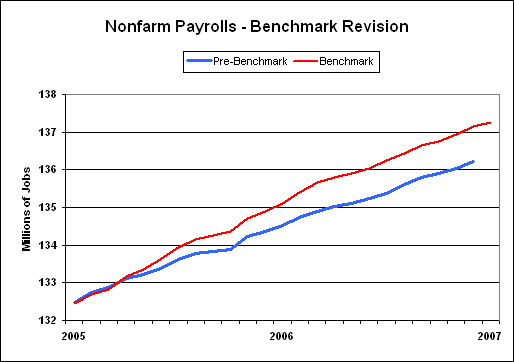
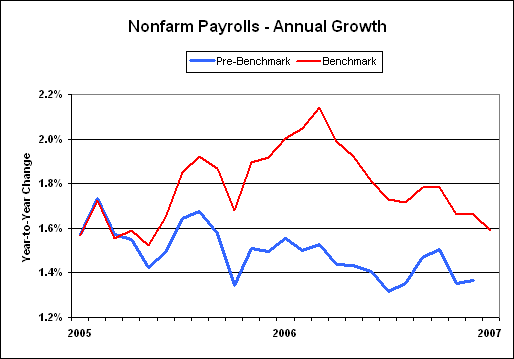
The two graphs above show the results of the benchmark revisions on both the level and year-to-year change in seasonally-adjusted nonfarm payrolls. Even with the revised reporting, relative recent employment has been slowing sharply.
It is the story shown by the revised year-to-year growth patterns in the payroll data that can be compared with other harder or more-independent measures of employment activity.
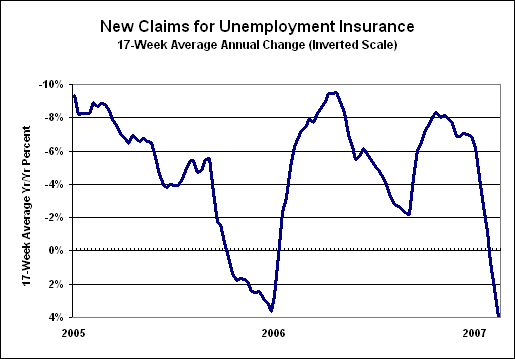
New claims for unemployment insurance, on a 17-week moving average, are surging, which is an economic negative (please note the scale of annual growth is inverted in the graph). The prior surge was tied to the effects of Katrina and the other severe hurricanes of 2005. Somehow, the hurricane effects largely were missed and then further tempered in the benchmark revisions to the payroll data.
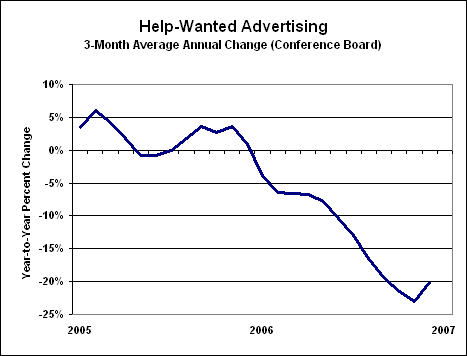
Although help-wanted advertising never recovered from the 2000 recession, annual growth — based on a three-month moving average — has fallen deep into new recession territory during the last year.
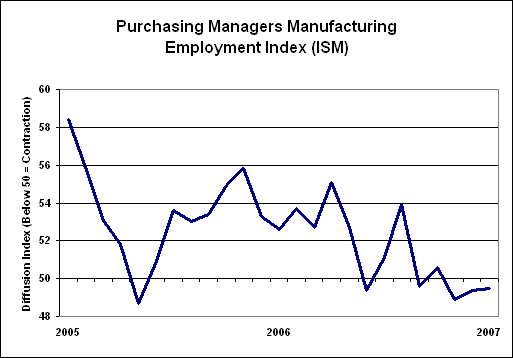
In the last several months, the employment component of the manufacturing purchasing managers survey has had a reading below 50.0, indicating contracting employment. Such is consistent with recession.
The various sections for each of the above indicators discuss current readings. Beyond the payroll data and the related troubled surveying, biases and built-in guesstimates, credibility for new claims comes from the paper trail behind it. Separately, help-wanted advertising and the purchasing managers survey are compiled independent of BLS oversight.