


No. 270: December Employment Report
JOHN WILLIAMS’ SHADOW GOVERNMENT STATISTICS
COMMENTARY NUMBER 270
December Employment Report
January 8, 2010
__________
Broader December Unemployment Rates Notched Higher
U-6 at 17.3%, SGS at 21.9%
December Household Employment Reported Down by 589,000
December Payroll Employment Probably Shrank by
About 500,000
__________
PLEASE NOTE: The next scheduled Commentary is planned for Thursday, January 14th, following the release of the December retail sales report. There will be a subsequent Commentary on the 15th, following release of December CPI and industrial production. An extended newsletter reviewing 2009 and previewing 2010 should follow over the ensuing weekend.
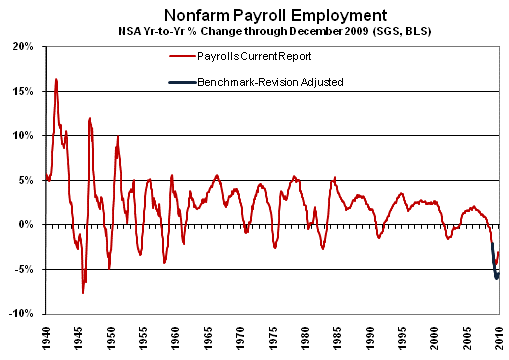
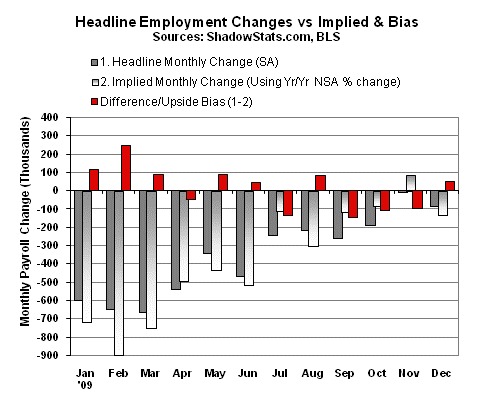
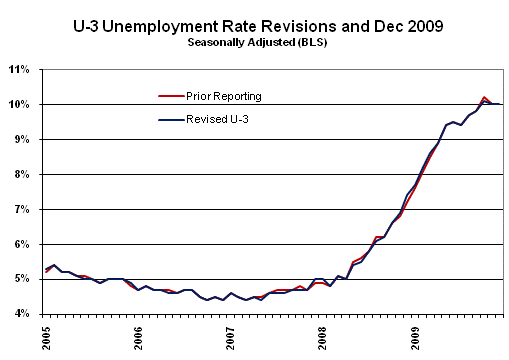
– Best wishes to all, John Williams Employment/Unemployment Reporting Remains Heavily Distorted. As discussed in Wednesday’s Commentary 269, unusual distortions in seasonal factors likely are skewing current employment and unemployment data, with ongoing patterns of economic weakness creating artificial positive spikes in seasonally-adjusted current reporting. Accordingly, the latest employment reporting likely is of particularly poor quality, with bad seasonal factors suppressing the headline unemployment rate and narrowing the reported decline in payroll employment. Net of these factors, payrolls likely declined by about 500,000 (85,000 decline reported) in December, of which roughly 250,000 was attributable to a terribly flawed Birth-Death Model, roughly 135,000 was due to the concurrent seasonal factor bias which only reflects seasonal distortions between 2008 and 2009, and the balance of roughly a further 100,000 is tied to seasonal-factor problems from long-term distortions of the down-trend which will be detailed in a forthcoming newsletter. The headline U.3 unemployment rate likely was closer to 10.2% than the 10.0% reported, as discussed below. Payroll Survey. The BLS reported a statistically-insignificant, seasonally-adjusted jobs loss of 85,000 (down by 86,000 net of revisions) +/- 129,000 (95% confidence interval) for December 2009, following a revised 4,000 jobs gain (previously an 11,000 jobs loss) in November. The upside revision to November’s change was due to a downside revision to October payroll levels. From peak-to-trough (the peak month was December 2007; the current month of December 2009 is the short-lived trough of the current cycle), payroll employment has declined by a seasonally-adjusted 7,242,000 jobs, or by 5.2%. Net of the pending benchmark revision, the peak-to-trough decline likely has been closer to 10 million jobs or 7.2%. As the pace of reported monthly decline has slowed against year-ago comparisons, year-to-year contraction (unadjusted) in total nonfarm payrolls narrowed to 3.0% in December from an unrevised 3.4% decline in November and a 60-year low of a 4.4% decline in August. Adjusted for the benchmark revision due for release next month, however, December’s annual decline likely was around 5.4%, still the most severe annual contraction seen since the production shutdown following World War II, which hit a record trough of a 7.6% contraction in September 1945. Disallowing the post-war shutdown as a normal business cycle, the current annual decline would be the worst since the Great Depression. Concurrent Seasonal Factor Bias (CSFB). The pattern of impossible biases built into the headline monthly payroll employment of recent years resumed with the December report, after three months in reversal, with an upside bias of 50,000 jobs in December 2009 reporting. Instead of the headline jobs loss of 85,000, consistent application of seasonal-adjustment factors — net of what I call the concurrent seasonal factor bias (CSFB) — would have shown a monthly jobs contraction of 135,000. The CSFB has generated an upside reporting bias seen in seven of the last 12 months, with a rolling 12-month total upside headline-number bias of 189,000. A worksheet on this is available upon request. (See SGS Newsletter No. 50, for further background.) Birth-Death/Bias Factor Adjustment. As discussed in previous writings, the Birth-Death Model biases tend to overstate payroll employment during recessions. The flaws here were confirmed with the BLS estimate of an 824,000 downside benchmark revision for May 2009, announced three months ago, with a suggested ongoing monthly understatement of 200,000 to 250,000 or more in jobs losses per month. That benchmark revision will be published next month. The BLS initially indicated that the underlying assumptions to the Birth-Death Model were missing certain jobs losses, but that view apparently is reversing at the BLS, per reporting of John Crudele of the New York Post. Nonetheless, the Birth-Death model does not work in a recession, let alone a severe downturn, as will be detailed shortly in the pending full newsletter. Unable to measure what is happening on a timely basis, the BLS assumes jobs lost by companies going out of business are offset by start-up enterprises. So, when a company that has been reporting payrolls ceases to do so, because it has gone out of business, the BLS assigns it a level of employment commensurate with its prior reporting and industry trends. On top of those flawed assumptions the model then adds a fairly consistent upside bias to the payroll levels of roughly 900,000 each year, currently averaging about 74,000 jobs per month. The unadjusted December 2009 bias was a monthly addition of 59,000 jobs versus 60,000 the year before, and up from 30,000 in November 2009. Household Survey. The usually statistically-sounder household survey, which counts the number of people with jobs, as opposed to the payroll survey that counts the number of jobs (including multiple job holders) showed employment fell by 589,000 in December, following a revised 139,000 (previously reported 227,000) gain in November. The household survey went through its annual seasonal factor revisions in the latest reporting. The revamped seasonals appear to have exacerbated the current seasonal-factor distortions, throwing more-negative numbers into the past and muting the December U.3 unemployment rate by 0.2 percentage points. The seasonal factor revisions should wash out in any given year. With 0.1% upside revisions to U.3 in each of January, February and March, offset by only one 0.1% downside revision in October, that leaves a balance of 0.2% that was subtracted out of December’s reporting, which means it otherwise would have come in at about 10.2% instead of the post-revision report of 10.0%. Also, again, where unemployment seasonal factors should balance out over the period of a year, with the new seasonals, the January and February 2010 numbers appear due for some unusual catch-up spikes in the U.3 unemployment rate. The December 2009 seasonally-adjusted U.3 unemployment held at 9.97% +/- 0.23% (95% confidence interval) versus a 9.98% (previously 9.99%) unemployment rate in November. The broader December U.6 unemployment rose to an adjusted 17.3% (17.1% unadjusted), from an unrevised 17.2% (16.4% unadjusted) in November. The following graphs show the revised U.3 and U.6 unemployment rates, as published today by the BLS, along with the prior reporting. The revisions did not alter past history significantly, other than allowing for relatively happier December 2009 reporting than would have been seen otherwise. During the Clinton Administration, "discouraged workers" — those who had given up looking for a job because there were no jobs to be had — were redefined so as to be counted only if they had been "discouraged" for less than a year. This time qualification defined away the long-term discouraged workers. The remaining short-term discouraged workers (less than one year) are included in U.6. Adding the excluded long-term discouraged workers back into the total unemployed, unemployment — more in line with common experience as estimated by the SGS-Alternate Unemployment Measure — eased to about 21.9% in December from 21.8% in November. See the Alternate Data - Employment page for a graph and more detail including fully revised data. While 21.9% unemployment might raise questions in terms of a comparison with the purported peak unemployment in the Great Depression (1933) of 25%, the SGS level likely is about as bad as the peak unemployment seen in the 1973 to 1975 recession. The Great Depression unemployment rate was estimated well after the fact, with 27% of those employed working on farms. Today, less that 2% work on farms. Accordingly, for purposes of a Great Depression comparison, I would look at the estimated peak nonfarm unemployment rate in 1933 of 34% to 35%. Week Ahead. Given the underlying reality of a weaker economy and a more serious inflation problem than generally is expected by the financial markets, risks to reporting will tend towards higher-than-expected inflation and weaker-than-expected economic reporting in the months ahead. Such is true especially for economic reporting net of prior-period revisions. As discussed in Commentary No. 269, a number of series appear to have been distorted by seasonal factors warped by the extraordinary length and depth of the current downturn, one which is unprecedented in the period of modern economic reporting of the post World War II era. Particular issues are mentioned with individual series. Each of the following reports will impact consensus forecasts for fourth-quarter GDP, which seem to be bordering on a nonsensical pending economic boom. Against consensus forecasts, a wider trade deficit, weaker retail sales and industrial production, and higher inflation all would portend a downside shift in consensus economic forecasts and vice versa. Trade Balance (November 2009). Due for release on Tuesday, January 12th, some widening in the November trade deficit is likely, but pending catch-up in import paperwork flows is not likely until monthly data revisions are published in the next couple of months. Retail Sales (December 2009). Due for release on Thursday, January 14th, expectations are for a monthly gain of 0.4%, following November’s 1.3% increase, per Briefing.com. Underlying reality appears to be much weaker and offers some downside reporting risks, and most "gains" can be tied to higher inflation. Nonetheless, bad seasonals once again could spike the monthly number beyond consensus. Consumer Price Index (December 2009). Due for release on Friday, January 15th, the consensus for the CPI-U is for a 0.2% seasonally-adjusted monthly gain, per Briefing.com, versus 0.4% reported for November. The consensus usually tends to overestimate December CPI, but even here, unusual seasonal factors could offer a surprise either way. Annual inflation would increase or decrease in December 2009 reporting, dependent on the seasonally-adjusted monthly change, versus the 0.79% adjusted monthly decline seen in December 2008. I use the adjusted change here, since that is how consensus expectations are expressed. To approximate the annual inflation rate for December 2009, the difference in December’s headline monthly change versus the year-ago monthly change should be added to or subtracted directly from November 2009’s annual inflation rate of 1.84%. A consensus report of a seasonally-adjusted 0.2% monthly gain would result in year-to-year or annual December 2009 CPI-U inflation rate of roughly 2.8%. Industrial Production (December 2009). Due for release on Friday, January 15th, December production could be heavily skewed to the upside by bad seasonal factors, as shown in the purchasing managers manufacturing survey discussed in Wednesday’s Commentary No. 269. The Fed, however, has been sensitive to the general problem of current seasonal factors and may come in below consensus estimates of a 0.6% monthly gain (Briefing.com), against November’s 0.8% increase.

__________