


Income Variance/Dispersion as a Predictor of Long-Term Economic Trends
Reporting/Market Focus from the September 2005 Edition of the SGS Newsletter
For the leading economic indicators analyzed monthly in SGS, lead times to broad economic activity range between three and nine months. There is one indicator, however, that signals broad trends in liquidity and economic activity three to eight years in advance: income variance/dispersion. Since it is updated only once per year in the Census Bureau’s annual poverty report, it also will be updated in the SGS once a year, in September.
Income dispersion, also known as variance, measures the distribution of household income from very low levels to extremely high levels. The more income is distributed in the extreme ranges, the higher is income dispersion; the more income is distributed in the middle income brackets, the lower is the income dispersion. Extremely high levels of income dispersion have tended to precede great economic and financial catastrophes. Those events, in turn, have tended to redistribute income towards the middle, in something of a self-correcting cycle.
Some dozen or so years ago, while offering one of his occasional gloom-and-doom talks, Alan Greenspan noted that, "A potentially significant factor in the current state of long-run concerns is that the distribution of family income has become more dispersed."
Triggering Greenspan’s concern at the time was that variance in U.S. household income had retaken its pre-1987 stock crash high, a level not previously seen, except perhaps before the 1929 stock crash and the ensuing Great Depression. Last week, the Census Bureau released estimates of income dispersion for 2004 that were 30% higher than when the Fed Chairman’s knees were knocking. Is this cause for concern? Absolutely! Does Mr. Greenspan have any idea of what really is happening to the economy and the underlying financial system? He does, although he rarely admits or indicates same.
The distribution of wealth and income provides the fundamental structure for all economies. Where income drives consumption, shifts in income distribution impact economic activity. When income distribution shifts away from extremes, a greater portion of the consuming public is in the middle-income bracket, consumption becomes more broad-based, and the economy booms.
Consider, for example, that someone earning $10 million per year likely will buy fewer automobiles than 100 people each earning $100,000 per year.
As income distribution shifts toward extremes, variance and dispersion rise, consumption become less broad-based and the economy turns down. A shift in income distribution leads to a structural shift in economic activity.
The current distribution of income in the United States has developed in something of a free-market system, with government modification in the form of tax, monetary, welfare, labor and antitrust policies. Without getting into the merits of various forms of modification, and without getting into the larger philosophical questions of wealth distribution, shifts in income variance can be shown to have significant long-term impact on general economic activity.
Our analysis shows a leading relationship between the level of income dispersion and annual growth in systemic liquidity, not adjusted for inflation. This is one reason why the Federal Reserve sometimes finds itself pushing on a string when it tries to stimulate economic activity through money supply growth. As shown in the accompanying graph of inflation-adjusted household income vs. income dispersion, income variance was at an all-time extreme as of 2004.
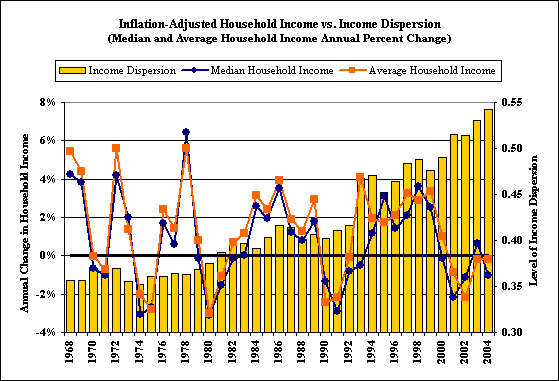
The measure used here is the median logarithmic deviation of income as published by the Census Bureau in its annual poverty report. There are a variety of income dispersion/variance measures, but they all show the same basic pattern: U.S. income variance is at an unprecedented level that portends a possible major break in the economic/financial system.
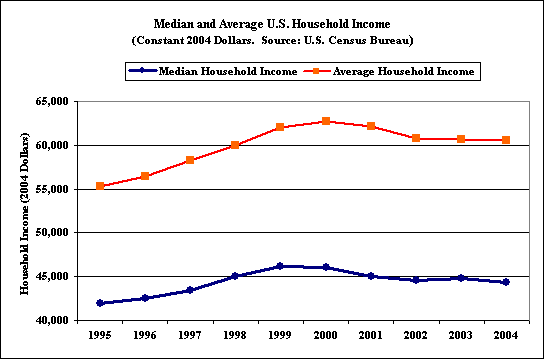
Also reported by the Census Bureau last week were estimates of inflation-adjusted median (meaning the middle measure) and average household income levels for 2004. Of some note, as shown in the second graph, both median and average household income, adjusted for inflation, have been shrinking since 1999/2000.
The combination of negative annual growth in household income and the accompanying spike in income dispersion, as shown in the first graph, is a particularly ominous pairing. Growth in household consumption cannot be sustained without income growth. If household consumption is down, the economy is going to grow at a slower pace than the number of households. The number of households grew by 1.0% in 2004 and by 0.6% in 2003, growth rates well below reported GDP growth.
The latest numbers from the Census Bureau show the system to be at the brink of instability and unable to sustain the GDP growth being reported by the Bureau of Economic Analysis.