


No. 254: Updated Economic Outlook, GDP, Durable Goods, Home Sales
JOHN WILLIAMS’ SHADOW GOVERNMENT STATISTICS
COMMENTARY NUMBER 254
Updated Economic Outlook, GDP, Durable Goods, Home Sales
October 29, 2009
__________
Recession Is Not Over
Quarterly GDP Growth Is Not Sustainable
With 92% of Growth in Nonrecurring Factors
Annual GDP Down 2.3% (5.7% SGS)
4th-Quarter GDP Should Resume
Quarter-to-Quarter Decline
Durable Goods Orders at 1997 Level
Help-Wanted Advertising at New 58-Year Low
__________
PLEASE NOTE: The next planned Commentary is for Friday, November 6th, following the release of the October employment and unemployment report.
– Best wishes to all, John Williams
Economic Outlook Update: Economy Remains in Severe Recession. The general outlook for the U.S. economy continues to be for severe contraction, with the worst still ahead. The downturn will remain generally unresponsive to traditional stimuli, other than as seen in occasional blips from government giveaway gimmicks. The business contraction is structural in nature, tied to a lack of real growth in consumer income and liquidity constraints from contracting consumer credit. As a hyperinflation unfolds, the current circumstance will evolve into a hyperinflationary Great Depression. The Consumer Liquidity and the Depression special reports of September 14th of August 1st, respectively, hold and are included here by reference (available at www.shadowstats.com).
All U.S. recessions in the last four decades have had at least one positive quarter-to-quarter GDP reading, followed by renewed downturn. Such likely will be the case with the growth reported in the initial estimate of third-quarter 2009 GDP, that is, a quarterly GDP contraction for fourth-quarter 2009. With broad money supply in near-term contraction and with no relief to the structural problems impairing household liquidity, there is no economic recovery on the horizon.
As expected, the positive quarter-to-quarter change in third-quarter activity reflected one-time impacts from the clunkers and the first-time homebuyers programs, and a buildup in business inventories that will face liquidation in the fourth quarter.
The estimate of 3.5% annualized real growth for third-quarter GDP included a 1.7% gain from auto sales, a 0.6% gain from new residential construction, and a 0.9% gain from a largely-involuntary inventory buildup, which appears to be understated. In aggregate, those one-time stimulus or inventory items represented 92% of the reported quarterly growth. The nature of the stimulus-related gains was that they tended to steal business activity from the future. The months ahead are the future. Accordingly, fourth-quarter quarterly GDP change likely will turn negative, again.
Separately, in recent reporting, new orders for durable goods (see below) are continuing to bottom-bounce, not to recover. Also, the Conference Board just released its September help-wanted advertising number, showing a sharp monthly deterioration to a new historic low level (see Week Ahead employment detail). The mixed picture for housing starts is not a good one, either, given distortions currently distorting those series (see below).
GDP-Related Definitions. For purposes of clarity and the use of simplified language in the following text, here are definitions of key terms used related to GDP reporting:
"Gross Domestic Product (GDP)" is the headline number and the most widely followed broad measure of U.S. economic activity. It is published quarterly by the Bureau of Economic Analysis (BEA), with two successive monthly revisions and with an annual revision the following July.
"Gross Domestic Income (GDI)" is the theoretical equivalent to the GDP, but it is not followed by the popular press. Where GDP reflects the consumption side of the economy and GDI reflects the offsetting income side. When the series estimates do not equal each other, which almost always is the case, the difference is added to or subtracted from the GDI as a "statistical discrepancy." Although the BEA touts the GDP as the more accurate measure, the GDI is relatively free of the monthly political targeting the GDP goes through.
"Gross National Product (GNP)" is the broadest measure of the U.S. economy published by the BEA. Once the headline number, now it rarely is followed by the popular media. GDP is the GNP net of trade in factor income (interest and dividend payments). GNP growth usually is weaker than GDP growth for net-debtor nations. Games played with money flows between the United States and the rest of the world tend to mute that impact on the reporting of U.S. GDP growth.
"Real" means growth has been adjusted for inflation.
"Nominal" means growth or level has not been adjusted for inflation. This is the way a business normally records revenues or an individual views day-to-day income and expenses.
" GDP Implicit Price Deflator (IPD)" is the inflation measure used to convert GDP data from nominal to real. The adjusted numbers are based on "Chained 2005 Dollars," at present, where the 2005 is the base year for inflation, and "chained" refers to the methodology which gimmicks the reported numbers so much that the total of the deflated GDP sub-series misses the total of the deflated total GDP series by nearly $40 billion in "residual" as of second-quarter 2010.
"Quarterly growth," unless otherwise stated, is in terms of seasonally-adjusted, annualized quarter-to-quarter growth, i.e., the growth rate of one quarter over the prior quarter, raised to the fourth power, a compounded annual rate of growth. While some might annualize a quarterly growth rate by multiplying it by four, the BEA uses the compounding method, raising the quarterly growth rate to the fourth power. So a one percent quarterly growth rate annualizes to 1.01 x 1.01 x 1.01 x 1.01 = 1.0406 or 4.1%, instead of 4 x 1% = 4%.
"Annual growth" refers to the year-to-year change of the referenced period versus the same period the year before.
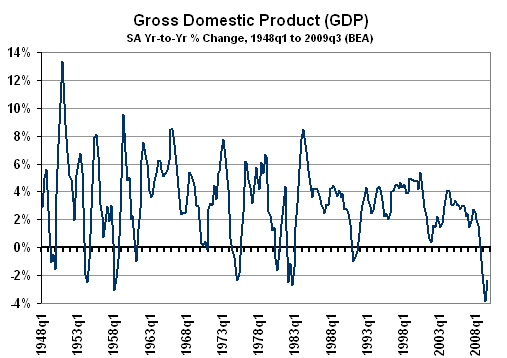
As shown in the accompanying graph, year-to-year GDP change remained deep in recession territory, and it remains likely to continue in negative territory well the into next year. With a quarterly contraction in the fourth-quarter GDP, the pace of annual decline would pick up, again. In the unlikely event that the Bureau of Economic Analysis can keep its fourth-quarter GDP estimated quarter-to-quarter growth in positive territory, the pattern unfolding here soon would become recognized as a double-dip recession. The worst of the U.S. economic contraction still is to come.
GDP Set for Renewed Contraction Next Quarter. The "advance" guesstimate for third-quarter 2009 Gross Domestic Product (GDP) released this morning (October 29th) by the Bureau of Economic Analysis (BEA) suggested annualized real growth for the quarter of 3.53% +/- 3% (95% confidence interval), following a 0.74% decline reported for the second quarter.
The year-to-year contraction in real third-quarter GDP narrowed to 2.33% from a record annual contraction of 3.83% in the second quarter. As shown in the graph above, the latest year-to-year decline generally is in line with annual-growth trough levels of major post-World War II recessions.
The BEA tends to target the consensus outlook for its "advance" estimate, and the consensus was at 3.2% coming into this morning, per Briefing.com. This targeting is due partially to the bulk of the data in the "advance" estimate being guesses, where hard information on the quarter just is not available. For example, the trade data, where net exports resumed their widening (an economic negative), are based on only two months of data for the quarter. Given the relative insignificance of the BEA’s first guesstimates here, no attempt is made by the BEA to estimate either Gross National Product (GNP) or Gross Domestic Income (GDI) for the quarter. Those first estimates should follow along with the first set of revisions to third-quarter GDP in next month’s reporting.
As discussed in the opening comments, nearly all the reported quarter-to-quarter gain in third-quarter GDP was due to auto sales and housing (boosted by now-expired one-time stimulus giveaways) and a largely involuntary inventory build-up (likely to be expanded in later revisions). As personal consumption and housing decline anew, lacking stimulus props, and as excess inventories get worked off, a renewed quarter-to-quarter decline in real fourth-quarter GDP is a fair bet.
The SGS Alternate-GDP estimate for third-quarter 2009 is an annual contraction of 5.7% versus the 2.3% official estimate, narrowed from 5.9% (3.8% official estimate) in the second quarter. While annualized real quarterly growth is not formally estimated on an alternative basis, a flat quarter-to-quarter circumstance, plus or minus, likely is realistic.
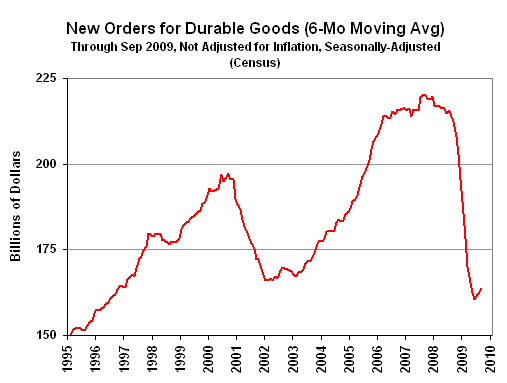
September Durable Goods Have Lost 12 Years of Growth. The Census Bureau reported yesterday (October 28th) that the regularly-volatile new orders for durable goods rose by 1.0% (up by 0.7% net of revisions) month-to-month in September, versus a revised 2.6% (was 2.4%) decline in August. In terms of year-to-year change, before any accounting for inflation, September’s new orders were down by 17.4%, following August’s revised annual decline of 19.3% (previously 19.1%). Adjusted for inflation, the series would have shown even sharper contractions.
As shown in the accompanying graph, the level of new orders for durable goods (smoothed for a six-month moving average), remains in territory last seen in 1997. Again, this is before inflation adjustment. I avoid deflating this series, due to the lack of a reasonable deflator measure available for durable goods. This is a similar pattern to that seen in real retail sales, industrial production and housing starts.
From the durable goods orders series peak in 2006, the September 2009 order level was down by 28.1%, within great depression territory per SGS definition of a greater than 25% peak-to-trough decline in economic activity. Since January 2009, the seasonally-adjusted series has flattened out at an extremely low level, averaging $162 billion per month. Against that, the September reading of $165.7 billion was within the normal range of volatility for reporting of this series.
The widely followed new orders for nondefense capital goods also gained in September, up by 2.5% (up 1.7% net of revisions) on a month-to-month basis, following August’s revised 7.7% (previously 7.1%) monthly decline. Year-to-year, September orders were down by 19.1%, versus a revised August annual decline of 23.5% (previously down by 22.9%). New orders for automobiles fell by 0.1% in September, suggesting some lack of follow-through from August’s clunkers-program-induced spike.
These new orders series are leading indicators to economic activity and are not showing any pending economic rebound.
New Homes Sales Remain Weak. With major distortions to both new and existing home sales reporting from rising foreclosures and the expiring first-time-homebuyer tax credit, September’s reporting results were mixed and not particularly meaningful. With the tax credit program having run its course, some fall-off in monthly sales is likely in the next month or two.
The Census Bureau reported yesterday (October 28th) that September new home sales fell by a statistically insignificant 3.6% (down 6.3% net of revisions) +/- 12.0% (95% confidence interval) month-to-month, following a revised 1.0% (previously 0.7%) gain in August. There was a large downward revision to the data before August. Year-to-year, September was down by 7.8%, following a revised 6.1% (previously 3.4%) decline in August.
Likely spiked by the tax credit expiration, existing home sales in September rose by 9.4% month-to-month, 9.2% year-to-year, to a two-year-high level of activity. Still heavily warped by foreclosures (estimated at 29% of sales in September), again, some downside volatility would be likely in the next couple of months.
Week Ahead. Given the underlying reality of a weaker economy and a more serious inflation problem than generally is expected by the financial markets, risks will favor higher-than-expected inflation and weaker-than expected economic reporting in the month ahead. Such is true especially for economic reporting net of prior-period revisions.
Payroll Employment and Unemployment (October 2009).Due for release on Friday, November 6th, expectations appear to be for a smaller decline in payrolls and a minimal notch upwards in unemployment. Briefing.com reports a consensus expectation of a 166,000 jobs loss in October, following a 263,000 jobs decline in September, with the October unemployment rate increasing to 9.9% from September’s 9.8% level. The economy remains much weaker than consensus, and reporting risk here continues to be for worse-than-expected numbers.
This morning’s release by the Conference Board of newspaper help-wanted advertising for September (a leading indicator to October’s employment report) showed the index fell to a new record low of 9, from the prior low of 10 that held for the preceding four months. This new 58-year low is a very negative signal for background employment conditions. As the various related employment series are updated in the next several days, a Commentary with a quick update on the pending employment/unemployment numbers is planned before the release.
The underlying related economic series still are consistent with roughly 500,000 of jobs loss per month, of which 300,000 or more should be reported for October, once the re-jiggering of prior-period monthly revisions is taken into account. An additional 200,000 is being missed completely, due to survey problems. The reporting risk for the unemployment rate is that it could break to 10.0% or above, but political pressures have to be substantial to push that odometer event as far off into the future as possible.
As indicated in last month’s employment report estimating the pending benchmark revision based on March 2009 (to be published in February 2010), the payroll survey has been missing about 200,000 in jobs loss per month, this year. Such will be corrected partially with revised data to be released in February 2010 and again in February 2011.
__________