


No. 366: First-Quarter GDP, Retail Sales Revisions, Hyperinflation Watch

COMMENTARY NUMBER 366
First-Quarter GDP, Retail Sales Revisions, Hyperinflation Watch
April 29, 2011
__________
Historical Retail Sales Revised Lower
First-Quarter GDP “Growth” Statistically Indistinguishable from Contraction
__________
PLEASE NOTE: The next regularly scheduled Commentary is for Friday, May 6th. It will cover the release of the April 2011 unemployment rate and payroll employment estimates.
—Best wishes to all, John Williams
That said, the poor-quality GDP reporting continued, with yesterday’s (April 28th) GDP estimate showing slowing annualized real (inflation-adjusted) quarterly growth in first-quarter 2011, down to 1.8% from 3.1% in the fourth-quarter. In the popular press, the slowing was blamed on factors such as bad weather, higher oil prices due to Middle East turmoil, declining housing activity and military spending. Bad weather had negligible impact. Higher food, oil and gasoline prices did have meaningful impact, but the issue there was more Federal Reserve debasement of the U.S. dollar than global political tensions. The sharp deterioration in underlying trade data as reported last month by the Bureau of Economic Analysis (BEA) appears largely to have been ignored. Those numbers purportedly are used by the BEA in estimating the GDP’s net export account. GDP data anywhere close to the official trade reporting would have taken the GDP growth estimate into negative territory. As a result of the trade issues, and the wide error margins for GDP reporting (see detail following), the first-quarter growth estimate was of unusually poor quality and just as easily could have been reported as a contraction, as it was a small gain.
Retail Sales Benchmark Shows Weaker Recent Economic History. As shown in the accompanying graph, recent retail sales activity was lowered by roughly one-percent from previous reporting. Adjusted for inflation, real retail still troughed in March 2009, but at a level 1.05% below where it last had been estimated. The level of real retail sales for December 2010—peak of the holiday season—was revised lower by 1.15%, with the most recent March 2011 estimate revised lower by 1.10%.
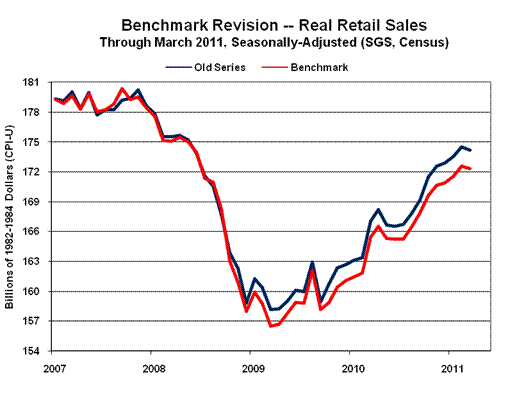
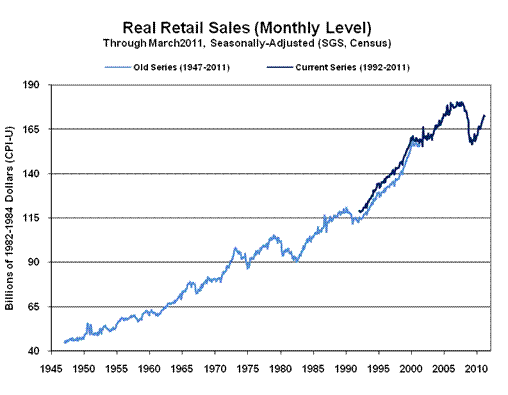
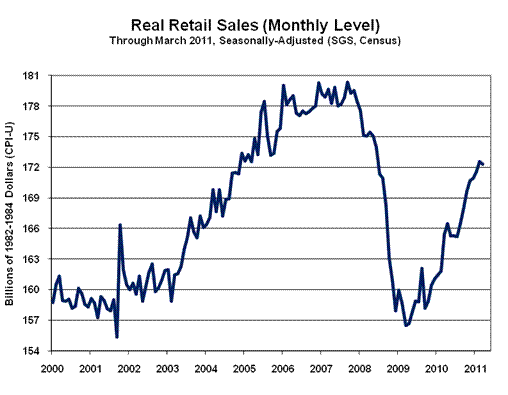
The following graphs of real retail sales, both of post-World War II historical perspective and the nearer-term detail, have been updated for the latest revisions.
GDP-Related Definitions. For purposes of clarity and the use of simplified language in the following text, here are definitions of key terms used related to GDP reporting:
"Gross Domestic Product (GDP)" is the headline number and the most widely followed broad measure of U.S. economic activity. It is published quarterly by the Bureau of Economic Analysis (BEA), with two successive monthly revisions and with an annual revision the following July.
"Gross Domestic Income (GDI)" is the theoretical equivalent to the GDP, but it is not followed by the popular press. Where GDP reflects the consumption side of the economy and GDI reflects the offsetting income side. When the series estimates do not equal each other, which almost always is the case, the difference is added to or subtracted from the GDI as a "statistical discrepancy." Although the BEA touts the GDP as the more accurate measure, the GDI is relatively free of the monthly political targeting the GDP goes through.
"Gross National Product (GNP)" is the broadest measure of the U.S. economy published by the BEA. Once the headline number, now it rarely is followed by the popular media. GDP is the GNP net of trade in factor income (interest and dividend payments). GNP growth usually is weaker than GDP growth for net-debtor nations. Games played with money flows between the United States and the rest of the world tend to mute that impact on the reporting of U.S. GDP growth.
"Real" means growth has been adjusted for inflation.
"Nominal" means growth or level has not been adjusted for inflation. This is the way a business normally records revenues or an individual views day-to-day income and expenses.
" GDP Implicit Price Deflator (IPD)" is the inflation measure used to convert GDP data from nominal to real. The adjusted numbers are based on "Chained 2005 Dollars," at present, where the 2005 is the base year for inflation, and "chained" refers to the methodology which gimmicks the reported numbers so much that the total of the deflated GDP sub-series misses the total of the deflated total GDP series by nearly $40 billion in "residual" as of second-quarter 2010.
"Quarterly growth," unless otherwise stated, is in terms of seasonally-adjusted, annualized quarter-to-quarter growth, i.e., the growth rate of one quarter over the prior quarter, raised to the fourth power, a compounded annual rate of growth. While some might annualize a quarterly growth rate by multiplying it by four, the BEA uses the compounding method, raising the quarterly growth rate to the fourth power. So a one percent quarterly growth rate annualizes to 1.01 x 1.01 x 1.01 x 1.01 = 1.0406 or 4.1%, instead of 4 x 1% = 4%.
"Annual growth" refers to the year-to-year change of the referenced period versus the same period the year before.
GDP. Published yesterday, April 28th, by the Bureau of Economic Analysis (BEA), the “advance” or first estimate of real (inflation-adjusted) first-quarter 2011 Gross Domestic Product (GDP) showed annualized quarterly growth of 1.75% +/- 3% (95% confidence interval), down from 3.11% in fourth-quarter 2010. Net of an unwanted buildup in nonfarm inventories, growth would have been 0.75%.
Year-to-year change in first-quarter 2011 over first-quarter 2010 continued the slowing trend in annual growth, coming in at 2.28%, down from 2.78% in the fourth-quarter, and well off the peak reported growth of 3.25% purportedly seen in third-quarter 2010.
The first-quarter GDP implicit price deflator estimate was at an annualized pace of 1.90%, versus 0.35% in the fourth-quarter. In contrast, annualized seasonally-adjusted quarterly inflation for the CPI-U in the first-quarter spiked to a seasonally-adjusted 5.22%, from 2.62% annualized inflation in the fourth-quarter (see Commentary No. 363). The lower the inflation rate that is used in deflating the GDP, the stronger is the resulting inflation-adjusted number and vice versa. A slightly more realistic inflation number would have pushed the “advance” quarterly growth rate into negative territory.
The SGS Alternate-GDP estimate for first-quarter 2011 is an approximate annual contraction of 2.6% versus the official estimate of a 2.3% gain. Such is more negative than the alternate 2.1% annual contraction (2.8% official gain) in the fourth-quarter (see the Alternate Data tab). While annualized real quarterly growth is not estimated formally on an alternative basis, a meaningful quarter-to-quarter contraction appears to have been realistic for the first-quarter, in what generally has been a protracted period of bottom-bouncing.

Reflecting the latest reporting, the preceding graph shows year-to-year percent change in the official inflation-adjusted quarterly GDP for the history of the series. The record annual contraction for the series was 4.11%, seen in second-quarter 2009. Again, the GDP and related series will go through their annual benchmark revisions on July 29, 2011.
GNP and GDI. Due to the paucity of meaningful data (the “advance” GDP itself is just a guesstimate), the initial estimates of Gross National Product (GNP) and Gross Domestic Income (GDI) will not be released until next month.
Fed Chairman Bernanke, however, opted to have a press conference on Wednesday (April 27th). His wording was very careful. He explained how everything was working out perfectly. He also was clear that the Federal Reserve was not responsible for any of the problems upsetting the public, including higher gasoline prices or a weaker dollar. The U.S. stock market was happy, but the Fed Chairman’s comments were far from honest, and the precious metals and currency markets did not buy all the happy news.
U.S. inflation is on the rise, due primarily to the Fed’s successful efforts at starting to debase the U.S. dollar. It is the dollar’s weakness that primarily has driven oil prices higher, more so than political tensions in the Middle East and North Africa, or Mr. Bernanke’s suggestions of surging global oil demand. As a result of Fed activity, the U.S. dollar has lost its safe-haven status and is hitting all-time lows against a number of major currencies. As noted in the Hyperinflation Special Report (2011) (page 7), even the Fed’s Vice-Chairman has acknowledged current Fed policy is weakening the U.S. dollar.
Next week, this section will assess what may be the beginning of an upturn in the broad money supply (SGS-Ongoing-M3 Estimate).
The economic and systemic solvency crises are ongoing. The inflation and currency circumstance (U.S. dollar versus the stronger major currencies and precious metals) continues to deteriorate. The broad economic and inflation outlooks discussed in the Hyperinflation Report continue unabated.
Employment and Unemployment (April 2011). The estimates of the April unemployment rate and payroll employment are due for release on Friday, May 6th. Once again, they will be clouded by major quality issues with seasonal adjustments (see Commentary No. 361). Against what likely will be reasonably strong expectations for headline payrolls and the unemployment rate, underlying reality remains suggestive of a much weaker environment: contracting employment and rising unemployment. Shifting distortions in the seasonal factors can offer the financial markets an unhappy surprise here at any time.
__________