


No. 748: July Trade Deficit and Construction Spending, Increasing Income Dispersion

COMMENTARY NUMBER 748
July Trade Deficit and Construction Spending, Increasing Income Dispersion
September 3, 2015
__________
Revisions to Trade-Balance Reporting Methodology
Indicate Minimally a 3% Historical Understatement of the U.S. Trade Shortfall
Negative Implications for 2016 GDP Benchmark Revisions
Narrowing of the Headline July Trade Deficit
Had Positive Implications for Third-Quarter GDP Reporting
Inflation Jump Accounted for Bulk of Gain in July Construction Spending
Fed Games-Playing and the Employment Report
___________
PLEASE NOTE: The next regular Commentary, tomorrow, Friday, September 4th, will cover August employment and unemployment reporting.
Best wishes to all! — John Williams
OPENING COMMENTS AND EXECUTIVE SUMMARY
Fed Rate Action and August Employment and Unemployment Reporting. Federal Reserve Vice Chairman Fischer has indicated that the decision to raise or not to raise rates at the FOMC meeting, in two weeks, would be influenced heavily by tomorrow’s August labor reporting. That sounds like a set-up of some form, trying shift blame away from the Fed, for its action or inaction, and pinning it otherwise on unreliable data out of the Bureau of Labor Statistics. Historically, the Fed has been able to get a pretty good indication, in advance, of whether a labor report would be strong or weak. It would be highly surprising if the Fed Vice Chairman did not have some indication of what was going to happen, before tossing his comments into the marketplace.
Based on underlying economic reality, my betting is for a weak labor-market report. If, however, headline unemployment drops to 5.2%, with a sharp decline in the number of unemployed being offset by a strong gain in the number of employed—not a drop in the unemployment rate coming from unemployed being defined out of headline existence—one might wonder about fix being put in for the Fed. The FOMC would do well act with confidence, rather than appear to be so uncertain as to what it can or should do. Frankly, it looks like the Fed has lost decisive control of monetary policy, and global or domestic perceptions of a weak or ineffectual central bank can do more long-term damage to the dollar and domestic financial-market confidence than can the Fed making a bad interest rate call.
Further comment on the Fed’s games-playing will follow with tomorrow’s, September 4th, Commentary No. 749, in the context of the headline labor detail.
Today’s Commentary (September 3rd). The balance of today’s Opening Comments concentrates on the reporting of the July trade deficit and construction spending, along with an update of consumer conditions. The Hyperinflation Outlook Summary will return shortly, excerpted from No. 742 Special Commentary: A World Increasingly Out of Balance and Commentary No. 743, and addressing the still-evolving financial-market instabilities and crises.
The Week Ahead section provides an updated preview of tomorrow’s reporting of August labor-market conditions.
Trade Deficit—July 2015—Revised Reporting Methodology Indicates Minimally a Three-Percent Understatement of the Historical Deficit. Where imports are counted on the negative side of the trade balance, a change in reporting methodology now shows that imports have been understated regularly, with the effect of underestimating the size of the U.S. trade deficit by at least three-percent. Such has negative implications for historical, broad economic growth and for future GDP benchmark revisions.
Beginning with the headline reporting for July 2015, the Bureau of Economic Analysis (BEA) and the Census Bureau introduced a change in the trade-deficit calculation, now counting low-value imports, that previously neither were reported nor calculated in the monthly balance of payments estimates. To allow for near-term reporting consistency in recent headline data, trade detail back to January 2015 has been restated with a "temporary balance of payments adjustment for low-value imports," included in the trade calculations. Full historical revisions will follow in June 2016.
Those changes were incorporated along with other regular minor revisions to the trade deficit for first-half 2015, with the net effect of widening the six-month trade deficit by 3.3%. The bulk of that was due to the new reporting approach. Even greater trade deterioration looms with further new detail still to be added. Separately, as a result of the temporary restatement of historical post-December 2014 reporting, current headline data no longer are consistent earlier data, such as might be seen with year-ago comparisons.
July Trade Deficit Narrowed with Initial Positive Implications for Third-Quarter GDP. The nominal July 2015 trade deficit narrowed versus June, which in turn still widened versus May, in the context of the restatement of first-half 2015 trade activity tied to changes in reporting methodology. The initial headline real July trade detail suggested a positive contribution to headline Gross Domestic Product (GDP) in the current quarter (a narrowing of the deficit in the net export account). The revised real June deficit, however, still did not support the headline narrowing of the net-export-account deficit reported in both the first and second estimates of second-quarter 2015 GDP (see Commentary No. 747), although the second-quarter real deficit did improve minimally from its initial estimate.
Nominal (Not-Adjusted-for-Inflation) July 2015 Trade Deficit. The nominal, seasonally-adjusted monthly trade deficit in goods and services for July 2015, on a balance-of-payments basis, narrowed by $3.342 billion to $41.863 billion, versus a revised $45.205 billion in June 2015. The July 2015 nominal deficit widened versus the now, non-comparable $41.411 billion trade shortfall in July 2014.
In terms of month-to-month trade patterns, that headline $3.342 billion narrowing in the July deficit reflected an increase of $0.809 billion in monthly exports, combined with a $2.534 billion decline in monthly imports (there is a rounding difference). The plunge in imports reflected a $1.5 billion decline for pharmaceutical preparations (more than offsetting a one-month $1.3 billion surge in June), and a sharp drop in cell phone imports, while crude oil imports increased, reflecting higher oil prices.
Real (Inflation-Adjusted) July 2015 Trade Deficit. Adjusted for seasonal factors, and net of oil-price swings and other inflation (2009 chain-weighted dollars, as used in GDP deflation), but not reflective at this point of the change in reporting methodology, the July 2015 merchandise trade deficit (no services) narrowed to $56.208 billion, from a revised $58.983 billion in June 2015. The July 2015 shortfall still widened sharply versus a $48.346 billion real deficit in July 2014.
As currently reported, the annualized quarterly real merchandise trade deficit stood at $613.4 billion for second-quarter 2014, $588.6 billion for third-quarter 2014, $605.5 billion for fourth-quarter 2014, $692.1 billion for first-quarter 2015 and a revised $694.3 billion for second-quarter 2015. Widening quarter-to-quarter real trade deficits subtract growth from the quarterly real GDP estimates and vice versa.
With July’s first trade-deficit estimate in place, the initial trend for the annualized quarterly real trade shortfall in third-quarter 2015 was $674.5 billion. Again, based only on one month’s preliminary estimate, that number suggested a narrowing versus the second-quarter 2015 deficit, and was indicative of a positive trade-based contribution to the initial estimate of the third-quarter 2015 GDP growth rate.
Construction Spending—July 2015—0.7% Headline Gain Largely Was Due to Rising Inflation. In the context of continuing, volatile upside monthly revisions, the 0.7% gain in July construction spending largely was accounted for by a related 0.5% spike in construction inflation. Even so, the patterns of real growth here still continue to run well ahead of, and are not supported by, growth in related construction employment. That suggests that the government estimates of construction inflation are too low, as generally confirmed by private surveys (see the PPI Final Demand Construction Index section).
Reflecting all revisions and full quarterly reporting, second-quarter 2015 real construction spending (deflated by PPI construction inflation) showed a revised, annualized 28.3% quarterly gain, versus an unrevised 4.1% annualized gain in first-quarter 2015. Based solely on the initial headline reporting for July 2015, third-quarter annualized growth was on track for an annualized 5.3% gain.
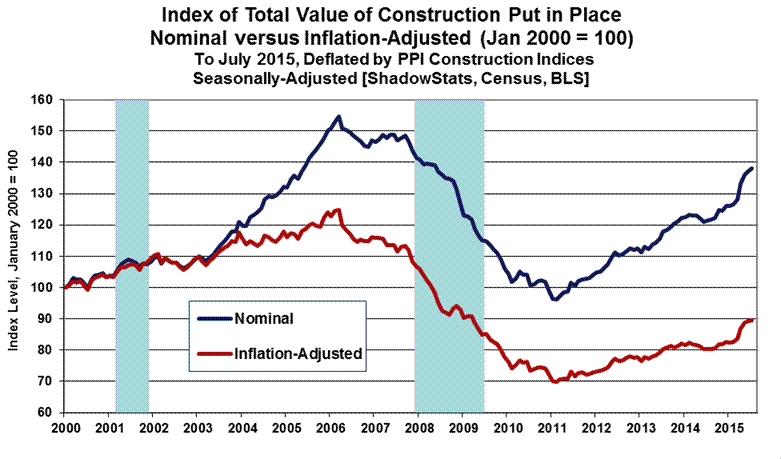
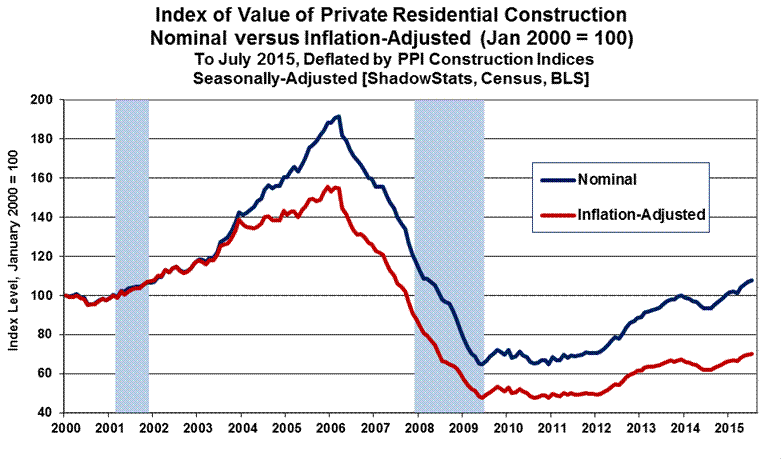
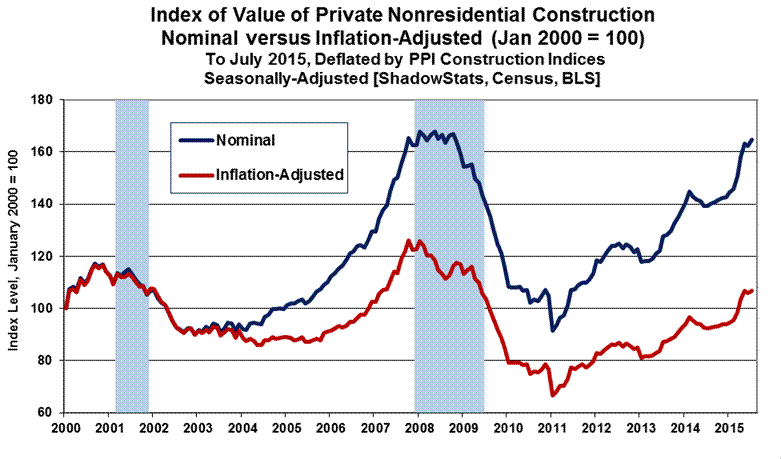
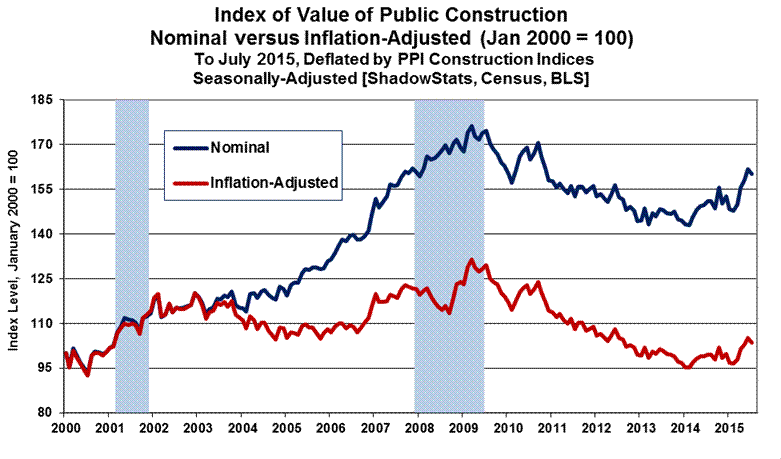
The following Graphs 4 to 7 show comparative nominal and real construction activity for the aggregate series as well as for private residential- and nonresidential-construction and public construction spending. Seen after adjustment for inflation, the aggregate series had remained in low-level stagnation into first-quarter 2015. It spiked in recent months, but slowed in the last two months of reporting, with the real series in July 2015 still holding at 28.3% (-28.3%) below its pre-recession peak of March 2006. The general pattern of real activity remains one of low-level, albeit up-trending stagnation.
PPI Final Demand Construction Index (FDCI). ShadowStats uses the Final Demand Construction Index (FDCI) component of the Producer Price Index (PPI) for deflating the current aggregate activity in the construction-spending series. The subsidiary private- and public-construction PPI series are used in deflating the subsidiary series in the accompanying graphs.
The previously-used New Construction Index (NCI) was so far shy of reflecting construction costs as to be virtually useless. Although closely designed to match this construction-spending series, the FDCI and subsidiary numbers have two problems. First, the historical data only go back to November 2009. Second, they still understate actual construction inflation. Private surveys tend to show higher construction-related inflation than is reported by the government. For example, year-to-year inflation reflected in the privately-published Building Cost Index [Dodge Data and Analytics (McGraw Hill) Engineering News-Record] is running about one-third above the headline pace of annual inflation in the PPI’s Final Demand Construction Index.
Graph 1: Index, Nominal versus Real Value of Total Construction
Graph 2: Index, Nominal versus Real Value of Private Residential Construction
Graph 3: Index, Nominal versus Real Value of Private Nonresidential Construction
Graph 4: Index, Nominal versus Real Value of Public Construction
There is no perfect, publicly-available inflation measure for deflating construction. For the historical series in the accompanying graphs, the numbers are deflated by the NCI through November 2009, and by the FDCI and subsidiaries thereafter.
For July 2015, the seasonally-adjusted FDCI month-to-month inflation jumped to a 0.53%, from 0.09% in June. In terms of year-to-year inflation, the July 2015 FDCI rose to 1.99% from 1.81% in June 2015. Where the subsidiary series tend to track the aggregate inflation detail over time, July 2015 headline publicly-funded construction inflation gained 0.44% for the month, 2.07% year-to-year, with privately-funded construction inflation up by 0.71% for the month, also up by 2.07% year-to-year.
Headline Reporting for July 2015. The headline, total value of construction put in place in the United States for July 2015 was $1,083.4 billion, on a seasonally-adjusted—but not-inflation-adjusted—annual-rate basis. That estimate was up by a statistically-insignificant 0.7%, versus a revised $1,075.9 billion in June. In turn, June spending also was up by a revised 0.7%, versus a revised level of $1,068.4 billion in May 2015, while May spending was up by 2.3% from an unrevised $1,044.6 billion in April.
Adjusted for FDCI inflation, aggregate real spending in July 2015 was up by 0.2%, following a revised June 2015 gain of 0.6%.
On a year-to-year or annual-growth basis, July 2015 nominal construction spending rose by a statistically-significant 13.7% +/- 2.3%, versus a revised annual gain of 13.2% in June 2015. Net of construction costs indicated by the FDCI, year-to-year change in spending was up 11.5% in July 2015, versus a revised 11.2% in June 2015.
The statistically-insignificant, headline monthly increase of 0.7% in nominal July 2015 aggregate construction spending, versus the 0.7% gain in June 2015 spending, included a headline monthly decline of 1.0% (-1.0%) in July public spending, versus a 2.2% gain in June spending. Private spending increased by 1.3% in July, following a 0.1% gain in June. Within total private construction spending, the residential sector rose by 1.1% in July, versus a 0.9% gain in June, while the nonresidential sector rose by 1.5% in July, versus a decline of 0.7% (-0.7%) in June. The Graphs 14 to 21 in the Reporting Detail section show this detail, as well as comparative graphs of construction employment and housing starts.
Consumer Conditions—Updated for Full-August Sentiment and Confidence Surveys, and Pending Detail on 2014 Median Income and Income Distribution. Updating Commentary No. 743 of August 17th, and as otherwise discussed regularly in these Commentaries, structural liquidity woes continue to constrain domestic economic activity, severely, as they have since before the Panic of 2008. Never recovering in the post-Panic era, limited growth in household income and credit, and a faltering consumer outlook, have eviscerated and continue to impair domestic business activity, which feeds off the financial health and liquidity of consumers.
Without real (inflation-adjusted) growth in household income and without the ability or willingness to take on meaningful new debt, the consumer simply has not had the wherewithal to fuel sustainable economic growth. Impaired consumer liquidity and its direct restraints on consumption have been responsible for much of the economic turmoil of the last eight-plus years, driving the housing-market collapse and ongoing stagnation in consumer-related real estate and construction activity, as well as constraining real retail sales activity and the related, personal-consumption-expenditures category of the GDP. Together, those sectors account for more than 70% of total U.S. GDP activity.
Underlying economic fundamentals simply have not supported, and do not support a turnaround in broad economic activity. There has been no economic recovery, and there remains no chance of meaningful, broad economic growth, without a fundamental upturn in consumer- and banking-liquidity conditions.
The full-August measures for the Conference Board’s Consumer-Confidence and the University of Michigan’s Consumer-Sentiment measures are shown in Graphs 5 to 7, along with the latest readings on various liquidity measures: June consumer credit outstanding (Graph 8) and real first-quarter household-sector credit-market debt outstanding (Graph 9).
June median real monthly household income (Graph 10), currently scheduled for update by www.SentierResearch.com on September 10th, is accompanied by graphs of the annual (2013) measures of real median income and income dispersion (Graphs 11 to 13), as published by the Census Bureau in its last annual Poverty Survey. Scheduled for release on September 16th, the 2014 detail is previewed here.
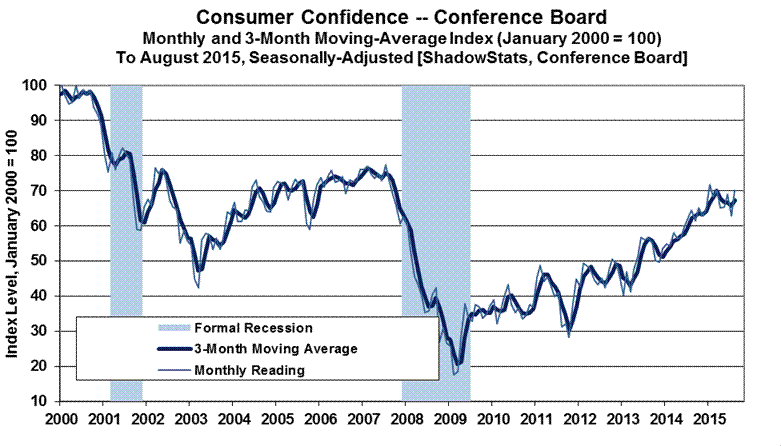
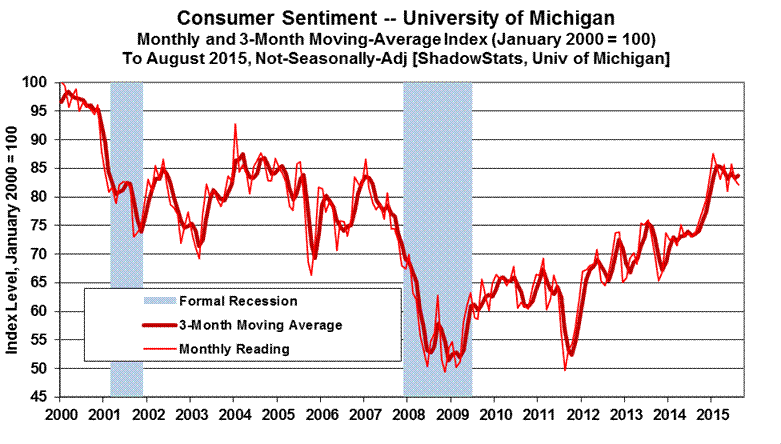
Consumer Confidence and Sentiment. The first three graphs reflect the latest headline activity in consumer confidence and sentiment. The Conference Board’s Consumer-Confidence Index (Graph 5) and the University of Michigan’s Consumer-Sentiment Index (Graph 6) for the full-month of August 2015 moved in opposite directions, with confidence up sharply, as surveyed primarily before recent financial-market turmoil, and with sentiment lower for the month. Both series continued to move lower, though, smoothed for their three-month and six-month moving-average readings. The confidence and sentiment series tend to mimic the tone of headline economic reporting in the press, and often are highly volatile month-to-month, as a result. With increasingly-negative, headline economic reporting ahead, successive negative hits to both the confidence and sentiment readings remain likely in the months ahead.
Graph 5: Consumer Confidence to August 2015
Graph 6: Consumer Sentiment to August 2015
Graph 7: Comparative Consumer Confidence and Sentiment (6-Month Moving Averages) since 1970
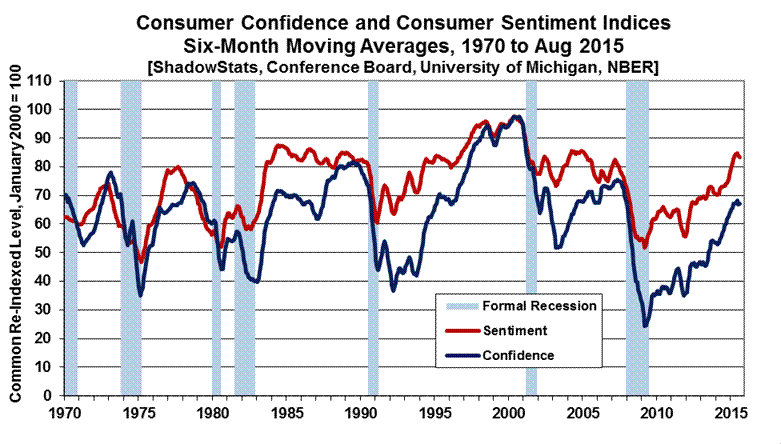
Smoothed for the irregular, short-term volatility, the two series remain at levels seen typically in recessions. Suggested in Graph 7—plotted for the last 40 years—the latest readings of confidence and sentiment generally have not recovered levels seen preceding most formal recessions of the last four decades. Generally, the consumer measures remain well below, or are inconsistent with, periods of historically-strong economic growth seen in 2014 and the strong, headline upturn in second-quarter 2015 GDP growth.
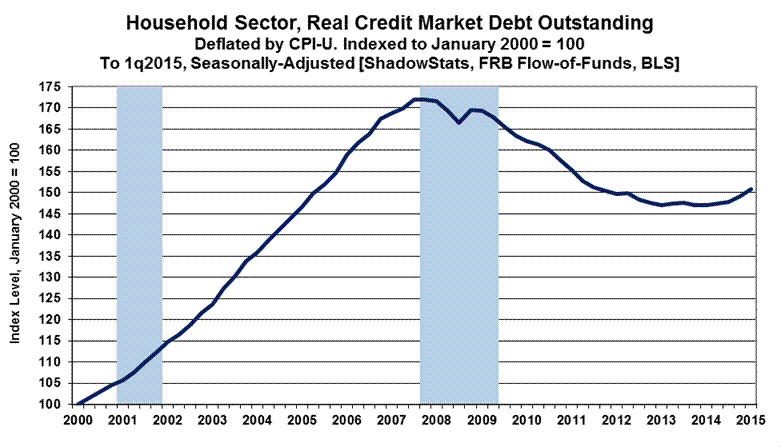
Consumer Credit. The next two graphs address consumer borrowing. Debt expansion can help make up for a shortfall in income growth. Shown in Graph 8 of Household Sector, Real Credit Market Debt Outstanding, household debt declined in the period following the Panic of 2008, and it has not recovered. The series includes mortgages, automobile and student loans, credit cards, secured and unsecured loans, etc., all deflated by the headline CPI-U. The level of real debt outstanding has remained stagnant for several years, reflecting, among other issues, lack of normal lending by the banking system into the regular flow of commerce. Updated through first-quarter 2015, the graph reflects the most-recent detail available from the Federal Reserve’s flow-of-funds data.
The slight upturn seen in the series in the two most-recent quarters, as also seen with the median household income survey, was due partially to gasoline-price-driven, negative CPI inflation, which has begun to pass out of the system. It also reflected surging student loans, as shown in the Graph 9.
Shown through the latest June 2015 reporting, Graph 9 of monthly Consumer Credit Outstanding is a subcomponent of the prior graph on real household sector debt, but it is not adjusted for inflation. Post-2008 Panic, outstanding consumer credit has continued to be dominated by growth in federally-held student loans, not in bank loans to consumers that otherwise would fuel broad consumption growth. The nominal level of Consumer Credit Outstanding (ex-student loans) has not rebounded or recovered since the onset of the recession. These disaggregated data are available and plotted only on a not-seasonally-adjusted basis.
Graph 8: Household Sector, Real Credit Market Debt Outstanding
Graph 9: Nominal Consumer Credit Outstanding

Household Income and Income Dispersion. The final four graphs in this section cover real median household income and measures of income dispersion as taken from Bureau of the Census data or otherwise as published by the Bureau in its annual Poverty Report.
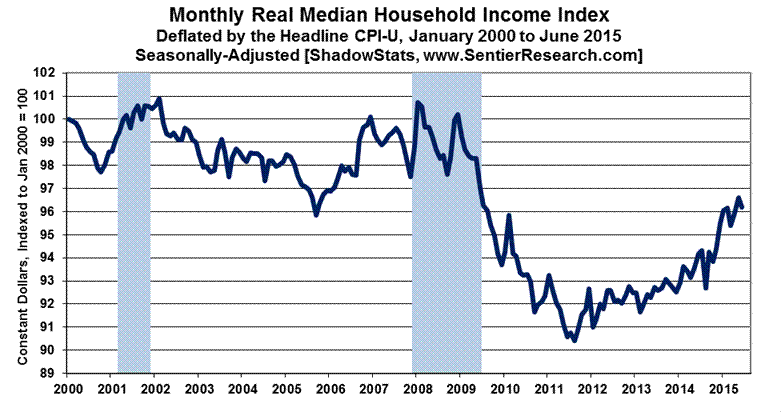
The Graph 10 shows monthly real median household income through June 2015, as reported by www.SentierResearch.com. This measure of real (inflation-adjusted) monthly median household income turned lower in June, reflecting flat, month-to-month nominal median income hit by rising consumer inflation. A similar circumstance generated a headline plunge in second-quarter 2015 real average weekly earnings, discussed in Commentary No. 745. The income series has been in low-level stagnation, with a recent uptrend boosted by dropping gasoline prices. Where negative inflation boosts the level of real growth relative to nominal growth, recent relative "strength" in the series largely reflected temporary, gasoline-price-driven, headline month-to-month contractions in CPI-U reporting, and flat-to-minus annual inflation. That monthly inflation issue reversed in May and June reporting.
Where lower gasoline prices have provided some minimal liquidity relief to the consumer, indications are that any effective extra cash has been used to pay down unsustainable debt, not to fuel new consumption. Despite recent, renewed downside pressure on oil prices, relief from low-priced gasoline should prove increasingly fleeting. As the U.S. dollar resumes its decline, petroleum prices spike anew.
On a monthly basis, when headline GDP purportedly started its solid economic recovery in mid-2009, household income nonetheless plunged to new lows and has yet to recover its level seen during the formal recession, or the pre-recession highs either for the 2007 recession or the 2001 recession.
Graph 10: Monthly Real Median Household Income through June 2015
Shown in Graph 11, the same series, published by the Census Bureau on an annual basis, deflated by headline CPI-U, confirmed that in 2013—the latest-available annual data—annual real median household income continued to hold at a low level of activity. In historical perspective, 2011, 2012 and 2013 income levels were below levels seen in the late-1960s and early-1970s. Such indicates the long-term nature of the evolution of the major structural changes squeezing consumer liquidity and impairing the current economy.
Graph 11: Annual Real Median Household Income through 2013

Headline annual reporting on various income measures for 2013 was published by the Census Bureau in September 2014 and covered in Commentary No. 658. The 2014 data will be released on September 16, 2015. The real annual median household income reading for 2014 likely will rise in tandem with the 2014 data seen in Graph 10, still holding at a level common with the mid-1990s and below levels seen in the late-1960s, early-1970s.
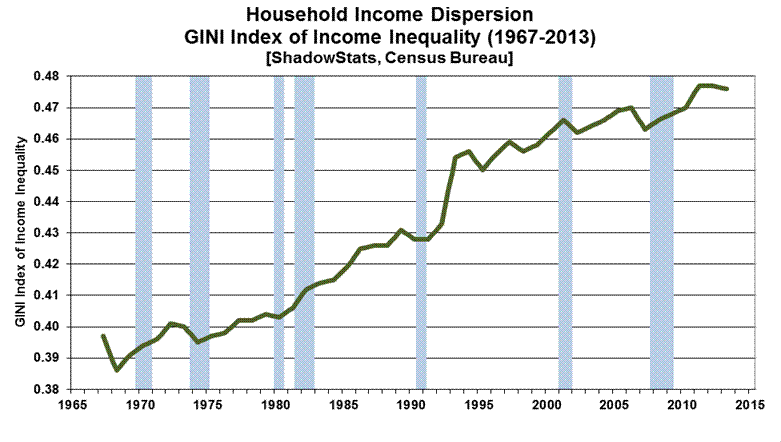
Graph 12: Annual GINI Index of Income Inequality through 2013
Graph 13: Annual Mean Logarithmic Deviation of Income through 2013
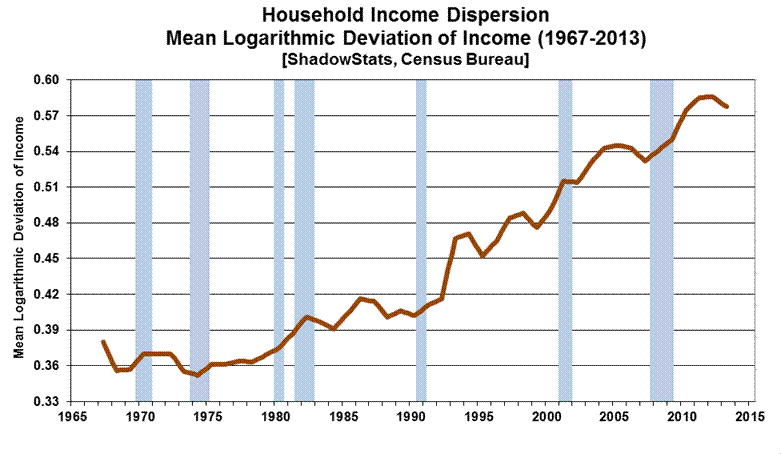
Two measures of income dispersion, or inequality, are shown through 2013 in Graphs 12 and 13. Also to be updated on September 16th, those numbers likely moved towards even greater extremes in 2014.
Measures of income dispersion, or variance, indicate how income is distributed within a population. A low level of income dispersion indicates that income tends to be concentrated in the middle, while a high level of dispersion indicates heavier income concentrations in the extremes of low and high income, with less in the middle. The higher the variance of income, the greater is the income dispersion.
Rising and near-record income dispersion levels usually foreshadow economic and financial-market turmoil. Despite—or perhaps due to—the ongoing nature of the economic and systemic-solvency crises, and the effects of the 2008 financial panic, income dispersion—the movement of income away from the middle towards both high- and low-level extremes—held near record highs in 2013, instead of moderating, as often has been seen otherwise during periods of financial distress.
With the current circumstance at a record extreme for 2011-to-2013, well above levels estimated to have prevailed before the 1929 stock-market crash and the Great Depression, increasingly difficult times are likely for at least the next several years (again, see Commentary No. 658 for a more-extensive discussion of these measures).
Conditions surrounding extremes in income variance usually help to fuel financial-market bubbles, which frequently are followed by financial panics and economic depressions. The sequence of those factors tends to redistribute income in a manner that usually lowers income variance, helping economic recovery. Again, other than for a brief dip following the 1987 stock-market crash, however, U.S. income variance since 1987 has been higher than has been estimated for the economy going into the 1929 stock-market crash and the Great Depression, and its current reading remains nearly double that of any other “advanced” economy. Instead of being tempered by the 2008 financial panic and the ongoing economic and systemic-solvency crises, variance increased to a record level for 2011, 2012 and 2013. That suggests that the greatest negative impact of the systemic turmoil, so far, has been on those in the middle-income area. It also is suggestive of even greater financial and economic crises still ahead.
Related discussion are found in No. 742 Special Commentary: A World Increasingly Out of Balance and in 2014 Hyperinflation Report—The End Game Begins – First Installment Revised and 2014 Hyperinflation Report—Great Economic Tumble – Second Installment.
Consumer liquidity woes remain the basic constraint on current broad economic activity in the United States, which remains heavily consumer oriented. Without real growth in income and/or debt expansion and willingness to take on new debt, and with consumer confidence and sentiment at levels consistent with a significant portion of consumers under financial stress, there has been no basis for a sustainable economic expansion since the Panic of 2008. There are no prospects for a recovery in the near term.
[The Reporting Detail section includes expanded detail on July Trade and Construction Spending.]
__________
REPORTING DETAIL
U.S. TRADE BALANCE (July 2015)
Revision to Trade Balance Reporting Methodology Indicated At Least a Three-Percent Understatement of the Historical U.S. Trade Deficit. Where imports are counted on the negative side of the trade balance, a change in reporting methodology now shows that imports have been understated regularly, with the effect of underestimating the size of the U.S. trade deficit by at least three-percent. Such has negative implications for historical, broad economic growth and for future GDP benchmark revisions.
Beginning with the headline reporting for July 2015, the Bureau of Economic Analysis (BEA) and the Census Bureau introduced a change in the trade-deficit calculation, now counting low-value imports, that previously neither were reported nor calculated in the monthly balance of payments estimates. To allow for near-term reporting consistency in recent headline data, trade detail back to January 2015 has been restated with a "temporary balance of payments adjustment for low-value imports," included in the trade calculations.
Those changes were incorporated along with other regular minor revisions to the trade deficit for first-half 2015, with the net effect of widening the six-month trade deficit by 3.3%. The bulk of that was due to the new reporting approach. Even greater trade deterioration looms with further new detail still to be added. Separately, as a result of the temporary restatement of historical post-December 2014 reporting, current headline data no longer are consistent earlier data, such as might be seen with year-ago comparisons.
Noted in monthly trade balance Press Release, "The Census Bureau will revise historical statistics in June 2016 with the annual revision release. To maintain time-series consistency for imports of goods on a balance of payments (BOP) basis, the U.S. Bureau of Economic Analysis has applied temporary BOP adjustments to imports of goods on a Census basis beginning with January 2015 statistics. These adjustments will be removed from imports of goods on a BOP basis in June 2016 when the Census Bureau revises historical statistics."
July Trade Deficit Narrowed with Initial Positive Implications for Third-Quarter GDP. The nominal July 2015 trade deficit narrowed versus June, which in turn still widened versus May, in the context of the restatement of first-half 2015 trade activity tied to changes in reporting methodology. The initial headline real July trade detail suggested a positive contribution to headline Gross Domestic Product (GDP) in the current quarter (a narrowing of the deficit in the net export account). The revised real June deficit, however, still did not support the headline narrowing of the net-export-account deficit reported in both the first and second estimates of second-quarter 2015 GDP (see Commentary No. 747), although the second-quarter real deficit did improve minimally from its initial estimate.
Nominal (Not-Adjusted-for-Inflation) July 2015 Trade Deficit. The BEA and the Census Bureau reported this morning, September 3rd, that the nominal, seasonally-adjusted monthly trade deficit in goods and services for July 2015, on a balance-of-payments basis, narrowed by $3.342 billion to $41.863 billion, versus a revised $45.205 [previously $43.839] billion in June 2015. The July 2015 nominal deficit widened versus the now, non-comparable $41.411 billion trade shortfall in July 2014.
In terms of month-to-month trade patterns, that headline $3.342 billion narrowing in the July deficit reflected an increase of $0.809 billion in monthly exports, combined with a $2.534 billion decline in monthly imports [difference is in rounding]. The plunge in imports reflected a $1.5 billion decline for pharmaceutical preparations (more than offsetting a one-month $1.3 billion surge in June), and a sharp drop in cell phone imports, while crude oil imports increased, reflecting higher oil prices.
Energy-Related Petroleum Products. For July 2015, the not-seasonally-adjusted average price of imported oil moved higher to $54.20 per barrel, versus $53.76 per barrel in June 2015, but was down from $97.81 per barrel in July 2014. Also not-seasonally-adjusted, physical oil-import volume in July 2015 averaged 7.632 million barrels per day, up from 7.446 million in June 2015 but down from 7.701 million in July 2014.
Ongoing Cautions on Data Quality. Potentially heavy distortions in headline data continue from seasonal adjustments. Similar issues affect other economic releases, such as retail sales and payrolls, where the headline number reflects month-to-month change. Discussed frequently (see 2014 Hyperinflation Report—Great Economic Tumble – Second Installment for example), the extraordinary length and depth of the current business downturn and disruptions have disrupted regular seasonality patterns. Accordingly, the markets should not rely too heavily on the accuracy of the monthly headline data.
Real (Inflation-Adjusted) July 2015 Trade Deficit. Adjusted for seasonal factors, and net of oil-price swings and other inflation (2009 chain-weighted dollars, as used in GDP deflation), but not reflective at this point of the change in reporting methodology, the July 2015 merchandise trade deficit (no services) narrowed to $56.208 billion, from a revised $58.983 [previously $59.339] billion in June 2015. The July 2015 shortfall widened sharply versus a $48.346 billion real deficit in July 2014.
As currently reported, the annualized quarterly real merchandise trade deficit stood at $613.4 billion for second-quarter 2014, $588.6 billion for third-quarter 2014, $605.5 billion for fourth-quarter 2014, $692.1 billion for first-quarter 2015 and a revised $694.3 [previously $695.7] billion for second-quarter 2015. Widening quarter-to-quarter real trade deficits subtract growth from the quarterly real GDP estimates and vice versa.
With July’s first trade-deficit estimate in place, the initial trend for the annualized quarterly real trade shortfall in third-quarter 2015 was $674.5 billion. Again, based only on one month’s preliminary estimate, that number suggested a narrowing versus the second-quarter 2015 deficit, and was indicative of a positive trade-based contribution to the initial estimate of the third-quarter 2015 GDP growth rate.
CONSTRUCTION SPENDING (July 2015)
July Construction Spending Gain of 0.7% Largely Was Due to Rising Inflation. In the context of continuing, volatile upside monthly revisions, the 0.7% gain in July construction spending largely was accounted for by a related 0.5% spike in construction inflation. Even so, the patterns of real growth here still continue to run well ahead of, and are not supported by, growth in related construction employment. That suggests that the government estimates of construction inflation are too low, as generally confirmed by private surveys (see the PPI Final Demand Construction Index section).
Reflecting all revisions and full quarterly reporting, second-quarter 2015 real construction spending (deflated by PPI construction inflation) showed an annualized 28.3% quarterly gain [previously up by 25.7%], versus an unrevised 4.1% annualized gain in first-quarter 2015. Based solely on the initial headline reporting for July 2015, third-quarter annualized growth was on track for an annualized 5.3% gain.
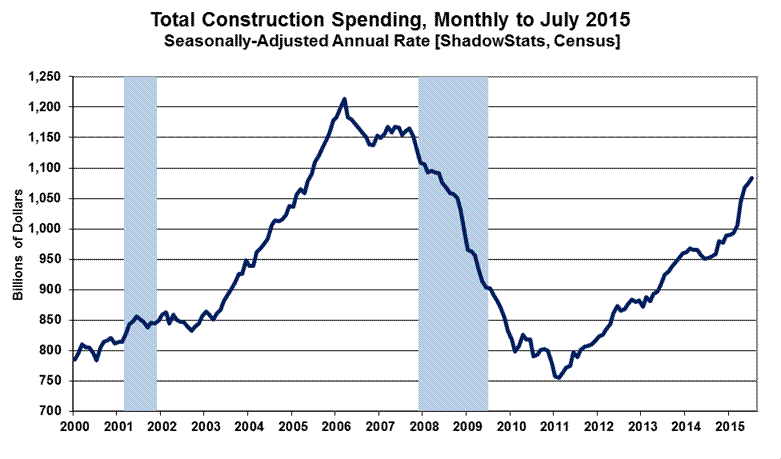
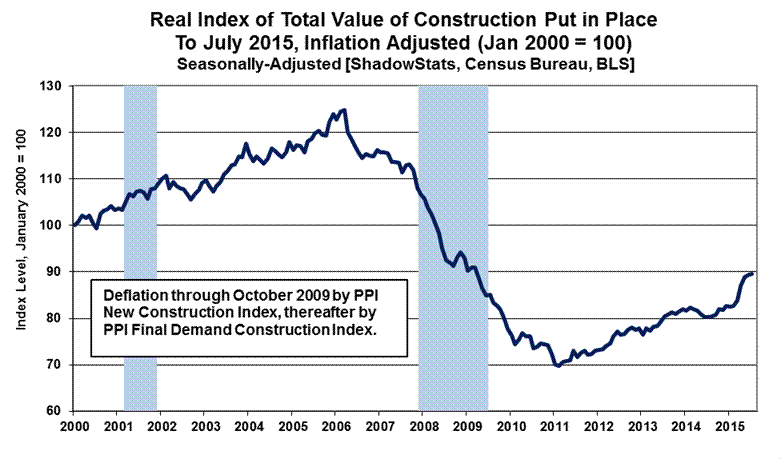
Graphs 4 to 7 in the Opening Comments section show comparative nominal and real construction activity for the aggregate series as well as for private residential- and nonresidential-construction and public construction spending. Seen after adjustment for inflation, the aggregate series had remained in low-level stagnation into first-quarter 2015. It spiked in recent months, but slowed in the last two months of reporting, with the real series in July 2015 still holding at 28.3% (-28.3%) below its pre-recession peak of March 2006. The general pattern of real activity remains one of low-level, albeit up-trending stagnation. The aggregate nominal detail is shown here in Graph 14, with the real detail in Graph 15.
PPI Final Demand Construction Index (FDCI). ShadowStats uses the Final Demand Construction Index (FDCI) component of the Producer Price Index (PPI) for deflating the current aggregate activity in the construction-spending series. The subsidiary private- and public-construction PPI series are used in deflating the subsidiary series graphed in the Opening Comments.
Graph 14: Total Nominal Construction Spending
Graph 15: Index of Total Real Construction Spending
The previously-used New Construction Index (NCI) was so far shy of reflecting construction costs as to be virtually useless. Although closely designed to match this construction-spending series, the FDCI and subsidiary numbers have two problems. First, the historical data only go back to November 2009. Second, they still understate actual construction inflation. Private surveys tend to show higher construction-related inflation than is reported by the government. For example, year-to-year inflation reflected in the privately-published Building Cost Index [Dodge Data and Analytics (McGraw Hill) Engineering News-Record] is running about one-third above the headline pace of annual inflation in the PPI’s Final Demand Construction Index.
There is no perfect, publicly-available inflation measure for deflating construction. For the historical series in the accompanying graphs, the numbers are deflated by the NCI through November 2009, and by the FDCI and subsidiaries thereafter.
For July 2015, the seasonally-adjusted FDCI month-to-month inflation jumped to a 0.53%, from 0.09% in June. In terms of year-to-year inflation, the July 2015 FDCI rose to 1.99% from 1.81% in June 2015. Where the subsidiary series tend to track the aggregate inflation detail over time, July 2015 headline publicly-funded construction inflation gained 0.44% for the month, 2.07% year-to-year, with privately-funded construction inflation up by 0.71% for the month, also up by 2.07% year-to-year.
Headline Reporting for July 2015. The Census Bureau reported September 1st the headline, total value of construction put in place in the United States for July 2015 was $1,083.4 billion, on a seasonally-adjusted—but not-inflation-adjusted—annual-rate basis. That estimate was up by a statistically-insignificant 0.7% +/- 1.8% (all confidence intervals are at the 95% level), versus a revised $1,075.9 [previously $1,064.6] billion in June. In turn, June spending also was up by a revised 0.7% [previously up by 0.1%] versus a revised $1,068.4 [previously $1,063.5, initially $1.035.8] billion in May 2015. In turn, May spending was up by 2.3% from an unrevised $1,044.6 billion in April.
Adjusted for FDCI inflation, aggregate real spending in July 2015 was up by 0.2%, following a revised June 2015 gain of 0.6%.
On a year-to-year or annual-growth basis, July 2015 nominal construction spending rose by a statistically-significant 13.7% +/- 2.3%, versus a revised annual gain of 13.2% [previously up by 12.0%] in June 2015.
Net of construction costs indicated by the FDCI, year-to-year change in spending was at 11.5% in July 2015, versus a revised 11.2% in June 2015.
The statistically-insignificant, headline monthly increase of 0.7% in nominal July 2015 aggregate construction spending, versus the 0.7% gain in June 2015 spending, included a headline monthly decline of 1.0% (-1.0%) in July public spending, versus a 2.2% gain in June spending. Private spending increased by 1.3% in July, following a 0.1% gain in June. Within total private construction spending, the residential sector rose by 1.1% in July, versus a 0.9% gain in June, while the nonresidential sector rose by 1.5% in July, versus a decline of 0.7% (-0.7%) in June. The graphs that follow show the latest extended detail.
Construction and Related Graphs. The earlier Graphs 14 and 15 reflected total construction spending through July 2015, both in the headline nominal dollar terms, and in real terms, after inflation adjustment. The inflation-adjusted graph is on an index basis, with January 2000 = 100.0. Adjusted for the PPI’s NCI measure through October 2009 and the PPI’s Final Demand Construction Index thereafter, real aggregate construction spending showed the economy slowing in 2006, plunging into 2011, then turning minimally higher in an environment of low-level stagnation, trending lower from late-2013 into mid-2014 and in a low-level uptrend into 2015, with a recent spike that now appears to be topping out.
Despite the recent uptrend, the pattern of inflation-adjusted activity here—net of government inflation estimates—does not confirm the economic recovery indicated by the headline GDP series (see Commentary No. 747). To the contrary, the latest broad construction reporting, both before (nominal) and, more prominently, after (real) inflation adjustment, generally still shows a pattern of low-level, variable stagnation, where activity never recovered pre-recession highs.
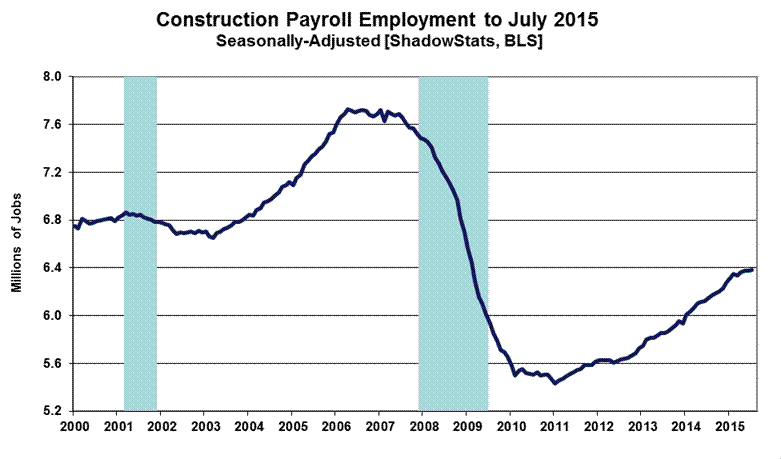
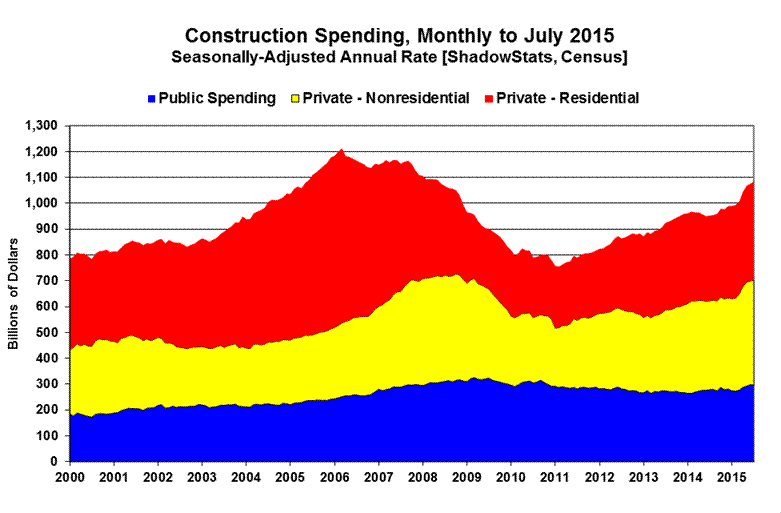
The Graph 16 shows July 2015 construction employment, as detailed in Commentary No. 741. In theory, payroll levels should move more closely with the inflation-adjusted aggregate series, where the nominal series reflects the impact of costs and pricing, as well as a measure of the level of physical activity. The construction employment graph and detail will be updated for August payroll reporting in Commentary No. 749, tomorrow, Friday, September 4th. Graph 17, follows that, showing total nominal construction spending, broken out by the contributions from total-public (blue), private-nonresidential (yellow) and private-residential spending (red).
Graph 16: Construction Payroll Employment to July 2015
Graph 17: Aggregate Nominal Construction Spending by Major Category to July 2015
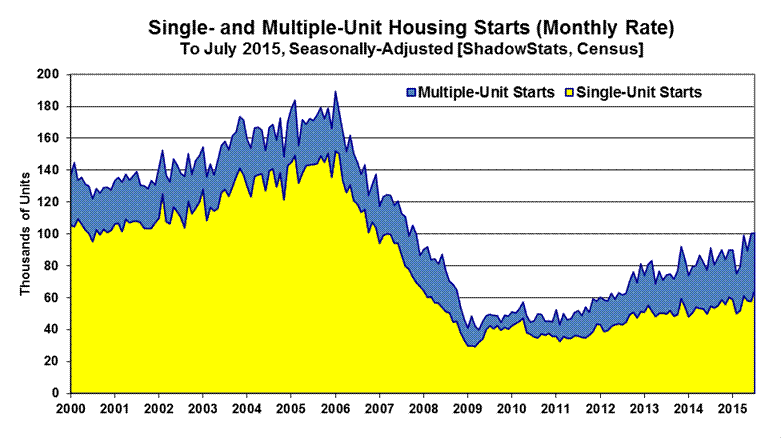
The next two graphs (Graph 18 and 19) cover private residential construction along with housing starts (combined single- and multiple-unit starts) for July 2015 (see Commentary No. 744). Keep in mind that the construction spending series is in nominal (not-adjusted-for-inflation) dollars, while housing starts reflect unit volume, which should tend to be more parallel with the real (inflation-adjusted) series shown in the Opening Comments section.
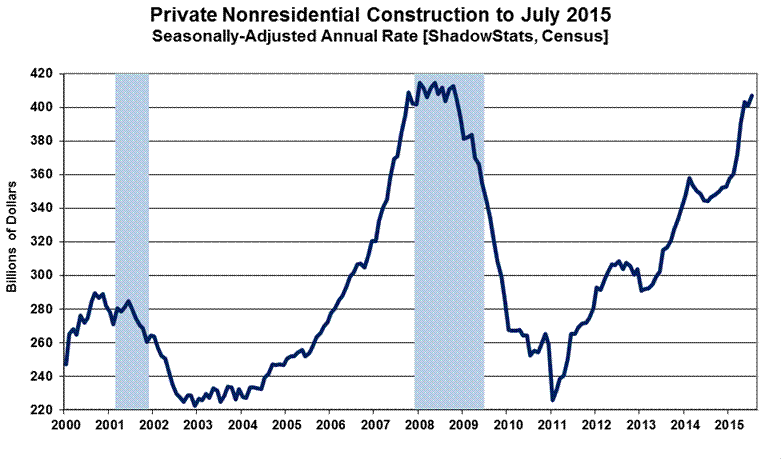
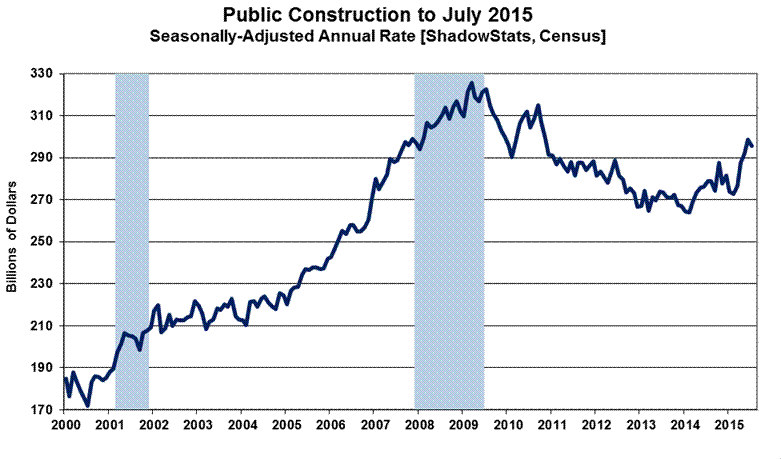
The final set of two graphs (Graphs 20 and 21) shows the patterns of the monthly level of activity in private nonresidential-construction spending and in public-construction spending. The spending in private-nonresidential construction remains off its historic peak, but it recently has been closing in on the pre-recession high, rallying sharply. Public construction spending, which is 98% nonresidential, had continued in a broad downtrend, with intermittent bouts of fluttering stagnation and then some upturn in growth in the last year or so.
Graph 18: Nominal Private Residential Construction Spending to July 2015

Graph 19: Single- and Multiple-Unit Housing Starts to July 2015
Graph 20: Nominal Private Nonresidential Construction Spending to July 2015
Graph 21: Nominal Public Construction Spending to July 2015
__________
WEEK AHEAD
Economic Reporting Generally Should Trend Much Weaker than Expected; Inflation Will Rise Anew, Along with Higher Oil Prices. In a fluctuating trend to the downside, amidst mixed reporting in headline data, market expectations for business activity nonetheless tend to respond to the latest economic hype in the popular media. That general effect holds the consensus outlook at overly-optimistic levels, with current expectations still exceeding any potential, underlying economic reality. , the expectations trend generally has continued to soften.
Headline reporting of the regular monthly economic numbers increasingly should turn lower in the weeks and months ahead, along with an eventual downside revision to the just-upwardly-revised second-quarter GDP estimate, and along with likely downside or otherwise much weaker-than-expected reporting for at least the next several quarters of GDP (and GDI and GDP) into 2016.
CPI-U consumer inflation—driven lower earlier this year by collapsing prices for gasoline and other oil-price related commodities—likely has seen its near-term, year-to-year low, having turned positive in June 2015, for the first time in six months, having notched somewhat higher in July.
Upside inflation pressures should continue to build, particularly as oil prices begin to rebound, once again, a process that eventually should accelerate rapidly, along with the pending sharp downturn in the exchange-rate value of the U.S. dollar. These areas, the general economic outlook and longer range reporting trends were reviewed broadly, recently, in No. 742 Special Commentary: A World Increasingly Out of Balance and No. 692 Special Commentary: 2015 - A World Out of Balance.
A Note on Reporting-Quality Issues and Systemic-Reporting Biases. Significant reporting-quality problems remain with most major economic series. Beyond the pre-announced gimmicked changes to reporting methodologies of the last several decades, which have tended to understate actual inflation and to overstate actual economic activity, ongoing headline reporting issues are tied largely to systemic distortions of monthly seasonal adjustments. Data instabilities—induced partially by the still-evolving economic turmoil of the last eight-to-ten years—have been without precedent in the post-World War II era of modern-economic reporting. The severity and ongoing nature of the downturn provide particularly unstable headline economic results, when concurrent seasonal adjustments are used (as with retail sales, durable goods orders, employment and unemployment data, discussed and explored in the labor-numbers related Commentary No. 695).
Combined with recent allegations of Census Bureau falsification of data in its monthly Current Population Survey (the source for the Bureau of Labor Statistics’ Household Survey), these issues have thrown into question the statistical-significance of the headline month-to-month reporting for many popular economic series (see Commentary No. 669).
PENDING RELEASE:
Updated – Employment and Unemployment (August 2015). The Bureau of Labor Statistics (BLS) will publish its August 2015 labor tomorrow, Friday, September 4th. Both employment and unemployment numbers remain due for heavily-negative, headline surprises, given the ongoing general weak tone of recent reporting of most other, regular monthly economic series.
Established monthly distortions to payroll employment (excessive upside biases, and publishing irregularities with the concurrent-seasonal-factor process) continue, however, as do the regular monthly distortions to headline unemployment (definitional issues with "discouraged workers," and publishing irregularities with the concurrent-seasonal-factor process).
Late market expectations are for a payroll growth in August 2015 close to the initial headline gain of 215,000 jobs in July (for August, MarketWatch is at 213,000, Bloomberg is at 223,000), with August’s headline U.3 unemployment rate expected to notch lower to 5.2%, versus the 5.3% July estimate. Early expectations (MarketWatch) had been for a payroll gain of 195,000 and for unemployment to hold at 5.3%
As with the narrowing of the headline unemployment rate in recent months and years, any further narrowing of the August U.3 unemployment rate likely would encompass more employed being redefined off the unemployment rolls and out of the headline labor force, rather than gaining new employment.
Underlying economic fundamentals continue to suggest deterioration in the broader unemployment rates such as U.6 and the ShadowStats Alternate Unemployment Measure, as well as slowing or negative month-to-month growth in headline payrolls.
August Payroll Gain Expectations Now Are Above the Implied Monthly Trend. As published previously by ShadowStats-affiliate www.ExpliStats.com, in its analysis of the biases built into the BLS’s concurrent-seasonal-factor modeling of the July 2015 payroll-employment reporting, the built-in-bias trend for August 2015 is for a headline monthly employment gain of 198,000 (see Commentary No. 741). Where consensus forecasts usually settle-in near the trend level, early-consensus expectations had been 3,000 jobs shy of the trend number, but expectations have moved higher by 20,000 jobs or so in the past week.
To the extent that underlying fundamentals will continue to shine through all the regular monthly volatility and distortions, headline activity should continue to favor much weaker-than-expected payroll gains, and higher-than-expected unemployment rates.
__________