


No. 793: CPI, Real Retail Sales, Production, Housing Starts, GDP and U.S. Dollar

COMMENTARY NUMBER 793
CPI, Real Retail Sales, Production, Housing Starts, GDP and U.S. Dollar
March 17, 2016
___________
With a Contracting Economy and a Waffling Fed, the
U.S. Dollar Has Tumbled, Turning Negative Year-to-Year,
Boosting Gold, Silver and Oil Prices
Both Industrial Production and Real Retail Sales
Are on Track for First-Quarter 2016 Quarterly Contractions
Housing Starts Continued in Low-Level Stagnation,
Still Down 48% (-48%) from Their Pre-Recession Peak
February 2016 Annual Inflation Softened Across the Board:
CPI-U at 1.0%, CPI-W at 0.7%, ShadowStats at 8.7%
Real Income Rose in February, and the Cost of Living Fell,
Only on a Seasonally-Adjusted Basis
___________
PLEASE NOTE: The next regular Commentary scheduled for Thursday, March 24th, will cover February New Orders for Durable Goods and New- and Existing-Homes Sales. A subsequent missive on Friday, March 25th, will review the third estimate of, second revision to fourth-quarter GDP, along with initial GDI and GNP reporting. Updates will follow as needed with financial-market circumstances.
Best wishes to all — John Williams
OPENING COMMENTS AND EXECUTIVE SUMMARY
Dollar Tumbles Against an Impotent Fed and a Renewed Economic Downturn. Subsequent to yesterday’s (March 16th) meeting of the Federal Reserve’s Federal Open Market Committee (FOMC), and an official statement that indicated less-aggressive tightening by the Fed—a toning down of potential future rate hikes—global markets responded with heavy selling of the U.S. dollar. In tandem with the dollar sell-off, the prices of gold, silver and oil rallied sharply. Such market volatility usually invites short-lived central bank interventions, but the corner may have been turned to the downside on the U.S. dollar outlook. Updates will follow as necessary.
Discussed in today’s Hyperinflation Watch section, having peaked at the beginning of this year at a thirteen-year high, broad-dollar measures now have turned down year-to-year. Much-more-massive dollar selling still looms in the year ahead, along with nascent, serious, domestic-inflation problems.
The U.S. Federal Reserve and U.S. Treasury never resolved the Panic of 2008. Extraordinary stopgap measures were used then, at any cost, to prevent the imminent collapse of the financial system. Underlying problems that had fueled the panic were addressed only minimally, if at all, with most central bank and Treasury actions aimed at nothing more than buying some time. That time is running out, and the Federal Reserve, the U.S. Treasury and other global central banks and financial institutions still have no way out. Discussed in No. 777 Year-End Special Commentary, the decision to prevent systemic collapse was made in 2008. The end result from that ongoing process will be a horrendous inflation problem, not a deflation problem.
While stocks and bonds also are rallying today, in response to the Fed’s less-aggressive tightening stance, the ensuing upturn in inflation eventually should pummel the bond market. While stocks respond favorably to lower interest rates, recessions usually are not kind to equities, and the unfolding, renewed downturn should become increasingly severe. To the extent that stocks rally as an inflation hedge, they will tend to lag behind actual inflation, particularly when it is accelerating. As the economic and inflation circumstances deteriorate, U.S. dollar-denominated domestic equity markets likely will be losers, in both inflation-adjusted real terms, as well as denominated in gold or a stronger currency like the Swiss franc. When the dust settles on the currently volatile markets, see if the DJIA and the S&P 500 rallied by more than the U.S. dollar declined or by more than the rally in the price of gold. Early indications, pre-currency interventions, do not favor the equities.
Underlying Detail Continues to Show an Economic Contraction, yet Headline Fourth-Quarter 2015 GDP Contraction May Await July Benchmarking. The third estimate, second revision to fourth-quarter 2015 GDP growth on March 25th (see Week Ahead detail) is expected to show some downside revision, but not to turn negative, yet. Initially reported with positive, annualized, inflation-adjusted real quarterly growth of 0.69%, fourth-quarter GDP revised to 1.01% in its second estimate. The March 25th release also will provide the initial estimates of fourth-quarter 2015 Gross National Product (GNP) and Gross Domestic Income (GDI). Those GDP near-equivalents often offer some surprises.
While a quarterly contraction appears to remain the underlying reality for the fourth-quarter GDP, and where first-quarter 2016 also appears to be in play for a quarterly downturn, based on headline February 2016 reporting for industrial production and real retail sales, the July 29th GDP benchmarking now appears to be the best bet for delineating current, headline quarterly GDP contractions. Expectations for same likely will follow major downside benchmark revisions to both the production and retail sales series in April, where a formal recession still may be called before mid-year.
Again, all the elements are in place for that, except a headline GDP contraction, which no longer is necessary for a “recession.” Presidential politics may become a consideration in the formal recession call. That has happened before. Nonetheless, markets informally are beginning to recognize a renewed downturn, and the Federal Reserve—acting as though the downturn is in play—keeps talking in circles.
Your Real Income Rose in February and Your Cost Living Fell, if You Were Seasonally-Adjusted. The late Albert Sindlinger hated to be called a “pollster,” but he surveyed consumer conditions and outlook with a high degree of accuracy, better than anyone else in his day did. An old friend and consultant to Herbert Hoover, he started his own full-time consumer surveying business with Hoover’s funding, post-World War II. Hoover, who had benefitted from Sindlinger’s pre-war surveying for the motion-picture industry, wanted Sindlinger to provide an accurate assessment of consumer conditions on a regular basis for the sitting U.S. President. Hoover wanted no future president to lack accurate information on economic conditions, as he had experienced initially post-1929 stock crash. Accordingly, Al’s polling was provided to presidents from Harry Truman on, into the Reagan Administration. The first Bush Administration, however, purportedly was not interested.
Al Sindlinger was a good friend, one who had extraordinary insights on consumer behavior and always had a related story to tell. One was his description of the seasonal-adjustment process, which is used with popularly followed economic data to smooth out regular seasonal variations in monthly or quarterly numbers.
“If you stand with one foot in a bucket of boiling water, and the other foot in a bucket of ice water,” he would begin to chuckle, “seasonally-adjusted, you’re just as comfortable as you can be!”
Then he would go on to lament the circumstance of the person who was unemployed in the real world, but might be employed theoretically on a seasonally-adjusted basis. Those issues came to mind, looking at the headline inflation and income numbers, as just published by the Bureau of Labor Statistics (BLS). Month-to-month inflation in January and February rose, and real income declined, before seasonal adjustment. After adjustment, inflation was flat or declined and real income rose.
Today’s Commentary (March 17th). The balance of these Opening Comments provides summary coverage of the February 2016 CPI and related real Retail Sales and Earnings, Industrial Production and Housing Starts. The Hyperinflation Watch includes the regular gold and dollar graphs that accompany the CPI Commentary, updated for the latest market turmoil. The most recent Hyperinflation Outlook Summary is found in Commentary No. 783, again with No. 777 Year-End Special Commentary as background to currently unfolding financial circumstances.
The Week Ahead section previews next week’s GDP revision (see also the opening paragraphs of these Opening Comments), and reporting of New Orders for Durable Goods and New- and Existing Home Sales.
Consumer Price Index (CPI)—February 2016—Headline Inflation Depressed by Seasonal Adjustment Patterns. In keeping with tradition, seasonal adjustments early in the New Year continued to reduce aggregate month-to-month headline inflation for February 2016. Monthly CPI-U inflation contracted by an adjusted 0.17% (-0.17%), down from an unadjusted monthly increase of 0.08%. In like manner, January 2016 headline inflation had been reduced to 0.03% from what was a stronger, unadjusted monthly inflation rate of 0.17%.
Gasoline prices fell sharply, again, but that was only partially countered by rising food prices and “core” inflation, again, on a seasonally-adjusted basis. Gasoline prices appear likely to close out March 2016 on the upside, however, the first unadjusted monthly increase since June of last year.
On an annual and unadjusted basis, February 2016 inflation eased to 1.02% from a ten-month high of 1.37% in January 2016. Separately, with the annual CPI-U inflation at 1.0%, year-to-year inflation is not and has not been quite as soft as indicated in headline reporting, when considered in the context of traditional CPI reporting and common experience. The ShadowStats Alternate Inflation Measures rose in February by 4.5% annual inflation, based on 1990 methodologies, and by 8.7%, based on 1980 methodologies.
Updated in today’s Hyperinflation Watch and discussed more broadly in No. 777 Year-End Special Commentary, high risk of extreme flight from the U.S. dollar continues—a massive dollar debasement—threatening to generate increasingly rapid, upside energy and global-commodity inflation, which would drive headline U.S. consumer inflation much higher.
CPI-U. The headline, seasonally-adjusted February 2016 CPI-U declined by 0.17% (-0.17%) month-to-month. That followed an “unchanged” month-to-month CPI-U in January, which was up by a minimal 0.03% at the second decimal point.
The adjusted headline February inflation number was boosted by seasonal adjustments to the foods sector, but otherwise suppressed by seasonal adjustments to the energy and “core” sectors. On an unadjusted basis, February 2015 CPI-U rose by 0.08%, following an unadjusted monthly gain of 0.17% in January.
Not seasonally adjusted, February 2016 year-year inflation for the CPI-U softened to 1.02%, from 1.37% in January 2016. Separately, core CPI-U inflation showed unadjusted year-to-year inflation of 2.33% in February 2016, versus 2.21% in January 2016.
CPI-W. The February 2016 seasonally-adjusted, headline CPI-W, which is a narrower series and has greater weighting for gasoline than does the CPI-U, declined month-to-month by 0.32% (-0.32%), following an “unchanged” minimal decline month-to-month of 0.03% (-0.03%) in January. On an unadjusted basis, the monthly CPI-W declined by 0.04% (-0.04%) in February 2016, having increased by 0.12% in January.
Unadjusted, February 2016 annual CPI-W rose by 0.68%, following an annual gain of 1.21% in January 2016.
Chained-CPI-U. The headline C-CPI-U is not seasonally adjusted, with year-to-year inflation for the unadjusted February 2016 C-CPI-U at 0.54%, versus an annual gain of 1.02% in January 2016.
Alternate Consumer Inflation Measures. The ShadowStats-Alternate Consumer Inflation Measures are constructed on top of the unadjusted CPI-U series. The ShadowStats-Alternate Consumer Inflation Measure (1990-Base) year-to-year annual inflation was roughly 4.6% in February 2016, versus 5.0% in January 2016. The February 2016 ShadowStats-Alternate Consumer Inflation Measure (1980-Base), which reverses gimmicked changes to official CPI reporting methodologies back to 1980, was at about 8.7% year-to-year, versus 9.0% in January 2016.
Real Retail Sales—February 2016—Trending Towards a First-Quarter 2016 Quarterly Contraction; Continuing Intense Recession Signal. A sharp downside revision to January 2016 retail sales has turned the outlook for real first-quarter 2016 activity from a quarterly gain to a quarterly contraction.
Not adjusted for inflation, headline nominal retail sales in February 2016 declined by 0.15% (-0.15%), in the context of the sharp downside revision to headline January activity. Headline January sales showed a revised monthly decline of 0.40% (-0.40%) [previously up by 0.18%], with a revised gain of 0.31% [previously up by 0.16%] in December, as detailed in Commentary No. 792.
Year-to-year nominal change in February 2016 retail sales was 3.09%, versus a downwardly-revised 2.99% in January 2016 and an upwardly revised 2.59% in December 2015.
Based on the headline seasonally-adjusted decline of 0.17% (-0.17%) in February 2016 CPI-U, a gain of gain of 0.03% in January and monthly decline of 0.11% (-0.11%) in December, February 2016 real retail sales rose for the month by 0.02% (effectively flat), January real retail sales fell by 0.43% (-0.43%) [previously up by 0.15%] and December real sales rose by a revised 0.42% [previously up by 0.27%].
Intense Signal of Recession in Annual Real Growth. During normal economic times, annual real growth in Retail Sales at or below 2.0% signals an imminent recession. That signal basically has been in play since February 2015 (the “new” recession likely will be timed from December 2014, based on industrial production, retail sales and other indicators), suggesting a deepening, broad economic downturn.
Year-to-year change in real retail sales was 2.09% in February 2016, a downwardly revised 1.62% in January 2016 and an upwardly revised 1.91% in December 2015. With annual real growth in first-quarter 2016 at 1.63%, and fourth-quarter 2015 at 1.50%, the recession signal is intense, consistent with an unfolding recession. Graphs 11 and 13 in the Reporting Detail, show the latest patterns of headline annual real growth.
First-Quarter 2016 Annualized Real Growth Turned Negative. Reflecting the latest revisions to the nominal detail, annualized contraction in first-quarter 2015 real Retail Sales narrowed to 0.83% (-0.83%). Second-quarter 2015 annualized real growth slowed in revision to 3.39%. Third-quarter 2015 annualized real growth held at an unrevised gain of 3.10%, while fourth-quarter 2015 growth held effectively flat, at a revised annualized real gain of 0.42%.
Based solely on the headline detail for January and February 2016, first-quarter 2016 real retail sales reporting is on an early track for an annualized quarterly contraction of 0.32% (-0.32%). Based just on the initial, unrevised reporting for January 2016, first-quarter activity had been on track for an annualized gain of 1.57%. Adjusted for realistic inflation (see Graph 2, Commentary No. 789 and No. 777 Year-End Special Commentary), however, real retail sales and the broad economy never truly recovered from the economic collapse into 2008 and 2009.
Consumer Liquidity Problems Continue to Impair Retail Sales. Constraining retail sales, the consumer remains in an extreme liquidity bind (see Reporting Detail). Without sustained growth in real income, and without the ability and/or willingness to take on meaningful new debt in order to make up for the income shortfall, the U.S. consumer has been unable to sustain positive growth in domestic personal consumption, including retail sales, real or otherwise.
As official consumer inflation resumes its upside climb in the year ahead, and as overall retail sales continue to suffer from the ongoing consumer liquidity squeeze—reflected partially by the general pattern of ongoing real earnings difficulties discussed in the next section—these data should continue trending meaningfully lower, in what should be recognized shortly as a formal “new” recession.
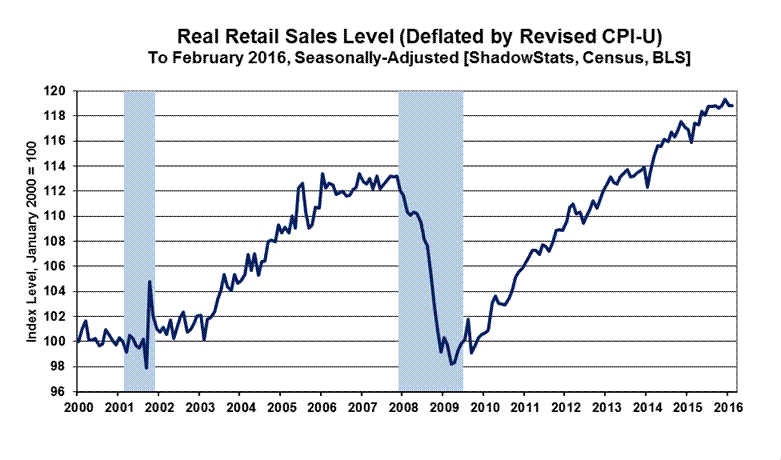
Corrected Real Retail Sales—February 2016. The apparent “recovery” of headline real retail sales shown in Graph 1 (see also Graph 20) generally continued into late-2014, although headline reporting turned down in December 2014, into first-quarter 2015, turned higher into the third-quarter 2015, slowed to a near-standstill in fourth-quarter 2015, and has just slumped anew through February 2016. Nonetheless, headline real growth in retail sales continues to be overstated heavily, due to the understatement of the rate of CPI-U inflation used in deflating the retail sales series. Discussed more fully in Chapter 9 of 2014 Hyperinflation Report—Great Economic Tumble – Second Installment and Public Commentary on Inflation Measurement, deflation by too-low an inflation number (such as the CPI-U) results in the deflated series overstating inflation-adjusted economic growth.
Both of the accompanying graphs are indexed to January 2000 = 100.0 to maintain consistency in the series of graphs related to corrected inflation-adjustment (including the regular plots of industrial production [see the next section], new orders for durable goods and GDP). The first graph reflects the official real retail sales series, except that it is indexed, instead of being expressed in dollars. The plotted patterns of activity and rates of growth are exactly same for the official series, whether the series is indexed or expressed in dollars, as is evident in a comparison of Graph 1 with Graph 20 in the Reporting Detail section.
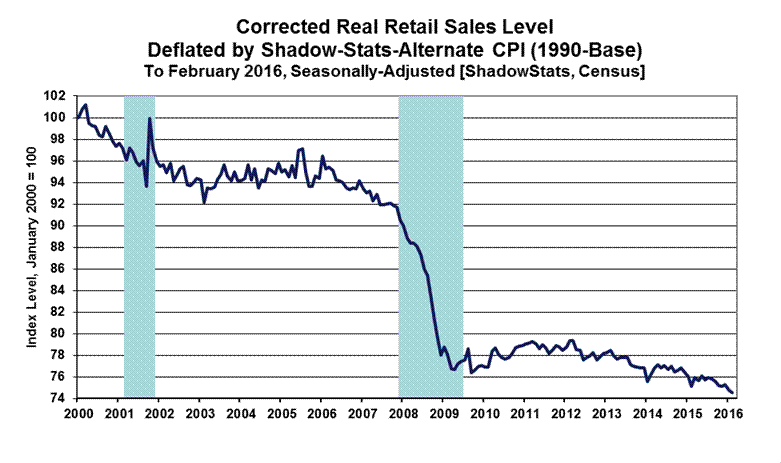
Instead of being deflated by the CPI-U, the “corrected” real retail sales numbers—in Graph 2—use the ShadowStats-Alternate Inflation Measure (1990-Base) for deflation. With the higher inflation of the ShadowStats measure, the revamped numbers show a pattern of plunge and stagnation and renewed downturn, consistent with patterns seen in consumer indicators like real average weekly earnings (see Graph 3), broad unemployment series and in most housing statistics (see Commentary No. 790 and today’s reporting on February 2016 Housing Starts). A topping out in late-2011 and early-2012 reverted to renewed decline in second-quarter 2012 in this series (Graph 2), which had been bottom-bouncing at a low-level plateau of economic activity since the economic collapse into 2009. The renewed contraction has trended into and deepened on a monthly basis throughout 2015, and now into 2016, allowing for the occasional and temporary upside blips.
Graph 1: Headline Real Retail Sales Level, Indexed to January 2000 = 100
Graph 2: “Corrected” Real Retail Sales Level, Indexed to January 2000 = 100
Real Average Weekly Earnings—February 2016—Headline Monthly Gains Still Boosted by Negative Monthly Inflation. The BLS published its estimates for real average weekly earnings for February 2016, coincident with the release of the February 2016 CPI-W. In the production and nonsupervisory employees category—the only series for which there is a meaningful history—headline real average weekly earnings rose month-to- month by 0.02% in February 2016, versus a revised gain of 0.32% in January and a downwardly-revised monthly gain of 0.62% in December.
For those not living in a seasonally-adjusted world, real average weekly earnings declined month-to-month by 0.06% (-0.06%) in February 2016, by 0.53% (-0.53%) in January and by 0.66% (-0.66%) in December.
Year-to-year and seasonally-adjusted, annual growth in February 2016 real average weekly earnings rose to 1.43%, from a revised 1.27% in January 2016, versus a revised 2.24% in December 2015. Not seasonally adjusted, annual growth in February 2016 fell to 0.02%, from a revised 1.21% in January 2016 and a revised 2.24% in December 2015.
On a quarterly basis, real-average weekly earnings grew at an annualized headline pace of 6.62% in first-quarter 2015, fell by 0.49% (-0.49%) in second-quarter 2015, fell by 0.46% (-0.46%) in third-quarter 2015 and gained a revised 3.91% in fourth-quarter 2015. Based just on January and February 2016 reporting, first-quarter 2016 was showing an early, annualized growth rate of 2.91%. That had been 2.98% based just on initial January detail.
The CPI-W deflated reporting here is distorted versus CPI-U-deflated series, where the CPI-W—more heavily weighted with gasoline prices—tends to have much deeper, negative headline inflation, at present, with resulting weaker headline, inflation-adjusted growth than would be seen with the CPI-U.
Graph 3: Real Average Weekly Earnings, Production and Nonsupervisory Employees, 1965-to-Date
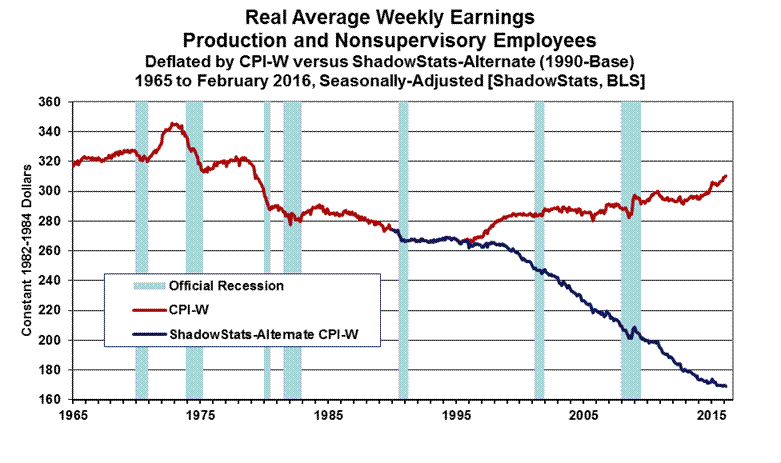
The preceding Graph 3 plots this series, showing earnings as officially deflated by the BLS (red-line), and as adjusted for the ShadowStats-Alternate CPI Measure, 1990-Base (blue-line). When inflation-depressing methodologies of the 1990s began to kick-in, the artificially-weakened CPI-W (also used in calculating Social Security cost-of-living adjustments) helped to prop up the reported real earnings.
Official real earnings today still have not recovered their inflation-adjusted levels of the early-1970s, and, at best, have been in a minimal uptrend for the last two decades. Negative inflation from the collapsing gasoline prices, however, has helped to boost recent real earnings in the headline series.
Deflated by the ShadowStats measure, real earnings have been in fairly-regular decline for the last four decades, much closer to common experience than the pattern suggested by the CPI-W. See the Public Commentary on Inflation Measurement for further detail.
Index of Industrial Production—February 2016—First-Quarter on Track for Annual and Quarterly Contractions. In the context of contracting annual growth and prior-period revisions, the headline February 2016 production drop of 0.49% (-0.49%) reflected continued weakness in the mining sector, a reversal of the prior month’s weather-distorted utility surge, and a small gain in the manufacturing sector. Two of the three major industry groups that comprise U.S. industrial production declined in February, dominated by a decline of 1.44% (-1.44%) in mining (including oil and gas production) and a decline of 4.03% (-4.03%) in utility usage, which was returning to more-normal weather-related circumstances. Manufacturing showed a headline monthly gain of 0.16%, but that series never has regained, and remains 2.73% below, its pre-recession peak (see Graphs 28 to 36).
Quarterly and Annual Production Contractions. Annual growth in aggregate production held in negative territory for the fourth straight month, down in February 2016 by 1.03% (-1.03%), setting up first-quarter 2016 as the second consecutive quarter of both negative-annual and negative-quarterly growth. On the basis of quarter-to-quarter contraction, first-quarter 2016 would be the fourth such contraction of the last five quarters. Such activity is not seen outside of formal recessions.
First-quarter 2015 industrial production contracted at an annualized quarterly pace of 0.35% (-0.35%), followed by a second-quarter 2015 contraction of 2.30% (-2.30%), a downwardly-revised gain of 2.59% in third-quarter 2015 production, and a minimally shallower decline of 3.12% (-3.12%) in fourth-quarter 2015. Based solely on the headline January and February 2016 numbers, first-quarter 2016 production was contracting at an annualized pace of 0.17% (-0.17%). Based just on the initial January 2016 reporting, first-quarter 2016 production had been growing at an annualized pace of 0.87%.
Separately, year-to-year growth in quarterly production continued to slow and now is in decline, ranging from a positive 3.47% in first-quarter 2015, to 1.45% in second-quarter 2015, to a revised 1.13% in third-quarter 2015, to a revised annual decline of 0.82% (-0.82%) in fourth-quarter 2015. Based on the headline January and February 2016 detail, first-quarter 2016 activity was on track for a straight annual contraction of 0.78% (-0.78%). That previously had been a contraction of 0.54% (-0.54%), based only on initial January 2016 reporting.
Historical patterns in this series as they relate to recessions were reviewed meaningfully in the production Commentary No. 780. Discussed there, except in unusual circumstances such as national strikes, annual quarterly growth in industrial production does not contract outside of periods that eventually are declared formal recessions. In consistent form, the industrial production series continues to indicate that broad U.S. economic activity entered a “new” recession, likely to be timed officially from December of 2014.
Annual Revisions on April 1st. The Federal Reserve Board has announced its intent to publish annual revisions to the industrial production series mid-day on Friday, April 1st. Specifics are covered in the Reporting Detail.
Headline Industrial Production—February 2016. In the context of largely offsetting prior-period revisions, the headline monthly decline in seasonally-adjusted February 2016 Industrial Production of 0.49% (-0.49%) would have been the same to the second decimal point, versus prior reporting of the January 2016 level of activity.
The said, the monthly decline of 0.49% (-0.49%) in February 2016 total production followed a downwardly-revised monthly gain of 0.78% in January, a shallower decline of 0.48% (-0.48%) in December and a little-changed contraction of 0.74% (-0.74%) in November.
Detailed in Graphs 28 to 31 of the Reporting Detail, by major industry groups, the headline February 2016 monthly aggregate production decline of 0.5% (-0.5%) [a January gain of 0.8%] was composed of a monthly February gain of 0.2% [a January gain of 0.5%] in manufacturing activity; a February decline of 1.4% (-1.4%) [a January decline of 0.7% (-0.7%)] in mining activity (including oil and gas production); and a February drop of 4.0% (-4.0%) [a January gain of 4.2%] in utilities activity.
Year-to-year change in February 2016 was a decline of 1.03% (-1.03%), versus a basically unrevised January 2016 annual decline of 0.69% (-0.69%), a shallower annual decline in December 2015 of 1.74% (-1.74%) and a steeper annual decline in November of 1.17% (-1.17%). Again, annual growth has turned sharply negative, a circumstance common to formal, post-World-War II recessions.
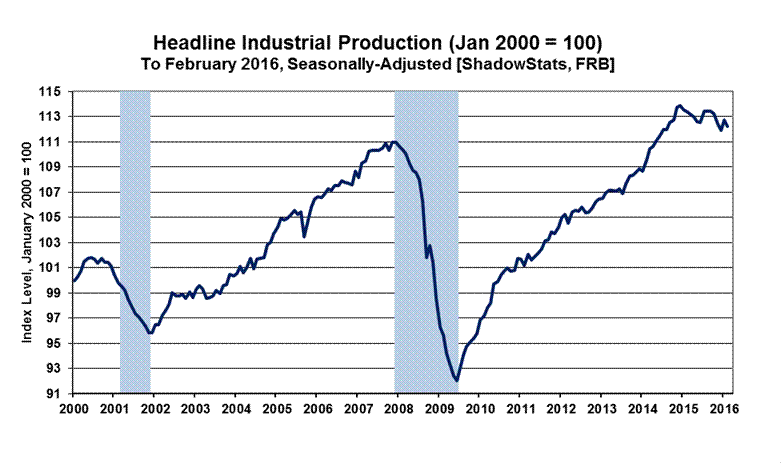
Production Graphs—Corrected and Otherwise. The regular graphs of headline production level and annual growth detail are found in the Reporting Detail (Graphs 25 to 28), along with the drill-down graphs of major subcomponents of the production series (Graphs 29 to 36). The level of headline production showed a topping-out process late in 2014, followed by a deepening downturn into first- and second-quarter 2015. Third-quarter 2015 showed some bounce, but fourth-quarter activity turned down anew, well off recent-peak activity, dropping sharply into negative year-to-year growth and quarterly growth on a quarterly basis, patterns rarely seen outside of recession (see Commentary No. 780). Those patterns have continued into first-quarter 2016. Such faltering patterns of monthly, quarterly and annual decline last were seen in the depths of the economic collapse from 2007 into 2009 and are not seen otherwise with this persistence and magnitude outside of formal recessions.
Graphs 4 and 5, which follow in this section, address reporting quality issues tied just to the overstatement of headline growth that results directly from the Federal Reserve Board using too-low an estimate of inflation in deflating some components of its production estimates into real dollar terms, for inclusion in the Index of Industrial Production. Hedonic quality adjustments to the inflation estimates understate the inflation rates used in deflating those components; thus overstating the resulting inflation-adjusted growth in the headline industrial production series (see Public Comment on Inflation and Chapter 9 of 2014 Hyperinflation Report—Great Economic Tumble).
Graph 4 shows official, headline industrial production reporting, but indexed to January 2000 = 100, instead of the Fed’s formal index that is set at 2012 = 100. The 2000 indexing simply provides for some consistency in the series of revamped “corrected” graphics (including real retail sales [see prior section], new orders for durable goods and the GDP); it does not affect the appearance of the graph or reported growth rates (as can be seen with a comparison to Graph 28 in the Reporting Detail section).
Graph 4: Indexed Headline Level of Industrial Production (Jan 2000 = 100)
Graph 5: Headline ShadowStats-Corrected Level of Industrial Production (Jan 2000 = 100)
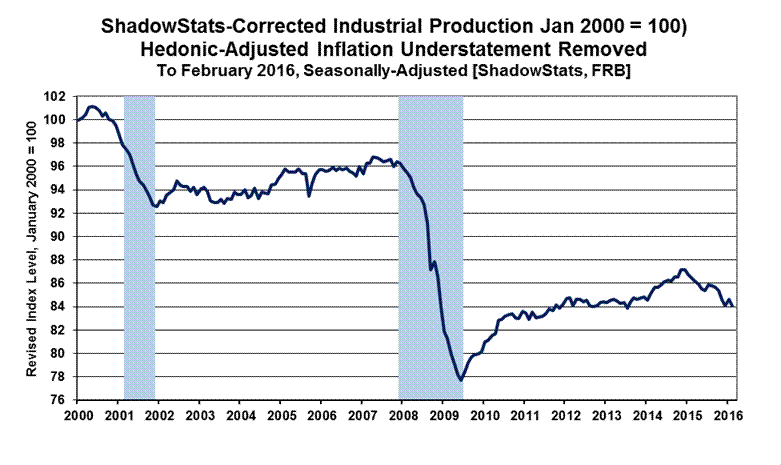
Graph 5 is a recast version of Graph 4, corrected for the estimated understatement of the inflation used in deflating certain components of the production index. Estimated hedonic-inflation adjustments have been backed-out of the official industrial-production deflators used for headline reporting.
This “corrected” Graph 5 shows some growth in the period subsequent to the official June 2009 trough in production activity, however, that upturn has been far shy of the full recovery and the renewed expansion reported in official GDP estimation (see Commentary No. 789, and No. 777 Year-End Special Commentary). Unlike the headline industrial production data and the headline GDP numbers, corrected production levels have not recovered pre-recession highs. Instead, corrected production entered a period of protracted low-level, but up-trending, stagnation in 2010, with irregular quarterly contractions seen through 2014, and an irregular uptrend into 2014, a topping-out in late-2014 and generally turning lower through 2015 into first-quarter 2016.
Where the corrected series has remained well shy of a formal recovery, both the official and corrected series suffered an outright contraction in both first- and second-quarter 2015; this is a pattern of severe economic weakness last seen during the economic collapse. Despite the brief third-quarter uptick, fourth-quarter 2015 industrial production saw both annual and quarterly contractions, with continued quarterly and annual downturn unfolding in first-quarter 2016 as well.
Housing Starts—February 2016—Activity Remained in Smoothed. Low-Level Stagnation. Showing a continued, smoothed pattern of faltering stagnation, headline February 2016 housing starts rebounded in unstable month-to-month reporting, more than offsetting the monthly decline in January 2016 activity. Going against bad-weather impact of the year before, monthly changes were without much statistical significance, but the heavily-weather-bloated annual gains were significant.
First-Quarter Housing Reverses Trend, Now on Track for Annualized Quarterly Growth of 4.9%. In terms of annualized quarter-to-quarter change, the regularly-unstable aggregate housing-starts count fell at an annualized-quarterly pace of 26.2% (-26.2%) in first-quarter 2015, rose at an annualized 96.3% pace in second-quarter 2015, basically was flat with a 0.2% annualized third-quarter 2015 pace of growth, and fell at a revised, annualized pace of 7.7% (-7.7%) in fourth-quarter 2015, in line with the still-developing, headline contraction in fourth-quarter 2015 GDP activity.
Based solely on the unstable headline January and February 2016 detail, housing starts now are on track for an annualized first-quarter 2016 gain of 4.9%. Based just on the unstable, initial headline reporting for January, the quarter had been on track for an annualized contraction of 10.5% (-10.5%).
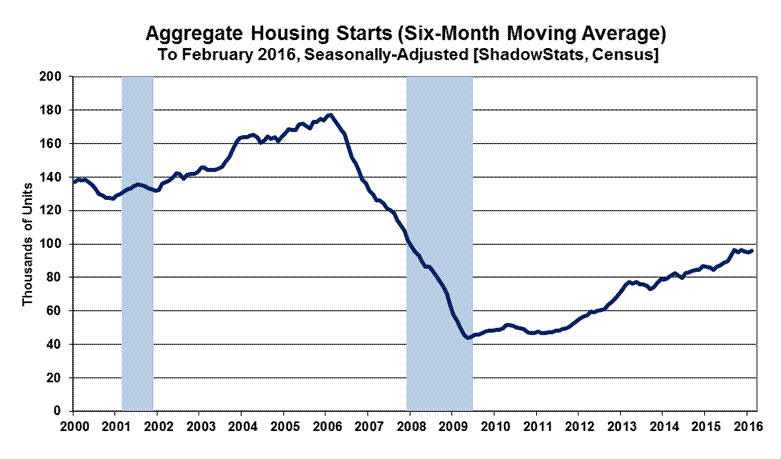
Smoothed Numbers. Despite the regular volatility and instabilities in the housing starts series, the general pattern of low-level stagnation continued, with its up-trending six-month moving-average pattern faltering anew, softening and flattening out in tandem with the most-recent headline detail. This pattern is viewed best in terms of the headline activity, smoothed by a six-month moving average, as shown in Graph 9 and in the longer-range historical aggregate activity shown in Graph 38 in the Reporting Detail. While the minor upside trend in the broad pattern of stagnation in the aggregate series has stalled, total February 2016 housing-starts activity remained well below any recovery level, down from its pre-recession high by 48% (-48%).
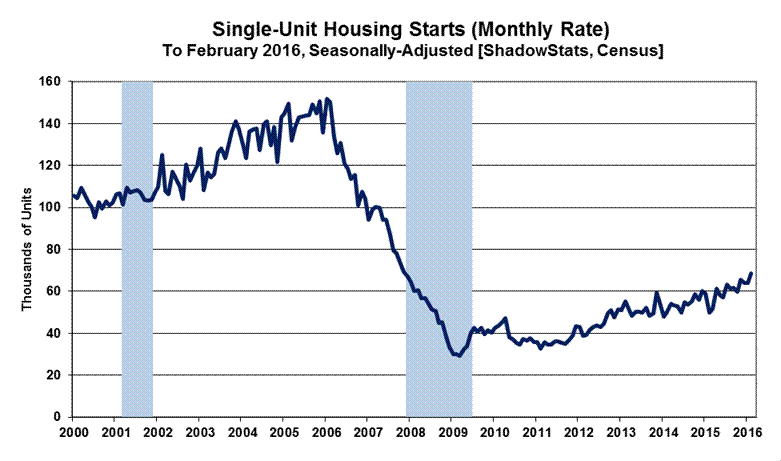
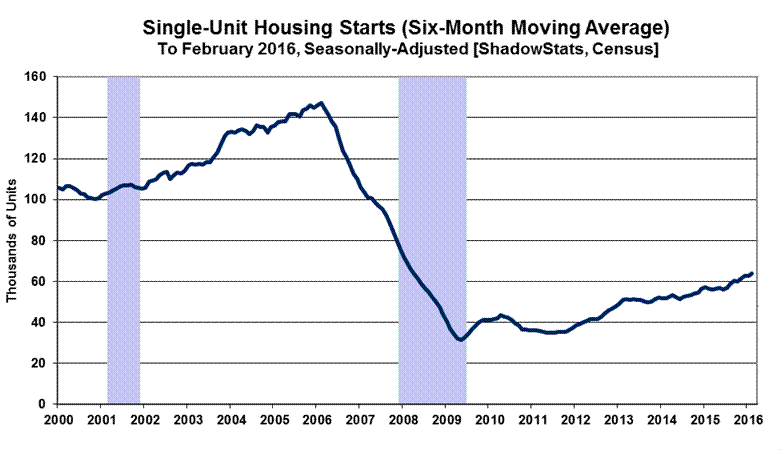
Separately, the dominant, single-unit housing starts component of the series (see Graphs 10 and 11) remained down by 58% (-58%) from its January 2006 pre-recession peak.
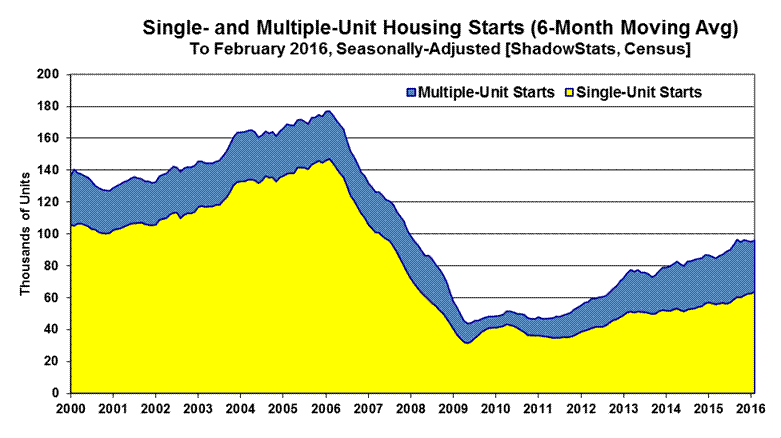
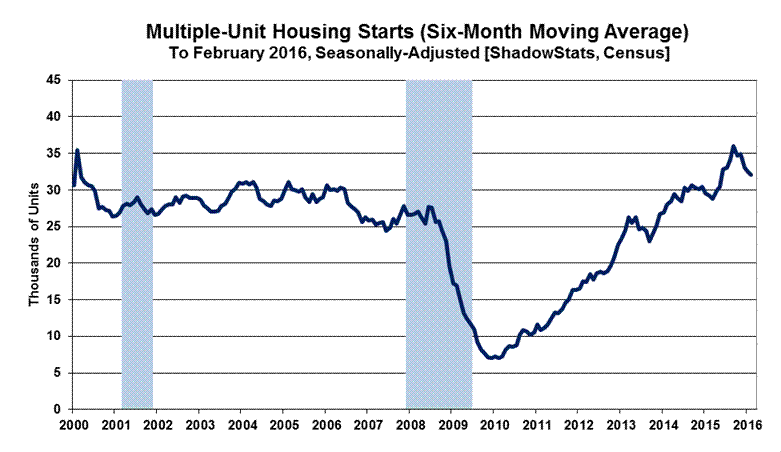
Reflected in the smoothed graphs, the aggregate Housing Starts continued to falter from what had been an earlier, minimal uptrend (Graph 9). Such encompassed an uptick the six-month-smoothed single-unit activity (Graph 11) and a downtick in the smoothed multiple-unit starts (Graph 13).
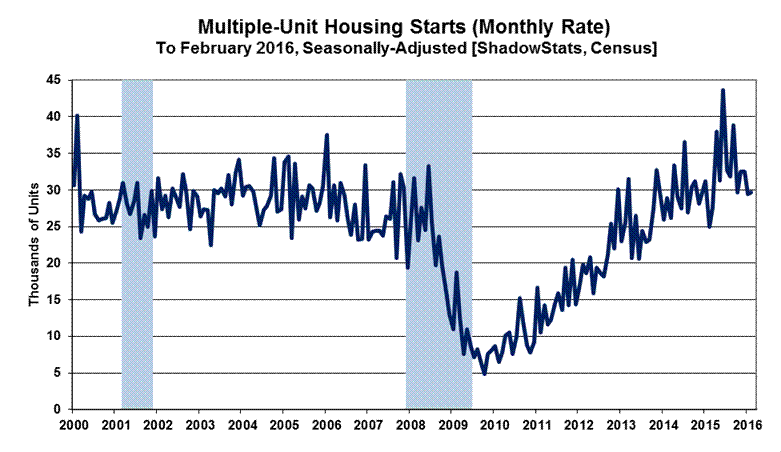
Over time, the bulk of the extreme, reporting instability, and what had been the minimal uptrend in the aggregate series, was due largely to particularly-volatile reporting in the multiple-unit housing-starts category (apartments, etc.). Recent activity in multiple-unit starts had recovered to above pre-recession levels, again, in the context of extreme month-to-month volatility. Even so, the recent impact of that recovery has been fading, likely in response to the intensifying general economic slowdown. Otherwise, the multiple-unit series detail largely has been lost in the aggregate housing starts series.
Consumer Liquidity Problems Continue to Impair Housing Activity. Constraining residential real estate activity and personal consumption, the consumer remains in an extreme liquidity bind, as updated briefly in Commentary No. 792 and Commentary No. 791 and as discussed broadly in Commentary No. 790 and No. 777 Year-End Special Commentary and as further discussed in the Reporting Detail.
On a per-structure basis, housing starts volume has remained stagnant. The series is dominated by the single-unit category, which has remained broadly stagnant, albeit slightly up-trending at the moment, on a smoothed basis, with some offset in smoothed down-trending activity, at present, in the multiple-unit category. Aggregate activity has continued to hold at a low level of activity, since hitting bottom in early-2009. The private housing sector never recovered from the business collapse of 2006 into 2009.
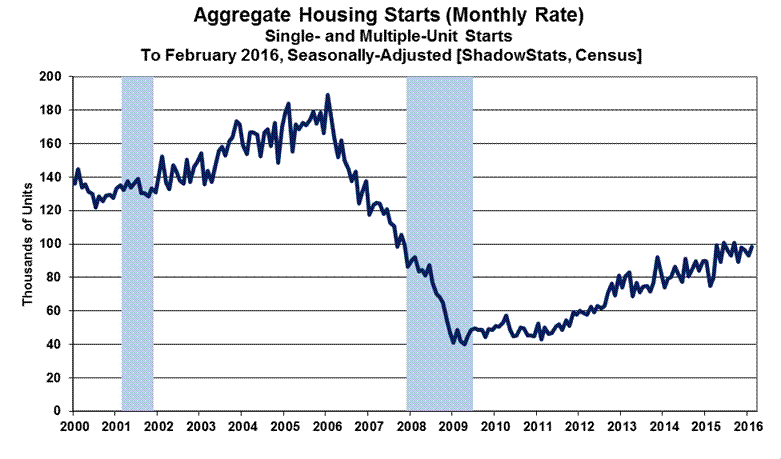
Headline February 2016 Housing-Starts. February 2016 Housing Starts rose month-to-month in the context of upside revisions to January 2016 and December 2015 activity. February details showed a statistically-insignificant, seasonally-adjusted, headline monthly gain of 5.2%. Such followed revised monthly declines in January 2016 of 3.4% (-3.4%) and in December 2015 of 1.4% (-1.4%). Net of prior-period revisions, February 2016 housing starts rose by 7.2%, instead of the headline gain of 5.2%. Level-of-activity detail is plotted in Graphs 6 and 8, and in Graphs 37 and 38 of the Reporting Detail.
Year-to-year change in the seasonally-adjusted, February 2016 aggregate Housing Starts measure was a statistically-significant gain of 30.9%, against weather-collapsed activity of the year before, and versus upwardly-revised annual gains of 3.7% in January 2016 and 7.3% in December 2015.
The February 2016 headline gain of 5.2% in total housing starts encompassed headline monthly gains of 7.2% in the “one unit” category and 2.4% in the “five units or more” category. As most commonly is the case, not one of the headline changes was statistically significant, on month-to-month basis, although the total and single-unit year-to-year changes were significant.
By-Unit Category. Where the irregular housing starts series can show varying patterns, that partially is due to a reporting mix of residential construction products, with the largest physical-count category of one-unit structure housing starts—generally for individual consumption, resulting in new home sales—versus multi-unit structure starts that generally reflect the building of rental and apartment units.
February 2015 single-unit structure starts increased month-to-month by a statistically-insignificant 7.2%, following revised declines in January 2016 of 0.3% (-0.3%) and 2.2% (-2.2%) in December 2015. Single-unit starts for February 2016 showed a statistically-significant, year-to-year annual gain of 37.0%, versus revised annual gains of 8.6% in January 2016 and 6.2%in December 2015 (see Graphs 6, 7, 10 and 11).
Housing starts for apartment buildings (generally 5-units-or-more) in February 2016 rose month-to-month by a statistically-insignificant 2.4%, versus a revised declines of 9.1% (-9.1%) in January 2016 and 2.9% (-2.9%) in December 2015. The statistically-insignificant February 2016 year-to-year gain of 16.8% followed revised annual declines of 9.5% (-9.5%) in January 2016 and 0.1% (-0.1%) in December 2015.
Expanding the multi-unit housing starts category to include 2-to-4-units plus 5-units-or-more usually reflects the bulk of rental- and apartment-unit activity. The Census Bureau does not publish estimates of the 2-to-4-units category, due to statistical significance problems (a general issue for the aggregate series). Nonetheless, the total multi-unit category can be estimated by subtracting the single-unit category from the total category (see Graphs 6, 7, 12 and 13).
Accordingly, the statistically-insignificant February 2016 monthly gain of 5.2% in aggregate starts was composed of statistically-insignificant gains of 7.2% in one-unit structures and 0.8% in the multiple-unit structures categories (2-units-or-more, including the 5-units-or-more category). Again, these series are shown in the accompanying graphs.
Housing Starts Graphs. Headline reporting of housing starts activity is expressed by the Census Bureau as an annualized monthly pace of starts, which was 1,178,000 in February 2016, versus a revised 1,120,000 [previously 1,099,000] in January 2016. The scaling detail in the aggregate Graphs 37 and 38 at the end of the Reporting Detail section reflects those annualized numbers.
Nonetheless, given the nonsensical monthly volatility in reporting and the exaggerated effect of annualizing the monthly numbers in this unstable series, the magnitude of monthly activity and the changes in same, more realistically are reflected at the non-annualized monthly rate. Consider that the headline 236,000 month-to-month gain in the annualized April 2015 housing starts was larger than any actual total (non-annualized) level of monthly starts ever, for a single month. That is since related starts detail first was published after World War II.
Accordingly, the monthly rate of 98,167 units in February 2016, instead of the annualized 1,178,000-headline number, is used in the scaling of the Graphs 6 to 13 in these Opening Comments. With the use of either scale of units, though, appearances of the graphs and the relative monthly, quarterly and annual percentage changes are otherwise identical, as can be seen in a comparison of Graph 8 versus Graph 37 in the Reporting Detail.
The record monthly low level of activity seen for the present aggregate series was in April 2009, where the annualized monthly pace of housing starts then was down 79% (-79%) from the January 2006 pre-recession peak. Against that downside-spiked low in April 2009, the February 2016 headline number was up by 146%, but it still was down by 48% (-48%) from the January 2006 pre-recession high for the series. Shown in the historical perspective of the post-World War II era, current aggregate-starts activity is in stagnation at low levels that otherwise have been at or near the historical troughs of recession activity of the last 70 years, as reflected in Graph 38 at the end of the Reporting Detail section.
Graph 6: Single- and Multiple-Unit Housing Starts (Monthly Rate of Activity)

Graph 7: Single- and Multiple-Unit Housing Starts (Six-Month Moving Average, Monthly Rate of Activity)
Graph 8: Aggregate Housing Starts (Monthly Rate of Activity)
Graph 9: Aggregate Housing Starts (Six-Month Moving Average, Monthly Rate of Activity)
Graph 10: Single-Unit Housing Starts (Monthly Rate of Activity)
Graph 11: Single-Unit Housing Starts (Six-Month Moving Average, Monthly Rate of Activity)
Graph 12: Multiple-Unit Housing Starts (Monthly Rate of Activity)
Graph 13: Multiple-Unit Housing Starts (Six-Month Moving Average, Monthly Rate of Activity)
[The Reporting Detail section includes additional information and graphs on
the CPI and related series, Industrial Production and Housing Starts.]
__________
HYPERINFLATION WATCH
UPDATED GOLD AND U.S. DOLLAR GRAPHS AND CIRCUMSTANCES
Intensifying U.S. Economic Downturn Increasingly Befuddles the Fed, Triggering Heavy Dollar Selling and Rallying Prices for Gold, Silver and Oil. Updated here are the regular gold and dollar graphs and comments provided in the monthly CPI Commentary. The currency and commodity markets are in turmoil as we go to press, as discussed in the Opening Comments, and in line with circumstances discussed in No. 777 Year-End Special Commentary. Short-lived government interventions could be expected in the current environment of heavy dollar-selling. Updates will follow as needed.
Noted in last month’s Commentary No. 785, high risk of extreme flight from the U.S. dollar—a massive dollar debasement—in the weeks and months ahead threatened to generate rapid, upside movement in energy and commodity prices, which would drive headline U.S. consumer inflation much higher. That circumstance may have been put into play by the waffling seen yesterday (March 16th) in the FOMC’s policy statement, and in the subsequent public comments of Federal Reserve Chair Janet Yellen.
Global market expectations initially for the Fed rate hike of December 2015, and for subsequent rate hikes, had been primary props for strengthening the U.S. dollar in the currency markets. Underlying those expectations had been the perpetual hype of an expanding U.S. economy. Further tightening now, however, is increasingly unlikely for the Federal Reserve. Instead, with the economy falling apart, the U.S. central bank once again likely will have to accommodate the liquidity needs of a U.S. Treasury facing much-larger-than-expected government fiscal shortfalls, while at the same time having to maintain adequate liquidity in a still-impaired banking system.
Nascent and evolving dollar problems continue to surface, increasingly in response to the declining domestic business activity and to faltering U.S. systemic stability: the increasingly-obvious systemic impotency of the U.S. Federal Reserve. Dollar selling has been heavy as we go to press, and that remains vulnerable to rapid acceleration as global recognition solidifies around these deteriorating fundamentals.
Intensifying global and domestic political, economic and liquidity crises, and fiscal and monetary instabilities all should increasingly pummel the U.S. dollar and boost the safe-haven demand for the physical holding of precious metals. Again, global-market sentiment can shift massively with little warning. The ongoing economic and financial-system-liquidity crises threaten systemic instabilities that, as with their Panic of 2008 precursors, cannot be contained without further, official actions and serious inflation consequences.
Again, discussed in No. 777 Year-End Special Commentary, the decision to save the domestic and global financial systems from collapse was made in 2008. Nothing was done then, fundamentally, to resolve the underlying problems and instabilities that brought the crisis to a head. Primarily stopgap measures were used, instead, to buy time, and they largely have been run to, and have reached their limits. Perpetual systemic salvation under such circumstances promises eventual systemic collapse in a hyperinflation, not in a hyperdeflation.
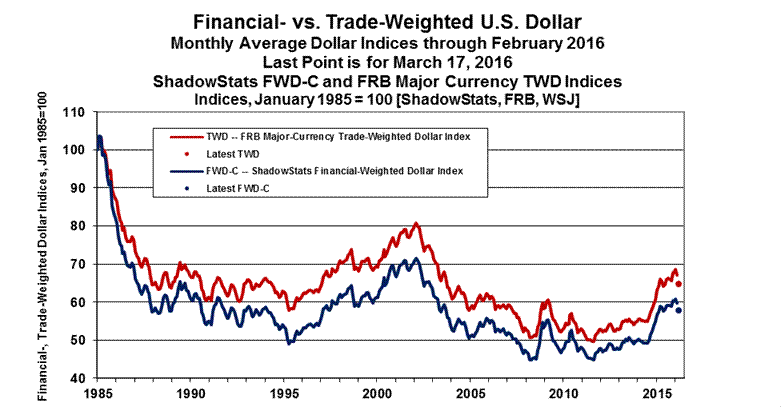
Graph 14: Financial- versus Trade-Weighted U.S. Dollar
Graph 15: Year-to-Year Change, Financial- versus Trade-Weighted U.S. Dollar
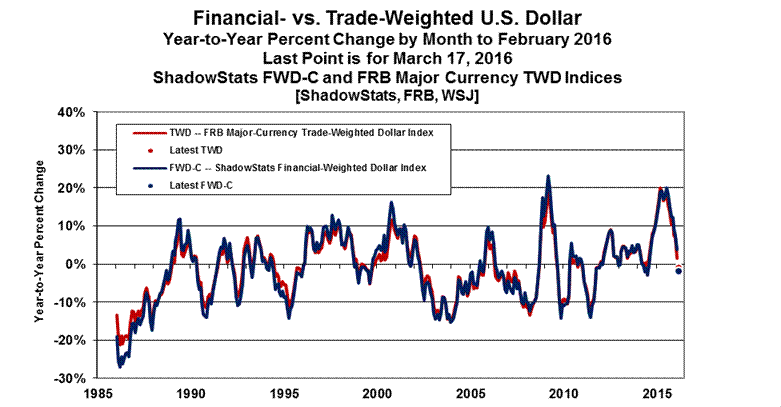
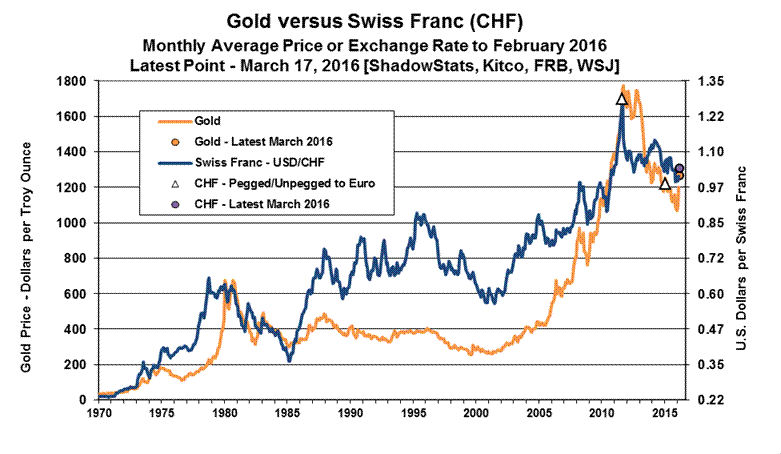
The monthly plots of the U.S. Dollar (Graphs 14 and 15) precede, while the three gold graphs (Graphs 16, 17 and 18) that regularly accompany the CPI Commentaries, follow. The trade- and financial-weighted dollar measures have shown increased volatility, with annual growth turning negative year-to-year in the last several days. Increasingly, the global markets do not appear to buying the concept that all is right with the U.S. financial system and economy. The “Latest March” points in these graphs reflect late-morning New York prices for March 17th, post-FOMC statement, in a very volatile circumstance.
Detailed in Commentary No. 772, the ShadowStats Financial-Weighted Dollar measure recently was expanded to incorporate that Chinese Yuan (CNY)/Renminbi (RMB).
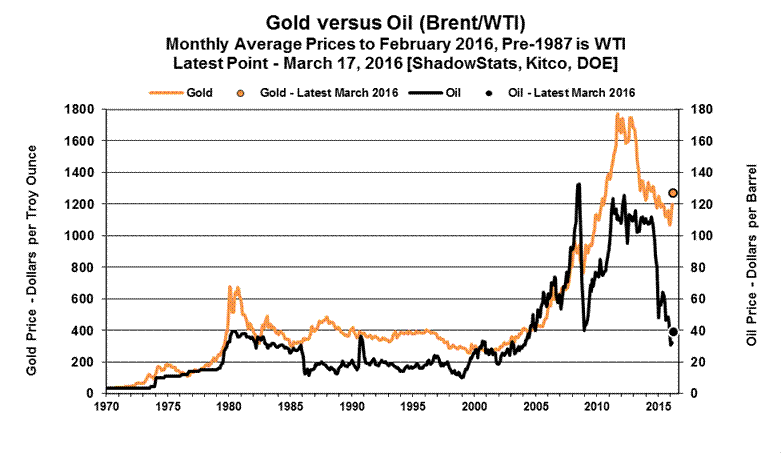
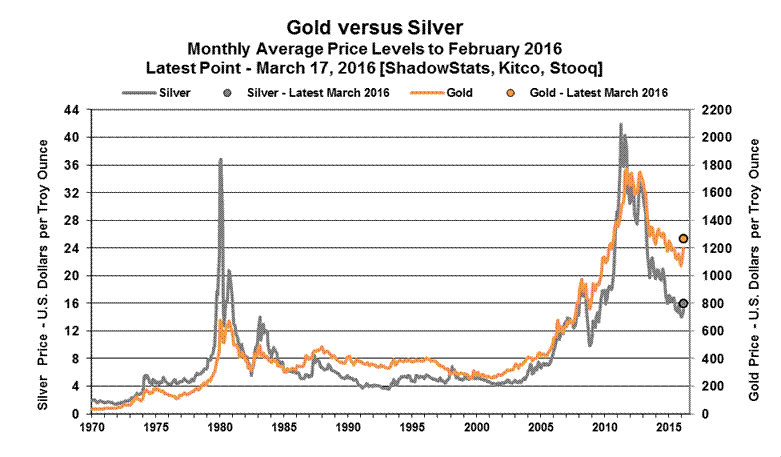
Oil prices have begun to rebound—despite an increasing oil glut—in response to the weakening U.S. dollar. Such threatens to rekindle headline U.S. inflation. As the U.S. dollar faces continued, fundamental debasement, holdings of physical gold and silver will continue to offer the strongest options for preserving the purchasing power and desired liquidity for one’s wealth and assets, through the difficult times ahead. To be effective, such protection needs to be held in place through the peak of the crisis.
Graph 16: Gold versus the Swiss Franc
Graph 17: Gold versus Oil
Graph 18: Gold versus Silver
__________
REPORTING DETAIL
CONSUMER PRICE INDEX—CPI (February 2016)
Headline Monthly CPI-U Inflation Depressed by Seasonal Adjustment Patterns. [These first three paragraphs largely are repeated from the Opening Comments section.] In keeping with tradition, seasonal adjustments early in the New Year continued to reduce aggregate month-to-month headline inflation for February 2016. Monthly CPI-U inflation contracted by an adjusted 0.17% (-0.17%), down from an unadjusted monthly gain of 0.08%. In like manner, January 2016 headline inflation had been reduced to 0.03% from what was a stronger, unadjusted monthly inflation rate of 0.17%. Gasoline prices fell sharply, again, but that was only partially countered by rising food prices and “core” inflation, again, on a seasonally-adjusted basis. Gasoline prices appear likely to close out March 2016 on the upside, however, the first unadjusted monthly increase since June of last year.
On an annual and unadjusted basis, February 2016 inflation eased to 1.02% from a ten-month high of 1.37% in January 2016. Separately, although the annual CPI-U inflation slowed to 1.0%, year-to-year inflation is not and has not been quite as soft as indicated in headline reporting, when considered in the context of traditional CPI reporting and common experience. The ShadowStats Alternate Inflation Measures rose in February by 4.5% annual inflation, based on 1990 methodologies, and by 8.7%, based on 1980 methodologies.
Longer-Range Inflation Outlook. Updated in today’s Hyperinflation Watch and discussed more broadly in No. 777 Year-End Special Commentary, high risk of extreme flight from the U.S. dollar—a massive dollar debasement—threatens to generate increasingly rapid, upside energy and global-commodity inflation, which would drive headline U.S. consumer inflation much higher.
__________________
Notes on Different Measures of the Consumer Price Index
The Consumer Price Index (CPI) is the broadest inflation measure published by the U.S. Government, through the Bureau of Labor Statistics (BLS), Department of Labor:
The CPI-U (Consumer Price Index for All Urban Consumers) is the monthly headline inflation number (seasonally adjusted) and is the broadest in its coverage, representing the buying patterns of all urban consumers. Its standard measure is not seasonally-adjusted, and it never is revised on that basis except for outright errors.
The CPI-W (CPI for Urban Wage Earners and Clerical Workers) covers the more-narrow universe of urban wage earners and clerical workers and is used in determining cost of living adjustments in government programs such as Social Security. Otherwise, its background is the same as the CPI-U.
The C-CPI-U (Chain-Weighted CPI-U) is an experimental measure, where the weighting of components is fully substitution based. It generally shows lower annual inflation rate than the CPI-U and CPI-W. The latter two measures once had fixed weightings—so as to measure the cost of living of maintaining a constant standard of living—but now are quasi-substitution-based. Since it is fully substitution based, the series tends to reflect lower inflation than the other CPI measures. Accordingly, the C-CPI-U is the “new inflation” measure being proffered by Congress and the White House as a tool for reducing Social Security cost-of-living adjustments by stealth. Moving to accommodate the Congress, the BLS introduced changes to the C-CPI-U estimation process with the February 26, 2015 reporting of January 2015 inflation, aimed at finalizing the C-CPI-U estimates on a more-timely basis, and enhancing its ability to produce lower headline inflation than the traditional CPI-U.
The ShadowStats Alternative CPI-U Measures are attempts at adjusting reported CPI-U inflation for the impact of methodological change of recent decades designed to move the concept of the CPI away from being a measure of the cost of living needed to maintain a constant standard of living. There are two measures, where the first is based on reporting methodologies in place as of 1980, and the second is based on reporting methodologies in place as of 1990.
__________________
CPI-U. The BLS reported March 16th that the headline, seasonally-adjusted February 2016 CPI-U declined by 0.2% (-0.2%) month-to-month, down by 0.17% (-0.17%) at the second decimal point. That followed an “unchanged” at 0.0% month-to-month in January, which was up by 0.03% at the second decimal point.
The adjusted headline February inflation number was boosted by seasonal adjustments to the foods sector, but otherwise suppressed by seasonal adjustments to the energy and “core” sectors. On an unadjusted basis, February 2015 CPI-U rose by 0.08%, following an unadjusted monthly gain of 0.17% in January.
Seasonal adjustments for monthly gasoline inflation were negative in February 2016, turning an unadjusted headline decline of 9.91%% (-9.91%) into an adjusted contraction of 13.04% (-13.04%). A headline, unadjusted monthly decline of 8.99% (-8.99%) for the month had been estimated by the Department of Energy (DOE).
Major CPI-U Groups. Encompassed by the seasonally-adjusted decline of 0.17% (-0.17%) in February 2016 CPI-U [up by an unadjusted 0.08%], February food inflation rose by a seasonally-adjusted 0.16% for the month [up by an unadjusted 0.07%], February energy inflation declined by a seasonally-adjusted 5.95% (-5.95%) [down by an unadjusted 4.50% (-4.50%)], while the adjusted “core” (ex-food and energy) inflation rate rose by 0.28% [up by 0.47% unadjusted] for the month.
Separately, core CPI-U inflation showed unadjusted year-to-year inflation of 2.33% in February 2016, versus 2.21% in January 2016.
Year-to-Year CPI-U. Not seasonally adjusted, February 2016 year-year inflation for the CPI-U softened to 1.0% (1.02% at the second decimal point), versus 1.4% (1.37%) in January 2016.
Year-to-year, CPI-U inflation would increase or decrease in next month’s March 2016 reporting, dependent on the seasonally-adjusted monthly change, versus the adjusted, headline gain of 0.18% in March 2015 CPI-U. The adjusted change is used here, since that is how consensus expectations are expressed. To approximate the annual unadjusted inflation rate for March 2016, the difference in March’s headline monthly change (or forecast of same), versus the year-ago monthly change, should be added to or subtracted directly from the February 2016 annual inflation rate of 1.02%. For example, a seasonally-adjusted, headline monthly gain of 0.2% in the March 2016 CPI-U would be needed to keep the headline annual CPI-U from falling below 1.0%, plus-or-minus, depending on rounding.
CPI-W. The February 2016 seasonally-adjusted, headline CPI-W, which is a narrower series and has greater weighting for gasoline than does the CPI-U, declined month-to-month by 0.32% (-0.32%), following an “unchanged” minimal decline month-to-month of 0.03% (-0.03%) in January. On an unadjusted basis, the monthly CPI-W declined by 0.04% (-0.04%) in February 2016, having increased by 0.12% in January.
Year-to-Year CPI-W. Unadjusted, February 2016 annual CPI-W rose by 0.68%, following an annual gain of 1.21% in January 2016.
Chained-CPI-U. The headline C-CPI-U is not seasonally adjusted, with year-to-year inflation for the unadjusted February 2016 C-CPI-U at 0.54%, versus an annual gain of 1.02% in January 2016.
See discussions in the earlier CPI Commentary No. 721 and in the opening notes in the CPI Section of Commentary No. 699 as to recent changes in the series. More-frequent revisions and earlier finalization of monthly detail are designed to groom the C-CPI-U series as the new Cost of Living Adjustment (COLA) index of choice for the budget-deficit-strapped federal government, as discussed in the Public Commentary on Inflation Measurement.
Alternate Consumer Inflation Measures. The ShadowStats-Alternate Consumer Inflation Measures are constructed on top of the unadjusted CPI-U series. Adjusted to pre-Clinton methodologies—the ShadowStats-Alternate Consumer Inflation Measure (1990-Base)—year-to-year annual inflation was roughly 4.6% in February 2016, versus 5.0% in January 2016.
The February 2016 ShadowStats-Alternate Consumer Inflation Measure (1980-Base), which reverses gimmicked changes to official CPI reporting methodologies back to 1980, was at about 8.7% (8.67% for those using a second decimal point) year-to-year, versus 9.0% in January 2016.
Note: The ShadowStats-Alternate Consumer Inflation Measures largely have been reverse-engineered from the components of the BLS’s CPI-U-RS series. That series provides an official estimate of historical inflation, assuming that all current methodologies were in place going back in time. The changes reflected there are parallel with and of the same magnitude of change as estimated by the BLS, when a given methodology was changed. The ShadowStats estimates are adjusted on an additive basis for the cumulative impact on the annual inflation rate from the various BLS changes in methodology (reversing the net aggregate inflation reductions by the BLS). The series are adjusted by ShadowStats for those aggregate changes, but the series otherwise are not recalculated.
Over the decades, the BLS has altered the meaning of the CPI from being a measure of the cost of living needed to maintain a constant standard of living, to something that neither reflects the constant-standard-of-living concept nor measures adequately what most consumers view as out-of-pocket expenditures. Roughly five percentage points of the additive ShadowStats adjustment since 1980 reflect the BLS’s formal estimate of the annual impact of methodological changes; roughly two percentage points reflect changes by the BLS, where ShadowStats has estimated the impact not otherwise published by the BLS. For example, the BLS does not consider more-frequent weightings of the CPI series to be a change in methodology. Yet that change has had the effect of reducing headline inflation from what it would have been otherwise (See Public Commentary on Inflation Measurement for further details.)
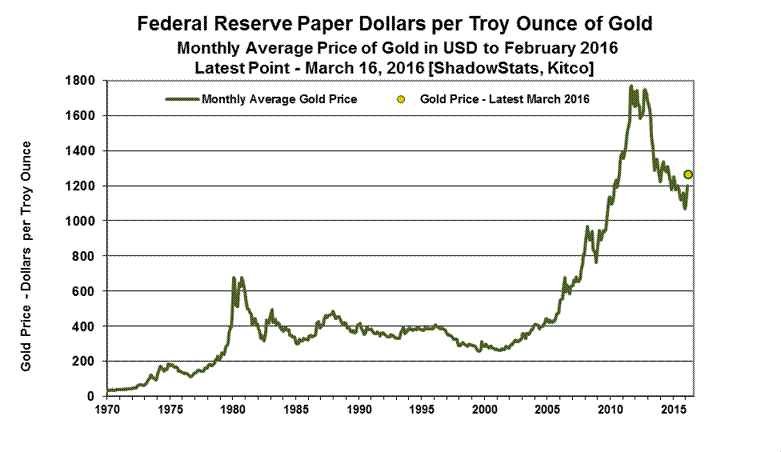
Graph 19: Monthly Average Gold Price in Dollars (Federal Reserve Notes)
Gold and Silver Historic High Prices Adjusted for February 2016 CPI-U/ShadowStats Inflation—
CPI-U: GOLD at $2,591 per Troy Ounce, SILVER at $151 per Troy Ounce
ShadowStats: GOLD at $12,651 per Troy Ounce, SILVER at $736 per Troy Ounce
Despite the September 5, 2011 historic-high gold price of $1,895.00 per troy ounce (London afternoon fix), and despite the multi-decade-high silver price of $48.70 per troy ounce (London fix of April 28, 2011), gold and silver prices have yet to re-hit their 1980 historic levels, adjusted for inflation. The earlier all-time high of $850.00 (London afternoon fix, per Kitco.com) for gold on January 21, 1980 would be $2,591 per troy ounce, based on February 2016 CPI-U-adjusted dollars, and $12,651 per troy ounce, based on February 2016 ShadowStats-Alternate-CPI (1980-Base) adjusted dollars (all series here are not seasonally adjusted).
In like manner, the all-time high nominal price for silver in January 1980 of $49.45 per troy ounce (London afternoon fix, per silverinstitute.org)—although approached in 2011—still has not been hit since 1980, including in terms of inflation-adjusted dollars. Based on February 2016 CPI-U inflation, the 1980 silver-price peak would be $151 per troy ounce and would be $736 per troy ounce in terms of February 2016 ShadowStats-Alternate-CPI (1980-Base) adjusted dollars (again, all series not seasonally adjusted).
As shown in Table 1, on page 31 of 2014 Hyperinflation Report—The End Game Begins – First Installment Revised, over the decades, the increases in gold and silver prices have compensated for more than the loss of the purchasing power of the U.S. dollar as reflected by CPI inflation. They also effectively have come close to fully compensating for the loss of purchasing power of the dollar based on the ShadowStats-Alternate Consumer Price Measure (1980-Methodologies Base).
Real (Inflation-Adjusted) Retail Sales—February 2016—Trending Towards a First-Quarter 2016 Quarterly Contraction; Continuing Intense Recession Signal. A sharp downside revision to January 2016 retail sales has turned the outlook for first-quarter 2016 real sales activity from a quarterly gain to a contraction.
Not adjusted for inflation, headline nominal retail sales in February 2016 declined by 0.15% (-0.15%), in the context of the sharp downside revision to headline January activity. Headline January sales showed a revised monthly decline of 0.40% (-0.40%) [previously up by 0.18%], with a revised gain of 0.31% [previously up by 0.16%] in December, as detailed in Commentary No. 792.
Year-to-year nominal change in February 2016 retail sales was 3.09%, versus a downwardly-revised 2.99% [previously 3.44%] in January 2016 and an upwardly revised 2.59% [previously 2.55%] in December 2015.
Based on the headline seasonally-adjusted decline of 0.17% (-0.17%) in February 2016 CPI-U, a gain of gain of 0.03% in January and monthly decline of 0.11% (-0.11%) in December, February 2016 real retail sales rose for the month by 0.02% (effectively flat), January real retail sales fell by 0.43% (-0.43%) [previously up by 0.15%] and December real sales rose by a revised 0.42% [previously up by 0.27%].
Intense Signal of Recession in Annual Real Growth. During normal economic times, annual real growth in Retail Sales at or below 2.0% signals an imminent recession. That signal basically has been in play since February 2015 (the “new” recession likely will be timed from December 2014, based on industrial production, retail sales and other indicators), suggesting a deepening, broad economic downturn.
Year-to-year change in real retail sales was 2.09% in February 2016, a downwardly revised 1.62% [previously 2.07%] in January 2016 and an upwardly revised 1.91% [previously 1.76%] in December 2015. With annual real growth in first-quarter 2016 at 1.63% and fourth-quarter 2015 at 1.50%, the recession signal is intense, consistent with a signal of unfolding recession. Graphs 11 and 13, following, show the latest patterns of headline annual real growth.
First-Quarter 2016 Annualized Real Growth Turned Negative. Reflecting the latest revisions to the nominal detail, annualized contraction in first-quarter 2015 real Retail Sales narrowed to 0.83% (-0.83%) [previously down by 1.44% (-1.44%)]. The changes in the first- and second-quarter growth rates here are due solely to inconsistent seasonal-adjustment factor revisions used to boost headline February 2016 reporting (see discussion in Commentary No. 792).
Second-quarter 2015 annualized real growth slowed in revision to 3.39% [previously up by 4.03%]. Third-quarter 2015 annualized real growth held at an unrevised gain of 3.10%, while fourth-quarter 2015 growth held effectively flat, at a revised annualized real gain of 0.42% [previously up by 0.23%].
Based solely on the headline detail for January and February 2016, first-quarter 2016 real retail sales reporting is on an early track for an annualized quarterly contraction of 0.32% (-0.32%). Based just on the initial, unrevised reporting for January 2016, first-quarter activity had been on track for an annualized gain of 1.57%. Adjusted for realistic inflation (see Graph 2 in the Opening Comments, Commentary No. 789 and No. 777 Year-End Special Commentary), however, real retail sales and the broad economy never truly recovered from the economic collapse into 2008 and 2009.
Consumer Liquidity Problems Continue to Impair Retail Sales. Constraining retail sales and residential real estate activity, the consumer remains in an extreme liquidity bind, as updated briefly Commentary No. 792 and Commentary No. 791 and as discussed broadly in Commentary No. 790 and No. 777 Year-End Special Commentary. Without sustained growth in real income, and without the ability and/or willingness to take on meaningful new debt in order to make up for the income shortfall, the U.S. consumer has been unable to sustain positive growth in domestic personal consumption, including retail sales, real or otherwise, with parallel weakness seen in the housing and related construction industries. Those circumstances—in the last eight-plus years of economic collapse and stagnation—have prevented a normal recovery in broad U.S. economic activity, 70% of which is dependent on personal spending.
As official consumer inflation resumes its upside climb in the year ahead, and as overall retail sales continue to suffer from the ongoing consumer liquidity squeeze—reflected partially by the general pattern of ongoing real earnings difficulties discussed in the next section—these data should continue trending meaningfully lower, in what should be recognized shortly as a formal “new” recession.
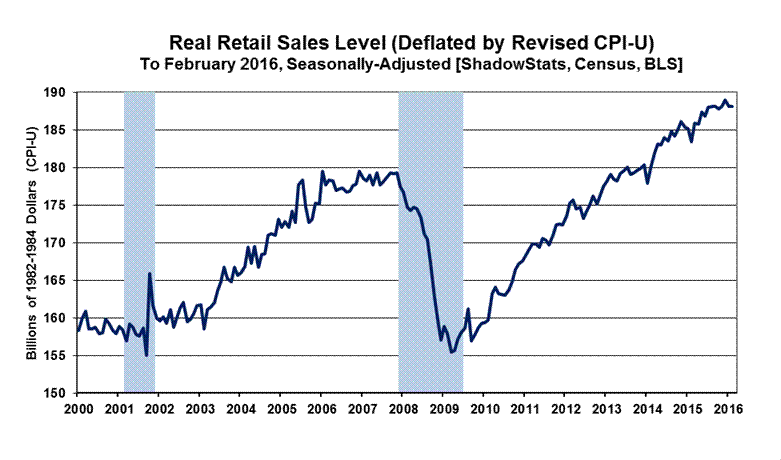
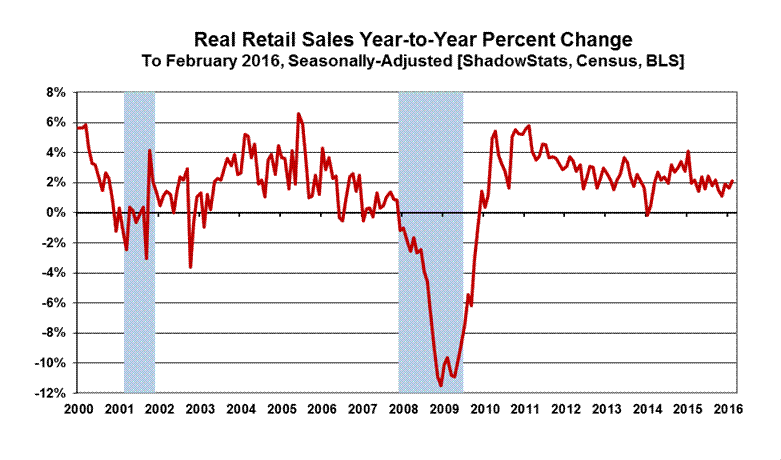
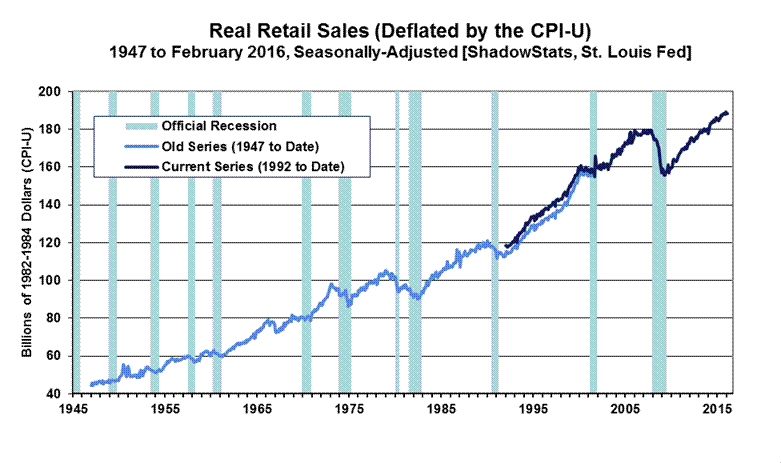
Real Retail Sales Graphs. Graph 20, the first of the four graphs following, shows the level of real retail sales activity (deflated by the CPI-U) since 2000; Graph 21 shows the year-to-year percent change for the same period. In the context of downside revision to January nominal retail sales, the level of headline monthly activity turned lower in January 2016. Where the aggregate headline fourth-quarter 2015 growth largely had dissipated in various revisions, and flattened out, first-quarter 2016 activity now is on track for a quarterly decline in real activity
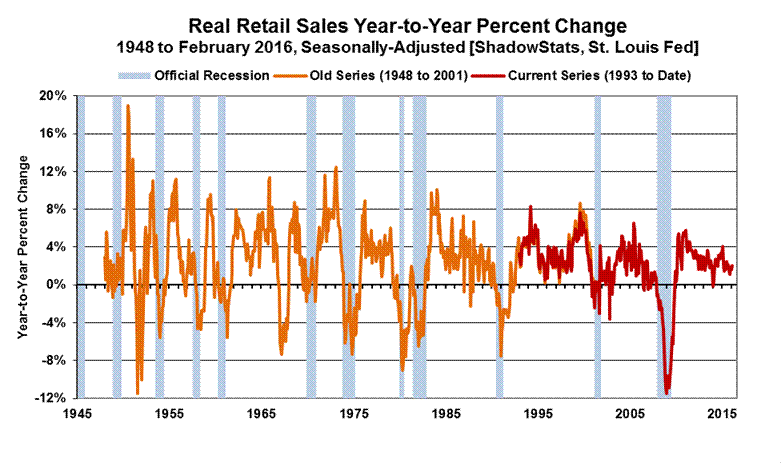
Annual real growth had slowed markedly into fourth-quarter 2015, with the downwardly revised January 2016 and headline February 2016 real annual growth still generating a recession signal. Graphs 22 and 23 show the level of, and annual growth in, real retail sales (and its predecessor series) in full post-World War II detail.
The relative strength seen in the real retail series, and the recovery in the headline industrial production series through year-end 2014, after which it turned down sharply (see the accompanying industrial production detail), largely reflect the understatement of the rate of inflation used in deflating the respective series. Discussed more fully in Chapter 9 of 2014 Hyperinflation Report—Great Economic Tumble – Second Installment, deflation by too-low an inflation number (such as the CPI-U) results in the deflated series overstating inflation-adjusted, real economic growth.
Shown in the latest “corrected” real retail sales—Graph 2 in the Opening Comments section—with the deflation rates corrected for the understated inflation reporting of the CPI-U, the recent pattern of real sales activity has turned increasingly negative. The corrected graph shows that the post-2009 period of protracted stagnation ended, and a period of renewed and ongoing contraction began in second-quarter 2012 and continues to date. The corrected real retail sales numbers use the ShadowStats-Alternate Inflation Measure (1990-Base) for deflation instead of the CPI-U. A similar pattern of deteriorating activity can be seen in Graph 5 of “corrected” industrial production.
Graph 20: Real Retail Sales (2000 to 2016)
Graph 21: Real Retail Sales (2000 to 2016), Year-to-Year Percent Change
Graph 22: Real Retail Sales (1947 to 2016)
Graph 23: Real Retail Sales (1948 to 2016), Year-to-Year Percent Change
Real (Inflation-Adjusted) Average Weekly Earnings—February 2016—Headline Monthly Gains Still Boosted by Negative Monthly Inflation. The BLS published its estimates for real average weekly earnings for February 2016, coincident with the release of the February 2016 CPI-W. In the production and nonsupervisory employees category—the only series for which there is a meaningful history—headline real average weekly earnings rose month-to- month by 0.02% in February 2016, versus a revised gain of 0.32% [previously up by 0.31%] in January and a downwardly-revised monthly gain of 0.62% [previously up by 0.66%] in December.
For those not living in a seasonally-adjusted world, real average weekly earnings declined month-to-month by 0.06% (-0.06%) in February 2016, by 0.53% (-0.53%) in January and by 0.66% (-0.66%) in December.
Year-to-year and seasonally-adjusted, annual growth in February 2016 real average weekly earnings rose to 1.43%, from a revised 1.27% [previously 1.32%] in January 2016, versus a revised 2.24% [previously 2.29%] in December 2015. Not seasonally adjusted, annual growth in February 2016 fell to 0.02% from a revised 1.21% [previously 1.26%] in January 2016 and a revised 2.24% [previously 2.12%] in December 2015.
On a quarterly basis, real-average weekly earnings grew at an annualized headline pace of 6.62% in first-quarter 2015, fell by 0.49% (-0.49%) in second-quarter 2015, fell by 0.46% (-0.46%) in third-quarter 2015 and gained a revised 3.91% [previously 3.98%] in fourth-quarter 2015. Based just on January and February 2016 reporting, first-quarter 2016 was showing an early, annualized growth rate of 2.91%. That had been 2.98% based just on initial January detail.
The CPI-W deflated reporting here is distorted versus CPI-U-deflated series, where the CPI-W—more heavily weighted with gasoline prices—tends to have much deeper, negative headline inflation, with resulting weaker headline, inflation-adjusted growth than would be seen with the CPI-U.
Found in the Opening Comments section, Graph 3 plots this series, showing earnings as officially deflated by the BLS (red-line), and as adjusted for the ShadowStats-Alternate CPI Measure, 1990-Base (blue-line). When inflation-depressing methodologies of the 1990s began to kick-in, the artificially-weakened CPI-W (also used in calculating Social Security cost-of-living adjustments) helped to prop up the reported real earnings. Official real earnings today still have not recovered their inflation-adjusted levels of the early-1970s, and, at best, have been in a minimal uptrend for the last two decades (albeit spiked recently by negative headline inflation). Deflated by the ShadowStats (1990-Based) measure, real earnings have been in fairly-regular decline for the last four decades, which is much closer to common experience than the pattern suggested by the CPI-W. See the Public Commentary on Inflation Measurement for further detail.
Real (Inflation-Adjusted) Money Supply M3—February 2016—Faltering Annual Growth. The signal for a double-dip, multiple-dip or simply protracted, ongoing recession, based on annual contraction in the real (inflation-adjusted) broad money supply (M3), remains in place and rapidly is deepening anew, despite real annual M3 growth having rallied in positive territory for several years. As shown in the accompanying graph—based on February 2016 CPI-U reporting and the latest ShadowStats-Ongoing M3 Estimate (including annual Federal Reserve Board money supply revisions)—annual inflation-adjusted growth in February 2016 M3 notched higher to held at 2.6%, up from a revised 2.5% [previously 2.6%] in January, then its lowest level since September 2014. The uptick in the monthly rate of year-to-year change reflected almost offsetting declines in both annual CPI-U inflation and M3 growth (see Commentary No. 790).
Graph 24: Real M3 Annual Growth versus Formal Recessions
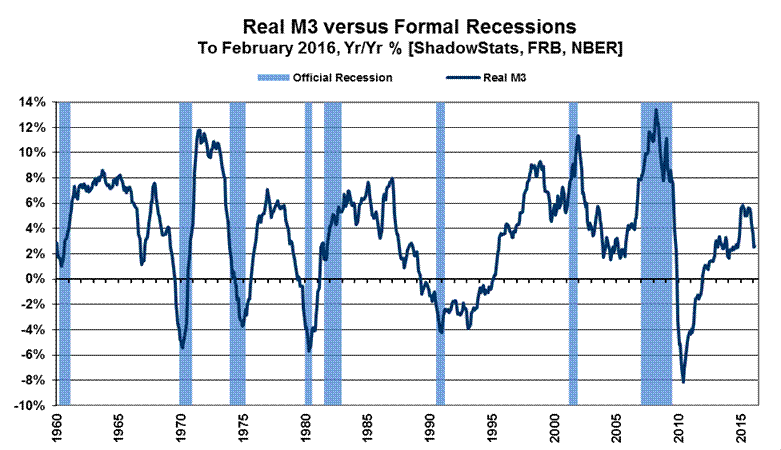
The signal for a downturn or an intensified downturn is generated when annual growth in real M3 first turns negative in a given cycle; the signal is not dependent on the depth of the downturn or its duration. Breaking into positive territory does not generate a meaningful signal one way or the other for the broad economy. The current “new” downturn signal was generated in December 2009, even though there had been no upturn since the economy purportedly hit bottom in mid-2009. Again, when real M3 growth breaks above zero, there is no signal; the signal is generated only when annual growth moves into negative territory. The broad economy tends to follow in downturn or renewed deterioration roughly six-to-nine months after the signal. Weaknesses in a number of economic series have continued to the present, with significant new softness in recent reporting. Actual post-2009 economic activity has remained at relatively low levels of activity—in protracted stagnation, with no actual recovery (see Commentary No. 739 and No. 777 Year-End Special Commentary).
Despite the purported, ongoing recovery shown in headline GDP activity, a renewed downturn in official data is underway and should gain official recognition in the near future of a “new” or multiple-dip recession (see the Opening Comments). Reality remains that the economic collapse into 2009 was followed by a plateau of low-level economic activity—no meaningful upturn, no recovery from or end to the official 2007 recession—and the unfolding renewed downturn remains nothing more than a continuation and re-intensification of the downturn that began unofficially in 2006.
INDEX OF INDUSTRIAL PRODUCTION (February 2016)
First-Quarter Production on Track for Annual and Quarterly Contractions. In the context of contracting annual growth and prior-period revisions, the headline February 2016 production drop of 0.49% (-0.49%) reflected continued weakness in the mining sector, a reversal of the prior month’s weather-distorted utility surge, and a small gain in the manufacturing sector. Two of the three major industry groups that comprise U.S. industrial production declined in February, dominated by a decline of 1.44% (-1.44%) in mining (including oil and gas production) and a decline of 4.03% (-4.03%) in utility usage, which was returning to more-normal weather-related circumstances. Manufacturing showed a headline monthly gain of 0.16%, but that series never has regained, and remains 2.73% below, its pre-recession peak (see Graphs 28 to 36).
Quarterly and Annual Production Contractions. Annual growth in aggregate production held in negative territory for the fourth straight month, down in February 2016 by 1.03% (-1.03%), setting up first-quarter 2016 as the second consecutive quarter of both negative annual and negative quarterly growth. On the basis of quarter-to-quarter contraction, first-quarter 2016 would be the fourth such contraction of the last five quarters. This type of activity is not seen outside of formal recessions.
First-quarter 2015 industrial production contracted at an annualized quarterly pace of 0.35% (-0.35%), followed by a second-quarter 2015 contraction of 2.30% (-2.30%), a downwardly-revised gain of 2.59% [previously 2.65%] in third-quarter 2015 production, and a minimally shallower fourth-quarter 2015 contraction of 3.12% (-3.12%) [previously down by 3.25% (-3.25%)].
Based solely on the headline January and February 2016 numbers, first-quarter 2016 production was contracting at an annualized pace of 0.17% (-0.17%). Based just on the initial January 2016 reporting, first-quarter 2016 production had been growing at an annualized pace of 0.87%.
Separately, year-to-year growth in quarterly production continued to slow and now is in decline, ranging from a positive 3.47% in first-quarter 2015, to 1.45% in second-quarter 2015, to a revised 1.13% [previously 1.17%] in third-quarter 2015, to a revised annual decline of 0.82% (-0.82%) [previously down by 0.84% (-0.84%)] in fourth-quarter 2015. Based on the headline January and February 2016 detail, first-quarter 2016 activity was on track for a straight annual contraction of 0.78% (-0.78%). That previously had been a contraction of 0.54% (-0.54%), based only on initial January 2016 reporting.
Historical patterns in this series as they relate to recessions were reviewed meaningfully in the production Commentary No. 780. Discussed there, except in unusual circumstances such as national strikes, annual quarterly growth in industrial production does not contract outside of periods that eventually are declared formal recessions. In consistent form, the industrial production series continues to indicate that broad U.S. economic activity entered a “new” recession, likely to be timed officially from December of 2014.
Annual Revisions on April 1st. The Federal Reserve Board has announced its intent to publish annual revisions to the industrial production series mid-day on Friday, April 1st, the same day as the March employment and unemployment reporting by the Bureau of Labor Statistics, and the February construction spending reporting by the Census Bureau (coverage of the labor and construction-spending conditions is planned for Commentary No. 796 on April 1st). ShadowStats will use the ensuing weekend for analysis of the production revisions, with a review of the same to be published along with coverage of the February trade-deficit release in Commentary No. 797 of Tuesday, April 5th.
The production revisions should reflect more-complete and more-accurate information for the period surrounding 2014, as well as revamped seasonal factors. The Fed noted also that “estimation methods for some series may be changed,” with related data recast back to 1972. More complete and accurate data usually result in downside revisions to previously estimated activity. Changes to reporting methodology usually have the effect of adding in new upside assumptions and biases to the series. Revisions here will be incorporated into the July 29th annual benchmark revisions to the GDP.
Headline Industrial Production—February 2016. The Federal Reserve Board released its first estimate of seasonally-adjusted, February 2016 industrial production on March 16th. In the context of largely offsetting prior-period revisions the headline monthly decline in February 2016 of 0.49% (-0.49%) would have been the same to the second decimal point, versus prior reporting of the January 2016 level of activity.
The said, the monthly decline of 0.49% (-0.49%) in February 2016 total production followed a downwardly-revised monthly gain of 0.78% [previously up by 0.92%] in January, a shallower decline of 0.48% (-0.48%) [previously down by 0.67% (-0.67%)] in December and a little-changed contraction of 0.74% (-0.74%) [previously down by 0.76% (-0.76%)] in November.
Detailed in Graphs 28 to 31, by major industry groups, the headline February 2016 monthly aggregate production decline of 0.5% (-0.5%) [a January gain of 0.8%] was composed of a monthly February gain of 0.2% [a January gain of 0.5%] in manufacturing activity; a February decline of 1.4% (-1.4%) [a January decline of 0.7% (-0.7%)] in mining activity (including oil and gas production); and a February drop of 4.0% (-4.0%) [a January gain of 4.2%] in utilities activity.
Year-to-year change in February 2016 was a decline of 1.03% (-1.03%), versus a basically unrevised January 2016 annual decline of 0.69% (-0.69%) [previously down by 0.70% (-0.70%)] , a shallower annual decline in December 2015 of 1.74% (-1.74%) [previously down by 1.89% (-1.89%)], a steeper annual decline in November of 1.17% (-1.17%) [previously down by 1.13% (-1.13%)]. Again, annual growth has turned sharply negative, a circumstance common to formal, post-World-War II recessions.
Production Graphs. The regular two sets of long- and short-term industrial production levels and annual growth rates (Graphs 25 to 28) set the background for the drill-down detail graphs of various components of the aggregate industrial series (Graphs 29 to 36).
Graphs 25 and 26, and Graphs 27 and 28 show headline industrial production activity to date. Graph 25 shows the monthly year-to-year percent change in the aggregate series, in historical context since World War II. With the headline annual declines in monthly production currently hitting 1.74% (-1.74%) in December 2015, 0.69% (-0.69%) in January 2016 and 1.03% (-1.03%) in February 2016, the pattern is one not seen outside of formal recessions, post-World War II.
Graph 26 shows the monthly level of the production index post-World War II, with a topping-out and renewed downturn—deepening quarterly contractions in first- and second-quarter 2015, with a bounce in third-quarter 2015, followed by a renewed and deeper fourth-quarter contraction, and further quarterly downturn unfolding in first-quarter 2016. Such patterns of monthly and quarterly declines and stagnation were seen last in the economic collapse into 2009. Graphs 27 and 28 show the same series in greater near-term detail, beginning in January 2000.
Seen most clearly in Graph 27, the pattern of year-to-year activity dipped anew in 2013, again, to levels usually seen at the onset of recent recessions, bounced higher into mid-2014, fluctuated thereafter, now turning sharply negative, as seen traditionally only in formal recessions. Growth remains well off the recent relative peak for the series, which was 8.56% in June 2010, going against the official June 2009 trough of the economic collapse. Indeed, as shown in Graph 25, the June 2009 year-to-year contraction of 15.20% (-15.20%)—the end of second-quarter 2009—was the steepest annual decline in production since the shutdown of wartime production following World War II.
Although official production levels have moved higher since the June 2009 trough, corrected for the understatement of inflation used in deflating portions of the industrial production index (see the Opening Comments section, Graph 5) the series has shown more of a pattern of stagnation with a slow upside trend, since 2009, with irregular quarterly contractions interspersed. The slow uptrend continued into a topping out pattern in late-2014. Headline growth—purportedly neutered of any inflation impact— contracted in both first- and second-quarter 2015, with monthly activity moving lower again, following a third-quarter increase. The “corrected” series has done the same but remains well shy of a formal recovery.
[Graphs 25 to 28 begin on the following page]
Graph 25: Industrial Production, Year-to-Year Percent Change since 1945
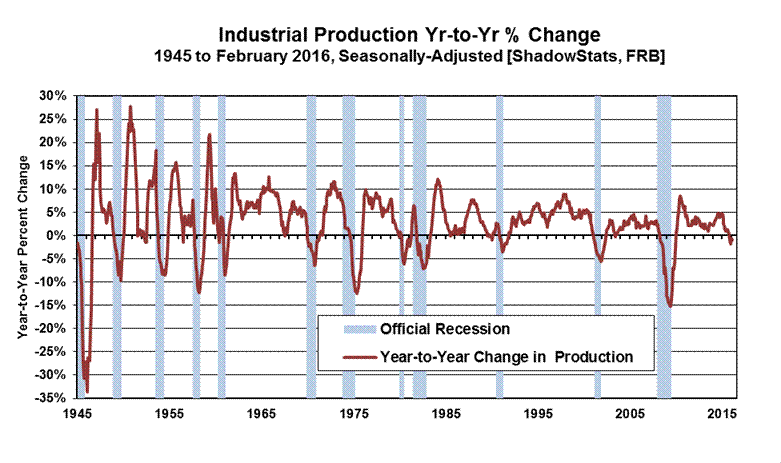
Graph 26: Index of Industrial Production (Aggregate) since 1945
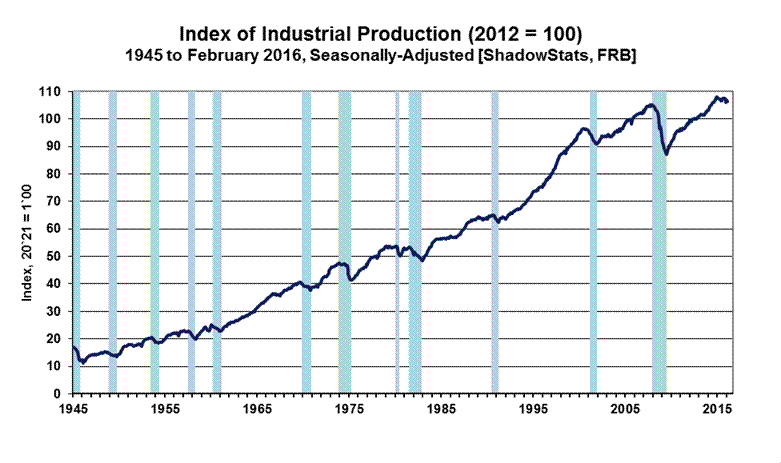
Graph 27: Aggregate Industrial Production, Year-to-Year Percent Change since 2000
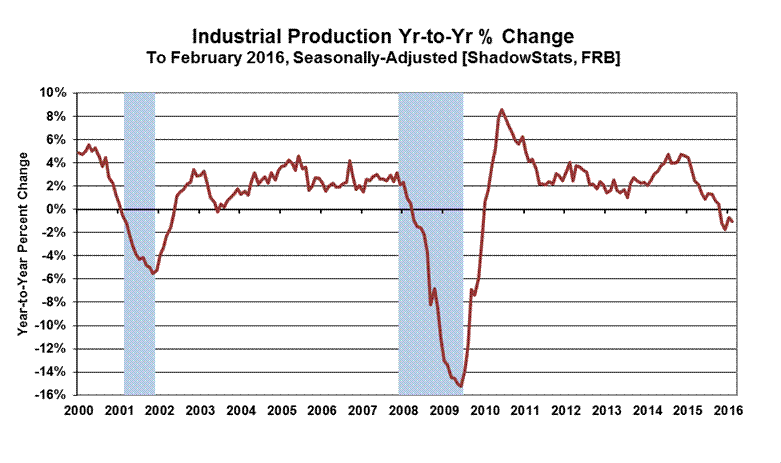
Graph 28: Index of Aggregate Industrial Production since 2000
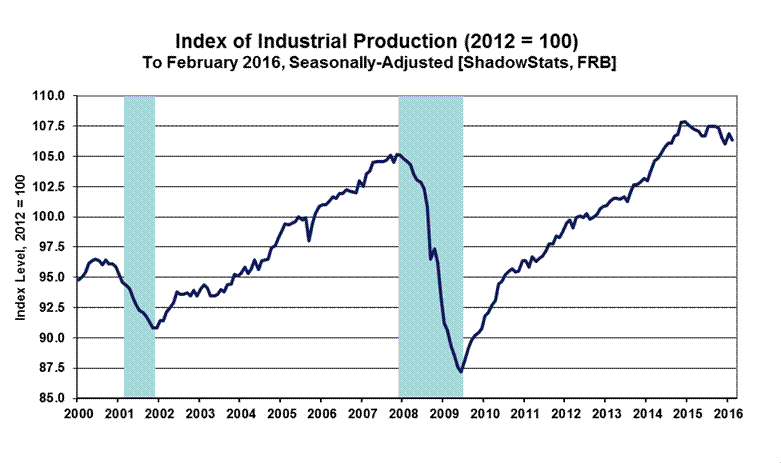
Drilling Down into the February 2016 U.S. Industrial Production Detail. Graphs 28 to 31 show headline reporting of industrial production and its major components. The broad, aggregate index (Graph 28) contracted in both first- and second-quarter 2015, and again in fourth-quarter 2015, after a third-quarter bounce. Reporting through February 2016 headline was consistent with a further contraction for first-quarter 2016 activity on both a year-to-year and quarter-to-quarter basis. Such circumstances simply are not seen outside of recessions, discussed in the regular reporting of headline production earlier in this section and in Commentary No. 780.
Again, in headline February 2016 reporting, only one of the February production series was stronger month-to-month (manufacturing), two were weaker (utilities and mining), as reflected in Graphs 29 to 31.
Graph 29: Industrial Production - Manufacturing (75.93% of Aggregate)
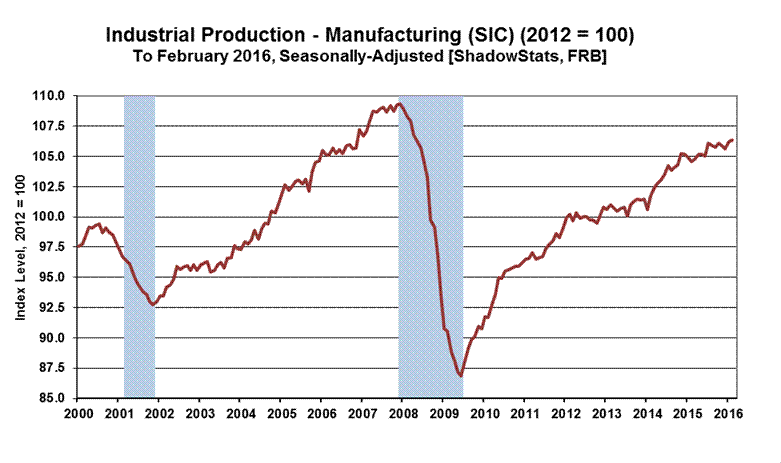
Graph 29 of the dominant manufacturing sector showed a month-to-month gain of 0.16% in February, versus a revised gain of 0.54% [previously up by 0.47%] in January 2016. This series still remains down by 2.73% (-2.73%) from reclaiming its pre-recession high of December 2007.
The utilities sector (Graph 30) fell month-to-month by 4.03% (-4.03%) in February 2016, versus a revised gain of 4.20% [previously up by 5.41%] in January 2016, moved largely by the temporary impact of “unseasonable” extremes or reversals of same in weather patterns.
Mining-sector activity (Graph 31) continued its decline in February 2016, down month-to-month by 1.44% (-1.44%), that followed a downwardly revised contraction if 0.66% (-0.66%) [previously “flat,” up by just 0.02%] in January.
Activity here, particularly in oil and gas exploration and production (and coal production), remains the near-term focus of this analysis, where oil and gas pricing issues increasingly have taken a toll on aggregate production and broad economic activity. This sector easily recovered its pre-recession high and accounts for the full “recovery” seen in the aggregate production detail since the economic collapse. Mining production, however, has turned down sharply recently, reflecting a number of factors, including the decline in oil prices (and related U.S. dollar strength) and government actions to limit coal production. Broad February 2016 mining activity remained down 12.85% (-12.85%) from its December 2014 peak.
Graph 30: Industrial Production - Utilities (10.86% of the Aggregate)
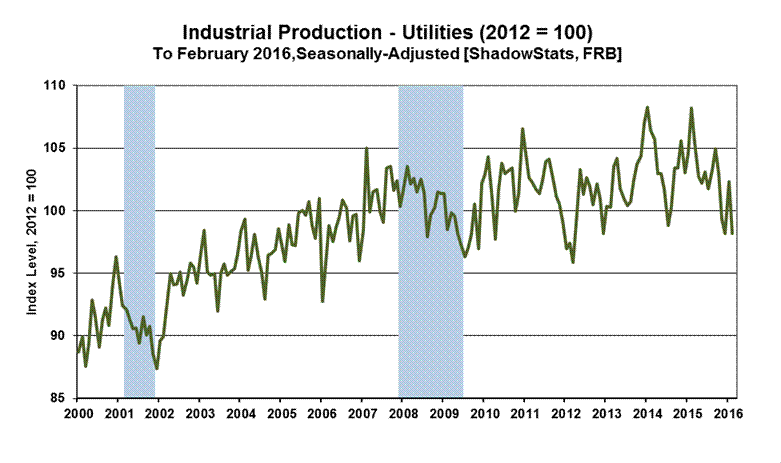
Graph 31: Industrial Production - Mining, Including Oil and Gas (13.20% of the Aggregate)
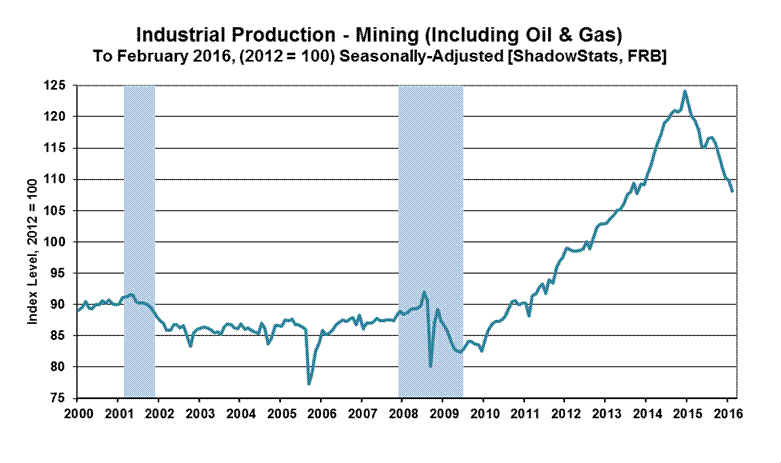
Graph 32 reflects monthly production continuing off the near-term-trough in activity for gold and silver, irrespective of the recent pummeling given the prices of precious metals by market interventions likely orchestrated by flailing central banks. Discussed in today’s Hyperinflation Watch, however, pricing circumstances may be shifting to the upside for gold and silver, as well as for oil.
Graph 32: Mining – Gold and Silver Mining (Since 2000)
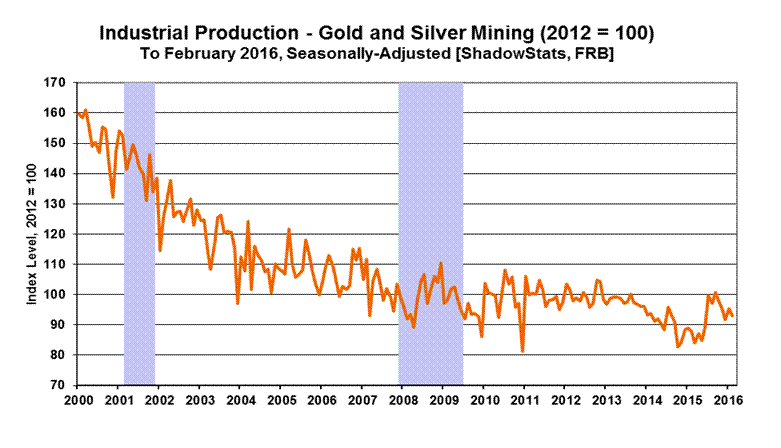
Graph 33: Mining - Coal Mining (Since 2000)
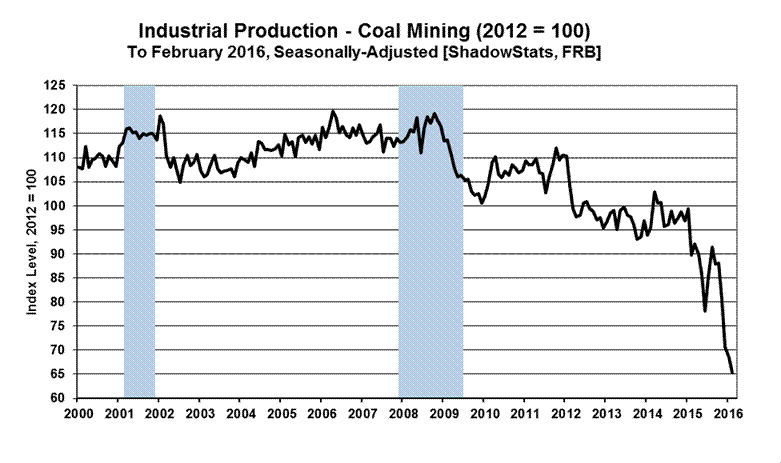
Graph 33 shows a continuing, sharp headline drop in volatile, month-to-month coal production.
With oil prices beginning to move off recent lows, oil and gas extraction remains off its all-time high, but still is showing some near-term stability, a minor upturn, as seen in Graph 34, with exploration in terms of oil and gas drilling (Graph 35) continuing to drop sharply. The recent collapse in drilling largely is an artefact of the massive U.S. dollar rally and oil-price plunge that began in July 2014. Those shifts appeared, at least initially, to be U.S.-orchestrated covert actions designed to stress Russia, financially, in response the circumstance in Ukraine. Shown in Graph 36, with some lag following the sharp movements in oil prices, oil and gas exploration tends to move in tandem. The oil price index used is for the West Texas Intermediate (WTI) monthly average spot price, deflated using the ShadowStats Alternate CPI measure (based on 1990 methodologies).
With the dollar beginning to weaken anew, dollar-denominated oil prices should strengthen on a relative basis, and vice versa, even in circumstances with the current excessive supply conditions. At such time as the U.S. dollar declines meaningfully—ShadowStats is looking for a massive sell-off in the dollar in the year ahead—U.S. dollar-denominated oil prices should rally (see Hyperinflation Watch).
Graph 34: Mining – U.S. Oil & Gas Extraction (Since 2000)
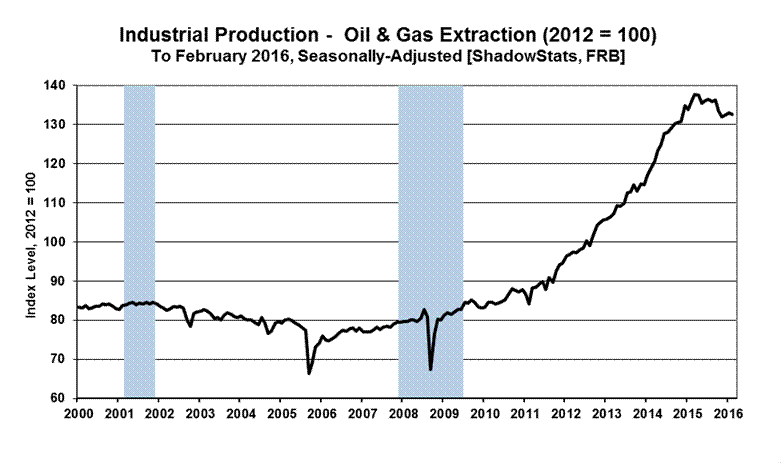
Graph 35 – U.S. Drilling for Oil & Gas (Since 2000)
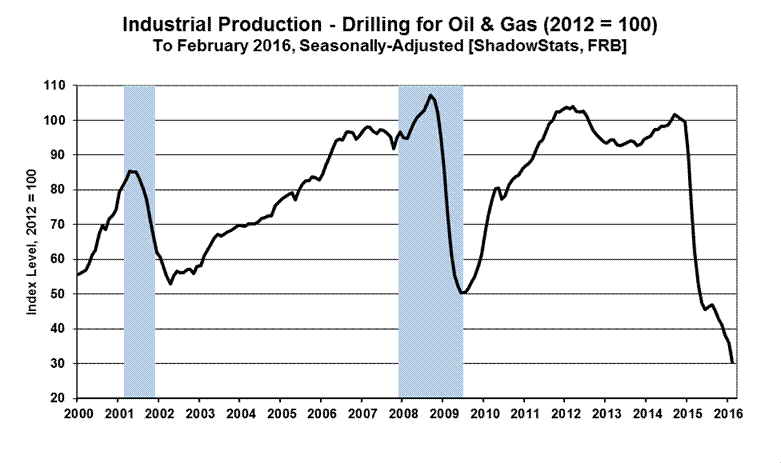
Graph 36: Mining – U.S. Drilling for Oil & Gas versus Real Oil Prices (WTI ShadowStats 1990 Base)
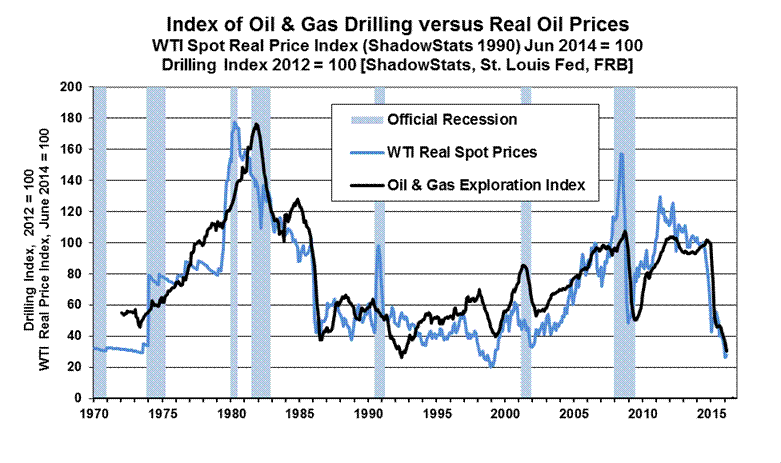
RESIDENTIAL INVESTMENT (February 2016)
Housing Starts Activity Remained in Smoothed. Low-Level Stagnation. Showing a continued, smoothed pattern of faltering stagnation, headline February 2016 housing starts rebounded in unstable month-to-month reporting, more than offsetting the monthly decline in January 2016 activity. Going against bad-weather impact of the year before, monthly changes were without much statistical significance, but the heavily-weather-bloated annual gains were significant.
First-Quarter Housing Reverses Trend, Now on Track for Annualized Quarterly Growth of 4.9%. In terms of annualized quarter-to-quarter change, the regularly unstable aggregate housing-starts count fell at an annualized-quarterly pace of 26.2% (-26.2%) in first-quarter 2015, rose at an annualized 96.3% pace in second-quarter 2015, basically was flat with a 0.2% annualized third-quarter 2015 pace of growth, and fell at a revised, annualized pace of 7.7% (-7.7%) [previously down by 9.4% (-9.4%)] in fourth-quarter 2015, in line with the still-developing, headline in contraction fourth-quarter 2015 GDP activity.
Based solely on the unstable headline January and February 2016 detail, housing starts now are on track for an annualized first-quarter 2016 gain of 4.9%. Based just on the unstable, initial headline reporting for January, the quarter had been on track for an annualized contraction of 10.5% (-10.5%).
Smoothed Numbers. Despite the regular volatility and instabilities in the housing starts series, the general pattern of low-level stagnation continued, with its up-trending six-month moving-average pattern faltering anew, softening and flattening out in tandem with the most-recent headline detail. This pattern is viewed best in terms of the longer-range historical graph of aggregate activity (Graph 38), at the end of this section, and particularly in the context of the headline activity, smoothed by a six-month moving average, as shown in Graph 9 in the Opening Comments section. While the minor upside trend in the broad pattern of stagnation in the aggregate series has stalled, total February 2016 housing-starts activity remained well below any recovery level, down from its pre-recession high by 48% (-48%).
Separately, the dominant, single-unit housing starts component of the series (Graphs 10 and 11 in the Opening Comments) remained down by 58% (-58%) from its January 2006 pre-recession peak.
Reflected in the smoothed graphs in the Opening Comments, the aggregate housing-starts series continued to falter from what had been an earlier, minimal uptrend (Graph 9). Such encompassed an uptick the six-month-smoothed single-unit activity (Graph 11) and a downtick in the smoothed multiple-unit starts (Graph 13).
Over time, the bulk of the extreme, reporting instability and what had been the minimal uptrend in the aggregate series was due largely to particularly-volatile reporting in the multiple-unit housing-starts category (apartments, etc.). Recent activity in multiple-unit starts had recovered to above pre-recession levels, again, in the context of extreme month-to-month volatility. Even so, the recent impact of that recovery has been fading, likely in response to the intensifying general economic slowdown. Otherwise, the multiple-unit series detail largely has been lost in the aggregate housing starts series.
Consumer Liquidity Problems Continue to Impair Housing Activity. Constraining residential real estate activity and personal consumption, the consumer remains in an extreme liquidity bind, as updated briefly in Commentary No. 792 and Commentary No. 791 and as discussed broadly in Commentary No. 790 and No. 777 Year-End Special Commentary. Without sustained growth in real income, and without the ability and/or willingness to take on meaningful new debt in order to make up for the income shortfall, the U.S. consumer has been unable to sustain positive growth in broad U.S. economic activity, particularly as tied to residential real estate.
On a per-structure basis, housing starts volume has remained stagnant. The series is dominated by the single-unit category, which has remained broadly stagnant, albeit slightly up-trending at the moment, on a smoothed basis, with some offset in smoothed down-trending activity, at present, in the multiple-unit category. Aggregate activity has continued to hold at a low level of activity, since hitting bottom in early-2009. The private housing sector never recovered from the business collapse of 2006 into 2009.
There remains no chance of a near-term, sustainable turnaround in the housing market, without a fundamental upturn in consumer and banking-liquidity conditions. That has not happened and does not appear to be in the offing.
February 2016 Housing-Starts, Headline Reporting. Headline February 2016 Housing Starts rose month-to-month in the context of upside revisions to January 2016 and December 2015 activity. The Census Bureau reported March 16th, a statistically-insignificant, seasonally-adjusted, headline monthly gain of 5.2% +/- 19.8% (all confidence intervals are expressed at the 95% level) in February 2016 housing starts. Such followed a revised monthly decline in January 2016 of 3.4% (-3.4%) [previously down by 3.8% (-3.8%), and a revised monthly decline in December 2015 of 1.4% (-1.4%) [previously down by 2.8% (-2.8%)] in December 2015. Net of prior-period revisions, February 2016 housing starts rose by 7.2%, instead of the headline gain of 5.2%. Level-of- activity detail is plotted in Graphs 6 and 8 of the Opening Comments, and in Graphs 37 and 38 at the end of this section.
Year-to-year change in the seasonally-adjusted, February 2016 aggregate housing-starts measure was a statistically-significant gain of 30.9% +/- 19.1%, against weather-collapsed activity of the year before, and versus an upwardly-revised annual gain of 3.7% [previously up by 1.8%] in January 2016, and an upwardly-revised annual gain of 7.3% [previously up by 5.8%] in December 2015.
The February 2016 headline gain of 5.2% in total housing starts encompassed headline monthly gains of 7.2% in the “one unit” category and 2.4% in the “five units or more” category. As most commonly is the case, not one of the headline changes was statistically significant, on month-to-month basis, although the total and single-unit year-to-year changes were significant.
By-Unit Category (See Graphs in the Opening Comments). Where the irregular housing starts series can show varying patterns, that partially is due to a reporting mix of residential construction products, with the largest physical-count category of one-unit structure housing starts—generally for individual consumption, resulting in new home sales—versus multi-unit structure starts that generally reflect the building of rental and apartment units.
Housing starts for single-unit structures in February 2016 increased month-to-month by a statistically-insignificant 7.2% +/- 20.4%, following a revised January 2016 decline of 0.3% (-0.3%) [previously down by 3.9% (-3.9%)], and a revised decline of 2.2% (-2.2%) [previously down by 2.8% (-2.8%)] in December 2015. Single-unit starts for February 2016 showed a statistically-significant year-to-year annual gain of 37.0% +/- 18.8%, versus revised annual gains of 8.6% [previously 3.5%] in January 2016 and 6.2% [previously up by 5.1%] in December 2015 (again see Graphs 6, 7, 10 and 11 in the Opening Comments).
Housing starts for apartment buildings (generally 5-units-or-more) in February 2016 rose month-to-month by a statistically-insignificant 2.4% +/- 40.4%, versus a revised decline of 9.1% (-9.1%) [previously down by 2.5% (-2.5%)] in January 2016 and a revised contraction in December 2015 of 2.9% (-2.9%) [previously down by 5.5% (-5.5%)]. The statistically-insignificant February 2016 year-to-year gain of 16.8% +/- 41.3% followed revised annual declines of 9.5% (-9.5%) [previously down by 3.8% (-3.8%)] in January 2016 and 0.1% (-0.1%) [previously up by 8.0%] in December 2015.
Expanding the multi-unit housing starts category to include 2-to-4-units plus 5-units-or-more usually reflects the bulk of rental- and apartment-unit activity. The Census Bureau does not publish estimates of the 2-to-4-units category, due to statistical significance problems (a general issue for the aggregate series). Nonetheless, the total multi-unit category can be estimated by subtracting the single-unit category from the total category (see Graphs 6, 7, 12 and 13 in the Opening Comments).
Accordingly, the statistically-insignificant February 2016 monthly gain of 5.2% in aggregate starts was composed of statistically-insignificant gains of 7.2% in one-unit structures and 0.8% in the multiple-unit structures categories (2-units-or-more, including the 5-units-or-more category). Again, these series all are graphed in the Opening Comments section.
Housing Starts Graphs. Headline reporting of housing starts activity is expressed by the Census Bureau as an annualized monthly pace of starts, which was 1,178,000 in February 2016, versus a revised 1,120,000 [previously 1,099,000] in January 2016. The scaling detail in the aggregate Graphs 37 and 38 at the end of this section reflects those annualized numbers. Nonetheless, given the nonsensical monthly volatility in reporting and the exaggerated effect of annualizing the monthly numbers in this unstable series, the magnitude of monthly activity and the changes in same, more realistically are reflected at the non-annualized monthly rate. Consider that the headline 236,000 month-to-month gain in the annualized April 2015 housing starts was larger than any actual total (non-annualized) level of monthly starts ever, for a single month. That is since related starts detail first was published after World War II.
Accordingly, the monthly rate of 98,167 units in February 2016, instead of the annualized 1,178,000-headline number, is used in the scaling of Graphs 6 to 13 in the Opening Comments. With the use of either scale of units, though, appearances of the graphs and the relative monthly, quarterly and annual percentage changes are otherwise identical, as can be seen in a comparison of Graph 37 with Graph 7 in the Opening Comments.
The record monthly low level of activity seen for the present aggregate series was in April 2009, where the annualized monthly pace of housing starts then was down 79% (-79%) from the January 2006 pre-recession peak. Against that downside-spiked low in April 2009, the February 2016 headline number was up by 146%, but it still was down by 48% (-48%) from the January 2006 pre-recession high for the series. Shown in the historical perspective of the post-World War II era, current aggregate-starts activity is in stagnation at low levels that otherwise have been at or near the historical troughs of recession activity of the last 70 years, as reflected in accompanying Graph 38.
Graph 37: Housing Starts (Annualized Monthly Rate of Activity), 2000 to Date
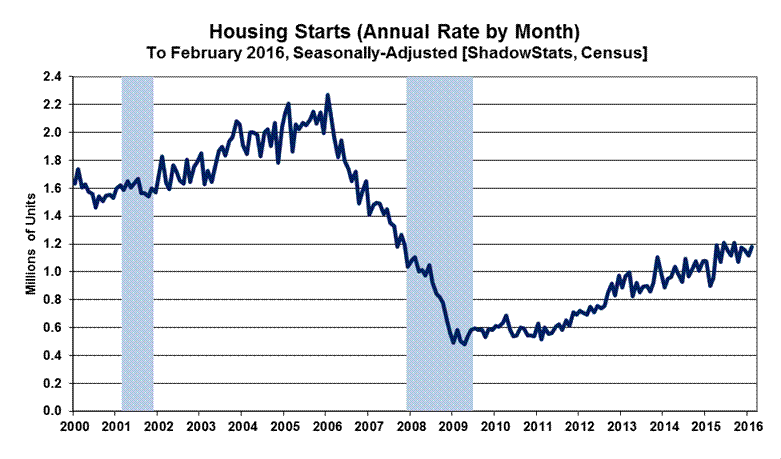
Graph 38: Housing Starts (Annualized Monthly Rate of Activity), 1946 to Date
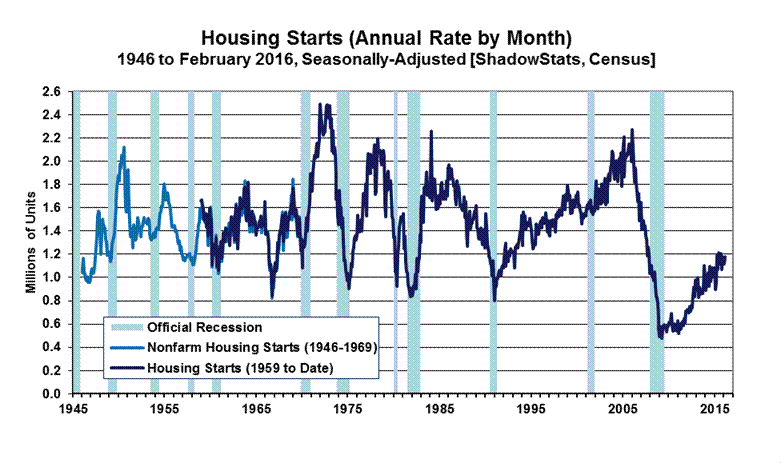
__________
WEEK AHEAD
Economic Reporting Should Continue on the Downside of Expectations, Increasingly Pummeling the Dollar and Boosting Gold, Silver and Oil Prices. Likely moving to the downside, again, amidst intensifying, negative headline reporting in weeks ahead, market expectations for business activity should increasingly deteriorate, even as reviewed in the popular media. The broad trend in weakening expectations for business activity has continued, and movement towards looming recession recognition has accelerated, as discussed in the Opening Comments, in Commentary No. 789 and in No. 777 Year-End Special Commentary. Increasingly negative reaction has surfaced in trading of the U.S. dollar and in related financial markets, with some upside movement in prices for gold and silver (see the Hyperinflation Watch, Commentary No. 784 and Commentary No. 785). Circumstances here also should limit further heavy selling in the oil market, increasingly turning oil prices to the upside, in response to intensified dollar selling.
Weaker headline reporting of the regular monthly economic numbers increasingly should be accompanied by much worse-than-expected—negative—reporting for at least the next several quarters of GDP (and GDI and GNP), still for fourth-quarter 2015 and well into the looming 2016 detail (see the Opening Comments). That includes an eventual outright quarterly contraction in revised fourth-quarter 2015 GDP activity, as well as other pending downside revisions to GDP history in the 2016 annual benchmark revisions, due on July 29th. Increasingly, in conjunction with pending downside revisions to industrial production and retail sales, the GDP benchmarking likely will be the point at which recent headline GDP reporting revises to contraction.
CPI-U consumer inflation—intermittently driven lower in 2015 and early-2016 by collapsing prices for gasoline and other oil-price related commodities—likely has seen its near-term, year-to-year low. Although month-to-month headline inflation was unchanged for January 2016, annual CPI-U jumped sharply, against year-ago weak inflation, to a 15-month high. Although headline monthly February inflation was negative, annual inflation remained positive. Monthly prices should turn positive, again, as early as March, with rising gasoline prices. Inflation will rise more sharply, going forward, pending a weakening U.S. dollar environment, and a related upturn in oil prices and other commodities. Separately, fundamental reporting issues with the CPI are discussed here: Public Commentary on Inflation Measurement.
Note on Reporting-Quality Issues and Systemic-Reporting Biases. Significant reporting-quality problems remain with most major economic series. Beyond the pre-announced gimmicked changes to reporting methodologies of the last several decades, which have tended to understate actual inflation and to overstate actual economic activity, ongoing headline reporting issues are tied largely to systemic distortions of monthly seasonal adjustments. Data instabilities—induced partially by the still-evolving economic turmoil of the last nine-to-eleven years—have been without precedent in the post-World War II era of modern-economic reporting. The severity and ongoing nature of the downturn provide particularly unstable headline economic results, when concurrent seasonal adjustments are used (as with retail sales, durable goods orders, employment and unemployment data). That has been discussed and explored in the labor-numbers related Supplemental Commentary No. 784-A and Commentary No. 695.
Separately, discussed in Commentary No. 778, a heretofore unheard of spate of “processing errors” has surfaced in recent surveys of earnings (Bureau of Labor Statistics) and construction spending (Census Bureau). This is suggestive of deteriorating internal oversight and control of the U.S. government’s headline economic reporting. At the same time, it indicates an openness of the involved statistical agencies in revealing the reporting-quality issues.
Combined with ongoing allegations in the last year or two of Census Bureau falsification of data in its monthly Current Population Survey (the source for the BLS Household Survey), these issues have thrown into question the statistical-significance of the headline month-to-month reporting for many popular economic series (see Commentary No. 669).
PENDING RELEASES:
Existing- and New-Home Sales (February 2016). February 2016 Existing-Home Sales are due for release on Monday, March 21st, from the National Association of Realtors (NAR), with the February 2016 New-Home Sales report due from the Census Bureau on Wednesday, March 23rd. Both Existing- and New-Home Sales will be covered in the next Commentary No. 794 of March 24th.
Discussed in today’s Housing Starts detail, the consumer remains in an extreme liquidity bind, constraining residential real estate activity. Such was updated briefly in Commentary No. 792 and Commentary No. 791 and discussed broadly in Commentary No. 790 and No. 777 Year-End Special Commentary. Without sustained growth in real income, and without the ability and/or willingness to take on meaningful new debt in order to make up for the income shortfall, the U.S. consumer has been unable to sustain positive growth in broad U.S. economic activity, particularly as tied to residential real estate.
Where the private housing sector never recovered from the business collapse of 2006 into 2009, there remains no chance of a near-term, sustainable turnaround in the home-sales activity, without a fundamental upturn in consumer and banking-liquidity conditions. That has not happened and does not appear to be in the offing.
Headline Existing-Home Sales remain subject to extreme month-to-month volatility as the NAR attempts to adjust and account for headline monthly closings of home sales, in the context of regulatory-induced timing disruptions on mortgage closings. That circumstance led to a misleading collapse of headline sales in November a misleading sales explosion in December and questionable numbers in January. When those factors fully are resolved, Existing-Home Sales should resume a pattern of relatively low-level stagnation, going forward.
Further, smoothed for regular extreme and nonsensical monthly gyrations, a continuing pattern of stagnation or downturn in New-Home Sales also is likely. Its pattern of low-level stagnation turned from up-trending to down-trending in September 2015. Monthly changes in activity here rarely are statistically-significant, amidst the otherwise unstable headline monthly reporting and revisions.
New Orders for Durable Goods (February 2016). The Census Bureau will report February 2016 New Orders for Durable Goods on Thursday, March 24th, which will be covered in Commentary No. 794 of that date. Net of irregular activity in commercial aircraft orders, aggregate orders likely continued a pattern of down-trending stagnation, consistent with some downside catch up.
Commercial aircraft orders are booked for the long-term—years in advance—so they have only limited impact on near-term production. Further, by their nature, these types of orders do not lend themselves to seasonal adjustment. As a result, the durable goods measure that best serves as a leading indicator to broad production—a near-term leading indicator of economic activity and the GDP—is the activity in new orders, ex-commercial aircraft.
Gross Domestic Product (GDP)—Fourth-Quarter 2015, Third Estimate, Second Revision (GNP and GDI Initial Estimates). The Bureau of Economic Analysis (BEA) will publish its third estimate, second revision of fourth-quarter 2015 Gross Domestic Product (GDP) on Friday, March 25th It will be covered in Commentary No. 795 of that date. Discussed in the opening section of today’s Opening Comments, the third estimate of growth should revise lower, but an actual headline contraction probably awaits the July 29th GDP benchmark revisions. Where the initial reporting of annualized real quarterly growth here had been 0.69%, that revised to 1.01% in the first revision, with expectations for some downside revision in this next round of reporting.
Fourth-quarter 2015 GDP should be in an outright quarterly contraction in its final form. Formal recession recognition (timed from December 2014) likely would follow shortly in the wake of the eventual announcement of a headline contraction in fourth-quarter 2015 GDP, or even a headline contraction in first-quarter 2016 GDP, which may be seen before the benchmarking.
Recent headline seasonal-adjustment revisions to the CPI and PPI already suggest that pending revisions to GDP inflation patterns already would have the fourth-quarter 2015 GDP in headline contraction, but those elements should not come into play, again, until the GDP benchmarking. Separately, solid indications of the pending downside GDP revisions should be evident in the looming downside benchmark revisions to Industrial Productions (April 1st) and Retail Sales (April 29th).
Per the BEA, initial estimates for fourth-quarter 2015 Gross National Product (GNP) and Gross Domestic Income (GDI) also will be published on March 25th. Where GDI is the theoretical income-side equivalent of the consumption-side GDP, and where GNP is the broadest U.S. economic measure (GDP is GNP net of trade flows in interest and dividend payments), those two alternate-GDP measures often provide interesting contrasts to the generally poor-quality and inconsistent headline reporting of the GDP.
__________