Thursday, March 15th, 2012
Please see our introductory pages on payroll tax receipts for some background information on this data series. Also our previous update (Feb. 17th) for a discussion of 2012 potential tax receipt growth.
Note: In all that follows, "Tax Receipts" and "Tax Deposits" refer to payments deposited by employers on the basis of payroll activity, and received by the US Treasury . The deposits consist of income tax withheld from employees, plus payroll taxes (i.e. Social Security and Medicare contributions made by both the employer and employees.) We analyze the Daily Treasury Statements and, despite any appearance to the contrary in the Treasury’s Monthly Statements, these two taxes cannot be separately identified at the time deposits are received.
Understanding Tax Receipts During This Bonus Season.
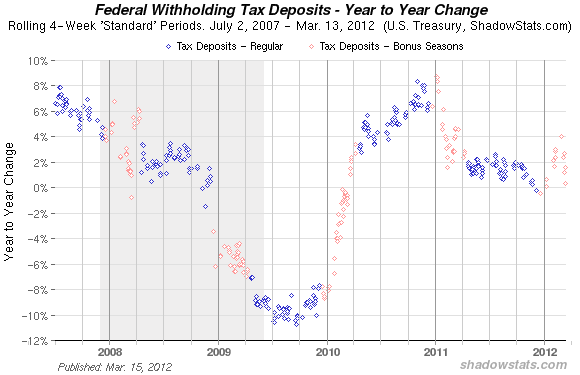
In the chart above, we see the year-on-year growth in receipts falling to almost zero in the four-weeks ended March 13th, from a high of 4% at the beginning of the month.
This looks to be due to a shifting forward of some 2012 March bonuses into February. Some employers may have wished to ensure - while the payroll tax holiday extension was still in doubt - that their employees enjoyed the 2% reduction on their bonus tax before it possibly expired in March.
We expect a rebound in growth over the next three to four weeks. As discussed in our previous Update, if - as per the BLS - job numbers are up 1.5% year-over-year, and average wages up 2.5%, we should see growth in tax receipts of between 4% and 5% once we are into April and out of bonus season.
Friday, February 17th, 2012
Please see our introductory pages on payroll tax receipts for some background information on this data series.
Analyzing the Potential for Tax Receipts Growth in 2012
Note: In all that follows, "Tax Receipts" and "Tax Deposits" refer to payments deposited by employers on the basis of payroll activity, and received by the US Treasury . The deposits consist of income tax withheld from employees, plus payroll taxes (i.e. Social Security and Medicare contributions made by both the employer and employees.) We analyze the Daily Treasury Statements and, despite any appearance to the contrary in the Treasury’s Monthly Statements, these two taxes cannot be separately identified at the time deposits are received.
Overview
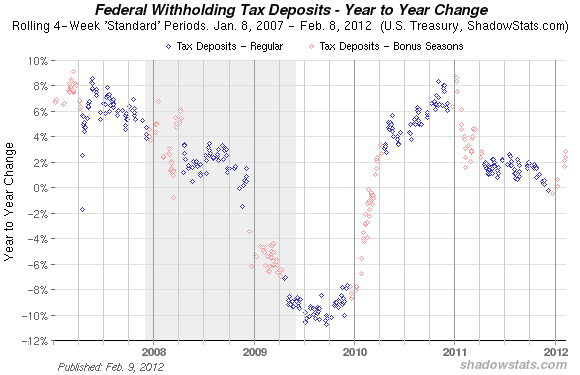
The year-to-year change in tax receipts - as is to be expected - jumped up as we moved into 2012. (See charts below.)
Using the 2011 and 2012 tax-rate structures together with broad assumptions about the working population, we have modeled expected tax growth rates for different scenarios of earnings and jobs growth. In one scenario, based on the average earnings and jobs growth estimated by the Bureau of Labor Statistics for the twelve months to January 2012, our model predicts a corresponding year-over-year tax receipt growth rate of between 4% and 5%.
For the four weeks to February 9th, 2012, however, we see an actual year-over-year growth in tax receipts of 3.0%. Since we are in the midst of bonus season, which our model does not cover, we cannot yet draw a clear comparison between what would be expected from BLS reported employment growth and what currently is observed. Clarification must wait until April, and the end of bonus season.
As pointed out in the last review in December, the annual bonus season masks the impact of regular payroll earnings on tax receipts. To make this clearer, the charts have been modified so as to highlight in different colors the periods when bonus effects are present.

Another Note on Calendar Effects
Due to the pattern of December and January national holidays this year, our proprietary series of "standardized" four-week periods has more gaps than usual. We again urge readers to pay no attention to simple calendar-month year-to-year comparisons of the raw Treasury data. See the introductory pages on payroll tax receipts and the last review of December, 22nd for an explanation of this.
Tax Growth Scenarios
If we look at the chart of year-over-year growth in tax deposits, we can see step jumps at the beginning of each calendar year. Although bonuses vary from year to year and have some transient effect on these charts, the more important issue is the change to the IRS income tax bands, allowances and credits, and how they interact with wage rises. Also, in 2011 the introduction of FICA payroll tax "holiday" was a large factor.
For individual employees, given wage growth, tax filing status, deductions and allowances, the percentage change in the tax deposits associated with their employment can be calculated. With no typical or average employee, however, the tax change over the whole working population cannot be calculated similarly.
Nonetheless, because of a convexity in the income tax curves, we have found that the percentage change in tax for certain percentage changes in income is remarkably similar across a wide range of taxable incomes. In addition, although the ratio of withheld income tax to payroll taxes (Social Security and Medicare) varies hugely with income, we an use the fact that for the total population, both sets of taxes (which are added together in the deposits we are analyzing) are roughly equal in size.
The table below shows the simple estimates for what year-over-year tax growth could be for various combinations of across-the-board growth in wages and job numbers. These numbers have been calculated with the 2% payroll tax still in place. If this tax "holiday" had not continued past February (Congress this week agreed on such a continuation) we would have added roughly another 6.7% to all of these estimates.
The ± ranges are our estimate of uncertainties about how different workers’ income tax would change, depending on their circumstances.
Estimates of 2012 Year-over-Year Tax Deposit (%) Growth
(Not applicable to years other than 2012) |
Wage Growth*
(Yr/Yr %)
|
Growth in Number
of Jobs (Yr/Yr %) |
Growth in 4-Week
Tax Deposits (Yr/Yr %) |
| 2.0 |
1.0 |
3.0 ± 0.2 |
| 2.0 |
1.5 |
3.5 ± 0.2 |
| 2.0 |
2.0 |
4.0 ± 0.2 |
| 2.5 |
1.0 |
4.0 ± 0.4 |
| 2.5 |
1.5 |
4.5 ± 0.4 |
| 2.5 |
2.0 |
5.0 ± 0.4 |
| 3.0 |
1.0 |
4.8 ± 0.5 |
| 3.0 |
1.5 |
5.3 ± 0.5 |
| 3.0 |
2.0 |
5.8 ± 0.5 |
| (*) This is actual, not inflation-adjusted wage growth. The IRS raised all tax bands in 2012 by 2.46%, the average CPI inflation in the twelve months to August 2011. The official CPI-U measure in December 2011 showed a 3.0% year-over-year increase. |
Note that for the twelve months to mid-January, the Bureau of Labor Statistics reported total job growth of 1.5% and that average weekly earnings grew by 2.5% (in the private sector). This would put us in the 4.5% ± 0.4% range of tax growth (if applied uniformly as per the model, and extended to government and farm workers).
In the four weeks to February 9th, however, the observed year-over-year growth in tax deposits was 3.0%. This period will include some bonuses which are not accounted for in the model. So, we must really wait until their effect is over, in April, for a complete assessment. At this same date last year, though, tax growth was close to the level (about 1.5%) that appeared after the bonus season of 2011. This has occurred in other years past, when large swings in employment have not clouded the picture. This may be because early-February represents a pause between the two bonus "peaks" of December and March.
CAVEAT: This analysis makes a number of assumptions about averages of distributions which may not be justified. For example, although we may have an average earnings growth, it is may not be a good approximation to apportion this, as we have done here, across all employees. Thus, these numbers should really be placed in the context of trying to explain the kind of large jump in tax receipts we are seeing, and which we may see more of, rather than as an accurate tool for deducing underlying payroll growth.
(Note: We could not do a similar analysis In 2011 because the dropping of the Making Work Pay credit made the ranges on the tax growth estimates too wide, as tax-payers differed widely in how this change affected their overall tax as a percentage.)
Thursday, December 22nd, 2011
First, a Review of Our Data Series
We want to repeat our warning that simply using the monthly receipts reported by the Treasury Department is not useful. This is explained in our Overview of Payroll Tax Receipts but to illustrate this, in Fig.1 below we chart the year-to-year change in tax receipts between each calendar month from 2010 to 2011. The eleven data points are plotted with large gray circles.
We also plot the year-to-year change in the receipts of corresponding "standardized" four-week periods produced by our proprietary calendar-adjustment model. As you can see, the usefulness of the unadjusted data is limited.

Figure 1.
Recent Trend Change
Again, a reminder that the tax receipts between mid-December and April contain two annual bonus periods, and these distort the picture of what is happening in the underlying employment situation.
Confining our attention to post-April then, we see some minor ups and downs in the growth in tax receipts up to October (Standardized Period data in Fig.1) but there seems to be a more significant dip in November. Since the data points look-back over four weeks, we can mark the start of the decline in actual tax receipts to late October.
The significance of the dip is two-fold: (a) Although we have seen growth levels of 0.5% y-y in August, we feel that a lot of the variation was due to short-lived seasonal shifts. The Oct-Nov decline is longer lived; (b) The year-to-year growth in private payroll earnings as reported by the Bureau of Labor Statistics (BLS) has diverged from our tax series, as we shall see.
In Fig. 2 we show a longer-term view of the tax-growth series, overlaid with the year-to-year change in total earnings for private non-farm employment, as estimated by the BLS. (Official recession shaded gray.)

Figure 2.
Note that the relative levels of each series (Treasury tax and BLS earnings) change with each calendar year’s tax schedule. They will differ in percentage levels and slope, but the trends should parallel each other.
What we are looking at is that drop-off in tax growth in the final quarter (to date) of 2011, and contrasting this with a continuation of a roughly 3.5% growth rate in earnings estimates from the BLS Payroll Survey.
The BLS earnings estimates exclude farm and government workers, but some rough calculations show that it is unlikely that this can explain the discrepancy - unless there has been a dramatic (additional) decrease in hours worked by (remaining) state and local workers. (The BLS provides estimates of their numbers, but not hours and wages.)
We are, however, using the seasonally-adjusted BLS series. We do not use the unadjusted series here, since it contains reporting biases which are removed by the adjustment process. Because this series does not have a long history (commencing in early 2006) it requires special, additional seasonal-adjustment efforts by the BLS. Perhaps the seasonal adjustment process is having problems with the unusual volatility seen in the data’s brief history. We wish to undertake a closer examination of this, as an extension of the work we have done in replicating the seasonal adjustment process of the BLS’s job numbers (to be published).
Social Security Wage Limit
We have received questions asking whether the drop off in November tax receipts, on a year-to-year basis, might be explained by more and more employees reaching the Social Security contribution earnings limit of $106,800, and at that point making no more payroll contributions.
Although the year-to-year comparison cancels out the normal decline in social security contributions through the year, there is a "second order" effect whereby the 2011 drop in employee contribution from 6.2% to 4.2% will give a small residual, declining effect throughout the year (all else being equal, and absent actual growth). However, the decline is too small in size, and extends so smoothly throughout the year, that it cannot explain the November drop we are seeing. (This observation comes from modeling social security contributions based on the Census Bureau’s personal income distribution data.)
There may be further small effects due to larger bonuses at the start of the year causing the contribution limits to be reached earlier, or due to changes in income distribution from 2010. But given the slow tapering of the social security contributions over the year, we believe such effects must be neglible in size.
The tax deposit series is a wonderfully complex one though, and our analysis continues.
Coming Weeks
Unfortunately, year-end bonus season is upon us, and it will be hard or impossible to separate bonus payments from normal earnings in order to monitor the down-trend we are interested in here. Perhaps in January we may be able to make some conclusions about non-bonus levels, but we need to await the data.
Any questions seeking clarification, or insights into what is involved in the tax deposit data series are most welcome: Contact Form.
Wednesday, March 2nd, 2011
Overview of Payroll Tax Receipts
______
2% FICA Cut Partially Obscured by Bonus Season
______
A reduction of 2 percentage points in employee Social Security contributions came into effect on Jan 1st, 2011. The effect of this change cannot be clearly discerned in the tax receipts as yet, because:
- Much of January’s receipts are for payrolls made in December.
- Although we saw December year-end bonuses increase over the year before, the same cannot yet be said for the deferred bonuses which employers pay in the pariod Jan. 1 - Mar. 15th.
Thus we have two (or more - see below) competing changes. However, some of the sharp drop we have seen recently must be due to the FICA cut. In a month’s time, with bonuses out of the way, we will begin to see the pattern of regular payrolls take shape. What level of deposits might we expect? It is hard to predict accurately, but here are the factors:
- Let us take as an estimate that social security taxes account for about half of all payroll tax receipts. This includes employee and employer contributions each of 6.2% (excluding Medicare). So, a reduction in employee contributions to a 4.2% rate would give rise, roughty, to an 8% reduction in payroll tax receipts, year on year.
- The Making Work Pay credit has ceased as of Jan. 1st, This will act to increase the amount of tax withheld, though not by as much as the FICA-induced drop.
- There have been increases in the income tax bands of around 1.5%. This will tend to reduce the amount of tax withheld.
- According to the Bureau of Labor Statisics, as of January 2011, total weekly earnings in private employment grew by 2.5% year over year, including a contribution of 1.2% growth in the number of jobs. This would tend to increase the amount of tax withheld.
Adding and substracting all of these estimates together yields an estimate of tax receipts with a fairly low accuracy, but we could see payroll taxes coming in a few percentage points below 2010’s, although jobs and earnings growth in the coming month or so, remain to be seen.
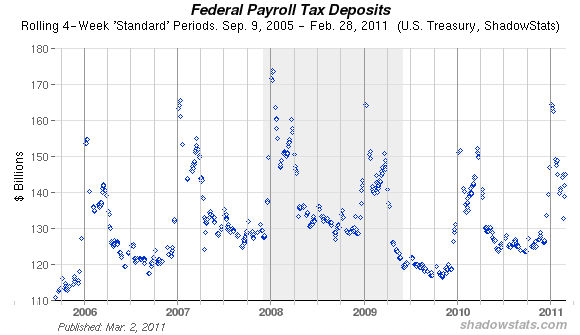
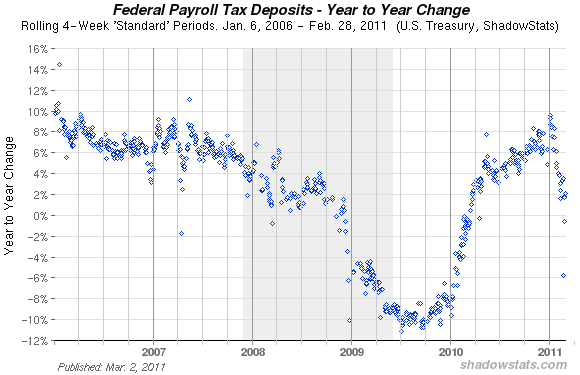
In the second chart below, the -6% point in February cannot be considered too significant given the bonus season and the possible effect of payroll systems catching up with the FICA tax change. The latest year over year change is back at the -2% level. We should get an indication of the new levels in April.
Wednesday, January 19th, 2011
Overview of Payroll Tax Receipts
______
2010 4th Quarter Growth
2010 Year-end Bonuses (Paid and Deferred)
______
2010 4th Quarter Growth
The pattern of tax receipt growth seem to imply a steady increase in total earnings.

Note that the acceleraton in year-year growth seems to stop in the 4th quarter. Remember: This is a growth chart, so a flat line at a positive level means growth in tax receipts. (The data points in the two red circles are, we believe, artifacts of the Thanksgiving holiday. )
But, remember also that we are looking here at the year-year or 12-month change. This depends not only on how earnings and tax are growing at a particular time in 2010 but also what changes were happening at the same time in 2009.
It is not possible for us to produce a monthly-change chart (yet). However, it is clear that:
- Earnings and tax were falling in the first three quarters of 2009, but that a turnaround started at about the start of Q4 2009.
- Thus in the 2nd and 3rd quarters of 2010, tax receipts were being compared with a falling picture 12 months prior, but when Q4 2010 is reached the comparison is between two growing periods.
So, a flattening off in the growth curve, to a steady 6% year-year, does not imply a slowing in monthly growth.
WARNING: The earnings growth we are talking about is not the same as growth in the number of jobs. Nor is it necessarily the growth in total weekly earnings as estimated by the BLS: Because people at different earnings levels pay different amounts of tax, there is a complex weighted averaging going on. See our note Analysis of Payroll Receipts for a discussion of income distribution effects.
End of Year Bonuses 2010 - A 15% Rise?
If we compare the spikes in payroll tax receipts at the end of 2009 and 2010 (see chart below) we get amounts of roughly $33bn and $38bn respectively. A 15% increase. (The chart shows the deposits in a set of rollling 4-week periods, but we assume that all of the year-end bonus tax will have been collected in the a single 4-week period, the one with the highest dollar amount.)

What does this tell us about the level of bonuses in 2010 compared with 2009?
Well, a 15% increase in tax does not mean that bonus payments increased by the same amount. Here’s why -
The amount of tax changes because:
- The number of people receiving bonuses changes.
- An individual’s bonus can change by X% but that can imply a signifcantly different percentage change in the tax. And this will depend on every individual’s position in the tax schedule brackets.
However, let’s make a few sweeping but reasonable assumptions and see what happens:
- Suppose that the set of people receiving bonuses for 2010 is roughly the same as those who received one in 2009.
- Suppose that their regular salary and bonus for 2010 takes their bonus within the same tax bracket as they found themselves in in 2009.
- Everyone enjoyed roughly the same % increase in their bonus.
Under these circumstances, the change in tax payable on the bonus IS proportional to the change in the bonus. Thus we can say (in this scenario) that everyone’s bonus went up by 15% last year (2010).
Now to get a non-proportional result, we would have to see bonuses moving people in between different tax brackets, and or people at different income levels receiving markedly different increases in bonus. Or, we would need to see a big change in the number of workers receiving a bonus from one year to another.
So, no definite numerical result is available, but it seems fair to say that total bonus payments have seen a healthy rise for year end 2010.
But that’s just the bonuses paid in December.
Deferred 2010 Bonuses
Empioyers running on an accrual accounting basis can choose to straddle the tax year by committing to bonuses before the end of 2010, but paying them in 2011 before mid-March. We will see a second spike in tax receipts begin to ramp up in January, peaking mid-March.
Given both the uncertainty over the retention by Congress of the exisitng tax brackets, plus the 2% reduction in FICA next year, it will be interesting to see if the relative amount of March/December payments changes compared with the previous year.
We shall see.
|


