


April 2006 Edition
JOHN WILLIAMS' SHADOW GOVERNMENT STATISTICS
Issue Number 18
April 12, 2006
_____
Gold and Oil Price Surges Foreshadow Dollar, Inflation and Political Turmoil
Inflationary Recession Continues Its Intensification
Both Current-Need and Systematic Manipulations Distort Key Economic Data
The price of gold has more than doubled in the last four years, in a steady run-up to what now is $600 per ounce. That market is sending out a warning signal of extreme danger facing the U.S. dollar and of rapidly increasing risk of severe global instability. Those observing these extraordinary times ignore such warnings at their peril.
At the same time, the political geniuses running Washington continue to fret over the latest polling numbers, while ignoring the unfolding fiscal and structural economic crises that eventually will thrust the U.S. dollar into its final tailspin and the domestic economy and financial markets into crash landings.
There are two broad types of political manipulation of economic data, systematic and current-event, and both are at work distorting economic reports. A new example of systematic manipulation -- using methodological change or redefinition -- is noted in this month's "Reporting Focus" on the PPI. Imported goods were excluded at one point from the pricing surveys. In an era of a generally weakening dollar, that removed some inflationary pressures from a series that was supposed to measure inflationary pressures.
The current-event manipulation, however, is what will dominate key economic figures out through the mid-term election. It involves direct political intervention in the reporting process in order to enhance the reported results. Indeed, the relatively happy news from the employment/unemployment front in March appears to have been carefully crafted by Administration manipulators. Similar efforts are likely to generate a reported surge in first-quarter GDP growth, as well as ongoing "strong" jobs data.
Nonetheless, continued negative inflation-adjusted growth in money supply (M2), monthly declines in key components of the purchasing managers surveys, sharp downturns in annual change for housing starts and help-wanted advertising, flat to negative annual change in consumer confidence and real earnings, and a record trade deficit all continue to show faltering economic activity.
Then there is inflation. With oil pushing $70 per barrel and gold at $600 per ounce, how can anyone talk about low and stable inflationary conditions with a straight face? Some inflation considerations are discussed in the following section on gold and in this month's "Reporting Focus" on the PPI.
Despite all the hype and all the propaganda, the doctored data are not fooling Main Street U.S.A., and they are not fooling the gold market.
Gold has served its owners over the millennia primarily as a store of wealth. Well beyond its demand for use in jewelry or as an industrial commodity, the recent surge in the price of gold is a direct measure of faltering public confidence in paper currencies, particularly the U.S. dollar, as well as a measure of public discomfort as to global political stability.
Changes in dollar value as measured against inflation and in currency exchange can be quantified and are discussed below. While inflation and currency movements usually are tied to together, as can be seen in the plots, that is not always the case.
Global political stability does not lend itself easily to quantification. Instead, the gold price itself can be used as a surrogate for measuring relative global stability, while currency values can be used as surrogates for relative country-to-country political stability. Problems involving the United States and its currency, however, usually involve a global scope.
Even that now-retired fan of substitution-based core inflation rates, Alan Greenspan, was noted to have followed gold as an indicator of pending inflation and of inflationary expectations.
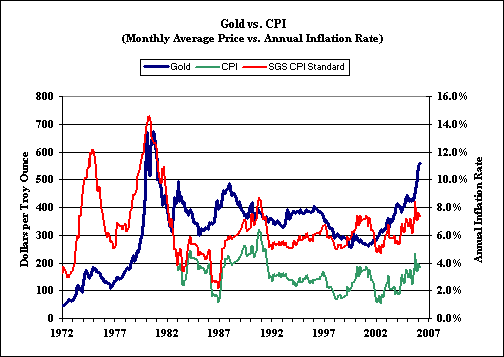
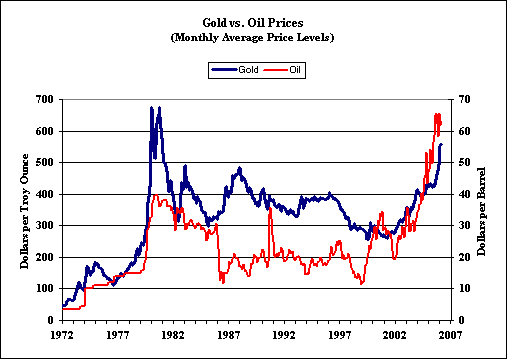
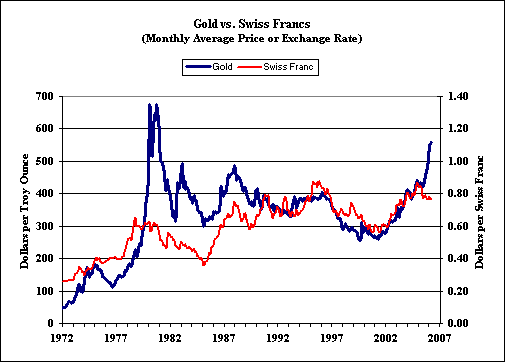
In the above graphs, the numbers are monthly averages for gold (London afternoon fix), oil (West Texas Intermediate spot) and the Swiss franc (noon buying rate New York City). The CPI measures are the CPI-U as published by the Bureau of Labor Statistics and the SGS Standard CPI, which is the CPI-U with methodological-change effects removed, using BLS estimates of same, as discussed in the October 2005 SGS "Reporting Focus."
The first two graphs show the gold price plotted against factors that reflect the U.S. dollar's purchasing power based on inflation. The first graph shows gold versus annual CPI inflation, both before and after the CPI methodological changes of the last 25 years. The second graph shows gold plotted against the oil price, where oil prices often are a major driving force behind the pace of CPI inflation. Oil price movements have about a 60% correlation with gold price movements. A noticeable variation in gold versus oil/inflation movement is in the 1987 timeframe, but that was when the U.S. dollar was in freefall in the currency markets, as seen in the next graph.
The third graph plots gold against the Swiss franc, a measure that reflects the U.S. dollar's purchasing power on a foreign exchange basis. Movement in the Swiss franc explains about 60% of the movement in the gold price in the last 30 years or so. Together, dollar debasement measures from currency and inflation perspectives explain roughly 80% of the movement in the historical price of gold.
The relationships go both ways, however, with movements in the price of gold often foreshadowing the inflation or currency movements to come. The current strength in gold, as shown in the graphs, is suggestive not only of higher inflation the near term, but also of a looming, sharp decline in the U.S. dollar.
In general, the broad economic outlook has not changed. The 2005 to 2007 inflationary recession continues to deepen. Recession, inflation and risks of heavy dollar selling are upon us and continue to offer a nightmarish environment for the still largely Pollyannaish financial markets.
The Shadow Government Statistics' Early Warning System (EWS) was activated in May 2005 and signaled the onset of a formal recession in July 2005. The EWS looks at historical growth patterns of key leading economic indicators in advance of major economic booms and busts and sets growth trigger points that generate warnings of major upturns or downturns when predetermined growth limits are breached. Since the beginning of 2005 a number of key indicators have been nearing or at their fail-safe points, with four indicators moving beyond those levels, signaling a recession. Once beyond their fail-safe points, these indicators have never sent out false alarms, either for an economic boom or bust.
Despite weak growth reported for fourth-quarter 2005 GDP, negative GDP growth is not likely to surface in regular government reporting until after the November 2006 election, given the rampant political manipulation of most key government numbers. In fact, a reported surge in GDP growth is a political likelihood for first-quarter 2006. The National Bureau of Economic Research (NBER) should time the downturn to mid-2005 and announce same also sometime after the election, so as not to be deemed politically motivated in its timing.
Whether or not there is a recession will be a hot topic in the popular financial media, with politics helping to fuel the debate as the election nears. Those Wall Street economists who act as shills for the market will keep up their "strong growth is just around the corner" hype regardless of any and all evidence to the contrary.
From the standpoint of common experience, this downturn will be considered the second leg of a double-dip recession, not an independent contraction as will be claimed officially.
Most economic data have softened, and the trend will accelerate sharply, with regular monthly contractions seen for both payroll employment and industrial production, although political manipulation can keep the payroll data afloat for a while. Significant deterioration also will be seen in corporate profits and federal tax receipts. Lower tax receipts will combine with disaster recovery spending and the ongoing war in Iraq to accelerate deterioration in the federal finances.
This outlook is predicated on economic activity that already has taken place and does not consider any risks from exogenous factors such as renewed terrorist activity in the United States, major natural disasters or a financial panic.
Market perceptions of the downturn in business activity are mixed. When expectations begin to anticipate weak data, expectations also will be lowered for inflation, although stagflation still seems to have gained a good foothold in some consensus thinking. Consensus forecasts generally will tend to be surprised on the downside for economic reports and on the upside for inflation reports, for some time to come.
The roots of the current difficulties are structural in nature. A consumer starved of income growth and overburdened with debt cannot sustain the real (inflation-adjusted) growth in consumption needed to keep GDP growth in positive territory. The income weakness is a direct result of the loss of a significant manufacturing base to offshore locations and the ensuing explosive, perpetual growth of the U.S. trade deficit.
Exacerbating economic and financial woes will be unusually high inflation during this contraction. Gold prices already are starting to anticipate the inflation troubles. Fueled by high oil prices, weakness in the U.S. dollar and accelerating Fed monetization of federal debt, inflation will not be brought under control simply by weakness in economic demand. Instead, persistently high prices only will serve to intensify the 2005 to 2007 recession, making it exceptionally long and protracted. Ongoing inflation woes and dollar problems will maintain upside pressure on long-term interest rates, inhibiting the traditional flattening of the yield curve expected with a recession.
Risks of the current circumstance evolving into a hyperinflationary depression remain extraordinarily high.
An unfolding inflationary recession is the worst of all worlds for the financial markets. Particularly hard hit will be the U.S. dollar, with downside implications for both equity and bond prices. When the system re-stabilizes, post-crisis, there will be exceptional investment opportunities for those who have been able to preserve their wealth, capital and liquidity.
(Each of these series is explored in the background article "A Primer On Government Economic Reports," available on the home page.)
As discussed in this month's opening comments, direct manipulation of key economic data appears to be well entrenched in current economic reporting. With the President's ratings continuing to bottom roll at historic lows, near-term economic reporting will remain gimmicked as long as possible, almost certainly through the mid-term election. As a result, reported economic results will continue having less than usual relevance to actual underlying activity, and upcoming reporting of the major series will be determined more by political need than by the economic factors that should drive the results.
Per subscriber request, analysis of key data will be extended to include a per capita basis, where appropriate, starting with the May newsletter.
Employment/Unemployment -- Thanks to ongoing seasonal adjustment shenanigans (shifting monthly seasonals as reporting progresses) and prior-period revisions, March's 211,000 new payroll jobs topped market expectations.
Further, the popularly followed seasonally-adjusted unemployment rate U-3 for March eased to 4.65% from February's 4.78%, well inside the published +/- 0.2% error margin. The unadjusted U-3 unemployment eased to 4.8% in March from February's 5.1%, and the broader U-6 unemployment measure eased to 8.5% from 9.0% in February. March's seasonally-adjusted U-6 rate also softened, easing to 8.2% from 8.5%. Including the long-term "discouraged workers" defined away during the Clinton administration, total unemployment remains roughly 12-percent. The household survey also showed seasonally-adjusted March employment (those people with at least one job) up by 384,000 versus a 183,000 gain in February.
For March, the payroll survey's seasonally-adjusted gain of 211,000 (177,000 net of revisions) +/- 108,000, followed a downwardly revised February gain of 225,000 (was 243,000). Annual growth in unadjusted March payrolls was 1.59%, slightly higher than February's revised 1.53% (was 1.58%).
March's payroll gain of 211,000 included a positive bias of 135,000 jobs in the "net birth/death" adjustment.
The latest report was against a background of falling annual growth in February help-wanted advertising, deteriorating employment trends as reported in the various March purchasing managers surveys, but improved new claims for unemployment insurance (see the respective sections).
Next Release (May 5): The political needs of the Administration remain great and will continue to offset the impact of sharply slowing economic activity in the employment data. While underlying reality would suggest downside surprises to April reporting, needed number massaging should keep jobs growth at or above what should be strong consensus expectations. The developing target reporting still appears to be 250,000 jobs per month, leading up to the mid-term election.
Gross Domestic Product (GDP) -- The "final" estimate revision of annualized inflation-adjusted growth for fourth-quarter GDP was no more than statistical noise in an otherwise worthless series, moving previously reported growth from 1.63% to 1.65% +/- 3.2%. Such still was the weakest reading in three years. Fourth-quarter growth remained well below the first quarter's "robust" 4.14%.
Year-to-year growth was unrevised at 3.22%, still down from the third quarter's 3.64%, and still the softest reading since second-quarter 2003. Final sales -- GDP net of inventory changes -- revised back into negative territory, down 0.25%, having been flat in the prior estimation, and down from 4.56% growth in the third quarter. The GDP inflation rate (deflator) last reported at an annualized 3.31%, revised upward to 3.47%, offsetting a slight upward revision to nominal GDP growth.
First estimates of alternate GDP measures, Gross National Product (GNP) and Gross Domestic Income (GDI), finally were published. Annualized real growth for fourth-quarter GNP was just 0.72%, down from 4.41% in the third quarter. Where GNP is GDP net of trade flows in factor income (interest and dividend payments), economic damage was seen from the nation's deteriorating net-debtor status.
Annualized real growth for fourth-quarter GDI slowed to 2.84% from the prior quarter's 5.27%. Growth was helped by some shrinkage in the statistical discrepancy. GDI represents the theoretically-equal income measure to the GDP's consumption measure.
Economists have been rallied by Wall Street and the Administration to tout booming GDP growth as likely in the first quarter. While such may be the actual reporting, it will not represent reality.
Despite the softness in the fourth-quarter GDP reporting, these numbers generally are used as political propaganda and usually have little or no relationship to underlying economic reality. Given the long-term upside methodological biases built into the GDP, an actual quarterly contraction of roughly two-percent in fourth-quarter GDP would have been closer to reality.
Next Release (April 28): The "advance" estimate for first-quarter 2006 GDP is likely to be manipulated to show the strong growth being built into the economic consensus. A large widening in today's trade deficit estimate could dampen those expectations a little.
Consumer Price Index (CPI) -- The BLS reported the seasonally-adjusted February CPI-U up by 0.05% (0.20% unadjusted), following January's 0.66% (0.76% unadjusted) gain. February's annual inflation rate eased to 3.60% from January's 3.99%.
The "experimental" Chained Consumer Price Index (C-CPI-U), the fully substitution based CPI that presumably is the eventual replacement for current CPI reporting, showed annual inflation of 3.04% In February, down from 3.41% in January.
Adjusted to pre-Clinton methodology, annual CPI growth was about 6.6% as of February, while the SGS Standard CPI, net of all the methodology changes of the last 30 years that were designed to suppress inflation reporting, stood at 7.4%.
Contrasted with February's 2.1% annual Core CPI-U inflation rate that excludes the necessities of food and energy, the SGS Base CPI-U that includes only the necessities was up 4.0% in February. The SGS rate, however, still suffers the standard CPI-U methodological understatement.
Next Release (April 19): The March CPI generally should surprise modest-to-soft consensus forecasts on the upside, with "core" inflation increasingly reflecting the effects of still-rising oil prices. As noted in this month's "Reporting Focus," PPI inflation does tend to lead the CPI and suggests that higher annual inflation already is in place.
Despite occasional short-term volatility, annual inflation will remain high and should accelerate to the upside as 2006 progresses. With seasonally-adjusted monthly inflation reported at 0.6% for March 2005, monthly March 2006 inflation above or below that will move the reported annual inflation rate in tandem.
To varying degrees, most of the following series have significant reporting problems. All series (including the more trouble free) will be addressed in a monthly "Reporting Focus," with this month's analysis examining the Producer Price Index (PPI).
In addition to the big three, other series that have been detailed are:
* The Federal Deficit (an original background article, update in the Alert of July 7, 2005, update in Supplement to December 2005 SGS);
* Consumer Confidence (November 2004 SGS);
* The Trade Balance (December 2004 SGS);
* Industrial Production (January 2005 SGS);
* Initial Claims for Unemployment Insurance (February 2005 SGS);
* Retail Sales (March 2005 SGS);
* Alternate Payroll Employment Measures (April 2005 SGS);
* Money Supply (Part I - SGS Early Warning System - May 2005 SGS, Part II - June 2005 SGS, M3 update - November 2005 Supplement, M2 update - March 2006 SGS);
* Financial- and Trade-Weighted U.S. Dollar Indices (July 2005 SGS);
* Short-Term Credit Measures (August 2005 SGS);
* Income Variance/Dispersion (September 2005 SGS);
* CPI (an original background article and October 2005 SGS);
* Help Wanted Advertising (January 2006 SGS);
* Purchasing Managers Survey (February 2006 SGS).
Federal Deficit -- While there have been no new monthly deficit numbers since the last newsletter, the gross federal debt has been updated to the end of March. As discussed in prior newsletters, the official, accounting-gimmicked 2005 deficit (fiscal year ended September 30th) was $318.5 billion, but it was eleven times higher -- at $3.5 trillion -- on a GAAP basis, per the U.S. Treasury (see the December 2005 SGS Supplement). The official, accounting-gimmicked deficit for 2004 was $412.8 billion.
As of February 2006, the fifth month in fiscal 2006, the twelve-month rolling accounting-gimmicked deficit was $312.6 billion, against $407.8 billion in February 2005, and against $307.3 billion and $319.4 billion, respectively, in January 2006 and December 2005.
Separate from the GAAP-based numbers and official deficit reporting, the change in gross federal debt is a fair indicator of actual net cash outlays by the government. As of fiscal-year-end 2005, the gross federal debt was $7.933 trillion, up $554 billion from September 2004, which, in turn, was up by $596 billion from September 2003.
The gross federal debt as of March 31, 2006 was $8.371 trillion, up $101 billion from February and up $594 billion from March 2005, which, in turn, was up $646 billion from March 2004.
Going forward, the official federal deficit will inflate quickly, as government finances suffer tax revenue losses from the intensifying recession. While GDP growth estimates can be gimmicked, incoming tax receipts will remain an independent estimate of underlying economic reality.
Initial Claims for Unemployment Insurance -- Annual growth in initial claims moved deeper into negative territory (an economic positive), although the improvement has been tied to the expiration of certain extended benefits and enhanced by recent annual revisions. On a smoothed basis for the 17 weeks ended April 1st, annual change fell to a 9.0% decline, following March 4th's 8.0% contraction (revised from 7.4%).
The volatility of the seasonally-adjusted weekly numbers is due partially to the seasonal-adjustment process. When the series is viewed in terms of the year-to-year change in the 17-week (three-month) moving average, however, such usually is a fair indicator of current economic activity.
Real Average Weekly Earnings -- February's real earnings were unchanged from January's reading, which showed a 0.2% decline from December. February's real earnings were down 0.1% from the year before, following January's 0.4% decline.
Volatility in this series comes primarily from variations in reported CPI growth. Allowing for the biases built into the CPI-W series used in deflating the average weekly earnings, annual change in this series signals ongoing severe financial strain on U.S. households and continuing recession.
Retail Sales -- While there has been no new monthly report since the last newsletter, the retail sales series went through an annual benchmark revision on March 30th, which lowered overall retail sales by 1.7% from the previously reported level.
As a result of revisions, February's seasonally-adjusted monthly retail sales fell by 1.4% (was down 1.3%) +/-0.7%, following a 3.0% (was 2.9%) gain in January.
Inflation-adjusted year-to-year growth in retail sales below 1.8% (using the official CPI-U for deflation) signals recession. February's annual growth on that basis was 3.0%, down from January's 5.3%. As CPI reporting continues its upward cycle in the month's ahead, real annual retail sales will fall again below its recession warning threshold, confirming the economic downturn.
Next Release (April 13): March retail sales should come in below strong expectations, reflecting declining economic activity.
Industrial Production -- Thanks to unusually large swings in estimated utility usage, seasonally-adjusted February production rebounded by 0.7% from January's 0.3% contraction (previously reported as a 0.2% decline). Production levels for November through January all were revised downward. Afterrevisions, February 2006 production was up 3.3% versus the year before.
Next Release (April 14): Industrial production increasingly should mirror the recession, entering a series of regular monthly contractions. As utility usage distortions from unusual weather patterns taper off, upcoming reports will tend to surprise market expectations on the downside, with a pattern of declining annual growth.
New Orders for Durable Goods -- February's seasonally-adjusted new orders for durable goods increased by 2.6% (4.2% net of revisions) for the month, following January's revised plunge of 8.9% (was 10.2%). Monthly volatility continues around large aircraft orders. February's annual growth rate was up 7.8%, following January's 7.7% gain (previously 5.7%). The widely followed nondefense capital goods orders rose by 1.6%, following the 19.8% plummet in January (previously down 20.0%).
At one time, durable goods orders was one of the better leading indicators of broad economic activity, when smoothed using a three-month moving average. After the semi-conductor industry stopped reporting new orders, however, the series' predictive ability suffered a serious setback.
Trade Balance -- The seasonally-adjusted February trade deficit is due out later this morning. As discussed last month, January's trade deficit widened to $68.5 billion, topping October 2005's record level of $67.8 billion. The December deficit revised to $65.1 billion (was $65.7 billion), up from November's $64.5 billion shortfall.
Next Release (April 12): Contrary to expectations, today's February trade deficit should deteriorate relative to January, putting downside pressure on overly rosy political estimates of first-quarter GDP growth. Generally, upcoming monthly deficits will continue to surge beyond consensus forecasts, with new record monthly deficits following regularly in the months ahead.
NOTE: Doug Gillespie will be posting an initial report on today's trade numbers entitled, "February Trade Data (#1)." For those interested in the overall results, check the "Latest Missives" section (middle column) on the home page of the Gillespie Research website. The material should be posted by 10:30 AM (ET).
Consumer Confidence -- March Consumer confidence gained for the month, but annual growth held in recession territory. The Conference Board's consumer confidence index rose by 4.4%, after February's 3.8% decline (previously down 4.8%), and the University of Michigan's March consumer sentiment rose by 2.5% after falling 4.9% the month before.
On a three-month moving-average basis for March, annual growth in the Conference Board's measure was up just 1.3%, while the University of Michigan number was down 5.5%. These lagging, not leading, indicators are signaling that the economy remains in recession.
Short-Term Credit Measures -- Annual growth in short-term credit measures for businesses continued strong, holding double digit annual growth, while annual growth in consumer credit continued to falter, with annual growth down to 2.6%.
Seasonally-adjusted consumer credit remained in serious slowdown, with February's consumer credit level still below that of September 2005. Preventing meaningful monthly growth, annual growth slowed from January's 2.8% to 2.6% in February. Without growth in income, growth in personal consumption can be supported over the short-term only by debt expansion or savings liquidation, and consumer debt expansion has screeched to a halt.
Annual growth in commercial paper outstanding surged to 19.3% in March from February's 17.7% pace. Annual growth in commercial and industrial loans inched lower to 12.7% in February from January's 13.0%. Rising sales can fuel short-credit needs, but so too can slowing sales, slowing collections and rising inventories.
Producer Price Index (PPI) -- The seasonally-adjusted February finished goods PPI fell by 1.4% (also down 1.4% unadjusted), following January's 0.3% gain. Annual PPI inflation eased to 3.7% from January's 5.7%. This "wholesale" inflation index and its relationship to the CPI are examined in this month's "Reporting Focus."
Next Release (April 18): Despite a large component of random volatility in monthly price variations, PPI inflation reporting over the next six-to-nine months should, in tandem with the CPI, top market expectations. Inflation should be stronger than consensus forecasts increasingly in the "core" inflation measures.
Purchasing Managers Survey (Non-Manufacturing) -- There is nothing unusually wrong with this survey of the service industry, except it does not have much meaning. Unlike its older counterpart, the manufacturing survey, if service companies such as law firms, hospitals or fast-food restaurants have "increased orders," that does not necessarily mean that economic activity is increasing.
The overall March index rose by 0.7% to 60.5 from February's 60.1. The index is a diffusion index, where a reading above 50.0 indicates a growing service economy, in theory. Both the employment and prices paid components, however, have some meaning.
The March employment component fell to 54.6 from 58.2, suggesting a deteriorating employment environment in the service sector.
The prices paid component diffusion index is a general indicator of inflationary pressures. The March index also eased, falling to 60.5 from 64.8 in February, a level that still is highly inflationary. On a three-month moving average basis, the annual change in March was a drop of 3.6%, following February's decline of 3.0%.
The following numbers are generally good-quality leading indicators of economic activity and inflation that offer an alternative to the politically-hyped numbers when the economy really is not so perfect. In some instances, using a three-month moving average improves the quality of the economic signal and is so noted in the text.
Economic Indicators
Purchasing Managers Survey (Manufacturing) - New Orders -- The March new orders index fell by 5.6% to 58.4, after February's index increased by 6.7% to 61.9. This measure breached its fail-safe point a number of months back, generating an SGS early warning indicator of pending recession.
The Commerce Department provides suspect seasonal factors for the series, and the resulting adjusted monthly numbers can be misleading in the reporting of month-to-month change. This problem is overcome by using year-to-year change on a three-month moving average basis. On that basis, the March index increased by 4.3% following February's decline of 0.6%. The index gradually has notched lower from its peak annual growth of 42.6% in April of 2004.
Published by the Institute for Supply Management (ISM), the new orders component of the purchasing managers survey is a particularly valuable indicator of economic activity. The index is a diffusion index, where a reading above 50.0 indicates rising new orders. The overall March ISM index eased to 55.2 from 56.7 in February. An index level of 50.0 divides a growing versus contracting manufacturing sector. The March employment component also fell, dropping to 52.5 from 55.0 in February.
Help Wanted Advertising Index (HWA) -- The February help-wanted advertising index increased to 39 from a revised 38 (was 37) in January. Annual contraction, on a three-month moving-average basis, however, deepened to 6.5% from January's 2.5% decline. Annual growth is deteriorating as the index bottom bounces, much as it has since the onset of the last recession.
Housing Starts -- February housing starts fell 8.0% after January's revised 15.8% (was 14.6%) gain. Annual change on a three-month moving average basis plunged to a 0.8% contraction in February from January's 6.3% gain. The series, once again, is at the brink of generating a recession warning signal.
Money Supply -- Based on one week's reporting for March, annual M3 growth was moving up, up and away, when the Federal Reserve turned off the radar screen. The Fed apparently does not want an inflation-wary public to see how accommodative Messrs. Greenspan and Bernanke really have been in terms of what once used to be the broad money measure. Annual growth for M3 in March was headed for something over 8.3%, following February's 8.0%. In contrast, annual growth in both M1 and M2 slowed in March to 0.1% and 4.6% from February's respective 0.4% and 4.7%, still signaling recession. Although M3 is gone, we will offer occasional comments as various elements of the lost data become available.
Before inflation adjustment, M1 and M2 monthly changes for March (preliminary estimate based on four weeks of data) versus February were down 0.03% and up 0.18%, versus down 0.54% and up 0.32 respectively. Adjusted for CPI inflation, March's M1 and M2 annual year-to-year rates of change were down 3.2% and up 1.1%, respectively, versus down 3.18% and up 1.0% in February. On a three-month moving-average basis, the March inflation-adjusted annual rates of change were down 3.1% and up 0.9%, levels that remain well underwater using the old-style CPI.
Inflation Indicators
Purchasing Managers Survey (Manufacturing) - Prices Paid -- The March prices paid diffusion index climbed to 66.5 from February's 62.5, in increasingly strong inflation territory. On a three-month moving average basis, March's year-to-year decline narrowed to 6.5% from February's drop of 7.7%.
Published by the Institute for Supply Management (ISM), the prices paid component of the purchasing managers survey is a reliable leading indicator of inflation activity. The measure is a diffusion index, where a reading above 50.0 indicates rising inflation.
Oil Prices -- West Texas Intermediate Spot (St. Louis Fed) rose in March to $62.90 per barrel, up 2.1% from February. Oil prices persist at highly inflationary levels, with March's average price up 15.8% from March 2005, versus February's 28.5% annual gain. Oil prices in early April have continued to rally, trading within striking distance of $70.
Spot prices have and will continue to gyrate. Despite ongoing near-term price volatility, high oil prices will remain a major contributing factor to the inflation side of the current inflationary recession. Oil price changes permeate costs throughout the economy, ranging from transportation and energy costs, to material costs in the plastics, pharmaceutical, fertilizer, chemical industries, etc. Anecdotal evidence remains strong that cost pressures have already passed into the so-called "core" inflation sectors.
Oil price volatility affects CPI reporting. Downside oil price movements tend to be picked up more quickly and fully by the BLS in its inflation measures than are upside movements. Even as currently understated, CPI and PPI inflation should be much stronger than commonly predicted for the next six-to-nine months, increasingly as a result of the persistently high oil prices.
U.S. Dollar -- The Shadow Government Statistics' Financial-Weighted U.S. Dollar Index is based on dollar exchange rates weighted for respective global currency trading volumes. March's monthly dollar average was virtually unchanged, up 0.03%, following February's 1.36% increase. March's year-to-year gain rose to 8.34% from February's 7.34%.
Similarly, March's monthly average of the Federal Reserve's Major Currency Trade-Weighted U.S. Dollar Index basically was flat, down 0.06% after February's 0.92% gain. March's rate of annual change increased to 5.39% from February's 4.17%.
Dollar trading in early April has been to the downside of March's averages. The relative strength in the financial- versus trade-weighted dollar still remains at a level that usually precedes a major dollar sell-off.
Underlying fundamentals remain extraordinarily negative for the greenback. With serious shocks looming in U.S. economic and fiscal data, heavy selling pressure against the U.S. currency could break at any time, with little warning. New record lows for the dollar still remain likely in the months ahead, despite any overt or covert supportive intervention by any central bank(s).
Generally, the weaker the dollar, the greater will be the ultimate inflation pressure and the eventual liquidity squeeze in the U.S. capital markets.
Today's Producer Price Index (PPI) is defined as measuring "average changes in prices received by domestic producers for their output." The series is published monthly, by the Bureau of Labor Statistics (BLS), based on a survey dated from the week that includes the 13th of the month. Full, official detail on the series is available from the BLS website - "Producer Price Index Overview."
As the oldest series regularly published by the BLS, the PPI has been through more severe series redefinition and methodological changes than most other series, including the Consumer Price Index (CPI). Unlike the CPI, however, the PPI is not commonly used as an inflation-adjustment mechanism in contracts or as a cost-of-living adjustment in government programs such as Social Security.
Initially published in 1902, with data back to 1891, the Wholesale Price Index (WPI) continued until 1978 as primarily a commodity price index. At that time, the series was renamed, with the term "Wholesale" being changed to "Producer," and with the index broken into subcomponents based on the level of completion of the surveyed goods: finished goods; intermediate materials, supplies and components; crude materials. Those separate series had been tracked previously, and historical data were recreated and published back through 1947.
Less drastic changes over time have included elimination of imported goods prices, which helped to erase inflation resulting from a weakening dollar. Hedonic quality adjustments also were introduced to the series, but not the geometric weighting that was applied to the CPI.
Once predominantly a measure of manufactured goods, PPI in the last decade or two increasingly has become a useless measure of the services sector "wholesale" inflation. Due to the limited scope of services surveying, those costs are heavily understated and artificially depress inflation reported for the broad finished goods index. For example, it is rare to find a PPI measure of insurance costs that represents more than 20 percent of the inflation rate seen in actual policy costs. The PPI concept lends itself as poorly and nonsensically to the services sector as the Purchasing Managers Survey concept (see comments in the February 2006 SGS "Reporting Focus" and this issue's respective Purchasing Managers Survey sections).
On top of all survey issues, the PPI measures usually are viewed on a seasonally-adjusted basis. Instead of smoothed monthly changes, however, the resulting adjusted data tend to show a high level of random volatility in terms of month-to-month change. Viewed in terms of year-to-year change, or the annual rate of inflation, though, the series begins to show a strong leading correlation to the CPI, as evidenced in the accompanying graphs.
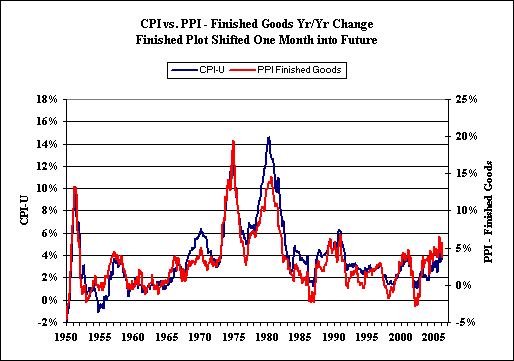

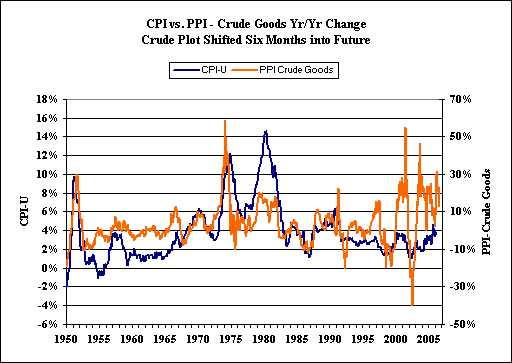
All the graphs show annual inflation by month, but the plots of the PPI stage-of-reporting components have been shifted ahead by the number of months indicated against the CPI plot, so as to show the best leading correlation between the PPI and the CPI.
Shown above, finished goods has a 93% correlation, with a one-month lead time, to the CPI; intermediate goods has a 77% correlation with a three-month lead; and crude goods has a 39% correlation with a six-month lead. As can be seen in the relative scales of change for the various PPI measures versus the CPI, the cruder the measure, the more volatile are the monthly year-to-year changes. Also, the cruder the index, the smaller the portion of the CPI it affects, and the more the PPI inflation rate is dampened in the ultimate CPI.
All three graphs, however, suggest that annual CPI inflation is headed higher in the months ahead, based on PPI annual inflation that already has been reported.
Further, given the leverage of retail markups on PPI costs, the reluctance of retailers to cut prices when crude costs decline, and the difference between surveyed goods, the CPI generally has outpaced the PPI over time.
That said, the CPI-U and PPI finished goods have an overall coincident correlation of 91%, broken out as 92% 1950 to 1980 versus 89% 1980 to date. In contrast, the SGS Standard CPI has a slightly better 91% correlation in the later 1980-to-date period (the period in which it varies from the CPI-U).
New orders for durable goods and nondefense capital goods are examined against the purchasing managers new orders series and the GDP's business investment (nonresidential fixed investment) account. What really is happening with capital investment?
This still-pending supplement is not ready for publication. The complexities of putting together a reliable independent sampling of goods for our alternate index to the CPI have proven and continue to be much more time consuming than envisioned. The project progresses, and the new series will be published, but its release is not imminent. I shall update subscribers as the situation evolves. I apologize to all for any inconvenience created by these delays.
May's Shadow Government Statistics is scheduled for release on Friday, May 12, 2006. The release date is two days later than normal due to travel. The monthly newsletter regularly is scheduled for posting on the Wednesday following the Friday release of the employment statistics. The posting of the next SGS on the website, as well as any supplements or interim alerts, will be advised immediately by e-mail.