


May 2006 Edition
JOHN WILLIAMS' SHADOW GOVERNMENT STATISTICS
Issue Number 19
May 17, 2006
_____
May and June Annual CPI Surge Likely
Government Numbers Show Weakest
Employment and Income Growth Outside of Recessions
Dollar Selling and Gold Price Surge
Foreshadow Market and Political Turmoil
The 2005 to 2007 inflationary recession has moved well beyond stagflation. Circumstances deteriorated markedly in the last month, and market perceptions of same have begun to surface. After tickling $600 per troy ounce a month ago, the price of gold broke above $700 before some profit taking earlier this week, although bullion is back above the $700 level as this is being written. At the same time, the U.S. dollar had a little bit of a tumble. In response to the issues bothering gold and belting the dollar, the credit and equity markets increasingly have had bad days. A great deal more of the same looms, as tentative market perceptions of trouble begin to solidify. The trouble is not only with a weak economy and high inflation, but also with a foundering administration and increasing odds of a shift of power coming out of the mid-term election.
PPI and CPI reporting and inflation signals in the purchasing managers surveys generally have been coming in above expectations. Soaring oil prices and a nascent dollar sell-off promise much higher inflation over the near term, with year-to-year timing promising to jolt annual inflation. In 2005, seasonally-adjusted May and June CPI declined by 0.1% in each month. With solid monthly increases in play for those months in 2006 -- beyond whatever gets reported in this morning's April report -- the monthly gains will get added directly to the annual inflation rate, plus. The effect should be the June CPI report showing annual inflation topping 5.0%, a 15-year inflation high.
The current inflation problem is driven by oil and dollar woes, factors separate from strong economic activity that commonly is viewed as the source of inflation. In like manner, Fed tightening -- designed in theory to slow the economy in order to slow inflation -- will do little to cool the current problem, shy of Volckerish rate hikes aimed at triggering such a severe downturn that prices are pulled down along with business activity into a depression. Quite to the contrary, current Fed activity has been the reverse of the jawboned inflation fighting, aimed at stimulating liquidity, not killing it. While short-term interest rates have been increased, broad money growth also has been soaring, at least prior to its reporting cut-off. Excessive money growth tends to be an inflation stimulant, not a retardant.
Signs that the economy is not doing too well abound. Housing starts appear ready to signal recession, and the housing sector has been one of very few bright spots in economic activity over the last six years or so. Aside from politically-gimmicked GDP reporting, most numbers, net of inflation, have been soft to down over the last month, including retail sales, purchasing managers new orders, help wanted advertising, narrow money growth, real earnings, consumer sentiment and even the employment report. Exceptions have included strong industrial production, volatile new orders for durable goods and an improved but still staggering trade deficit.
A subscriber recently suggested adding per capita analysis to appropriate data, and what follows shows government data, as reported, and on a per capita basis, using government population estimates. A certain portion of economic growth and employment growth, for example, is attributable simply to the expansion of the population. When activity or employment fails to keep up with population growth -- roughly 0.9% per year -- individuals tend to suffer economic discomfort.
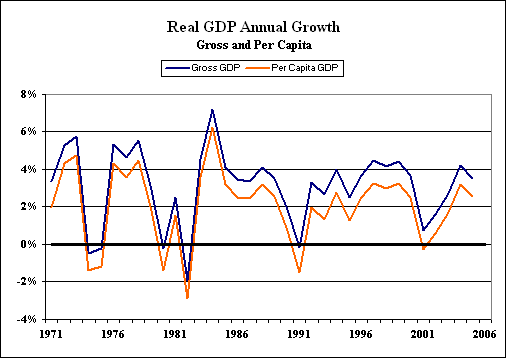
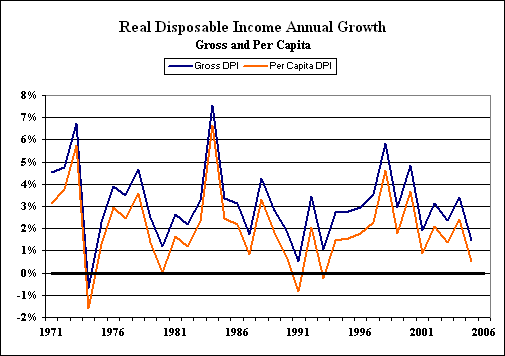
With the U.S. population approaching 300,000,000, per capita GDP in 2005 was $42,128, while per capita disposable personal income (DPI) was $30,494. Annual growth in these numbers is most significant when viewed on an inflation-adjusted basis.
The graphs show inflation-adjusted growth in annual average GDP and DPI. The per capita numbers tend to move in tandem, lagging by the difference in annual population growth. Of particular interest in these officially reported numbers is that while GDP growth rates in 2004 and 2005 were above average, such was not the case for 2005 DPI. Per capita DPI at 0.5% was nearing the 0.0% threshold of economic pain, lower than in the 2001 recession and at the lowest level since the end of the 1990/1991 recession.
Keep in mind that these are official numbers. Adjusted for upside methodological biases and understated inflation of recent decades, both annual 2005 DPI measures would be negative, as would the per capita GDP. The aggregate GDP growth would be just above zero.

The above graph updates year-to-year, inflation-adjusted growth for both the Official GDP and the SGS Alternate GDP measures, as last published in the August 2005 SGS. Growth in the official series has been unusually stable for the last seven quarters, although it has softened a little, recently. The SGS alternate measure shows a similar pattern with a lower growth level, which turned negative in fourth-quarter 2005.
The better part of the difference in growth rates is in the inflation estimate. In principle, GDP growth first is estimated before any adjustment for inflation. Next, inflation is subtracted from the nominal growth, and the result is the popularly-followed, real (inflation-adjusted) GDP growth rate. Of course, any understatement of inflation used in deflating the series results in a parallel overstatement of the reported growth rate. The GDP deflator at present appears to be understated by 3.0% to 3.5% (meaning 3.0% to 3.5% overstatement of annual real growth). A good portion of this is tied to presumed deflation in computers due to quality enhancements (see further comments in this month's "Reporting Focus").
As the GDP became an instrument of political propaganda, however, the reporting process appears to have been reversed. The desired inflation-adjusted growth rate to be reported is targeted/estimated and then the needed inflation adjustments are calculated as residuals as the difference between the needed inflation adjusted growth and the estimated nominal growth.
Please note that the referenced SGS Alternate GDP growth is an approximation of year-to-year, not quarter-to-quarter, change. A minor variation in annual growth can lead to wild swings in the quarterly growth rates. That said, year-to-year quarterly growth cannot turn negative -- as the SGS Alternate GDP did in the fourth quarter -- without there having been at least one quarterly contraction.
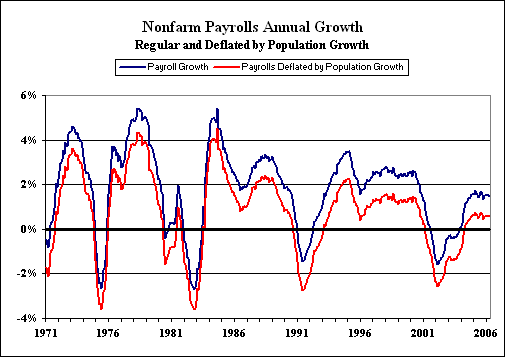
The graph above shows the year-to-year change in payroll employment, not seasonally adjusted, as normally viewed and as deflated by population growth. The current annual payroll growth, net of population growth, is a minimal 0.5%.
Putting the lie to normal economic growth in 2005 as suggested in the first GDP chart above is that both income (DPI) and payroll growth rates are at the lowest sustained levels seen outside of any recession of the last 35 years. Again, adjusted for reporting biases, these official numbers are consistent with an actual recession.
In general, the broad economic outlook has not changed. The 2005 to 2007 inflationary recession continues to deepen. Recession, inflation and risks of heavy dollar selling are upon us, gaining greater market credence, and they continue to offer a nightmarish environment for somewhat less Pollyannaish financial markets than were in place last month.
The Shadow Government Statistics' Early Warning System (EWS) was activated in May 2005 and signaled the onset of a formal recession in July 2005. The EWS looks at historical growth patterns of key leading economic indicators in advance of major economic booms and busts and sets growth trigger points that generate warnings of major upturns or downturns when predetermined growth limits are breached. Since the beginning of 2005 a number of key indicators have been nearing or at their fail-safe points, with four indicators moving beyond those levels, signaling a recession. Once beyond their fail-safe points, these indicators have never sent out false alarms, either for an economic boom or bust. Housing starts appears ready to generate such a signal in the next month or so.
With a resumed economic boom massaged into first-quarter GDP reporting, negative GDP growth is not likely to surface in regular government reporting until after the November 2006 election, given the rampant political manipulation of most key numbers. The National Bureau of Economic Research (NBER) should time the downturn to mid-2005 and announce same also sometime after the election, so as not to be deemed politically motivated in its timing.
Whether or not there is a recession will be a hot topic in the popular financial media, with politics helping to fuel the debate as the election nears. Those Wall Street economists who act as shills for the market will keep up their "strong growth is just around the corner" hype regardless of any and all evidence to the contrary.
From the standpoint of common experience, this downturn will be considered the second leg of a double-dip recession, not an independent contraction as will be claimed officially.
Most economic data have softened, and the trend will accelerate sharply, with regular monthly contractions seen for both payroll employment and industrial production, although political manipulation can keep the payroll and production data afloat for a while longer. Significant deterioration also will be seen in corporate profits and federal tax receipts. Lower tax receipts will combine with disaster recovery spending and the ongoing war in Iraq to accelerate deterioration in the federal finances.
This outlook is predicated on economic activity that already has taken place and does not consider any risks from exogenous factors such as renewed terrorist activity in the United States, major natural disasters or a financial panic.
Market perceptions of the downturn in business activity are mixed. When expectations begin to anticipate weak data, expectations also will be lowered for inflation, although worsening stagflation seems to have gained a good foothold in some consensus thinking. Consensus forecasts generally will tend to be surprised on the downside for economic reports and on the upside for inflation reports, for some time to come.
The roots of the current difficulties are structural in nature. A consumer starved of income growth and overburdened with debt cannot sustain the real (inflation-adjusted) growth in consumption needed to keep GDP growth in positive territory. The income weakness is a direct result of the loss of a significant manufacturing base to offshore locations and the ensuing explosive, perpetual growth of the U.S. trade deficit.
Exacerbating economic and financial woes will be unusually high inflation during this contraction. Gold prices already are showing anticipation of the inflation troubles. Fueled by high oil prices, weakness in the U.S. dollar and accelerating Fed monetization of federal debt, inflation will not be brought under control simply by weakness in economic demand. Instead, persistently high prices only will serve to intensify the 2005 to 2007 recession, making it exceptionally long and protracted. Ongoing inflation woes and dollar problems will maintain upside pressure on long-term interest rates, inhibiting the traditional flattening of the yield curve expected with a recession.
Risks of the current circumstance evolving into a hyperinflationary depression remain extraordinarily high.
An unfolding inflationary recession is the worst of all worlds for the financial markets. Particularly hard hit will be the U.S. dollar, with downside implications for both equity and bond prices. When the system re-stabilizes, post-crisis, there will be exceptional investment opportunities for those who have been able to preserve their wealth, capital and liquidity.
(Each of these series is explored in the background article "Primer On Government Economic Reports," available on the home page.)
This month's opening comments explored annual growth rates and several per capita measures related to GDP and employment, showing a not-so-happy picture, even using official data. Nonetheless, direct manipulation of key economic data appears to be well entrenched in current economic reporting. With the President's ratings continuing to bottom roll at historic lows, near-term economic reporting will remain gimmicked as long as possible, almost certainly through the mid-term election. As a result, reported economic results will continue having less than usual relevance to actual underlying activity, and upcoming reporting of the major series will be determined more by political need than by the economic factors that should drive the results.
Employment/Unemployment -- Despite the usual games playing with seasonal factors, prior-period revisions and an expanded fudge factor, April's 138,000 new payroll jobs were shy of market expectations.
Further, the popularly followed seasonally-adjusted unemployment rate U-3 for April rose to 4.72% from March's 4.65%, an increase that was well inside the published +/- 0.2% error margin. The unadjusted U-3 unemployment rose to 4.9% from March's 4.8%, and the broader U-6 unemployment measure rose to 8.7% from 8.5% in March. April's seasonally-adjusted U-6 rate held at 8.2%. Including the long-term "discouraged workers" defined away during the Clinton administration, total unemployment remains roughly 12-percent. The household survey also showed seasonally-adjusted April employment (those people with at least one job) up by just 47,000 versus a 384,000 gain in March.
For April, the payroll survey's seasonally-adjusted gain of 138,000 (102,000 net of revisions) +/- 108,000 followed a downwardly revised March gain of 200,000 (was 211,000). Annual growth in unadjusted April employment dropped to 1.40% from March's 1.57%.
April's payroll gain of 138,000 included a positive bias of 271,000 jobs in the "net birth/death" adjustment, a fudge factor that was 65,000 higher than the one used for April 2005.
The latest report was against a background of declining help-wanted advertising and minor deterioration in new claims for unemployment insurance, but stronger employment trends as reported in the various April purchasing managers surveys, (see the respective sections).
Next Release (June 2): The political needs of the Administration remain great and will continue to offset the impact of sharply slowing economic activity in the employment data. While underlying reality would suggest downside surprises to May reporting, number massaging should keep jobs growth at or above what should be moderate consensus expectations. Look for the targeted reporting still to move back towards 250,000 jobs per month, as the mid-term election nears.
Gross Domestic Product (GDP) -- As expected, the "advance" estimate of annualized inflation-adjusted growth for first-quarter 2006 GDP was spiked to meet political and financial-market needs. The reported growth of 4.82% +/- 3.2% showed a "healthy" rebound from the fourth quarter's tepid 1.65% growth. A little closer look at reporting reality is covered in this month's opening comments.
The first quarter's reported year-to-year growth was 3.47%, up from the fourth-quarter's 3.22%, but still below the third quarter's 3.64%. Final sales -- GDP net of inventory changes -- surged to 5.38% from the fourth quarter's 0.25% contraction, reflecting large inventory liquidation. The GDP inflation rate (deflator) came in at 3.26% down from the prior quarter's 3.47%, but still above the under-reported CPI inflation of the period.
First estimates of alternate first-quarter GDP measures, Gross National Product (GNP) and Gross Domestic Income (GDI), will not be published for another two months.
GDP reporting generally is used as political propaganda and usually has little or no relationship to underlying economic reality. Given the long-term upside methodological biases built into the GDP, an annual growth rate slightly into negative territory would have been closer to reality.
Next Release (May 25): The "preliminary" estimate for first-quarter 2006 GDP likely will revise upward, thanks to the reporting of a lower March trade deficit. The numbers likely will continue to be dominated by the political needs of the administration.
Consumer Price Index (CPI) -- The BLS reported the seasonally-adjusted March CPI-U up by 0.35% (0.55% unadjusted) following February's 0.05% (0.20% unadjusted) and January's 0.66% (0.76% unadjusted) gain. Seasonal adjustments have depressed CPI reporting for the first three months of 2006: 1.06% seasonally adjusted for the three months (4.32% annualized) versus 1.52% unadjusted for the three months (6.24% annualized). March's annual inflation rate eased to 3.36% from 3.60% in February. As discussed in the opening comments, reported annual CPI inflation should surge in May and June.
The "experimental" Chained Consumer Price Index (C-CPI-U), the fully substitution based CPI that presumably is the eventual replacement for current CPI reporting, showed annual inflation of 3.02% in March, virtually unchanged from February's 3.04%.
Adjusted to pre-Clinton methodology, annual CPI growth was about 6.4% as of March, while the SGS Standard CPI, net of all the methodology changes of the last 30 years that were designed to suppress inflation reporting, stood at 7.2%.
Contrasted with March's 2.1% annual Core CPI-U inflation rate that excludes the necessities of food and energy, the SGS Base CPI-U that includes only the necessities was up 3.6% in March. The SGS rate, however, still suffers the standard CPI-U methodological understatement.
Next Release (Today, May 17): The April CPI generally should surprise modest consensus forecasts on the upside. "Core" inflation increasingly should reflect the effects of still-rising oil prices.
(NOTE: Details will be available on the Gillespie Research website later today at "April Consumer Prices - #1.")
Despite short-term volatility, annual inflation will remain high and should accelerate to the upside as 2006 progresses, with increasing upside pressures seen not only from oil prices, but also from a weak U.S. dollar. With seasonally-adjusted monthly inflation reported at 0.4% for April 2005, monthly April 2006 inflation above or below that will move the reported annual inflation rate in tandem. In 2005, May and June CPI declined by 0.1% in each month. Such offers a catch-up window in 2006 in which annual inflation should surge, in line with monthly CPI increases.
To varying degrees, most of the following series have significant reporting problems. All series (including the more trouble free) will be addressed in a monthly "Reporting Focus," with this month's analysis examining New Orders for Durable Goods.
In addition to the big three, other series that have been detailed are:
* The Federal Deficit (an original background article, update in the Alert of July 7, 2005, update in Supplement to December 2005 SGS);
* Consumer Confidence (November 2004 SGS);
* The Trade Balance (December 2004 SGS);
* Industrial Production (January 2005 SGS);
* Initial Claims for Unemployment Insurance (February 2005 SGS);
* Retail Sales (March 2005 SGS);
* Alternate Payroll Employment Measures (April 2005 SGS);
* Money Supply (Part I / SGS Early Warning System - May 2005 SGS, Part II - June 2005 SGS, M3 update November 2005 Supplement, M2 update March 2006 SGS);
* Financial- and Trade-Weighted U.S. Dollar Indices (July 2005 SGS);
* Short-Term Credit Measures (August 2005 SGS);
* Income Variance/Dispersion (September 2005 SGS);
* Consumer Price Index (an original background article and October 2005 SGS);
* Help Wanted Advertising (January 2006 SGS);
* Purchasing Managers Survey (February 2006 SGS);
* Producer Price Index (April 2006 SGS).
Federal Deficit -- As discussed in prior newsletters, the official, accounting-gimmicked 2005 deficit (fiscal year ended September 30th) was $318.5 billion, but it was eleven times higher -- at $3.5 trillion -- on a GAAP basis, per the U.S. Treasury (see the December 2005 SGS Supplement). The official, accounting-gimmicked deficit for 2004 was $412.8 billion.
As of April 2006, the seventh month in fiscal 2006, the twelve-month rolling accounting-gimmicked deficit was $265.7 billion, against $365.9 billion in April 2005, and against $326.8 billion in March 2006.
Separate from the GAAP-based numbers and official deficit reporting, the change in gross federal debt is a fair indicator of actual net cash outlays by the government. As of fiscal year-end 2005, the gross federal debt was $7.933 trillion, up $554 billion from September 2004, which, in turn, was up by $596 billion from September 2003.
The gross federal debt as of April 30, 2006 was $8.340 trillion, down $31 billion from March and up $575 billion from April 2005, which, in turn, was up $631 billion from April 2004.
Going forward, the official federal deficit will inflate, as government finances suffer tax revenue losses from the intensifying recession. While GDP growth estimates can be gimmicked, incoming tax receipts will remain an independent estimate of underlying economic reality.
Initial Claims for Unemployment Insurance -- Annual growth in initial claims eased into slightly less negative territory (an economic negative). On a smoothed basis for the 17 weeks ended May 6th, annual change rose to an 8.3% decline from April 1st's 9.0% decline.
The volatility of the seasonally-adjusted weekly numbers is due partially to the seasonal-adjustment process. When the series is viewed in terms of the year-to-year change in the 17-week (three-month) moving average, however, such usually is a fair indicator of current economic activity.
Real Average Weekly Earnings -- March's real earnings fell by 0.3% from February, but February's earnings were revised to a 0.4% gain from unchanged. Both March and February's real earnings were up 0.1% from the year before.
Volatility in this series comes primarily from variations in reported CPI growth. Allowing for the biases built into the CPI-W series used in deflating the average weekly earnings, annual change in this series signals ongoing severe financial strain on U.S. households and continuing recession.
Retail Sales -- April's seasonally-adjusted monthly retail sales rose by 0.5% +/-0.7%, following March's unrevised gain of 0.6% and February's 1.4% decline. The monthly growth was due largely to inflation. Without gasoline station sales that were spiked by rising gasoline prices, for example, retail sales growth was just 0.2%.
Inflation-adjusted year-to-year growth in retail sales below 1.8% (using the official CPI-U for deflation) signals recession. April's annual growth on that basis was about 3.2%, down from March's 4.4%. As reporting of annual CPI inflation surges for May and June, real annual retail sales will fall again below its recession warning threshold, confirming the economic downturn.
Next Release (June 13): May retail sales should come in below strong expectations, reflecting declining economic activity.
Industrial Production -- Seasonally-adjusted April production surged 0.8%, along with upward revisions to recent months' activity. March production gained 0.6%, after a 0.4% February increase. After downward revisions last month, the current upward revisions appear to be centered on mining, most likely tied to previously poor-quality estimates of Gulf Coast energy production. After the revisions, April 2006 production was up 4.7% versus the year before, following March's 3.8% annual gain.
Next Release (June 15): Still look for industrial production increasingly to mirror the recession, entering a series of regular monthly contractions and a pattern of slowing annual growth, which will surprise market expectations on the downside. Accordingly, look to the May release for some downside shock. Then again, we may be starting to see an early political initiative by Mr. Bernanke.
New Orders for Durable Goods -- Showing typical volatility, March's seasonally-adjusted new orders for durable goods jumped by 6.1% (9.4% net of revisions) following February's 3.4% (previously 2.6%) increase. Monthly volatility continued around large aircraft orders. March's annual growth rate surged by 19.7%, following February's 8.0% gain (previously 7.8%).
The widely followed nondefense capital goods orders jumped by 12.1% in March, following February's 4.0% gain (previously 1.6%).
At one time, durable goods orders was one of the better leading indicators of broad economic activity, when smoothed using a six-month moving average. After the semi-conductor industry stopped reporting new orders, however, the series' predictive ability suffered a serious setback. See this month's "Reporting Focus" for details.
Trade Balance -- The seasonally-adjusted February and March trade deficits narrowed some from January, but the swings are most likely flukes of seasonal adjustment, unless potential U.S. dollar and financial markets woes have caught the eye of someone in the administration. If the data are being doctored, such will become apparent in the next month or so. The current numbers were needed to help justify stronger first-quarter GDP growth. There is little question, though, that the trade deficit still is in a phase of meaningful deterioration.
As reported, January's record $68.6 billion trade shortfall was followed by $65.6 in February and $62.0 in March.
(NOTE: Two articles containing related material of possible interest are available on the Gillespie Research website:
1 - "March Trade Data/April Import Prices - #1" and
2 - "Some Horror Numbers Regarding the Trade and Current-Account Deficits.")
One subscriber queried as to how reported imported oil prices could have averaged $52.26 per barrel in March, with oil prices averaging $10 per barrel higher than that in the month. Such is a good question. I have rarely seen reported oil import prices catch up with market prices. There are several factors at work. First there are a number of grades of oil imported at different prices. Second, the time between purchase and delivery through the U.S. customs system generally exceeds a month, and third, a fair portion of imported product is under contract, where contract prices can be below current spot prices.
Next Release (June 9): Contrary to the last two month's reporting and likely consensus expectations, the April trade deficit should deteriorate sharply. Generally, upcoming monthly deficits will surge beyond consensus forecasts, with new record monthly deficits following regularly in the months ahead.
Consumer Confidence -- April Consumer confidence was mixed, with the somewhat more reliable Michigan series taking a large hit. The Conference Board's consumer confidence index rose by 1.9%, after March's 4.7% gain (previously up 4.4%), while the University of Michigan's April consumer sentiment plunged by 11.1% after rising 2.5% the month before.
On a three-month moving-average basis for April, annual growth in the Conference Board's measure was just 4.9%, while the University of Michigan number was down 7.2%. These lagging, not leading, indicators are signaling that the economy remains in recession, with the Michigan series suggesting circumstances have deteriorated.
Short-Term Credit Measures -- Annual growth in short-term credit measures for businesses remained strong, holding double digit annual growth, while annual growth in consumer credit remained soft, with annual growth at 2.6%.
Seasonally-adjusted consumer credit remained in serious slowdown. Preventing meaningful monthly growth, annual growth slowed from February's 2.7% to 2.6% in March. Without growth in income, growth in personal consumption can be supported over the short-term only by debt expansion or savings liquidation, and consumer debt expansion has come to a halt.
Annual growth in commercial paper outstanding slowed to 16.4% in April from 19.1% in March. Annual growth in commercial and industrial loans inched lower to 12.5% in March from 12.7% in February. Rising sales can fuel short-term credit needs, but so too can slowing sales, slowing collections and rising inventories.
Producer Price Index (PPI) -- The seasonally-adjusted March and April finished goods PPI rose respectively by 0.5% (0.3% unadjusted) and 0.9% (1.0% unadjusted), following February's decline of 1.4% (also down 1.4% unadjusted). While March's annual PPI inflation eased to 3.5% from February's 3.7%, April's annual inflation rate rose to 4.0%.
Next Release (June 13): Despite a large component of random volatility in monthly price variations, PPI inflation reporting over the next six-to-nine months should -- in tandem with the CPI -- continue to top market expectations. "Core" inflation, in particular, should be increasingly stronger than consensus forecasts.
Purchasing Managers Survey (Non-Manufacturing) -- There is nothing unusually wrong with this survey of the service industry, except it does not have much meaning. Unlike its older counterpart, the manufacturing survey, if service companies such as law firms, hospitals or fast-food restaurants have "increased orders," that does not necessarily mean that economic activity is increasing.
The overall April index rose by 4.1% to 63.9 from 60.5 in March. The index is a diffusion index, where a reading above 50.0 indicates a growing service economy, in theory. Both the employment and prices paid components, however, have some meaning.
The April employment component rose to 56.5 from 54.6 in March, suggesting a slightly improved employment environment in the service sector.
The prices paid component diffusion index is a general indicator of inflationary pressures. The April index soared, jumping from 60.5 in March to 70.5 in April, a level that is highly inflationary. On a three-month moving average basis, the annual change in April was a decline of 0.6% versus March's drop of 3.6%.
The following numbers are generally good-quality leading indicators of economic activity and inflation that offer an alternative to the politically-hyped numbers when the economy really is not so perfect. In some instances, using a three-month moving average improves the quality of the economic signal and is so noted in the text.
Economic Indicators
Purchasing Managers Survey (Manufacturing) - New Orders -- The April new orders index eased by 1.4% to 57.6, following March's 5.6% decline to 58.4. This measure breached its fail-safe point nearly a year ago, generating an SGS early warning indicator of pending recession.
The Commerce Department provides suspect seasonal factors for the series, and the resulting adjusted monthly numbers can be misleading in the reporting of month-to-month change. This problem is overcome by using year-to-year change on a three-month moving average basis. On that basis, the April index increased by 5.7% following March's 4.3% rise. The index gradually has notched lower from its peak annual growth of 42.6% in April of 2004.
Published by the Institute for Supply Management (ISM), the new orders component of the purchasing managers survey is a particularly valuable indicator of economic activity. The index is a diffusion index, where a reading above 50.0 indicates rising new orders. The overall April ISM index rose to 57.3 from 55.2 in March. An index level of 50.0 divides a growing versus contracting manufacturing sector. The April employment component also rose, increasing to 55.8 from 52.5 in March.
Help Wanted Advertising Index (HWA) -- The March help-wanted advertising index declined to 38 from 39 in February. Annual contraction, on a three-month moving-average basis was 5.7% in March versus a drop of 6.5% in February. Annual growth has shown sharp deterioration as the index bottom bounces, much as it has since the onset of the last recession.
Housing Starts -- The housing starts series is at the brink of signaling recession. Seasonally-adjusted April housing starts fell by 7.4% from a revised March, in conjunction with an annual benchmark revision. March was down for the month by 6.4%, in revision (previously down 7.8%), after February's 5.9% drop (originally an 8.0% decline). Annual change on a three-month moving average basis plunged to a 2.8% decline following March's 3.0% rise.
Money Supply -- Annual growth for both M1 and M2 picked up some in April to 1.9% and 4.9% from March's respective 0.9% and 4.7%, but still signaled recession.
Before inflation adjustment, M1 and M2 monthly gains for April were 0.4% and 0.3%, respectively, versus March's gains of 0.6% and 0.4%. Adjusted for CPI inflation, April's M1 and M2 annual year-to-year rates of change were down 1.5% and up 1.5%, respectively, versus down 2.4% and up 1.2% in March. On a three-month moving-average basis, the April inflation-adjusted annual rates of change were down 2.3% and up 1.2%, levels that remain well underwater using the old-style CPI.
Despite the Fed's recent decision to cease reporting surging annual M3 growth, the systemic problems created by that now-hidden elephant are beginning to show in M2 growth. While the Fed may be pushing interest rates higher, it is not tightening. The U.S. central bank still is flooding the system with liquidity.
Inflation Indicators
Purchasing Managers Survey (Manufacturing) - Prices Paid -- The April prices paid diffusion index jumped 7.5% to 71.5 from March's 66.5, in severe inflation territory. On a three-month moving average basis, April's year-to-year decline continued to narrow, down by 4.3% after March's 6.5% drop.
Published by the Institute for Supply Management (ISM), the prices paid component of the purchasing managers survey is a reliable leading indicator of inflation activity. The measure is a diffusion index, where a reading above 50.0 indicates rising inflation.
Oil Prices -- West Texas Intermediate Spot (St. Louis Fed) surged in April to a record $69.69 per barrel, up 10.8% from March's $62.90. Oil prices persist at highly inflationary levels, with April's average price up 31.4% from April 2005 and up sharply from March's 15.8% annual gain. Oil prices in early May generally have been above $70, with profit taking earlier this week taking oil below that level.
Spot prices have and will continue to gyrate. Despite ongoing near-term price volatility, high oil prices will remain a major contributing factor to the inflation side of the current inflationary recession. Oil price changes permeate costs throughout the economy, ranging from transportation and energy costs, to material costs in the plastics, pharmaceutical, fertilizer, chemical industries, etc. Anecdotal evidence remains strong that cost pressures have already passed into the so-called "core" inflation sectors.
Oil price volatility affects CPI reporting. Downside oil price movements tend to be picked up more quickly and fully by the BLS in its inflation measures than are upside movements. Even as currently understated, CPI and PPI inflation should be much stronger than commonly predicted for the next six-to-nine months, increasingly as a result of the persistently high oil prices.
U.S. Dollar -- The U.S. dollar has started to tumble, softening in April and taking a sharp hit in early May. The Shadow Government Statistics' Financial-Weighted U.S. Dollar Index is based on dollar exchange rates weighted for respective global currency trading volumes. For April, the monthly dollar average was down 1.37%, following March's virtually unchanged 0.03% gain. April's year-to-year growth eased to 5.29% from March's 8.34%.
In like manner, April's monthly average of the Federal Reserve's Major Currency Trade-Weighted U.S. Dollar Index fell 1.32% after March's 0.06% decline. April's rate of annual change dropped to 2.31% from March's 5.29%.
Dollar selling began picking up steam in the last couple of weeks of April and intensified in early May. As of May 12th, the financial-weighted and the trade-weighted dollars were down 5.2% and 4.6%, respectively, from their April averages. The relative strength in the financial- versus trade-weighted dollar, however, remains at a level that usually precedes a major dollar sell-off.
Underlying fundamentals remain extraordinarily negative for the U.S. currency. With serious shocks looming in U.S. economic and fiscal data, heavier selling pressure against the U.S. currency could intensify at any time, with little warning. New record lows for the dollar still remain likely in the months ahead, despite any overt or covert supportive intervention by any central bank(s).
Generally, the weaker the dollar, the greater will be the ultimate inflation pressure and the eventual liquidity squeeze in the U.S. capital markets.
New Orders for Durable Goods is a subset of the U.S. Census Bureau's survey of Manufacturers' Shipments, Inventories and orders. The Census survey M3 (no relation to the late monetary aggregate) is published monthly, with an "advance" report on durable goods usually published towards the end of the month following the survey and a week ahead of the formal M3 report.
Durable goods are those products designed to last three years or more and tend to represent investments for businesses or consumers. Historically, the patterns of annual growth in this series have provided a reliable indicator of pending economic activity, but there are a number of problems with the survey, and the loss of reported semiconductor orders in March 2002 did serious damage to series reliability. The semiconductor industry just stopped participating in this voluntary survey.
The survey of durable goods orders never has been a scientifically designed survey with statistical significance attributable to its results, and it only covers large companies with sales generally over $500 million. Somewhere between 40% and 60% of those surveyed respond in a given month, so a fair amount of guesstimation gets built into the results. Orders supposedly are net of cancellations, but that does not always happen.
In contrast, the purchasing managers new orders index includes smaller companies and gives each company's response equal weight in the index calculations. Accordingly, the purchasing managers survey is not dominated by sporadic large and long-term airplane orders, unlike the durable goods survey.
Within GDP reporting, durable goods are reported in several categories, but the business investment (nonresidential fixed investment) account is the one most closely followed by the markets. Business investment has its parallel in durable goods among nondefense capital goods orders, but again the scope of the survey -- particularly the lack of semiconductor orders -- remains an issue. The problem in losing semiconductor reporting was that those orders indicated looming activity in the computer industry, a major component of GDP durable goods reporting.
In theory, business investment growth in GDP represents an estimation of 100% of industry activity, but inflation-adjusted growth has been dominated by computer sales. In turn, inflation-adjusted computer sales have been spiked artificially by government overestimation of deflation in computer prices, where deflation has been used to adjust for relative product features and quality. Accordingly there is a related upside bias built into the GDP's business investment calculations.
As shown in the following graph, year-to-year change in inflation-adjusted durable goods orders has a good correlation with the business cycle, reflecting all the recessions of the last 35 years. The price deflator here, though, is the CPI-U. As bad as the CPI data are, they are better than the GDP deflators used for durable goods. Also, the monthly reporting is highly volatile, so a six-month moving average has been used.

The series may still work in predicting recessions, but that remains to be seen. There has been no recognized recession since 2001, which was before semiconductor orders were lost. The series is not showing a recession at the moment. The two lines in the graph reflect the change in aggregate reporting from the old Standard Industrial Code (SIC) for identifying industries to the NAFTA mandated North American Industrial Code (NAIC). How the two aggregated series could vary as sharply as they did is hard to comprehend for a stable series. Another business cycle or two will help calibrate the reliability of the surviving durable goods data in predicting major economic upturns and downturns.
With housing starts close to a full recession signal, a variety of housing-related data will be explored as to current market conditions. Housing activity and prices, major props of recent economic activity, appear to be headed for a sharp downturn.
June's Shadow Government Statistics is scheduled for release on Wednesday, June 7, 2006. The monthly newsletter regularly is scheduled for posting on the Wednesday following the Friday release of the employment statistics. The posting of the next SGS on the website, as well as any supplements or interim alerts, will be advised immediately by e-mail.