


September 2006 Newsletter
Issue Number 23
September 25, 2006
__________
Upsides for Inflation and Gold Have Not Yet Been Touched
Business Downturn Accelerates
Poverty Report Suggests GDP Reporting Fraud
Katrina and Pre-Election Manipulations Distort Current Numbers
Dollar Selling and Higher Interest Rates in Offing
The economy's crash landing was evident in most economic reporting of the last month and has been getting increased press in the popular media. On the plus side, volatile oil and related gasoline prices have enjoyed a short-term decline -- just in time for the election -- but inflation problems are only beginning. Despite unusual reporting distortions that will surface in the next two months, the broad outlook for a deepening inflationary recession continues. While these conditions remain bearish long-term for the U.S. equity and credit markets and for the U.S. dollar, they remain extremely bullish for gold.
It would be quite surprising if the election went well for the Republicans. The electorate votes pocketbook issues more than any other, and the problems go much deeper than gyrating gasoline prices. Most voters know how they are doing, without the benefit of advice from gimmicked government data. Wall Street favors the Republicans, so a poor showing for the GOP should be a negative for equity prices.
Note of Caution. The economy remains in a deteriorating inflationary recession, but two non-economic conditions are likely to lead to major distortions in the economic reports for the next several months.
First, with post-Labor Day electioneering underway, the White House is under heavy pressure to generate positive economic news. While the news on underlying economic fundamentals broadly is not good, a great deal of reporting flexibility within the Administration's statistical agencies allows for significant reporting shenanigans. Direct manipulation of key economic data appears to be well entrenched and should continue at least into the November election.
Second, a year ago, Hurricanes Katrina, Rita and Wilma devastated parts of the Gulf Coast and Florida. The storms' early economic effects not only will distort year-to-year economic comparisons, but also the seasonal-adjustment factors used in calculating month-to-month changes.
While investors and the markets would do well to go into data hibernation for the next quarter, that will not happen. Unusual data releases may have unusual market impacts. The underlying reality of an inflationary recession in play will remain, however, with the data reconfirming same in the post-election environment.
Faltering Economic Data. Monthly contractions and slowing or contracting annual growth patterns surfaced in real (inflation-adjusted) retail sales, industrial production, real average weekly earnings, the purchasing managers survey, durable goods orders, consumer confidence, housing and help-wanted advertising. The trade deficit surged to a new monthly record. Contrary to financial media hype, however, the sharp increase in the deficit was not driven by oil prices. Also, payroll growth remained minimal, with annual growth falling off at an accelerating pace. Details are discussed in the respective sections
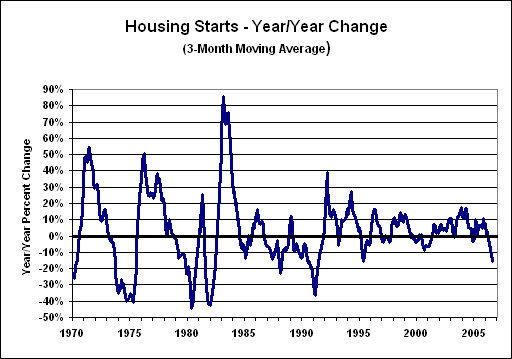
The downturn in housing is getting worse, quickly. Housing starts were down at an annual pace of 19.8% in August, an annual drop of 15.3% on a three-month moving average basis, which is shown in the graph above. Annual declines in home sales are mirroring the fall-off in housing starts.
The only really positive economic report in the last month was the unbelievable upward revision to second-quarter GDP growth. With annualized real GDP growth now at 2.9%, official recent growth has been only slightly below average. GDP reporting, though, has been reduced to the status of political propaganda, as discussed in this month's GDP, Alternate Reality and the Reporting/Market Focus sections.
Perhaps the Reporting/Market Focus is the most disquieting section this month, where the data from the latest poverty report show that income dispersion hit a record high in 2005 (higher than pre-Great Depression). Such a reading foreshadows an economic/financial disaster. Further, annual declines reported in inflation-adjusted median and average household income for 1999 to 2004 -- patterns consistent with reporting from the Internal Revenue Service -- indicate that the strong GDP growth rates of the last several years cannot be accurate.
As an aside, the Census Bureau provided detail for a column written by Floyd Norris in The New York Times (August 19, 2006) indicating that annual inflation-adjusted contractions in car dealer sales of more than two-percent (currently down 2.4%) always signal recession (usually one that already is underway). It certainly is unusual for the Census Bureau to get involved publicly in such analysis, and likely involves the National Bureau of Economic Research (NBER), official arbiter of recessions. This could be an early indication that declaration of a new official recession is under consideration.
Inflation and Gold Outlooks Remain Strong "Are you still bullish on gold?" asked a subscriber following a particularly grueling day in the commodity markets. Gold was down below $600 per troy ounce (as it still is), having traded above $700 just a few months back. My answer to the question was a resounding yes. The fundamental outlook for gold remains unaltered -- as bullish as it could be -- despite any fleeting flutterings in oil prices or pre-election political hype.
The view here has to be to the long-term circumstance, not to day-to-day price swings, which indeed can be wild. Gold prices historically have had periods of high volatility, and central banks do what they can to encourage downside price movement when an opportunity arises. That said, all the underlying fundamentals that drove gold to recent highs remain in play, with no hope of turning around.
Contributing to short-term gold-price volatility, U.S. inflation has been driven heavily by oil prices over the last year or so. The recent decline in oil prices, combined with year-ago comparisons to the inflation spike that followed Hurricane Katrina, promises a sharp one-time drop in inflation reporting in the month ahead. The decline will be mitigated by the increasing penetration of higher oil costs into the non-energy sectors of the economy. Other inflationary pressures increasingly will be seen from weakness in the U.S. dollar and increased Federal Reserve monetization of federal debt.
The decline in oil prices to the $60 per barrel range is not likely to last. Current pricing has been helped by eased political tensions in the Middle East, which are a direct reflection of Administration pre-election policies, as well as by a fortuitously mild hurricane season so far for the Gulf of Mexico. Look for Middle Eastern tensions to revive right after the election, or sooner, if U.S. opponents decide to stir things up. The hurricane season still has over a month to run.
Consider, too, that $60 oil was unthinkable at the beginning of 2005. Now OPEC is suggesting that oil below $60 is unthinkable.
Among longer-term considerations, the U.S. dollar has been soft in recent trading, but it still has not faced its looming, protracted and massive sell-off. The election likely will not be a good one for the Republicans, despite any positive rating boost President Bush is getting from the pre-election decline in gasoline prices. The actual fiscal U.S. condition remains one of undeclared bankruptcy. The financial markets remain like a house of cards built upon financial leverage, upon leverage, upon leverage. The world's central bankers are aware of the underlying reality and recognize their limited abilities to contain the financial and economic crises ahead.
Simply put, the intractable U.S. economic and financial conditions and the increasingly unstable global political conditions have not changed. In like manner, our outlook for a protracted, continuing U.S. economic downturn, mounting inflationary pressures and increasing financial-market instabilities have not changed.
Rather than trying to peg the upside price potential of gold at a certain level, gold's price potential should be viewed in terms of the number of digits: three figure (price in hundreds of dollars), four figure (thousands of dollars), five figure (tens of thousands), etc. The untenable fiscal, financial and global political conditions in place for the United States could generate six- or seven-figure prices, or even much higher, within a decade, possibly by the end of the current decade. The upside is only limited by the inverse relationship to the fathomless pit into which the U.S. dollar's purchasing power has been tumbling at an accelerating pace.
Alternate Realities. In general, if a government economic measure does match common public experience, it has little use outside of academia or the spin-doctoring rooms of the Fed and Wall Street. This section regularly will cover the Shadow Government Statistics (SGS) alternate measures of official CPI and GDP reporting. The methodologies for the series are discussed in the August 2006 SGS. Effects of gimmicked methodological changes have been removed from the official series so as to reflect more accurately the common public experience, as embodied by the post-World War II CPI and the pre-Reagan era GDP.
Of some discomfort to the low-inflation hypesters -- those continually touting "core" inflation -- even the gimmicked annual core inflation rates are on the upswing.
                          Eight Levels of Inflation
                   Annual Inflation for June to August 2006


          Measure                                 June   July  August
          I-1 Core PCE Deflator                   2.3%r  2.4%   n.a.
          I-2 Core C-CPI                          2.4%   2.5%   2.7%
          I-3 Core CPI-U                          2.6%   2.7%   2.8%
          I-4 PCE Deflator                        3.5%   3.4%   n.a.
          I-5 C-CPI                               3.7%   3.5%   3.4%
          I-6 CPI-U                               4.3%   4.1%   3.8%
          I-7 Pre-Clinton CPI-U                   7.4%   7.3%   7.0%
          I-8 SGS Alternate Consumer Inflation   11.0%  11.0%  10.8%


          (r) Revised.
          Notes: I-1 to I-3 reflect the core inflation rates, respectively,
          of the substitution-based personal consumption expenditure (PCE)
          deflator, the Chained-CPI-U and the geometrically-weighted CPI-U.
          I-4 to I-6 are the same measures with energy and food inflation
          included.  The CPI-U (I-6) is the measure popularly followed by
          the financial press, when the media are not hyping core inflation.
          I-7 is the CPI-U with the effects of geometric weighting (Pre-
          Clinton Era as estimated by SGS) reversed.  This is the top series
          in the CPI graph on the SGS home page www.shadowstats.com.
          I-8 reflects the SGS Alternate Consumer Inflation measure, which
          reverses the methodological gimmicks of the last 25 years or so,
          plus an adjustment for the Clinton-Era geometric weighting that is
          not otherwise accounted for in BLS historic bookkeeping.
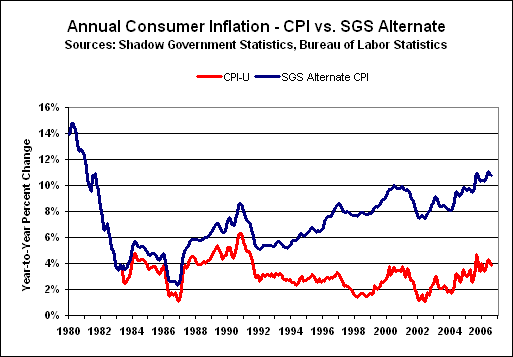
(NOTE: Historical data on both the official and SGS-Alternate CPI series are available for download on the Alternate Data page of www.shadowstats.com.)
The alternate second-quarter GDP growth reflects the downward revisions from retail sales and trade reporting that somehow were missed in the official "preliminary estimate." The alternate second-quarter inflation-adjusted annual GDP growth rate is a decline of 1.0% versus the official 3.6% gain.
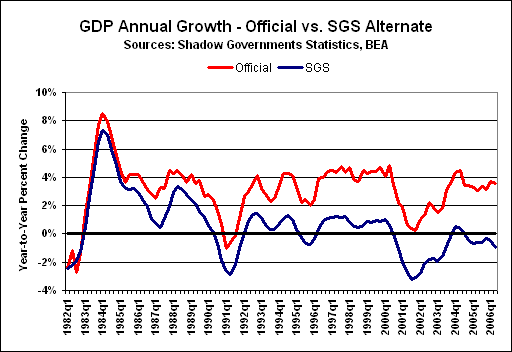
(NOTE: Historical data on both the official and SGS-Alternate GDP series are available for download on the Alternate Data page of www.shadowstats.com.)
In general, the broad economic outlook has not changed, and the financial markets increasingly are concerned over developing signs of both uncontained inflation and a developing recession. Indeed, the 2005 to 2007 (likely 2008) inflationary recession continues to deepen.
A contracting economy, inflation and risks of intensifying dollar selling are upon us and continue to offer the worst of all environments for increasingly less-Pollyannaish financial markets. The exception of course is the gold market, where the traditional inflation-hedge and flight-to-safety/quality vehicle will continue earning its keep -- shy of irregular volatility -- as the dollar weakens, inflation accelerates and the global political situation continues to deteriorate.
The Shadow Government Statistics' Early Warning System (EWS) was activated in May 2005 and signaled the onset of a formal recession in July 2005. The EWS looks at historical growth patterns of key leading economic indicators in advance of major economic booms and busts and sets growth trigger points that generate warnings of major upturns or downturns when predetermined growth limits are breached. Since the beginning of 2005 a number of key indicators had been holding near or at their fail-safe points. Seven indicators now have moved beyond those levels, signaling a recession.
Retail sales, help-wanted advertising and housing starts generated such signals in the last several months. Once beyond their fail-safe points, these indicators never have sent out false alarms, either for an economic boom or bust.
The false economic boom massaged into first-quarter GDP reporting was a precursor to the overstatement of second-quarter GDP growth. The reported annualized real growth of 2.9% should have been a contraction. Irrespective of underlying reality, negative GDP growth is not likely to surface in regular government reporting until after the November election. Such is helped by rampant political manipulation of many key numbers. The National Bureau of Economic Research (NBER) eventually should time the downturn to mid-2005 and announce same also sometime after the election, so as not to be deemed politically motivated in its timing.
Whether or not there is a recession increasingly is a hot topic in the popular financial media, with politics helping to fuel the debate as the election nears. Those Wall Street economists who act as shills for the market will keep up their "strong growth is just around the corner" hype regardless of any and all evidence to the contrary.
From the standpoint of common experience, this downturn will be considered the second leg of a double-dip recession, not an independent contraction as will be claimed officially.
Most economic data have softened, with the trend accelerating. Regular monthly contractions are near for both payroll employment and industrial production, although political manipulation and weather distortions can keep the official payroll and production data afloat for a while longer. Significant deterioration also will be seen in corporate profits and federal tax receipts, despite any near-term volatility to the contrary. Depressed tax receipts will combine with negligible fiscal discipline and ongoing war spending to accelerate deterioration in the federal finances.
This general outlook is predicated on economic activity that already has taken place and does not consider any risks from exogenous factors such as renewed terrorist activity in the United States, world war, major natural disasters or a financial panic.
Market perceptions of the downturn in business activity are increasing sharply. As expectations begin to anticipate weak data, traditional expectations also are being lowered for inflation, despite the obvious oil problem. Worsening stagflation, however, seems to have gained a good foothold in some consensus thinking. Still, consensus forecasts generally will tend to be surprised on the downside for economic reports and on the upside for inflation reports, for some time to come.
The roots of the current difficulties are structural in nature. A consumer starved of income growth and overburdened with debt cannot sustain the real growth in consumption needed to keep GDP growth in positive territory. The income weakness is a direct result of the loss of a significant manufacturing base to offshore locations and the ensuing explosive, perpetual growth of the U.S. trade deficit.
Exacerbating economic and financial woes will be unusually high inflation during this contraction. Gold prices already have signaled inflation and other difficulties. Fueled by high oil prices, weakness in the U.S. dollar and accelerating Fed monetization of federal debt, inflation will not be brought under control simply by weakness in economic demand. Instead, persistently high prices only will serve to intensify the recession, making it exceptionally long and protracted. Ongoing inflation woes and dollar problems will maintain upside pressure on long-term interest rates, reversing what currently is an inverted yield curve that some view as a recession signal.
Faltering economic activity and mounting inflation have created a nightmarish conundrum for the political operatives at the Federal Reserve. Soft economic numbers and high inflation are being spun as "conflicting data", but an inflationary recession is in play, and there is little the Fed can do about it.
The hype fed to the investing public -- that a weak economy means low inflation and interest rates -- cannot work in the current environment. Any conflicts that arise are not in the economic data but in simplistic views on economic activity espoused by Wall Street, or in the statistical manipulation goals of the politicians. Those latter issues explain Fed Chairman Bernanke's continued tap dancing on the inflation outlook. Such is anchored in putting a positive spin on an impossible situation and avoiding a financial-market meltdown before November 7th. The markets have been reasonably cooperative, so far.
In the present circumstance, inflation driven by robust economic demand would be a happy event, but such is not to be. Rather, the purchasing power of the U.S. dollar is being lost to wasting diseases, eroded by foreign exchange weakness in the trade-deficit plagued greenback, malfeasance in domestic fiscal and monetary policies, and external disruptions such as cartel-orchestrated price surges in oil. All the latter factors are in play.
From the Federal Reserve's perspective, at present, mixed signals are the best that can be offered to the markets. Allowing for the possibility of renewing the faux "tightening," signals Mr. Bernanke's devotion to keeping inflation under control. The Fed's "pause" in hiking interest rates signals Mr. Bernanke's devotion to maintaining solid economic growth. While the games playing may keep market sentiment gyrating for a while, the Fed is in an untenable position. Raising rates will do little to contain a non-demand driven inflation, while holding or lowering rates will do little to stimulate the structurally-impaired economy. The current "pause" in the Fed's raising short-term interest rates likely will not survive the election by much more than a month.
From the standpoint of the federal government, traditional economic stimuli in the form of tax cuts or increased federal spending have reached their practical limits with the current budget-deficit excesses.
Due to the inability of the government or central bank to stabilize this environment, risks of the current situation evolving into a hyperinflationary depression are extraordinarily high. Such a development involving the world's reserve currency would lead to a collapse of the current global currency system. In order to regain public confidence, monetary authorities likely would structure gold into the base of any new international currency system.
The unfolding inflationary recession is the worst of all worlds for the financial markets. Particularly hard hit will be the U.S. dollar, with significant downside moves looming for both equity and bond prices. Despite recent extreme volatility, the price of gold is headed much higher. At such time as the system re-stabilizes, post-crisis, there will be exceptional investment opportunities for those who have been able to preserve their wealth, capital and liquidity.
The Federal Reserve keeps playing its games, trying to be non-disruptive to the financial markets. Matching market expectations, the FOMC held rates steady last week, and likely will do so next month, just prior to the election. Typically the Central Bank avoids policy moves in the weeks leading up to an election. Post-election is a different story. Renewed inflation pressures and intensifying dollar weakness could have the markets looking for rate hikes as early as the December 12th FOMC meeting.
Improved inflation numbers in the next month will be short-lived and will not be a result of any Federal Reserve policy, just volatile oil prices and year-ago disaster comparisons. With the economy tumbling, ongoing hype of a cleverly orchestrated soft landing should begin to disappear, soon. The economy has crashed, and there is not much the Federal Reserve can or could have done about it. The deepening recession should show up in generally weaker-than-expected corporate profits.
In terms of the broad financial market picture through year-end, the U.S. dollar should sell off sharply on a trade-weighted basis and particularly against the Swiss franc. As a partial result of the mounting dollar and inflation difficulties, the domestic yield curve will turn positive and steepen sharply, due primarily to rising long-term interest rates.
The combination of softer profits, a weak dollar and higher rates likely will not play out happily for equities. Renewed concerns tied to the dollar, inflation and global instabilities suggest an upbeat year-end for the precious metals, despite recent selling.
Equities -- The stock market generally has done well recently, given expectations of a passive fed, contained inflation, a soft economic landing, a relatively tranquil Middle East and, so far, a quiet hurricane season. None of the props underlying equities will be long-lived, other than possibly the good hurricane season.
The hard economic landing already is breaking, and the election should not go well for the market-favored Republicans. The timing on the reversal of other factors should follow the election, but they could break sooner.
Particularly damaging to current market euphoria will be the terrible dollar tumble ahead. Liquidity problems resulting from that will tend to push long-term yields higher and equity prices much lower. The dollar's sell-off could begin at any time with little warning.
As mentioned last month (please forgive the repetition here which is for the benefit of recent subscribers), fall is at hand, and the squirreling season is upon us. I once retained a mass psychologist in an effort to explain why stock market crashes tended to take place in October and November. His answer was that humans had a vestigial squirreling instinct. As the squirrels start gathering acorns for the winter, so too do investment strategies among humans sometimes go through a shift.
Credit Markets -- Contrary to all the hoopla over lower oil and gasoline prices, inflation is far from peaking, although the CPI will take a heavily publicized hit next month. Inflation concerns will return after the election. By early 2007, the Fed will be looking at further interest rate hikes in defense of the U.S. dollar. Barring a stock-market crash, it will not be shifting to an easing stance to stimulate the stock market or the economy.
Underlying fundamentals still indicate that long-term interest rates are headed sharply higher by the end of the year and into 2007. This move in rates will be dominated by rising inflation, by a weakening dollar and by foreign investors increasingly moving their assets out of dollar-denominated instruments.
A number of factors drive interest rate movements, including economic activity, inflation, credit demand, political stability and relative dollar strength and accompanying cash inflows and outflows from abroad. The recession will offer major downside pressure on rates, but inflation and the dollar will provide the dominant upside pressures on rates.
Since the last newsletter, the yield curve on Treasuries has turned slightly more negative, with the constant maturity 10-year yield at 4.65% and the 3-month bill at 4.92%, overall about 20 basis points lower. An added couple of hundred basis points at the long end would do a great deal towards flipping the yield curve to a fairly normal positive slope.
U.S. Dollar -- On average, the U.S. dollar weakened in August, with renewed selling pressure in the last week or so. The "pause" in Fed policy has been a factor, where inflation pressures generally are moving rates to the upside outside the United States.
The dollar's tumble has just begun, with very negative and disorderly markets awaiting the greenback. As the downturn in the value of the U.S. currency accelerates, fallout in the credit and equity markets should not be pleasant.
Underlying fundamentals are so bad, they only could be marginally worse. Driving relative currency values are relative conditions in domestic economic activity, inflation, interest rates, government financial conditions and political stability. Though not fully recognized, all these factors for the United States -- relative to its major trading partners -- are negative. The U.S. economy is in recession, inflation is spiking and interest rates are rising abroad, while the Fed -- at least temporarily -- has stopped raising rates at home. The actual U.S. federal deficit is beyond containment, promising a hyperinflationary environment at some time. Further, despite a short-term bounce in the President's approval rating, it still is at a level that has crashed the greenback in the past.
Timing is uncertain, but the break in the dollar should come quickly, with little if any advance warning. Serious shocks loom in U.S. economic and fiscal data and deteriorating domestic politics. New record lows for the dollar are likely before the end of the year, despite any overt or covert supportive intervention by any central bank(s). At some point, certain Asian central banks even could be encouraging the dollar selling.
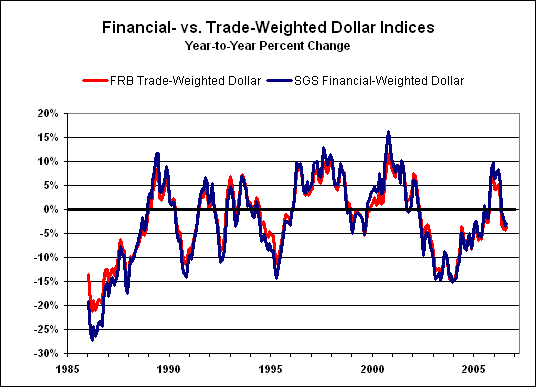
Generally, the weaker the dollar, the greater will be the ultimate inflation pressure and liquidity squeeze in the U.S. equity and capital markets. As shown in the following graphs, the U.S. dollar appears to have entered a selling phase.
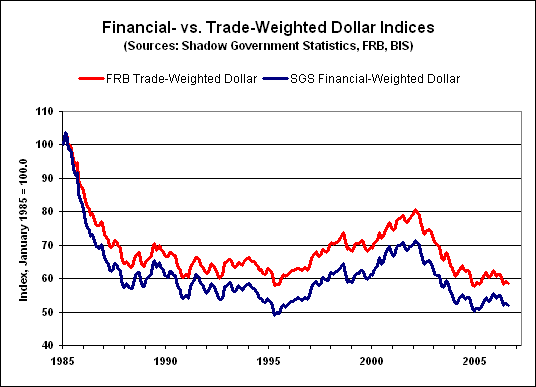
(NOTE: Historical data on both dollar series are available for download on the Alternate Data page of www.shadowstats.com. See the July 2005 SGS for methodology.)
U.S. Dollar Indices. The Shadow Government Statistics' Financial-Weighted U.S. Dollar Index is based on dollar exchange rates weighted for respective global currency trading volumes. For August, the monthly dollar average declined 1.15%, after July's 0.03% gain. August's year-to-year change was a decline of 2.85%, after a drop of 3.54% in July.
In the same directions, August's monthly average of the Federal Reserve's Major Currency Trade-Weighted U.S. Dollar Index fell by 0.93%, after increasing by 0.51% in July. August's year-to-year decline of 3.48% moderated slightly from July's 4.31% year-to-year contraction.
As we go to press, where the dollar indices in September generally have been stronger than the August averages, some selling pressure has developed in the last week.
Gold -- After averaging around $630 per troy ounce in July and August, the gold price tumbled below $600 per troy ounce into the $570 range earlier in September, and has rebounded some in the last week to around $590. As discussed in the opening comments, the long-term outlook for gold remains highly positive.
As a hedge against currency problems and inflation, and as the preferred safe-haven vehicle, the price of gold generally should move higher and set new historical highs in the months ahead, despite any near-term volatility. The currency and inflation issues are chronic and will deteriorate sharply before an ultimate collapse in the global currency system. Such does not prevent interim wild gold price gyrations, however, particularly if central banks think they see an opportunity to tarnish gold's image. One of the alluring features of the precious metal, of course, is that is does not tarnish.
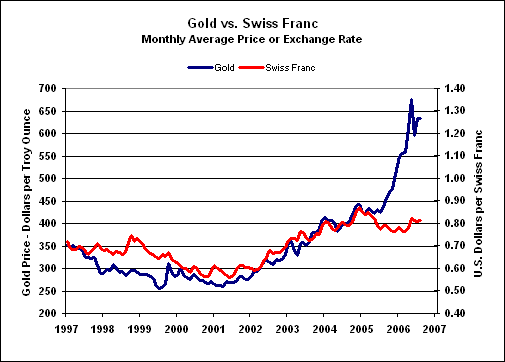
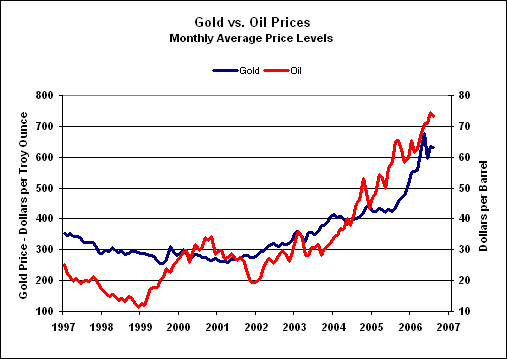
The updated gold versus oil and Swiss franc graphs are little changed, reflecting monthly averages through August. As we go to press, gold is trading around $590, oil around $60 and the Swiss franc around $0.81.
As cautioned in this month's Opening Comments, near-term reporting of economic performance will have less than usual relevance to actual underlying activity. Upcoming reporting of the major series often will be determined by political need rather than by the economic factors that should drive the results. Separately, many results will suffer heavy annual and seasonally-adjusted monthly distortions, as the effects of last year's devastating hurricanes once more roil the data. The first obvious effects are noted under initial claims for unemployment insurance.
Employment/Unemployment -- August's 128,000 payroll increase again was in line with diminished expectations, but its magnitude was marginal for the fifth straight month. The "improved" unemployment rate, however, was a political positive, as the employment data once more sent mixed signals intended to please both the credit markets and the electorate.
As reported by the Bureau of Labor Statistics (BLS), the popularly followed seasonally-adjusted U-3 unemployment rate eased insignificantly in August to 4.69%+/-0.2% from 4.75% in July. Unadjusted August U-3 dropped to 4.6% from 5.0%, while the broader adjusted U-6 moved from 8.5% to 8.4%, and the unadjusted U-6 eased from 8.8% to 8.3%.
Including the long-term "discouraged workers" defined away during the Clinton administration, total unemployment remains roughly 12%. The household survey also showed seasonally-adjusted August employment (those people with at least one job) up by 250,000, after being down by 34,000 in July.
For August, the payroll survey's seasonally-adjusted gain of 128,000 (146,000 net of revisions) remained close to the published reporting error of +/-108,000. This followed an upwardly revised July gain of 121,000 (was 113,000). Annual growth in unadjusted August employment was 1.26%, down from the near-term peak of 1.71% in August 2005.
August's payroll gain of 128,000 included a positive bias of 121,000 jobs in the "net birth/death" adjustment, a fudge factor that was little changed from the 125,000 used for August 2005. The fudge factor softens in September (it was a 50,000 gain in September 2005), which could place some downside reporting pressure on next month's payrolls.
The September data will be measured against year ago numbers that were affected by Hurricane Katrina. Since Katrina's full impact never showed up in the official payroll or unemployment reporting of the time, it will be interesting to see how the current numbers are handled by the BLS.
The latest report was against a background of continued collapsing growth in help-wanted advertising, rising new claims for unemployment insurance and weak purchasing managers employment indices (see the respective sections).
Next Release (October 6): The political needs of the Administration remain great and should have particular impact on the September report, which is the most politically sensitive -- in terms of timing -- before the November election. Separately, the data could be distorted to the upside by year-ago Katrina comparisons and related distortions to seasonal factors. Happy news is a reasonably good bet, regardless of any miserable underlying reality.
Gross Domestic Product (GDP) -- The "preliminary" estimate of annualized real growth for second-quarter 2006 GDP was 2.90% +/-3.0%, revised upward from an initial estimate of 2.46%, and down from 5.58% in the first quarter. As revised, the growth rate still was statistically indistinguishable from a contraction.
Likely as a result of political considerations, negative revisions and reporting in related retail sales and trade deficit that would have reduced the reported second-quarter GDP appear to have been ignored. As discussed in prior newsletters, quarterly growth would have been negative in the second quarter but for the unusual reporting of quarterly inflation changes.
Annual real second-quarter GDP growth revised to 3.60% from an initial 3.49%, still down from 3.69% in the first quarter.
Initial reporting on the broadest national income measure, Gross National Product (GNP), was published. GNP includes trade flows in interest and dividend payments that are lacking in GDP. Annualized real second-quarter GNP growth was 2.58% in initial reporting. The difference between reported GNP and GDP growth rates is economic damage done by the net-debtor status of the United States versus the rest of the world.
Final sales -- GDP net of inventory changes -- revised to a gain of 2.3% from 2.0% in the second quarter, down from 5.6% in the first quarter.
The GDP inflation rate (deflator) in the second quarter incredibly held at a revised 3.34% (originally 3.30%) versus 3.26% in the prior quarter, despite explosive growth in quarterly CPI inflation.
GDP reporting remains primarily a tool of political propaganda and usually has little or no relationship to underlying economic reality. Given the long-term upside methodological biases built into the GDP, an annual rate of contraction of 1.0% would have been closer to reality for the second quarter. Detail of the SGS-Alternate GDP is shown in Alternate Reality section of the Opening Comments.
Next Release (September 28): The "final" estimate revision for second-quarter 2006 GDP should be little more than statistical noise.
Consumer Price Index (CPI) -- The BLS reported the seasonally-adjusted August CPI-U rose by 0.25% (0.20% unadjusted), following July's 0.44% (0.30% unadjusted) increase. On a not-seasonally-adjusted basis, August's annual inflation rate (I-6) was 3.82%, down from July's 4.15%. The eight levels of annual inflation, I-1 to I-8, are detailed in the table in the Alternate Reality section.
The CPI-W (wage earners), which usually follows the CPI-U (all urban consumers), gained 0.4% for the month, contrasted with the 0.2% CPI-U gain. While rounding accounted for part of the difference, there is a suggestion of some unusual seasonal factor adjustments for the CPI-U. The CPI-W is used in calculating annual cost-of-living adjustments (third quarter average annual inflation) for Social Security. With the drop pending in September annual inflation, this year's adjustment could be around 3.6% to 3.7%, down from last year's 4.1%.
The "experimental" Chained Consumer Price Index (C-CPI-U), the fully substitution based CPI that presumably is the eventual replacement for current CPI reporting, showed annual inflation (I-5) of 3.42% in August, versus 3.52% in July.
Adjusted to pre-Clinton methodology (I-7), annual CPI growth was about 7.0% as of August, against 7.3% in July. The SGS Alternate Consumer Inflation measure (I-8), which reverses gimmicked changes to official CPI reporting methodologies of recent decades, shows annual inflation at 10.8% in August, versus 11.0% in July.
Annual Core CPI-U inflation rate (I-3), which excludes the necessities of food and energy, rose to 2.8% in August, up from 2.7% in July. In contrast, the SGS Base CPI-U annual inflation rate, which includes only the necessities, held at 4.4% in August for the third straight month. The SGS rate, however, still suffers the standard CPI-U methodological understatement.
Next Release (October 18): Inflation has not peaked, but it likely will take a double hit in the next report, from lower oil prices and year-ago comparisons with the effects of the Katrina disaster. Nonetheless, surprises still should come in on the upside of weak expectations, tied particularly to core numbers, which already have started to firm. Increasingly, they should reflect the slow process of oil prices permeating nearly all levels of business activity.
Despite short-term volatility, annual inflation will remain high and should continue to accelerate to the upside, following September's hit. Pressures will continue not only from the ongoing and lagged effects of oil prices, but also from a weak U.S. dollar. Seasonally-adjusted monthly inflation was up 1.22% for September 2005, which means that monthly September 2006 inflation above or below that level will move the reported annual inflation rate in tandem.
Federal Deficit -- As discussed in prior newsletters, the official, accounting-gimmicked 2005 deficit (fiscal year ended September 30th) was $318.5 billion, but it was eleven times higher -- at $3.5 trillion -- on a GAAP basis, per the U.S. Treasury (see the December 2005 SGS Supplement for detail). The official, accounting-gimmicked deficit for 2004 was $412.8 billion.
The gimmicked 2006 deficit will come in below the 2005 number. This improved deficit is little more than statistical noise in the big picture and appears due largely to special, short-lived corporate tax breaks on repatriation of foreign profits. That arrangement stimulated a significant, one-time surge in corporate tax receipts, which had no relationship to underlying economic activity. The "narrowing" deficit is not due to booming economic activity and likely will be more than offset in GAAP-based detail to be released in December.
As of August 2006, the 11th month in fiscal 2006, the twelve-month rolling accounting-gimmicked deficit was $268.6 billion, up from $255.4 billion in July, and against $328.0 billion in August 2005.
Separate from the GAAP-based numbers and official deficit reporting, the change in gross federal debt is a fair indicator of actual net cash outlays by the government. As of fiscal year-end 2005, the gross federal debt was $7.933 trillion, up $554 billion from September 2004, which, in turn, was up by $596 billion from September 2003.
The gross federal debt as of August 31, 2006 was $8.515 trillion, up $7 billion from July and up $588 billion from August 2005, which, in turn, was up $576 billion from August 2004.
Going forward, the official federal deficit will inflate, as government finances suffer tax revenue losses from the intensifying recession and relative tax receipt declines after the expiration of the tax incentives. While GDP growth estimates can be gimmicked, incoming tax receipts (based on consistently applied tax policies) remain an independent estimate of underlying economic reality and eventually will reflect the economy's mounting difficulties.
Initial Claims for Unemployment Insurance -- Annual change in initial claims again moved at an accelerating pace into less negative territory (an economic negative) through the reporting of the September 2nd week, but it reversed in the next two reports due to the year-ago impact of Hurricane Katrina. On a smoothed basis for the 17 weeks ended September 2nd, annual change narrowed to a 2.2% decline from August 5th's 2.8% decline. For the September 16th week, however, the annual decline had fallen to 6.2% as the initial reporting from the effects of Hurricane Katrina worked into the year-ago numbers.
Usually, the volatility of the seasonally-adjusted weekly numbers is due partially to the seasonal-adjustment process. When the series is viewed in terms of the year-to-year change in the 17-week (four-month) moving average, however, such generally is a fair indicator of current economic activity.
Real Average Weekly Earnings -- August's seasonally-adjusted real earnings plunged by 0.5% for the month, after an unchanged level in July (revised from a 0.1% decline). August's real earnings, however, were up 0.3% from the year before, following a 0.1% decline in July.
Volatility in this series comes primarily from variations in reported CPI growth. Allowing for the biases built into the CPI-W series used in deflating the average weekly earnings, annual change in this series signals ongoing severe financial strain on U.S. households and continuing recession. As a note of interest, August CPI-W was up by 0.4% for the month, against a 0.2% increase for the CPI-U.
Retail Sales -- August's seasonally-adjusted monthly increase in retail sales of 0.2% (0.1% net of revisions) +/-0.7%, followed an unrevised 1.4% gain in July. Net of CPI inflation, August sales were down less than 0.1%, the third monthly decline in four months.
When inflation-adjusted year-to-year growth in retail sales falls below 1.8% (using the official CPI-U for deflation), such signals recession. The signal was generated in June. Before inflation adjustment, August's annual growth was 6.7%, up from July's 4.8%. Net of inflation, August's annual growth was 2.7%, up from July's 0.6%. The same numbers in a three-month moving average were 1.4% for August, down from 1.6% in July.
Next Release (October 13): September retail sales should come in below expectations, reflecting declining economic activity. Inflation-adjusted growth should remain negative on a monthly basis, with annual growth generally continuing to slow.
Industrial Production -- With some relief in the abnormally hot weather, distortions from utility usage reversed, and seasonally-adjusted August production declined by 0.1%, following an unrevised 0.4% gain in July. June's utility-distorted 0.8% production surge, however, revised upward to 1.1%. Year-to-year change in August was up by 4.7%, off July's growth rate of 5.3% (revised from 4.9%).
Keep in mind that unseasonably hot weather spikes not only utility usage, but also reported production in a number of manufacturing categories, where activity is estimated by electricity consumption. Turn up the air conditioning in a computer factory, and the Federal Reserve thinks computer production is on the rise.
Next Release (October 17): Look for industrial production increasingly to mirror the recession, with regular monthly contractions and a pattern of slowing annual growth setting in. Such will surprise market expectations on the downside. With the return to more normal temperature patterns, September reporting could offer some downside shocks.
New Orders for Durable Goods -- Volatile durable goods orders declined in July, with seasonally-adjusted orders down by 2.4% (2.0% net of revisions), following a revised June gain of 3.5% (previously 3.1%). July's orders were up 11.1% from the year before.
The widely followed nondefense capital goods orders inched higher by 0.2% in July, after a revised 2.1% gain in June (previously up by 1.3%). July's annual growth rate was up 11.6%.
At one time, durable goods orders was a solid leading indicator of broad economic activity, when smoothed using a six-month moving average. After the semi-conductor industry stopped reporting new orders, however, the series' predictive ability suffered a serious setback.
Trade Balance -- Returning to a more normal pattern, July's seasonally-adjusted trade deficit widened to a record $68.0 billion from $64.8 billion in June. Contrary to Wall Street hype, the deterioration was not tied to oil. Oil imports actually were down for the month.
In terms of physical volume, July oil imports dropped by 5.9% for the month to 10,373,000 barrels per day, a measure that covers the most significant portion of trade-related seasonal adjustment. Oil import prices averaged $64.84 per barrel, up by 4.5% from June. The combination showed the July daily average dollar value of oil imports to have been 1.7% lower than in June. With oil removed, the monthly July deficit would have been roughly $68.4 billion, instead of $68.0 billion.
Despite sporadic manipulation and other occasional volatility, there is little question that the trade deficit remains in a phase of meaningful deterioration.
Next Release (October 12): The August trade deficit should continue the widening trend. Upcoming deficit reports will surge beyond consensus forecasts and regularly set new records.
Consumer Confidence -- August consumer confidence measures plunged, with annual growth in negative territory for both series. The Conference Board's August consumer confidence plummeted by 7.2%, after July's revised increase of 1.5% (was 1.0%), while the University of Michigan's consumer sentiment fell by 3.25, following July's 0.2% decline.
On a three-month moving-average basis for August, annual growth in the Conference Board's measure turned negative, down 1.1%, against a 1.3% gain in the prior month, while the University of Michigan number was down 10.7%, following July's 11.0% decline. These lagging, not leading, indicators are signaling that the economy remains in a deepening recession.
Short-Term Credit Measures -- Annual growth in short-term commercial credit measures remains strong, holding double-digit percentage annual growth, while annual growth in consumer credit remains below average.
Growth in seasonally-adjusted consumer credit remained sub-par in July, with annual growth easing to 3.7%, down from a revised 3.9% (was 3.5%) in June. Without growth in income (see this month's Reporting/Market Focus), growth in personal consumption can be supported over the short-term only by debt expansion or savings liquidation. Consumer debt expansion -- though moving -- is still soft enough to act as a constraint on economic growth.
Annual growth in commercial paper outstanding in August moved higher, again, standing at 17.5% versus 17.0% in July. Annual growth in commercial and industrial loans also increased, up 15.3% in August, against 13.5% in July and 14.0% in June. Rising sales can fuel short-term credit needs, but so too can slowing sales, slowing collections and rising inventories.
Producer Price Index (PPI) -- The seasonally-adjusted August finished goods PPI rose just 0.1% (0.1% unadjusted) following a like 0.1% (0.2% unadjusted) gain in July. August's annual PPI inflation dropped to 3.7% from July's 4.2%. Seasonally-adjusted August intermediate goods rose by 0.4% for the month, while crude goods were up 2.2%. The monthly inflation numbers were depressed partially by irregular seasonal adjustment factors that were suggestive of some political tampering.
Next Release (October 17): Despite a large component of random volatility in monthly price variations, PPI inflation reporting over the next six-to-nine months, including September, should top depressed expectations. "Core" inflation, in particular, should offer upside surprises to consensus forecasts, despite reporting games played by the BLS. Nonetheless, the September reading will pick up effects from lower oil prices, and the monthly number for finished goods likely still will be a weak one.
The following numbers are generally good-quality leading indicators of economic activity and inflation that offer an alternative to the politically-hyped numbers when the economy really is not so perfect. In some instances, using a three-month moving average improves the quality of the economic signal and is so noted in the text.
Economic Indicators
Purchasing Managers Survey: Manufacturing New Orders -- The August new orders index declined by 3.4% to 54.2, after July's drop of 3.1%. This measure breached its fail-safe point in mid-2005, generating an SGS early warning indicator of pending recession.
The Commerce Department provides suspect seasonal factors for the series, and the resulting adjusted monthly numbers can be misleading in the reporting of month-to-month change. This problem is overcome by using year-to-year change on a three-month moving average basis. On that basis, the August index fell by 2.8%, following July's 0.8% contraction. The index gradually has notched lower from its peak annual growth of 42.6% in April of 2004.
Published by the Institute for Supply Management (ISM), the new orders component of the purchasing managers survey is a particularly valuable indicator of economic activity. The index is a diffusion index, where a reading above 50.0 indicates rising new orders.
The overall August ISM manufacturing index eased to 54.5 from 54.7 in July. An index level of 50.0 divides a growing versus contracting manufacturing sector. The August employment component jumped to 54.0 from July's 50.7 reading.
The service-sector ISM index does not have much meaning related to broad economic activity. Unlike its older counterpart, the manufacturing survey, if service companies such as law firms, hospitals or fast-food restaurants have "increased orders," that does not necessarily mean that economic activity is increasing. That said, the overall services index rose to 57.0 in August, from 54.8 in July.
Both the services employment and prices paid components, however, have some meaning. The August employment component fell by 5.7% to 51.4, from 54.5 in July. The prices paid component is covered under the Inflation Indicators.
Help Wanted Advertising Index (HWA) -- The July help-wanted advertising set a new 45-year low at 32. June's initial reading of 33 was revised upward to 34. Although this series never recovered from the last recession -- it has just bottom bounced and rolled -- with the annual contraction in the three-month moving average dropping to 13.0% from a revised 10.4% (previously 12.2%) in June, it continues to generate a deepening signal for fresh economic contraction.
Housing Starts -- As discussed and graphed in the opening comments, housing starts are tumbling dramatically. Seasonally-adjusted August housing starts fell 6.0% for the month, following a 3.3% decline in June and a 6.1% drop in May. With August's year-to-year change down by 19.8%, following July's 14.4% contraction, the annual change on a three-month moving-average basis now stands at a year-to-year drop of 15.3%, which is generating an intensifying recession signal.
In related data, plunging respective rates of annual contraction in July of 21.6% and 11.2% for new- and existing-home sales, also are consistent with a sharp economic downturn.
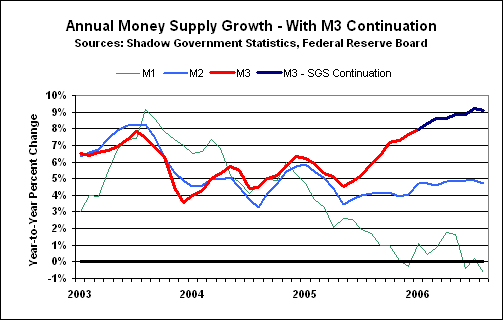
Money Supply -- Real annual growth rates for M1 and M2 remain consistent with the ongoing recession, while the nominal (not-inflation-adjusted) annual growth in M3 -- as estimated by the SGS Continuing M3 Series -- remains strong enough to fuel inflation concerns.
Annual growth in August for monthly M1 fell by 0.6%, versus a 0.2% gain in July, while annual M2 growth eased to 4.7% from 4.9%. The SGS Continuing M3 Series for August was up 9.1% from the year before, down slightly from an upwardly revised 9.2% in July. Annual growth rates in large time deposits and institutional money funds -- the two largest non-M2 components of M3 -- topped 20% and 13%, respectively.
(NOTE: Historical annual growth data for the money supply series, including the ongoing SGS estimates of M3, are available for download on the Alternate Data page of www.shadowstats.com. See the August 2006 SGS for methodology.)
Before inflation adjustment, monthly seasonally-adjusted M1 and M2 fell by 0.3% and rose by 0.3%, respectively, in August, following 0.2% and 0.3% increases in July. The seasonally-adjusted monthly gain for M3 in August was roughly 1.0%, up from 0.7% in July.
Adjusted for CPI inflation, August's M1 and M2 annual year-to-year rates of change were down 4.3% and up 0.8%, respectively. On a three-month moving-average basis, the August inflation-adjusted annual rates of change were down 4.2% and up 0.7%, levels that remain well underwater using the old-style CPI.
Inflation Indicators
Purchasing Managers Surveys: Prices Paid Indices -- On the manufacturing side, the August prices paid diffusion index softened to 73.0 from July's 78.5, a reading still indicative of intense inflationary pressure. On a three-month moving average basis, August's annual growth was up by 40.9% from the year before, compared with July's 47.8%.
On the non-manufacturing side, the August prices paid diffusion index eased to 72.4 from July's 74.8, also at a level signaling intense inflationary pressure. On a three-month moving average basis, August's annual growth was up by 11.5%, a slightly softer pace than July's 16.9%.
Published by the Institute for Supply Management (ISM), the prices paid components of the purchasing managers surveys are reliable leading indicators of inflation activity. The measures are diffusion indices, where a reading above 50.0 indicates rising inflation.
Oil Prices -- West Texas Intermediate Spot (St. Louis Fed) eased back in August, averaging $73.05 per barrel, down 1.8% from July's record average of $74.41 per barrel. Oil prices persist at extraordinarily inflationary levels, with August's average up 12.4% from the year before, after July's annual gain of 26.8%. Oil prices through mid-September have sold off sharply, trading somewhat above +ACQ-60 per barrel as we go to press. That, combined with the year-ago oil price surge from Katrina, promises a short-lived reversal in annual oil price change for September.
Spot prices will continue to gyrate and can be expected to be on rise again shortly after the November election, if not before. Middle Eastern political tensions are likely to intensify once again from the standpoint of U.S. policy, following the election. Threats to oil production in the Gulf of Mexico from hurricanes remain a possibility for another month or so. Separately, OPEC members are suggesting that $60 is a price floor that might be enforced through production cut backs.
Despite continuing near-term price volatility, high oil prices will remain a major contributing factor to the inflation side of the current inflationary recession. Oil prices remain extremely high, and still are working their way through the system. Oil price changes permeate costs throughout the economy, ranging from transportation and energy costs, to material costs in the plastics, pharmaceutical, fertilizer, chemical industries, etc. Cost pressures already have passed significantly into the so-called "core" inflation sectors. That pattern should accelerate despite any near-term easing of oil prices.
Oil price volatility affects CPI and PPI reporting. Downside oil price movements tend to be picked up more quickly and fully by the BLS in its inflation measures than are upside movements. Even as currently understated, CPI and PPI inflation will tend to be stronger than commonly predicted for the next six-to-nine months, partially as a result of the persistency of the high oil prices.
Quarterly/Annual Reporting -- Most series analyzed are published on a monthly or weekly basis. Followed economic/market series that are published with less-than-monthly frequency include:
Annual:
- Financial Statements of the United States Government (most recent analysis was a Supplement to December 2005 SGS; next analysis is due as a Supplement to the December 2006 SGS).
- Income Variance/Dispersion (most recent analysis is the current September 2006 SGS - next analysis is due September 2007).
Quarterly:
- Flow of Funds Accounts of the United States (most recent analysis: July 2006 SGS - next analysis is due October 2006 SGS).
Reporting/Market Foci -- The various economic and financial-market series are being addressed in a monthly "Reporting/Market Focus," with this month's analysis examining the annual Income Variance reporting. Employment, GDP, CPI and the Federal Deficit separately are explored in the background article "A Primer On Government Economic Reports," available on the Home page of www.shadowstats.com.
The series detailed so far in the Reporting Foci or background articles are listed below. The referenced SGS publications are available on the Archives page of www.shadowstats.com.
- Consumer Confidence (November 2004 SGS).
- Consumer Price Index (an original background article, October 2005 SGS, alternate numbers introduced August 2006 SGS).
- Credit Measures, Short-Term (August 2005 SGS).
- Durable Goods, New Orders for (May 2006 SGS).
- Employment/Unemployment (an original background article, alternate measures (April 2005 SGS).
- Federal Deficit (an original background article, update in the Alert of July 7, 2005, update in Supplement to December 2005 SGS).
- Gross Domestic Product (an original background article, alternate numbers introduced August 2006).
- Help Wanted Advertising (January 2006 SGS).
- Housing Starts and related housing statistics (June 2006 SGS).
- Income Variance/Dispersion (September 2005 SGS, September 2006 SGS).
- Industrial Production (January 2005 SGS).
- Money Supply (Part I / SGS Early Warning System
- May 2005 SGS, Part II - June 2005 SGS, M3 update November 2005 Supplement, M2 update March 2006 SGS, M3 continuing series introduced August 2006).
- Producer Price Index (April 2006 SGS).
- Purchasing Managers Survey (February 2006 SGS).
- Retail Sales (March 2005 SGS).
- SGS Early Warning System (May 2005 SGS, June 2005 SGS).
- Trade Balance (December 2004 SGS).
- Unemployment Insurance, Initial Claims for (February 2005 SGS).
- U.S. Dollar Indices, Financial- and Trade-Weighted (July 2005 SGS).
Income variance is a long-term driver and indicator of economic activity. Another record high -- well in excess of the level seen before the 1929 stock crash and Great Depression -- was reported as part of the Census Bureau's just-released Income, Poverty, and Health Insurance Coverage in the United States: 2005
For the leading economic indicators analyzed monthly in SGS, lead times to broad economic activity range between three and nine months. One indicator, however, signals broad trends in liquidity and economic activity three to eight years in advance: income variance/dispersion.
Income variance, also known as dispersion, measures the distribution of household income from very low levels to extremely high levels. The more income is distributed in the extreme ranges, the higher is income dispersion; the more income is distributed in the middle income brackets, the lower is the income dispersion. Extremely high levels of income dispersion have tended to precede great economic and financial catastrophes. Those events, in turn, have tended to redistribute income towards the middle, in something of a self-correcting cycle.
The 1986 variance in U.S. household income, which led the 1987 stock crash, was at the highest level estimated in modern times for the United States, topping the high seen before the 1929 stock crash and the ensuing Great Depression. The income variance level fell following the 1987 crash, but recovered the 1986 level in 1992. The Census Bureau's estimate of 2005 income dispersion was 31.0% higher than the pre-1987-crash level.
The distribution of wealth and income provides the fundamental structure for all economies. Where income drives consumption, shifts in income distribution impact economic activity. When income distribution shifts away from extremes, a greater portion of the consuming public is in the middle-income bracket, consumption becomes more broadly based, and the economy booms.
Consider, for example, that someone earning $10 million per year likely will buy fewer automobiles than 100 people each earning $100,000 per year.
As income distribution shifts toward extremes, variance and dispersion rise, consumption becomes less broadly based and the economy turns down. A shift in income distribution leads to a structural shift in economic activity, such as currently is underway.
The current distribution of income in the United States has developed in something of a free-market system, with government modification in the form of tax, monetary, welfare, labor and antitrust policies. Without getting into the merits of various forms of modification, and without getting into the larger philosophical questions of wealth distribution, shifts in income variance can be shown to have significant long-term impact on general economic activity.
Our analysis shows a leading relationship between the level of income dispersion and annual growth in systemic liquidity, not adjusted for inflation. This is one reason why the Federal Reserve sometimes finds itself pushing on a string when it tries to stimulate economic activity through money supply growth (as it covertly is doing at present with M3). As shown in the following graph of inflation-adjusted household income vs. income dispersion, income variance was at an all-time extreme as of 2005.
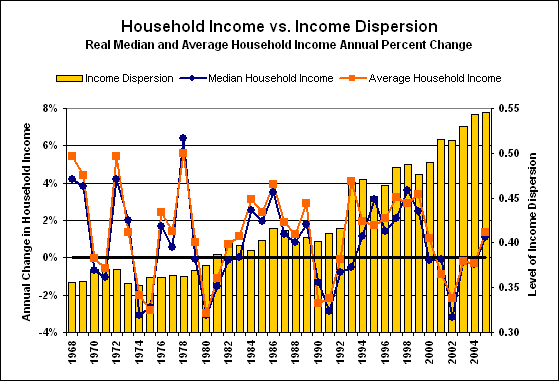
The measure used here is the mean logarithmic deviation of income as published by the Census Bureau in its annual poverty report. There are a variety of income dispersion/variance measures, but they all show the same basic pattern: U.S. income variance is at an unprecedented level that portends a major break in the economic/financial system.
Also reported in the poverty report were estimates of inflation-adjusted average and median (meaning the middle measure) household income levels for 2005. Of some note, as shown in the graphs below, both average and median household income contracted each year from 1999/2000 through 2004, with a suspect rebound in 2005. The earlier years are consistent with data from the Internal Revenue Service. Reality for 2005 eventually will come from IRS reporting.
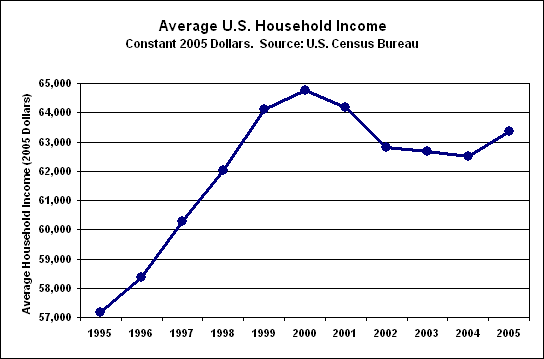
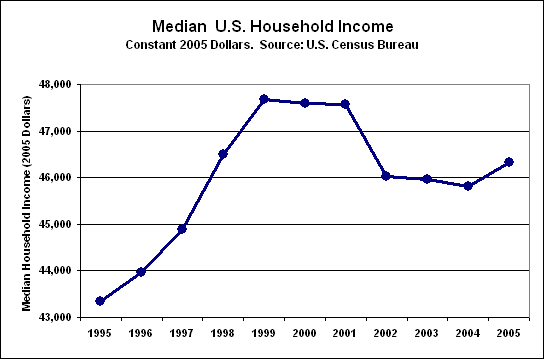
When real household income is in contraction, so too, usually, is the economy. This suggests that the one-year 2001 recession was much deeper and longer than proclaimed officially, lasting from 2000 through 2004. The unbelievable 2005 income gains likely were a pre-election gimmick worked by "re-weightings" that will revise away next year as IRS data become available. If so, these data will tend to confirm a longstanding SGS contention that the current recession is the second leg of a double-dip recession (see GDP graph in Alternate Reality section). The combination of negative annual growth in household income and the accompanying spike in income dispersion, as shown in the first graph, is a particularly ominous pairing.
Sustained economic growth is possible only in the event of sustained income growth. Debt growth and asset liquidation can buy only short-lived boosts in consumption. Nonetheless, Mr. Greenspan tried his best to gain time in stimulating stock-market and housing bubbles. The respective bubble bursts have helped in timing severe downlegs in the current double-dip recession.
The household income data cannot possibly support reported GDP growth of recent years, suggesting there is an ongoing reporting fraud at the Bureau of Economic Analysis.
Allowing for growth in the number of households, 2004 aggregate inflation-adjusted household income grew by just 0.9%, and 2005 (accepting the reported gain in average household income) was up by 2.3%, annual rates of growth well below annual official GDP growth that has held above 3.0% for the same years. Sustained GDP growth well above real income growth is not possible. Consumption growth fueled only by debt growth and asset liquidation has practical limits. These numbers indicate that reported GDP growth has been systematically and significantly overstated.
These numbers from the Census Bureau also show the system to be continuing at the brink of instability and unable to sustain the phony positive GDP growth reported by the Bureau of Economic Analysis.
As to poverty, the measures of same reported in this survey are poorly defined and manipulated by frequent methodological revisions. As a result, the poverty numbers are of no value. This situation is exacerbated by every-other report coming out two months before national elections.
Subscribers often ask why SGS does not cover the quarterly U.S. productivity numbers. The answer is that those numbers are even more worthless than the GDP data. Where the Federal Reserve and recent administrations have patted each other on the back tied to the heavily touted productivity miracle, SGS will assess current and historical productivity and attempt to debunk a favorite Wall Street myth.
Also, second-quarter 2006 Flow of Funds will be analyzed in a separate section. Have the first quarter's early trends of foreign investors moving out of U.S. Treasuries and other financial instruments intensified? The answer appears to be not yet.
October's "Shadow Government Statistics" is targeted for release on Wednesday, October 25, 2006. The monthly newsletter tentatively is scheduled for the Wednesday following the release of the monthly CPI report, but the schedule is subject to change. Final publication date will be noted on the home page of shadowstats.com at the top of the "Latest Monthly Commentary" column. The posting of the next SGS newsletter on the Web site, as well as all Flash Updates and any Alerts, will be advised immediately by e-mail.