


January/February 2007 Edition
JWSGS - JANUARY/FEBRUARY 2007 EDITION - Feb. 20, 2007
JOHN WILLIAMS' SHADOW GOVERNMENT STATISTICS
Issue Number 27 & 28
February 20, 2007
__________
Economic Activity in Rapid Decline as Miracle Recovery Fades
Central Bank Dollar Holdings Exacerbate Hyperinflation Risk
Stock Market Euphoria Misses Economic/Political Realities
Dollar Sell-Off, Gold Boom Lie Ahead
__________
A standard monthly recapitulation of the full, broad economic and financial-market outlook, based on the current and prior newsletters, will be constructed for next month's newsletter. Once set, any monthly changes to that text will be highlighted so that regular readers may avoid re-reading material they have seen before, but they will have the material available for reference, if so desired. This SGS newsletter was put to bed before the release of the January CPI release on February 21st -- John Williams
OVERVIEW -- OPENING COMMENTS
An upside blip in economic reporting from unseasonably good weather spiked some December economic data, and market expectations for the economy soared. The U.S. economy, however, does not turn quickly without warning, and early January data showed the recession not only to be very much in place, but also to be deepening rapidly. Although inflation will continue to rise without a further oil price spike, sudden indications of renewed possible terrorist attacks and rumblings of a possible U.S. attack on Iran hold the potential for a rekindled surge in oil prices. Under these circumstances, the U.S. financial markets remain in peril, with higher interest rates, lower equity prices, heavy dollar selling and significant gold buying on the horizon.
Confirming the recession, much weaker than expected growth surfaced in the most recent reporting of housing starts, retail sales, industrial production, the purchasing managers manufacturing survey, annual growth in durable goods orders, new claims for unemployment insurance, and employment. Conditions in the labor and the nature of the benchmark revisions to payroll employment are explored in this month's Reporting/Market Focus.
All the key SGS leading indicators have generated recession signals in the last year and a half, and those signals now all are deepening as the downturn accelerates. Industrial production appears ready to join the group as a coincident indicator.
With President Bush's positive ratings sinking to the lowest level ever seen in the history of such polling, which started after World War II, the Administration has been trying to push its economic "successes" as an offset to rising public discomfort with the Iraq War.
On the plus side for the economy, shortly following the President's economic good news blitz, was an unbelievable upturn reported for fourth-quarter GDP growth. The growth was dominated by a bogus trade deficit improvement that since has been discredited by a surge in the December trade deficit.
Some other headlines came out of the GDP/income reporting as to the personal saving rate falling to its lowest level since the depths of the Great Depression. While that undoubtedly is the circumstance, the GDP report is of such poor quality that it cannot be relied upon to tell the story.
Inflation reporting rebounded in December, but it likely will see softer annual inflation in January, thanks to continued swings in oil prices. Nonetheless, the outlook for inflation is for a significant upswing in the months ahead, regaining last year's annual inflation highs by mid-year, irrespective of any further upside movement in oil prices.
Helping to fuel price inflation is the rising growth in the broadest money supply measure, M3, which by our reckoning now is at a five-year high of 11.0%. A looming sell-off in the dollar also will tend to spike prices, in addition to the long-term effects of high oil prices that still are surfacing in higher prices for an increasing number of goods and services.
In some form of political accommodation with United States, the Saudis recently have put forth a variety of statements on oil production and the oil markets that clearly have been intended to dampen oil prices. At the same time, the U.S. has been putting forth a number of stories on the Iranian nuclear program and on Iranian involvement against U.S. troops in Iraq. These stories are unsubtle suggestions that some form of U.S. attack on Iran could be near. In the last several days, stories also have surfaced of Al Qaida regaining control of its network. Whatever is in the works likely is not going to be good news for those rooting for lower prices and lower inflation.
The combination of a contracting economy and rising inflation have the Fed uncomfortable, and there is little the U.S. central bank can do to alleviate the situation, as discussed in this month's Markets Perspective.
Reported Annual Trade Deficit at Record. Unfortunately, the quality of reporting for the U.S. trade deficit is of increasingly suspect quality. The December report included the annual numbers for 2006, where the total deficit for goods and services hit a record $763.6 billion, up from $716.7 billion in 2005 and $611.3 billion in 2004. Of the 2006 total, a goods deficit of $836.1 billion partially was offset by a $72.5 billion surplus in services.
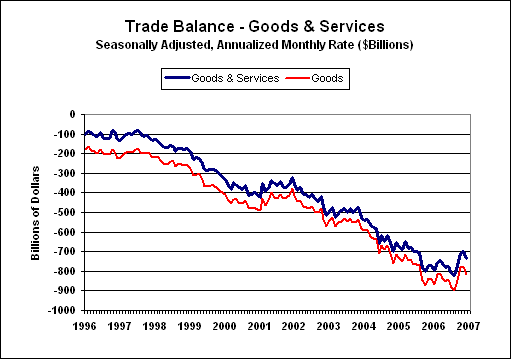
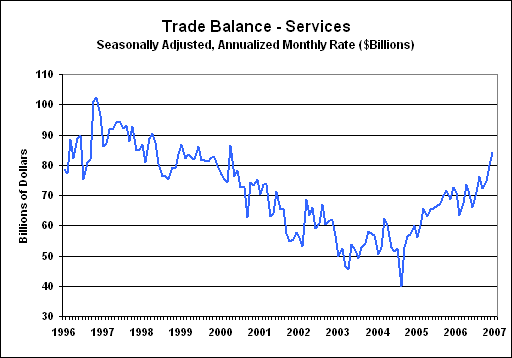
One problem with the numbers is that the services surplus is just a plug guesstimate -- with no hard numbers behind it -- unlike the goods deficit, which has a significant paper trail. As shown in the graphs above, the services surplus started to take off in mid-2004 and has been softening the blow of the widening goods deficit ever since. Its primary use is as a reporting gimmick. Consider, for example, when the Department of Commerce publishes the U.S. trade balance by region, it does so only for goods. The services numbers are not real.
On a goods only basis, the 2006 deficit widened to $818.1 billion from $787.5 billion in 2005. The largest component of that was with Communist China, with a 2006 deficit of $232.5 billion versus a $201.5 billion deficit in 2005.
Red China sits with an increasing stockpile of U.S. dollar reserves, while its relationship with the United States turns increasingly adversarial. Such does not hold out positive prospects for the U.S. dollar.
In another trade coup, the U.S. trade deficit with NAFTA widened in 2006 to $136.9 billion, versus $128.9 billion in 2005. The deficit deterioration was due to a surging deficit with Mexico, which increased to $64.1 billion in 2006 from $49.7 billion the year before. The deficit with Canada actually narrowed.
The trade deficit with OPEC widened to $104.9 billion in 2006, versus $92.9 billion in 2005.
The deficit with Japan increased to $88.4 billion in 2006, versus $82.5 billion in 2005.
Shy of trade swings tied to big oil price changes, the overall trade picture remained bleak in 2006, with the U.S. showing only a limited number of small surpluses in global trade. This is one of the key structural economic problems facing the United States.
A Dumbed-Down Public and Interest Rate Options. A systemic problem in the United States that partially accounts for the particularly low quality of most politicians elected to national office, and for the sometimes blind public and financial-media acceptance of Wall Street hype, has been the dumbing-down of the U.S. public in the post-World War II era.
While being interviewed for a network nightly news program ten years ago, I was cautioned that the language used for broadcast was aimed at the intellect of a 10-year old. Recently, I was similarly advised by a different national network news program that my language should be suitable for a fourth grader (9-year old). Consider that those who watch the national evening news programs likely are better educated than average.
What triggers the above comments is the inability of the popular financial media to consider more than two interest rate circumstances. In the first case, the economy is strong, and inflationary pressures mean the Fed will have to tighten in order to fight rising prices. In the second case, the economy is weak, and inflation will not be a problem, so the Fed has to ease so as to stimulate the economy.
Aside from the painful reality that the U.S. central bank currently has no ability either to fight inflation or to stimulate the economy, such thinking does not allow for the current circumstance of a slowing/recessionary economy with inflation and currency problems. This thinking also explains some wild mood swings in the markets from a little weather distortion in economic statistics.
Raising rates to tame inflation works when prices are being driven higher by strong demand. In the current circumstance, however, inflation is being driven by non-demand factors spiking oil prices and increasingly will be fueled by a weakening dollar. In an environment where the economy is in a long-term structural contraction, where lack of adequate real (inflation-adjusted) income growth is acting as a major constraint on personal consumption, no amount of easing or money supply expansion can produce sustainable economic growth.
The Fed continues to salve the markets with platitudes and varying stories on contained inflation and stable business conditions, which are aimed at avoiding the looming financial-market meltdown. Once U.S. dollar selling begins in earnest, though, the Fed will have little choice but to "tighten" -- at least briefly -- in defense of the dollar. Unlike the 1987 financial panic, when the Fed abandoned the greenback's defense in order to salvage the U.S. stock market, no one, including Mr. Bernanke has had do deal with a U.S. recession unfolding in an environment where the financial markets are so heavily dependent on foreign capital for liquidity.
While the standard two interest rate scenarios are nice fodder for a gullible public, the Federal Reserve's next rate action likely will be a rate hike in defense of the dollar, even though U.S. economic growth will be tanking.
Alternate Realities. This section updates the Shadow Government Statistics (SGS) alternate measures of official CPI and GDP reporting. When a government economic measure does not match common public experience, it has little use outside of academia or the spin-doctoring rooms of the Federal Reserve, White House and Wall Street.
Effects of gimmicked methodological changes have been removed from the official series so as to reflect more accurately the common public experience, as embodied by the post-World War II CPI and the pre-Reagan-Era GDP. The methodologies for the series are discussed in the August 2006 SGS (see Archives page at www.shadowstats.com).
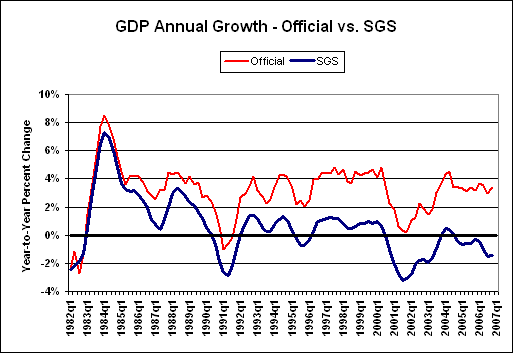
GDP. The alternate fourth-quarter GDP growth reflects the "advance" estimate revision, with many of the methodological gimmicks of recent decades removed. The alternate fourth-quarter inflation-adjusted annual growth rate (year-to-year, as opposed to the popularly-touted annualized quarter-to-quarter rate) for GDP was a decline of roughly 1.4% versus the official 3.4% gain.
[Note: Historical data on both the official and SGS-Alternate GDP series are available for download on the Alternate Data page of www.shadowstats.com.]
Please note that the Alternate GDP numbers tend to show deeper and more protracted recessions than have been formally reported or reflected in related official reporting. Nonetheless, the patterns shown in the alternate data are broadly consistent with the payroll employment and industrial production series (as revised), which are major indicators used by the National Bureau of Economic Research in determining the official timing of U.S. business cycles.
CPI. The gimmicked annual core inflation held even in December, as regular inflation reporting continued to rebound. Oil prices remain high, and despite recent downside oil price volatility, higher energy and material costs continue permeating broad economic activity. Both core and regular inflation reporting annual should trend higher in the months ahead, despite any short-term swings in upcoming the January annual data.

[Note: Historical data on both the official and SGS-Alternate CPI series are available for download on the Alternate Data page of www.shadowstats.com.]
How Hyperinflationary Depression Could Break and Hedging Against
Same
This is the second in a series of articles on the greatest threat facing the U.S. economy and financial markets: hyperinflationary depression. Last month's SGS explored why the system faces hyperinflation instead of deflation. The current SGS looks at how the crisis could break and explores approaches to preserving wealth and assets in the turbulent times ahead. The next SGS will discuss business operations in, and day-to-day living with, hyperinflation.
The economic downturn already underway in the United States is an inflationary recession that could evolve into a hyperinflationary depression by the end of the decade.
In terms of hyperinflation, the circumstance envisioned is not one of double- or triple- digit inflation, but more along the lines of seven to 10 digit inflation seen in other circumstances during the last century. Under these circumstances, the currency becomes worthless, as seen in Germany (Weimar Republic) in the early 1920s, in Hungary after World War II and in the dismembered Yugoslavia of the early 1990s
The historical culprit generally has been massive printing of currency that the involved government needed to support its system, when it did not have the ability to raise the money through taxes or other means.
In the United States, the printing presses have not been revved up heavily, yet, but the commitments are in place, as seen in the annual GAAP-based deficit for 2006 of $4.6 trillion, up from $3.5 trillion in 2005 (see the December 2006 SGS Reporting/Market Focus). That amount is far beyond the ability of the government to tax and is increasing sharply each year. While the inevitable inflationary collapse based solely on these funding needs could be pushed well into the next decade, actions already taken may have set the stage for an earlier crisis.
Efforts at buying time have made the circumstance worse. By pushing recent Treasury funding needs on foreign investors -- stuck with excess dollars from the ever-expanding U.S. trade deficit -- has created a huge dollar overhang in the markets. The more the crisis has been pushed into the future, the greater the potential for pending calamity has become.
Milton Friedman and Anna Jacobson Schwartz noted in their classic A Monetary History of the United States that the early stages of the Weimar Republic hyperinflation was accompanied by a huge influx of foreign capital, much as had happened during the U.S. Civil War. The speculative influx of capital into the U.S. at the time of the Civil War inflation helped to stabilize the system, as the recent foreign capital influx to the United States has helped stabilize the equity and credit markets of recent years. Following the Civil War, however, the underlying economy had significant untapped potential and was able to generate strong, real economic activity that covered the spending excesses of the war.
Post-World War I Germany was a different matter, where the country was financially and economically depleted as a penalty for losing the war. Here, after initial benefit, the influx of foreign capital helped to destabilize the system. "As the mark depreciated, foreigners at first were persuaded that it would subsequently appreciate and so bought a large volume of mark assets ..." Such boosted the foreign exchange value of the German mark and the value of German assets. "As the German inflation went on, expectations were reversed, the inflow of capital was replaced by an outflow, and the mark depreciated more rapidly ... (Friedman p. 76)."
The Weimar circumstance is closer to the current U.S. circumstance, although, in certain aspects, the current situation is worse. Unlike the untapped economic potential of the United States 140 years ago, today's U.S. economy is languishing in the structural problems of the loss of its manufacturing base and a shift of domestic wealth offshore.
In the early 1920s, foreign investors were not propping up the world's reserve currency in an effort to prevent a global financial collapse, knowing in advance that they were doomed to take a large hit on their investments in Germany. In today's environment, both central bank and major private investors know that the dollar is going to be a losing proposition. They either expect and/or hope that they can get out of the dollar in time to lock in their profits, or, primarily in the case of the central banks, that they can forestall the ultimate global economic crisis.
It is this environment that leaves the U.S. dollar open to potentially such a rapid and massive decline, and dumping of U.S. Treasuries, that the Federal Reserve would be forced to monetize significant sums of Treasury debt, triggering the early phases of a monetary inflation. In this environment annual multi-trillion dollar deficits rapidly would feed into a vicious, self-feeding cycle of currency debasement and hyperinflation.
In such a circumstance, gold would be a primary hedging tool that would retain real value and also be portable in the event of possible civil turmoil. Real estate also would provide a basic hedge, but would lack the portability and liquidity of gold. Having some funds invested offshore would be a plus in circumstances where the government might impose currency or capital controls.
From the standpoint of day-to-day survival, something of a barter system likely would develop, where items such as cases of scotch might hold particular value.
This whole area will be explored in greater depth in next month's newsletter.
MARKETS PERSPECTIVE
Market expectations on future Fed policy have changed twice, so far this year, as unusual weather patterns bloated indications of December business activity, alleviating rapidly building recession concerns. Those concerns returned quickly, though, as January data more than reversed the earlier misleading happy story of some of December's numbers. We still look for the Fed's next action to be an increase in short-term interest rates aimed at stabilizing the U.S. currency.
The U.S. economy remains in a severe, structural inflationary recession, saddled with an impotent Fed and a federal government that is fiscally bankrupt in all but name. In combination, these factors offer the worst of all environments to the financial markets. Ahead lie higher long-term interest rates and much lower U.S. equity prices. On the plus side is the outlook for gold, which provides a solid hedge against many of the problems that have started to surface. Key to the near-term movements of these markets remains the fate of the U.S. dollar.
The fundamentals stacked against the greenback have never been worse. When the dollar dumping begins, the other markets will be put in play in a manner that eventually will shake the foundations of the global financial system.
U.S. Equities -- The various stock market indices remain far removed from underlying reality, with the Dow Jones Industrial Average (DJIA) regularly pushing on to a new historic highs. Threats to the current market's euphoria remain in the unfolding recession, higher interest rates and heavy dollar selling.
That the stock market is so irrational is not unusual. What is unusual is the severity of the negative underlying fundamentals. I continue to expect the major indices to suffer heavy selling and large declines before year-end 2007. A fair-market value for the DJIA based on historical price/earnings norms and current circumstances would be around 8,500, down about a third from its current level. Of course, a market in heavy sell-off rarely stops at fair value.
U.S. Credit Market -- Long-term interest rates tended to gyrate 10 to 20 basis points around the economic recovery/renewed recession outlook speculation of the last month or so, but the yield curve on Treasuries remained inverted throughout, adding some confirmation to our point that the inversion is due more to massive foreign buying of Treasuries in recent years than to recessionary expectations.
Accordingly, the key to a major upside movement in long-term yields remains a highly likely major sell-off in the U.S. dollar. With several Asian central banks suggesting the time to move out of the dollar is it hand, any dumping of foreign U.S. Treasury holdings would have the immediate impact of spiking interest rates, particularly at the long end of the yield curve.
While expectations of the Fed's next action on interest rates may swing wildly with rapidly changing economic expectations, the U.S. dollar's behavior remains the primary concern. The U.S. economic and political systems are in trouble, and that will pressure the greenback to the downside. The Fed's next action still remains a likely spike in interest rates in defense of the dollar.
U.S. Dollar -- As market speculation briefly moved away from a looming U.S. recession, the U.S. dollar rallied some in response. With market speculations on the economy now reversing, slight selling pressure on the U.S. currency has resumed.
The pending major dollar sell-off could hit at any time with no advance warning. It could be triggered by any number of factors ranging from a negative economic report, to a political embarrassment for the Federal Reserve or Administration, to a terrorist attack or even military action against Iran. Whatever the trigger, it is likely to come within the next couple of months. When it comes, broad selling should be heavy enough to overcome short-lived interventions by certain Asian central banks. Central banks outside the U.S. have been holding off liquidating their dollar reserves, though the desire to liquidate is strong. There is mounting risk of some related central bank dollar dumping.
In terms of underlying fundamentals that tend to drive currency trading, the dollar's portfolio could not be worse. Relative to major trading partners, the U.S. economy is much weaker, interest rates are lower, inflation is higher, fiscal conditions are abysmal, and relative political stability is near an all time low. The President's approval rating commonly has moved currency trading in the past. Current conditions are the worst seen in the post-World War II era, compounded by the presence of a Congress to the President.
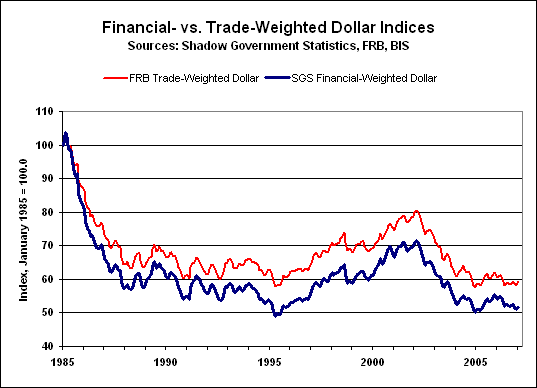
Generally, the greater the magnitude of the dollar selling, the greater will be the ultimate inflation pressure and liquidity squeeze in the U.S. capital markets. As shown in the following graph, however, the U.S. dollar moved higher in January, riding out the unseasonably pleasant weather.
[Note: Historical data on both dollar series are available for download on the Alternate Data page of www.shadowstats.com. See the July 2005 SGS for methodology.]
U.S. Dollar Indices. The Shadow Government Statistics' Financial-Weighted U.S. Dollar Index (FWD) is based on dollar exchange rates weighted for respective global currency trading volumes. For January 2007, the monthly dollar average rose by 1.48%, after a 1.53% decline in December. The January 2007 average index level of 51.71 (base month of January 1985 = 100.00) was down 4.50% from January 2006, following an annual rate of decline of 7.55% in December.
Also rebounding, January's monthly average of the Federal Reserve's Major Currency Trade-Weighted U.S. Dollar Index (TWD) rose by 1.82%, after a 0.73% decline in December.
Please note the FRB's TWD has been re-weighted, reducing December's level by 0.1%, from 58.29 to 58.21 (base month of January 1985 = 100.00). The January 2007 monthly average index of 59.27 was down 2.28% from the year before, against December's annual decline of 5.56%.
The stronger performance of the FRB versus the SGS series continues to be due to a much heavier weighting of the Canadian dollar in the TWD versus the FWD. The U.S. dollar has continued to strengthen against its Canadian counterpart.
Gold -- The price of gold has trended higher in recent months, but the precious metal's upside will be almost unbounded as the U.S. dollar tumbles, and certainly as the greenback begins its terminal slide.
Nonetheless, gold price volatility is likely to remain high, particularly with potential central-bank manipulation, including talk of gold sales. Still, central banks know well that they should be increasing their gold holdings, not liquidating them.
As discussed in the ongoing Hyperinflation Series, the eventual complete collapse of the U.S. dollar -- the world's reserve currency -- will force the creation of a new international currency system. Gold likely will be structured into any replacement system in an effort by those organizing the new currency structure to gain public acceptance.
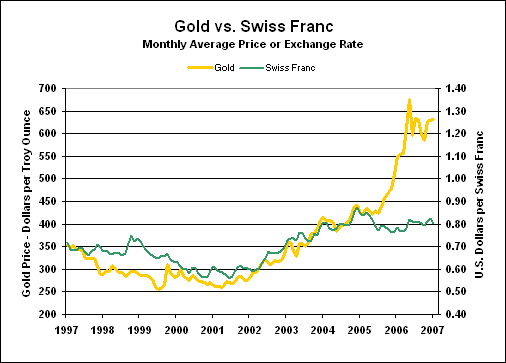
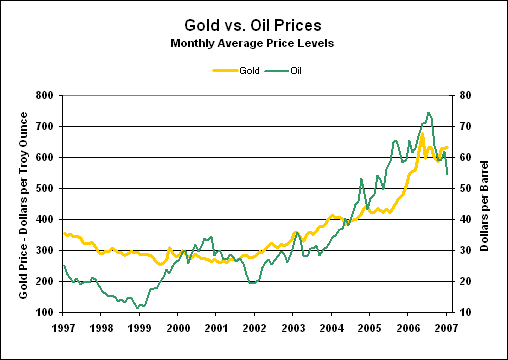
The updated gold versus oil and Swiss franc graphs show January averages. As we go to press, gold is trading around $660, oil is shy of $60 and the Swiss franc is shy of $0.81. Look for all three measures to trade significantly higher in before mid-year.
REPORTING PERSPECTIVE
The Big Three Market Movers
Recent economic reporting has been distorted by unusual weather conditions in December and early January. As discussed in the Opening Comments, market sentiment turned overnight from an economy headed in into recession to an economy experiencing renewed vigor. The economy's downturn, however, did not change, and perceptions are turning just as quickly back to recession as the distortions reverse in January data. Beyond short-term data disruptions, recent and upcoming releases of the major series are, and likely will be, subject to massaging for both the perceived political needs of the Administration and the financial market needs of the Federal Reserve Board.
Nonetheless, the reality of the deteriorating, underlying inflationary recession once again will surface in the popularly followed economic series. Against lagging and distorted market expectations, most near-term economic reporting will surprise the markets on the downside, while most inflation reporting should surprise the markets on the upside.
Employment/Unemployment -- Employment conditions remain bleak, despite strong upside revisions to payroll levels. This month's Reporting/Market Focus reviews the Bureau of Labor Statistics (BLS) annual benchmark revisions to the payroll survey along with other, more-independent indicators of the labor market. The benchmark revisions highlight the meaninglessness of the monthly payroll reporting, over which Wall Street hyperventilates so regularly. What follows here are the specifics of the December 2006 January 2007 reported monthly results.
The BLS reported seasonally-adjusted January payrolls up by 111,000 (1,044,000 net of revisions -- see Reporting/Market Focus) +/- 129,000, following December's revised gain of 206,000 (previously 167,000). On an unadjusted, year-to-year basis, annual payroll growth slowed sharply in January to 1.61% from 1.70% in December. Please note we now are using the BLS's 95% confidence interval for monthly employment change of +/- 129,000 jobs, instead of the previous 90% confidence interval of +/- 106,000, given the rapidly increasing magnitude of recent revisions, pre-benchmark.
The January 2007 payroll growth included a 175,000 downside bias provided by the net birth/death model. Although the BLS ceased publishing its bias factors for the pre-March 2006 (benchmark month) period, February usually sees the bias factors swing to the upside, and all biases have been upped in response to the benchmark problems. Accordingly, the biases will place upside pressure on February reporting.
The consistency of the household survey, which counts the number of people who have a job, as opposed to the number of jobs counted in the payroll survey, just went through its annual demolition. Due to changes in the assumed U.S. population, all the household data were revamped, but the BLS no longer provides a bridge in the reporting. It does not show what the reporting would have been on a consistent basis.
So, although the household survey reported seasonally-adjusted employment of 145,957,000 in January 2007, whether that was higher or lower than December's 145,926,000, on a consistent basis, is unknown by the public.
Similarly, although the unemployment portion of the household data showed the seasonally-adjusted January U.3 unemployment rate at 4.59% +/- 0.23% (95% confidence interval), one cannot tell if that is higher or lower than December's 4.48%, on a consistent basis. With a like caveat, unadjusted U.3 was 5.0% in January, 4.3% in December. The unadjusted broader U.6 measure was 9.1% in January, 7.8% in December. Adjusted U.6 was 8.3% in January, 8.0% in December. Including the long-term "discouraged workers" defined away during the Clinton administration, total unemployment remains roughly 12%.
The latest report was against a background of ongoing collapse of annual growth in help-wanted advertising, rapidly intensifying weakness in new claims for unemployment insurance and very weak purchasing managers employment indices (see the respective sections).
Next Release (March 9): The payroll survey should be weaker than expected in February, despite the upside bias swing, along with a rise in the unemployment rate. It will be interesting to see if the massive prior-period upward revisions continue, or if that recent pattern was just a ruse to bloat the base underneath the benchmark revision so as to boost historic jobs creation claims by the Administration. Going forward, payrolls, like production, should begin to show monthly contractions, consistent with the deepening recession.
Gross Domestic Product (GDP) -- The "advance" estimate revision of annualized real (inflation-adjusted) growth for fourth-quarter 2006 was 3.47% +/- 3%, up from the third quarter's 1.96% and the second-quarter's 2.56%, but it was down from the first quarter's 5.58%. Measured fourth-quarter 2006 over fourth-quarter 2005, real growth was 3.38%, up from 3.15% in 2005. For the year of 2006, average real GDP growth also was 3.38%, up from 3.22% in 2005.
With the Bureau of Economic Analysis (BEA) now jiggering the trade data, nearly half the reported fourth-quarter GDP growth was attributable to the supposed narrowing of the inflation-adjusted trade deficit (net exports). Our separate analysis of the data shows a best-case outcome of an unchanged real trade deficit for the quarter, before allowing for the reported "unexpected" sharp deterioration in the December trade deficit. The December trade information was not available when the "advance" estimate was made. Further, government trade calculations in the GDP were aided by seasonal shifts applied only to the constant-dollar trade numbers and by sharp increases in fourth-quarter "residuals," where the proffered data just do not add up.
While the GDP report is the government's broadest estimate of U.S. economic activity, it is also the least meaningful and most heavily massaged of all major government economic series. Primarily it has become a tool for economic propaganda.
Adjusting for methodological distortions built into GDP reporting over time, the SGS Alternate GDP measure suggests economic reality is much weaker than officially reported, with a year-to-year annual contraction of roughly 1.4% for fourth-quarter 2006 GDP, slightly narrowed from the third quarter's 1.5%, and down from a 0.3% decline in fourth-quarter 2005 over fourth-quarter 2004 GDP (see the graph in the Alternate Reality section in the Opening Comments). For the year of 2006, average change in real Alternate SGS GDP was a contraction of 1.1%, versus a 0.5% contraction for 2005.
The GDP inflation rate (deflator) in the fourth quarter fell to 1.54%, versus 1.88% in the third quarter. Such reflects the violent moves in oil prices, and actually was more realistic for once than the CPI's annualized 0.79% quarterly contraction.
The "advance" release is too much of a guesstimate for the BEA even to try to guess the alternate GDP measures: the broader Gross National Product (GNP) and the theoretically-equivalent Gross Domestic Income (GDI). The GNP and GDI estimates will follow in the revisions of the next month or two.
Next Release (February 28): The "preliminary" estimate revision of fourth-quarter 2006 GDP should come in below the "advance" estimate, given subsequent weakness in trade and production reporting.
Consumer Price Index (CPI) -- The BLS initially reported the seasonally-adjusted December CPI-U up by 0.55% (0.15% unadjusted) for the month, following November's unchanged reading (down 0.15% unadjusted). Subsequently, the BLS published its annual seasonal adjustment revisions, and the December CPI then was up by 0.45% following November's new 0.05% increase. What on a seasonally adjusted basis had been an annualized quarterly CPI contraction of 2.1% in fourth-quarter 2006, suddenly narrowed to a contraction of 0.79%. The numbers did not get any more realistic, however, the new seasonals just shifted the patterns of change around a little within the year.
Keep in mind that the unadjusted CPI-U (I.6) never is revised (except for the occasional reporting error). Accordingly, annual inflation initially reported for December 2006 at 2.54% remained 2.54%, compared with December 2005 annual inflation of 3.42%. Average 2006 inflation was 3.23% versus 3.39% in 2005.
The eight levels of annual inflation, I.1 to I.8, are shown in the table in the Alternate Reality section, as is the plot of the SGS Alternate Consumer Inflation number.
The "experimental" Chained Consumer Price Index (C-CPI-U), the fully substitution based CPI that presumably is the eventual replacement for current CPI reporting, showed annual inflation (I.5) of 2.36% in December, up from 1.92% in November. Annual average C-CPI-U inflation for 2006 was 2.90% versus 2.81% in 2005.
Adjusted to pre-Clinton methodology (I.7), annual CPI growth was about 5.8% in December, up from 5.4% in November. The SGS Alternate Consumer Inflation Measure (I.8), which reverses gimmicked changes to official CPI reporting methodologies of recent decades, was 10.0% in December, up from 9.4% in November. For 2006, the Average Annual SGS Alternate Consumer Inflation Measure was 10.2%, the strongest reading since 1981.
Next Release (February 21): Annual inflation has not peaked, but it will take some months into 2007 to regain its recent high annual rates. With seasonally-adjusted CPI-U rising 0.6% in monthly January 2006 CPI reporting, any monthly reporting above or below that for the imminent CPI release of January 2007 will add or subtract directly to or from the annual CPI-U inflation rate. With consensus forecasts around 0.1% for monthly inflation, annual inflation likely will have taken a 0.4% to 0.5% hit in January.
Reporting surprises for inflation still should come in on the upside of weak expectations, both for full as well as core numbers. Increasingly reflecting the slow process of oil prices permeating nearly all levels of business activity, upside movement in core rates, in particular, will tend to shock the markets.
Also due with the pending January CPI release is a BLS shift to reporting of the CPI to three decimal points, instead of the current one. While such will increase the apparent precision of various reported percentage changes, it will do nothing in terms of improving the overall accuracy of the methodologically-impaired consumer price measure.
Other Troubled Key Series
Federal Deficit -- As discussed in the December SGS, the federal government's fiscal 2006 (fiscal year-end September 30th) deficit, prepared based on generally accepted accounting principles (GAAP), widened to $4.6 trillion from 2005's $3.5 trillion. Those numbers dwarfed the officially-gimmicked 2006 federal budget deficit of $248.2 billion, which was down $70.8 billion from 2005's $318.5 billion.
Though still lacking the accrual accounting of the GAAP numbers, the change in gross federal debt is a better indicator of actual net cash outlays by the federal government than is the gimmicked deficit reporting. As of fiscal year-end 2006, the gross federal debt stood at $8.507 trillion, up by $574 billion from 2005, which in turn was up $554 billion from 2004.
For the rolling 12 months through January 2007, the gimmicked deficit was $191.9 billion, versus $307.3 billion in January 2006, compared with rolling deficits of $209.2 billion and $319.7 billion in December of 2007 and 2006. As of January 31, 2007, the gross federal debt stood at $8.708 trillion, up by $511 billion from January 2006, which in turn was up by $568 billion from January 2005. As of December 31, 2006, the gross federal debt stood at $8.680 trillion, up by $510 billion from December 2005, which in turn was up by $574 billion from December 2004.
Despite the bookkeeping games played by the Administration and Congress, even the gimmicked deficit should widen this year, as government finances suffer increasingly from tax revenue losses due to the intensifying recession and relative tax receipt declines after the expiration of recent tax incentives. While GDP growth estimates can be gimmicked, incoming tax receipts (based on consistently applied tax policies) remain an independent estimate of underlying economic reality and eventually will reflect the economy's mounting difficulties.
Initial Claims for Unemployment Insurance -- Annual change in initial claims has soared into positive territory (an economic negative) due to the continued sharp deterioration in recent numbers. New claims, averaged over the last four weeks (ended February 10th), are up 11.2% from last year, but year-ago comparisons using the 17-week moving average still are dampened by the trailing effects of last year's devastating hurricanes passing through the data. On a smoothed basis for the 17 weeks ended February 10th, annual change rose into positive territory, up 3.9%. Such contrasts with the 17-week average decline of 6.9% as of December 23rd. Current growth patterns are graphed and discussed further in this month's Reporting/Market Focus.
More often than not, week-to-week volatility of the seasonally-adjusted weekly numbers is due to the Labor Department's efforts to seasonally adjust these numbers around holiday periods. The Labor Department has demonstrated an inability to do such adjusting successfully. When the new claims series is viewed in terms of the year-to-year change in the 17-week (four-month) moving average, however, such generally is a fair indicator of current economic activity.
Real Average Weekly Earnings -- December's seasonally-adjusted real earnings fell by 0.1%, following a revised November gain of 0.3% (previously 0.2%). Annual growth slowed to 2.1% in December, from 2.7% (previously 2.6%) in November.
Gyrations in the poor quality of reported CPI growth account for most month-to-month volatility in this series. Adjusting for the major upside biases built into the CPI-W inflation measure used in deflating the average weekly earnings, annual change in this series shows the average worker to be under severe financial stress in an ongoing recession.
Retail Sales -- A weather-distorted series, seasonally-adjusted January retail sales basically were flat, down by 0.01% +/- 0.7%, versus December. December retail sales were up 0.9% (unrevised) from November, which was up 0.6% from October (initially 1.0%). Of some note, January gasoline station sales were down by 0.7% from December, suggesting negligible dampening of January CPI from gasoline prices.
Real (inflation-adjusted) year-to-year growth in retail sales below 1.8% (using the official CPI-U for deflation) signals recession, and a signal first was generated in this business cycle back in June 2006. Before inflation adjustment, January 2007 growth plunged to 2.9%, from a weather-spiked reading of 5.7% in December. With December annual CPI at 2.5%, and market expectations for January annual CPI at 2.0%, real annual retail sales growth rapidly is nearing negative territory, an event usually seen only in the depths of a recession.
Next Releases (March 13, 29): February retail sales again should come in below expectations, generally mirroring the recession. Inflation-adjusted growth should be negative on a monthly basis, with annual real growth also moving into contraction territory. A benchmark revision is due on March 29th. Look for historical retail sales growth to be weaker in revision.
Industrial Production -- Even with the December and January numbers subject to weather distortions, industrial production has begun settling into a recessionary pattern, consistent with the below-50 readings in the November and January purchasing managers manufacturing surveys (see related section).
Initially reported at a monthly gain of 0.4%, seasonally adjusted December production revised upwards to 0.5% in January reporting, but such was in conjunction with downward revisions to prior months. As a result, the seasonally-adjusted annualized quarterly contraction in fourth-quarter 2006 production revised from 0.55% to a more severe contraction of 0.78%, consistent with what often would be a coincident contraction in GDP.
Assuming that a portion of December's production gain was a weather distortion, the 0.5% decline reported for January's seasonally-adjusted monthly change likely reversed some of the earlier misstatement. Annual growth in January production slowed to 2.6%, from 3.0% in December and 3.3% in November
Next Release (March 16): Look for industrial production to contract again in February, confirming the recession. Monthly contractions in this series shortly will become regular.
New Orders for Durable Goods -- The usually volatile durable goods orders rose in December by a seasonally-adjusted by 3.1% (3.6% net of revisions), after a 3.2% (previously 1.9%) November increase. December's orders rose 2.0% from the year before, after November's annual gain of 0.6% (revised from 0.3%), a near-recessionary level for a third month.
The closely followed nondefense capital goods orders rose by 9.0% for the month of December, following November's 0.3% (previously 0.2%) decline. December's annual growth rate for nondefense capital goods orders was down a recessionary 9.5%, following November's 7.6% decline.
Durable goods orders lost its status as a solid leading economic indicator when the semi-conductor industry stopped reporting new orders.
Trade Balance -- Certain the key 2006 annual trade statistics are graphed and discussed in the Opening Comments section. What follows here focuses on the regular monthly reporting.
The seasonally-adjusted monthly December trade deficit widened to $61.2 billion, topping consensus forecasts. The November deficit revised to $58.1 billion from its initial reporting of $58.2 billion. The December accounting reflected a small increase in oil prices and a continued sharp plunge in the physical volume of imported oil.
The larger-than-expected December deficit suggests some looming downward adjustment to growth in the "preliminary estimate" revision to fourth-quarter GDP, due on February 28th.
For 2006, the reported goods and services deficit widened to $763.6 billion from $716.7 billion in 2005.
Next Release (March 9): The January trade deficit should show some further rebound from understatement in the latter part of 2006, likely topping consensus forecasts. Despite interim bumps from gyrating oil prices, the months ahead will see a pattern of regularly increasing deficits that once again will be setting new records by mid-year 2007.
Consumer Confidence -- January confidence measures rose for the month but annual growth trends slowed. The Conference Board's January consumer confidence -- adjusted by the usual suspect seasonal factors -- rose by 0.3%, after a revised 4.5% increase in December. The unadjusted University of Michigan's consumer sentiment rose by 5.7% in January after declining by 0.4% in December.
On a diminishing year-to-year basis into December, the damage done to confidence in 2005 by the severe hurricane season largely was responsible for the gains seen in late-2006 annual growth patterns. On a three-month moving-average basis for January, annual growth in the Conference Board's measure eased to 5.4% from 11.5% in December, while annual growth in the University of Michigan's number slowed to 6.2% from 12.2% in December. These lagging, not leading, indicators still show the economy has been in trouble.
Beware the mid-month Consumer Sentiment release from the University of Michigan. Its sampling base is so small as to be virtually valueless in terms of statistical significance.
Short-Term Credit Measures -- Despite annual growth in consumer credit notching higher, monthly growth in revolving credit (credit cards) was flat in December, suggesting less-than-robust holiday sales. Annual growth in short-term commercial credit continued strong, albeit at somewhat slower growth rates.
Seasonally-adjusted consumer credit grew by 0.3% for the month of December, with annual growth up 4.6%, following 4.5% in December and 4.3% in November. In the current environment, where inflation-adjusted growth in income is not adequate to support meaningful growth in the personal consumption component of GDP, sustained GDP growth can be supported temporarily by debt expansion or savings liquidation. Consumer debt expansion has stalled on a monthly basis, though, suggesting a major constraint on economic growth.
Annual growth in commercial paper outstanding remained strong in January at 18.3%, down from December's 21.5% but still higher than November's 17.8%. Annual growth in commercial and industrial loans also was solid but slowed somewhat to 13.3% in January, down from 14.8% in December and 15.1% in November. Strong growth in the commercial credit measures can signal credit needs tied either to rising sales and receivables/inventory, or to slowing sales and slowing collections and involuntarily rising inventories.
Producer Price Index (PPI) -- Partially reflecting oil-price gyrations, the re-weighted and re-seasonally-adjusted January finished goods PPI fell by 0.6% (down 0.2% unadjusted), versus December's 0.9% gain. The 2.0% inflation surge in November was redefined to 1.8%. January's annual PPI inflation eased to 0.2% from 1.1% in December and 0.9% in November. Seasonally-adjusted January intermediate goods fell by 0.7% for the month (up 0.5% in December), while crude goods dropped by 6.3% (up 2.8% in December).
Next Release (March 15): Despite oil price swings and an innate random volatility in monthly price variations, PPI inflation reporting over the next six-to-nine months remains likely to exceed overly-depressed expectations. February core inflation, in particular, is subject to an upside surprise for consensus forecasts, despite the rapid deterioration in reporting quality.
Better-Quality Numbers
The following numbers are generally good-quality leading indicators of economic activity and inflation that offer an alternative to the politically-hyped numbers when the economy really is not so perfect. In some instances, using a three-month moving average improves the quality of the economic signal and is so noted in the text.
Economic Indicators
Purchasing Managers Survey: Manufacturing New Orders -- Despite the overall January purchasing managers manufacturing index showing a contracting manufacturing sector -- consistent with recession -- the January new orders index fell by 3.1% to 50.3, holding just above the official contraction level. With the unreliable government-generated seasonal factors revised for prior history, the December new orders index stood at 51.9, up from 49.7 in November.
Seasonal-factor distortions are overcome by viewing the series using year-to-year change on a three-month moving average basis. On that basis, the January new orders index fell by 13.6%, against contractions of 12.7% in December and 13.6% in November.
The index gradually has notched lower from its peak annual growth of 42.6% in April of 2004. As an SGS early warning indicator of a major economic shift, the new orders measure breached its fail-safe point in mid-2005, generating a signal of pending recession.
Published by the Institute for Supply Management (ISM), the new orders component of the purchasing managers survey is a particularly valuable indicator of economic activity. The index is a diffusion index, where a reading below 50.0 indicates contracting new orders.
The overall January ISM manufacturing index dropped to 49.3 from December's 51.4 and November's upwardly revised 49.9. Again, an index level below 50.0 indicates a contracting manufacturing sector. The January employment component moved to 49.5, from 49.4 in December and 48.9 in November, showing continued contraction in manufacturing employment. The series is graphed and further discussed in this month's Reporting/Market Focus.
The service-sector ISM index does not have much meaning related to overall business activity, since new order activity at law firms, hospitals or fast-food restaurants have little obvious relationship to broad economic activity. That said, the overall January services index rose to 59.0 from December's level of 56.7.
Both the services employment and prices paid components, however, have some meaning. The January employment component eased to 51.7 from 53.2 in December. The prices paid component is covered in the Inflation Indicators.
Help-Wanted Advertising Index (HWA) -- The Conference Board keeps publishing major monthly revisions in its help-wanted advertising index, raising a question, once again, of reporting quality. November and October had been reported at 30, but both were revised to 29, leaving three consecutive months' readings at levels last seen during the Eisenhower Administration. Against that, December surged by 13.8% to 33, the highest reading since June. At work in December possibly was a weather-related distortion, which will become evident one way or the other within the next couple of months.
Viewed on a three-month moving average basis, December's year-to-year change was a contraction of 20.2% versus November's annual change trough of a 23.0% decline. The series still indicates rapidly deteriorating employment conditions, which are graphed and discussed further in this month's Reporting/Market Focus. Where the index never recovered from the 2000 recession, its recent, deepening plunge signals a renewed and rapid contraction in economic activity.
Housing Starts -- Seasonally-adjusted January housing starts plunged by 14.3% +/- 7.1% for the month, with year-to-year change collapsing by 37.8% +/- 5.2%. The January numbers likely suffered some from the relatively stronger December data that had been enhanced by mild weather and borrowed some business from January. Month-to-month, December was up 5.0%, versus a 5.9% gain in November, with year-to-year change down 17.9% in December, against a 26.6% decline in November.
Due to the volatility of the data and the occasional weather distortions, the numbers for annual change best are viewed on a three-month moving-average basis. So calculated, the January year-to-year drop was 27.9%, the worst reading since the depths of the 1990/1991 recession. The series continues to signal an intensifying recession.
In related data, respective rates of annual contraction for December new- and existing-home sales were 11.0% and 7.9%. Although the annual rates of change were less negative than in the prior month, indicated activity likely will drop sharply in January, reflecting the weather distortions and remaining consistent with a sharp economic downturn.
Money Supply -- Annual growth in the SGS Continuing M3 hit 11.0% in January, up from 10.8% in December. Helped by rising M2 growth, January's annual M3 growth was at a five-year high. Growth has been increasing steadily since the near-term trough of 4.6% in March 2005. If M3 growth still were published by the Federal Reserve, financial market concerns of excessive liquidity creation would be even more highly vocalized than they are at present. The same would be true for inflation concerns.
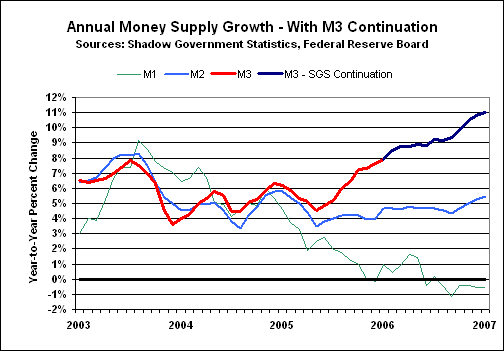
[Note: Historical annual growth data for the money supply series, including the ongoing SGS estimates of M3, are available for download on the Alternate Data page of www.shadowstats.com. See the August 2006 SGS for methodology.]
Before inflation adjustment, seasonally-adjusted January M1 and M2 respectively rose by 0.4% and 0.9% for the month, after a respective 0.4% decline and 0.6% increase in December. Month-to-month M3 change was approximately 0.8% for January and 1.0% in December.
Annual growth in January for monthly M1 fell by 0.5%, versus a 0.6% contraction in December, while annual M2 growth rose to 5.5% from 5.3%. Net of distorted annual CPI inflation, real annual growth rates for January M1 and M2 remained consistent with the ongoing recession, with January's M1 and M2 year-to-year rates of change down by roughly 2.5% and up 3.4%, respectively. On a three-month moving-average basis, the January inflation-adjusted annual rates of change were down 2.6% and up 3.0%, levels that still were underwater using the old-style CPI.
Inflation Indicators
Purchasing Managers Surveys: Prices Paid Indices -- Although the January prices paid indices remained in inflationary territory for both purchasing managers surveys, the monthly shifts were mixed. The different signals likely result from the non-seasonal adjustment of prices in the manufacturing survey versus the seasonal adjustment of prices in the non-manufacturing survey. Not only are the seasonal factors provided by the Commerce Department of little value, but also they get revised at this time of year, with the effect of changing past history.
In line with oil price changes, price index movements have been volatile. On the manufacturing side, the January price index rose to 53.0 from 47.5 in December, which was down from 53.5 in November. On a three-month moving average basis, January's annual change was down by 23.7%, against December's decline of 33.3% and November's drop of 30.0%.
On the non-manufacturing side, the January prices diffusion index eased to 55.2 from 59.7 in December and against 57.2 in November. On a three-month moving average basis, January's annual change was a decline of 18.7%, versus a 21.3% drop in December and 20.3% fall in November.
Published by the Institute for Supply Management (ISM), the prices paid components of the purchasing managers surveys are reliable leading indicators of inflationary pressure. The measures are diffusion indices, where a reading above 50.0 indicates rising prices.
Oil Prices -- The monthly-average West Texas Intermediate Spot (St. Louis Fed) fell to $54.57 per barrel, down 12.0% from $62.03 in December, which, in turn, had been up 4.5% from November's $59.37. The January average was down 16.7% from the year before, against December's 4.4% annual increase and November's 1.8% annual gain. High volatility remains the norm, with February oil prices up from January, where they fell sharply last year. Recent trading has been on either side of $60.00 per barrel, with the nearby contract closing around $58 on today.
As discussed in the Opening Comments, global political conditions favor a sharp spike in oil prices in the months ahead, irrespective of any games playing by the Administration and the Saudis. Also remaining in play is the dollar-based pricing of oil, which would be threatened in the event of a likely massive sell-off in the U.S. dollar. Where dollar weakness is the equivalent of an oil price cut for oil purchasers denominated in an appreciating currency, market forces tend to push dollar-based oil prices higher, and that exacerbates inflation problems in the United States. If oil pricing were shifted to something other than the greenback, inflationary pressures would be even more intense, as any drop in the dollar would be reflected directly as an increase in the price of oil for U.S. consumption.
Whether from supply and demand, geo-political or currency pressures, oil prices will remain at highly inflationary levels and will continue as a major contributing factor to U.S. inflation woes. Historically high oil prices still are working their way through all levels of U.S. economic activity, ranging from transportation and energy costs, to material costs in the plastics, pharmaceutical, fertilizer, chemical industries, etc.
These broad inflationary pressures will remain intact despite any near-term oil price volatility. Although these pressures may be slow to surface in government reporting of the so-called "core" inflation measures, even the gimmicked core measures will start to show persistently high rates of price increases that should distress the U.S. financial markets.
As confirmed in recent reporting, downside oil price movements are picked up more quickly and fully by the BLS in its inflation measures than are upside movements. Nonetheless, the general trend in both CPI and PPI reporting -- at both the aggregate and core levels -- will be to the upside through at least the third quarter of 2007.
Please note that the guide to background articles and to prior monthly Reporting/Market Foci -- previously published here, prior to the Reporting/Market Focus section -- has been removed from the newsletter and added to the Archives Page at www.shadowstats.com.
Reporting/Market Focus (January/February 2007) -- Payroll
Employment and Alternate Measures Indicate Bleak Labor Market
Despite a one-time sharp boost to payroll levels, relative monthly and annual jobs performance remained near-recessionary. Further, other more-independent indicators of labor conditions already are showing a recession to be in place.
The release of the January 2007 payroll survey included the annual benchmark revision, which added 754,000 jobs to the seasonally-adjusted March 2006 employment level. With the BLS's revision methodology, such translated into an upward revision of 933,000 to the previously reported December 2006 payrolls.
Even so, the resulting report of a 111,000 monthly gain in seasonally-adjusted January payrolls was statistically indistinguishable from a contraction, and annual growth -- albeit higher than before the revisions -- slowed meaningfully from 1.7% in December to 1.6% in January.
The annual benchmark revision is based on a comparison of the prior year's March (2006 in the current case) payroll estimates, as regularly surveyed, against a universe of payroll employment as estimated from employers' state unemployment insurance filings. The benchmarking process never has worked particularly well because of basic surveying flaws and the way the BLS handles non-responses from major firms or their surrogates (payroll processing firms) in the surveys. Nonetheless the 2006 comparisons suggested an unusually large difference, and one that was in a politically embarrassing direction for the BLS. Employment growth purportedly had been understated.
Blamed for the "needed" revisions were inadequate bias factors (birth/death model) and problems in measuring Katrina-related employment effects. So the monthly bias factors -- designed to compensate for the creation of jobs by non-reporting new companies -- are likely to be revised upwards by roughly 300,000, in aggregate, to 1,300,000 per year. The biggest problem with the bias factors is that they never have been designed to account properly for a recessionary environment, where aggregate biases should be negative, accounting for companies going out of business.
As to the other issues, the BLS still does not understand the reporting problems it had along the Gulf Coast in the wake of 2005's extraordinarily severe hurricane system. That particular statistical quagmire likely never will be resolved.

Has there been a double-counted benchmark revision? In the months prior to the benchmark revision, monthly revisions regularly threw large amounts of new employment growth into past history. Such is shown in the graph above, where the original monthly gain is shown against the final monthly gain reported before the benchmark revision and after the benchmark revision. In the last six months of 2006, an extra 300,000 jobs were created in prior period revisions. Keep in mind that the benchmark monthly changes are after the overall upward benchmark revision had boosted employment levels by nearly 1,000,000 jobs as of January 2007, on top of the previously boosted statistics.
What appears to have been at work here is the puffing of jobs created by the Administration, prior to the November election, without tickling inflation concerns. Whether this pattern continues in the next several months will be quite telling as to what the Administration is doing.
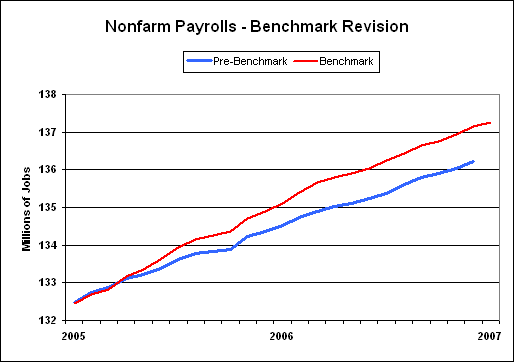
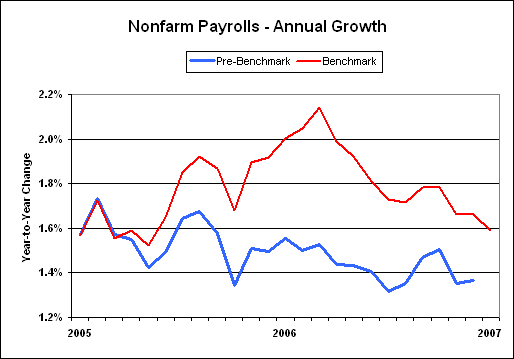
The two graphs above show the results of the benchmark revisions on both the level and year-to-year change in seasonally-adjusted nonfarm payrolls. Even with the revised reporting, relative recent employment has been slowing sharply.
It is the story shown by the revised year-to-year growth patterns in the payroll data that can be compared with other harder or more-independent measures of employment activity.
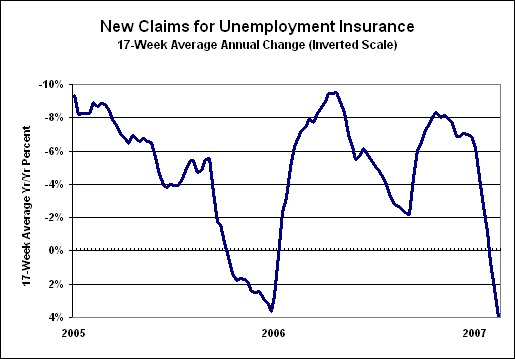
New claims for unemployment insurance, on a 17-week moving average, are surging, which is an economic negative (please note the scale of annual growth is inverted in the graph). The prior surge was tied to the effects of Katrina and the other severe hurricanes of 2005. Somehow, the hurricane effects largely were missed and then further tempered in the benchmark revisions to the payroll data.
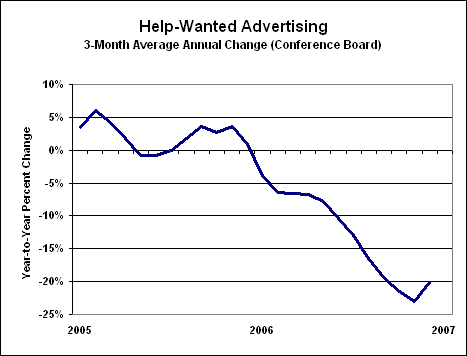
Although help-wanted advertising never recovered from the 2000 recession, annual growth -- based on a three-month moving average -- has fallen deep into new recession territory during the last year.
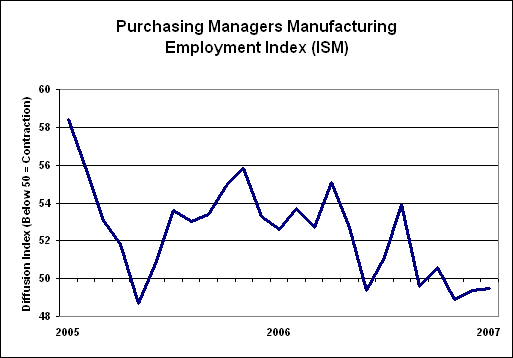
In the last several months, the employment component of the manufacturing purchasing managers survey has had a reading below 50.0, indicating contracting employment. Such is consistent with recession.
The various sections for each of the above indicators discuss current readings. Beyond the payroll data and the related troubled surveying, biases and built-in guesstimates, credibility for new claims comes from the paper trail behind it. Separately, help-wanted advertising and the purchasing managers survey are compiled independent of BLS oversight.
Upcoming Reporting/Market Focus for March -- Federal Reserve's
Flow of Funds and Manipulated Data
Scheduled initially for January, this Reporting/Market Focus on the Federal Reserve's Flow of Funds Accounts (FOF) has been shifted to the March newsletter, coincident with the 2006 annual FOF data due to be published at that time. Questionable statistical practices at the Board of Governors of the Federal Reserve System go well beyond the elimination of M3 reporting. Unusual patterns and revisions have shown up in recent quarterly FOF reporting that shows the sources and uses of cash and credit within the U.S. financial system and economy. These anomalies, and significance of same, are explored.
___________________________________________
March's "Shadow Government Statistics" newsletter is targeted for release during the week of March 19th. Its posting on the Web site, as well as all interim Flash Updates and Alerts, will be advised immediately by e-mail. OCCASIONALLY, BRIEF UPDATES ARE COMMUNICATED BY E-MAIL. IF YOU ARE NOT RECEIVING E-MAIL NOTIFICATIONS, PLEASE LET USE KNOW at johnwilliams@shadowstats.com or use our feedback option on the site.
Issue Number 27 & 28
February 20, 2007
__________
Economic Activity in Rapid Decline as Miracle Recovery Fades
Central Bank Dollar Holdings Exacerbate Hyperinflation Risk
Stock Market Euphoria Misses Economic/Political Realities
Dollar Sell-Off, Gold Boom Lie Ahead
A standard monthly recapitulation of the full, broad economic and financial-market outlook, based on the current and prior newsletters, will be constructed for next month's newsletter. Once set, any monthly changes to that text will be highlighted so that regular readers may avoid re-reading material they have seen before, but they will have the material available for reference, if so desired. This SGS newsletter was put to bed before the release of the January CPI release on February 21st -- John Williams
An upside blip in economic reporting from unseasonably good weather spiked some December economic data, and market expectations for the economy soared. The U.S. economy, however, does not turn quickly without warning, and early January data showed the recession not only to be very much in place, but also to be deepening rapidly. Although inflation will continue to rise without a further oil price spike, sudden indications of renewed possible terrorist attacks and rumblings of a possible U.S. attack on Iran hold the potential for a rekindled surge in oil prices. Under these circumstances, the U.S. financial markets remain in peril, with higher interest rates, lower equity prices, heavy dollar selling and significant gold buying on the horizon.
Confirming the recession, much weaker than expected growth surfaced in the most recent reporting of housing starts, retail sales, industrial production, the purchasing managers manufacturing survey, annual growth in durable goods orders, new claims for unemployment insurance, and employment. Conditions in the labor and the nature of the benchmark revisions to payroll employment are explored in this month's Reporting/Market Focus.
All the key SGS leading indicators have generated recession signals in the last year and a half, and those signals now all are deepening as the downturn accelerates. Industrial production appears ready to join the group as a coincident indicator.
With President Bush's positive ratings sinking to the lowest level ever seen in the history of such polling, which started after World War II, the Administration has been trying to push its economic "successes" as an offset to rising public discomfort with the Iraq War.
On the plus side for the economy, shortly following the President's economic good news blitz, was an unbelievable upturn reported for fourth-quarter GDP growth. The growth was dominated by a bogus trade deficit improvement that since has been discredited by a surge in the December trade deficit.
Some other headlines came out of the GDP/income reporting as to the personal saving rate falling to its lowest level since the depths of the Great Depression. While that undoubtedly is the circumstance, the GDP report is of such poor quality that it cannot be relied upon to tell the story.
Inflation reporting rebounded in December, but it likely will see softer annual inflation in January, thanks to continued swings in oil prices. Nonetheless, the outlook for inflation is for a significant upswing in the months ahead, regaining last year's annual inflation highs by mid-year, irrespective of any further upside movement in oil prices.
Helping to fuel price inflation is the rising growth in the broadest money supply measure, M3, which by our reckoning now is at a five-year high of 11.0%. A looming sell-off in the dollar also will tend to spike prices, in addition to the long-term effects of high oil prices that still are surfacing in higher prices for an increasing number of goods and services.
In some form of political accommodation with United States, the Saudis recently have put forth a variety of statements on oil production and the oil markets that clearly have been intended to dampen oil prices. At the same time, the U.S. has been putting forth a number of stories on the Iranian nuclear program and on Iranian involvement against U.S. troops in Iraq. These stories are unsubtle suggestions that some form of U.S. attack on Iran could be near. In the last several days, stories also have surfaced of Al Qaida regaining control of its network. Whatever is in the works likely is not going to be good news for those rooting for lower prices and lower inflation.
The combination of a contracting economy and rising inflation have the Fed uncomfortable, and there is little the U.S. central bank can do to alleviate the situation, as discussed in this month's Markets Perspective.
Reported Annual Trade Deficit at Record. Unfortunately, the quality of reporting for the U.S. trade deficit is of increasingly suspect quality. The December report included the annual numbers for 2006, where the total deficit for goods and services hit a record $763.6 billion, up from $716.7 billion in 2005 and $611.3 billion in 2004. Of the 2006 total, a goods deficit of $836.1 billion partially was offset by a $72.5 billion surplus in services.
One problem with the numbers is that the services surplus is just a plug guesstimate -- with no hard numbers behind it -- unlike the goods deficit, which has a significant paper trail. As shown in the graphs above, the services surplus started to take off in mid-2004 and has been softening the blow of the widening goods deficit ever since. Its primary use is as a reporting gimmick. Consider, for example, when the Department of Commerce publishes the U.S. trade balance by region, it does so only for goods. The services numbers are not real.
On a goods only basis, the 2006 deficit widened to $818.1 billion from $787.5 billion in 2005. The largest component of that was with Communist China, with a 2006 deficit of $232.5 billion versus a $201.5 billion deficit in 2005.
Red China sits with an increasing stockpile of U.S. dollar reserves, while its relationship with the United States turns increasingly adversarial. Such does not hold out positive prospects for the U.S. dollar.
In another trade coup, the U.S. trade deficit with NAFTA widened in 2006 to $136.9 billion, versus $128.9 billion in 2005. The deficit deterioration was due to a surging deficit with Mexico, which increased to $64.1 billion in 2006 from $49.7 billion the year before. The deficit with Canada actually narrowed.
The trade deficit with OPEC widened to $104.9 billion in 2006, versus $92.9 billion in 2005.
The deficit with Japan increased to $88.4 billion in 2006, versus $82.5 billion in 2005.
Shy of trade swings tied to big oil price changes, the overall trade picture remained bleak in 2006, with the U.S. showing only a limited number of small surpluses in global trade. This is one of the key structural economic problems facing the United States.
A Dumbed-Down Public and Interest Rate Options. A systemic problem in the United States that partially accounts for the particularly low quality of most politicians elected to national office, and for the sometimes blind public and financial-media acceptance of Wall Street hype, has been the dumbing-down of the U.S. public in the post-World War II era.
While being interviewed for a network nightly news program ten years ago, I was cautioned that the language used for broadcast was aimed at the intellect of a 10-year old. Recently, I was similarly advised by a different national network news program that my language should be suitable for a fourth grader (9-year old). Consider that those who watch the national evening news programs likely are better educated than average.
What triggers the above comments is the inability of the popular financial media to consider more than two interest rate circumstances. In the first case, the economy is strong, and inflationary pressures mean the Fed will have to tighten in order to fight rising prices. In the second case, the economy is weak, and inflation will not be a problem, so the Fed has to ease so as to stimulate the economy.
Aside from the painful reality that the U.S. central bank currently has no ability either to fight inflation or to stimulate the economy, such thinking does not allow for the current circumstance of a slowing/recessionary economy with inflation and currency problems. This thinking also explains some wild mood swings in the markets from a little weather distortion in economic statistics.
Raising rates to tame inflation works when prices are being driven higher by strong demand. In the current circumstance, however, inflation is being driven by non-demand factors spiking oil prices and increasingly will be fueled by a weakening dollar. In an environment where the economy is in a long-term structural contraction, where lack of adequate real (inflation-adjusted) income growth is acting as a major constraint on personal consumption, no amount of easing or money supply expansion can produce sustainable economic growth.
The Fed continues to salve the markets with platitudes and varying stories on contained inflation and stable business conditions, which are aimed at avoiding the looming financial-market meltdown. Once U.S. dollar selling begins in earnest, though, the Fed will have little choice but to "tighten" -- at least briefly -- in defense of the dollar. Unlike the 1987 financial panic, when the Fed abandoned the greenback's defense in order to salvage the U.S. stock market, no one, including Mr. Bernanke has had do deal with a U.S. recession unfolding in an environment where the financial markets are so heavily dependent on foreign capital for liquidity.
While the standard two interest rate scenarios are nice fodder for a gullible public, the Federal Reserve's next rate action likely will be a rate hike in defense of the dollar, even though U.S. economic growth will be tanking.
Alternate Realities. This section updates the Shadow Government Statistics (SGS) alternate measures of official CPI and GDP reporting. When a government economic measure does not match common public experience, it has little use outside of academia or the spin-doctoring rooms of the Federal Reserve, White House and Wall Street.
Effects of gimmicked methodological changes have been removed from the official series so as to reflect more accurately the common public experience, as embodied by the post-World War II CPI and the pre-Reagan-Era GDP. The methodologies for the series are discussed in the August 2006 SGS (see Archives page at www.shadowstats.com).
GDP. The alternate fourth-quarter GDP growth reflects the "advance" estimate revision, with many of the methodological gimmicks of recent decades removed. The alternate fourth-quarter inflation-adjusted annual growth rate (year-to-year, as opposed to the popularly-touted annualized quarter-to-quarter rate) for GDP was a decline of roughly 1.4% versus the official 3.4% gain.
[Note: Historical data on both the official and SGS-Alternate GDP series are available for download on the Alternate Data page of www.shadowstats.com.]
Please note that the Alternate GDP numbers tend to show deeper and more protracted recessions than have been formally reported or reflected in related official reporting. Nonetheless, the patterns shown in the alternate data are broadly consistent with the payroll employment and industrial production series (as revised), which are major indicators used by the National Bureau of Economic Research in determining the official timing of U.S. business cycles.
CPI. The gimmicked annual core inflation held even in December, as regular inflation reporting continued to rebound. Oil prices remain high, and despite recent downside oil price volatility, higher energy and material costs continue permeating broad economic activity. Both core and regular inflation reporting annual should trend higher in the months ahead, despite any short-term swings in upcoming the January annual data.
                          Eight Levels of Inflation
               Annual Inflation for October to December 2006


                                                                       2006
          Measure                                 Oct    Nov    Dec    Avg
          I.1 Core PCE Deflator                   2.4%   2.2%   2.2%   2.2%
          I.2 Core Chained-CPI-U                  2.5%   2.3%   2.3%   2.3%
          I.3 Core CPI-U                          2.7%   2.6%   2.6%   2.5%
          I.4 PCE Deflator                        1.5%   1.9%   2.3%   2.8%
          I.5 Chained-CPI-U                       1.6%   1.9%   2.4%   2.9%
          I.6 CPI-U                               1.3%   2.0%   2.5%   3.2%
          I.7 Pre-Clinton CPI-U                   4.7%   5.4%   5.8%   6.4%
          I.8 SGS Alternate Consumer Inflation    8.9%   9.4%  10.0%  10.2%


          Notes: I.1 to I.3 reflect the core inflation rates, respectively,
          of the substitution-based personal consumption expenditure (PCE)
          deflator, the Chained-CPI-U and the geometrically-weighted CPI-U.
          I.4 to I.6 are the same measures with energy and food inflation
          included. The CPI-U (I.6) is the measure popularly followed by
          the financial press, when the media are not hyping core inflation.
          I.7 is the CPI-U with the effects of geometric weighting (Pre-
          Clinton Era as estimated by SGS) reversed. This is the top series
          in the CPI graph on the SGS home page www.shadowstats.com.
          I.8 reflects the SGS Alternate Consumer Inflation measure, which
          reverses the methodological gimmicks of the last 25 years or so,
          plus an adjustment for the Clinton-Era geometric weighting that is
          not otherwise accounted for in BLS historic bookkeeping.
[Note: Historical data on both the official and SGS-Alternate CPI series are available for download on the Alternate Data page of www.shadowstats.com.]
This is the second in a series of articles on the greatest threat facing the U.S. economy and financial markets: hyperinflationary depression. Last month's SGS explored why the system faces hyperinflation instead of deflation. The current SGS looks at how the crisis could break and explores approaches to preserving wealth and assets in the turbulent times ahead. The next SGS will discuss business operations in, and day-to-day living with, hyperinflation.
The economic downturn already underway in the United States is an inflationary recession that could evolve into a hyperinflationary depression by the end of the decade.
In terms of hyperinflation, the circumstance envisioned is not one of double- or triple- digit inflation, but more along the lines of seven to 10 digit inflation seen in other circumstances during the last century. Under these circumstances, the currency becomes worthless, as seen in Germany (Weimar Republic) in the early 1920s, in Hungary after World War II and in the dismembered Yugoslavia of the early 1990s
The historical culprit generally has been massive printing of currency that the involved government needed to support its system, when it did not have the ability to raise the money through taxes or other means.
In the United States, the printing presses have not been revved up heavily, yet, but the commitments are in place, as seen in the annual GAAP-based deficit for 2006 of $4.6 trillion, up from $3.5 trillion in 2005 (see the December 2006 SGS Reporting/Market Focus). That amount is far beyond the ability of the government to tax and is increasing sharply each year. While the inevitable inflationary collapse based solely on these funding needs could be pushed well into the next decade, actions already taken may have set the stage for an earlier crisis.
Efforts at buying time have made the circumstance worse. By pushing recent Treasury funding needs on foreign investors -- stuck with excess dollars from the ever-expanding U.S. trade deficit -- has created a huge dollar overhang in the markets. The more the crisis has been pushed into the future, the greater the potential for pending calamity has become.
Milton Friedman and Anna Jacobson Schwartz noted in their classic A Monetary History of the United States that the early stages of the Weimar Republic hyperinflation was accompanied by a huge influx of foreign capital, much as had happened during the U.S. Civil War. The speculative influx of capital into the U.S. at the time of the Civil War inflation helped to stabilize the system, as the recent foreign capital influx to the United States has helped stabilize the equity and credit markets of recent years. Following the Civil War, however, the underlying economy had significant untapped potential and was able to generate strong, real economic activity that covered the spending excesses of the war.
Post-World War I Germany was a different matter, where the country was financially and economically depleted as a penalty for losing the war. Here, after initial benefit, the influx of foreign capital helped to destabilize the system. "As the mark depreciated, foreigners at first were persuaded that it would subsequently appreciate and so bought a large volume of mark assets ..." Such boosted the foreign exchange value of the German mark and the value of German assets. "As the German inflation went on, expectations were reversed, the inflow of capital was replaced by an outflow, and the mark depreciated more rapidly ... (Friedman p. 76)."
The Weimar circumstance is closer to the current U.S. circumstance, although, in certain aspects, the current situation is worse. Unlike the untapped economic potential of the United States 140 years ago, today's U.S. economy is languishing in the structural problems of the loss of its manufacturing base and a shift of domestic wealth offshore.
In the early 1920s, foreign investors were not propping up the world's reserve currency in an effort to prevent a global financial collapse, knowing in advance that they were doomed to take a large hit on their investments in Germany. In today's environment, both central bank and major private investors know that the dollar is going to be a losing proposition. They either expect and/or hope that they can get out of the dollar in time to lock in their profits, or, primarily in the case of the central banks, that they can forestall the ultimate global economic crisis.
It is this environment that leaves the U.S. dollar open to potentially such a rapid and massive decline, and dumping of U.S. Treasuries, that the Federal Reserve would be forced to monetize significant sums of Treasury debt, triggering the early phases of a monetary inflation. In this environment annual multi-trillion dollar deficits rapidly would feed into a vicious, self-feeding cycle of currency debasement and hyperinflation.
In such a circumstance, gold would be a primary hedging tool that would retain real value and also be portable in the event of possible civil turmoil. Real estate also would provide a basic hedge, but would lack the portability and liquidity of gold. Having some funds invested offshore would be a plus in circumstances where the government might impose currency or capital controls.
From the standpoint of day-to-day survival, something of a barter system likely would develop, where items such as cases of scotch might hold particular value.
This whole area will be explored in greater depth in next month's newsletter.
Market expectations on future Fed policy have changed twice, so far this year, as unusual weather patterns bloated indications of December business activity, alleviating rapidly building recession concerns. Those concerns returned quickly, though, as January data more than reversed the earlier misleading happy story of some of December's numbers. We still look for the Fed's next action to be an increase in short-term interest rates aimed at stabilizing the U.S. currency.
The U.S. economy remains in a severe, structural inflationary recession, saddled with an impotent Fed and a federal government that is fiscally bankrupt in all but name. In combination, these factors offer the worst of all environments to the financial markets. Ahead lie higher long-term interest rates and much lower U.S. equity prices. On the plus side is the outlook for gold, which provides a solid hedge against many of the problems that have started to surface. Key to the near-term movements of these markets remains the fate of the U.S. dollar.
The fundamentals stacked against the greenback have never been worse. When the dollar dumping begins, the other markets will be put in play in a manner that eventually will shake the foundations of the global financial system.
U.S. Equities -- The various stock market indices remain far removed from underlying reality, with the Dow Jones Industrial Average (DJIA) regularly pushing on to a new historic highs. Threats to the current market's euphoria remain in the unfolding recession, higher interest rates and heavy dollar selling.
That the stock market is so irrational is not unusual. What is unusual is the severity of the negative underlying fundamentals. I continue to expect the major indices to suffer heavy selling and large declines before year-end 2007. A fair-market value for the DJIA based on historical price/earnings norms and current circumstances would be around 8,500, down about a third from its current level. Of course, a market in heavy sell-off rarely stops at fair value.
U.S. Credit Market -- Long-term interest rates tended to gyrate 10 to 20 basis points around the economic recovery/renewed recession outlook speculation of the last month or so, but the yield curve on Treasuries remained inverted throughout, adding some confirmation to our point that the inversion is due more to massive foreign buying of Treasuries in recent years than to recessionary expectations.
Accordingly, the key to a major upside movement in long-term yields remains a highly likely major sell-off in the U.S. dollar. With several Asian central banks suggesting the time to move out of the dollar is it hand, any dumping of foreign U.S. Treasury holdings would have the immediate impact of spiking interest rates, particularly at the long end of the yield curve.
While expectations of the Fed's next action on interest rates may swing wildly with rapidly changing economic expectations, the U.S. dollar's behavior remains the primary concern. The U.S. economic and political systems are in trouble, and that will pressure the greenback to the downside. The Fed's next action still remains a likely spike in interest rates in defense of the dollar.
U.S. Dollar -- As market speculation briefly moved away from a looming U.S. recession, the U.S. dollar rallied some in response. With market speculations on the economy now reversing, slight selling pressure on the U.S. currency has resumed.
The pending major dollar sell-off could hit at any time with no advance warning. It could be triggered by any number of factors ranging from a negative economic report, to a political embarrassment for the Federal Reserve or Administration, to a terrorist attack or even military action against Iran. Whatever the trigger, it is likely to come within the next couple of months. When it comes, broad selling should be heavy enough to overcome short-lived interventions by certain Asian central banks. Central banks outside the U.S. have been holding off liquidating their dollar reserves, though the desire to liquidate is strong. There is mounting risk of some related central bank dollar dumping.
In terms of underlying fundamentals that tend to drive currency trading, the dollar's portfolio could not be worse. Relative to major trading partners, the U.S. economy is much weaker, interest rates are lower, inflation is higher, fiscal conditions are abysmal, and relative political stability is near an all time low. The President's approval rating commonly has moved currency trading in the past. Current conditions are the worst seen in the post-World War II era, compounded by the presence of a Congress to the President.
Generally, the greater the magnitude of the dollar selling, the greater will be the ultimate inflation pressure and liquidity squeeze in the U.S. capital markets. As shown in the following graph, however, the U.S. dollar moved higher in January, riding out the unseasonably pleasant weather.
[Note: Historical data on both dollar series are available for download on the Alternate Data page of www.shadowstats.com. See the July 2005 SGS for methodology.]
U.S. Dollar Indices. The Shadow Government Statistics' Financial-Weighted U.S. Dollar Index (FWD) is based on dollar exchange rates weighted for respective global currency trading volumes. For January 2007, the monthly dollar average rose by 1.48%, after a 1.53% decline in December. The January 2007 average index level of 51.71 (base month of January 1985 = 100.00) was down 4.50% from January 2006, following an annual rate of decline of 7.55% in December.
Also rebounding, January's monthly average of the Federal Reserve's Major Currency Trade-Weighted U.S. Dollar Index (TWD) rose by 1.82%, after a 0.73% decline in December.
Please note the FRB's TWD has been re-weighted, reducing December's level by 0.1%, from 58.29 to 58.21 (base month of January 1985 = 100.00). The January 2007 monthly average index of 59.27 was down 2.28% from the year before, against December's annual decline of 5.56%.
The stronger performance of the FRB versus the SGS series continues to be due to a much heavier weighting of the Canadian dollar in the TWD versus the FWD. The U.S. dollar has continued to strengthen against its Canadian counterpart.
Gold -- The price of gold has trended higher in recent months, but the precious metal's upside will be almost unbounded as the U.S. dollar tumbles, and certainly as the greenback begins its terminal slide.
Nonetheless, gold price volatility is likely to remain high, particularly with potential central-bank manipulation, including talk of gold sales. Still, central banks know well that they should be increasing their gold holdings, not liquidating them.
As discussed in the ongoing Hyperinflation Series, the eventual complete collapse of the U.S. dollar -- the world's reserve currency -- will force the creation of a new international currency system. Gold likely will be structured into any replacement system in an effort by those organizing the new currency structure to gain public acceptance.
The updated gold versus oil and Swiss franc graphs show January averages. As we go to press, gold is trading around $660, oil is shy of $60 and the Swiss franc is shy of $0.81. Look for all three measures to trade significantly higher in before mid-year.
Recent economic reporting has been distorted by unusual weather conditions in December and early January. As discussed in the Opening Comments, market sentiment turned overnight from an economy headed in into recession to an economy experiencing renewed vigor. The economy's downturn, however, did not change, and perceptions are turning just as quickly back to recession as the distortions reverse in January data. Beyond short-term data disruptions, recent and upcoming releases of the major series are, and likely will be, subject to massaging for both the perceived political needs of the Administration and the financial market needs of the Federal Reserve Board.
Nonetheless, the reality of the deteriorating, underlying inflationary recession once again will surface in the popularly followed economic series. Against lagging and distorted market expectations, most near-term economic reporting will surprise the markets on the downside, while most inflation reporting should surprise the markets on the upside.
Employment/Unemployment -- Employment conditions remain bleak, despite strong upside revisions to payroll levels. This month's Reporting/Market Focus reviews the Bureau of Labor Statistics (BLS) annual benchmark revisions to the payroll survey along with other, more-independent indicators of the labor market. The benchmark revisions highlight the meaninglessness of the monthly payroll reporting, over which Wall Street hyperventilates so regularly. What follows here are the specifics of the December 2006 January 2007 reported monthly results.
The BLS reported seasonally-adjusted January payrolls up by 111,000 (1,044,000 net of revisions -- see Reporting/Market Focus) +/- 129,000, following December's revised gain of 206,000 (previously 167,000). On an unadjusted, year-to-year basis, annual payroll growth slowed sharply in January to 1.61% from 1.70% in December. Please note we now are using the BLS's 95% confidence interval for monthly employment change of +/- 129,000 jobs, instead of the previous 90% confidence interval of +/- 106,000, given the rapidly increasing magnitude of recent revisions, pre-benchmark.
The January 2007 payroll growth included a 175,000 downside bias provided by the net birth/death model. Although the BLS ceased publishing its bias factors for the pre-March 2006 (benchmark month) period, February usually sees the bias factors swing to the upside, and all biases have been upped in response to the benchmark problems. Accordingly, the biases will place upside pressure on February reporting.
The consistency of the household survey, which counts the number of people who have a job, as opposed to the number of jobs counted in the payroll survey, just went through its annual demolition. Due to changes in the assumed U.S. population, all the household data were revamped, but the BLS no longer provides a bridge in the reporting. It does not show what the reporting would have been on a consistent basis.
So, although the household survey reported seasonally-adjusted employment of 145,957,000 in January 2007, whether that was higher or lower than December's 145,926,000, on a consistent basis, is unknown by the public.
Similarly, although the unemployment portion of the household data showed the seasonally-adjusted January U.3 unemployment rate at 4.59% +/- 0.23% (95% confidence interval), one cannot tell if that is higher or lower than December's 4.48%, on a consistent basis. With a like caveat, unadjusted U.3 was 5.0% in January, 4.3% in December. The unadjusted broader U.6 measure was 9.1% in January, 7.8% in December. Adjusted U.6 was 8.3% in January, 8.0% in December. Including the long-term "discouraged workers" defined away during the Clinton administration, total unemployment remains roughly 12%.
The latest report was against a background of ongoing collapse of annual growth in help-wanted advertising, rapidly intensifying weakness in new claims for unemployment insurance and very weak purchasing managers employment indices (see the respective sections).
Next Release (March 9): The payroll survey should be weaker than expected in February, despite the upside bias swing, along with a rise in the unemployment rate. It will be interesting to see if the massive prior-period upward revisions continue, or if that recent pattern was just a ruse to bloat the base underneath the benchmark revision so as to boost historic jobs creation claims by the Administration. Going forward, payrolls, like production, should begin to show monthly contractions, consistent with the deepening recession.
Gross Domestic Product (GDP) -- The "advance" estimate revision of annualized real (inflation-adjusted) growth for fourth-quarter 2006 was 3.47% +/- 3%, up from the third quarter's 1.96% and the second-quarter's 2.56%, but it was down from the first quarter's 5.58%. Measured fourth-quarter 2006 over fourth-quarter 2005, real growth was 3.38%, up from 3.15% in 2005. For the year of 2006, average real GDP growth also was 3.38%, up from 3.22% in 2005.
With the Bureau of Economic Analysis (BEA) now jiggering the trade data, nearly half the reported fourth-quarter GDP growth was attributable to the supposed narrowing of the inflation-adjusted trade deficit (net exports). Our separate analysis of the data shows a best-case outcome of an unchanged real trade deficit for the quarter, before allowing for the reported "unexpected" sharp deterioration in the December trade deficit. The December trade information was not available when the "advance" estimate was made. Further, government trade calculations in the GDP were aided by seasonal shifts applied only to the constant-dollar trade numbers and by sharp increases in fourth-quarter "residuals," where the proffered data just do not add up.
While the GDP report is the government's broadest estimate of U.S. economic activity, it is also the least meaningful and most heavily massaged of all major government economic series. Primarily it has become a tool for economic propaganda.
Adjusting for methodological distortions built into GDP reporting over time, the SGS Alternate GDP measure suggests economic reality is much weaker than officially reported, with a year-to-year annual contraction of roughly 1.4% for fourth-quarter 2006 GDP, slightly narrowed from the third quarter's 1.5%, and down from a 0.3% decline in fourth-quarter 2005 over fourth-quarter 2004 GDP (see the graph in the Alternate Reality section in the Opening Comments). For the year of 2006, average change in real Alternate SGS GDP was a contraction of 1.1%, versus a 0.5% contraction for 2005.
The GDP inflation rate (deflator) in the fourth quarter fell to 1.54%, versus 1.88% in the third quarter. Such reflects the violent moves in oil prices, and actually was more realistic for once than the CPI's annualized 0.79% quarterly contraction.
The "advance" release is too much of a guesstimate for the BEA even to try to guess the alternate GDP measures: the broader Gross National Product (GNP) and the theoretically-equivalent Gross Domestic Income (GDI). The GNP and GDI estimates will follow in the revisions of the next month or two.
Next Release (February 28): The "preliminary" estimate revision of fourth-quarter 2006 GDP should come in below the "advance" estimate, given subsequent weakness in trade and production reporting.
Consumer Price Index (CPI) -- The BLS initially reported the seasonally-adjusted December CPI-U up by 0.55% (0.15% unadjusted) for the month, following November's unchanged reading (down 0.15% unadjusted). Subsequently, the BLS published its annual seasonal adjustment revisions, and the December CPI then was up by 0.45% following November's new 0.05% increase. What on a seasonally adjusted basis had been an annualized quarterly CPI contraction of 2.1% in fourth-quarter 2006, suddenly narrowed to a contraction of 0.79%. The numbers did not get any more realistic, however, the new seasonals just shifted the patterns of change around a little within the year.
Keep in mind that the unadjusted CPI-U (I.6) never is revised (except for the occasional reporting error). Accordingly, annual inflation initially reported for December 2006 at 2.54% remained 2.54%, compared with December 2005 annual inflation of 3.42%. Average 2006 inflation was 3.23% versus 3.39% in 2005.
The eight levels of annual inflation, I.1 to I.8, are shown in the table in the Alternate Reality section, as is the plot of the SGS Alternate Consumer Inflation number.
The "experimental" Chained Consumer Price Index (C-CPI-U), the fully substitution based CPI that presumably is the eventual replacement for current CPI reporting, showed annual inflation (I.5) of 2.36% in December, up from 1.92% in November. Annual average C-CPI-U inflation for 2006 was 2.90% versus 2.81% in 2005.
Adjusted to pre-Clinton methodology (I.7), annual CPI growth was about 5.8% in December, up from 5.4% in November. The SGS Alternate Consumer Inflation Measure (I.8), which reverses gimmicked changes to official CPI reporting methodologies of recent decades, was 10.0% in December, up from 9.4% in November. For 2006, the Average Annual SGS Alternate Consumer Inflation Measure was 10.2%, the strongest reading since 1981.
Next Release (February 21): Annual inflation has not peaked, but it will take some months into 2007 to regain its recent high annual rates. With seasonally-adjusted CPI-U rising 0.6% in monthly January 2006 CPI reporting, any monthly reporting above or below that for the imminent CPI release of January 2007 will add or subtract directly to or from the annual CPI-U inflation rate. With consensus forecasts around 0.1% for monthly inflation, annual inflation likely will have taken a 0.4% to 0.5% hit in January.
Reporting surprises for inflation still should come in on the upside of weak expectations, both for full as well as core numbers. Increasingly reflecting the slow process of oil prices permeating nearly all levels of business activity, upside movement in core rates, in particular, will tend to shock the markets.
Also due with the pending January CPI release is a BLS shift to reporting of the CPI to three decimal points, instead of the current one. While such will increase the apparent precision of various reported percentage changes, it will do nothing in terms of improving the overall accuracy of the methodologically-impaired consumer price measure.
Federal Deficit -- As discussed in the December SGS, the federal government's fiscal 2006 (fiscal year-end September 30th) deficit, prepared based on generally accepted accounting principles (GAAP), widened to $4.6 trillion from 2005's $3.5 trillion. Those numbers dwarfed the officially-gimmicked 2006 federal budget deficit of $248.2 billion, which was down $70.8 billion from 2005's $318.5 billion.
Though still lacking the accrual accounting of the GAAP numbers, the change in gross federal debt is a better indicator of actual net cash outlays by the federal government than is the gimmicked deficit reporting. As of fiscal year-end 2006, the gross federal debt stood at $8.507 trillion, up by $574 billion from 2005, which in turn was up $554 billion from 2004.
For the rolling 12 months through January 2007, the gimmicked deficit was $191.9 billion, versus $307.3 billion in January 2006, compared with rolling deficits of $209.2 billion and $319.7 billion in December of 2007 and 2006. As of January 31, 2007, the gross federal debt stood at $8.708 trillion, up by $511 billion from January 2006, which in turn was up by $568 billion from January 2005. As of December 31, 2006, the gross federal debt stood at $8.680 trillion, up by $510 billion from December 2005, which in turn was up by $574 billion from December 2004.
Despite the bookkeeping games played by the Administration and Congress, even the gimmicked deficit should widen this year, as government finances suffer increasingly from tax revenue losses due to the intensifying recession and relative tax receipt declines after the expiration of recent tax incentives. While GDP growth estimates can be gimmicked, incoming tax receipts (based on consistently applied tax policies) remain an independent estimate of underlying economic reality and eventually will reflect the economy's mounting difficulties.
Initial Claims for Unemployment Insurance -- Annual change in initial claims has soared into positive territory (an economic negative) due to the continued sharp deterioration in recent numbers. New claims, averaged over the last four weeks (ended February 10th), are up 11.2% from last year, but year-ago comparisons using the 17-week moving average still are dampened by the trailing effects of last year's devastating hurricanes passing through the data. On a smoothed basis for the 17 weeks ended February 10th, annual change rose into positive territory, up 3.9%. Such contrasts with the 17-week average decline of 6.9% as of December 23rd. Current growth patterns are graphed and discussed further in this month's Reporting/Market Focus.
More often than not, week-to-week volatility of the seasonally-adjusted weekly numbers is due to the Labor Department's efforts to seasonally adjust these numbers around holiday periods. The Labor Department has demonstrated an inability to do such adjusting successfully. When the new claims series is viewed in terms of the year-to-year change in the 17-week (four-month) moving average, however, such generally is a fair indicator of current economic activity.
Real Average Weekly Earnings -- December's seasonally-adjusted real earnings fell by 0.1%, following a revised November gain of 0.3% (previously 0.2%). Annual growth slowed to 2.1% in December, from 2.7% (previously 2.6%) in November.
Gyrations in the poor quality of reported CPI growth account for most month-to-month volatility in this series. Adjusting for the major upside biases built into the CPI-W inflation measure used in deflating the average weekly earnings, annual change in this series shows the average worker to be under severe financial stress in an ongoing recession.
Retail Sales -- A weather-distorted series, seasonally-adjusted January retail sales basically were flat, down by 0.01% +/- 0.7%, versus December. December retail sales were up 0.9% (unrevised) from November, which was up 0.6% from October (initially 1.0%). Of some note, January gasoline station sales were down by 0.7% from December, suggesting negligible dampening of January CPI from gasoline prices.
Real (inflation-adjusted) year-to-year growth in retail sales below 1.8% (using the official CPI-U for deflation) signals recession, and a signal first was generated in this business cycle back in June 2006. Before inflation adjustment, January 2007 growth plunged to 2.9%, from a weather-spiked reading of 5.7% in December. With December annual CPI at 2.5%, and market expectations for January annual CPI at 2.0%, real annual retail sales growth rapidly is nearing negative territory, an event usually seen only in the depths of a recession.
Next Releases (March 13, 29): February retail sales again should come in below expectations, generally mirroring the recession. Inflation-adjusted growth should be negative on a monthly basis, with annual real growth also moving into contraction territory. A benchmark revision is due on March 29th. Look for historical retail sales growth to be weaker in revision.
Industrial Production -- Even with the December and January numbers subject to weather distortions, industrial production has begun settling into a recessionary pattern, consistent with the below-50 readings in the November and January purchasing managers manufacturing surveys (see related section).
Initially reported at a monthly gain of 0.4%, seasonally adjusted December production revised upwards to 0.5% in January reporting, but such was in conjunction with downward revisions to prior months. As a result, the seasonally-adjusted annualized quarterly contraction in fourth-quarter 2006 production revised from 0.55% to a more severe contraction of 0.78%, consistent with what often would be a coincident contraction in GDP.
Assuming that a portion of December's production gain was a weather distortion, the 0.5% decline reported for January's seasonally-adjusted monthly change likely reversed some of the earlier misstatement. Annual growth in January production slowed to 2.6%, from 3.0% in December and 3.3% in November
Next Release (March 16): Look for industrial production to contract again in February, confirming the recession. Monthly contractions in this series shortly will become regular.
New Orders for Durable Goods -- The usually volatile durable goods orders rose in December by a seasonally-adjusted by 3.1% (3.6% net of revisions), after a 3.2% (previously 1.9%) November increase. December's orders rose 2.0% from the year before, after November's annual gain of 0.6% (revised from 0.3%), a near-recessionary level for a third month.
The closely followed nondefense capital goods orders rose by 9.0% for the month of December, following November's 0.3% (previously 0.2%) decline. December's annual growth rate for nondefense capital goods orders was down a recessionary 9.5%, following November's 7.6% decline.
Durable goods orders lost its status as a solid leading economic indicator when the semi-conductor industry stopped reporting new orders.
Trade Balance -- Certain the key 2006 annual trade statistics are graphed and discussed in the Opening Comments section. What follows here focuses on the regular monthly reporting.
The seasonally-adjusted monthly December trade deficit widened to $61.2 billion, topping consensus forecasts. The November deficit revised to $58.1 billion from its initial reporting of $58.2 billion. The December accounting reflected a small increase in oil prices and a continued sharp plunge in the physical volume of imported oil.
The larger-than-expected December deficit suggests some looming downward adjustment to growth in the "preliminary estimate" revision to fourth-quarter GDP, due on February 28th.
For 2006, the reported goods and services deficit widened to $763.6 billion from $716.7 billion in 2005.
Next Release (March 9): The January trade deficit should show some further rebound from understatement in the latter part of 2006, likely topping consensus forecasts. Despite interim bumps from gyrating oil prices, the months ahead will see a pattern of regularly increasing deficits that once again will be setting new records by mid-year 2007.
Consumer Confidence -- January confidence measures rose for the month but annual growth trends slowed. The Conference Board's January consumer confidence -- adjusted by the usual suspect seasonal factors -- rose by 0.3%, after a revised 4.5% increase in December. The unadjusted University of Michigan's consumer sentiment rose by 5.7% in January after declining by 0.4% in December.
On a diminishing year-to-year basis into December, the damage done to confidence in 2005 by the severe hurricane season largely was responsible for the gains seen in late-2006 annual growth patterns. On a three-month moving-average basis for January, annual growth in the Conference Board's measure eased to 5.4% from 11.5% in December, while annual growth in the University of Michigan's number slowed to 6.2% from 12.2% in December. These lagging, not leading, indicators still show the economy has been in trouble.
Beware the mid-month Consumer Sentiment release from the University of Michigan. Its sampling base is so small as to be virtually valueless in terms of statistical significance.
Short-Term Credit Measures -- Despite annual growth in consumer credit notching higher, monthly growth in revolving credit (credit cards) was flat in December, suggesting less-than-robust holiday sales. Annual growth in short-term commercial credit continued strong, albeit at somewhat slower growth rates.
Seasonally-adjusted consumer credit grew by 0.3% for the month of December, with annual growth up 4.6%, following 4.5% in December and 4.3% in November. In the current environment, where inflation-adjusted growth in income is not adequate to support meaningful growth in the personal consumption component of GDP, sustained GDP growth can be supported temporarily by debt expansion or savings liquidation. Consumer debt expansion has stalled on a monthly basis, though, suggesting a major constraint on economic growth.
Annual growth in commercial paper outstanding remained strong in January at 18.3%, down from December's 21.5% but still higher than November's 17.8%. Annual growth in commercial and industrial loans also was solid but slowed somewhat to 13.3% in January, down from 14.8% in December and 15.1% in November. Strong growth in the commercial credit measures can signal credit needs tied either to rising sales and receivables/inventory, or to slowing sales and slowing collections and involuntarily rising inventories.
Producer Price Index (PPI) -- Partially reflecting oil-price gyrations, the re-weighted and re-seasonally-adjusted January finished goods PPI fell by 0.6% (down 0.2% unadjusted), versus December's 0.9% gain. The 2.0% inflation surge in November was redefined to 1.8%. January's annual PPI inflation eased to 0.2% from 1.1% in December and 0.9% in November. Seasonally-adjusted January intermediate goods fell by 0.7% for the month (up 0.5% in December), while crude goods dropped by 6.3% (up 2.8% in December).
Next Release (March 15): Despite oil price swings and an innate random volatility in monthly price variations, PPI inflation reporting over the next six-to-nine months remains likely to exceed overly-depressed expectations. February core inflation, in particular, is subject to an upside surprise for consensus forecasts, despite the rapid deterioration in reporting quality.
The following numbers are generally good-quality leading indicators of economic activity and inflation that offer an alternative to the politically-hyped numbers when the economy really is not so perfect. In some instances, using a three-month moving average improves the quality of the economic signal and is so noted in the text.
Economic Indicators
Purchasing Managers Survey: Manufacturing New Orders -- Despite the overall January purchasing managers manufacturing index showing a contracting manufacturing sector -- consistent with recession -- the January new orders index fell by 3.1% to 50.3, holding just above the official contraction level. With the unreliable government-generated seasonal factors revised for prior history, the December new orders index stood at 51.9, up from 49.7 in November.
Seasonal-factor distortions are overcome by viewing the series using year-to-year change on a three-month moving average basis. On that basis, the January new orders index fell by 13.6%, against contractions of 12.7% in December and 13.6% in November.
The index gradually has notched lower from its peak annual growth of 42.6% in April of 2004. As an SGS early warning indicator of a major economic shift, the new orders measure breached its fail-safe point in mid-2005, generating a signal of pending recession.
Published by the Institute for Supply Management (ISM), the new orders component of the purchasing managers survey is a particularly valuable indicator of economic activity. The index is a diffusion index, where a reading below 50.0 indicates contracting new orders.
The overall January ISM manufacturing index dropped to 49.3 from December's 51.4 and November's upwardly revised 49.9. Again, an index level below 50.0 indicates a contracting manufacturing sector. The January employment component moved to 49.5, from 49.4 in December and 48.9 in November, showing continued contraction in manufacturing employment. The series is graphed and further discussed in this month's Reporting/Market Focus.
The service-sector ISM index does not have much meaning related to overall business activity, since new order activity at law firms, hospitals or fast-food restaurants have little obvious relationship to broad economic activity. That said, the overall January services index rose to 59.0 from December's level of 56.7.
Both the services employment and prices paid components, however, have some meaning. The January employment component eased to 51.7 from 53.2 in December. The prices paid component is covered in the Inflation Indicators.
Help-Wanted Advertising Index (HWA) -- The Conference Board keeps publishing major monthly revisions in its help-wanted advertising index, raising a question, once again, of reporting quality. November and October had been reported at 30, but both were revised to 29, leaving three consecutive months' readings at levels last seen during the Eisenhower Administration. Against that, December surged by 13.8% to 33, the highest reading since June. At work in December possibly was a weather-related distortion, which will become evident one way or the other within the next couple of months.
Viewed on a three-month moving average basis, December's year-to-year change was a contraction of 20.2% versus November's annual change trough of a 23.0% decline. The series still indicates rapidly deteriorating employment conditions, which are graphed and discussed further in this month's Reporting/Market Focus. Where the index never recovered from the 2000 recession, its recent, deepening plunge signals a renewed and rapid contraction in economic activity.
Housing Starts -- Seasonally-adjusted January housing starts plunged by 14.3% +/- 7.1% for the month, with year-to-year change collapsing by 37.8% +/- 5.2%. The January numbers likely suffered some from the relatively stronger December data that had been enhanced by mild weather and borrowed some business from January. Month-to-month, December was up 5.0%, versus a 5.9% gain in November, with year-to-year change down 17.9% in December, against a 26.6% decline in November.
Due to the volatility of the data and the occasional weather distortions, the numbers for annual change best are viewed on a three-month moving-average basis. So calculated, the January year-to-year drop was 27.9%, the worst reading since the depths of the 1990/1991 recession. The series continues to signal an intensifying recession.
In related data, respective rates of annual contraction for December new- and existing-home sales were 11.0% and 7.9%. Although the annual rates of change were less negative than in the prior month, indicated activity likely will drop sharply in January, reflecting the weather distortions and remaining consistent with a sharp economic downturn.
Money Supply -- Annual growth in the SGS Continuing M3 hit 11.0% in January, up from 10.8% in December. Helped by rising M2 growth, January's annual M3 growth was at a five-year high. Growth has been increasing steadily since the near-term trough of 4.6% in March 2005. If M3 growth still were published by the Federal Reserve, financial market concerns of excessive liquidity creation would be even more highly vocalized than they are at present. The same would be true for inflation concerns.
[Note: Historical annual growth data for the money supply series, including the ongoing SGS estimates of M3, are available for download on the Alternate Data page of www.shadowstats.com. See the August 2006 SGS for methodology.]
Before inflation adjustment, seasonally-adjusted January M1 and M2 respectively rose by 0.4% and 0.9% for the month, after a respective 0.4% decline and 0.6% increase in December. Month-to-month M3 change was approximately 0.8% for January and 1.0% in December.
Annual growth in January for monthly M1 fell by 0.5%, versus a 0.6% contraction in December, while annual M2 growth rose to 5.5% from 5.3%. Net of distorted annual CPI inflation, real annual growth rates for January M1 and M2 remained consistent with the ongoing recession, with January's M1 and M2 year-to-year rates of change down by roughly 2.5% and up 3.4%, respectively. On a three-month moving-average basis, the January inflation-adjusted annual rates of change were down 2.6% and up 3.0%, levels that still were underwater using the old-style CPI.
Inflation Indicators
Purchasing Managers Surveys: Prices Paid Indices -- Although the January prices paid indices remained in inflationary territory for both purchasing managers surveys, the monthly shifts were mixed. The different signals likely result from the non-seasonal adjustment of prices in the manufacturing survey versus the seasonal adjustment of prices in the non-manufacturing survey. Not only are the seasonal factors provided by the Commerce Department of little value, but also they get revised at this time of year, with the effect of changing past history.
In line with oil price changes, price index movements have been volatile. On the manufacturing side, the January price index rose to 53.0 from 47.5 in December, which was down from 53.5 in November. On a three-month moving average basis, January's annual change was down by 23.7%, against December's decline of 33.3% and November's drop of 30.0%.
On the non-manufacturing side, the January prices diffusion index eased to 55.2 from 59.7 in December and against 57.2 in November. On a three-month moving average basis, January's annual change was a decline of 18.7%, versus a 21.3% drop in December and 20.3% fall in November.
Published by the Institute for Supply Management (ISM), the prices paid components of the purchasing managers surveys are reliable leading indicators of inflationary pressure. The measures are diffusion indices, where a reading above 50.0 indicates rising prices.
Oil Prices -- The monthly-average West Texas Intermediate Spot (St. Louis Fed) fell to $54.57 per barrel, down 12.0% from $62.03 in December, which, in turn, had been up 4.5% from November's $59.37. The January average was down 16.7% from the year before, against December's 4.4% annual increase and November's 1.8% annual gain. High volatility remains the norm, with February oil prices up from January, where they fell sharply last year. Recent trading has been on either side of $60.00 per barrel, with the nearby contract closing around $58 on today.
As discussed in the Opening Comments, global political conditions favor a sharp spike in oil prices in the months ahead, irrespective of any games playing by the Administration and the Saudis. Also remaining in play is the dollar-based pricing of oil, which would be threatened in the event of a likely massive sell-off in the U.S. dollar. Where dollar weakness is the equivalent of an oil price cut for oil purchasers denominated in an appreciating currency, market forces tend to push dollar-based oil prices higher, and that exacerbates inflation problems in the United States. If oil pricing were shifted to something other than the greenback, inflationary pressures would be even more intense, as any drop in the dollar would be reflected directly as an increase in the price of oil for U.S. consumption.
Whether from supply and demand, geo-political or currency pressures, oil prices will remain at highly inflationary levels and will continue as a major contributing factor to U.S. inflation woes. Historically high oil prices still are working their way through all levels of U.S. economic activity, ranging from transportation and energy costs, to material costs in the plastics, pharmaceutical, fertilizer, chemical industries, etc.
These broad inflationary pressures will remain intact despite any near-term oil price volatility. Although these pressures may be slow to surface in government reporting of the so-called "core" inflation measures, even the gimmicked core measures will start to show persistently high rates of price increases that should distress the U.S. financial markets.
As confirmed in recent reporting, downside oil price movements are picked up more quickly and fully by the BLS in its inflation measures than are upside movements. Nonetheless, the general trend in both CPI and PPI reporting -- at both the aggregate and core levels -- will be to the upside through at least the third quarter of 2007.
Please note that the guide to background articles and to prior monthly Reporting/Market Foci -- previously published here, prior to the Reporting/Market Focus section -- has been removed from the newsletter and added to the Archives Page at www.shadowstats.com.
Despite a one-time sharp boost to payroll levels, relative monthly and annual jobs performance remained near-recessionary. Further, other more-independent indicators of labor conditions already are showing a recession to be in place.
The release of the January 2007 payroll survey included the annual benchmark revision, which added 754,000 jobs to the seasonally-adjusted March 2006 employment level. With the BLS's revision methodology, such translated into an upward revision of 933,000 to the previously reported December 2006 payrolls.
Even so, the resulting report of a 111,000 monthly gain in seasonally-adjusted January payrolls was statistically indistinguishable from a contraction, and annual growth -- albeit higher than before the revisions -- slowed meaningfully from 1.7% in December to 1.6% in January.
The annual benchmark revision is based on a comparison of the prior year's March (2006 in the current case) payroll estimates, as regularly surveyed, against a universe of payroll employment as estimated from employers' state unemployment insurance filings. The benchmarking process never has worked particularly well because of basic surveying flaws and the way the BLS handles non-responses from major firms or their surrogates (payroll processing firms) in the surveys. Nonetheless the 2006 comparisons suggested an unusually large difference, and one that was in a politically embarrassing direction for the BLS. Employment growth purportedly had been understated.
Blamed for the "needed" revisions were inadequate bias factors (birth/death model) and problems in measuring Katrina-related employment effects. So the monthly bias factors -- designed to compensate for the creation of jobs by non-reporting new companies -- are likely to be revised upwards by roughly 300,000, in aggregate, to 1,300,000 per year. The biggest problem with the bias factors is that they never have been designed to account properly for a recessionary environment, where aggregate biases should be negative, accounting for companies going out of business.
As to the other issues, the BLS still does not understand the reporting problems it had along the Gulf Coast in the wake of 2005's extraordinarily severe hurricane system. That particular statistical quagmire likely never will be resolved.
Has there been a double-counted benchmark revision? In the months prior to the benchmark revision, monthly revisions regularly threw large amounts of new employment growth into past history. Such is shown in the graph above, where the original monthly gain is shown against the final monthly gain reported before the benchmark revision and after the benchmark revision. In the last six months of 2006, an extra 300,000 jobs were created in prior period revisions. Keep in mind that the benchmark monthly changes are after the overall upward benchmark revision had boosted employment levels by nearly 1,000,000 jobs as of January 2007, on top of the previously boosted statistics.
What appears to have been at work here is the puffing of jobs created by the Administration, prior to the November election, without tickling inflation concerns. Whether this pattern continues in the next several months will be quite telling as to what the Administration is doing.
The two graphs above show the results of the benchmark revisions on both the level and year-to-year change in seasonally-adjusted nonfarm payrolls. Even with the revised reporting, relative recent employment has been slowing sharply.
It is the story shown by the revised year-to-year growth patterns in the payroll data that can be compared with other harder or more-independent measures of employment activity.
New claims for unemployment insurance, on a 17-week moving average, are surging, which is an economic negative (please note the scale of annual growth is inverted in the graph). The prior surge was tied to the effects of Katrina and the other severe hurricanes of 2005. Somehow, the hurricane effects largely were missed and then further tempered in the benchmark revisions to the payroll data.
Although help-wanted advertising never recovered from the 2000 recession, annual growth -- based on a three-month moving average -- has fallen deep into new recession territory during the last year.
In the last several months, the employment component of the manufacturing purchasing managers survey has had a reading below 50.0, indicating contracting employment. Such is consistent with recession.
The various sections for each of the above indicators discuss current readings. Beyond the payroll data and the related troubled surveying, biases and built-in guesstimates, credibility for new claims comes from the paper trail behind it. Separately, help-wanted advertising and the purchasing managers survey are compiled independent of BLS oversight.
Scheduled initially for January, this Reporting/Market Focus on the Federal Reserve's Flow of Funds Accounts (FOF) has been shifted to the March newsletter, coincident with the 2006 annual FOF data due to be published at that time. Questionable statistical practices at the Board of Governors of the Federal Reserve System go well beyond the elimination of M3 reporting. Unusual patterns and revisions have shown up in recent quarterly FOF reporting that shows the sources and uses of cash and credit within the U.S. financial system and economy. These anomalies, and significance of same, are explored.
March's "Shadow Government Statistics" newsletter is targeted for release during the week of March 19th. Its posting on the Web site, as well as all interim Flash Updates and Alerts, will be advised immediately by e-mail. OCCASIONALLY, BRIEF UPDATES ARE COMMUNICATED BY E-MAIL. IF YOU ARE NOT RECEIVING E-MAIL NOTIFICATIONS, PLEASE LET USE KNOW at johnwilliams@shadowstats.com or use our feedback option on the site.