


Flash Update
JOHN WILLIAMS’ SHADOW GOVERNMENT STATISTICS
FLASH UPDATE
June 5, 2009
__________
May Jobs Loss Was About 538,000 Net of Biases
Versus 345,000 Official Decline
Birth-Death Model Upside Bias Increased by 27%
Annual Payroll Decline Deepened to 4.0%
SGS-Alternate Unemployment at 20.5%
__________
PLEASE NOTE: Following a brief update this weekend on the money supply (annual M3 growth still appears likely to increase in May versus April), the next planned Flash Update is for Thursday, June 11th, after the release of the May retail sales report. Any interim Flash Update or Alert would be published as dictated by developing economic or financial-market circumstances.
– Best wishes to all, John Williams
Employment Reporting Assumptions Shift? The Bureau of Labor Statistics (BLS) released a "mixed" report of U.S. employment/unemployment conditions in May, with a better-than-expected 345,000 drop in May payrolls, which appeared to be aimed at supporting "the recession is over" hype, but a worse-than-expected rise in unemployment to 9.6% told a different story. The recession continues to deepen. It is not over and my broad outlook has not changed.
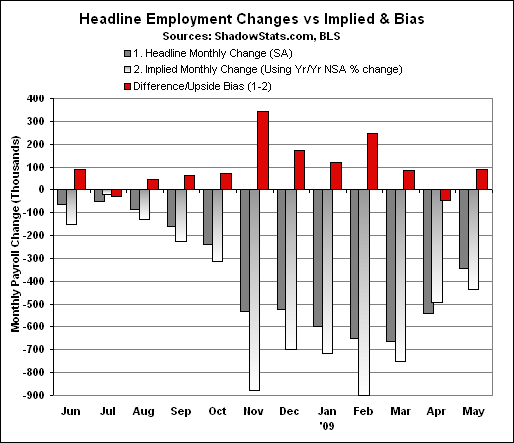
The jobs report also reflected upward revisions to March and April reporting, but such were due largely to the gimmicked recasting of seasonal factors each month on top of slightly improved unadjusted data. The concurrent seasonal factor bias (CSFB) narrowed the reported jobs contraction by about 89,000, while the revamped birth-death model likely narrowed the contraction by at least another 104,000 (60,000 usual adjusted average plus 44,000 in new biases). (See separate discussions below.)
Accordingly, net of these gimmicks, the May nonfarm monthly payroll loss would have been about 538,000, still improved versus a similarly adjusted April, but not within the scope of purported statistical significance. On the downside, year-to-year payroll loss continued to deepen, and the unemployment report showed meaningful deterioration in the broad employment environment.
There has been a shift in reporting patterns to show upside prior-period revisions in the establishment (payroll) survey, including upside changes to March reporting, which had been revised lower in April’s reporting (successive revisions for a given month usually continue in the same direction). This suggests that the BLS may have shifted internal reporting assumptions, with the effect of generating less-negative numbers. Assumptions include, for example, the handling of companies that fail to report payrolls in the current month (are they out of business or just late in handling paperwork?). There certainly has been a shift to the upside in terms of birth-death model assumptions.
While the household (unemployment) survey easily gets distorted by seasonal factors and definitional quirks, the seasonal factors are not recast every month, as they are in the payroll numbers, and the household survey is a scientifically designed sampling. The BLS claims better sampling accuracy for the household survey, but reporting and revisions of the last year clearly show that not to be the case. Accordingly, the ongoing deterioration in the household survey should not be ignored by those proclaiming a resurgent economy. The employment and unemployment numbers are coincident, not lagging indicators of broad economic activity.
Payroll Survey. The BLS reported a statistically-significant, seasonally-adjusted jobs loss of 345,000 (down 263,000 net of revisions) +/- 129,000 (95% confidence interval) for May 2009, following a revised 504,000 (previously 539,000) jobs loss in April and a revised 652,000 (previously 699,000) jobs loss in March.
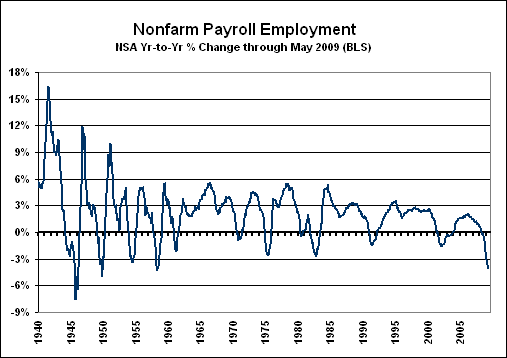
From peak-to-current (the peak month was December 2007; the current month of May also is the short-lived trough of the current cycle), payroll employment has declined by a seasonally-adjusted 6,001,000 jobs, or 4.3%. Year-to-year contraction (unadjusted) in total nonfarm payrolls continued to deepen, down 4.00% in May versus a revised 3.78% (was 3.82%) in April. The seasonally-adjusted series also continued contracting year-to-year, down by 3.90% in May versus a revised 3.75% (was 3.81%) in April.
The unadjusted annual decline in May payrolls was the worst since May 1958, as shown in the accompanying graph of year-to-year change in payroll growth. At the current pace of deepening annual decline, by the July 2009 employment report (due for release in August), the annual percentage contraction in payrolls will be the most severe since the production aftershocks following World War II.
Concurrent Seasonal Factor Bias. The pattern of impossible biases being built into the headline monthly payroll employment resumed, following a one-month lapse, with an upside bias of 89,000 jobs in May 2009 reporting (see the accompanying graph). Instead of the headline jobs loss of 345,000, consistent application of seasonal-adjustment factors — net of what I call the concurrent seasonal factor bias — would have shown by itself a more-severe monthly jobs loss of about 434,000. This pattern has generated an upside reporting bias in 10 of the last 12 months, with a rolling 12-month total upside headline-number bias of 1,254,000. A worksheet on this is available upon request. (See SGS Newsletter No. 50, for further background.)
Birth-Death/Bias Factor Adjustment. An increasing distortion that overstates monthly jobs gains is the monthly upside bias factor (birth-death model). Never designed to handle the downside pressures from a recession, the model adds a fairly consistent upside bias to the payroll levels each year, having averaged about 60,000 jobs per month in the year-ended March 2009 (benchmark revision month), assuming that the BLS adequately seasonally adjusts for same. Historically, however, the BLS has had problems with the related seasonals, when there has been a shift in bias amounts.
Given that the most-recent annual benchmark revision was unusually benign and showed an overstatement of previously reported jobs growth, one would have expected 2009 to 2010 the jobs biases to have been reduced. Instead, the April 2009 bias was 226,000, up from 176,000 the year before, and the May 2009 bias was 220,000, up from 176,000 the year before. Such suggests that the monthly birth-death bias has been increased by roughly 27% from last year, to an average upside bias of about 76,000 jobs per month.
Accordingly, I have estimated a monthly upside bias for May of 60,000 (the monthly average in place after seasonal adjustment) plus 44,000 (the added bias for May 2009, which likely has not been redistributed over all the months with appropriate seasonal adjustment), for a total of 104,000. I have no argument with those looking to net out the total 220,000 monthly bias; the only issue is seasonal adjustment, and those monthly factors are being played with and revised every month.
Household Survey. The usually statistically-sounder household survey, which counts the number of people with jobs, as opposed to the payroll survey that counts the number of jobs (including multiple job holders), showed May employment fell by 437,000, after rising by a reported 120,000 in April and falling by 861,000 in March. At work here continue to be poor quality seasonal adjustments.
The May 2009 seasonally-adjusted U.3 unemployment rate showed another statistically-significant increase, to 9.36% +/- 0.23%, from 8.87% in April and from 8.54% in March. Unadjusted U.3 rose to 9.1% in May, from 8.6% in April and versus 9.0% in March. The broader May U.6 unemployment rate rose to an adjusted 16.4% (15.9% unadjusted), from 15.8% (15.4% unadjusted) in April and versus 15.6% (16.2% unadjusted) in March. The less than proportionate seasonally-adjusted increase in the U.6 measure, versus the U.3 measure, again reflected seasonal factor distortions.
During the Clinton Administration, "discouraged workers" — those who had given up looking for a job because there were no jobs to be had — were redefined so as to be counted only if they had been "discouraged" for less than a year. This time qualification defined away the bulk of the discouraged workers. Adding them back into the total unemployed — unemployment in line with common experience — as estimated by the SGS-Alternate Unemployment Measure, rose to about 20.5% in May, versus 20.0% in April and 19.8% in March. Updated graph and data have been posted to the Alternate Data tab at www.shadowstats.com.
Employment Environment. Based on the better-quality underlying series discussed below (all are leading indicators to the May jobs report and the upcoming June report), and updated for new data since the May 29th Flash Update, the May jobs loss should have exceeded 600,000. It still may end up reflecting such a loss in subsequent revisions.
April newspaper help-wanted advertising held at its record-low reading of 10 for the second consecutive month, down by 44.8% year-to-year change on a three-month moving average basis. The annual decline in March was a record 45.2%. Similar, deepening annual fall-offs were seen in the nascent online help-wanted advertising measures for April, with the Conference Board reporting a 36.6% annual decline in new online help-wanted ads in May.
Annual growth (positive growth is an economic negative) in new claims for unemployment insurance has remained near a record level, with the 17-week moving average up by 76.1% as of May 30th, down a notch from 76.8% the week before. Such still was shy of the historical peak growth rate of 78.8% seen in March 1975. A month ago, annual growth was 75.8%; a year ago growth was 14.8%.
Mixed versus April reporting, employment readings continued deep in recession territory for the May manufacturing (May was 34.3 versus 34.4 in April, where readings of 50.0 and above are considered positive) and non-manufacturing (May was 39.0 versus 37.0 in April) purchasing managers surveys.
Week Ahead. Trade Deficit: Consensus expectations are for minor deterioration in the deficit versus March, per Briefing.com, due for release next Wednesday (June 10th). Chances are fair for a worse-than-expected number, given the pending catch-up in rising oil price costs and the impact of same on imports.
Retail Sales: Consensus expectations appear to be for a small monthly gain in May retail sales, due for release next Thursday (June 11th). Such a result is possible given some eventual bottom-bouncing and rising inflation. The year-to-year contraction, however, will continue to be severe in both nominal and real (unadjusted and adjusted for inflation) terms, with the monthly change a fair bet to be in contraction, net of inflation and reporting revisions.
__________