


No. 365: March Home Sales, Durable Goods Orders

COMMENTARY NUMBER 365
March Home Sales, Durable Goods Orders
April 27, 2011
__________
Pending Benchmarks to Retail Sales and Durable Goods Orders
Should Show Economy to Have Been Weaker
Home Sales Remain Troubled
__________
PLEASE NOTE: The next regularly scheduled Commentary is for Friday, April 29th. It will cover the April 28th release of the first-estimate of first-quarter 2011 GDP. Dependent on the timing of the release of full details of the retail sales benchmark revision, that revision will be covered in the GDP Commentary or shortly thereafter.
—Best wishes to all, John Williams
Separately, with the markets expecting slower GDP growth in tomorrow’s first-quarter GDP announcement, any suggestion today (April 27th) by the Fed of ending quantitative easing would be a surprise. The circumstance will be discussed in Friday’s Commentary.
The widely followed nondefense capital goods orders rose by 3.2% (up by 6.0% before prior-period revisions) in March, versus a revised month-to-month gain of 5.2% (previously up by 2.5%) in February. For March, the unadjusted year-to-year growth in the series was 20.7%, up from a revised 7.8% (previously 6.5%) gain in February.
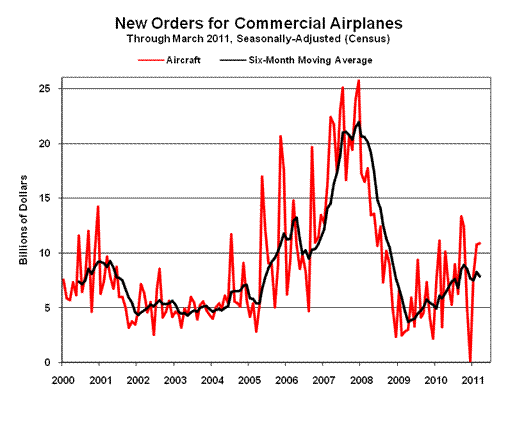
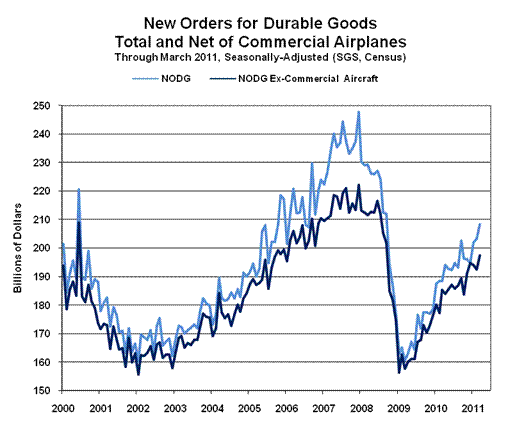
The preceding graphs are not adjusted for inflation and show the monthly volatility in the seasonally-adjusted durable goods new orders series from airplane orders. Aircraft orders are irregular in timing and usually are booked years in advance, with resulting minimal impact on near-term economic activity. The first graph shows commercial aircraft orders on both a monthly and on a six-month moving-average basis, where the second graph shows seasonally-adjusted monthly total new orders for durable goods (NODG), as well as NODG net of aircraft orders.
The recent uptrend in the aggregate series has been influenced heavily by the positive news in aircraft sales, as well as from last year’s benchmark revision that built an upside bias into the monthly data. Due to the latter, downside revisions are likely in the pending benchmark. The plotted data are not adjusted for inflation, because there is no particularly meaningful inflation index that makes sense as the deflator. Net of inflation, however, the pattern of monthly increases—seen on average since 2009—would be shallower, much shallower.
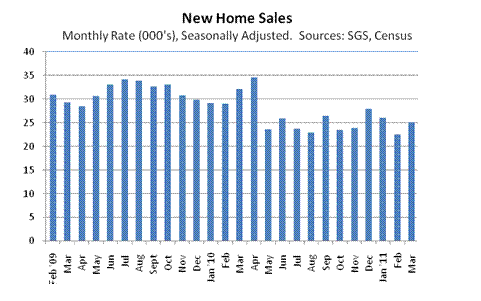
Tuesday’s (April 25th) reporting of March new-home sales (counted based on contract signings, Census Bureau) showed a statistically-insignificant monthly gain of 11.1% (up 20.0% before prior-period revisions) +/- 25.3% (95% confidence interval) from February. February’s revised level was down by 13.5% (previously down by 16.9%) from January. The year-to-year decline in March 2011 new-home sales was a statistically-significant 21.9% +/- 12.0% (95% confidence interval), versus a revised 22.2% (previously 28.0%) decline in February.
The April 20th release of March 2011 existing-home sales (counted based on actual closings, National Association of Realtors [NAR]) showed a 3.7% monthly increase (up by 4.5% net of prior-period revisions), versus February’s revised 8.9% (previously 9.6%) monthly decline. On a year-to-year basis, March sales were down by 5.9% from March 2010.
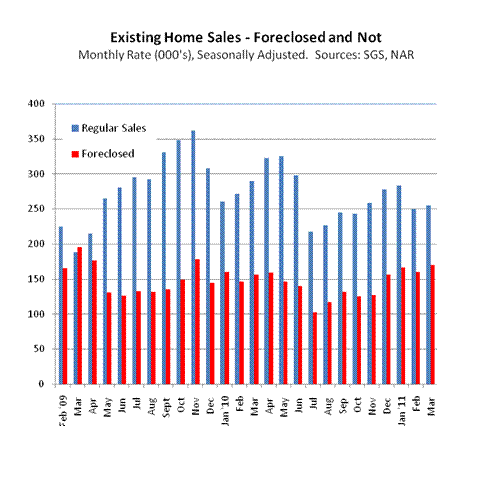
Foreclosure activity remained an intensifying distorting factor for home sales, with "distressed" activity accounting for an estimated 40% of existing sales in the NAR’s March reporting, the highest portion seen since Spring 2009, and up from 39% in February.
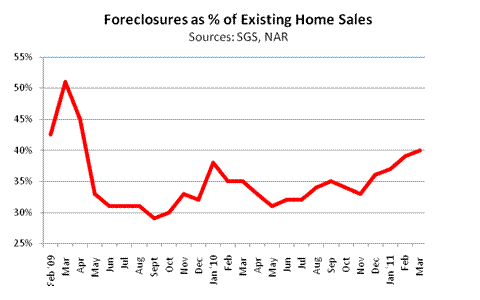
Separately, the Census Bureau acknowledges that a portion of new home sales also is from foreclosure activity but offers no estimate as to the scope of the issue. Some in the construction trade have difficulty competing with the pricing of foreclosed properties. Until the foreclosure problems get worked out in the system, monthly changes in these home sales numbers cannot be taken as meaningful positive indicators (when the numbers are positive) of underlying activity in homeowner real estate, as it relates to general economic activity.

Gross Domestic Product—GDP (First-Quarter 2011 “Advance” or First Estimate). The “advance” estimate of first-quarter GDP is due for release tomorrow, Thursday, April 28th. Briefing.com indicates a consensus estimate for the headline annualized quarterly real (inflation-adjusted) growth rate of 1.7%, while online.wsj.com is showing 2.0%, both lower than the 3.1% last reported for fourth-quarter 2010. “Advance” estimates usually are targeted by the Bureau of Economic Analysis (BEA) to match the consensus forecast. Even with consensus consideration of the weakening trade picture, underlying reality is weaker than the consensus, and reporting risk accordingly should be to the downside of consensus. Due to travel, this release will be covered in a Commentary on Friday, April 29th.
Retail Sales (Annual Benchmark Revision). The annual benchmark revision to retail sales is due for release on Friday, April 29th. Look for major downside revisions to previously reported economic history of the last several years. A separate Commentary will be published at such time as the fully revised historical data become available.
__________