


No. 348: Labor Conditions and Revisions

COMMENTARY NUMBER 348
Labor Conditions and Revisions
February 4, 2011
__________
"Recovery" Since April 2010 Just Evaporated
500K Payroll Jobs Disappeared in Benchmark Revision
January Payrolls Were Down 52K But for Upped Bias-Factor
Unemployment Rate Distorted by Seasonal-Adjustment Crisis
Unemployment: 9.0% (U.3), 16.1% (U.6), 22.2% (SGS)
__________
PLEASE NOTE: Given the time involved in assessing this morning’s employment and unemployment data, and benchmark revisions to same, today’s Commentary will be split in two. The update on systemic liquidity (it is deteriorating again), and a review of specific examples of the temporary loss of credible month-to-month reporting due to flaws in certain seasonal-adjustment methodologies, will follow over the weekend. The next regular Commentary is planned for Friday, February 11th, following release of December trade deficit data.
Hyperinflation: The 2011 update to the Hyperinflation Report remains planned for around mid-month. Many thanks for the influx of requests for particular issues or questions to be addressed. This is the last call for such requests. Please e-mail details to johnwilliams@shadowstats.com as soon as possible.
– Best wishes to all, John Williams
In last month’s release, the BLS proclaimed, "Since December 2009, total payroll employment has increased by 1.1 million, or an average of 94,000 per month." As a result of the revisions, the previous payroll trough of December 2009 now has been replaced by February 2010, and the gain in payrolls from December 2009 to December 2010 eased back to 909,000.
From peak-to-trough (the peak month now is January 2008 [previously December 2007]; February 2010 [previously December 2009] is the short-lived official trough of the current cycle), payroll employment declined by a seasonally-adjusted 8,750,000 jobs, or 6.3% (previously 8,363,000 jobs, or 6.1%). As of January 2011 reporting, payrolls purportedly have regained 0.8% or 1,019,000 jobs since the February 2009 trough.
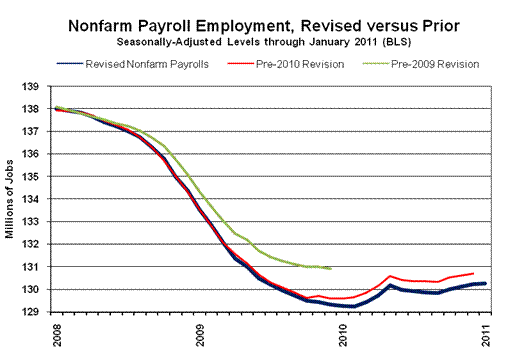
As shown in the above graph, the current seasonally-adjusted payroll level, which is represented by the thick blue line, really is not showing an economic recovery as much as it is ongoing bottom-bouncing at a low level of activity. The biggest bounce shown there is from the short-lived effects of the 2010 federal census. Please note that all graphs reflect not only the revisions through December 2010, but also the new reporting of January 2011.
The red line shows the pre-2010 benchmark level, and the green line shows the pre-2009 benchmark level. Meaningful downside revisions have been the norm over the years, and they result from excessive upside biases added into the monthly numbers as part of the Birth-Death Model discussed in that section. Incredibly, despite ongoing regular overstatement of payrolls by the BLS, the BLS appears to have upped, not lowered, the excessive biases in its latest rendition. Without the higher bias, the reported January 2011 payroll gain of 36,000 would have been a decline of 52,000.
The graph following shows the benchmarked payrolls with the effects of the temporary census hiring removed. Despite all the recent market hype on economic recovery, the good times are not apparent in the payroll data — a coincident indicator of economic activity — where payrolls remain below levels seen a decade ago. This is despite the U.S. population growing by more than 10% in the same period. The structural impairments to U.S. economic activity continue to constrain normal commercial activity, preventing any meaningful recovery in business activity, as discussed in Special Commentary No. 342.
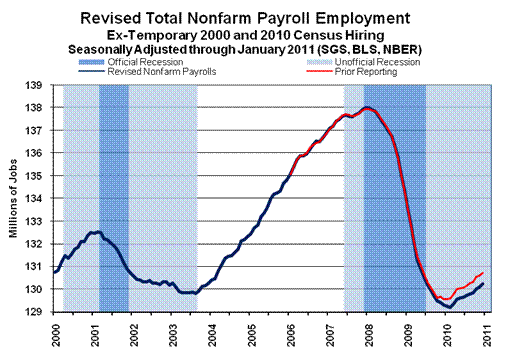
The benchmark revision affected seasonally-adjusted data back through 2006. The revisions to the unadjusted numbers started with a 32,000 downside revision in April 2009 and ranged up to a 538,000 drop in September 2010. Affected by regular "revisions" December’s (last month’s) payroll level was reduced by 483,000.
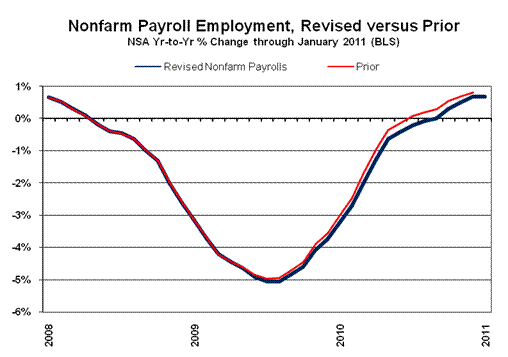
As shown in the next graph, year-to-year change softened during the benchmark period, and appears to have flattened out with the new January reporting.
At Crisis Level, Seasonal Factor Distortions Warped January’s Unemployment Rate. As has been discussed recently, and as will be explored more extensively in this weekend’s Commentary, the extraordinary severity and duration of the economic duress in the United States during the last three to four years has destabilized traditional seasonal-factor adjustments and the related monthly reporting of certain economic series.
The unemployment rate rose in January 2011, not seasonally adjusted. The 0.4% decline reported in the headline January unemployment rate appears to be a seasonal-factor issue. My late-friend Alfred Sindlinger — surveyor of consumer conditions — always would get a twinkle in his eyes when he discussed the absurdity of seasonal adjustments and the individual, particularly with respect to people who were unemployed in reality, unable to benefit from those seasonally-adjusted jobs that the government said they were holding. More follows over the weekend.
Payroll Survey Detail. The BLS reported a statistically-insignificant, seasonally-adjusted January 2011 jobs gain of 36,000 (a drop of 447,000 before prior-period and benchmark revisions) +/- 129,000 (95% confidence interval). December payrolls showed a revised 121,000 gain (previously 103,000), after total December payrolls were lowered by 483,000 in revision. In terms of year-to-year change, the unadjusted January 2011 number was up by 0.67% (0.43% net of prior-period revisions) from the year before, but that was flat-to-down from December’s revised 0.68% year-to-year gain (previously 0.82%).
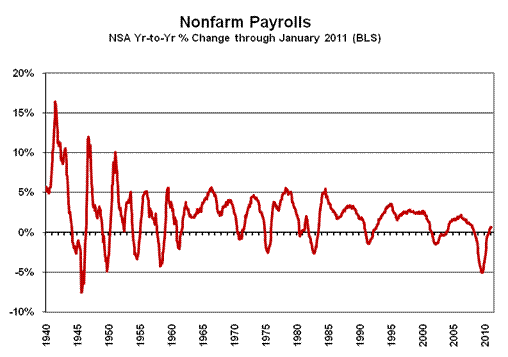
The graph of long-term year-to-year payroll change reflects the numbers as reported in the benchmark revisions, with no adjustments for census hiring variations. Thanks to recent, protracted bottom-bouncing in the payroll series, current annual growth has recovered from the post-World War II record 5.06% decline in August 2009 (before the benchmark, the record was a 4.96% decline in July 2009). The August 2009 decline was the most severe annual contraction seen since the production shutdown at the end of World War II, which reflected a trough of a 7.59% annual contraction in September 1945. Disallowing the post-war shutdown as a normal business cycle, the August 2009 annual decline remains the worst since the Great Depression.
Birth-Death/Bias Factor Adjustment. Despite the ongoing and regular overstatement of monthly payroll employment — as evidenced by the regular annual downward benchmark revisions to the payroll numbers — the BLS appears to have upped its monthly bias in initial reporting of the post-benchmark period. In January 2010, there was a negative monthly bias used of 427,000, yet today’s January 2011 bias was less negative, at minus 339,000. But for the relatively positive change in the bias, January 2011’s 36,000 payroll gain would have been a decline of 52,000.
Where the BLS cannot measure the impact of jobs loss and jobs creation from employers starting up or going out of business on a timely basis (within at least five years, if ever), such information is estimated by the addition of a bias-factor generated by the Birth-Death Model (a model of the effects of new business creation and old business bankruptcies).
Effective with today’s release, the BLS is estimating its monthly bias factors on a quarterly basis, instead of on an annual basis, but the change does not appear to have addressed the fundamental flaws of the Birth-Death Model, discussed as usual in the ensuing paragraphs.
Positive assumptions — commonly built into government statistical reporting and modeling — can become self-fulfilling prophesies, with "stronger" economic data being reported as a result of happy guesstimates, or underlying assumptions of ongoing economic recovery. Indeed, historically, the Birth-Death Model biases have tended to overstate payroll employment levels — to understate employment declines — during recessions. There is a faulty underlying premise here that jobs created by start-up companies in this downturn have more than offset jobs lost by companies going out of business. So, if a company fails to report its payrolls because it has gone out of business, the BLS assumes it still has its previously-reported employees and adjusts those numbers for the trend in the company’s industry.
Further, presumed additional "surplus" jobs, created by start-up firms, get added on to the payroll estimates each month as a special add-factor. These add-factors likely are running now at about above 50,000 per month (seasonally-adjusted). I still estimate this monthly bias should be negative by 200,000 or so, on average. Since it is not, the BLS continues regularly to overestimate monthly growth in payroll employment by roughly 250,000 jobs. Much of that misreporting, which was not picked up in the 2010 benchmarking, now will not be corrected until at least the 2011 benchmark revision (based on the upcoming March 2011 benchmarking) to be published in February 2012.
Household Survey. The usually statistically-sounder household survey, which counts the number of people with jobs, as opposed to the payroll survey that counts the number of jobs (counting multiple job holders more than once), went through annual revisions to its seasonally-adjusted data last month, while this month, population estimates were adjusted, leaving January 2011 reporting inconsistent with and not comparable to prior reporting.
From the household survey, January 2011 showed an employment gain of 117,000 as published, but such is the non-comparable number. The BLS indicates the gain really was 589,000, before the population alterations, versus a seasonally-adjusted monthly employment gain of 297,000 reported for December.
As noted in the opening comments, the U.3 unemployment has been affected by highly unstable seasonal factors that are artifacts of the severe and extraordinarily protracted downturn in U.S. economic activity, not from changing seasonal patterns. As shown with unadjusted data detail that follows, the January U.3 unemployment rate rose; it is just that the poor-quality seasonal factors were inadequate to boost the adjusted series.
The January 2011 seasonally-adjusted headline (U.3) unemployment rate declined by a statistically-significant 0.37 percentage point to 9.05% +/- 0.23% (95% confidence interval), from 9.42% in December. The official number was 9.0498%, just 333 unemployed people (within rounding error on the reporting detail) of coming in at 9.1%, but the "comparable" number was 8.9993%. Not seasonally adjusted, January’s U.3 unemployment rose to 9.8% from 9.1% in December.
The January U.6 unemployment rate dropped to a seasonally-adjusted 16.1% from 16.7% in December, again suffering from seasonal-maladjustment. The unadjusted rate rose to 17.3% in January from 16.6% in December. The broadest unemployment rate published by the BLS, U.6 includes accounting for those marginally attached to the labor force (including short-term discouraged workers) and those who are employed part-time for economic reasons (they cannot find a full-time job).
In 1994, during the Clinton Administration, "discouraged workers" — those who had given up looking for a job because there were no jobs to be had — were redefined so as to be counted only if they had been "discouraged" for less than a year. This time qualification defined away the long-term discouraged workers. The remaining short-term discouraged workers (less than one year) are included in U.6.
Adding the SGS estimate of excluded long-term discouraged workers back into the total unemployed and labor force, unemployment — more in line with common experience as estimated by the SGS-Alternate Unemployment Measure — declined to about 22.2% in January 2011 from 22.4% in December. The SGS estimate generally is built on top of the official U.6 reporting and tends to follow its relative monthly movements and will suffer some of the current seasonal-adjustment woes afflicting the base series. See the Alternate Data tab for a graph and more detail.
As discussed in earlier writings, while an unemployment rate around 22% might raise questions in terms of a comparison with the purported peak unemployment in the Great Depression (1933) of 25%, the SGS level likely is about as bad as the peak unemployment seen in the 1973 to 1975 recession. The Great Depression unemployment rate was estimated well after the fact, with 27% of those employed working on farms. Today, less that 2% work on farms. Accordingly, for purposes of a Great Depression comparison, I would look at the estimated peak nonfarm unemployment rate in 1933 of 34% to 35%.
Trade Balance (December 2010). The estimated December 2010 trade deficit is scheduled for release on February 11th. Anything shy of a significant improvement in the inflation-adjusted deficit should have significant downside revision implications for the next estimate of fourth-quarter 2010 GDP (due for release on February 25th).
__________