


No. 350: December Trade Deficit

COMMENTARY NUMBER 350
December Trade Deficit
February 11, 2011
__________
December Trade Data Suggest Softer 4th-Quarter GDP in Revision
Deficits Deepen with Biggest Trading Partners
__________
PLEASE NOTE: The next regular Commentary is planned for Tuesday, February 15th, following release of January Retail Sales data. Subsequent Commentaries next week are scheduled for Wednesday, February 16th, following release of the details on January Producer Prices, Housing Starts and Industrial Production; and for Thursday, February 17th, following release of the January Consumer Price Index.
The Hyperinflation Special Report (Update 2011) tentatively is scheduled for release on Tuesday February 22nd, with a significant quantity of subscriber-raised issues and questions that will be addressed in the text.
– Best wishes to all, John Williams
Looking at the hard numbers, though, the December reporting suggested a contribution of roughly 1.6 percentage points to fourth-quarter GDP growth, which included a contribution of 3.2 percentage points from the goods trade in the initial or advance fourth-quarter annualized GDP growth estimate, based just on October and November reporting. Since the total "advance estimate" annualized growth rate for the GDP also was 3.2%, there is potential here for significant downside GDP revision, when the "second estimate" of fourth-quarter GDP is published on February 25th. Such assumes, of course, a relationship between trade and GDP reporting, which sometimes fails to materialize in the GDP.
On an annual basis, the trade deficit resumed its historical deterioration (in both nominal and real terms), with trade deficits widening anew with major U.S. trading partners.
Nominal (Not-Adjusted-for-Inflation) Trade Deficit. For December 2010, the Bureau of Economic Analysis (BEA) and the Census Bureau reported today (February 11th) that the nominal, seasonally-adjusted monthly trade deficit in goods and services widened to $40.6 billion from an unrevised $38.3 billion in November 2010. The December 2010 deficit also widened from $37.1 billion a year ago.
On an annual basis, the 2010 trade deficit in goods and services (balance of payments basis) widened to $497.8 billion versus $374.9 billion in 2009, reflecting a more rapid increase in imports than exports. In 2008, the deficit was $698.8 billion.
Against November 2010, the December trade balance showed gains in both exports and imports, with the import pick-up stronger than the export increase, due partially to oil activity. Oil imports reflected both higher prices and physical import volume. Specifically, for the month of December 2010, the not-seasonally-adjusted average price of imported oil was $79.78 per barrel, up from $76.81 in November 2010, and up from $73.14 in December 2009. In terms of not-seasonally-adjusted physical oil imports, December 2010 volume averaged 9.115 million barrels per day, versus 8.606 million in November 2010 and 9.010 million in November 2009.
For the year, imported oil prices averaged $74.66 per barrel, up 31.1% from $56.93 in 2009. In 2010, physical oil import volume average 9.254 million barrels per day, up from 9.082 million in 2009.
Real (Inflation-Adjusted) Trade Deficit. With annual revisions and December reporting in place, as reported by the BEA, adjusted for seasonal factors and inflation (2005 chain-weighted dollars as used in reporting real GDP), the fourth-quarter goods deficit was at an annualized pace of $543.2 billion. That was down from the third-quarter annualized goods deficit estimate of $594.7 billion. The implied $53 billion improvement would be enough to account for roughly 1.6 percentage points in fourth-quarter GDP growth, but the initial estimate of 3.2% annualized fourth-quarter GDP real growth included 3.2 percentage points based on the goods deficit guessed from just October and November data (yes, the "advance estimate" GDP growth was accounted for fully by the guessed trade number). Accordingly, there is some downside-revision risk for the upcoming fourth-quarter GDP revision on February 25th.
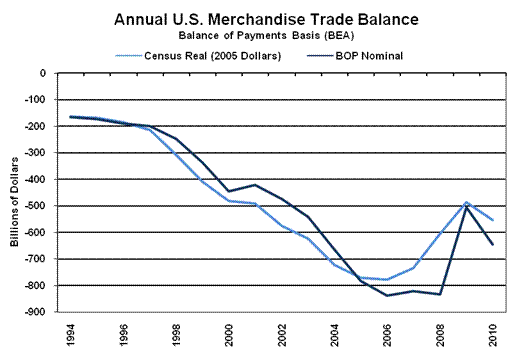
On an annual basis the real trade deficit in goods (the services components is largely a guess, with little hard data behind it, so the BEA does not publish hard estimates of its surplus adjusted for inflation) in 2010 was $555.3 billion (2005 chain-weighted dollars) versus $486.6 billion in 2009, again reflecting stronger import than export growth. The deficit in 2008 was $604.0 billion.
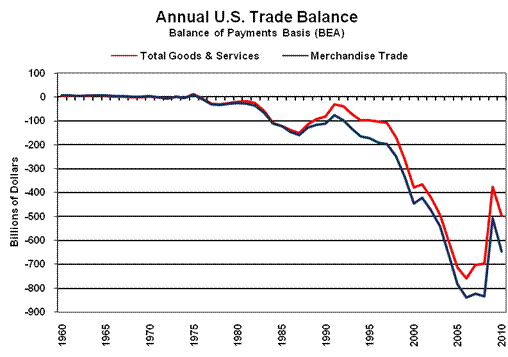
The preceding graphs show the historical annual trade deficit. The first graph shows both the total goods and services balance, as well as the traditional merchandise trade balance. The services component was added to the merchandise reporting so as to help reduce the reported total deficit. While the services component is a legitimate concept, very little of it actually can be measured, so it largely is a guessed number.
The second graph shows the merchandise trade deficit both before and after adjustment for inflation. The unadjusted number is of greatest significance to the currency markets, while the inflation adjusted number is used in calculating GDP growth, at least some of the time.
2010 Merchandise Trade Deficits Jumped Minimally 20% with Top Trading Partners. The U.S. 2010 trade deficits generally worsened with traditionally larger-deficit trading partners or groups:
(1) The deficit with China widened 20.4% to $273.1 billion in 2010 from $226.9 billion in 2009.
(2) With OPEC, the 2010 deficit widened by 54.9% to $95.6 billion from $61.7 billion in 2009.
(3) The deficit with NAFTA widened by 35.4% to $94.0 billion in 2010 from $69.4 billion in 2009. The deficit with Mexico increased by 38.7%, to $66.3 billion from $47.8 billion in 2009, with the Canadian deficit up by 28.1% in 2010 to $27.7 billion from $21.6 billion in 2009.
(4) The deficit with Japan increased by 33.8% to $59.8 billion in 2010 from $44.7 billion in 2009.
(5) The deficit with Germany was up by 22.3% to $34.5 billion in 2010 from $28.2 billion in 2009.
2010 U.S. Merchandise Trade Surpluses. The top five U.S. trade surpluses in 2010 were mixed versus 2009:
(1) The surplus with Hong Kong was $22.3 billion, up by 27.4% from $17.5 billion in 2009. This should be viewed in the context of the deficit with China.
(2) The surplus with the Netherlands was $16.0 billion, down 0.6% from $16.1 billion in 2009.
(3) The surplus with Australia was $13.2 billion, up by 13.8% from $11.6 billion in 2009.
(4) The surplus with Singapore was $11.7 billion, up by 80.0% from $6.5 billion in 2009.
(5) The surplus with Brazil was $11.4 billion, up by 90.0% from $6.0 billion in 2009.
Week Ahead. Given the unfolding reality of an intensifying double-dip recession and more-serious inflation problems than generally are anticipated by the financial markets, risks to reporting will tend towards higher-than-expected inflation and weaker-than-expected economic reporting in the months ahead. Increasingly, previously unreported economic weakness should show up in prior-period revisions.
Retail Sales (January 2011). Due for release on Tuesday, February 15th, January retail sales remain subject to warped seasonal-factor effects, as discussed in Commentary No. 349. Given possible reporting catch-up and greater underlying weakness than broadly is recognized, odds favor a weaker report than a likely relatively positive consensus forecast. Higher inflation well could take the monthly change negative on an inflation-adjusted monthly basis.
Residential Construction (January 2011). Due for release on Wednesday, February 16th, January housing starts likely will continue to weaken, with any upside surprise unlikely to be of no statistical significance.
Industrial Production (January 2011). Due for release on Wednesday, February 16th, January industrial production — aside from the continued effects of unseasonably bad weather spiking utility usage — should be down for the month, again, likely weaker than consensus forecasts.
Producer Price Index — PPI (January 2011). Due for release on Wednesday, February 16th, the January 2011 PPI should tend to be on the upside of expectations, although the series is irregularly volatile.
Consumer Price Index — CPI (January 2011). Due for release on Thursday, February 17th, the January 2011 CPI again should reflect not only higher gasoline prices, but also upside inflation pressures from other dollar-denominated commodity prices spiked by the Federal Reserve’s U.S. dollar debasement policy, as well as from some spreading oil-price impact into the broad "core" economy.
The monthly numbers also will undergo the annual seasonal-adjustment revisions, which can shift around inflation patterns of the last year.
Not-seasonally-adjusted, year-to-year inflation would increase or decrease in the January 2011 reporting, dependent on the reported seasonally-adjusted monthly change, versus the 0.17% adjusted monthly gain seen in January 2010. I use the adjusted change here, since that is how consensus expectations are expressed. To approximate the annual inflation rate for January 2011, the difference in January’s headline monthly change (or forecast of same) versus the year-ago monthly change should be added to or subtracted directly from December 2010’s reported annual inflation rate of 1.50%. A monthly increase of 0.3%, for example, would yield a year-to-year January 2011 inflation rate of about 1.6%.
__________