


No. 358: February CPI, PPI, Production, Housing Starts, Real Retail Sales, Real M3

COMMENTARY NUMBER 358
February CPI, PPI, Production, Housing Starts, Real Retail Sales, Real M3
March 17, 2011
__________
Economy Slumps Anew as Inflation Soars
Fed’s Dollar Debasement Efforts Begin to Yield Their Poisoned Fruit
February Annual Consumer Inflation: 2.1% (CPI-U), 2.3% (CPI-W), 9.6% (SGS)
Housing Starts Fall Back to Post-World War II Historic Low
__________
PLEASE NOTE: The next regular Commentary is scheduled for Friday, March 25th, covering revised fourth-quarter GDP, February Homes Sales and New Orders for Durable Goods. Also scheduled for release on March 25th is the annual benchmark revision to industrial production. The revisions will be analyzed in a Commentary after full data have been made available.
—Best wishes to all, John Williams

Notes on Different Measures of the Consumer Price Index.
The Consumer Price Index (CPI) is the broadest inflation measure published by U.S. Government, through the Bureau of Labor Statistics (BLS), Department of Labor:
The CPI-U (Consumer Price Index for All Urban Consumers) is the monthly headline inflation number (seasonally adjusted) and is the broadest in its coverage, representing the buying patterns of all urban consumers. Its standard measure is not seasonally adjusted, and it never is revised on that basis except for outright errors,
The CPI-W (CPI for Urban Wage Earners and Clerical Workers) covers the more-narrow universe of urban wage earners and clerical workers and is used in determining cost of living adjustments in government programs such as Social Security. Otherwise its background is the same as the CPI-U.
The C-CPI-U (Chain-Weighted CPI-U) is an experimental measure, where the weighting of components is fully substitution based. It generally shows lower annual inflation rate than the CPI-U and CPI-W. The latter two measures once had fixed weightings—so as to measure the cost of living of maintaining a constant standard of living—but now are quasi-substitution-based. Since it is fully substitution based, the series tends to reflect lower inflation than the other CPI measures. Accordingly, the C-CPI-U is the "new inflation" measure being proffered by Congress and the White House as a tool for reducing Social Security cost-of-living adjustments by stealth. Moving to accommodate the Congress, the BLS announced pending changes to the C-CPI-U estimation and reporting process on October 22, 2014, which are described in Commentary No. 668
The ShadowStats Alternative CPI-U measures are attempts at adjusting reported CPI-U inflation for the impact of methodological change of recent decades designed to move the concept of the CPI away from being a measure of the cost of living needed to maintain a constant standard of living.
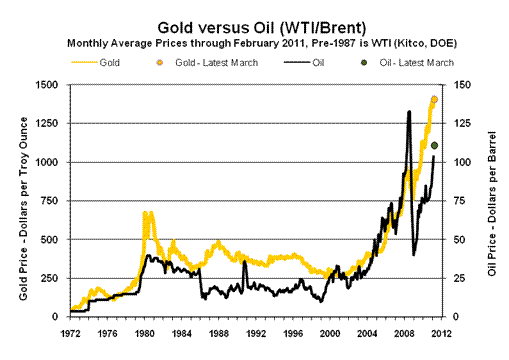
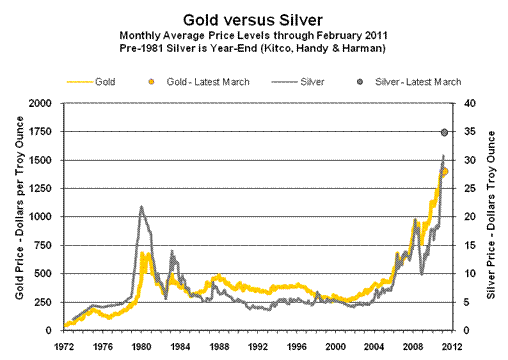
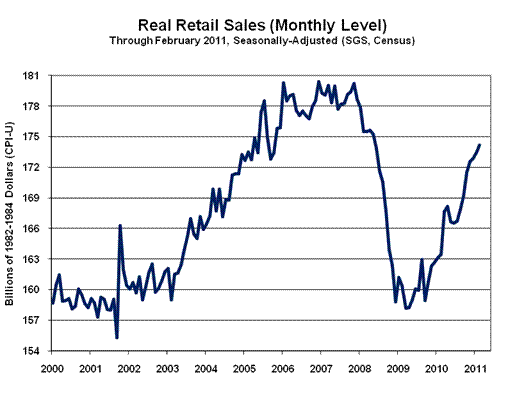
Annualized, seasonally-adjusted, CPI-U inflation for the three months ended February 2011, versus the three months ended November 2010, continued to accelerate, with respective gains of 4.26% versus 2.53%. Last month, annualized inflation was up by 3.10% for the three months ended January 2011, versus 2.26% for the three months ended October 2010. For fourth-quarter 2010, the annualized inflation was 2.62% versus1.43% in the third-quarter. February’s unadjusted year-to-year CPI-U inflation surged to 2.11%, from a 1.63% annual increase in January. Year-to-year inflation would increase or decrease in next month’s March 2011 reporting, dependent on the seasonally-adjusted monthly change, versus the virtually flat 0.02% adjusted monthly gain seen in March 2010. I use the adjusted change here, since that is how consensus expectations are expressed. To approximate the annual inflation rate for March 2011, the difference in March’s headline monthly change (or forecast of same) versus the year-ago monthly change should be added to or subtracted directly from February 2011’s reported annual inflation rate of 2.11%. Annual CPI inflation should top 3% within the next two months. CPI-W. The narrower, seasonally-adjusted CPI-W, which has greater weighting for gasoline than does the CPI-U, rose in February 2011 by 0.62% (up 0.52% unadjusted), following January’s adjusted monthly increase of 0.45% (up 0.53% unadjusted). Reflecting DOE gasoline prices increases, the adjusted monthly CPI-W gain would have been 0.72% instead of the reported 0.62% Annualized, seasonally-adjusted, CPI-W inflation for the three months ended February 2011, versus the three months ended November 2010, continued to accelerate, with respective gains of 4.93% versus 3.02%. Last month, annualized inflation was up by 3.56% for the three months ended January 2011, versus 2.73% for the three months ended October 2010. For fourth-quarter 2010, the annualized inflation was 3.09% versus1.71% in the third-quarter. Unadjusted, February 2011’s year-to-year CPI-W inflation was 2.35%, against a 1.80% annual increase in January. C-CPI-U. The Chain-Weighted CPI-U—the fully substitution-based series that gets touted by CPI opponents and inflation apologists, including the recent presidential deficit commission, as the replacement for the CPI—is reported only on an unadjusted basis. Year-to-year inflation increased to 1.97% in February 2011, from 1.45% in January. Alternate Consumer Inflation Measures. Adjusted to pre-Clinton (1990) methodology, annual CPI inflation was roughly 5.5% in February 2011, up from 5.0% in January, while the SGS-Alternate Consumer Inflation Measure, which reverses gimmicked changes to official CPI reporting methodologies back to 1980, rose to about 9.6% (9.62% for those using the extra digit) in February, from about 9.1% in January. The SGS-Alternate Consumer Inflation Measure adjusts on an additive basis for the cumulative impact on the annual inflation rate of various methodological changes made by the BLS (the series is not recalculated). Over the decades, the BLS has altered the meaning of the CPI from being a measure of the cost of living needed to maintain a constant standard of living, to something that no longer reflects the constant-standard-of-living concept. Roughly five percentage points of the additive SGS adjustment reflect the BLS’s formal estimate of the annual impact of methodological changes; roughly two percentage points reflect changes by the BLS, where SGS has estimated the impact not otherwise published by the BLS. Gold and Silver Highs Adjusted for CPI-U/SGS Inflation. Despite March 7th’s historic high gold price of $1,437.50 per troy ounce (London afternoon fix) and the multi-decade high silver price of $36.60 per troy ounce (London fix), gold and silver prices have yet to approach their historic high levels, adjusted for inflation. The earlier all-time high of $850.00 (London afternoon fix, per Kitco.com) of January 21, 1980 would be $2,418 per troy ounce, based on February 2011 CPI-U-adjusted dollars, $8,215 per troy ounce based on SGS-Alternate-CPI-adjusted dollars (all series not seasonally adjusted). In like manner, the all-time high price for silver in January 1980 of $49.45 per troy ounce (London afternoon fix, per silverinstitute.org) has not been hit since, including in terms of inflation-adjusted dollars. Based on February 2011 CPI-U inflation, the 1980 silver price peak would be $141 per troy ounce and would be $478 per troy ounce in terms of SGS-Alternate-CPI-adjusted dollars (again, all series not seasonally adjusted). As shown on page 43 of the Hyperinflation Special Report (2011), over the decades, the price of gold has compensated for more than the loss of the purchasing power of the U.S. dollar as reflected by CPI inflation, while it has effectively fully compensated for the loss of purchasing power of the dollar based on the SGS-Alternate Consumer Price Measure (1980 Methodologies Base). Real Money Supply M3. The signal of the still unfolding double-dip recession, based on annual contraction in the real (inflation-adjusted) broad money supply (M3), most recently discussed in the Hyperinflation Special Report (2011), continues and is graphed below. Based on the February CPI-U report and the latest February SGS-Ongoing M3 Estimate, the annual contraction in real M3 for February 2011 deepened anew (due primarily to rising inflation), down by 4.3%, versus a 3.9% annual contraction in January. The signal for a downturn or an intensified downturn is generated when annual growth in real M3 first turns negative in a given cycle; the signal is not dependent on the depth of the downturn or its duration. The current downturn signal was generated just over one year ago, in December 2009. The broad economy tends to follow in downturn or renewed deterioration roughly six to nine months after the signal, as has appeared to have started in recent months. Increasing weakness in a number of series should become evident as benchmark revisions to industrial production, retail sales and GDP show weaker than currently assumed economic activity for the last year or two, and as current reporting turns increasingly negative. Such eventually will lead to recognition of a double-dip recession. February real retail sales rose at a year-to-year pace of 6.57%, versus the revised 6.32% (previously 6.01%) annual gain reported for January. The “recovery” in real retail sales is reflected in the preceding graphs. Both graphs show the monthly level of the seasonally-adjusted activity. The first graph shows the data in historical context since World War II. The second graph shows the same numbers in clearer detail for the current period beginning in 2000. Since November 2008, monthly real retail sales (CPI-U deflated) have been fluctuating around an average of $164.6 billion (the deflated February number was $174.2 billion). With likely benchmark revisions (due April 29th), the series should be topping out. There has been no change in underlying fundamentals that would support a sustainable turnaround in personal consumption or in general economic activity—no recovery—just general bottom-bouncing. Accordingly, real retail sales levels in the months ahead should turn increasingly negative. Annualized, seasonally-adjusted PPI inflation for the last three months (ended February) accelerated to 14.0%, up from an annualized pace of 6.6% in the prior three months ended November. Unadjusted and year-to-year, February 2011’s PPI inflation was 5.6% versus 3.6% in January, and at the highest level in 11 months. Separately, on a monthly basis, seasonally-adjusted February 2011 intermediate goods rose by 2.0% (up by 1.1% in January), with February’s crude goods prices jumping up by 3.4% (up by 3.3% in January). Year-to-year inflation in February intermediate goods was up by 7.8% (a 6.0% gain in January), with February’s annual inflation in crude goods at 15.9% (up by 10.0% in January).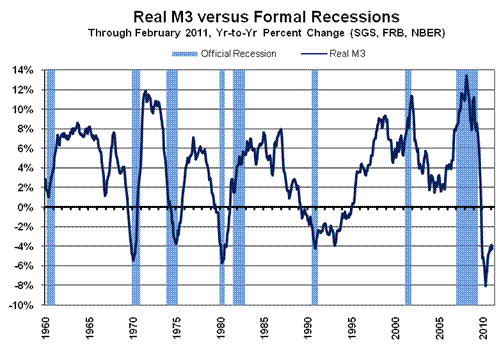

Year-to-year change in February 2011 production was 5.55%, down from a revised 5.61% (previously 5.15%) gain in January, and down from the revised near-term peak of 8.35% in June. The year-to-year contraction of 12.86% seen in May 2009 was the steepest annual decline in production growth since the shutdown of war-time production following World War II.
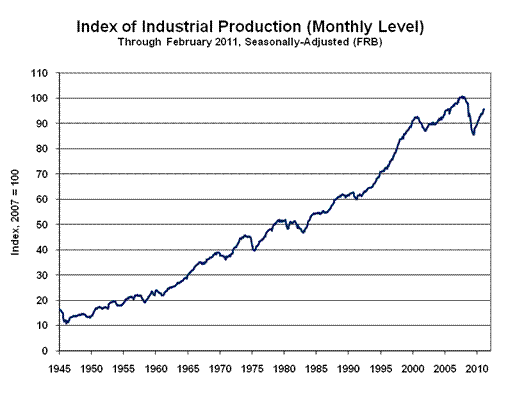
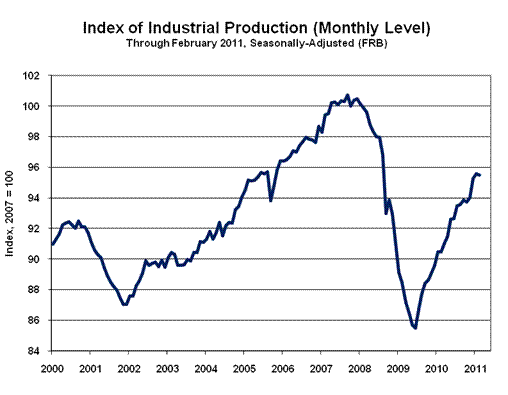
The “recovery” in industrial production is reflected in the preceding graphs. Both graphs show the monthly level of the production index. The first graph shows the data in the historical context since World War II. The second graph shows the same numbers in clearer detail for the current period beginning in 2000, including the February 2011 downtick.
For the last 26 months, the production index has averaged 90.62, around which the series has been fluctuating, although it consistently has been moving higher in recent months. Production activity had leveled off at a low-level plateau of activity that at one point effectively wiped out the last eight years of growth in industrial production. Keep in mind that these data all will be recast in the pending benchmark revision (March 25th). Despite ongoing upside gains generated by short-lived stimulus and seasonal-factor distortions, the series likely still is bottom-bouncing and should begin to soften anew, consistently and significantly, in the oncoming months.
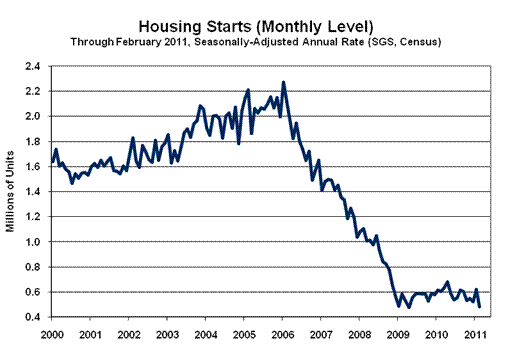
Year-to-year change in February starts was a statistically-significant decline of 20.8% +/- 10.5% (95% confidence interval), following a revised annual 1.0% increase (previously a 2.6% decline) in January.
Although the pattern of housing starts generally remains one of bottom-bouncing at an historically low-level plateau of activity, as seen over the last 26 months, recent activity has started to slow anew, meaningfully. Significantly weaker monthly numbers remain likely in the months ahead. Since December 2008, housing starts have been bottom-bouncing, averaging a seasonally-adjusted annual rate of 568,000. In those 26 months, all monthly readings have been within the normal range of monthly volatility for the series around that average, with the February 2011 monthly reading of 479,000 not only 16% below average, but again also effectively at the historic low of 477,000 seen in April 2009. The April 2009 low, as shown in the first graph, also was well below any level reported in the predecessor series of nonfarm housing starts series, which was introduced in 1946. Housing starts appear to have begun rolling down hill, anew, and that should be reflected quite clearly in the next several months of reporting.

Home Sales (February 2011). February existing home sales (National Association of Realtors) are due for release on Monday, March 21st, followed by new home sales (Census Bureau) on Wednesday, March 23rd. As with the sharp deterioration seen in housing starts, these volatile series should remain extremely weak, with any positive monthly change (new homes) again lacking statistical significance. Also, as usual, given the extreme volatility, reporting error and revisions in these series, given the poor-quality seasonal adjustments, given continuing negative anecdotal evidence, and given ongoing massive distortions from increasingly volatile foreclosure activity, the monthly movements in these numbers remain particularly meaningless.
New Orders for Durable Goods (February 2011). Due for release on Thursday, March 24th, February’s new orders for durable goods likely will not show a meaningful monthly change, with odds slightly favoring a decline in this irregularly volatile series.
Gross Domestic Product—GDP (Fourth-Quarter 2010—Third Estimate, Second Revision). The second revision (third estimate) of fourth-quarter GDP is due for release on March 25th. The revision likely will be no more than statistical noise around the prior, revised annualized real growth level of 2.8%. Initial reporting of Gross National Product (GNP) and Gross Domestic Income (GDI), however, could offer a surprise.
Index of Industrial Production (Annual Benchmark Revisions). The annual benchmark revision to the index of industrial production is due for release at noon on Friday, March 25th. Availability of full historical data sometimes lags the press release. Look for the revisions to restate recent economic history to the downside.
__________