


No. 371: May Employment and Unemployment

COMMENTARY NUMBER 371
May Employment and Unemployment
June 3, 2011
__________
Softer Employment Picture Reflected Minor Catch Up In Distorted Data –
Much Weaker Data Loom Despite Ongoing Reporting Quality Issues
Annual Growth in May Payrolls Slowed Anew
May Unemployment Rates: 9.1% (U.3), 15.8% (U.6), 22.3% (SGS)
Broad Money Supply Growth Jumps Again
__________
PLEASE NOTE: The next regularly scheduled Commentary is for Thursday, June 9th. It will cover the U.S. trade balance reporting for April 2011.
—Best wishes to all, John Williams
Opening Comments and Executive Summary. So, suddenly the economy is grinding to a halt? A more realistic case is that the economy never was as strong as advertised, and that the sharp plunge in the May purchasing managers survey and the sudden slowing in May employment growth reflected some catch up in recent (and still ongoing) poor-quality reporting that has been warped heavily by seasonal-factor distortions. These early May indicators are on the heels of April data that suggested a stalling economy. Where some of the April data also may have reflected some reversal of recent reporting distortions, actual business activity continues to suffer severely, and much-more-extreme reporting “catch up” looms in the month and months ahead. There simply is and has been no underlying fundamental circumstance at hand that could sustain positive growth in the broad U.S. economy.
Labor Conditions. Separate from the seasonal-factor distortions, the year-to-year gain in unadjusted May payroll employment softened for the first time since 2009. Otherwise, this morning’s (June 3rd) jobs report showed a headline 54,000 monthly payroll increase that was statistically indistinguishable from a monthly contraction. Even that small gain was accounted for by downside revisions to prior-period reporting and an upped Birth-Death Model bias factor. The headline May unemployment rate rose to 9.1% from 9.0% in April, with the broader U.6 measure easing back to 15.8% from 15.9%. Where part of the decline in U.6 was due to short-term discouraged workers rolling into the long-term discouraged worker category, the SGS Alternate-Unemployment Measure held at 22.3%.
Seasonal Factors Mauled by Disruptions to Normal Business from the Severe Length and Depth of the Economic Downturn. As discussed extensively in prior writings (see Hyperinflation Special Report (2011) for example), seasonal factors can work well in normal economic conditions to remove regular fluctuations in economic activity that result from factors such the holiday shopping season or timing of the school year. The economic contraction of the last four or five years, however, has been the most severe and protracted in the period of modern economic reporting (post-World War II). Patterns of the economic collapse overwhelmed the statistical modeling of normal seasonal patterns, destabilizing the seasonal factors and making month-to-month comparisons of monthly series virtually meaningless.
An example of this was shown in Commentary No. 349, involving the purchasing managers survey. In normal times, good-quality seasonal factors are reasonably stable from one year to the next.
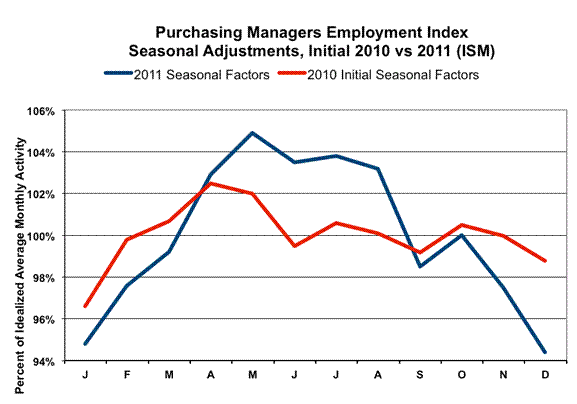
The extreme shifts seen in the employment-component seasonal factors for the purchasing managers manufacturing survey between 2010 and 2011 were not stable, as shown in the above graph. Where the factor is divided into the number to be adjusted, the higher the adjustment is, the lower will be the adjusted number. Hence, the relatively high seasonal-adjustment factor for May 2011 partially was responsible for the size of the downside swing from the seasonally-adjusted April (62.7, unadjusted 64.5) employment component to the May (58.2, unadjusted 61.0) component, catching up from earlier overstatement in the series. Where this series is revised annually, neither the 2011 nor the 2010 seasonal adjustments are or were stable and meaningful, with result that widely followed month-to-month comparisons simply are unreliable, effectively useless, at present.
The distortions to reporting are intensified when the seasonal-adjustment revisions are done monthly (as with payrolls and retail sales). Reporting accuracy is sacrificed further, when the reporting (BLS or Commerce Department) shows only seasonally-adjusted revisions to current months, while the revisions actually go back for years. Some specifics on payrolls are shown in the Reporting Details section.
No Chance of Sustainable Economic Growth until Underlying Structural Consumer Income Problems Are Resolved. Following the initial plunge in economic activity from late-2007 into 2009, and an ensuing, protracted period of bottom-bouncing, I contend that the broad U.S. economy began to turn down anew in the latter part of 2010. The reporting of current economic weakness likely reflects some catch up in reporting of a new down-leg in a double- or multiple-dip recession, which increasingly should gain broad market recognition. Although numbers in the months ahead still will be subject to the volatility and distortions from the ongoing reporting-quality issues, upcoming economic reporting likely will tend towards accelerating deterioration. Quarter-to-quarter real GDP change could turn negative in second- or third-quarter 2011 reporting
Fundamentally, with consumer income not growing faster than inflation and with debt-expansion potential still severely restricted, broad economic activity has no basis for entering a period of sustained growth. At best, various short-lived stimulus gimmicks may have short-lived impact.
Consider the recent 13-month reduction in social security withholding taxes that took effect in January 2011. The Bureau of Economic Analysis (BEA) regularly overstates income estimates using imputations and upside biases, and it understates inflation (fully-substitution based with hedonic adjustments), with resulting overstated inflation-adjusted income growth rates. Even so, the BEA reported (May 27th) that seasonally- and inflation-adjusted monthly disposable income (effectively consumer take-home pay) was down or unchanged month-to-month in February, March and April 2011 (the latest number). Indeed, the reported April 2011 level was even with the pre-stimulus level of December 2010.
Hyperinflation Watch—QE3 Nears with Weakening Economic Data. As discussed in recent Commentaries, the Fed’s various “quantitative-easing” programs appear to have been specifically aimed at trying to prevent a banking-system collapse. Systemic-solvency and federal-fiscal problems all intensify with a weak economy, but the Fed has no ability at present to turn the economy around. Economic weakness, however, does provide the Fed with cover for its programs, and QE3 likely will not be far off (by third-quarter 2011), if official data continue to show the economy faltering anew. Dollar selling and gold buying pressures already seem to be reflecting some anticipation of the Fed’s next round of actions. The broad inflation and economic outlooks discussed in Hyperinflation Special Report (2011) continue unabated.
SGS Ongoing-M3 Estimate for May on Track to Show Increasingly Solid Annual and Monthly Growth. The preliminary estimate for the SGS Ongoing-M3 Estimate for May 2011 will be published tomorrow (June 4th) in the Alternate Data section. At present, the series is on track for year-to-year growth of about 1.8%, versus a 0.6% gain in April and a 0.9% annual decline in March. A month-to-month pick up appears to be in the works for May, as well, for the fourth consecutive month, up by about 0.7%, following a 0.8% estimated gain in April. The estimated month-to-month changes are less reliable than the estimates of annual growth.
__________
REPORTING DETAIL
Constant Recalculation of Payroll Seasonal Factors Intensifies Reporting Distortions. As discussed in the Opening Comments, seasonal-factor estimation has been severely distorted by the extreme depth and duration of the economic contraction. These distortions are exacerbated for payroll employment data based on the BLS’s monthly seasonal-factor re-estimations and lack of full reporting.
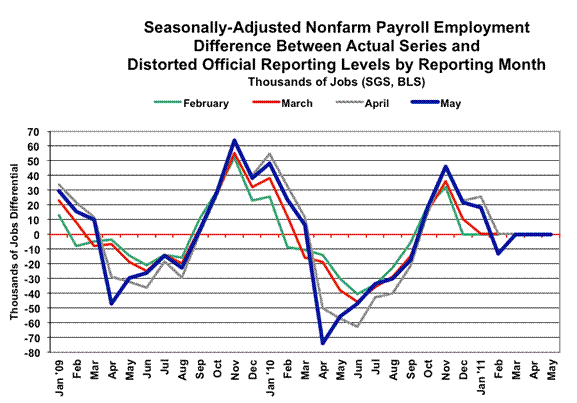
While the BLS recalculates the monthly seasonal factors each month for payroll employment, going back a number of years, it only publishes revised data for the last two months of reporting (March and April 2011 with the May 2011 report). Shown in the preceding graph, the latest “concurrent” seasonal factor changes reduced the level of payrolls in April 2010 (with a downside change in April 2011), which helped to provide a small relative spike to the May 2011 number. With just two months of prior reporting shown as revised, the downward revision to April 2010 is not published by the BLS, so as to avoid “confusing” people who use the data.
Meaningful seasonal-adjustments tend to be stable over time, without wild fluctuations every time the seasonals are re-estimated. This is true particularly for series like payroll employment and retail sales, where the seasonal factors are concurrent—recalculated each month for the current month’s raw data. If the payroll seasonals were stable, the lines in the preceding graph would be flat and coincident. Instead the variations appear to be intensifying with each successive month. The monthly recalculations of seasonally-adjusted payroll levels show irregular revisions, with monthly swings of plus or minus 70,000 jobs shifting over time. To the extent the numbers affect current reporting, the differences are enough potentially to alter financial-market perceptions and reactions.
The big issue remains that the month-to-month seasonally-adjusted payroll data have become increasingly worthless, with reporting errors likely now well beyond the official 95% confidence interval of +/- 129,000 jobs in the reported monthly payroll change. Yet the media and the markets tout the data as meaningful, usually without question or qualification.
The inconsistency differences in the graph were calculated based on the raw data and the seasonal-adjustment program available to the public on the BLS Web site. Using the BLS data, we have calculated the seasonally-adjusted numbers as the BLS should be showing them, as of the current reporting, and the differences between official reporting and the consistent seasonally-adjusted series.
Payroll Survey Detail. The Bureau of Labor Statistics (BLS) reported a statistically-insignificant, seasonally-adjusted May 2011 jobs gain of 54,000 (an increase of 15,000 jobs before prior-period revisions) +/- 129,000 (95% confidence interval). April payrolls showed a revised 232,000 (previously 244,000) gain. Yet, as discussed earlier, some of the softening in growth was due to minor catch up in the ongoing statistical distortions from the monthly recasting of seasonal adjustment factors, which shift seasonally-adjusted jobs from earlier months, but where the BLS does not publish the earlier revisions. It is not so much that jobs growth suddenly is slowing, it is that previously reported jobs growth never was as advertised.
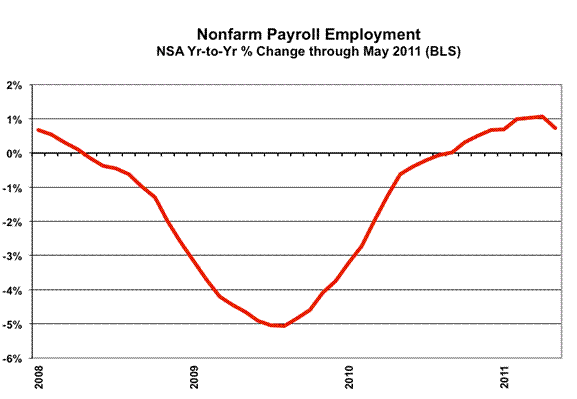
In terms of year-to-year change, the unadjusted May 2011 growth rate slowed to 0.73%, down from the revised 1.06% (previously 1.07%) annual growth reported in April.
Although the graphs of long-term year-to-year unadjusted payroll change had shown a recent rising trend in annual growth, which primarily reflected the still-protracted bottom-bouncing in the payroll series, that pattern had flattened out in the last several months and now has begun to soften, as shown in the first graph following of the near-term detail in year-to-year change.
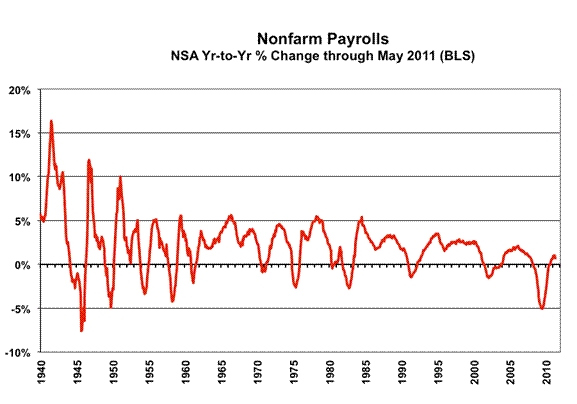
As shown in the preceding longer-term graph (historical detail back to World War II), with the bottom-bouncing of recent years, current annual growth has recovered from the post-World War II record 5.06% decline in August 2009, which was the most severe annual contraction seen since the production shutdown at the end of World War II (a trough of a 7.59% annual contraction in September 1945). Disallowing the post-war shutdown as a normal business cycle, the August 2009 annual decline remains the worst since the Great Depression, and the current level of employment is far from any recovery.
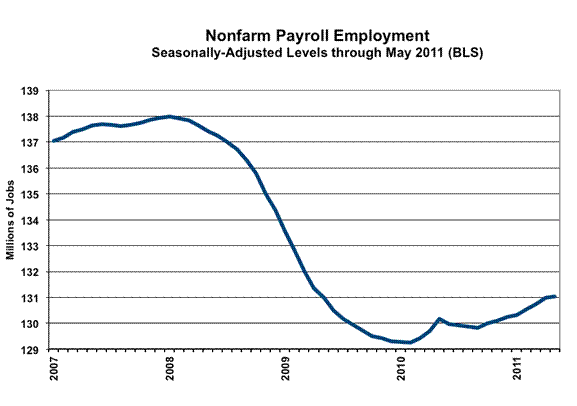
In the above plot of seasonally-adjusted payroll levels (as reported by the BLS) the current level of nonfarm payrolls shows a flattening and certainly no recovery to pre-recession highs. The data continue to bottom-bounce along a plateau of low-level activity, with the latest payroll level still well below where it was a decade ago, even though the U.S. population has increased by more than 10% in the same period.
Birth-Death/Bias Factor Adjustment. Despite the ongoing and regular overstatement of monthly payroll employment—as evidenced by the regular and massive, annual downward benchmark revisions to the reported payroll numbers—the BLS keeps upping its monthly biases in post-benchmark reporting. For May 2011, there was a positive monthly bias used of 206,000 jobs, up from the revised estimate of 192,000 used in May 2010. In April, the net bias was a boost of 175,000 jobs. These upside biases reflect an ongoing assumption of a net positive jobs creation by new companies versus those going out business. Such becomes a self-fulfilling system, as the upside biases boost financial-market and political needs with relatively good headline data, while also setting up the next year’s downside benchmark revisions, which traditionally are ignored by the media and the politicians.
Where the BLS cannot measure the impact of jobs loss and jobs creation from employers starting up or going out of business, on a timely basis (within at least five years, if ever), such information is estimated by the addition of a bias-factor generated by the Birth-Death Model (a model of the effects of new business creation and old business bankruptcies). The fundamental defects of the Birth-Death Model are discussed as usual in the ensuing paragraphs.
Positive assumptions—commonly built into government statistical reporting and modeling—can become self-fulfilling prophesies, with “stronger” economic data being reported as a result of happy guesstimates, or underlying assumptions of ongoing economic recovery. Indeed, historically, the Birth-Death Model biases have tended to overstate payroll employment levels—to understate employment declines—during recessions. There is a faulty underlying premise here that jobs created by start-up companies in this downturn have more than offset jobs lost by companies going out of business. So, if a company fails to report its payrolls because it has gone out of business, the BLS assumes it still has its previously-reported employees and adjusts those numbers for the trend in the company’s industry.
Further, presumed additional “surplus” jobs, created by start-up firms, get added on to the payroll estimates each month as a special add-factor. These add-factors have averaged 40,000 jobs per month over the last 12 months. I still estimate this monthly bias should be negative by roughly 200,000 or so, on average. Since it is not, the BLS overestimates monthly growth in payroll employment by roughly 240,000 jobs. Much of that misreporting was not picked up in the 2010 benchmarking, and now will not be corrected until at least the 2011 benchmark revision (based on the upcoming March 2011 benchmarking) to be published in February 2012.
Household Survey. The usually statistically-sounder household survey, which counts the number of people with jobs, as opposed to the payroll survey that counts the number of jobs (counting multiple job holders more than once), showed a May 2011 employment gain of 105,000 versus April, which in turn, was down by 190,000 from March. Unfortunately, issues with seasonal factors also cloud the significance of the reported monthly levels in the adjusted headline U.3 unemployment rate and other adjusted household-survey numbers. Again, adjusted data have been moved by highly unstable seasonal factors that are artifacts of the severe and extraordinarily protracted downturn in U.S. economic activity, not by the regular and stable seasonal patterns that were in place before the current economic crisis.
The May 2011 seasonally-adjusted headline (U.3) unemployment rate rose by a statistically-insignificant 0.09 percentage point to 9.05% +/- 0.23% (95% confidence interval), from 8.96% in April. Not-seasonally-adjusted, May’s U.3 unemployment rate held even with April’s at 8.7%.
The May U.6 unemployment rate notched lower to a seasonally-adjusted 15.8% from 15.9% in April, still suffering from seasonal-maladjustment, with some close to 150,000 of the unadjusted short-term discouraged workers in U.6 likely rolling into the nether world of the long-term discouraged worker category in the SGS measure. The unadjusted U.6 rate fell to 15.4% in May, from 15.5% in April. The broadest unemployment rate published by the BLS, U.6 includes accounting for those marginally attached to the labor force (including short-term discouraged workers) and those who are employed part-time for economic reasons (they cannot find a full-time job).
In 1994, during the Clinton Administration, “discouraged workers”—those who had given up looking for a job because there were no jobs to be had—were redefined so as to be counted only if they had been “discouraged” for less than a year. This time qualification defined away the long-term discouraged workers. The remaining short-term discouraged workers (less than one year) are included in U.6.
Adding the SGS estimate of excluded long-term discouraged workers back into the total unemployed and labor force, unemployment—more in line with common experience as estimated by the SGS-Alternate Unemployment Measure—held at about 22.3% in May, unchanged from. The SGS estimate generally is built on top of the official U.6 reporting, and tends to follow its relative monthly movements. Accordingly, it will suffer some of the current seasonal-adjustment woes afflicting the base series. See the Alternate Data tab for more detail.
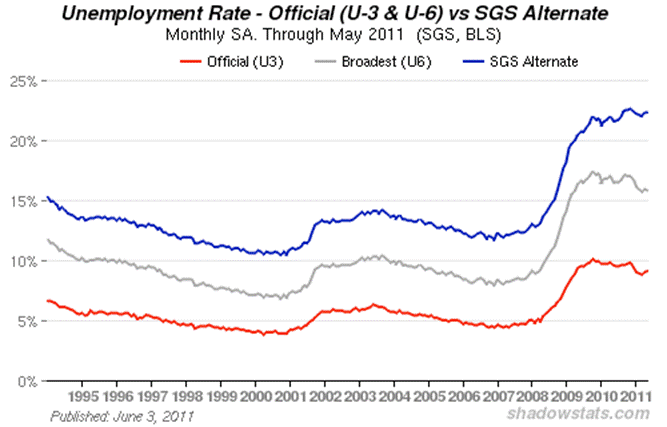
As discussed in previous writings, while an unemployment rate around 22% might raise questions in terms of a comparison with the purported peak unemployment in the Great Depression (1933) of 25%, the SGS level likely is about as bad as the peak unemployment seen in the 1973 to 1975 recession. The Great Depression unemployment rate was estimated well after the fact, with 27% of those employed working on farms. Today, less that 2% work on farms. Accordingly, for purposes of Great Depression comparison, I would look at the estimated peak nonfarm unemployment rate in 1933 of 34% to 35%.
Week Ahead. Though still not widely acknowledged, there is both an intensifying double-dip recession and a rapidly escalating inflation problem. Until such time as financial-market expectations fully catch up with underlying reality, reporting generally will continue to show higher-than-expected inflation and weaker-than-expected economic results in the month and months ahead. Increasingly, previously unreported economic weakness should show up in prior-period revisions.
Trade Balance (April 2011). The April trade deficit is due for release on Thursday, June 9th. Further monthly deterioration is likely both before and after adjustment for inflation. The deficit reporting remains likely to continue offering worse-than-expected results versus likely consensus estimates.
__________