


No. 374: May Housing Starts

COMMENTARY NUMBER 374
May Housing Starts
June 16, 2011
__________
Housing Starts Remain in Downhill Bottom-Bouncing
__________
PLEASE NOTE: The next regularly scheduled Commentary is for Friday, June 24th, covering the second revision to first-quarter GDP, May new orders for durable goods and May home sales.
—Best wishes to all, John Williams
Opening Comments and Executive Summary. The May housing starts release held no surprises this morning (June 16th), with the reported 3.5% monthly gain in this highly volatile series virtually indistinguishable from a monthly contraction, in terms of statistical significance. Housing activity continues to bottom-bounce in a downtrend. Activity remains at historically low levels, down roughly 75% from the markets seen just five years ago.
With the collapsed real estate markets, and financing for same, major factors behind the U.S. systemic-solvency woes, and with housing activity feeding into demand for furnishings, appliances, etc., the ongoing story here offers no near-term good news for either the solvency or economic crises.
Hyperinflation Watch—Greece. To the extent that Greece’s solvency crisis threatens systemic collapse, short-term funding solutions almost certainly will be found by the interested sovereign states and central banks, including particularly the U.S. Government and the Federal Reserve. As seen in 2008, systemic failure will be avoided so long as it is possible to do so with the spending of whatever money needs to be created, or with the extension of whatever financial guarantees are needed. Due to domestic political concerns, U.S. activity here likely will be covert—worked through a third party—or otherwise downplayed as much as possible.
The crises facing the United States and the U.S. dollar dwarf those in the euro system, and should tend to dominate the financial markets as the issues with Greece and others tend to be stabilized. The broad inflation and economic outlooks discussed in Hyperinflation Special Report (2011) continue unabated.
__________
REPORTING DETAIL
HOUSING STARTS (MAY 2011)
May Gain Was Statistically Meaningless. The regularly volatile housing starts series continued its pattern of weakening bottom-bouncing in May, albeit with a small monthly uptick, but with no indications of a reprieve for the housing industry or the otherwise deteriorating broader economy. The Census Bureau reported this morning, June 16th, a statistically-insignificant monthly increase in seasonally-adjusted May 2011 housing starts of 3.5% +/- 14.5% (95% confidence interval); the gain was 7.1% before prior-period revisions. April starts were revised to an 8.8% (previously 10.6%) monthly decline.
Year-to-year change in May housing starts was a statistically-insignificant decline of 3.4% +/- 10.2% (95% confidence interval), following a revised annual 21.3% (previously 23.9%) decline in April. The sharp narrowing in annual decline reflected the May 2010 drop-off in post-stimulus activity, and the continuation of a downwardly-sloped trend of bottom-bouncing since.
Indeed, the pattern of housing starts has remained one of stagnation at an historically low-level plateau of activity, over the last 30 months, with recent activity turning down anew. The six-month moving-average of seasonally-adjusted housing starts held at 562,000 in May, 6.8% above the historic low six-month moving-average seen in May 2009. Significantly weaker monthly numbers remain likely in the months ahead. Since December 2008, housing starts have averaged a seasonally-adjusted annual rate of 569,000. In that period, all monthly readings have been within the normal range of monthly volatility for the series around that average, with the 560,000 May 2011 monthly reading at 1.6% below average.
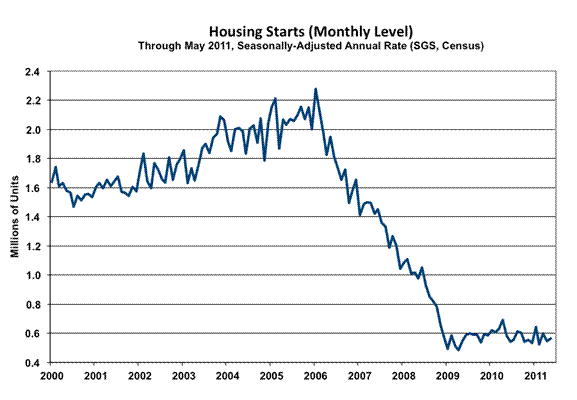
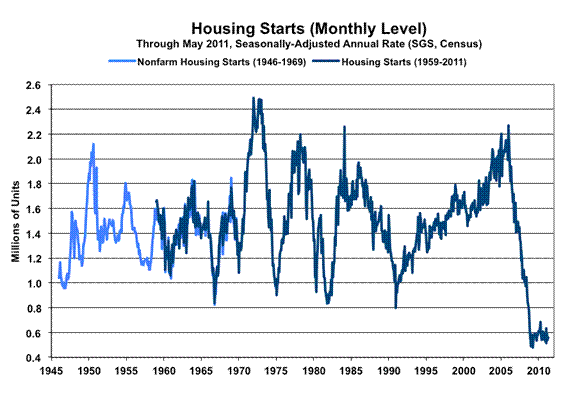
As shown in the preceding graphs, current monthly housing starts activity remains near the record monthly low for the present series seen in April 2009. The current number also is well below any level reported in the predecessor nonfarm housing starts series, which was introduced in 1946. The first graph shows recent detail for current housing starts activity, the second graph shows the same data within the historical context of the post-World War II period.
Week Ahead. Though still not widely acknowledged, there is both an intensifying double-dip recession and a rapidly escalating inflation problem. Until such time as financial-market expectations fully catch up with underlying reality, reporting generally will continue to show higher-than-expected inflation and weaker-than-expected economic results in the month and months ahead. Increasingly, previously unreported economic weakness should show up in prior-period revisions.
Home Sales (May 2011). May existing home sales (National Association of Realtors) are due for release on Tuesday, June 21st, followed by new home sales (Census Bureau) on Thursday, June 23rd. As with the continuing historic weakness in housing starts, these volatile series should remain extremely weak, with any positive monthly change (new homes) again lacking statistical significance. Also, as usual, given the extreme volatility, reporting error and revisions in these series, given the poor-quality seasonal adjustments, given continuing negative anecdotal evidence, and given ongoing massive distortions from increasingly volatile foreclosure activity, the monthly movements in these numbers (particularly to the upside) remain meaningless.
Gross Domestic Product—GDP (First-Quarter 2011—Second Revision or Third Estimate). The second revised estimate of first-quarter GDP is due for release from the Bureau of Economic Analysis (BEA) on Friday, June 24th. Changes at the second revision usually are no more than statistical noise around the first revision, which in this case showed headline, annualized real growth of 1.8%. Annual GDP revisions, however, are due on July 29th, along with the “advance” estimate of second-quarter GDP. A lowered level of first-quarter GDP is likely in the pending major downside revisions to previously-reported GDP activity. The BEA, however, usually tries to keep the annualized quarterly growth rate of the last quarter before the revisions (first-quarter 2011 GDP in this case) as close to the prior reporting as possible. Such helps divert media attention some from earlier downside changes, and the reduced level of overall activity.
New Orders for Durable Goods (May 2011). Due for release on Friday, June 24th, May’s new orders for durable goods likely will not show a meaningful monthly change, with odds slightly favoring a decline in this irregularly volatile series.
__________