


No. 379: June CPI, Industrial Production

COMMENTARY NUMBER 379
June CPI, Industrial Production
July 15, 2011
__________
Economy Falters as Key Indicators Put in Worst Performances
Since “End” of the Recession in June 2009
Higher Energy Prices Create Broad Inflationary Pressures Across the Economy
Despite Short-Lived Dip in Gasoline Prices
June Annual Consumer Inflation Held at 32-Month High
June’s Annual Inflation: 3.6% (CPI-U), 4.1% (CPI-W), 11.1% (SGS)
Annual “Core” Inflation in a Steady Upside Move Since QE2
__________
PLEASE NOTE: The next regular Commentary is scheduled for Wednesday, July 20th. It will cover June housing starts, the outlook for upcoming GDP second-quarter 2011 reporting and benchmark revisions, and a review of systemic liquidity measures.
—Best to all, John Williams
Opening Comments and Executive Summary. Economic activity has slowed sharply. At the same time, higher oil costs have started to create broad inflationary pressures that neither are in the direct “energy” sector, nor driven by strong economic demand. These patterns are based on official government reporting, with all the biases and current seasonal-factor distortions that are in that reporting. Underlying reality is even worse: an inflationary double-dip recession. The implications are horrendous in terms of the federal budget deficit, Treasury funding needs and banking-system solvency, where the current not-so-happy projections are overly optimistic, based on underlying assumptions of positive economic growth and contained inflation. This circumstance also likely is why Fed Chairman Bernanke suddenly started hemming and hawing about having another round of “stimulus,” some form of a QE3. Yes, the economy is that weak.
June CPI. The June CPI-U showed a seasonally-adjusted monthly decline of 0.2%, although the annual, year-to-year inflation rate held at 3.6%, its highest level since October 2008. The monthly decline in adjusted gasoline prices still was exacerbated slightly by seasonal factors, but that will reverse sharply in July, as the seasonal-adjustment effects flip to the other side.
As seen in both today’s (July 15th) CPI reporting and yesterday’s PPI reporting, the broad economy is experiencing pass-through upside inflationary pressures from higher oil costs. Significant here is that higher inflation does not reflect a strengthening economy, but rather it is tied to the dollar-debasement efforts of the Fed, the resulting weakness in the U.S. dollar and the related strength in oil prices.
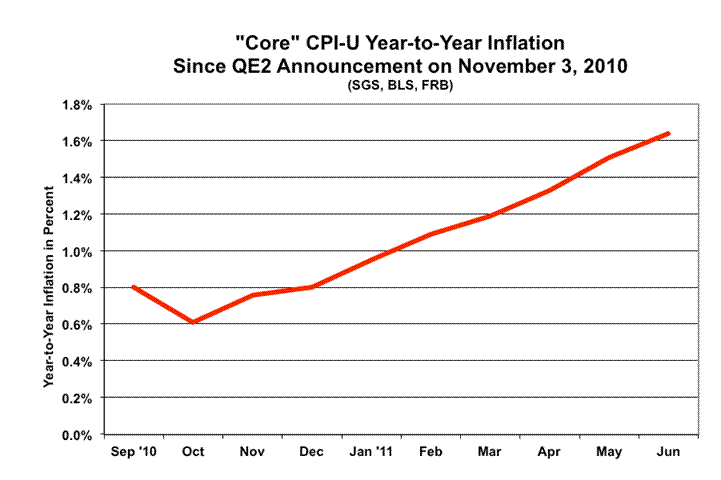
As seen in the graph above, the current rise in annual “core” inflation started following Mr. Bernanke’s efforts first at jawboning, and then actually moving to debase the U.S. dollar with the announcement of QE2 on November 3, 2010. While the Fed prefers to ignore food and energy inflation, its targeted “core” inflation rate showed 2.5% annualized inflation in second-quarter 2011, up from 1.7% in first-quarter 2011. The second-quarter inflation pace is one that should forestall a QE3, if the Fed were being forthright in explaining its actions to date. Systemic solvency issues (under cover of a weakening economy), though, should force QE3 shortly. At such time as the Fed might introduced the next easing, the U.S. central bank effectively will have signaled abandonment of any plans at near-term inflation containment.
June Industrial Production and Real Retail Sales. I disagree with the use of annualized rates for expressing quarterly GDP change, since those numbers rarely are consistent in any consecutive four-quarter period. That said, using annualized rates is the U.S. convention, and I shall use it here for some comparative measures.
With second-quarter reporting now in place for real (inflation-adjusted) retail sales and for industrial production, those results may offer a little guidance on what to expect with the July 29th “advance” estimate on annualized, inflation-adjusted second-quarter 2011 GDP growth.
Annualized growth in both the retail and production series collapsed in second-quarter 2011. Industrial production showed annualized growth of 4.82% in first-quarter 2011, but that plunged to 0.8% in the second-quarter. In like manner, real retail sales growth collapsed from 5.02% in the first-quarter to 0.32% in the second-quarter. For both series, the results were the weakest seen since outright contractions in second-quarter 2009, at the official “end” to the 2007 recession.
Other than an improvement in net exports and possible inventory gains, there is not much out there to suggest a second-quarter GDP number that would be stronger than the first-quarter’s estimate of 1.9%. A formal forecast here will be offered with the next Commentary, along with an assessment of the likely benchmark revisions that also will be published July 29th.
Hyperinflation Watch. The broad inflation and economic outlooks discussed in the Hyperinflation Special Report (2011) continue to unfold and are unchanged. Beyond the potential default and/or U.S. debt downgrade issues discussed in yesterday’s Commentary No. 378, any new considerations were covered in the previous section. A detailed review of systemic liquidity will be included in the next Commentary.
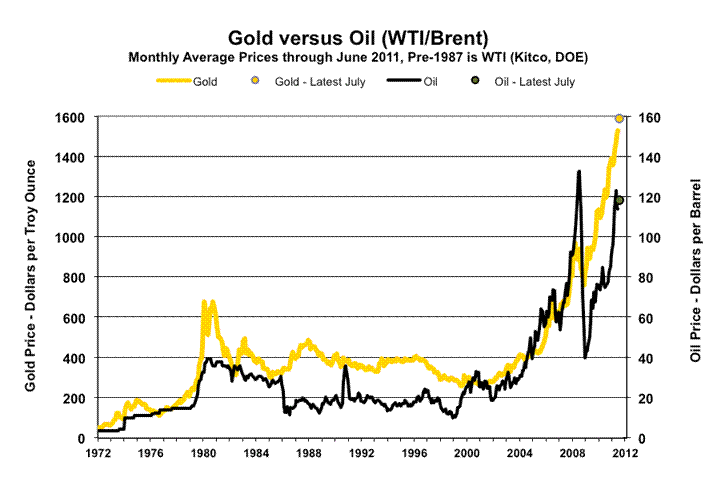
The regular gold, silver, Swiss franc and oil charts follow.


__________
REPORTING DETAIL
CONSUMER PRICE INDEX (JUNE 2011)
Annual Inflation Rates Hold Despite Monthly Dip in Gasoline Prices. June CPI reporting showed a stall in annual inflation growth, as a short-lived dip in gasoline prices had some impact. What has to be distressing, though, to those such as the Fed Chairman, who likes to ignore food and energy inflation, is that “core” inflation steadily has continued to rise. The rising “core” inflation reflects upside pricing pressures from higher oil prices, not from economic demand, and is graphed in the Opening Comments and Executive Summary.
Notes on Different Measures of the Consumer Price Index.
The Consumer Price Index (CPI) is the broadest inflation measure published by U.S. Government, through the Bureau of Labor Statistics (BLS), Department of Labor:
The CPI-U (Consumer Price Index for All Urban Consumers) is the monthly headline inflation number (seasonally adjusted) and is the broadest in its coverage, representing the buying patterns of all urban consumers. Its standard measure is not seasonally adjusted, and it never is revised on that basis except for outright errors,
The CPI-W (CPI for Urban Wage Earners and Clerical Workers) covers the more-narrow universe of urban wage earners and clerical workers and is used in determining cost of living adjustments in government programs such as Social Security. Otherwise its background is the same as the CPI-U.
The C-CPI-U (Chain-Weighted CPI-U) is an experimental measure, where the weighting of components is fully substitution based. It generally shows lower annual inflation rate than the CPI-U and CPI-W. The latter two measures once had fixed weightings—so as to measure the cost of living of maintaining a constant standard of living—but now are quasi-substitution-based. Since it is fully substitution based, the series tends to reflect lower inflation than the other CPI measures. Accordingly, the C-CPI-U is the "new inflation" measure being proffered by Congress and the White House as a tool for reducing Social Security cost-of-living adjustments by stealth. Moving to accommodate the Congress, the BLS announced pending changes to the C-CPI-U estimation and reporting process on October 22, 2014, which are described in Commentary No. 668
The ShadowStats Alternative CPI-U measures are attempts at adjusting reported CPI-U inflation for the impact of methodological change of recent decades designed to move the concept of the CPI away from being a measure of the cost of living needed to maintain a constant standard of living.
With the short-lived dip in June’s gasoline prices, the pace of annualized, seasonally-adjusted CPI-U inflation slowed slightly in second-quarter 2011 to 4.09%, from 5.22% in first-quarter 2011.
June’s unadjusted year-to-year CPI-U inflation held at 3.56%, virtually unchanged from May’s 3.57% and still the strongest pace of annual inflation since October 2008.
The June report also showed, though, that the inflationary pressures from higher energy prices have spread to the broad economy (see the Opening Comments and Executive Summary). On an annual basis, “core” CPI-U inflation notched higher again in June, up to 1.64%, from 1.51% in May. When Fed Chairman Bernanke used his jawboning in an effort to debase the U.S. dollar in the markets, in advance of announcing QE2 in November 2010, annual “core” inflation was at 0.61%.
Year-to-year total CPI-U inflation would increase or decrease in next month’s July 2011 reporting, dependent on the seasonally-adjusted monthly change, versus the 0.35% gain in the adjusted monthly level reported for July 2010. I use the adjusted change here, since that is how consensus expectations are expressed. To approximate the annual inflation rate for July 2011, the difference in July’s headline monthly change (or forecast of same) versus the year-ago monthly change should be added to or subtracted directly from June 2011’s reported annual inflation rate of 3.56%. Annual CPI-U inflation should move to top 4% in the next couple of months. The CPI-W broke that barrier in May, hitting 4.1% (4.12%), and it held at 4.1% (4.06%) in today’s reporting.
I apologize to readers for using the wrong number for the June 2010 monthly change indicated in last month’s version of the previous paragraph. The month-to-month change in last June’s CPI-U was a decline of 0.21% (not a 0.17% gain), which is why—with a 0.22% monthly decline reported today for June 2011—the annual inflation rate virtually was unchanged.
CPI-W. The narrower, seasonally-adjusted CPI-W, which has greater weighting for gasoline than does the CPI-U, fell in June 2011 by 0.34% (down by 0.19% unadjusted), following May’s adjusted monthly increase of 0.14% (up 0.55% unadjusted).
The pace of annualized, seasonally-adjusted CPI-W inflation slowed in second-quarter 2011 to 4.55%, from 6.04% in first-quarter 2011.
Unadjusted, June 2011’s year-to-year CPI-W inflation was 4.06%, against a 4.12% annual increase in May.
C-CPI-U. The Chain-Weighted CPI-U—the fully substitution-based series that gets touted by CPI opponents and inflation apologists, including the recent presidential deficit commission, as the replacement for the CPI—is reported only on an unadjusted basis. Year-to-year inflation increased to 3.37% in June 2011, versus 3.28% in May.
The C-CPI-U is the measure being contemplated in the current deficit-reduction negotiations in Washington to replace the CPI-W in cost of living adjustments (COLA). Specifically, reducing Social Security COLA is being touted as a major cost reduction. The issues here were discussed in Commentary No. 376.
Alternate Consumer Inflation Measures. Adjusted to pre-Clinton (1990) methodology, annual CPI inflation was roughly 6.9% in June 2011, at the same level as in May, while the SGS-Alternate Consumer Inflation Measure, which reverses gimmicked changes to official CPI reporting methodologies back to 1980, eased slightly, due primarily to rounding, to about 11.1% (11.13% for those using the extra digit) in June, from about 11.2% in May.
The SGS-Alternate Consumer Inflation Measure adjusts on an additive basis for the cumulative impact on the annual inflation rate of various methodological changes made by the BLS (the series is not recalculated). Over the decades, the BLS has altered the meaning of the CPI from being a measure of the cost of living needed to maintain a constant standard of living, to something that no longer reflects the constant-standard-of-living concept. Roughly five percentage points of the additive SGS adjustment reflect the BLS’s formal estimate of the annual impact of methodological changes; roughly two percentage points reflect changes by the BLS, where SGS has estimated the impact not otherwise published by the BLS.
Gold and Silver Highs Adjusted for CPI-U/SGS Inflation. Despite the yesterday’s (July 14th) historic-high gold price of $1,590.50 per troy ounce (London afternoon fix) and the multi-decade high silver price of $48.70 per troy ounce (London fix of April 28th), gold and silver prices have yet to approach their 1980 historic levels, adjusted for inflation. The earlier all-time high of $850.00 (London afternoon fix, per Kitco.com) of January 21, 1980 would be $2,466 per troy ounce, based on June 2011 CPI-U-adjusted dollars, $8,545 per troy ounce based on SGS-Alternate-CPI-adjusted dollars (all series not seasonally adjusted).
In like manner, the all-time high price for silver in January 1980 of $49.45 per troy ounce (London afternoon fix, per silverinstitute.org), although approached recently, still has not been hit since 1980, including in terms of inflation-adjusted dollars. Based on June 2011 CPI-U inflation, the 1980 silver price peak would be $144 per troy ounce and would be $497 per troy ounce in terms of SGS-Alternate-CPI-adjusted dollars (again, all series not seasonally adjusted).
As shown on page 43 of the Hyperinflation Special Report (2011), over the decades, the price of gold has compensated for more than the loss of the purchasing power of the U.S. dollar as reflected by CPI inflation, while it has effectively fully compensated for the loss of purchasing power of the dollar based on the SGS-Alternate Consumer Price Measure (1980 Methodologies Base).
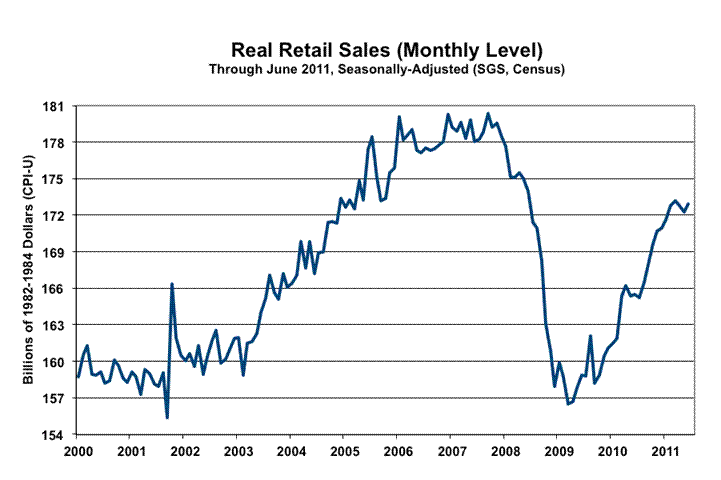
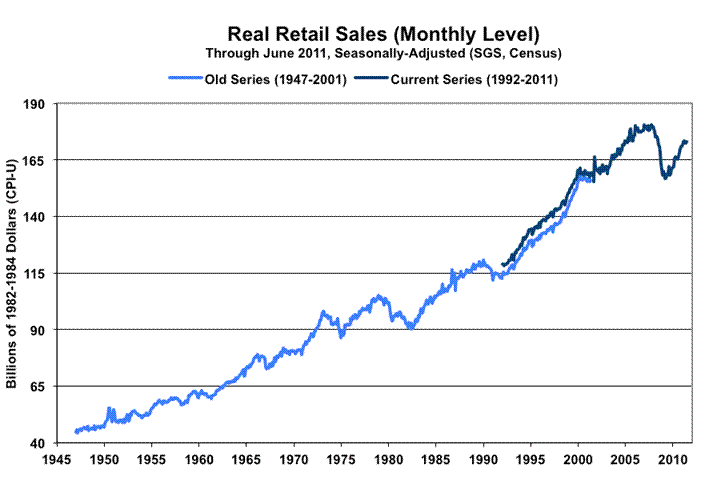
Real (Inflation-Adjusted) Retail Sales. Real retail sales stalled in second-quarter 2011. Based on the June 2011 CPI-U reporting, inflation- and seasonally-adjusted monthly June 2011 retail sales rose by 0.36%, where, before inflation adjustment, the current number was up by 0.24%. Real May sales revised to a decline of 0.28% (previously a drop of 0.40%). The shrinkage in the May decline was due primarily to a downside revision to April’s data.
June’s real retail sales rose at a year-to-year pace of 4.48%, versus a revised 4.20% (previously 4.13%) annual gain reported for May.
Second-quarter 2011 real retail sales virtually were unchanged (up less than 0.1% [0.08%]) from first-quarter sales. Annualized quarterly real growth dropped from 5.02% in the first-quarter to 0.32% in the second quarter. That was the weakest quarterly performance since an outright contraction in second-quarter 2009, the official “end” of the 2007 recession (see Opening Comments and Executive Summary).
The ongoing “recovery” in real retail sales is reflected in the following graphs, which show the latest monthly levels of inflation- and seasonally-adjusted activity. The first of these shows close historical detail for the period beginning in 2000; the second shows the same data in historical context since World War II.
Using the SGS Alternate-CPI Inflation estimates for deflation of the retail series would not have shown an ongoing rise in activity for the last year or so. It is my preference here, and wherever otherwise possible, to use the official estimates (the series here is as calculated by the St. Louis Fed), since that eliminates a level of argument over what is being reported. As official consumer inflation picks up, and as overall retail sales suffer from the ongoing consumer liquidity squeeze, these data have started to turn down in what will become eventually an official and formal double-dip recession.
There has been no change in underlying fundamentals that would support a sustainable turnaround in personal consumption or in general economic activity—no recovery—just general bottom-bouncing. Accordingly, real retail sales levels in the months ahead should become increasingly negative.
Real Money Supply M3. The signal of the still unfolding double-dip recession, based on annual contraction in the real (inflation-adjusted) broad money supply (M3), most recently discussed in the Hyperinflation Special Report (2011), continues and is graphed below. Based on the June CPI-U report and the latest June SGS-Ongoing M3 Estimate, the annual contraction in real M3 for June 2011 was 1.3%, versus a 1.4% annual contraction in May.

The signal for a downturn or an intensified downturn is generated when annual growth in real M3 first turns negative in a given cycle; the signal is not dependent on the depth of the downturn or its duration. The current downturn signal was generated in December 2009. The broad economy tends to follow in downturn or renewed deterioration roughly six-to-nine months after the signal, as has appeared to have started in recent months. Increasing weakness in a number of series should become evident in the months ahead, with the July 29th benchmark revisions to GDP likely to show much weaker economic activity for the last year or two than currently is reported. Such eventually will lead to recognition of a double-dip recession.
INDUSTRIAL PRODUCTION (JUNE 2011)
Industrial Production Stalled in Second Quarter 2011. June’s production was spiked by relative downside revisions to prior reporting, with activity in second-quarter 2011 flattening out. This morning’s (July 15th) Federal Reserve Board release of seasonally-adjusted June 2011 industrial production showed a monthly gain of 0.19% (a gain of 0.10% net of prior-period revisions) versus May. In turn, monthly change in May production was revised to a 0.08% contraction (previously a 0.10% gain).
Year-to-year growth in June 2011 production was 3.41%, versus the revised 3.32% (previously 3.42%) in May, and down from the recent relative peak year-to-year change of 7.75% in June 2010. The year-to-year contraction of 14.83% seen in June 2009, at the end of second-quarter 2009, was the steepest annual decline in production growth since the shutdown of war-time production following World War II.
Second-quarter 2011 industrial production basically was flat (up just 0.20%) against first-quarter production. Annualized quarterly growth dropped from 4.82% in the first-quarter to 0.80% in the second quarter. That was the weakest quarterly performance since an outright contraction in second-quarter 2009, the official “end” of the 2007 recession (see Opening Comments and Executive Summary).
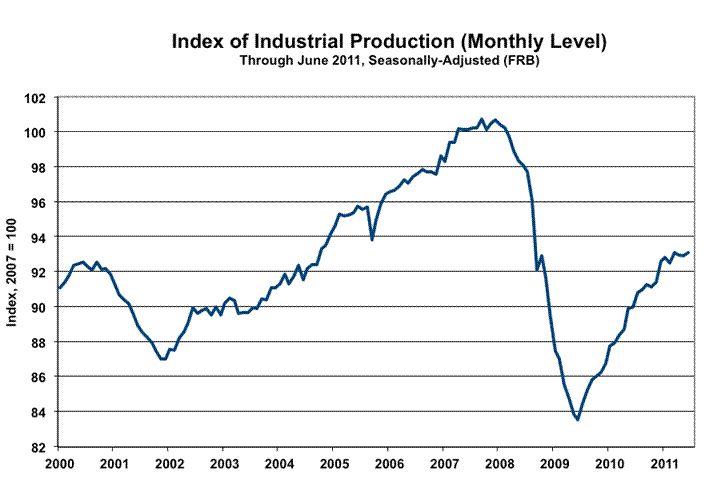
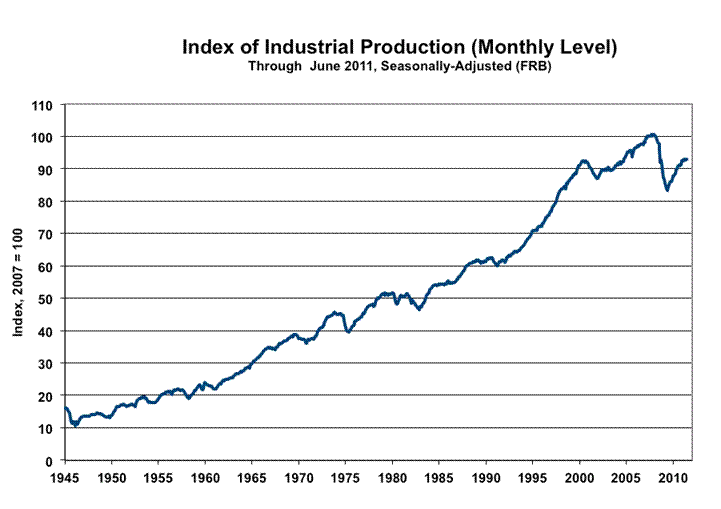
The “recovery” in industrial production is reflected in the preceding graphs. Both graphs show the monthly level of the production index. The first of these shows close historical detail for the period beginning in 2000, the second shows the same data in historical context since World War II.
For the last 34 months, the production index has averaged 88.9, around which the series has fluctuated. Although it had been moving higher, it has started to flatten out in recent months. The June reading was at 93.1, just 0.5% above where it was in December 2010.
Week Ahead. Though still not widely acknowledged, there is both an intensifying double-dip recession and a rapidly escalating inflation problem. Until such time as financial-market expectations fully catch up with underlying reality, reporting generally will continue to show higher-than-expected inflation and weaker-than-expected economic results in the month and months ahead. Increasingly, previously unreported economic weakness should show up in prior-period revisions.
Residential Construction (June 2011). Due for release on Tuesday, July 19th, June’s housing starts likely continued a general declining trend, still pushing towards or setting new historic lows. As has been the case for many months, any reported upside monthly movement likely will remain statistically indistinguishable from a monthly contraction.
__________