


No. 382: Second-Quarter GDP and Revisions, Durable Goods Orders

COMMENTARY NUMBER 382
Second-Quarter GDP and Revisions, Durable Goods Orders
July 29, 2011
__________
GDP Growth Slows Markedly
Official Downturn Much Deeper In Revision
Latest GDP No Longer Has Recovered Pre-Recession High
2009 Annual GDP Drop Now Worst Since 1932
— Outside of World War II Production Shutdown
__________
PLEASE NOTE: The next regular Commentary is scheduled for Friday, August 5th. It will cover the employment and unemployment data for July 2011.
—Best to all, John Williams
Opening Comments and Executive Summary. In late-2006, the U.S. economy unofficially entered its worst economic downturn since the Great Depression. After an extreme plunge in activity in 2008 and 2009, business activity entered a protracted period of bottom-bouncing. Beyond brief, stronger bounces from short-lived stimulus factors, the economy has started to weaken anew.
Officially, the recession was timed from fourth-quarter 2007 to second-quarter 2009, and it was the deepest since the Great Depression. Activity now is slowing anew per GDP reporting, and when GDP turns negative again, later this year, an official double-dip recession should be in place. Earlier growth, though, never was as strong as initially reported, and meaningful downside benchmark revisions to gross domestic product (GDP) history and second-quarter reporting, as published today (July 29th) by the Bureau of Economic Analysis (BEA) now show:
- Reported annualized quarterly real (inflation-adjusted) GDP growth rates since third-quarter 2010 have been reported as positive, but they have not been statistically meaningful in terms of being positive as opposed to being in contraction.
- Annual real GDP growth is slowing faster than it did going into the official 2007 recession.
- The latest real GDP no longer has recovered its pre-2007 recession peak in activity, as had been the case since fourth-quarter 2010 in prior reporting.
- With the exception of the post-World War II production shutdown—which usually is not viewed as an economic cycle—the decline in real 2009 GDP growth now is reported as the deepest annual economic collapse since 1932.
In other economic reporting this week, both new orders for durable goods and new home sales turned down slightly, but the changes were not meaningful. Home sales continued a pattern of bottom-bouncing.
Second-Quarter GDP and Revisions. The “advance” second-quarter GDP estimate of annualized real growth was below consensus, at 1.3%. While that was a slowing from the first-quarter’s 1.9% growth, reported last month, first-quarter growth was revised lower to 0.4% in today’s report, and that made the initial second-quarter estimate appear as an improvement. Reflecting all the benchmark revisions, the real level of first-quarter 2011 GDP was revised lower by 1.6% from prior reporting.
As usually has been the case—and consistent with recent negative revisions to related nonfarm payrolls, retail sales, trade, industrial production and new orders for durable goods—the annual benchmark revisions to U.S. GDP reflected sharp downside changes to recent history. Per the BEA, “The percent change in real GDP was revised down 0.3 percentage point for 2008, was revised down 0.9% percentage point for 2009, and was revised up 0.1 percentage point for 2010.” As seen in the benchmarks of the underlying series, where better information was available (2008 and 2009), the downside revisions were sharp. Where relatively little new information was available (2010), the overestimated BEA guesstimates continued, subject to downside revisions in next year’s benchmarking.
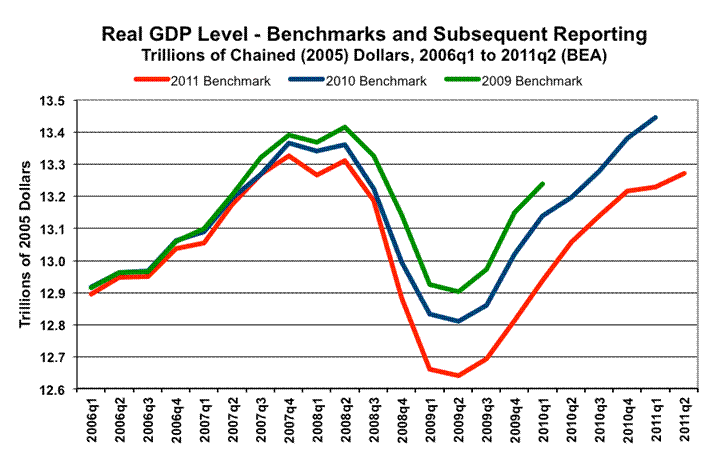
The following graph shows how the reporting has unfolded for the economic downturn that began officially as of fourth-quarter 2007. The plot shows reporting as it was, subsequent to the 2009 benchmark, the 2010 benchmark and subsequent reporting, and the 2011 benchmark and second-quarter 2011 reporting (just released). In the last two revisions, the overly optimistic assumptions out of the BEA were moved a little closer to reality.
Note that the pre-recession high in real GDP activity was revised lower, and that the first-quarter 2011 GDP level, which had been 1.3% above that fourth-quarter 2007 peak, now is 0.7% below it.

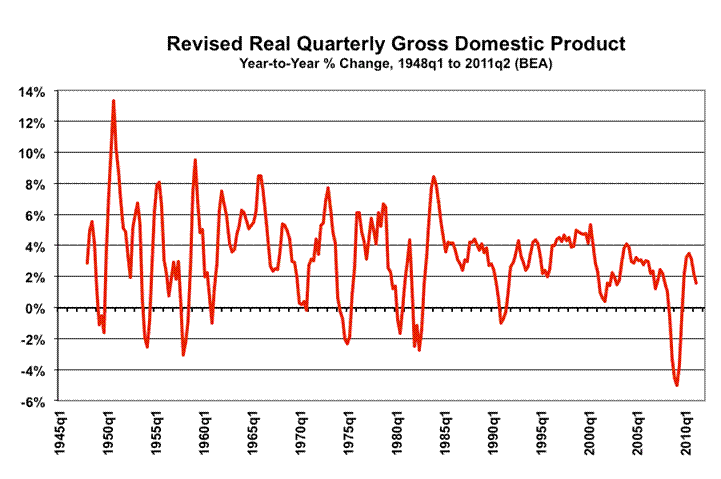
The second graph shows the revised real GDP levels in historical perspective since the beginning of the reported series in 1947. The current downturn clearly is the most significant in the history of the series.
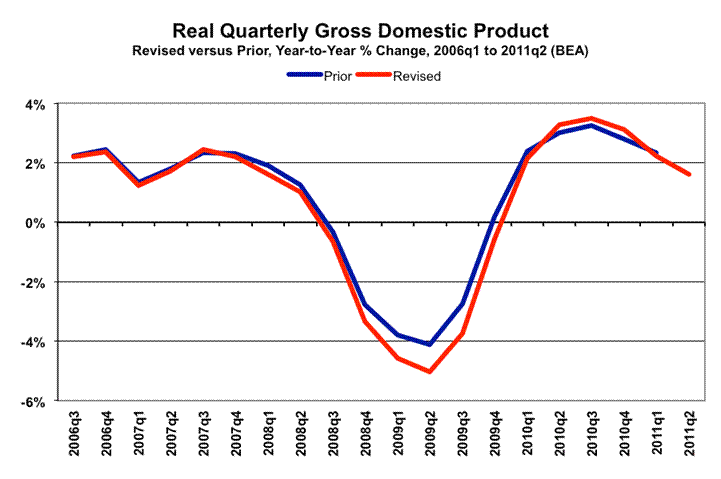
The next series of graphs show the revised annual or year-to-year rates of change in both quarterly and annual real GDP. The first graph shows the near-term quarterly data since 2006. The latest year-to-year real GDP growth as of second-quarter 2011 slowed to 1.6%, down from 2.2% in the first-quarter, and down from the near-term peak of 3.5% in third-quarter 2010. Annual growth is dropping off sharply, which often leads to annual and quarterly contractions. Coming into the 2007 recession, annual growth was flat to positive.
The following graph shows the year-to-year change in the revised quarterly real numbers since 1948. The revised annual decline in second-quarter 2009 GDP of 5.0% (previously a 4.1% contraction), remains the deepest contraction in the history of the quarterly GDP series.
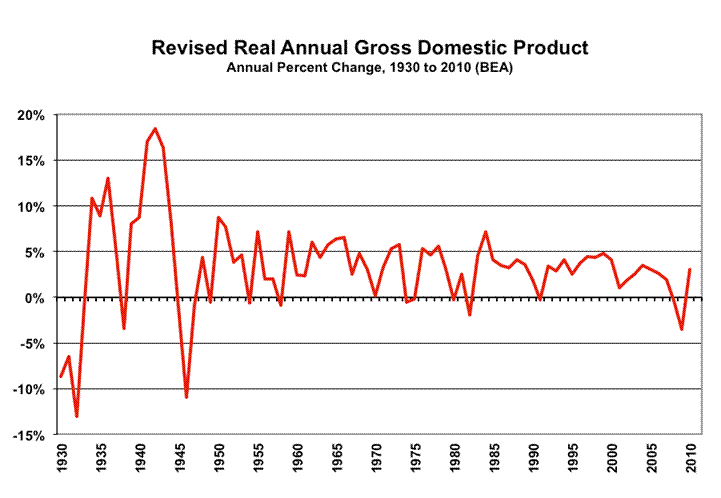
As shown in the subsequent graph of annual change (year-to-year change in the annual average GDP), the revised real 3.5% contraction for the full year of 2009, now is the worst annual economic contraction seen since since 1932. The big drop in 1946 was from the shutdown of war production and generally is not considered an economic cycle.
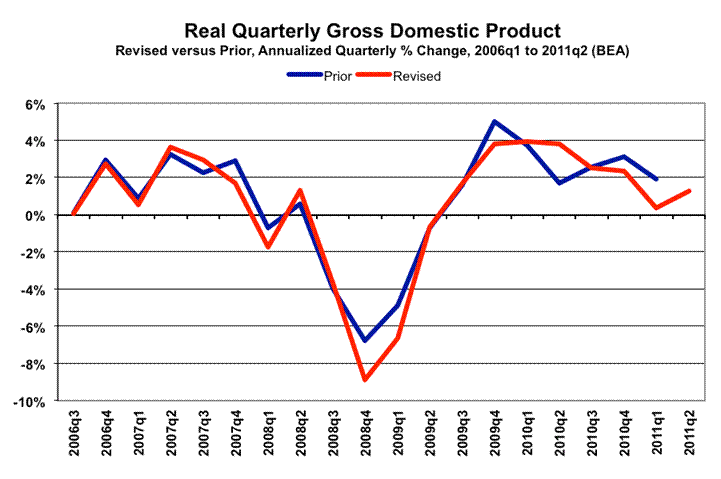
Rounding out the ways of looking at the GDP, the above graph shows the most-followed but least-meaningful of the measures, where the real quarter-to-quarter growth rate is annualized to become the headline number that moves the financial markets. Not annualized, the quarter-to-quarter growth rates in the first- and second-quarters were 0.09% and 0.32%, respectively, little more than statistical noise around being unchanged. They possibly have been massaged a little bit to keep the quarterly growth rates in minimally positive as opposed to negative territory.
The one thing to note is that the trend in the revised quarter-to-quarter reporting generally is towards a slowing in recent economic activity.
Hyperinflation Watch. The broad inflation and economic outlooks discussed in the Hyperinflation Special Report (2011) continue to unfold and are unchanged. The debate in Washington as to an effort at limited reduction in the long-term U.S. federal deficit, in conjunction with an increase in the federal debt limit, continues as we go to press. The points raised in Commentary No. 381 remain my current view on the matter. Any surprising developments would be addressed in a Special Commentary.
__________
REPORTING DETAIL
GROSS DOMESTIC PRODUCT (Benchmark Revisions, “Advance” Second-Quarter 2011)
GDP-Related Definitions. For purposes of clarity and the use of simplified language in the following text, here are definitions of key terms used related to GDP reporting:
"Gross Domestic Product (GDP)" is the headline number and the most widely followed broad measure of U.S. economic activity. It is published quarterly by the Bureau of Economic Analysis (BEA), with two successive monthly revisions and with an annual revision the following July.
"Gross Domestic Income (GDI)" is the theoretical equivalent to the GDP, but it is not followed by the popular press. Where GDP reflects the consumption side of the economy and GDI reflects the offsetting income side. When the series estimates do not equal each other, which almost always is the case, the difference is added to or subtracted from the GDI as a "statistical discrepancy." Although the BEA touts the GDP as the more accurate measure, the GDI is relatively free of the monthly political targeting the GDP goes through.
"Gross National Product (GNP)" is the broadest measure of the U.S. economy published by the BEA. Once the headline number, now it rarely is followed by the popular media. GDP is the GNP net of trade in factor income (interest and dividend payments). GNP growth usually is weaker than GDP growth for net-debtor nations. Games played with money flows between the United States and the rest of the world tend to mute that impact on the reporting of U.S. GDP growth.
"Real" means growth has been adjusted for inflation.
"Nominal" means growth or level has not been adjusted for inflation. This is the way a business normally records revenues or an individual views day-to-day income and expenses.
" GDP Implicit Price Deflator (IPD)" is the inflation measure used to convert GDP data from nominal to real. The adjusted numbers are based on "Chained 2005 Dollars," at present, where the 2005 is the base year for inflation, and "chained" refers to the methodology which gimmicks the reported numbers so much that the total of the deflated GDP sub-series misses the total of the deflated total GDP series by nearly $40 billion in "residual" as of second-quarter 2010.
"Quarterly growth," unless otherwise stated, is in terms of seasonally-adjusted, annualized quarter-to-quarter growth, i.e., the growth rate of one quarter over the prior quarter, raised to the fourth power, a compounded annual rate of growth. While some might annualize a quarterly growth rate by multiplying it by four, the BEA uses the compounding method, raising the quarterly growth rate to the fourth power. So a one percent quarterly growth rate annualizes to 1.01 x 1.01 x 1.01 x 1.01 = 1.0406 or 4.1%, instead of 4 x 1% = 4%.
"Annual growth" refers to the year-to-year change of the referenced period versus the same period the year before.
GDP. Published today, July 29th, by the Bureau of Economic Analysis (BEA), the initial or “advance” estimate of second-quarter 2011 gross domestic product (GDP) showed annualized quarterly growth of 1.28% (down by 4.49% before prior-period benchmark revisions) +/- 3% (95% confidence interval), versus a revised estimate of a 0.36% (previously 1.91%) gain for first-quarter 2011. In this most worthless of major economic series, the reported annualized growth rates for the last two quarters are little more than statistical noise around the unchanged level. They possibly have been massaged a little to keep the quarterly growth rates in minimally-positive as opposed to minimally-negative territory.
Year-to-year change in second-quarter 2011 over second-quarter 2010 continued a slowing trend in annual growth, up by 1.62% versus 2.24% (previously 2.33%) in the first-quarter. Such was well off the near-term peak in reported growth of 3.51% (previously 3.25%) in third-quarter 2010.
The second-quarter GDP implicit price deflator was estimated at 2.39%, versus a revised 2.73% (previously 2.05%) in the first-quarter. In contrast, annualized seasonally-adjusted quarterly inflation for the CPI-U in the second-quarter eased to 4.09% from a seasonally-adjusted 5.22% in the first-quarter. The lower the inflation rate that is used in deflating the GDP, the stronger is the resulting inflation-adjusted number and vice versa. A slightly more realistic inflation number would have pushed the “advance” quarterly growth rate into negative territory.
The SGS Alternate-GDP estimate for second-quarter 2011 is an approximate annual contraction of 2.8% versus the official estimate of a 1.6% gain. Such is more negative than the alternate 2.6% annual contraction (2.2% official gain) in the first-quarter (see the Alternate Data tab). The benchmark revision, once again, has brought official reporting somewhat closer to the SGS estimates. While annualized real quarterly growth is not estimated formally on an alternative basis, a meaningful quarter-to-quarter contraction appears to have been realistic for the second-quarter, in what generally has been a protracted period of business bottom-bouncing.
GNP and GDI. Historical revisions here will be assessed in a subsequent Commentary. Second-quarter estimates of the gross national product (GNP) and gross domestic income (GDI) will not be published until the second estimate of the second-quarter GDP.
NEW ORDERS FOR DURABLE GOODS (JUNE 2011)
Decline in June Durable Goods Orders and Gain in May Likely Were Exacerbated by Bad Seasonals. The Census Bureau reported July 27th that the regularly-volatile, seasonally-adjusted new orders for durable goods fell for the month of June 2011 by 2.1% (down by 1.8% before prior-period revisions), after an unrevised 1.9% gain was reported for May. June’s monthly decline reflected a 20.5% plunge in in irregular, long-term aircraft orders, a category that showed a revised 31.4% (previously 36.5%) surge in May. Some of the Paris Air Show orders appear to have been booked in May, with poor-quality seasonal adjustments of same likely skewing the recent monthly aircraft-order patterns.
Unadjusted, year-to-year change in total June 2011 new orders slowed to 7.4% from a revised 11.4% (previously 10.8%) annual gain in May. Current durable goods reporting remains subject to many of the same sampling and adjustment problems that are seen with retail sales and payroll reporting.
The widely followed nondefense capital goods orders declined by 4.1% (down by 4.3% before prior-period revisions) in June, versus a revised month-to-month 5.2% (previously 5.8%) gain in May, with both months also affected by the wild swings in order activity for nondefense aircraft. For June, the unadjusted year-to-year growth in the series was 6.3%, down sharply from the revised 17.2% (previously 16.4%) annual growth estimated for May.
NEW HOME SALES (JUNE 2011)
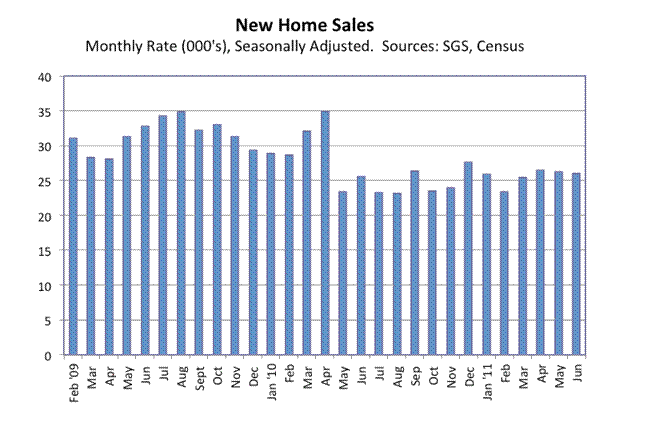
June New Home Sales Showed Ongoing Bottom-Bouncing. Consistent the long-term trends in housing starts and existing home sales (See Commentary No. 382 for June details), the July 26th release of June new-home sales (counted based on contract signings, Census Bureau) showed an ongoing pattern of bottom-bouncing near historic lows, with a statistically-insignificant monthly decline of 1.0% (down 2.2% before prior-period revisions) +/- 14.6% (95% confidence interval) from May. May’s decline was revised to 3.4% (previously down by 2.1%) against April. The year-to-year gain in June 2011 new-home sales was a statistically-insignificant 1.6% +/- 16.5% (95% confidence interval), versus a revised 12.1% (previously 13.5%) annual May gain.
The high volatility in annual change is due to the lapsing of stimulus effects a year ago. As with existing home sales, part of the new sales volume is due to foreclosure activity, but the Census Bureau does not provide an estimate of foreclosure volume.
Week Ahead. Though still not widely acknowledged, there is both an intensifying double-dip recession and a rapidly escalating inflation problem. Until such time as financial-market expectations fully catch up with underlying reality, reporting generally will continue to show higher-than-expected inflation and weaker-than-expected economic results in the month and months ahead. Generally, previously unreported economic weakness should show up in prior-period revisions.
Unemployment Rate and Payroll Employment (July 2011). Nonfarm payrolls and the unemployment rates published in recent months have indicated slowing economic activity and have disappointed generally overly-optimistic consensus forecasts. That pattern should repeat itself in the reporting for July, due for release on Friday, August 5th. Payrolls are at risk of showing an outright monthly contraction, with the unemployment rate notching higher once again. As seen also in recent months, any reporting in the other direction likely still would include a payroll contraction and higher unemployment rate within the 95% statistical reporting confidence intervals (+/- 129,000 for payroll change, +/- 0.2% for the unemployment rate). As has been the case for some time, unstable seasonal adjustments can distort the reported monthly changes in these series meaningfully.
__________