


No. 432: First-Quarter 2012 GDP

COMMENTARY NUMBER 432
First-Quarter 2012 GDP
April 27, 2012
__________
First-Quarter GDP Growth Not Statistically Significant
Recovery Is an Illusion Created by Use of Artificially-Low Inflation
__________
PLEASE NOTE: The next regular Commentary is scheduled for Monday, April 30th covering the March 2012 PCE deflator and the annual benchmark revision to the retail sales series. A subsequent Commentary on Friday May 4th will cover April employment and unemployment, along with March construction spending.
PUBLIC COMMENT ON INFLATION MEASUREMENT. Within the next week, we will post a Public Comment on Inflation Measurement, offering a review of the issues surrounding the U.S. government’s estimates of inflation, and the rationale and methodology behind the SGS-Alternate CPI Measures and inflation-corrected economic series. Details will include how academic theory was used by politicians as cover for changing the concept of the cost of living of maintaining a “constant standard of living” to a much different “constant level of satisfaction”—with resulting reductions in reported inflation—and how the SGS Alternate-CPI Measures are derived from the Bureau of Labor Statistics’ own estimates of the effects on reported inflation of various methodological changes implemented in the last several decades.
Best wishes to all — John Williams
Opening Comments and Executive Summary. The illusion of an economic recovery continued with today’s (April 27th) headline report of 2.2% growth in first-quarter gross domestic product (GDP). Although the latest uptick in the economy was at a softer pace than in the prior quarter, official reporting now shows that GDP activity has moved successively higher—above the peak level of activity estimated for before the 2007 recession—since third-quarter 2011. Yet, no other major economic series has confirmed that pattern. If the GDP data were meaningful, that circumstance would be nearly impossible.
Indeed, the “recovery” is an illusion that has been created as a direct result of methodological changes in government inflation reporting of recent decades. Those methodological changes have resulted in an artificial lowering of official rates of inflation. As shown in Special Commentary No. 426, Special Commentary No. 429 and in the ensuing Commentaries No. 430 and No. 431, the faux growth problem is in the use of understated inflation estimates in deflating a number of economic series.
Major economic series that have no underlying pricing base—such as housing starts, payroll employment and consumer confidence—correspondingly do not require inflation adjustment to put them on a consistent theoretical basis with the concept of real (inflation-adjusted) GDP. Those series confirm a history of business activity in recent years that shows a plunge in the economy from 2006/2007 into late-2008/mid-2009, followed by a period of protracted, low-level stagnation, or bottom-bouncing, instead of a “recovery.”
Major economic series that have some underlying pricing base—such as GDP, retail sales, industrial production, new orders for durable goods and household income have shown more of a recovery, but not a full one. Even so, the durable goods and income series show the non-recovery pattern using just official inflation numbers. Once adjusted for inflation distortions—inflation corrected—the other series, including the GDP (see graphs that follow), become consistent with other reporting. They reflect the historical pattern of economic activity seen otherwise in the payroll and housing numbers.
Official GDP reporting. In terms of official reporting, however, headline growth for first-quarter 2012 GDP slowed to 2.2% from 3.0% in the fourth-quarter. While the gain in the “advance” estimate was not statistically significant, the related detail reflected unsustainable growth in automobile consumption and production, and continued (but slowing) inventory build-up; a gain in residential but fall-off in commercial construction; neutral trade-deficit impact; and declining defense spending. Even with the slowing inventory accumulation, final sales (GDP net of inventory change) showed first-quarter growth of 1.61%, versus the 2.2% headline number. An involuntary build-up of inventories usually is followed by a corrective pullback in production. March industrial production suggested such a pullback.
The annualized GDP inflation rate (implicit price deflator—IPD) for the first-quarter was estimated at a 1.5%, up versus the 0.9% in the fourth-quarter, with year-to-year inflation of 1.9% for the first-quarter, versus 2.2% in the fourth-quarter. The pattern of inflation change was consistent with, but at much lower levels than CPI reporting.
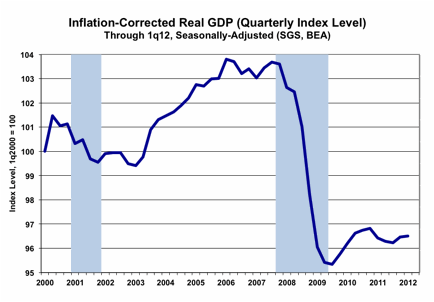
Official and Inflation-Corrected GDP Graphs. Following are two graphs reflecting the latest GDP information. The first graph shows the real GDP level, as deflated by the official IPD. Note the recent recovery of activity versus pre-recession levels. The second graph is inflation-corrected. It is the same as the first graph, but the IPD has been adjusted to add back roughly two-percentage points of annual inflation estimated to have been lost due to methodological changes of recent decades. The differences here will be discussed in the upcoming Public Comment on Inflation Measurement.

Hyperinflation Watch. The weaker-than-expected initial growth estimate for first-quarter GDP rounds out a month of indicators showing increasingly soft economic activity. The economy has not recovered from its multi-year plunge in activity from 2006/2007 into late-2008/mid-2009. The recent reporting of some economic gains largely has been an illusion, tied to the effects of underestimated inflation.
As previously noted, the U.S. consumer does not have the ability to sustain growth in personal consumption expenditures (71% of GDP), due to structural problems with household income and debt. Accordingly, there is no recovery underway or likely in the near future.
Underlying economic reality does not have positive implications for the system. Ongoing economic stagnation and renewed contraction will mean much-worse-than-anticipated federal budget deficits, U.S. Treasury funding needs and banking-system solvency issues. Despite current protestations to the contrary, the Fed likely will be forced into a new round of easing in an effort to support the still-faltering banking system. As has been the case in recent years, though, any action here again should be under the cover of attempting to stimulate the economy. Any such action also likely will provide a trigger for heavy selling of the U.S. dollar and upside pressure on domestic inflation.
In the context of the updated economic background published in Special Commentary No. 426 and Special Commentary No. 429 on consumer liquidity, and with full consideration to other intervening economic, inflation and financial-market developments since the January 25, 2012 publication of the hyperinflation report, the broad economic, inflation and hyperinflation outlooks discussed in Hyperinflation 2012 have not changed.
__________
REPORTING DETAIL
GROSS DOMESTIC PRODUCT—GDP (First-Quarter 2012, First or “Advance” Estimate)
GDP-Related Definitions. For purposes of clarity and the use of simplified language in the following text, here are definitions of key terms used related to GDP reporting: "Gross Domestic Product (GDP)" is the headline number and the most widely followed broad measure of U.S. economic activity. It is published quarterly by the Bureau of Economic Analysis (BEA), with two successive monthly revisions and with an annual revision the following July. "Gross Domestic Income (GDI)" is the theoretical equivalent to the GDP, but it is not followed by the popular press. Where GDP reflects the consumption side of the economy and GDI reflects the offsetting income side. When the series estimates do not equal each other, which almost always is the case, the difference is added to or subtracted from the GDI as a "statistical discrepancy." Although the BEA touts the GDP as the more accurate measure, the GDI is relatively free of the monthly political targeting the GDP goes through. "Gross National Product (GNP)" is the broadest measure of the U.S. economy published by the BEA. Once the headline number, now it rarely is followed by the popular media. GDP is the GNP net of trade in factor income (interest and dividend payments). GNP growth usually is weaker than GDP growth for net-debtor nations. Games played with money flows between the United States and the rest of the world tend to mute that impact on the reporting of U.S. GDP growth. "Real" means growth has been adjusted for inflation. "Nominal" means growth or level has not been adjusted for inflation. This is the way a business normally records revenues or an individual views day-to-day income and expenses. "
GDP Implicit Price Deflator (IPD)" is the inflation measure used to convert GDP data from nominal to real. The adjusted numbers are based on "Chained 2005 Dollars," at present, where the 2005 is the base year for inflation, and "chained" refers to the methodology which gimmicks the reported numbers so much that the total of the deflated GDP sub-series misses the total of the deflated total GDP series by nearly $40 billion in "residual" as of second-quarter 2010.
"Quarterly growth," unless otherwise stated, is in terms of seasonally-adjusted, annualized quarter-to-quarter growth, i.e., the growth rate of one quarter over the prior quarter, raised to the fourth power, a compounded annual rate of growth. While some might annualize a quarterly growth rate by multiplying it by four, the BEA uses the compounding method, raising the quarterly growth rate to the fourth power. So a one percent quarterly growth rate annualizes to 1.01 x 1.01 x 1.01 x 1.01 = 1.0406 or 4.1%, instead of 4 x 1% = 4%. "Annual growth" refers to the year-to-year change of the referenced period versus the same period the year before.
As discussed in the Opening Comments and Executive Summary section and in Hyperinflation 2012, the “recovery” is an illusion created by the use of understated inflation in deflating key dollar-denominated series, such as the GDP. The lower the rate of inflation that is used for the deflator, the stronger is the reported inflation-adjusted growth.
Consistent with this regular overstatement of broad economic activity by the Bureau of Economic Analysis (BEA), the GDP series remains the most worthless and the most heavily politicized of the government’s popularly followed economic reports.
The official numbers all are subject to annual revisions scheduled for July 27th. Downside restatements are likely for historical GDP reporting back through the first-quarter 2009, which is as far back as the revisions are due to go, at present.
GDP. Published this morning, April 27th, by the BEA, the “advance” or first estimate of first-quarter 2012 gross domestic product (GDP) showed real (inflation-adjusted) quarterly growth at a statistically-insignificant 2.20% +/- 3% (95% confidence interval), down from the 2.95% last reported for fourth-quarter 2011. For each of the five quarters since first-quarter 2011, estimated growth rates have been little more than statistical noise around the unchanged level, and these heavily guessed-at numbers possibly have been massaged to keep the quarterly growth rates in minimally-positive, as opposed to minimally-negative territory.The first-quarter growth estimate reflected unsustainable growth in automobile production and continued (but slowing) inventory build-up, a gain in residential but fall-off in commercial construction, neutral trade-deficit impact, and declining defense spending. Net of inventory changes, the final sales category showed first quarter growth of 1.61%, versus 1.14% final sales growth in the fourth-quarter. An involuntary build-up of inventories usually is followed by a corrective pullback in production, and March industrial production suggested that such a pullback could be underway.
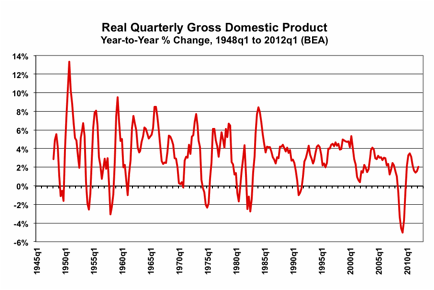
As shown in the following graph, the year-to-year real change in first-quarter 2012 GDP was 2.08%, up from 1.61% currently estimated for fourth-quarter 2011. The relative pick-up in annual growth is against a first-quarter 2011 number that was virtually flat. Current annual growth continued well off the near-term peak growth of 3.51% reported during third-quarter 2010. Again, all these numbers likely will revise to the downside in the upcoming July 27th annual revisions.
Implicit Price Deflator (IPD) and PCE Deflator. The first-quarter 2012 GDP implicit price deflator (IPD) was estimated at a 1.53% annualized quarterly rate, up versus the 0.85% reported for the fourth-quarter, with year-to-year inflation of 1.88% indicated for the first-quarter, versus 2.18% in the fourth-quarter.
For comparison purposes, annualized seasonally-adjusted quarterly inflation for the CPI-U in the first-quarter was 2.48%, versus 1.30% in the fourth-quarter, with year-to-year CPI-U at 2.82% in the first-quarter, versus 3.29% in the fourth-quarter.
For the first-quarter, the personal consumption expenditures (PCE) deflator rose at an annualized pace of 2.39%, up by 2.30% year-to-year and above the Fed’s 2.0% target. The fourth-quarter PCE deflator rose at an annualized pace of 1.17%, up by 2.67% year-to-year. The detail for March 2012 will be released on Monday (April 30th) and covered in the regular Commentary of that date.
The lower the inflation rate that is used in deflating the GDP, the stronger is the resulting inflation-adjusted number and vice versa. Inconsistencies in the BEA’s recent handling of the Bureau of Labor Statistics’ revisions to CPI seasonal adjustments (discussed in Commentary No. 421), promise revamped deflators in the upcoming July 27th annual revisions.
SGS-Alternate GDP. The SGS-Alternate GDP estimate for first-quarter 2012 is an approximate annual contraction of 2.2% versus the official estimate of a 2.1% gain. Such is less-negative than the alternate 2.7% annual contraction estimate (1.6% official gain) for the fourth-quarter (see the Alternate Data tab). While annualized real quarterly growth is not estimated formally on an alternate basis, a quarter-to-quarter contraction once again appears to have been a realistic possibility for the first-quarter, as it has been for the last five quarters, a period of protracted business bottom-bouncing in the real world.
Adjusted for gimmicked inflation and other methodological changes, the business downturn that began in 2006/2007 is ongoing; there has been no meaningful economic rebound. The inflation-corrected GDP graph (see the Opening Comments and Executive Summary section and Hyperinflation 2012) is based on the removal of the impact of hedonic quality adjustments that have reduced the reporting of annual GDP inflation by roughly two-percentage points. It is not the same measure as the SGS-Alternate GDP, which reflects the impact of reversing additional methodological distortions of recent decades.
GDI and GDP. Due to the poor quality and incompleteness of early survey data and guesstimates, the BEA will not publish estimates on first-quarter 2012 gross domestic income (GDI) or gross national product (GNP), until next month. The BEA would do well also—as a regular practice—to delay its GDP estimate by a month or two, rather than to mislead the public with particularly poor-quality early reporting that has no no more meaningful than consensus estimates. GDI is the income-side reporting equivalent of the consumption-side GDP. GNP is the broadest measure of U.S. economic activity, where GDP is GNP net of trade in factor-income, or interest and dividend payments.
Week Ahead. Recognition of an intensifying double-dip recession as well as an escalating inflation problem remains sporadic. The political system would like to see the issues disappear until after the election; the media does its best to avoid publicizing unhappy economic news; and the financial markets will do their best to avoid recognition of the problems for as long as possible, problems that have horrendous implications for the markets and for systemic stability.
Until such time as financial-market expectations move to catch up fully with underlying reality, or underlying reality catches up with the markets, reporting generally will continue to show higher-than-expected inflation and weaker-than-expected economic results in the months and year ahead. Increasingly, previously unreported economic weakness should show up in prior-period revisions.
Personal Consumption Expenditure (PCE) Deflator (March 2012). The initial guesstimate for the March PCE deflator is scheduled for release on Monday, April 30th. Once again, the Federal Reserve’s newly targeted inflation measure likely will exceed the 2.0% annual growth target. As discussed previously, the current concept of an inflation target serves only as pabulum for the financial markets, not as a defining priority that drives Fed policy.
Retail Sales (Annual Benchmark Revision). Due for release on Monday, April 30th, the annual benchmark revision to retail sales likely will show weaker growth in recent years, particularly in 2010, the year for which new hard data will be available.
Construction Spending (March 2012). Due for release on Tuesday, May 1st, the March reporting of construction spending likely will continue to show ongoing patterns of bottom-bouncing at low levels of activity for the series, particularly after inflation-adjustment. Monthly changes likely will not be statistically meaningful.
Employment and Unemployment (April 2012). April labor data are due for release on Friday, May 4th. The early expectation for April payroll employment is 193,000, up from the initial reporting of a 120,000 gain in March, with the headline unemployment rate for April expected to hold at 8.2%, the same level as reported for March, per MarketWatch.com. Check for an updated outlook in this section of the upcoming April 30th Commentary.
April labor data likely will disappoint expectations. Aside from ongoing underlying weakness in related economic fundamentals, these series also are due for some further catch up from what appears to have been an unusually positive spin given to the data in recent months by questionable seasonal factors.
__________