


No. 433: Retail Sales Benchmark, March PCE Deflator, Systemic Stress

COMMENTARY NUMBER 433
Retail Sales Benchmark, March PCE Deflator, Systemic Stress
April 30, 2012
__________
Retail Sales Benchmark Revision Showed Weaker Historical Growth
March PCE Deflator Closer to Fed’s Target
Indications of Intensifying Systemic Stress
__________
PLEASE NOTE: The next regular Commentary is scheduled for Friday, May 4th, and will cover April employment and unemployment, along with March construction spending and April money supply. Prior to the labor data release on Friday, we plan an update on several topics, including the promised extended background material on the BLS’s seasonal-adjustment modeling of payroll employment.
PUBLIC COMMENT ON INFLATION MEASUREMENT. Also by the end of this week, we will post the Public Comment on Inflation Measurement, offering a review of the issues surrounding the U.S. government’s estimates of inflation, and the rationale and methodology behind the SGS-Alternate CPI Measures and inflation-corrected economic series. Details will include how academic theory was used by politicians as cover for changing the concept of the cost of living of maintaining a “constant standard of living” to a much different “constant level of satisfaction”—with resulting reductions in reported inflation—and how the SGS Alternate-CPI Measures are derived from the Bureau of Labor Statistics’ own estimates of the effects on reported inflation of various methodological changes implemented in the last several decades.
Best wishes to all — John Williams
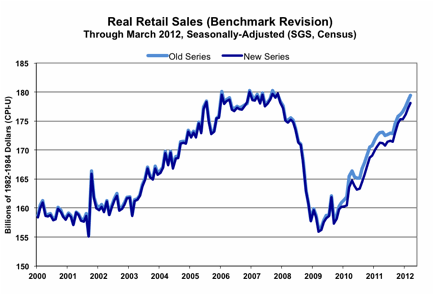
Opening Comments and Executive Summary. The Census Bureau published its annual revisions to the retail sales data this morning, April 30th, showing a downside revision of roughly 1.1% to the level of sales previously reported in 2010, where new hard data were available. In more recent reporting, where no new significant data were available, the ongoing, underlying happy assumptions offset some of the downside indicated by the harder numbers. This pattern has repeated itself year-after-year.
In conjunction with the minor downside benchmark revisions to industrial production, the retail sales restatement would favor downside revisions to historical GDP growth in the upcoming annual revisions on July 27th. That would mute the current official “recovery” a little bit.
Accordingly, the revised retail sales data show a slightly less-robust upturn in recent reporting, as indicated in the following graphs. The first graph shows the revised series (dark line) versus the old series, since 2000 (downside revisions were published for the full historical series, back to 1992). The second graph reflects the current and the prior (now discontinued) retail sales series since the end of World War II. All the data in the second graph are as revised.
The third graph reflects the real (inflation-adjusted by the CPI-U) retail sales series—of the first two graphs—corrected for inflation understatement from methodological shifts in the inflation series since 1990. This was discussed in Hyperinflation 2012 and most recently in Special Commentary No. 429.


Hyperinflation Watch—Systemic Stress. As the weakening trend in M3 growth (SGS-Ongoing M3 Estimate) begins to lock-in for April, systemic stress appears to be increasing. A new indicator of stress in the banking system will be introduced with the May 4th Commentary, along with formal indications of money supply changes in April.
Otherwise, in the context of the updated economic background published in Special Commentary No. 426 and Special Commentary No. 429 on consumer liquidity, and with full consideration to other intervening economic, inflation and financial-market developments since the January 25, 2012 publication of the hyperinflation report, the broad economic, inflation and hyperinflation outlooks discussed in Hyperinflation 2012 have not changed.
__________
REPORTING DETAIL
PERSONAL CONSUMPTION EXPENDITURE (PCE) DEFLATOR (March 2012)
March PCE Deflator Rose by 0.2% in the Month, with Year-to-Year Inflation at 2.1%. As reported today, April 30th, by the Bureau of Economic Analysis (BEA), the month-to-month change in the seasonally-adjusted March 2012 PCE deflator was a gain of 0.21% (up 0.20% net of prior period revisions), versus a revised gain of 0.32% (previously 0.34%) in February. Year-to-year inflation was 2.14% in March, versus an unrevised 2.34% in February.
The slowing in annual PCE deflator growth to 2.1% in March was just a notch above the Fed’s formal 2.0% target. Near-target reporting, however, should not become a protracted pattern.
Following in the gimmicked reporting of its quarterly GDP parent series, the monthly PCE deflator can vary widely month-to-month, thanks to prior-period revisions. Unlike the CPI-U series, which never is revised on a not-seasonally-adjusted basis so that the reported year-to-year inflation always remains fixed—the PCE deflator always is seasonally adjusted, it isn’t even estimated on an unadjusted basis.
In theory the PCE deflator measure should be virtually identical to the chain-weighted-CPI (C-CPI-U) (see Commentary No. 428 for details of the latest C-CPI-U and other inflation measures). The March 2012 PCE deflator showed 2.1% year-to-year inflation, versus an unrevised 2.3% in February; with the March C-CPI-U at 2.4%, versus 2.6% in February; March CPI-U at 2.7%, versus 2.9% in February; March CPI-W at 2.9%, versus 3.1% in February; and the March SGS-Alternate (1980-Base) at 10.3%, versus 10.5% in February.
As noted in Commentary No. 432, the first-quarter 2012 PCE deflator rose at an annualized pace of 2.39%, up by 2.30% year-to-year and above the Fed’s 2.0% target. The fourth-quarter PCE deflator rose at an annualized pace of 1.17%, up by 2.67% year-to-year.
Instead of suggesting a boost in interest rates, which would be a normal response with inflation running above the 2.0% target, the Fed keeps promising low interest rates into the foreseeable future, along with repetitive suggestions of possible renewed purchases of U.S. Treasury debt, actions that run counter to containing inflation. This “inflation targeting” effort primarily is pabulum for those in the markets who think the Fed really would move to contain inflation at the cost of impairing already-fragile banking-system solvency. The Fed’s primary function remains keeping the banking system afloat, at any cost.
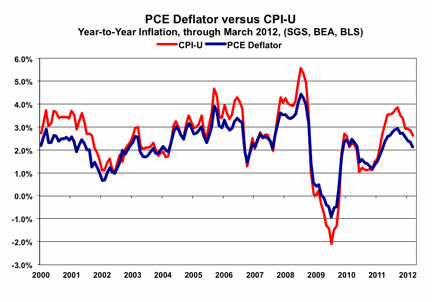

NOTE: The PCE deflator is the heavily massaged and modeled inflation rate for personal consumption expenditure, published on a monthly basis by the Bureau of Economic Analysis (BEA), and quarterly as part of the GDP release. The monthly series, which is a surrogate measure of consumer inflation—fully substitution and hedonic-based—currently is yielding the lowest annual consumer inflation rate of the major series (see the preceding graphs of the PCE deflator versus the CPI-U and the C-CPI-U. Unlike the more widely followed CPI-U measure, which never is revised and is published on a seasonally unadjusted-basis, the PCE deflator is heavily revised for many years following initial reporting, and it is available only on a heavily-massaged, seasonally-adjusted basis.
Week Ahead. Recognition of an intensifying double-dip recession as well as an escalating inflation problem remains sporadic. The political system would like to see the issues disappear until after the election; the media does its best to avoid publicizing unhappy economic news; and the financial markets will do their best to avoid recognition of the problems for as long as possible, problems that have horrendous implications for the markets and for systemic stability.
Until such time as financial-market expectations move to catch up fully with underlying reality, or underlying reality catches up with the markets, reporting generally will continue to show higher-than-expected inflation and weaker-than-expected economic results in the months and year ahead. Increasingly, previously unreported economic weakness should show up in prior-period revisions.
Construction Spending (March 2012). Due for release on Tuesday, May 1st, the March reporting of construction spending likely will continue to show ongoing patterns of bottom-bouncing at low levels of activity for the series, particularly after inflation-adjustment. Monthly changes likely will not be statistically meaningful.
UPDATE: Employment and Unemployment (April 2012). April labor data are due for release on Friday, May 4th. The expectations appear to have softened for April payroll employment to around 165,000, from an early estimate of 193,000 (MarketWatch.com), but up from the initial reporting of a 120,000 gain in March, with the headline unemployment rate for April expected to hold at 8.2%, the same level as reported for March (MarketWatch.com).
The revised consensus has moved much closer to the trend indication that comes out of the BLS’s seasonal-adjustment model. As discussed in Commentary No. 227, the trend number for the April payroll employment gain dropped to 152,000 from 182,000, subsequent to the release of the March payroll estimates published on April 6th.
Nonetheless, April labor data likely will disappoint expectations. Aside from ongoing underlying weakness in related economic fundamentals, these series also are due for some further catch up from what appears to have been an unusually positive spin given to the data in recent months by questionable seasonal factors.
__________