


No. 462: June Trade Balance, Consumer Credit

COMMENTARY NUMBER 462
June Trade Balance, Consumer Credit
August 9, 2012
__________
Bernanke Bemoans GDP Not Reflecting Common Experience
Trade Data Place Upside Pressure on Second-Quarter GDP Revision
Consumer Credit Growth Remains All in Student Loans
__________
PLEASE NOTE: The next regular Commentary is scheduled for Tuesday, August 14th, covering July 2012 retail sales and PPI. Ensuing Commentaries on August 15th and 16th will cover July 2012 CPI and industrial production, and housing starts, respectively.
Best wishes to all — John Williams
Opening Comments and Executive Summary. Federal Reserve Chairman Ben Bernanke likely has deep understanding of the woes besetting the U.S. economy and financial system. There just is little that the Federal Reserve can do to stimulate the economy or to resolve the systemic-solvency crisis. As head of the U.S. central bank, he also faces practical constraints on being able to talk openly about just how bad the economic and solvency crises are, for fear of roiling the financial markets.
Nonetheless, in an August 6th address to the International Association for Research in Income and Wealth, Mr. Bernanke went so far as to opine that “aggregate measures,” such as GDP, do not reflect common experience. Specifically, he noted that, “Exclusive attention to aggregate numbers [such as GDP] is likely to paint an incomplete picture of what many individuals are experiencing.” In more complete context:
“In the tradition of national income accounting, economic policymakers have typically focused on variables such as income, wealth, and consumption. The Federal Reserve has a statutory mandate to foster maximum employment and price stability, which motivates our extensive efforts to monitor and forecast measures of employment and inflation. Substantial research and the development of data collection infrastructures have, over the years, greatly enhanced our ability to receive timely and accurate measures of those variables. Aggregate measures, such as gross domestic product and personal consumption expenditures, are useful for monitoring people’s ability to meet basic material needs and for tracking cyclical and secular changes in the economy as a whole. Indeed, the experience of the recent financial crisis and the ensuing recession was strongly reflected in nearly all of these aggregate measures, indicating the severe economic stress felt by millions of people and hundreds of communities across the country.
“But, as many of you will discuss this week, aggregate statistics can sometimes mask important information. For example, even though some key aggregate metrics—including consumer spending, disposable income, household net worth, and debt service payments—have moved in the direction of recovery, it is clear that many individuals and households continue to struggle with difficult economic and financial conditions. Exclusive attention to aggregate numbers is likely to paint an incomplete picture of what many individuals are experiencing. One implication is that we should increase the attention paid to microeconomic data, which better capture the diversity of experience across households and firms. Another implication, however, is that we should seek better and more-direct measurements of economic well-being, the ultimate objective of our policy decisions.”
I agree with the Fed Chairman that the official, broad economic series do not reflect real-world activity as experienced by the average individual. The full depth and length of the economic collapse, however, also have not been fully reflected in headline reporting. If the Fed would like to understand why the popularly-followed broad economic series do not reflect common experience, it needs to look no further than how inflation is being handled in deflating those measures. The use of understated inflation in deflating the GDP, for example, produces overstated real (inflation-adjusted) GDP growth.
As discussed recently in Commentary No. 459, Special Report No. 445 and Hyperinflation 2012, the economic “recovery” has been nothing more than an illusion created by the use of understated inflation.
June Trade Deficit. The June 2012 trade deficit in goods and services narrowed sharply to $42.9 billion, from a revised $48.0 (previously $48.7) billion in May, and it narrowed versus a $50.3 billion deficit in June 2011. The smaller monthly deficit reflected an increase in exports and large drop in imports, with the import decline primarily reflecting a 7.2% monthly decline in oil import prices.
Today’s (August 9th) trade estimate showed a reversal of pattern in the widening or narrowing of the real (inflation-adjusted) second-quarter trade deficit versus first-quarter trade deficit. The pattern reversal has taken what had been a negative factor in initial second-quarter GDP reporting and made it a positive factor. In isolation—assuming no other revisions—the effect would be an upside first-revision to the second-quarter GDP on August 29th.
The real deficit in merchandise trade now has narrowed in the second-quarter 2012 versus the first-quarter, an economic positive. That pattern reflects just-published revisions as well as full trade reporting for the quarter. With just April and May data available for estimating the “advance” version of the second-quarter 2012 trade and GDP, that earlier “advance” trade deficit was estimated to have widened—not narrowed—a net negative for the initial GDP estimate.
June Consumer Credit Outstanding. As noted last month, we do not regularly report on consumer credit outstanding, other than as a usual part of the analysis of consumer liquidity (an update follows next week). Reporting quality for the credit series is poor, as evidenced by the frequent, major revisions to the series, as seen with many of the other financial-system reports published by the Federal Reserve.
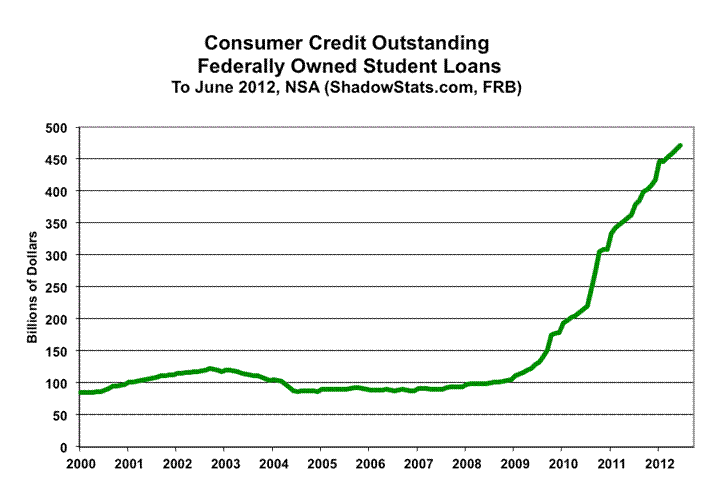
As discussed frequently (see Hyperinflation 2012 for example), and as shown in the following graphs, the highly touted (now-slowing) surge in consumer credit outstanding, since mid-2010, is dominated by the explosive growth in federal government holdings of student loans. Net of that factor, consumer credit outstanding has been stagnant, holding near the low of the current cycle.

Hyperinflation Watch—General Outlook Unchanged. General circumstances have not changed, with the detail in Special Report No. 445 (June 12th) having updated the hyperinflation outlook and the outlook for U.S. economic, U.S. dollar, and systemic-solvency conditions. That Special Report supplemented Hyperinflation 2012 (January 25th), which remains the primary Commentary detailing the hyperinflation story. The following text is the same as provided in recent Commentaries.
Official GDP reporting shows plunging economic activity from fourth-quarter 2007 to second-quarter 2009, with an ensuing upturn in activity that led to a full recovery as of fourth-quarter 2011, and that “recovery” has continued through initial second-quarter 2012 reporting.
In contrast to GDP reporting—and in line with patterns seen in better-quality economic series—I still contend that the economy began turning down in 2006, plunging in 2008 into 2009 and subsequently stagnating—bottom-bouncing—at a low level of activity, ever since. There has been no recovery since mid-2009, and the economic downturn now is intensifying once again. The renewed slowdown is evident in the current reporting of nearly all major economic series. Not one of those series shows a pattern of activity that confirms the recovery evident in the GDP series.
As shown in Commentary No. 459, the official recovery simply is a statistical illusion created by the government’s use of understated inflation in deflating the GDP, which has the result of overstating economic growth (see also Special Report No. 445).
The long-term fiscal solvency issues of the United States—where GAAP-based accounting shows annual deficits running in the $5 trillion range—are not being addressed, and the politicians currently running the government lack the political will to address those issues. That circumstance initially suggested a hyperinflation crisis by the end of this decade, but federal government and Federal Reserve actions—in response to the systemic-solvency crisis of 2008—accelerated the process, indicating a hyperinflation problem by no later than the end of 2014. The continuing economic downturn is intensifying the fiscal- and systemic-solvency problems.
Neither economic nor systemic-solvency issues have been resolved by U.S. government or Federal Reserve actions. With the economy weak enough to provide cover for further Fed accommodation to the still-struggling banking system, the next easing by the Fed—and it should follow as needed to support the banking system—likely will lead to a massive dollar-selling crisis and that will begin the process of a rapid upturn in domestic consumer inflation.
__________
REPORTING DETAIL
U.S. TRADE BALANCE (June 2012)
Narrowing of June Trade Deficit Reflected Lower Oil Prices; Second-Quarter Trade Deficit Offers Upside Pressure on Pending GDP Revision. The headline June trade deficit narrowed sharply versus May, which had narrowed minimally versus April. The reporting of the narrowed deficit was dominated by a decline in imports, which, in turn, was dominated by declining oil prices. Even with inflation adjustment, however, the full second-quarter deficit now has narrowed versus the first-quarter, where the second-quarter deficit had been indicated initially as widening, based on the incomplete data of two months used for the “advance” estimate of second-quarter GDP.
Where the initial widening of the quarterly deficit subtracted from GDP growth, the narrowing deficit now should flip the impact of the trade data to the plus-side, putting upside pressure on the first-revision to second-quarter GDP, due for release on August 29th.
Nominal (Not-Adjusted-for-Inflation) Trade Deficit. The Bureau of Economic Analysis (BEA) and the Census Bureau reported Thursday (August 9th) that the nominal, seasonally-adjusted monthly trade deficit in goods and services for June 2012, on a balance of payments basis, narrowed to $42.9 billion from a revised $48.0 (previously $48.7) billion in May and from $50.6 billion in April. The June 2012 deficit also narrowed from a $50.3 billion deficit in June 2011.
Against the revised May detail, the seasonally-adjusted June 2012 trade balance reflected a higher level of exports and a lower level of imports. Seasonally-adjusted petroleum-based imports dominated the sharp downturn in imports, reflecting a decline in oil prices and minimal changes in unadjusted physical oil import volume.
Crude Oil and Energy-Related Petroleum Products. For the month of June 2012, the not-seasonally-adjusted average price of imported oil dropped to $100.13 per barrel, from $107.91 in May and $109.94 in April 2012, and it was down from $105.93 in June 2011.
In terms of not-seasonally-adjusted physical oil imports, June 2012 volume averaged 8.781 million barrels per day, versus 8.784 million in May and 9.000 million in April 2012, and it was down from 9.812 million in June 2011.
Caution on Data Quality. The standard caution here for the monthly detail is that heavy distortions likely continue in the seasonal adjustments, much as has been seen in other economic releases, such as retail sales and payrolls, where the headline number reflects month-to-month change. As has been discussed frequently (see Hyperinflation 2012 for example), the extraordinary length and depth of the current business downturn have disrupted regular seasonality patterns. Accordingly, the markets should not rely heavily on the accuracy of the monthly headline data.
Real (Inflation-Adjusted) Trade Deficit. Adjusted for seasonal factors and net of oil-price swings and other inflation (2005 chain-weighted dollars as used in reporting real GDP), the June 2012 merchandise trade deficit (no services) came in at $44.2 billion, versus a revised $47.7 (previously $48.0) in May and a revised $48.9 (previously $48.7 billion) in April. The monthly numbers were revamped back to January.
With the revisions and full second-quarter reporting in place, the annualized pace of the second-quarter 2012 trade deficit was $563.2 billion, versus an initial estimate of $579.8 billion (based on reporting for just April and May of 2012). The first-quarter estimate revised to $574.7 billion (previously $572.1).
Where the initial second-quarter deficit estimate widened versus the first-quarter, the trade effect was a reduction in second-quarter GDP growth. Now, with the second-quarter deficit reversing to a narrowing versus the first-quarter, it becomes a plus to quarterly GDP growth and, accordingly, should put upside pressure on the August 29th GDP revision.
Week Ahead. Market recognition of an intensifying double-dip recession is taking a somewhat stronger hold, at the moment, while recognition of a mounting inflation threat remains sparse. The political system would like to see the issues disappear until after the election; the media does its best to avoid publicizing unhappy economic news or to put a happy spin on the numbers; and the financial markets will do their best to avoid recognition of the problems for as long as possible, problems that have horrendous implications for the markets and for systemic stability.
Until such time as financial-market expectations catch up fully with underlying reality, or underlying reality catches up with the markets, reporting generally will continue to show higher-than-expected inflation and weaker-than-expected economic results in the months and year ahead. Increasingly, previously unreported economic weakness should show up in prior-period revisions.
Retail Sales (July 2012). Scheduled for release on Tuesday, August 14th, by the Census Bureau, headline July 2012 retail sales likely will surprise market expectations on the downside, once again, following the initial reporting of a 0.5% monthly contraction in June. Structural liquidity problems besetting the consumer should continue to cap consumption growth at a level below the pace of inflation.
With the headline July CPI-U likely to show an increase, real (adjusted-for-inflation) retail sales should contract for the month.
Producer Price Index—PPI (July 2012). The July PPI is scheduled for release on Tuesday, August 14th. Despite some seasonal-factor muting of energy inflation, a jump in oil and foods prices should keep the monthly PPI inflation in positive territory—likely above market expectations—following the 0.1% month-to-month increase reported for June.
Consumer Price Index—CPI (July 2012). The release by the Bureau of Labor Statistics of the July 2012 CPI numbers is scheduled for Wednesday, August 15th, and the headline CPI inflation rate is a fair bet to top market expectations. Despite a near-10% jump in gasoline prices in the last four-to-five weeks, unadjusted average gasoline prices fell by 2.7% in July versus June, per the Department of Energy.
July, however, traditionally has seasonal adjustments that boost adjusted gasoline inflation. Those seasonals turned an unadjusted monthly decline of 1.5% in July 2011 gasoline into a seasonally-adjusted monthly gain of 4.7%. Add in rising food inflation and higher “core” inflation (everything but food and energy), the makings are in place for an upside surprise in monthly CPI inflation.
Year-to-year total CPI-U inflation would increase or decrease in the July 2012 reporting, dependent on the seasonally-adjusted monthly change, versus the 0.30% (initially a 0.5%) gain in the adjusted monthly level reported for July 2011. I use the adjusted change here, since that is how consensus expectations are expressed. To approximate the annual unadjusted inflation rate for July 2012, the difference in July’s headline monthly change (or forecast of same) versus the year-ago monthly change should be added to or subtracted directly from the June 2012 annual inflation rate of 1.66%.
Industrial Production (July 2012). Due for release Wednesday, August 15th, by the Federal Reserve, the headline industrial production number could receive some boost from strong utility usage, reflecting the unusual heat extremes seen around the country during July. Continued building of excess automobile inventories also could be a near-term plus. Otherwise, production should have contracted in the month, as suggested by two monthly contractions (June and July) in the purchasing managers survey of manufacturing.
On balance, there is a fair risk of a downside surprise to market expectations of strong July growth in the production series, following the initial headline reporting of a 0.4% gain in June. Volatile and unstable prior-period revisions are likely to continue.
Residential Construction (July 2012). Detail on July housing starts is due for release on Thursday, August 16th, by the Census Bureau. Following a 75% plunge in activity from 2006 through 2008, the ensuing four-year pattern of housing starts stagnation—at an historically low level of activity—likely did not change in July. As has become the standard circumstance, any reported monthly gain likely would not be statistically significant.
__________