


No. 524: April Industrial Production, PPI

COMMENTARY NUMBER 524
April Industrial Production, PPI
May 15, 2013
__________
April Production Sinks Below First-Quarter 2013 Average
PPI Hit Again by Oil and Seasonal Adjustments
Overly Optimistic Assumptions Understate Budget-Deficit Problems
__________
PLEASE NOTE: The next regular Commentary is scheduled for tomorrow, Thursday, May 16th, covering the April CPI and related real retail sales and earnings, and April housing starts.
Best wishes to all — John Williams
OPENING COMMENTS AND EXECUTIVE SUMMARY
Today’s missive offers summaries and analysis of the April industrial production and PPI. The decline in April PPI reflected lower oil prices and related, constrictive seasonal adjustments, as expected. The production numbers were suggestive of renewed economic downturn. A more comprehensive assessment of April economic data will be included in tomorrow’s May 16th Commentary, which also will cover the releases of the April CPI, related real (inflation-adjusted) retail sales and earnings numbers, and April housing starts.
Budget Deficits. The U.S. economy is not in rebound, and the recent jump in April’s federal tax receipts was due to one-time distortions generated by individuals and businesses taking protective actions amid year-end 2012 tax and fiscal-policy uncertainties.
The latest estimates of reduced cash-basis federal budget deficits (e.g., $642 billion estimated for the fiscal year ended September 30, 2013) out of the Congressional Budget Office (CBO) are woefully shy on realistic underlying assumptions, economic and otherwise. The CBO estimates also have little relationship to the actual deficits based on generally accepted accounting principles (GAAP). Those issues will be addressed in a separate Commentary in the May 20th week (tentatively May 22nd).
April 2013 PPI. The headline 0.7% decline in April 2013 PPI generally was as expected, dominated again by negative seasonal-adjustment pressures on unadjusted declining energy costs. Seasonally-adjusted finished-goods PPI fell by 0.66% (down by 0.31% unadjusted) in April, following a March adjusted contraction of 0.56% (up by 0.20% unadjusted). Unadjusted and year-to-year, April’s total finished-goods PPI slowed to a 0.56% gain, versus a preliminary 1.13% gain in March.
The seasonally-adjusted 0.7% (0.3% unadjusted) decline in headline monthly inflation for the April PPI reflected an adjusted 2.5% (unadjusted 0.8%) month-to-month decline in finished energy prices, and an adjusted 0.8% (unadjusted 0.7%) month-to-month decline in food prices, along with a negligible offset by an adjusted 0.1% (unadjusted 0.1%) gain in “core” inflation.
Looking ahead, the negative seasonal adjustments to energy inflation in the PPI turn neutral in May and flip to the plus-side in June.
April 2013 Industrial Production. April production reporting was suggestive of a renewed downturn in broad economic activity. In the context of downside revisions, headline April industrial production contracted at a monthly pace of 0.54%, versus a downwardly revised 0.32% gain March. That started second-quarter 2013 production at a level below that of the first-quarter. In addition, April’s annual growth slowed to 1.95%, from a downwardly revised 3.26% gain in March. The last time that year-to-year production growth slowed to the current level (other than in January) was at the formal onset of the 2007 recession.
The 0.5% monthly decline in general production was reflected in contracting activity in most areas, other than mining. A 0.4% drop in manufacturing was mirrored in sharp declines across all major market groups, including business equipment and consumer durable goods, such as automobiles. With a return to more-normal weather, utility usage eased back by 3.7% in the month, while April mining activity rose by 0.9%.
Corrected Industrial Production. Hedonic quality adjustments understate the inflation used in calculating some components of industrial production, with the effect of overstating the inflation-adjusted growth reported in the headline industrial production series (see Special Commentary (No. 485) and Public Comment on Inflation). The two graphs following address that issue. The first reflects official industrial production reporting, indexed to January 2000 = 100, instead of the Fed’s index that is set at 2007 = 100. The 2000 indexing is used simply to provide for some consistency in this series of revamped graphics. The second graph is a corrected version of the first, with estimated hedonic-inflation adjustments backed-out of the official deflator.

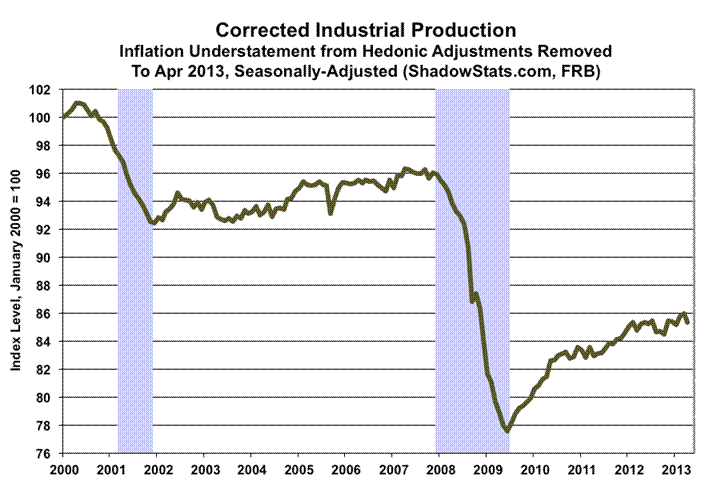
The “corrected” graph does show some growth in the period following the official June 2009 near-term trough in production activity. Yet, that upturn has been far shy of the full recovery and renewed expansion reported in official GDP estimates. Production levels have not regained pre-recession highs (even uncorrected), but, instead, entered a period of protracted low-level stagnation in 2012, with a quarterly contraction in third-quarter 2012, followed by continued stagnation and new indications of a renewed economic downturn.
[Further details on April industrial production and PPI are found in the Reporting Detail section.]
__________
HYPERINFLATION WATCH
Hyperinflation Outlook—Unchanged. This synopsis is unchanged from prior Commentary No. 522 of May 9th. The summary outlook here is intended for new subscribers and for readers looking for a condensed version of the broad overview of economic, inflation and financial circumstances, or who otherwise are not familiar with the hyperinflation report or special commentaries, linked below. Those latter documents are suggested as background reading on the financial turmoil and currency upheaval facing the United States in the next year or two.
The November 27, 2012 Special Commentary (No. 485) updated Hyperinflation 2012 and the broad outlook for the economy and inflation, as well as for systemic stability and the U.S. dollar. These remain the two primary articles outlining current conditions and the background to the hyperinflation forecast. The basics have not changed here, other than events keep moving towards the circumstance of a domestic hyperinflation by the end of 2014. Nonetheless, the next fully-updated hyperinflation report is targeted for publication in mid-to-late June, following publication in May of related underlying Special Reports, a new report on “employment/unemployment and the economy” in early-June, which will follow further updated and expanded versions of the Money Supply special report and the Public Commentary on Inflation.
Nothing is normal: not the economy, not the financial system, not the financial markets and not the political system. The system remains still in the throes and aftershocks of the 2008 panic and the near-systemic collapse, and from the ongoing responses to same by the Federal Reserve and federal government. Further panic is possible and hyperinflation is inevitable.
The economic and systemic solvency crises of the last eight years continue. There never was an actual recovery following the economic downturn that began in 2006 and collapsed into 2008 and 2009. What followed was a protracted period of business stagnation that began to turn down anew in second- and third-quarter 2012. The official recovery seen in GDP has been a statistical illusion generated by the use of understated inflation in calculating key economic series (see Commentary No. 519, and Public Comment on Inflation). Nonetheless, given the nature of official reporting, the renewed downturn likely will gain recognition as the second-dip in a double- or multiple-dip recession.
What continues to unfold in the systemic and economic crises is just an ongoing part of the 2008 turmoil. All the extraordinary actions and interventions bought a little time, but they did not resolve the various crises. That the crises continue can be seen in deteriorating economic activity and in the panicked actions by the Federal Reserve, where it still proactively is monetizing U.S. Treasury debt at a pace suggestive of a Treasury that is unable to borrow otherwise.
Before the mid-April rout in gold prices, there had been mounting hype about the Fed potentially pulling back on its “easing” and a coincident Wall Street push to talk-down gold prices. Those factors still appear to be little more than hype, designed for jawboning to support the U.S. dollar and to soften gold, in advance of the still-festering crises in the federal-budget and debt-ceiling negotiations. Despite orchestrated public calls for “prudence” by the Fed, the underlying and deteriorating financial-system and economic instabilities have self-trapped the Fed into an expanding-liquidity or easing role that likely will not be escaped until the ultimate demise of the U.S. dollar. Further complicating the circumstance for the U.S. currency is the increasing tendency of major U.S. trading partners to move away from using the dollar in international trade, such as seen most recently in the developing relationship between France and China.
The Fed’s recent and ongoing liquidity actions themselves suggest a signal of deepening problems in the financial system. Mr. Bernanke admits that the Fed can do little to stimulate the economy, but it can create systemic liquidity and inflation. Accordingly, the Fed’s continuing easing moves appear to have been primarily an effort to prop-up the banking system and also to provide back-up liquidity to the U.S. Treasury, under the political cover of a “weakening economy.” Mounting signs of intensifying domestic banking-system stress are seen in softening annual growth in the broad money supply, despite a soaring pace of annual growth in the monetary base, and in global banking-system stress, as reflected in the recent Cyprus crisis and continuing aftershocks.
Both Houses of Congress recently put forth outlines of ten-year budget proposals that are shy on detail. The ten-year plan by the Republican-controlled House proposes to balance the cash-based deficit as well as to address issues related to unfunded liabilities. The plan put forth by the Democrat-controlled Senate does not look to balance the cash-based deficit. Given continued political contentiousness and the use of unrealistically positive economic assumptions to help the budget projections along, little but gimmicked numbers and further smoke-and-mirrors are likely to come out of upcoming negotiations. With the Administration’s budget for fiscal-year 2014 released, these issues should be coming to a head very soon. The temporary suspension of the statutory federal debt limit expires May 18th, and Congressional action to raise the debt ceiling is mandatory before then, with the current (May 7th) debt more than $350 billion above that debt limit. There still appears to be no chance of a forthcoming, substantive agreement on balancing the federal deficit.
Indeed, ongoing and deepening economic woes assure that the usual budget forecasts—based on overly-optimistic economic projections—will fall far short of fiscal balance and propriety. Chances also remain nil for the government fully addressing the GAAP-based deficit that hit $6.6 trillion in 2012, let alone balancing the popularly-followed, official cash-based accounting deficit that was $1.1 trillion in 2012 (see No. 500: Special Commentary).
Efforts at delaying meaningful fiscal action, and at briefly postponing conflict over the Treasury’s debt ceiling, have bought the politicians in Washington minimal time in the global financial markets, but the time has run out and patience in the global markets is near exhaustion. The continuing unwillingness and political inability of the current government to address seriously the longer-range U.S. sovereign-solvency issues, only pushes along the regular unfolding of events that eventually will trigger a domestic hyperinflation, as discussed in Commentary No. 491.
The unfolding fiscal catastrophe, in combination with the Fed’s direct monetization of Treasury debt, eventually (more likely sooner rather than later) will savage the U.S. dollar’s exchange rate, boosting oil and gasoline prices, and boosting money supply growth and domestic U.S. inflation. Relative market tranquility likely will not last much longer, despite the tactics of delay by the politicians and obfuscation by the Federal Reserve.
This should become increasingly evident as the disgruntled global markets begin to move sustainably against the U.S. dollar. A dollar-selling panic is likely this year—of reasonably high risk in the next month or so—with its effects and aftershocks setting hyperinflation into action in 2014. Gold remains the primary and long-range hedge against the upcoming debasement of the U.S. dollar, irrespective of any near-term price gyrations in the gold market.
The rise in the price of gold in recent years was fundamental. The recent panicked sell-off in gold was not. With the underlying fundamentals of ongoing dollar-debasement in place, the upside potential for gold, in dollar terms, is limited only by its inverse relationship to the purchasing power of the U.S. dollar (eventually headed effectively to zero). Again, physical gold—held for the longer term—remains as a store of wealth, the primary hedge against the loss of U.S. dollar purchasing power.
__________
REPORTING DETAIL
INDEX OF INDUSTRIAL PRODUCTION (April 2013)
April Industrial Production Suggestive of Renewed Downturn. In the context of downside prior-period revisions, April industrial production contracted at a headline monthly pace of 0.5%. That started the second-quarter 2013 at a level below that of the first-quarter. Further, April’s annual growth slowed to a 1.9% pace. The last time year-to-year production growth slowed to that level (other than in January 2013) was at the formal onset of the 2007 recession. In this highly volatile series, the April reporting generally was consistent with a re-intensification of the economic downturn.
The 0.5% decline in general production seen in reduced activity in most areas, other than mining. A 0.4% monthly contraction in manufacturing was reflected in sharp contractions across all major market groups, including business equipment and consumer durable goods, such as automobiles. The auto contraction is reflective of industry activity, despite the contrary automobile sales gain reported in April retail sales. With a return to more-normal weather, utility usage eased back by 3.7% in the month, while April mining activity rose by 0.9%.
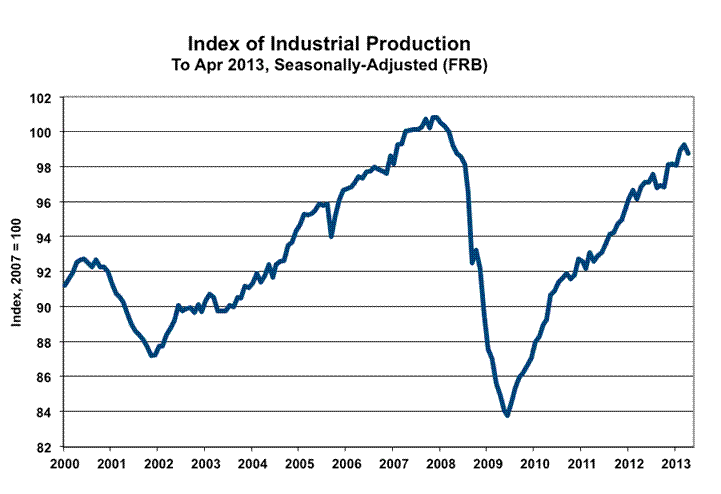
April 2013 Industrial Production. This morning’s (May 15th) Federal Reserve Board release of April 2013 industrial production activity showed a seasonally-adjusted, headline monthly contraction of 0.54% (down by 0.74% before prior-period revisions). That contraction was against a downwardly revised 0.32% (previously 0.41%) gain in March and a downwardly revised 0.91% (previously 1.06%, initially 0.75%) gain in February. Suggestive of a possible renewed contraction in broad economic activity, the April index level of 98.7 was slightly below the average level of 98.8 in first-quarter 2013.
As noted at the beginning of this section, the 0.5% headline monthly gain in aggregate production was due to a 0.4% contraction in manufacturing, a 3.7% pull back to more seasonable utility usage and a 0.9% gain in mining activity.
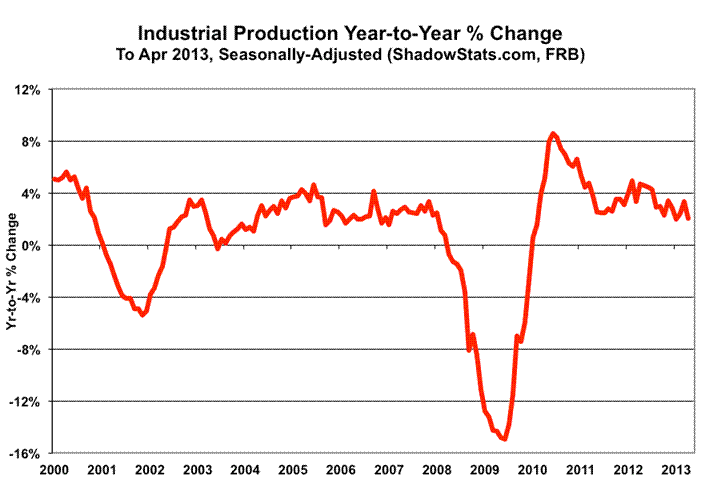
Year-to-year growth in April production slowed to 1.95% (rounds to 1.9%) from a downwardly-revised 3.26% (previously 3.47%) annual gain in March, and from a revised 2.37% (previously 2.49%, initially 2.46%) in February. The last time that year-to-year production growth slowed to current levels was at the formal onset of the 2007 recession.
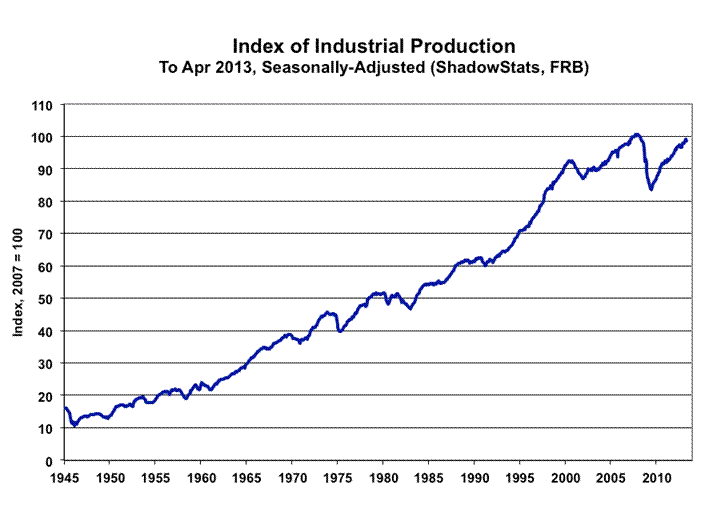
The “recovery” in industrial production is reflected in the following two sets of graphs. The first graph in the first set shows the monthly level of the production index, while second graph shows the year-to-year or annual percent change in the same series for recent historical detail in the period beginning January 2000. The second set of graphs shows the same data in historical context since World War II.
As shown more clearly in the first graph, current activity has notched lower, and annual growth has slowed to levels last seen in a slowing-growth pattern at the onset of the formal 2007 recession. Growth remains well off the recent relative peak annual growth of the series, which was 8.50% in June 2010, going against the official June 2009 trough of the economic collapse. Indeed, as shown in the second set of graphs, the year-to-year contraction of 15.02% in June 2009, at the end of second-quarter 2009, was the steepest annual decline in production since the shutdown of war-time production following World War II.
Although official production levels have moved higher since the June 2009 trough, the series still remains shy of a full recovery and appears to be turning down anew, unlike the dubious data in the GDP, which show full recovery as of fourth-quarter 2011, with renewed expansion ever since.
Corrected for the understatement of inflation used in deflating portions of the industrial production index, the series has shown more of a bottom-bouncing and recent-downturn pattern, since 2009, where it appears to have topped out coming into 2012, with a renewed downturn likely in process. The corrected production series is discussed and graphed in the Opening Comments section. Please note also that index base for those graphs showing production levels, both the corrected graph and the accompanying graph based on official reporting, is January 2000 = 100, instead of the Federal Reserve’s official 2007 = 100, used in the graphs here.

PRODUCER PRICE INDEX—PPI (April 2013)
Energy-Related Seasonals Deepened Headline PPI Contraction. As reported this morning, May 15th, by the Bureau of Labor Statistics (BLS), the regularly-volatile, seasonally-adjusted finished-goods producer price index (PPI) for April 2013 fell by 0.66% (down by 0.31% unadjusted), dominated again by negative seasonal-adjustment pressures on energy costs. That followed a March 2013 headline contraction of 0.56% (up by 0.20% unadjusted). The negative seasonal adjustments to energy inflation in the PPI turn neutral in May, next month, and flip to the plus-side in June.
The seasonally-adjusted, rounded 0.7% (0.3% unadjusted) decline in headline monthly inflation for the April 2013 PPI reflected an adjusted 2.5% (unadjusted 0.8%) month-to-month decline in finished energy prices, and an adjusted 0.8% (unadjusted 0.7%) month-to-month decline in food prices, along with a negligible offset by an adjusted 0.1% (unadjusted 0.1%) gain in “core” inflation.
Unadjusted and year-to-year, April’s total finished-goods PPI slowed to a 0.56% gain, versus a preliminary 1.13% gain in March. Annual change in the PPI has weakened on a monthly basis from a 7.08% near-term peak seen in July 2011, after which the annual numbers began going against a year-ago period, when Mr. Bernanke was running QE2, meeting with early success in debasing the U.S. Dollar and generating an increase in oil prices. QE3’s impact, so far, has just started to come into play, with the Fed’s expanded easing program having briefly put some upside pressure on oil prices.
Core Finished Goods. “Core” inflation is net of food and energy inflation. The concept of core inflation as a realistic measure of full inflation remains nonsensical, where food and energy account for 41.4% of the finished goods PPI (24.6% of the CPI-U, 27.6% of the CPI-W).
That said, the core measure, still is useful as an indication of how energy prices, in particular, are impacting the broad economy. For April 2013, the seasonally-adjusted month-to-month core PPI was up by 0.11% (up by 0.05% unadjusted), versus the March adjusted gain of 0.16% (up by 0.05% unadjusted). Year-to-year, unadjusted April core finished-goods inflation held at 1.71% for a third month. A comparison of core-PPI with core-CPI-U year-to-year growth in April will be graphed in the Reporting Detail section of tomorrow’s May 16th Commentary.
Intermediate and Crude Goods. Reflecting generally lower average oil prices and mixed seasonal-factor impact, on a month-to-month basis, seasonally-adjusted April 2013 intermediate-goods prices fell by 0.6%, following a 0.9% decline in March, while April crude-goods prices were down by 0.4%, following a 2.5% decline in March.
Year-to-year inflation in unadjusted April 2013 intermediate goods declined by 1.0%, having dropped by 0.8% in March. Year-to-year inflation in April 2013 crude goods rose by 3.1%, having declined by 0.3% in March.
__________
WEEK AHEAD
Weaker Economic and Inflation Data in the Week Ahead. Constrained by a down-month for gasoline and oil prices, which will be exacerbated by sharply-negative seasonal adjustments, tomorrow’s April 2013 consumer inflation numbers should show relatively large, seasonally-adjusted monthly contractions, but likely not as severe as the 0.7% April PPI contraction. That said, the highly irregular oil and gasoline price movements appear, once again, to be bottoming out. The distortions from increasingly irrelevant, shifting and severely-negative gasoline and oil price seasonal adjustments should continue in next month’s CPI (May) reporting, flipping to positive-side distortions in June and July’s adjusted reporting, while the PPI energy seasonal-adjustment distortions turn neutral in May and positive in June.
Beyond May, reflecting the still-likely negative impact of the continuing and expanded QE3, and the still-festering fiscal crisis/debt-ceiling negotiations on the U.S. dollar in the currency markets, reporting in the ensuing months and year generally should reflect much higher-than-expected inflation.
Where expectations for economic data in the week ahead appear to have softened, weaker-than-expected economic results still remain likely, given intensifying structural liquidity constraints on the consumer. Increasingly, previous estimates of economic activity should revise lower, particularly in upcoming annual benchmark revisions, as was seen for industrial production, and as pending for new orders for durable goods (May 17th), retail sales (May 31st), the trade deficit (June 4th), construction spending (July 1st) and the GDP (July 31st—comprehensive overhaul and redefinition back to 1929).
Reporting Quality Issues and Systemic Reporting Biases. Significant reporting-quality problems continue with most major economic series. Headline reporting issues remain tied largely to systemic distortions of seasonal adjustments. Distortions have been induced by the still-ongoing economic turmoil of the last six-to-seven years, which has been without precedent in the post-World War II era of modern economic reporting. These distortions provide particularly unstable reporting results, where concurrent seasonal adjustments are used (as with retail sales, durable goods orders, employment and unemployment data), and they have thrown into question the statistical-significance of the headline month-to-month reporting for many popular economic series.
With an increasing trend towards intensifying downside surprises in near-term economic reporting, recognition of an intensifying double-dip recession should continue to gain. Nascent concerns of a mounting inflation threat, though muted, increasingly are being rekindled by the Fed’s monetary policies. Again, though, significant inflation shocks are looming in response to the fiscal crisis and a likely, severe negative response in the global currency markets against the U.S. dollar.
The political system and Wall Street would like to see the issues disappear, and the popular media do their best to avoid publicizing unhappy economic news, putting happy spins on otherwise negative numbers. Pushing the politicians and media, the financial markets and their related spinmeisters do their best to avoid recognition of the problems for as long as possible, problems that have horrendous implications for the markets and for systemic stability, as discussed in Hyperinflation 2012, No. 485: Special Commentary and subsequent Commentaries.
Consumer Price Index—CPI (April 2013). The release by the Bureau of Labor Statistics (BLS) of the April 2013 CPI numbers is scheduled for tomorrow, Thursday, May 16th. The CPI could come in at or below the negative market consensus.
Average gasoline prices declined by 3.7% month-to-month, on a not-seasonally-adjusted basis, per the Department of Energy. As with the PPI, the BLS seasonal adjustments should push gasoline prices and other energy costs into an even steeper decline. As recently revised, an unadjusted monthly gain of 1.8% in April 2012 gasoline prices was turned to a 2.9% decline by downside seasonal adjustments. Similar effects in the April 2013 number would generate a negative 0.4-percentage-point contribution to the aggregate CPI, by itself, a contraction that appears to be below the expectations for the headline aggregate number. There should be some offsetting upside inflation pressures from food prices and core inflation.
Year-to-year, CPI-U inflation would increase or decrease in April 2013 reporting, dependent on the seasonally-adjusted monthly change, versus a reported “unchanged” monthly inflation rate in April 2012. The adjusted change is used here, since that is how consensus expectations are expressed. To approximate the annual unadjusted inflation rate for April 2013, the difference in April’s headline monthly change (or forecast of same), versus the year-ago monthly change, should be added to or subtracted directly from the March 2013 annual inflation rate of 1.47%. For example, a headline 0.3% monthly decline would reduce April annual inflation to about 1.2%.
Residential Construction (April 2013). Also, tomorrow, Thursday, May 16th, the estimate of April housing starts activity will be published by the Census Bureau. Despite market expectations of a small headline decline, reported month-to-month changes likely will continue to be statistically-insignificant, with ongoing stagnation in activity for single-unit housing starts.
In the wake of a 75% collapse in aggregate activity from 2006 through 2008, and an ensuing four-year pattern of housing starts stagnation at historically low levels, little has changed. There remains no chance of a near-term, sustainable turnaround in the housing construction market, unless there is a fundamental upturn in consumer and banking liquidity conditions. That has not happened.
New Orders for Durable Goods (Annual Benchmark Revision). On Friday, May 17th, the Commerce Department will publish the annual benchmark revision to new orders for durable goods. As usually has been the pattern with annual benchmarks, economic activity previously reported in recent years likely will be revised lower. Current ShadowStats planning is to detail those revisions, along with the April reporting of new orders for durable goods, in the Thursday, May 24th, Commentary.
__________