


No. 578: Trade Deficit, Construction Spending, New Home Sales

COMMENTARY NUMBER 578
Trade Deficit, Construction Spending, New Home Sales
December 4, 2013
__________
No Signs of a Growing Economy
Intensifying Weakness in Revised Third-Quarter Trade and Construction Data
Should Soften Third-Quarter GDP Growth
Construction Spending Falters Despite Statistically-Insignificant October Gain
New Home Sales Monthly Data Are Nonsense,
Extreme Volatility and Revisions Leave Monthly Changes Meaningless
__________
PLEASE NOTE: The next regular Commentary is scheduled for tomorrow, Thursday, December 5th covering the second estimate, first revision of third-quarter GDP, followed by a Commentary on December 6th covering November employment and unemployment numbers.
Best wishes to all — John Williams
OPENING COMMENTS AND EXECUTIVE SUMMARY
GDP Third-Quarter Growth Estimates Should Revise Lower. Irrespective of the revised headline GDP growth rate to be published tomorrow (December 5th), the economy is not growing. The latest construction and home sales data, if anything, show a period of stagnation that has shifted or is shifting to outright, renewed contraction. In like manner, the latest reporting on the trade deficit now indicates an even greater net-negative impact on third-quarter GDP growth, where the initial GDP estimate included an upside contribution from the trade sector.
The regular timing and sequencing of economic releases has been overturned temporarily by the impact of the October government shutdown, with two months of trade data released between the first and second estimates of third-quarter GDP, rather than usual one release. The initial GDP headline growth estimate of 2.8% should face some downside-revision pressure in the December 5th (tomorrow) first revision and/or the December 20th second revision. The September and October reporting of both the U.S. trade deficit and construction spending—reporting subsequent to the initial GDP headline estimate—promise negative impact on the existing GDP estimate.
Nonsense Numbers. Running counter to recent month-to-month declines in the privately-published existing-home sales, new-home sales showed a highly unlikely huge gain. Aside from some private investment in housing units, the primary buyers of new or existing homes simply are under severe structural liquidity constraints that are preventing an economic recovery, as well as a turnaround in the housing market. October new-home sales reporting simply was not credible and October construction spending was not meaningful, other than showing an ongoing trend of softening stagnation.
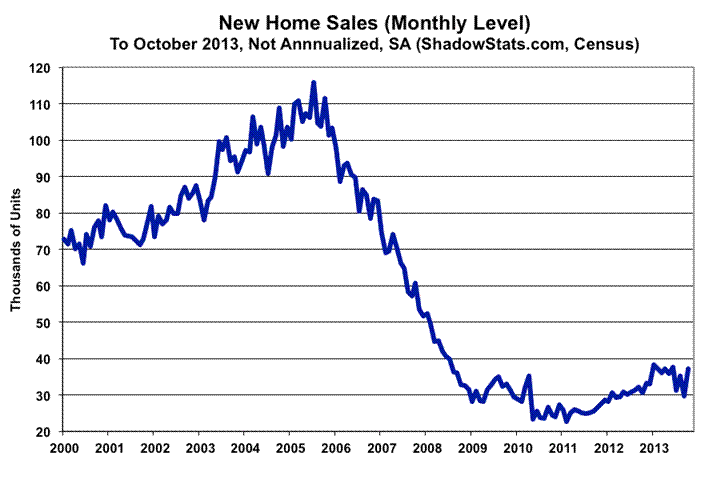
New-home sales data were particularly misleading and volatile, likely due in part to data gathering distortions and disruptions resulting from the government shutdown. Today’s (December 4th) report on October new-home sales showed a headline monthly gain of 25.4%, rising to an annualized monthly unit sales rate of 444,000. “Strongest Growth in 33-1/2 Years!” went the headlines. The monthly gain was large enough to be marginally statistically-significant (+/- 22.5% with a 95% confidence interval).
The headline October sales level almost recovered its level of four months ago. October, though, was only 5.5% above where the August number had been at the last reporting. With today’s initial estimates of September and October, and related revisions, here is what happened to the monthly reporting. August sales had been at 421,000 units, but they were revised to 379,000. September sales were reported new at an 18-month low of 354,000 (down by 15.9% from initial August reporting, and down 6.6% from the revised August number); year-to-year, September 2013 saw an annual contraction of 7.8%, versus a revised annual gain of 1.3% in August 2013, and a 21.6% annual gain for October.
Shy of an extraordinary upheaval in the economy, or other special factors, this type of volatility rarely is seen on a monthly basis, even for the highly-unstable new-home sales series. Where data problems are the most likely explanation here for the extreme volatility, using an average of the September and October sales rates for both months (399,000) makes some sense. Nonetheless, the ShadowStats graph of new home sales, seen at the end of this section, shows the headline numbers as published. Revisions that accompany the November reporting will be interesting.
Similar distortions were seen with construction spending, but the monthly headline changes, with lower volatility, never got close to the level of being statistically-significant. The headline monthly gain in October construction spending was an statistically-insignificant 0.8%, which followed a 0.3% decline in September spending. That sounds good for October at an annualized monthly rate of $908.4 billion, but that was 0.7% below the initial headline reporting of August 2013, at $915.1 billion. August was revised to $903.8 billion in the December 2nd reporting, muting what otherwise would have been a still statistically-insignificant 1.5% headline decline in September’s activity.
Again, the broad circumstance in the construction and housing markets remains one of stagnation, turning to renewed downturn. There is no recovery at hand.
U.S. Trade Balance—October 2013. Although the October trade deficit narrowed, that was in the context of greater deterioration seen in revisions to the September and third-quarter deficits. The revisions likely reflected some catch-up from earlier distortions in trade-flow paperwork. Further, the revision in the real (inflation-adjusted) September 2013 deficit was enough to intensify the downside pressure on pending revisions to GDP growth, as discussed in the previous section. Regardless of any monthly fluctuations and volatility, underlying economic reality continues to suggest an ongoing long-range deterioration in the U.S. trade deficit.
Nominal (Not-Adjusted-for-Inflation) Trade Deficit. The nominal, seasonally-adjusted monthly trade deficit in goods and services for October 2013, on a balance-of-payments basis, narrowed to a near-market-consensus $40.6 billion, from a revised $43.0 (previously $41.8) billion in September. The monthly trade deficit shrinkage reflected a larger increase ($3.4 billion) in exports than was seen in imports ($1.0 billion). Trade in energy-related products (including crude oil) resulted in about half the small gain in imports, with higher physical-import volume of oil more than offsetting lower oil prices.
Prior-period revisions included the monthly nominal data from April through September 2013, with the third-quarter deficit widening versus the second-quarter, and the second-quarter deficit widening against the first-quarter. To the extent that the quarterly deficits deteriorate on an inflation-adjusted basis, they will impact quarterly real GDP growth on the downside.
Real (Inflation-Adjusted) Trade Deficit. Adjusted for seasonal factors and net of oil-price swings and other inflation (2009 chain-weighted dollars, used for GDP deflation), the October 2013 merchandise trade deficit (no services) narrowed to $48.3 billion, versus a revised $51.4 (previously $50.4) billion in September, and versus $48.5 billion in October 2012.
The revised September estimate deteriorated enough to widen further the trade shortfall used in estimating the headline third-quarter 2013 GDP real growth rate.
The initial reporting of the September trade number had deteriorated enough versus earlier reporting in the quarter to turn the net-export account contribution to headline third-quarter GDP growth from positive to negative. Today’s revision to the September trade data shows that shift to be even more negative.
As initially guessed at by the BEA (with no September detail available), the net-export account contributed 0.31% of the 2.84% headline third-quarter GDP growth (see Commentary No. 571). Net of any other revisions, headline third-quarter GDP growth should revise to the downside by at least 0.3-percentage point—due just to the initial September trade data—in the first-revision, due tomorrow, December 5th. Again, whether the further effects of today’s trade revision also will show in tomorrow’s GDP estimate, or in the second GDP revision, scheduled for December 20th, remains to be seen.
Construction Spending—September and October 2013. An ongoing pattern of stagnation and renewed downturn continued with the latest report on construction spending, despite unusual monthly volatility and revisions that likely were affected by the recent government shutdown. For example, although the 0.8% headline gain in October 2013 was not statistically meaningful, revisions pushed the October spending level to below the initial headline reporting—the pre-shutdown level—for August 2013.
The advance headline reporting for third-quarter 2013 GDP was based on the initial August construction report. Where both July and August revised lower in the latest reporting, and headline September activity was reported in contraction, these results should offer some downside pressure on third-quarter GDP growth estimates, in tandem with the trade data. The effects could be seen either in the first revision to the GDP, tomorrow, December 5th, or in the second revision on December 20th.
For October, the headline monthly construction-spending gain was entirely in the public sector; private construction fell for the month. Although the general trend—even in nominal terms—has been minimally to the upside since 2011, and then flattening, monthly changes rarely have been statistically significant. The general pattern of activity has been one of plunge and stagnation, not the hyped GDP pattern of plunge and ever-after recovery, with the recovery starting in mid-2009.
Official Reporting. October spending was $908.4 billion, on a seasonally-adjusted—but not-inflation-adjusted—annual-rate basis. That estimate was up month-to-month by a statistically-insignificant 0.8%, versus an initial estimate of $901.2 billion in September, which was down by 0.3% against the revised August number. August was $903.8 (previously $915.1) billion and was up by 0.1% versus a revised $902.9 (previously $909.4) billion in July.
Adjusted for PPI new construction inflation, aggregate real spending in October 2013 was up by 0.8% month-to-month, versus a 0.3% contraction in September and a 0.1% gain in August.
On an annual-growth basis, October 2013 construction spending was up year-to-year by a statistically-significant 5.3%, versus 3.2% in September and 5.8% in August. Net of construction costs indicated by the PPI current construction index, year-to-year growth in spending was 4.6% in October, 2.5% in September and 4.4% in August.
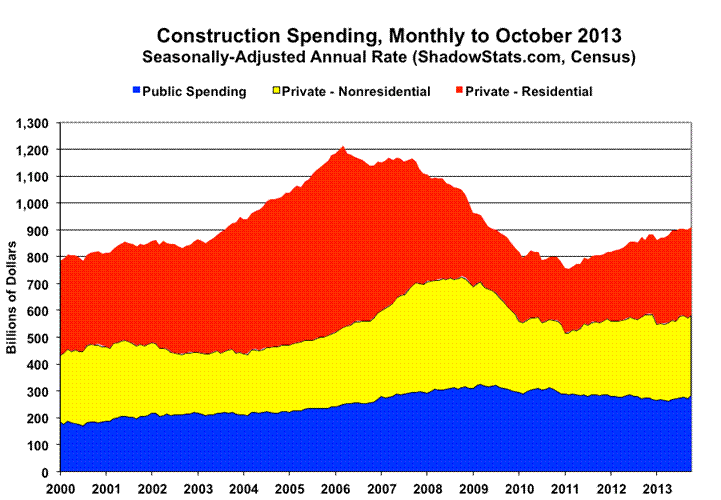
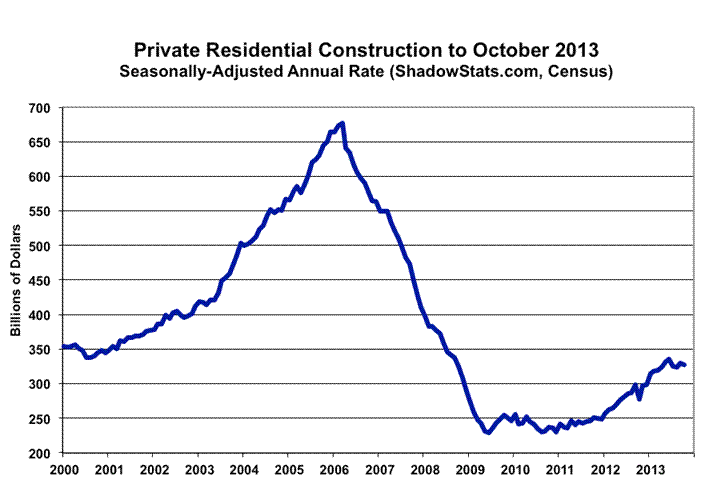
The statistically-insignificant 0.8% gain in monthly October 2013 construction spending, versus the 0.3% decline in September, included a 3.9% monthly gain in public construction spending, versus a 1.9% month-to-month decline in September. October private construction was down by 0.5%, following a 0.4% gain in September. Reflected in the following graphs is the 0.8% monthly gain in October total construction, with private residential construction down by 0.6%, private nonresidential construction down by 0.5% and public construction up by 3.9% for the month. Also reflected is the 0.3% monthly contraction in September total construction, with private residential construction up by 1.7%, private nonresidential construction down by 1.0% and public construction down by 1.9% for the month.


The preceding two graphs reflect total construction spending through October 2013, before and after inflation adjustment. The inflation adjusted graph is on an index basis, with January 2000 = 100.0.
There is no perfect inflation measure for deflating construction, but the PPI new construction index is the closest found in publicly available series. Adjusted for the PPI measure, construction spending shows the economy slowing in 2006, plunging into 2011 and then turning minimally higher in an environment of low-level stagnation, through the most-recent reporting. The pattern of inflation-adjusted activity here does not confirm the economic recovery shown in the headline GDP series (see Commentary No. 571). To the contrary, the latest construction reporting, both before and after inflation adjustment, shows a pattern of ongoing stagnation. Please note that the inflation series here will be revised after the publication of the revamped producer price index series, due for publication in February 2014 (see Commentary No. 575).
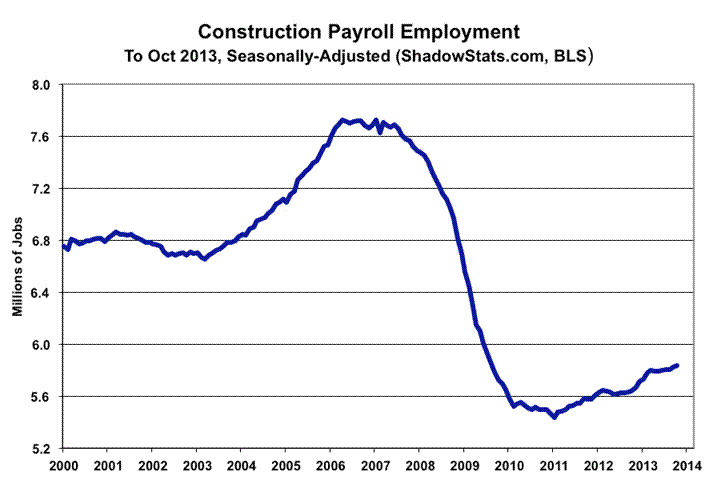
The next graph reflects the reporting of October 2013 construction employment, which will be updated with the December 6th Commentary and the release of November 2013 labor conditions. In theory, payroll levels should move more closely with the inflation-adjusted aggregate series, where the nominal series reflects the impact of costs and pricing, as well as a measure of the level of physical activity.
The next graph shows total construction spending, broken out by the contributions from total public spending (blue), private-nonresidential spending (yellow) and private residential spending (red).
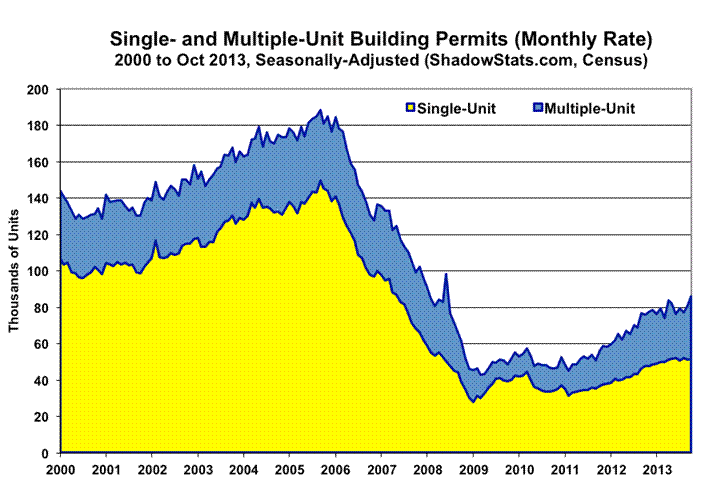
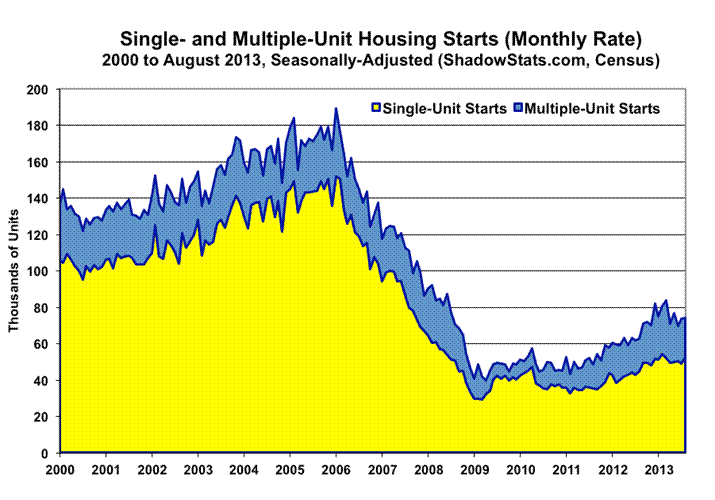
The next three graphs cover private residential construction, including housing starts data (last reported for August 2013) and building permits for October 2013 (see Commentary No. 576 for detail). Keep in mind that the construction spending series is in nominal (not-adjusted-for-inflation) dollars, while housing starts and building permits reflect unit volume.
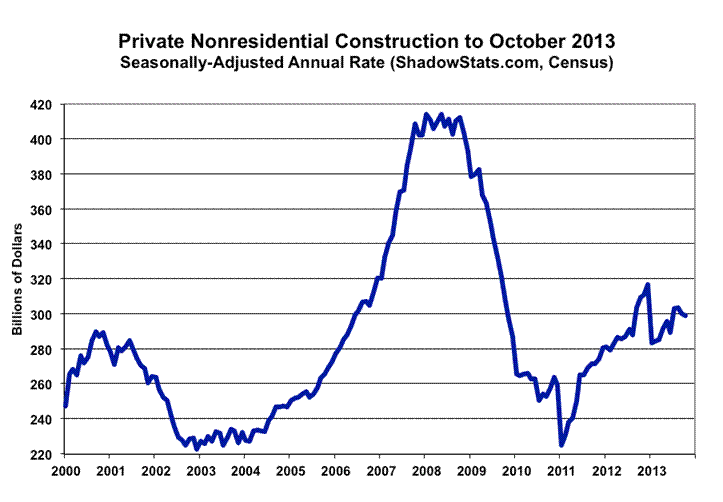
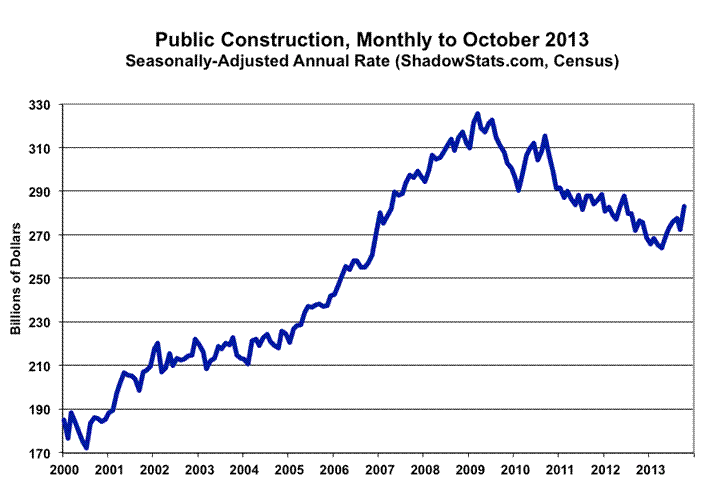
The last two graphs, preceding, show the patterns of the monthly level of activity in private nonresidential construction spending and in public construction spending. The spending in public construction spending, which is 98% nonresidential, has been in a broad downtrend following a short-lived upside bounce in 2010, and with an upside bounce in October 2013.
New-Home Sales—September and October 2013. The September and October new-home sales data were terribly flawed—meaningless—as discussed extensively in the first part of this Opening Comments section. The two months of new reporting were catch-up for the Census Bureau, and likely government-shutdown disruptions in data gathering led to the incredibly large swings in the September and October monthly data. A more realistic circumstance might be to look at an average of September and October for both months. Future revisions should be telling.
Structurally-impaired consumer liquidity has been a consistent constraint on consumption, whether in retail sales or housing. There have been no improvements in underlying economic fundamentals that would suggest a pending housing-industry turnaround or a broad economic recovery. Structural income and credit problems continue, where real median household income remains near its cycle low, where the only growth in consumer credit continues to be in student loans, and where consumer confidence and sentiment are falling, holding deep in traditional recession territory, not at levels usually seen in an economic recovery, as indicated by headline GDP reporting.
September and October New Home-Sales Gyrated Wildly. October 2013 new-home sales exploded to the upside, in the context of major downside revisions back to June 2013 and of an initial reporting of a sharp drop in September sales. The surge in growth here runs contrary to recent monthly declines in existing-home sales (see Commentary No. 574).
Headline new-home sales rose in October by a statistically-significant 25.4%, following the initial reporting of a headline 6.6% decline in September sales, against a downwardly revised August number. Before prior-period revisions, September fell by 15.9% for the month. August was up by a revised 1.6% (previously 7.9%), month-to-month. Despite all the hoopla, the level of October new-home sales was just 5.5% above where August had been in the prior reporting. Plus-or-minus 5.5% is normal monthly volatility in this otherwise unstable series.
Year-to-year, October sales rose by 21.6%. That followed a 7.8% annual decline in September, and a revised 1.3% (previously 12.6%) gain in August. Again, the numbers here are unstable and not reliable. They best are ignored for a month or two, or smoothed out over several months.
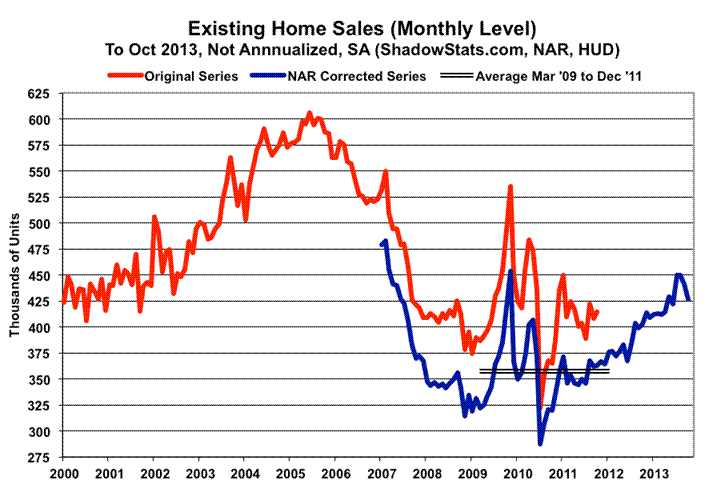
New Home-Sales Graphs. The regular monthly graph of new-home sales follows, along with the latest existing home sales graph from Commentary No. 574. For comparison purposes, even with the big upswing in October sales, new-home sales activity appears to be stagnant (declining if September and October are smoothed together). The pattern of activity here generally remains parallel to the graphs related to residential construction, and single-unit housing starts and building permits, shown in the prior construction spending section.
[For further detail on September and October construction spending and new-home sales,
and the October trade deficit, see the Reporting Detail Section.]
__________
HYPERINFLATION WATCH
Summary Hyperinflation Outlook—Unchanged. The Hyperinflation Outlook of Commentary No. 567 is repeated here without change. Detail on the pending publication of Hyperinflation 2014—The End Game, which will be a fully-updated and expanded version of Hyperinflation 2012, was discussed in the Opening Comments of Commentary No. 577.
This summary is intended as guidance for both new and existing subscribers, who are looking for a brief version of the broad outlook on the economic, systemic and inflation crises that face the United States in the year or so ahead.
Recommended Background Material. Commentary No. 559 (September 2013) and No. 527: Special Commentary (May 2013) supplemented No. 485: Special Commentary (November 2012), which reviewed shifting market sentiment on a variety of issues affecting the U.S. dollar and prices of precious metals. No. 485, in turn, updated Hyperinflation 2012 (January 2012)—the base document for the hyperinflation story—and the broad outlook for the economy and inflation, as well as for systemic-stability and the U.S. dollar. Of use here also are No. 500: Special Commentary on GAAP-based federal deficit reality and the Public Comment on Inflation.
These are the primary articles outlining current conditions and the background to the hyperinflation forecast, and they are suggested reading for subscribers who have not seen them and/or for those who otherwise are trying to understand the basics of the hyperinflation outlook. The fundamentals have not changed in recent years or recent months, other than events keep moving towards the circumstance of a domestic U.S. hyperinflation by the end of 2014. Nonetheless, a fully-updated Hyperinflation 2014—The End Game is planned by the end of November, again, as discussed in Commentary No. 567.
Hyperinflation Timing, Set for 2019 Back in 2004, Advanced to 2014 in Aftermath of 2008 Panic. While the U.S. government has lived excessively beyond its means for decades, it was not until the December 2003 (federal government’s 2004 fiscal year) enactment of the Medicare Prescription Drug, Improvement, and Modernization Act of 2003 that the United States was set solidly on a course for eventual hyperinflation. Back in 2004, ShadowStats began forecasting a hyperinflation by 2019; that forecast was advanced to 2014 as a result of the nature of, and the official handling of the 2008 panic and near-collapse of the domestic financial system. The hyperinflation forecast for 2014 remains in place, with 90% odds estimated in favor of its occurrence.
The initial unfunded liabilities for the Medicare overhaul, alone, added nearly $8 trillion in net-present-value unfunded liabilities to the fiscal-2004 federal deficit, based on generally accepted accounting principles (GAAP accounting), exceeding the total $7.4 trillion gross federal debt of the time. When approached by ShadowStats as to how this circumstance likely would lead to an eventual domestic hyperinflation, the response from a member of the Bush Administration was “that is too far into the future to worry about.”
That future has come too quickly. Adjusted for one-time events, GAAP-based federal deficits have averaged $5 trillion per year for the last seven years, with government spending and financial commitments exploding out of control. As of fiscal-2012 the GAAP-based annual federal deficit was an uncontainable and uncontrollable $6.6 trillion, with gross federal debt at $16.2 trillion and total federal obligations (net present value) in excess of $85 trillion, more than five-times the level of annual GDP and deteriorating at an annual pace in excess of $6 trillion per year. Details can be found in No. 500: Special Commentary.
On a GAAP-basis, the United States faces long-range insolvency. The global financial markets know it, and so do the miscreants currently controlling the U.S. government. Yet, as just demonstrated in the crisis negotiations surrounding the federal-government shutdown and debt ceiling, there is no controlling, political will in Washington to address the long-term solvency issues. The still-festering budget crisis and recent negotiations reflect no more than the formal, continued posturing and political delay of the same issues and crisis that nearly collapsed the U.S. dollar in August and September of 2011, that then were pushed beyond the 2012 election, and then pushed again to the just-postponed negotiations of October 2013.
The chances of the United States actually not paying its obligations or interest are nil. Instead, typically a country which issues its debt in the currency it prints, simply prints the cash it needs, when it can no longer can raise adequate funds through what usually become confiscatory tax rates, and when it can no longer sucker the financial markets and its trading partners into funding its spending. That results in inflation, eventual full debasement of the currency, otherwise known as hyperinflation. The purchasing power of the current U.S. dollar will drop effectively to zero.
Therein lies the root of a brewing crisis for the U.S. dollar (all “dollar” references here are to the U.S. dollar unless otherwise specified). Global financial markets have wearied in the extreme of the political nonsense going on in Washington. No one really wants to hold dollars to or hold investments in dollar-denominated assets, such as U.S. Treasury securities.
Due to ongoing solvency issues within the U.S. banking system, that Federal Reserve is locked into a liquidity trap of flooding the system with liquidity, with no resulting surge in the money supply. Yet, the Fed’s quantitative easings have damaged the dollar, which in turn has triggered sporadic inflation from the related boosting of oil prices. The overhang of dollars in the global markets—outside the formal U.S. money supply estimates—is well in excess of $10 trillion. As those funds are dumped in the global markets, the weakening dollar will trigger dumping of U.S. Treasury securities and general flight from the U.S. currency. As the Fed moves to stabilize the domestic financial system, the early stages of a currency-driven inflation will be overwhelmed by general flight from the dollar, and a resulting surge the domestic money supply. Intensifying the crisis, and likely coincident with heavy flight from the dollar, odds also are high of the loss of the dollar’s global-reserve-currency status.
These circumstances can unfold at anytime, with little or no warning. Irrespective of short-lived gyrations, the dollar should face net, heavy selling pressure in the months ahead from a variety of factors, including, but certainly not limited to: (1) a lack of Fed reversal on QE3; (2) a lack of economic recovery and renewed downturn; (3) concerns of increased quantitative easing by the Fed; (4) inability/refusal of those controlling the government to address the long-range sovereign-solvency issues of the United States; (5) declining confidence in, and mounting scandals involving the U.S. government.
It is the global flight from the dollar—which increasingly should become a domestic flight from the dollar—that should set the early stages of the domestic hyperinflation.
Approaching the End Game. As previously summarized, nothing is normal: not the economy, not the financial system, not the financial markets and not the political system. The financial system still remains in the throes and aftershocks of the 2008 panic and near-systemic collapse, and from the ongoing responses to same by the Federal Reserve and federal government. Further panic is possible and hyperinflation remains inevitable.
Typical of an approaching, major turning point in the domestic- and global-market perceptions, bouts of extreme volatility and instability have been seen with increasing frequency in the financial markets, including equities, currencies and the monetary precious metals (gold and silver). Consensus market expectations on the economy and Federal Reserve policy also have been in increasing flux. The FOMC and Federal Reserve Chairman Ben Bernanke have put forth a plan for reducing and eventually ending quantitative easing in the form of QE3, but that appears to have been more of an intellectual exercise aimed at placating Fed critics, than it was an actual intent to “taper” QE3. The tapering or cessation of QE3 was contingent upon the U.S. economy performing in line with deliberately, overly-optimistic economic projections provided by the Fed.
Manipulated market reactions and verbal and physical interventions have been used to prop stocks and the dollar, and to pummel gold.
Underlying economic reality remains much weaker than Fed projections. As actual economic conditions gain broader recognition, market sentiment even could shift from what now is no imminent end to QE3, to an expansion of QE3. The markets and the Fed are stuck with underlying economic reality, and, increasingly, they are beginning to recognize same. Business activity remains in continued and deepening trouble, and the Federal Reserve is locked into quantitative easing by persistent problems now well beyond its control. Specifically, banking-system solvency and liquidity remain the primary concerns for the Fed, driving the quantitative easing. Economic issues are secondary concerns for the Fed; they are used as political cover for QE3. That cover will continue for as long as the Fed needs it.
The same systemic problems will face incoming Fed Chairman Janet Yellin. She will face the same quandaries and issues addressed by current Chairman Ben Bernanke. Where she also has been involved actively in formulating current Fed policies, no significant shifts in Fed policy are likely. QE3 should continue for the foreseeable future.
At the same time, deteriorating expectations for domestic political stability reflect government scandals and conflicting policy actions, in addition to the dominant global-financial-market concern of there being no viable prospect of those controlling the U.S. government addressing the long-range sovereign-solvency issues of the United States government. These factors, in combination, show the end game to be at hand.
This still-forming great financial tempest has cleared the horizon; its early ill winds are being felt with increasing force; and its impact on the United States and those living in a dollar-based world will dominate and overtake the continuing economic and systemic-solvency crises of the last eight years. The issues that never were resolved in the 2008 panic and its aftermath are about to be exacerbated. Based on precedents established in 2008, likely reactions from the government and the Fed would be to throw increasingly worthless money at the intensifying crises, hoping to push the problems even further into the future. Such attempts to save the system, however, all have exceptional inflationary implications.
The global financial markets appear to have begun to move beyond the forced patience with U.S. policies that had been induced by the financial terror of the 2008 panic. Again, the dollar faces likely extreme and negative turmoil in the months ahead. A domestic hyperinflationary environment should evolve from something akin to these crises before the end of 2014.
Still Living with the 2008 Crisis. Despite the happy news from headline GDP reporting that the recession ended in 2009 and the economy is full recovery, there never has been an actual recovery following the economic crash that began in 2006, and collapsed into 2008 and 2009. No other major economic series has confirmed the pattern of activity now being reported in the GDP. Indeed, 2012 household income data from the Census Bureau showed no recovery whatsoever.
What followed the economic crash was a protracted period of business stagnation that began to turn down anew in second- and third-quarter 2012 (see the corrected GDP graph in the Opening Comments section of Commentary No. 552). The official recovery seen in GDP has been a statistical illusion generated by the use of understated inflation in calculating key economic series (see No. 527: Special Commentary and Public Comment on Inflation). Nonetheless, given the nature of official reporting, the renewed downturn still should gain eventual recognition as the second-dip in a double- or multiple-dip recession.
What continues to unfold in the systemic and economic crises is just an ongoing part of the 2008 turmoil. All the extraordinary actions and interventions bought a little time, but they did not resolve the various crises. That the crises continue can be seen in deteriorating economic activity and in the ongoing panicked actions by the Federal Reserve, where it still proactively is monetizing U.S. Treasury debt at a pace suggestive of a Treasury that is unable to borrow otherwise. As of the government shutdown, the Fed had monetized in excess of 100% of the net issuance of U.S. Treasury debt, since the beginning of calendar-year 2013.
The Fed’s unconscionable market manipulations and games playing in fueling speculation over the future of quantitative easing clearly were used to move the U.S. dollar (the purpose of initial quantitative easing was U.S. dollar debasement). QE3 and continuing efforts at dollar-debasement are not about to go away. Further complicating the circumstance for the U.S. currency is the increasing tendency of major U.S. trading partners to move away from using the dollar in international trade. The loss of some reserve status for the U.S. dollar is likely, as the crises break, and that would intensify both the dollar-selling and domestic U.S. inflationary pressures.
The Fed’s recent and ongoing liquidity actions themselves suggest a signal of deepening problems in the financial system. Mr. Bernanke admits that the Fed can do little to stimulate the economy, but it can create systemic liquidity and inflation. Accordingly, the Fed’s continuing easing moves appear to have been primarily an effort to prop-up the banking system and also to provide back-up liquidity to the U.S. Treasury, under the political cover of a “weakening economy.” Mounting signs of intensifying domestic banking-system stress are seen in soft annual growth in the broad money supply, despite a soaring pace of annual growth in the monetary base, and in mounting global banking-system stress.
U.S. Dollar Remains Proximal Hyperinflation Trigger. The unfolding fiscal catastrophe, in combination with the Fed’s direct monetization of Treasury debt, eventually (more likely sooner rather than later) will savage the U.S. dollar’s exchange rate, boosting oil and gasoline prices, and boosting money supply growth and domestic U.S. inflation. Relative market tranquility has given way to mounting instabilities, and extreme market turmoil likely looms, despite the tactics of delay by the politicians and ongoing obfuscation by the Federal Reserve.
This should become increasingly evident as the disgruntled global markets move sustainably against the U.S. dollar, a movement that may have begun. As discussed earlier, a dollar-selling panic is likely in the next several months, with its effects and aftershocks setting hyperinflation into action in 2014. Gold remains the primary and long-range hedge against the upcoming debasement of the U.S. dollar, irrespective of any near-term price gyrations in the gold market.
The rise in the price of gold in recent years was fundamental. The intermittent panicked selling of gold has not been. With the underlying fundamentals of ongoing dollar-debasement in place, the upside potential for gold, in dollar terms, is limited only by its inverse relationship to the purchasing power of the U.S. dollar (eventually headed effectively to zero). Again, physical gold—held for the longer term—remains as a store of wealth, the primary hedge against the loss of U.S. dollar purchasing power.
__________
REPORTING DETAIL
U.S. TRADE BALANCE (October 2013)
October Trade Deficit Narrowed, but September and Third-Quarter Deficit Widened in Revision. Although the October trade deficit narrowed versus September, that was in the context of revised, greater deterioration in September—both in nominal (not-adjusted-for-inflation) an real (inflation-adjusted) terms—as well in the context of net deterioration shown in revised second- and third-quarter 2013 nominal data. These revisions should reflect some catch-up from earlier distortions in trade-flow paperwork. The deterioration in revised, real September 2013 data was enough to intensify the downside pressure on pending revisions to GDP growth (see discussion in Opening Comments).
Regardless of short-term monthly volatility, underlying economic reality continues to suggest an ongoing long-range deterioration in the U.S. trade deficit.
Nominal (Not-Adjusted-for-Inflation) Trade Deficit. The Bureau of Economic Analysis (BEA) and the Census Bureau reported today, December 4th that the nominal, seasonally-adjusted monthly trade deficit in goods and services for October 2013, on a balance-of-payments basis, narrowed to a near-market-consensus $40.6 billion, from a revised $43.0 (previously $41.8) billion in September. The monthly trade deficit shrinkage reflected a larger increase ($3.4 billion) in exports than was seen in imports ($1.0 billion). Trade in energy-related products (including crude oil) resulted in about half of the small gain in imports, with higher physical-import volume in oil more than offsetting lower oil prices.
Energy-Related Petroleum Products. Lower prices and increased physical imports of oil led to a 3.4% increase in the value of imported, energy-related petroleum products on an unadjusted basis, in October, which was reduced to 1.5% by seasonal adjustments, accounting for about half the gain in monthly imports. For the month of October 2013, the not-seasonally-adjusted average price of imported oil fell to $99.96 per barrel, from $102.00 per barrel in September, and was about even with the $99.76 per barrel estimate for October 2012. Not-seasonally-adjusted, physical oil import volume in October 2013 averaged 7.820 million barrels per day, up from 7.661 million in September, but down from from 8.367 million barrels per day in October 2012.
Prior-Period Revisions. The October trade report included revisions to the monthly nominal data from April through September 2013. As previously estimated, the annualized nominal quarterly deficits for the first-through-third quarters of 2013 respectively were $490.5 billion, $471.1 billion $476.5 billion. Those same quarters now stand at $490.5 billion, $472.5 billion $483.0 billion. The largest deterioration, in revision, was seen in third-quarter 2013. September, which is the only month reported so far for fourth-quarter 2013 annualizes out at $487.7 billion. To the extent that the quarterly deficits deteriorate on an inflation-adjusted basis, they will impact quarterly real GDP growth on the downside.
Ongoing Cautions on Data Quality. As previously discussed, meaningful distortions in the regular monthly, physical flow-of-trade, and related paperwork, likely have been impairing the quality of recent trade reporting. The October revisions may have alleviated some of those issues. Separately, potentially heavy distortions in headline data also continue from seasonal adjustments, much as has been seen in other economic releases, such as retail sales and payrolls, where the headline number reflects month-to-month change. As has been discussed frequently (see Hyperinflation 2012 for example), the extraordinary length and depth of the current business downturn have disrupted regular seasonality patterns. Accordingly, the markets should not rely heavily on the accuracy of the monthly headline data.
Real (Inflation-Adjusted) Trade Deficit. Adjusted for seasonal factors and net of oil-price swings and other inflation (2009 chain-weighted dollars, used for GDP deflation), the October 2013 merchandise trade deficit (no services) narrowed to $48.3 billion, versus a revised $51.4 (previously $50.4) billion in September, and versus $48.5 billion in October 2012.
The revised September estimate deteriorated enough to widen further the trade shortfall used in estimating the headline third-quarter 2013 GDP real growth rate.
As discussed in the Opening Comments, one effect of the government shutdown was to alter, temporarily, the regular sequence of various economic reports. Usually, there is only one trade report between GDP reports, but today’s trade data release was the second such report between the initial estimate of third-quarter GDP and what will be the second reporting, or first revision of third-quarter GDP, tomorrow (December 5th).
The initial reporting of the September trade number had deteriorated enough versus earlier reporting in the quarter to turn the net-export account contribution to headline third-quarter GDP growth from positive to negative. Today’s revision to the September trade data shows that shift to be even more negative.
As initially guessed at by the BEA (with no September detail available), the net export account contributed 0.31% of the 2.84% headline third-quarter GDP growth (see Commentary No. 571). Net of any other revisions, headline third-quarter GDP growth should revise to the downside by at least 0.3-percentage point—due just to the initial September data—in the first-revision, due December 5th. Whether the effects of today’s trade revision also will show in tomorrow’s GDP estimate, or in the second GDP revision, scheduled for December 20th, remains to be seen.
As the inflation-adjusted numbers currently stand, the annualized, real merchandise trade deficit for full reporting of third-quarter 2013 revised to $584.9 (previously $580.7 billion), a greater deterioration—in revision—versus $572.7 billion in second-quarter 2013. As of the August reporting, the annualized deficit of $567.6 billion for the third-quarter (July and August reporting) appeared to have narrowed versus the what was then a $571.8 billion estimate for the second-quarter.
CONSTRUCTION SPENDING (September and October 2013)
September and October Construction-Spending Continued a Pattern of Stagnation or Renewed Downturn. As discussed in the Opening Comments, the headline construction spending and new-home sales data reflect unusual reporting patterns, which likely have been affected by data gathering disruptions surrounding the recent government shutdown. Despite the statistically-insignificant 0.8% headline gain in October 2013, October spending was well below the initial headline reporting for August 2013.
Initial headline reporting for third-quarter 2013 GDP was based on the initial August construction report. Both July and August since have revised lower, and headline September activity was reported in contraction. Accordingly, these results should offer some downside pressure on third-quarter GDP growth estimates, either in the first revision, tomorrow, December 5th, or in second revision on December 20th.
For October, the headline monthly gain was entirely in the public sector; private construction fell for the month. Although the general trend—even in nominal terms—has been minimally to the upside since 2011 and then flattening, monthly changes rarely have been statistically significant. The general pattern of activity has been one of plunge and stagnation, not the hyped GDP pattern of plunge and ever-after recovery, with recovery starting in mid-2009.
Official Reporting. The Census Bureau reported (December 2nd) the first estimates of the total value of construction put in place in the United States for September and October 2013. October spending was $908.4 billion, on a seasonally-adjusted—but not-inflation-adjusted—annual-rate basis. That estimate was up month-to-month by a statistically-insignificant 0.8% +/- 2.1% (all confidence intervals are at the 95% level), versus an initial estimate of $901.2 billion in September, which was a monthly decline of 0.3% against the revised August number. August was $903.8 (previously $915.1) billion and was up by 0.1% versus a revised $902.9 (previously $909.4) billion in July.
Adjusted for PPI new construction inflation, aggregate real spending in October 2013 was up by 0.8% month-to-month, versus a 0.3% contraction in September and a 0.1% gain in August. Please note that the inflation series here will be revised after the publication of the revamped producer price index series, due for publication in February 2014 (see Commentary No. 575).
On an annual-growth basis, October 2013 construction spending was up year-to-year by a statistically-significant 5.3% +/- 2.5%, versus 3.2% in September and 5.8% in August. Net of construction costs indicated by the PPI current construction index, year-to-year growth in spending was 4.6% in October, 2.5% in September and 4.4% in August. More-realistic private surveying suggests annual costs to be up by enough to come close to turning those annual construction-spending growth rates flat or into annual contractions.
The statistically-insignificant 0.8% gain in monthly October 2013 construction spending, versus the 0.3% decline in September, included a 3.9% monthly gain in public construction spending, versus a 1.9% month-to-month decline in September. October private construction was down by 0.5%, following a 0.4% gain in September. This month’s graphs are shown in the Opening Comments section, reflecting the 0.8% monthly gain in October total construction, with private residential construction down by 0.6%, private nonresidential construction down by 0.5% and public construction up by 3.9% for the month. Also reflected is the 0.3% monthly contraction in September total construction, with private residential construction up by 1.7%, private nonresidential construction down by 1.0% and public construction down by 1.9% for the month.
NEW-HOME SALES (September and October 2013)
Home Sales Activity Remains Constrained by Structural Consumer-Liquidity Problems. September and October new-home sales data were terribly flawed—meaningless—as discussed extensively in the first part of in the Opening Comments. The two months of new reporting were catch-up for the Census Bureau, and likely government-shutdown disruptions in data gathering led to incredibly large swings in the September and October monthly data. A more realistic circumstance might be to look at an average of September and October for both months. Future revisions should be telling.
Structurally-impaired consumer liquidity has been a consistent constraint on consumption, whether in retail sales or housing. There have been no improvements in underlying economic fundamentals that would suggest a pending housing-industry turnaround or a broad economic recovery. Structural income and credit problems continue, where real median household income remains near its cycle low, where the only growth in consumer credit continues to be in student loans, and where consumer confidence and sentiment are falling, holding deep in traditional recession territory, not at levels usually seen in an economic recovery, as indicated currently by headline GDP reporting.
September and October New Home-Sales Gyrated Wildly. Running contrary to recent monthly declines in existing-home sales (see Commentary No. 574), October 2013 new-home sales exploded to the upside, in the context of major downside revisions back to June 2013 and of an initial reporting of a sharp drop in September sales.
As reported today (December 4th) by the Census Bureau, headline new-home sales rose in October by a statistically-significant 25.4% +/-22.5% (95% confidence interval), following the initial reporting of a headline 6.6% decline in September sales, to an 18-month low, against a downwardly revised August number. Before prior-period revisions, September fell by 15.9% for the month. August was up by a revised 1.6% (previously 7.9%). Despite all the market hype, the level of October new-home sales was just 5.5% above where August had been in the prior reporting.
Year-to-year, October sales rose by 21.6%. That followed a 7.8% annual decline in September, and a revised 1.3% (previously 12.6%) annual gain in August. Again, the numbers here are unstable and not reliable. They best are ignored for a month or two, or smoothed out over several months.
New Home-Sales Graphs. The regular monthly graph of new-home sales is shown at the end of the Opening Comments section, along with the existing home sales graph from Commentary No. 574. For comparison purposes, even with the big upswing in October sales, new-home sales activity appears to be stagnant (declining if September and October are smoothed together). The pattern of activity here generally remains parallel to the graphs related to residential construction and single-unit housing starts and building permits shown in the Opening Comments section covering October construction spending.
__________
WEEK AHEAD
Weaker-Economic and Stronger-Inflation Reporting Likely in the Months Ahead. The markets generally remain overly optimistic as to the economic outlook, although expectations have softened during the last year. That circumstance, and underlying fundamentals that remain highly suggestive of deteriorating business activity, mean that weaker-than-consensus economic reporting should remain the general trend. Inflation likely will be higher than market expectations. Data distortions resulting from the October government shutdown increase the risk for unusual reporting and revisions in most federal-government and related series. [Other than for the deletion of the pending reporting released today, the Week Ahead is unchanged from the prior Commentary.]
In terms of monthly inflation reporting, energy-inflation-related seasonal-adjustment factors will be turning negative by year end, and were not positive enough in October to offset declines in unadjusted energy prices in the CPI or the PPI. That said, upside pressure on oil-related prices should reflect intensifying impact from a weakening U.S. dollar in the currency markets, and from ongoing political instabilities in the Middle East. The dollar faces pummeling from continuing QE3, and the soon-to-resurface fiscal-crisis/debt-ceiling debacle (see the Summary Hyperinflation Outlook section). Particularly in tandem with the likely weakened dollar, inflation reporting in the year ahead generally should reflect much higher-than-expected inflation (see also No. 527: Special Commentary).
A Note on Reporting Quality Issues and Systemic Reporting Biases. Significant reporting-quality problems remain with most major economic series. Headline reporting issues are tied largely to systemic distortions of seasonal adjustments. The data instabilities were induced by the still-ongoing economic turmoil of the last six-to-seven years, which has been without precedent in the post-World War II era of modern economic reporting. These impaired reporting methodologies provide particularly unstable headline economic results, where concurrent seasonal adjustments are used (as with retail sales, durable goods orders, employment and unemployment data), and they have thrown into question the statistical-significance of the headline month-to-month reporting for many popular economic series.
PENDING RELEASES:
Gross Domestic Product—GDP (Third-Quarter 2013, Second-Estimate, First Revision). The Bureau of Economic Analysis has scheduled release of the second estimate of third-quarter 2013 GDP for tomorrow, Thursday, December 5th (the third estimate is scheduled for December 20th). Market expectations appear to be for an upside revision to the initial 2.8% headline growth estimate, but the September trade report favors a downside revision, perhaps to 2.5% (see Commentary No. 573). Given the surveying problems the statistical agencies have had as a result of the October shutdown of the federal government, the first-estimate of the GDP included a great deal more in the way of guessing of data than was usual. Accordingly, this and the next revision could be unusually large; underlying economic reality favors adjustments to the downside.
Employment/Unemployment (November 2013). The release of November 2013 employment and unemployment by the Bureau of Labor Statistics (BLS) is schedule for Friday, December 6th. With November recovering from the effects of the October government shutdown, the numbers are going to be haphazard, at best. The extraordinary misreporting of October’s labor data was covered in Commentary No. 572.
The unemployment rate should decline, as the limited numbers of furloughed governments workers, who properly were counted as unemployed, should be employed again. Further, there is no reason to expect that the rapid loss of long-term unemployed from the headline labor force has subsided, so the expected decline in headline U.3 unemployment to the pre-shutdown 7.2% level, easily could drop to 7.1%. The broader U.6 and ShadowStats unemployment measures would tend to hold at higher respective levels.
From the payroll employment perspective, the BLS trend model suggests a 168,000 jobs gain in November. The consensus tends to reflect the trend model but seems to be setting somewhat above it. Underlying economic reality would suggest a downside surprise with the payrolls, with an outright contraction possible. Nonetheless, all these numbers are unsettled and could come in well outside general expectations.
__________