


No. 592: December CPI, Real Retail Sales and Earnings

COMMENTARY NUMBER 592
December CPI, Real Retail Sales and Earnings
January 16, 2014
__________
Inflation Picks Up as the Economy Slows Down
December Annual Inflation: 1.5% (CPI-U), 1.5% (CPI-W), 9.1% (ShadowStats)
Real Retail Sales Declined by 0.1% in Industry’s Flagship Month of December;
Slowing Annual Growth Signaled Recession
Real Weekly Earnings Declined in December
__________
PLEASE NOTE: The next regular Commentary is scheduled for tomorrow, Friday, January 17th, covering December housing starts and industrial production.
Best wishes to all — John Williams
OPENING COMMENTS AND EXECUTIVE SUMMARY
Real Retail Sales and Earnings Were Down, CPI Inflation Rose. Today’s (January 16th) Commentary covers the release of the December 2013 Consumer Price Index (CPI) and related real (inflation-adjusted) retail sales and earnings. Tomorrow’s January 17th Commentary will cover December housing starts and industrial production, along with a summary of recent economic reporting through that time. The substance of the new data, so far, has been to show a renewed trend of weakening economic activity, in conjunction with an upturn in inflationary pressures. The economy is going to get much weaker, quickly, while inflation should begin to move seriously to the upside, later in the year.
The monthly graphs of gold, silver and oil prices, and the U.S. dollar versus the Swiss franc, which usually accompany the CPI Commentary, follow at the end of the Hyperinflation Watch section.
December 2013 CPI—Inflation Rose Along with Higher Energy Prices. Volatile oil and gasoline prices continued to dominate headline inflation reporting. Although energy inflation was understated somewhat, that sector pushed both monthly and year-to-year inflation higher in the December Consumer Price Index (CPI), as it did it in earlier reporting of the December Producer Price Index (PPI).
The factors at work here are not happy ones, such as strong demand driving prices higher. Instead, either political circumstances or bad monetary policy aimed at debasing the U.S. dollar continue to generate a cost-push inflation that actually damages economic activity. Net of headline inflation, both real retail sales and earnings declined for the month of December; the declines would have been more severe if better quality—higher—inflation estimates had been used. The terribly constrained consumer liquidity circumstance leaves no room for consumer spending to drive an economic recovery.
Going forward, as discussed in Hyperinflation 2014—The End Game Begins, risks of a massive flight from the U.S. dollar favor resulting higher energy inflation driving headline consumer inflation much higher. The dollar problem could break at any time, with little warning. Renewed financial-market turmoil surrounding fiscal and monetary instabilities, worsening economic activity, and deteriorating political conditions in the Nation’s capital, all should come into play against the U.S. currency. Ongoing economic and financial-system-liquidity crises still threaten systemic instabilities that, as with their 2008 Panic precursors, cannot be contained without having further, serious inflation consequences.
CPI-U. The headline, seasonally-adjusted CPI-U for December 2013 rose by 0.30% (unchanged on an unadjusted basis), versus a 0.03% gain (down by 0.20% unadjusted) in November. The December headline reporting was close to market expectations. In next month’s reporting, the seasonally-adjusted inflation numbers will be revised back for five years. Those changes, however, will be only in the seasonal factors. The unadjusted series never is revised.
The headline 0.3% gain (unchanged unadjusted) in December 2013 CPI-U, reflected an adjusted monthly gain in December energy inflation of 2.1% (an unadjusted 0.6% gain), an adjusted gain in food inflation of 0.1% (up 0.1% unadjusted), and an adjusted gain in “core” inflation of 0.1% (down by 0.1% unadjusted).
Average-annual CPI-U inflation was 1.46% in 2013, versus 2.07% in 2012. On a seasonally-adjusted, annualized quarter-to-quarter basis, CPI-U inflation was 0.85% in fourth-quarter 2013, versus 2.63% in the third-quarter, a contraction of 0.03% in the second-quarter, and a 1.44% gain in the first-quarter.
Not seasonally adjusted, December 2013 year-to-year inflation for the CPI-U was 1.50%, versus 1.24% in November 2013, and 1.74% in December 2012.
CPI-W. The seasonally-adjusted, headline December 2013 CPI-W, which is a narrower series and has greater weighting for gasoline than does the CPI-U, rose by 0.34% for the month (up by 0.02% unadjusted), versus adjusted unchanged headline November inflation (down by 0.26% unadjusted).
Average-annual CPI-W inflation was 1.37% in 2013, versus 2.10% in 2012. On a seasonally-adjusted, annualized quarter-to-quarter basis, CPI-W inflation was 0.59% in fourth-quarter 2013, versus 2.98% in the third-quarter, a contraction of 0.39% in the second-quarter, and a 1.23% gain in the first-quarter.
Unadjusted, December 2013 year-to-year CPI-W inflation was 1.45%, up from 1.12% in November 2013, and against 1.68% in December 2012.
Chained-CPI-U. The initial reporting of year-to-year inflation for the December 2013 C-CPI-U was 1.34%, up from 1.14% in November 2013, and versus 1.58% in December 2012.
Although the BLS will not publish an annual-average Chained-CPI-U—presumably due to unreliable data that are subject to two years of heavy revisions—the annual number is calculated easily. The 2013 average is an index level of 133.634, up by 1.37% versus 2012 (the same inflation as in the CPI-W series, which is used in adjusting Social Security, etc.). The annual average index level in 2012 was 131.823, a gain of 2.10% versus the 2011 average.
Alternate Consumer Inflation Measures. Adjusted to pre-Clinton methodologies—the ShadowStats-Alternate Consumer Inflation Measure (1990-Base)—annual CPI inflation was roughly 5.0% in December 2013, versus 4.7% in November. The 1990-Base annual-average inflation was 4.9% in 2013 versus 5.5% in 2012. (See the Public Commentary on Inflation Measurement and Chained-CPI.)
The ShadowStats-Alternate Consumer Inflation Measure (1980-Base), which reverses gimmicked changes to official CPI reporting methodologies back to 1980, rose to about 9.1% (9.08% for those using the second decimal point) in December 2013, versus 8.8% in November. The 1980-Base annual-average inflation was 9.1% in 2013 versus 9.7% in 2012.
Real (Inflation-Adjusted) Retail Sales Declined in December 2013. Discussed in Commentary No. 590, the nominal monthly gains in headline retail sales for December 2013 of 0.23%, a revised 0.44% (previously 0.68%) for November, and a revised 0.52% (previously 0.61%) for October, all were before accounting for inflation.
Based on today’s reporting of a 0.30% headline gain in the December 2013 CPI-U, seasonally-adjusted real (inflation-adjusted) retail sales showed a monthly contraction of 0.07% (a rounded, headline contraction of 0.1%), versus a downwardly revised 0.40% real gain in November, and a downwardly revised 0.58% monthly gain in October.
Year-to-year growth in December 2013 real retail sales slowed to 2.57%, from a downwardly revised 2.96% in November and versus a downwardly revised 3.05% in October, as graphed in the Reporting Detail section. In normal economic times, the recent levels in annual real growth would be signaling a pending recession. In the current circumstance, this signal likely will serve as an indicator of a renewed downturn in broad economic activity.
All these numbers will change next month when the BLS revises its seasonally-adjusted CPI-U series (the unadjusted series never is revised).
Also noted in Commentary No. 590, there has been no change in the underlying consumer-liquidity fundamentals. There is nothing that would support a sustainable turnaround in retail sales, personal consumption, housing or general economic activity. There never was a broad economic recovery, and there is no recovery underway, just general bottom-bouncing that is turning down anew.
As official consumer inflation continues its upturn in the months ahead, and as overall retail sales continue to suffer from the ongoing consumer liquidity squeeze—reflected partially in continued real earnings difficulties, discussed in the second sub-section following—these data should trend meaningfully lower, in what eventually will gain recognition as a formal, double-dip recession.
Corrected Retail Sales. The first graph following reflects real retail sales as usually reported by the St. Louis Fed, deflated by the CPI-U, but it is indexed to January 2000 = 100. ShadowStats did the deflation using the December 2013 CPI-U and nominal retail sales releases. The CPI-U, however, understates inflation (see the Public Comment on Inflation), with the effect of overstating inflation-adjusted growth.
Instead of being deflated by the CPI-U, the “corrected” real retail sales numbers in the second graph use the ShadowStats-Alternate Inflation Measure (1990-Base) for deflation.
With the higher inflation of the ShadowStats measure, the revamped numbers show a pattern of plunge and stagnation, consistent with patterns seen in real median household income, consumer confidence measures, unemployment and housing statistics. A topping out in late-2011 and early-2012 reverted to renewed decline in second-quarter 2012 in this series, which had been bottom-bouncing along a low-level plateau of economic activity since the economic collapse from 2006 into 2009. The renewed contraction has been deepening. Although the October and November 2013 sales numbers ticked higher, December activity has turned lower, again.


Real Average Weekly Earnings Declined in December 2013. In the production and nonsupervisory employees series—the only earnings series for which there is a meaningful history—headline real average weekly earnings (deflated by the CPI-W) fell by 0.49% for the month of December, following a revised 0.55% gain in November.
Unadjusted and year-to-year, December real earnings growth slowed to 0.44%, from a revised 1.03% pace in November. Both the monthly and annual fluctuations in this series are irregular, but current reporting remains well within the normal bounds of volatility. Prior-period revisions are due to the instabilities in the BLS monthly surveys.
The accompanying graph of real average weekly earnings shows the earnings as officially deflated by the BLS (red-line), and as adjusted for the ShadowStats-Alternate CPI Measure, 1990-Base (blue-line). When inflation-depressing methodologies of the 1990s began to kick-in, the artificially weakened CPI-W (also used in calculating Social Security cost-of-living adjustments) helped to prop up the reported real earnings.
Official real earnings today still have not recovered their inflation-adjusted levels of the early-1970s, and, at best, have been flat for the last decade. Deflated by the ShadowStats measure, real earnings have been in fairly regular decline for the last four decades, which is much closer to common experience than the pattern suggested by the CPI-W. See Public Commentary on Inflation Measurement for further detail.

[For greater detail on the December CPI, real retail sales and earnings,
see the Reporting Detail section.]
__________
HYPERINFLATION WATCH
Hyperinflation Outlook. With the First Installment of Hyperinflation 2014—The End Game Begins published on January 7th, a new Hyperinflation Summary for this section will be added shortly.
Monthly Gold Graphs. Following are the regular graphs of gold prices versus the Swiss franc, oil prices and silver prices that usually accompany the Commentary on the monthly CPI release. Turmoil in the markets has continued, with the dollar showing minor weakness. As discussed in Hyperinflation 2014—The End Game Begins, the underlying fundamentals could not be much weaker for the U.S. dollar, and they could not be stronger for gold and silver, irrespective of recent price movements. Oil price volatility partially has reflected shifting political circumstances in the Middle East, but oil prices face significant, further upside pressure as the U.S. dollar comes under heavier selling pressure.
Renewed market turmoil surrounding fiscal and monetary instabilities, worsening economic activity, and deteriorating political conditions in the Nation’s capital, all should be poison to the markets. The U.S. dollar remains a good bet to be an early casualty; precious metals and oil prices should benefit.
The “latest January” points in the following graphs reflect conditions as of roughly mid-afternoon New York time, January 16th.


__________
REPORTING DETAIL
CONSUMER PRICE INDEX—CPI (December 2013)
Energy Prices Pushed Monthly and Annual Inflation Rates Higher. Once again, headline monthly inflation was dominated by volatility in oil and gasoline prices. Month-to-month and year-to-year, inflation generally rose in tandem with higher energy costs. The factors at work here are not happy ones, such as strong demand driving prices higher. Instead, either political circumstances or bad monetary policy aimed at debasing the U.S. dollar continue to generate a cost-push inflation that actually damages economic activity. Net of headline inflation, both real retail sales and earnings declined for the month of December; the declines would have been more severe, if better quality—higher level—inflation estimates had been used. Terribly constrained consumer liquidity leaves no room for consumer spending to drive an economic recovery.
Going forward, as discussed in Hyperinflation 2014—The End Game Begins, risks of a massive flight from the U.S. dollar, favor resulting upside energy inflation driving headline consumer inflation much higher. The dollar problems could break at any time, with little warning. Renewed financial-market turmoil surrounding fiscal and monetary instabilities, worsening economic activity, and deteriorating political conditions in the Nation’s capital, all should pummel the U.S. dollar. Ongoing economic and financial-system-liquidity crises still threaten systemic instabilities that, as with their 2008 Panic precursors, cannot be contained without further, official actions that have serious inflation consequences.
As a separate issue, inflation—as generally perceived by the public, from the standpoint of personal income or investment use—continues to run well above any of the government’s rigged price measures. Related methodological changes to the CPI series in recent decades were designed to understate the government’s reporting of consumer inflation, as discussed in the Public Comment on Inflation Measurement.
__________________
Notes on Different Measures of the Consumer Price Index
The Consumer Price Index (CPI) is the broadest inflation measure published by the U.S. Government, through the Bureau of Labor Statistics (BLS), Department of Labor:
The CPI-U (Consumer Price Index for All Urban Consumers) is the monthly headline inflation number (seasonally adjusted) and is the broadest in its coverage, representing the buying patterns of all urban consumers. Its standard measure is not seasonally adjusted, and it never is revised on that basis except for outright errors.
The CPI-W (CPI for Urban Wage Earners and Clerical Workers) covers the more-narrow universe of urban wage earners and clerical workers and is used in determining cost of living adjustments in government programs such as Social Security. Otherwise, its background is the same as the CPI-U.
The C-CPI-U (Chain-Weighted CPI-U) is an experimental measure, where the weighting of components is fully substitution based. It generally shows lower annual inflation rate than the CPI-U and CPI-W. The latter two measures once had fixed weightings—so as to measure the cost of living of maintaining a constant standard of living—but now are quasi-substitution-based. Since it is fully substitution based, the series tends to reflect lower inflation than the other CPI measures. Accordingly, the C-CPI-U is the “new inflation” measure being considered by Congress and the White House as a tool for reducing Social Security cost-of-living adjustments by stealth.
The ShadowStats Alternative CPI-U Measures are attempts at adjusting reported CPI-U inflation for the impact of methodological change of recent decades designed to move the concept of the CPI away from being a measure of the cost of living needed to maintain a constant standard of living. There are two measures, where the first is based on reporting methodologies in place as of 1980, and the second is based on reporting methodologies in place as of 1990.
__________________
CPI-U. The Bureau of Labor Statistics (BLS) reported this morning, January 16th, that the headline, seasonally-adjusted CPI-U for December 2013 rose by 0.30% (unchanged on an unadjusted basis), versus a 0.03% gain (down by 0.20% unadjusted) in November. The December headline reporting was close to market expectations.
The BLS used a gain of 0.7% in not-seasonally-adjusted gasoline prices, instead of the higher 1.1% increase indicated by the more-comprehensive, industry-based surveying of the Department of Energy. With positive seasonal adjustments, the gain in adjusted gasoline prices was 3.1%, as reported by the BLS. Seasonal adjustments also were positive for the headline “core” inflation, but they were slightly negative for food inflation.
In next month’s reporting, seasonally-adjusted inflation data will be revised back for five years. Those changes, however, are only in the seasonal factors. The unadjusted series never is revised.
Encompassed by the headline gain in December 2013 CPI-U of 0.3% (unchanged unadjusted), aggregate energy inflation in December was up by an adjusted 2.1% (an unadjusted 0.6% gain) for the month. In the other major CPI sectors, adjusted food inflation was up by 0.1% for the month (up 0.1% unadjusted), while “core” inflation rose by an adjusted 0.1% (down by 0.1% unadjusted).
Average-annual CPI-U inflation was 1.46% in 2013, versus 2.07% in 2012. On a seasonally-adjusted, annualized quarter-to-quarter basis, CPI-U inflation was 0.85% in fourth-quarter 2013, versus 2.63% in the third-quarter, a contraction of 0.03% in the second-quarter, and a 1.44% gain in the first-quarter.
Not seasonally adjusted, December 2013 year-to-year inflation for the CPI-U was 1.50%, versus 1.24% in November 2013 and 1.74% in December 2012.
Year-to-year, CPI-U inflation would increase or decrease in next month’s January 2014 reporting, dependent on the seasonally-adjusted monthly change, versus an adjusted and negligible 0.03% increase in the monthly inflation reported for January 2013. The adjusted change is used here, since that is how consensus expectations are expressed. To approximate the annual unadjusted inflation rate for January 2014, the difference in January’s headline monthly change (or forecast of same), versus the year-ago monthly change, should be added to or subtracted directly from the December 2013 annual inflation rate of 1.50%.
Core CPI-U. Seasonally-adjusted December 2013 “core” CPI-U inflation (net of food and energy inflation) rose by 0.11% (fell by 0.10% unadjusted), versus a seasonally-adjusted monthly gain of 0.15% (up by 0.03% unadjusted) in November.
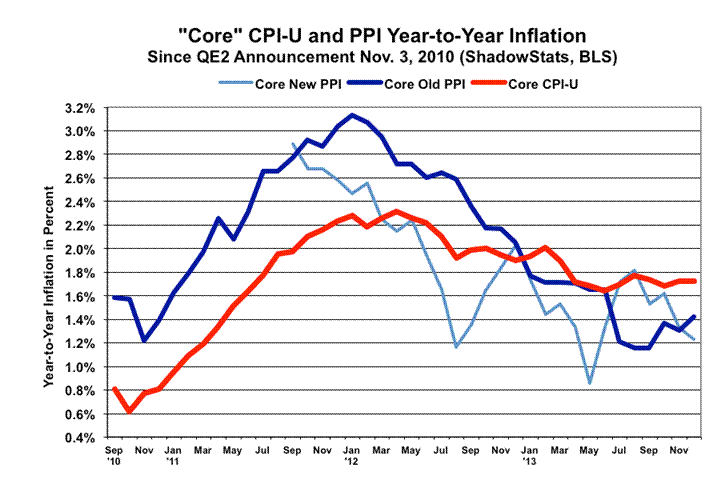
Twenty-four of the last thirty-seven months have shown rising year-to-year, or annual, core CPI-U inflation, with the year-to-year core CPI inflation holding at 1.72% in December 2013, versus 1.72% in November 2013 and against 1.89% in December 2012. As shown in the accompanying graph, the monthly CPI core annual inflation has held above the annual rate of core inflation in the PPI finished goods number since July 2013. With the redefinition of the PPI series looming with next month’s reporting, the thin lighter-blue line reflects the limited historical data available on what will be the new core “final demand” PPI measure (see Commentary No. 591). The new series does not appear to be particularly stable.
In terms of annual-average “core” CPI-U inflation, 2013 was 1.76%, versus 2.11% in 2012.
CPI-W. The December 2013 headline, seasonally-adjusted CPI-W, which is a narrower series and has greater weighting for gasoline than does the CPI-U, rose by 0.34% for the month (up by 0.02% unadjusted), versus adjusted unchanged November headline inflation (down by 0.26% unadjusted).
Average-annual CPI-W inflation was 1.37% in 2013, versus 2.10% in 2012. On a seasonally-adjusted, annualized quarter-to-quarter basis, CPI-W inflation was 0.59% in fourth-quarter 2013, versus 2.98% in the third-quarter, a contraction of 0.39% in the second-quarter, and a 1.23% gain in the first-quarter.
Unadjusted, December 2013 year-to-year CPI-W inflation was 1.45%, up from 1.12% in November 2013, and versus 1.68% in December 2012.
Chained-CPI-U. The initial reporting of year-to-year inflation for the December 2013 C-CPI-U was 1.34%, up from 1.14% in November 2013, and versus 1.58% in December 2012.
Although the BLS will not publish an annual-average Chained-CPI-U—presumably due to unreliable data that are subject to two years of heavy revisions—the annual number is calculated easily. The 2013 average is an index level of 133.634, up by 1.37% versus 2012 (the same annual growth as in the CPI-W series, which is used in adjusting Social Security, etc.). The annual average index level in 2012 was 131.823, a gain of 2.10% versus the 2011 average.
The recent, two-year budget deficit agreement (see Commentary No. 581) cut cost-of-living adjustments (COLA) for certain military retirees by one-percent. The Congressional negotiators did not use the Chained-CPI as had been threatened otherwise for Social Security, etc., where the idea had been that the chained series would cut COLAs by about one-percent on an annual basis, versus existing calculations. The approach taken is more open about what is being done, as opposed to the prior subterfuge of trying to pass off a fully-substitution-based CPI as a legitimate COLA measure.
The Chained-CPI-U currently is not designed as a benchmark cost-of-living indicator, with the series subject to revisions for two years, before the inflation-rate reduction is realized fully. Despite White House and Congressional considerations of making the chained index the new cost-of-living-adjustment (COLA) measure for programs such as Social Security, the system cannot be made workable as a concept for using a substitution-based CPI measure as a COLA, without the new index becoming even more of a sham than it already is. For further detail, see the Public Commentary on Inflation Measurement and Chained-CPI), and the C-CPI material posted on the BLS site, apparently in anticipation possible political uses for the measure: Chained CPI.
Alternate Consumer Inflation Measures. Adjusted to pre-Clinton methodologies—the ShadowStats-Alternate Consumer Inflation Measure (1990-Base)—annual CPI inflation was roughly 5.0% in December 2013, versus 4.7% in November. The 1990-Base annual-average inflation was 4.9% in 2013 versus 5.5% in 2012.
The ShadowStats-Alternate Consumer Inflation Measure (1980-Base), which reverses gimmicked changes to official CPI reporting methodologies back to 1980, rose to about 9.1% (9.08% for those using the second decimal point) in December 2013, versus 8.8% in November. The 1980-Base annual-average inflation was 9.1% in 2013 versus 9.7% in 2012.
[The balance of the text in this Alternate Consumer Inflation Measures sub-section is unchanged from the prior CPI Commentary.]
Note: The ShadowStats-Alternate Consumer Inflation Measure largely has been reverse-engineered from the BLS’s CPI-U-RS series, which provides an official estimate of historical inflation, assuming that all current methodologies were in place going back in time. The ShadowStats estimates effectively are adjusted on an additive basis for the cumulative impact on the annual inflation rate of various methodological changes made by the BLS (the series is not recalculated).
Over the decades, the BLS has altered the meaning of the CPI from being a measure of the cost of living needed to maintain a constant standard of living, to something that neither reflects the constant-standard-of-living concept nor measures adequately what most consumers view as out-of-pocket expenditures. Roughly five percentage points of the additive ShadowStats adjustment reflect the BLS’s formal estimate of the annual impact of methodological changes; roughly two percentage points reflect changes by the BLS, where ShadowStats has estimated the impact not otherwise published by the BLS. (See Public Commentary on Inflation Measurement and Chained-CPI for further details.)

Gold and Silver Highs Adjusted for CPI-U/ShadowStats Inflation. Despite the September 5, 2011 historic-high gold price of $1,895.00 per troy ounce (London afternoon fix), and despite the multi-decade-high silver price of $48.70 per troy ounce (London fix of April 28, 2011), gold and silver prices have yet to re-hit their 1980 historic levels, adjusted for inflation. The earlier all-time high of $850.00 (London afternoon fix, per Kitco.com) for gold on January 21, 1980 would be $2,546 per troy ounce, based on December 2013 CPI-U-adjusted dollars, and $10,478 per troy ounce, based on December 2013 ShadowStats-Alternate-CPI (1980-Base) adjusted dollars (all series not seasonally adjusted).
In like manner, the all-time high nominal price for silver in January 1980 of $49.45 per troy ounce (London afternoon fix, per silverinstitute.org), although approached in 2011, still has not been hit since 1980, including in terms of inflation-adjusted dollars. Based on December 2013 CPI-U inflation, the 1980 silver-price peak would be $148 per troy ounce and would be $610 per troy ounce in terms of December 2013 ShadowStats-Alternate-CPI (1980-Base) adjusted dollars (again, all series not seasonally adjusted).
As shown in Table 1, on page 31 of Hyperinflation 2014—The End Game Begins, over the decades, the increases in gold and silver prices have compensated for more than the loss of the purchasing power of the U.S. dollar as reflected by CPI inflation, while they effectively have come close to fully compensating for the loss of purchasing power of the dollar based on the ShadowStats-Alternate Consumer Price Measure (1980-Methodologies Base).
Real (Inflation-Adjusted) Retail Sales—December 2013. As covered in Commentary No. 590, the nominal monthly gains in headline retail sales for December 2013 of 0.23%, a revised 0.44% (previously 0.68%) for November, and a revised 0.52% (previously 0.61%) for October, all were before accounting for inflation.
Based on today’s reporting of a 0.30% headline gain in the December 2013 CPI-U, seasonally-adjusted real (inflation-adjusted) retail sales showed a monthly contraction of 0.07% (a rounded, headline contraction of 0.1%), versus a downwardly revised 0.40% real gain in November, and a downwardly revised 0.58% monthly gain in October.
Year-to-year growth in December 2013 real retail sales slowed to 2.57%, from a downwardly revised 2.96% (previously 3.43%) in November and versus a downwardly revised 3.05% (previously 3.15%, initially 2.91%) in October, as seen in the second graph following. In normal economic times, the recent levels in annual real growth would be signaling a pending recession. In the current circumstance, this signal likely will serve as an indicator of a renewed downturn in broad economic activity.
All these numbers will change next month when the BLS revises its seasonally-adjusted CPI-U series (the unadjusted series never is revised).
Real Retail Sales Turned Down Anew. The first of the three following graphs shows the level of real retail sales activity (deflated by the CPI-U) since 2000, and the second graph shows year-to-year percent change for the same period. The level of monthly activity turned down in December 2013, while December’s year-to-year change also moved lower, reflecting the impact of both softer nominal retail sales activity and higher consumer prices.


The third graph (immediately-preceding) shows the level of real retail sales (and its predecessor series) in full post-World War II detail. With December 2013 reporting, the nascent expansion of headline real retail sales above pre-recession levels, which began in February 2013, faltered in September, resumed in October and November, has faltered again. Where initial real changes in monthly retail sales generally had been flat, with subsequent upside revisions, the pattern has reversed, with prior growth now being revised lower.
The gross domestic product (GDP) expanded beyond pre-recession levels eleven quarters ago, starting in second-quarter 2011, and it has kept rising, well beyond the reported activity of any other series, including real retail sales and industrial production. There is no other major economic series showing the GDP’s pattern of both official, full recovery and extensive new growth. While real retail sales tend to lead the GDP, the “recovery” in retail reporting lagged the purported GDP recovery by two years. In like manner, the industrial production measure—a coincident GDP indicator—just broke above its pre-recession high in November 2013 reporting, but tomorrow’s Commentary No. 593 will show new detail, with an initial estimate of December activity and a revision to that November reporting.
The apparent “recovery” in the real retail sales series and industrial production (as well as in the GDP) is due to the understatement of the rate of inflation used in deflating retail sales and other series. As discussed more fully in Hyperinflation 2012 and Special Commentary (No. 485), and was will be updated in the Second Installment of Hyperinflation 2014, deflation by too-low an inflation number (such as the CPI-U) results in the deflated series overstating inflation-adjusted economic growth.
As shown in the latest “corrected” real retail sales graph, in the Opening Comments, with the deflation rates corrected for understated inflation, the recent pattern of real sales activity turns increasingly negative. The corrected graph shows that the post-2009 period of protracted stagnation ended, and a period of renewed contraction began in second-quarter 2012. The corrected real retail sales numbers use the ShadowStats-Alternate Inflation Measure (1990-Base) for deflation instead of the CPI-U.
As discussed in Commentary No. 590, there has been no change in the underlying consumer-liquidity fundamentals. There is nothing that would support a sustainable turnaround in retail sales, personal consumption, housing or general economic activity. There never was a broad economic recovery, and there is no recovery underway, just general bottom-bouncing that is turning down anew.
As official consumer inflation continues its upturn in the months ahead, and as overall retail sales continue to suffer from the ongoing consumer liquidity squeeze—reflected partially by continued real earnings difficulties, discussed in the next section—these data should trend meaningfully lower, in what eventually will gain recognition as a formal, double-dip recession.
Real (Inflation-Adjusted) Average Weekly Earnings—December 2013. Coincident with today’s December 2013 CPI release, the BLS also published real average weekly earnings for December. In the production and nonsupervisory employees series—the only series for which there is a meaningful history—headline real average weekly earnings (deflated by the CPI-W) fell by 0.49% for the month, following a revised 0.55% (previously 0.45%) gain in November.
Unadjusted and year-to-year, December real earnings growth slowed to 0.44%, from a revised 1.03% (previously 1.05%) pace in November. Both the monthly and annual fluctuations in this series are irregular, but current reporting remains well within the normal bounds of volatility. Prior-period revisions are due to the instabilities in the BLS monthly surveys.
The usual graph of this series is in the Opening Comments section. As shown there, the graph plots the earnings as officially deflated by the BLS (red-line), and as adjusted for the ShadowStats-Alternate CPI Measure, 1990-Base (blue-line). When inflation-depressing methodologies of the 1990s began to kick-in, the artificially-weakened CPI-W (also used in calculating Social Security cost-of-living adjustments) helped to prop up the reported real earnings. Official real earnings today still have not recovered their inflation-adjusted levels of the early-1970s, and, at best, have been flat for the last decade. Deflated by the ShadowStats measure, real earnings have been in fairly regular decline for the last four decades, which is much closer to common experience than the pattern suggested by the CPI-W. See Public Commentary on Inflation Measurement for further detail.
Real Money Supply M3—November 2013. The signal for a double-dip or ongoing recession, based on annual contraction in the real (inflation-adjusted) broad money supply (M3), discussed in Hyperinflation 2012, remains in place and continues, despite real annual M3 growth having turned to the upside. As shown in the accompanying graph—based on December 2013 CPI-U reporting and the latest ShadowStats-Ongoing M3 Estimate—annual inflation-adjusted growth in M3 for December 2013 declined to 1.8% from a revised 2.9% (previously 2.8%). The slowing in the December annual growth rate for real M3 again reflected a combination of a lower nominal annual growth rate in M3 and a higher annual CPI-U inflation rate.
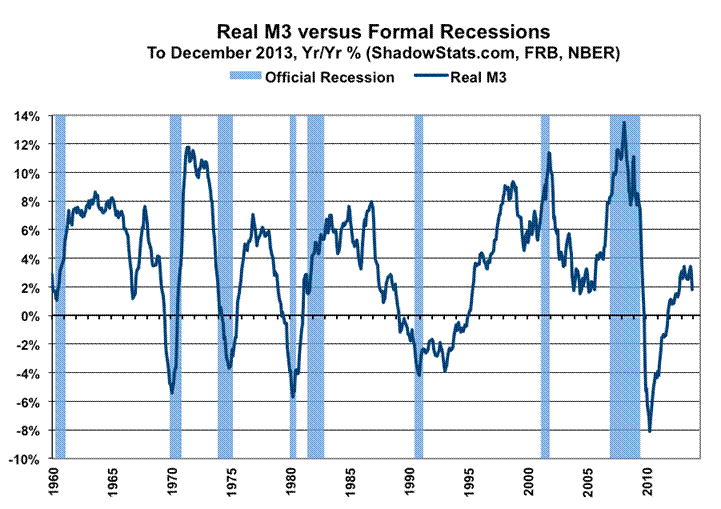
[The balance of the text in this Real Money Supply M3 sub-section is unchanged from the prior CPI Commentary, with a planned full update of the analysis (including still-another signal) in the pending Second Installment of Hyperinflation 2014.] The signal for a downturn or an intensified downturn is generated when annual growth in real M3 first turns negative in a given cycle; the signal is not dependent on the depth of the downturn or its duration. Breaking into positive territory does not generate a meaningful signal one way or the other for the broad economy. The current downturn signal was generated in December 2009, even though there had been no upturn since the economy hit bottom in mid-2009. The broad economy tends to follow in downturn or renewed deterioration roughly six-to-nine months after the signal. Weaknesses in a number of series continued into 2011 and 2012, with significant new softness in recent reporting. Actual post-2009 economic activity has remained at low levels—in protracted stagnation—as discussed in Special Commentary (No. 485).
A renewed downturn in official data is becoming more obvious, and that eventually should lead to official recognition of a double-dip recession. Reality remains that the economic collapse into 2009 was followed by a plateau of low-level economic activity—no upturn or recovery, no end to the official 2007 recession—and the unfolding renewed downturn remains nothing more than a continuation and re-intensification of the downturn that began unofficially in 2006.
__________
WEEK AHEAD
Weaker-Economic and Stronger-Inflation Reporting Likely in the Months and Year Ahead. At the moment, markets generally are overly optimistic as to the economic outlook, based on data that likely were puffed-up in the process of going through the data-gathering and reporting distortions of the October shutdown to the federal government. Although expectations should soften anew, quickly, there remains the potential for unusual, irregular and eventually corrective reporting and revisions in the months ahead.
That circumstance, and underlying fundamentals that remain highly suggestive of deteriorating business activity, mean that weaker-than-consensus economic reporting should become the general trend.
Stronger inflation reporting is likely. Upside pressure on oil-related prices should reflect intensifying impact from a weakening U.S. dollar in the currency markets, and from ongoing political instabilities in the Middle East. The dollar faces pummeling from continuing QE3, the ongoing U.S. fiscal-crisis debacle, a weakening U.S. economy and deteriorating U.S. political conditions (see Hyperinflation 2014—The End Game Begins). Particularly in tandem with a weakened dollar, reporting in the year ahead generally should reflect much higher-than-expected inflation.
A Note on Reporting Quality Issues and Systemic Reporting Biases. Significant reporting-quality problems remain with most major economic series. Headline reporting issues are tied largely to systemic distortions of seasonal adjustments. The data instabilities were induced by the still-ongoing economic turmoil of the last seven-to-eight years, which has been without precedent in the post-World War II era of modern economic reporting. These impaired reporting methodologies provide particularly unstable headline economic results, where concurrent seasonal adjustments are used (as with retail sales, durable goods orders, employment and unemployment data), and they have thrown into question the statistical-significance of the headline month-to-month reporting for many popular economic series.
PENDING RELEASES:
Index of Industrial Production (December 2013). The December 2013 index of industrial production is scheduled for release tomorrow, Friday, January 17th, by the Federal Reserve Board. Net of the irregular volatility in utility output tied to seasonable or seasonable weather, moderate expectations for December production growth are a fair bet to be disappointed, as companies increasingly move to reduce excessive inventory levels. There also remains the potential for unusual reporting volatility and revisions tied to data disruptions resulting from the October shutdown of the federal government.
Residential Construction—Housing Starts (December 2013). Also tomorrow, Friday, January 17th, the Census Bureau will publish its estimate of December 2013 housing starts. This series was distorted heavily by data-gathering and reporting issues that resulted from the government shutdown in October. Given last month’s seriously-flawed, coincident release of initial reporting for September, October and November 2013 monthly data, the December housing starts reporting could reflect catch-up reporting, significant prior-period revisions and/or further haphazard monthly detail. The markets appear to be looking for a large, downside correction, which is reasonable. Anything is possible in the December detail, but ultimately, the unbelievably strong data in the prior reporting should disappear in a sort-term correction or revisions in the next several moths.
Despite near-perpetual market expectations for strengthening activity in housing starts, reported month-to-month change likely will resume its regular pattern of statistical-insignificance, soon, with ongoing stagnation and renewed downturn seen in the aggregate series, as well as particularly for single-unit housing starts.
In the wake of a 75% collapse in aggregate activity from 2006 through 2008, and an ensuing five-year pattern of housing starts stagnation at historically low levels, little has changed. There remains no chance of a near-term, sustainable turnaround in the housing construction market, unless there is a fundamental upturn in consumer and banking-liquidity conditions. That has not happened and still does not appear to be in the offing.
__________