


No. 601: January Housing Starts, PPI

COMMENTARY NUMBER 601
January Housing Starts, PPI
February 19, 2014
__________
Unstable Housing Starts Showed a Corrective Plunge in January
January PPI Inflation Was Capped by the Service Sector
__________
PLEASE NOTE: The next regular Commentary is scheduled for tomorrow, February 20th, covering the January consumer price index (CPI) and real retail sales and earnings.
Best wishes to all — John Williams
OPENING COMMENTS AND EXECUTIVE SUMMARY
Pressures Mount for Negative First-Quarter GDP. This brief Commentary focuses on today’s (February 19th) economic releases for January housing starts and the new producer price index (PPI). Tomorrow’s Commentary No. 602 will provide a summary assessment of recent economic releases. January’s statistically-significant 16.0% month-to-month drop in the otherwise unstable housing starts series also reflected year-to-year growth turning negative by a statistically-insignificant 2.0%. These housing numbers provided the latest suggestion for a contraction in first-quarter 2014 GDP.
Separately, the new PPI delivered as promised for January 2014, with what would have been a 0.4% headline gain in finished goods inflation being flattened to 0.1% by the heavily-theoretical services sector of the new “total final demand” headline inflation number.
January’s New PPI Series Starts with an Inflation Jump in Goods, Muted by Services. As discussed in Commentary No. 591, a new producer price index (PPI)—effective with January 2014 reporting— has replaced the headline monthly measure of wholesale inflation in “finished goods,” with a headline monthly measure of wholesale “total final demand,” which is composed of “final demand goods” (basically the old “finished goods” series) and “final demand services,” which tends to cap the goods inflation when oil prices are an issue.
That was the pattern seen in the initial reporting for January 2014. Headline “final demand goods” rose by 0.4% in January. That was the same pace of inflation shown for the new series in December 2013, and 0.4% also was the headline inflation number for the old “final demand” series in December 2013. Due to headline “final demand services” monthly inflation of 0.1% in January, and a 0.1% contraction in December, the headline monthly inflation in the new “total final demand” was 0.2% for January 2014, versus 0.1% in December 2013.
Prior categories of “crude” and “intermediate” goods inflation have been recast into processed and unprocessed goods and services for intermediate demand. Intermediate demand also is broken into four stages of production flow for both goods and services. The new data often appear to be of limited meaning on the services side, little more than a dog’s breakfast of theoretical constructs. ShadowStats coverage in these areas will tend to be defined by subscriber needs and interests.
A further issue—cured only by the passage of time—is that the historical estimates for the new series are limited to five years.
January 2014 Headline PPI Detail. The Bureau of Labor Statistics (BLS) reported that the headline producer price index (PPI) for January 2014 reflected 0.2% month-to month “total final demand” inflation, following a 0.1% inflation gain in December 2013. Year-to-year, January inflation was up by 1.2%, versus 1.1% in December.
Broken out in the two major subcomponents for the new series, the “final demand goods” sector showed headline monthly inflation of 0.4% in January and 0.4% in December, with year-to-year inflation of 0.9% in January and 0.8% in December. The “final demand services” sector showed headline monthly inflation of 0.1% in January and negative inflation of 0.1% in December, with year-to-year inflation of 1.3% in January and 1.2% in December.
Descriptive materials on the new series are available on the BLS Web site here: New PPI Series, New PPI Detail, and today’s Press Release. ShadowStats will be using the updated PPI series and other information in an effort to improve inflation-adjusted reporting of the construction spending and new orders for durable goods series. ShadowStats also will look to track the old PPI series to the extent that it varies meaningfully from the “final demand goods” series. Subscriber suggestions as to which components of the new series are of greatest interest also will affect the coverage (contact: johnwilliams@shadowstats.com).
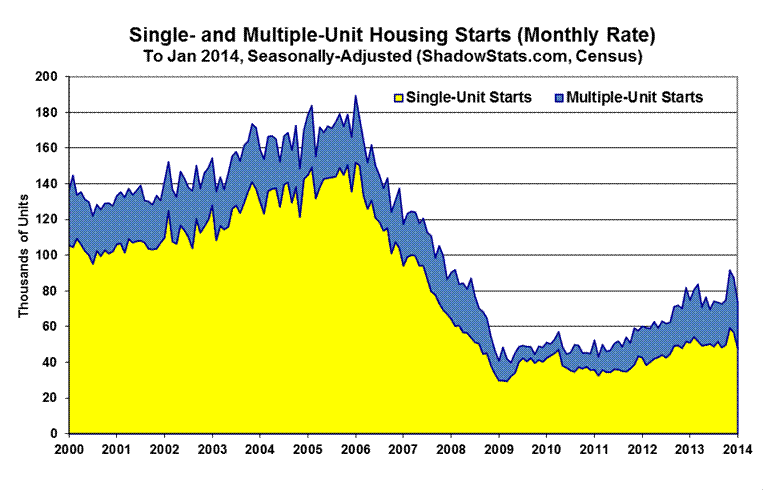
January 2014 Housing Starts—Catch-Up Monthly Plunge amidst Unstable Reporting. The housing starts series generally has been unstable enough in recent years that headline month-to-month changes in activity rarely have been statistically significant. Exacerbating that circumstance, the housing data—particularly housing starts and new home sales out of the Census Bureau—appear to have been distorted heavily by the impact of the October government shutdown on data-gathering and reporting processes. That was seen particularly with an initial headline monthly surge of 23% in November 2013 housing starts activity. Since then, monthly data have been reported on the downside, with the headline (and statistically-significant) 16.0% monthly decline in January 2014 starts returning the series to near-normal levels, both in the aggregate and by-unit categories. An upcoming annual revision to the housing data likely will result in the reporting of a smoother historical series. Going forward, monthly reporting should remain volatile, albeit at lower levels. The latest detail is reflected in the accompanying graph.

As discussed in Commentary No. 599, there has been no change in the underlying consumer-liquidity fundamentals. There is nothing that would support a sustainable turnaround in the housing industry or general economic activity. There never was an economic recovery, and there is no recovery underway, just broad bottom-bouncing that generally is turning down anew.
January 2014 Housing-Starts Detail. The headline monthly decline in seasonally-adjusted January 2014 housing starts of 16.0% was statistically-significant. That decline was in the context of an upside revision to December 2013 activity, where the January drop was 11.9% before prior-period revisions. Nonetheless, January’s activity reflected the second straight month of declines across the aggregate and major-component categories.
December’s monthly activity revised to a narrower decline of 4.8%, while November’s nonsensical monthly gain—likely warped by government-shutdown effects—revised minimally lower to 22.5%.
Year-to-year growth in the seasonally-adjusted, aggregate January 2014 housing-starts measure was a statistically-insignificant decline of 2.0%, versus an upwardly revised 6.6% annual gain for December, and minimally revised annual gain of 30.8% in November.
Where the irregular housing starts series can show varying patterns, that partially is due to a reporting mix of residential construction products, with one-unit housing starts that generally are for individual consumption, resulting in new home sales, versus multi-unit starts that generally reflect the building of rental and apartment units.
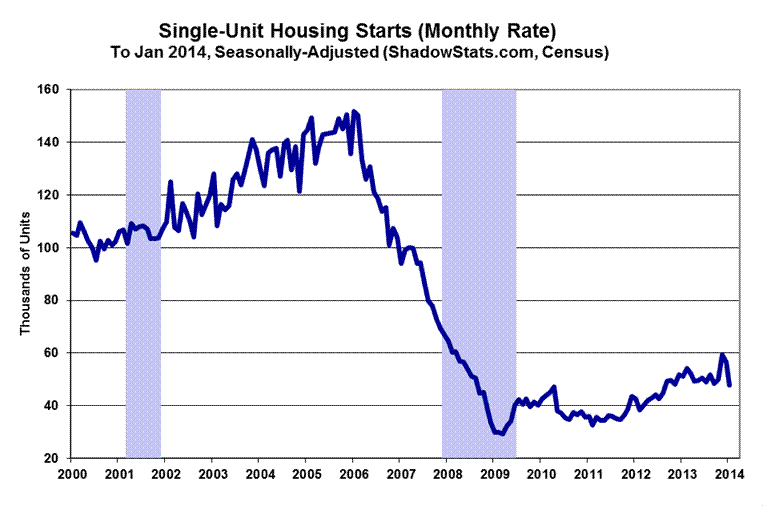
By Unit Category. Housing starts for single-unit structures in January fell by a statistically-significant 15.9% for the month, versus a revised contraction of 4.5% in December, and a revised gain of 18.8% in November (see the accompanying graphs). January’s annual decline of 6.7% was statistically-insignificant. December’s year-to-year increase revised to 9.8%, with November’s year-to-year increase revising to 23.8%.
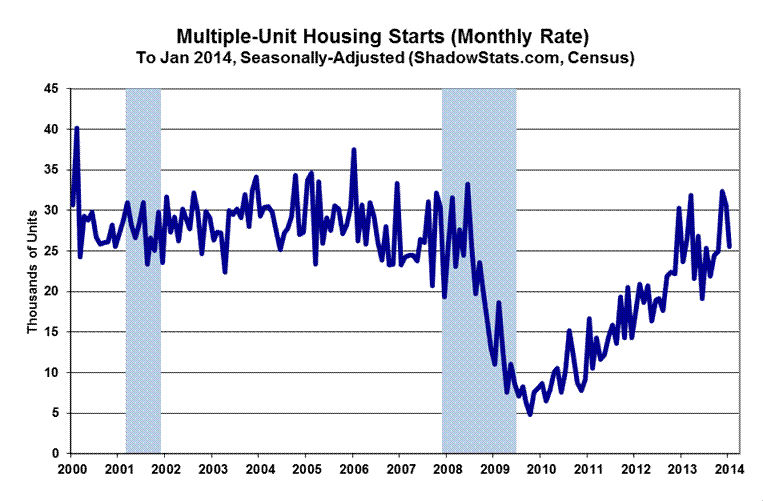
Reporting of housing starts activity for apartment buildings (generally 5 units or more) declined for the second month, down by a statistically-insignificant 12.8% in January, versus a revised 9.2% decline in December, and a revised 31.1% gain in November. January’s year-to-year gain of 9.9% was not statistically significant. December’s year-to-year activity revised to a 0.3% decline, while November’s annual gain revised to 48.0%.
Expanding the multi-unit housing starts category to include “2 to 4 units” plus “5 units or more,” usually reflects the bulk of rental- and apartment-unit activity. The Census Bureau does not publish estimates of the “2 to 4 units” category, due to statistical significance problems (a general issue for the aggregate series). Nonetheless, the total multi-unit category can be calculated by subtracting the single-unit category from the total category. Accordingly, the aggregate, statistically-significant January monthly decline of 16.0% was composed of a significant 15.9% monthly drop in one-unit housing starts, combined with an insignificant 16.3% monthly drop in starts of multiple-unit structures (2 units or more, including the category of 5 units or more). These are the series plotted in the accompanying graphs.
Further detail on the official residential construction numbers may be found on the site of ShadowStats affiliate www.ExpliStats.com.
Graphs of Aggregate Housing Starts Activity. The record monthly low seen for the present aggregate series was in April 2009, which was down 79% from the January 2006 pre-recession peak. Against the downside-spiked low in April 2009, the January 2014 headline number was up by 84%, but it still was down by 61% from the January 2006 series high. That detail is reflected in the graphs of this section, as well as in those of the Reporting Detail section.
The official reporting of housing starts is expressed at an annualized monthly pace of starts, which was 880,000 in January 2014, versus a revised 1,048,000 in December 2013. Those details are shown in the graphs in the Reporting Detail section. Where monthly activity more realistically is reflected at the actual monthly rate of 73.3 thousand in January, versus the annualized 880.0 thousand, the non-annualized monthly rate is used in the graphs that follow. With either scale, the appearance of the graph and the monthly and annual percent changes are the same.
[For greater detail on January 2014 housing starts and PPI, see the Reporting Detail section.]
__________
HYPERINFLATION WATCH
Hyperinflation Outlook. With the First Installment of Hyperinflation 2014—The End Game Begins published on January 7th, a new Hyperinflation Summary for this section will be added in conjunction with the publication of the Second Installment. The second and final installment will cover historical and prospective economic activity, as well as possible protective and preventative actions and reactions at both a personal and federal level, versus the unfolding circumstance. It will be published following the analysis of the much-delayed publication of the 2013 GAAP-based financial statements of the United States government, which currently are due for release on February 26th. The new material in the Second Installment will supplement and update the basic material already available to ShadowStats readers in Chapters 4, 5 and 9 of Hyperinflation 2012.
__________
REPORTING DETAIL
RESIDENTIAL CONSTRUCTION (January 2014)
Catch-Up Housing-Starts Plunge Was Amidst Unstable Reporting. The housing starts series has been unstable enough in recent years that headline month-to-month changes in activity rarely have been statistically significant. Exacerbating that circumstance, the housing data—particularly housing starts and new home sales out of the Census Bureau—appear to have been distorted heavily by the impact of the October government shutdown on data-gathering and reporting processes. That was seen in the initial headline monthly surge of 23% in November 2013 housing starts activity. Since then, monthly data have been reported on the downside, with the headline (and statistically-significant) 16.0% monthly decline in January 2014 starts returning the series to near-normal levels, both in the aggregate and by-unit categories. An upcoming annual revision to the housing data likely will result in the reporting of a smoother historical series. Going forward, monthly reporting should remain volatile, albeit at lower levels.
As discussed in Commentary No. 599, there has been no change in underlying consumer-liquidity fundamentals. There is nothing that would support a sustainable turnaround in the housing industry or general economic activity. There never was an economic recovery, and there is no recovery underway, just general bottom-bouncing that broadly is turning down anew.
January 2014 Housing-Starts Reporting. The Census Bureau reported today, February 19th, a statistically-significant, month-to-month headline decline in seasonally-adjusted January 2014 housing starts of 16.0% +/-12.1% (all confidence intervals are at the 95% level). The monthly decline was in the context of an upside revision to December 2013 activity, where the January drop was 11.9% before prior-period revisions. Nonetheless, January’s activity reflected the second straight month of declines across the major component categories.
December’s previous month-to-month decline of 9.8% revised to a decline of 4.8%. November’s nonsensical monthly gain—likely warped by government-shutdown effects—revised to 22.5% (previously 23.1%, initially 22.7%).
Year-to-year growth in the seasonally-adjusted, aggregate January 2014 housing-starts measure was a statistically-insignificant decrease of 2.0% +/- 12.0%, versus a revised annual gain in December of 6.6% (previously 1.6%), and an revised annual gain in November of 30.8% (previously 31.5%, initially 29.6%).
Where the irregular housing starts series can show varying patterns, that partially is due to a reporting mix of residential construction products, with one-unit housing starts that generally are for individual consumption, resulting in new home sales, versus multi-unit starts that generally reflect the building of rental and apartment units.
By Unit Category. Housing starts for single-unit structures in January fell by a statistically-significant 15.9% +/- 14.2% for the month, versus a revised contraction of 4.5% (previously down by 7.0%) in December, and a revised 18.8% (previously 19.5%, initially 20.8%) gain in November (see graphs in the Opening Comments section). January’s annual decline of 6.7% +/- 12.1% was statistically-insignificant. December’s year-to-year increase revised to 9.8% (previously 7.6%), with November’s year-to-year increase revising to 23.8% (previously 24.5%, initially 26.2%).
Reporting of housing starts activity for apartment buildings (generally 5 units or more) declined for the second month, down by a statistically-insignificant 12.8% +/- 11.6% in January, versus a revised 9.2% (previously 17.9%) monthly decline in December, and a revised 31.1% (previously 31.5%, initially 26.0%) gain in November. January’s year-to-year gain of 9.9% +/- 33.5% was not statistically significant. December’s year-to-year activity revised to a 0.3% (previously 9.6%) decline, while November’s annual gain was a revised 48.0% (previously 48.4%, initially 38.3%).
Expanding the multi-unit housing starts category to include “2 to 4 units” plus “5 units or more,” usually reflects the bulk of rental- and apartment-unit activity. The Census Bureau does not publish estimates of the “2 to 4 units” category, due to statistical significance problems (a general issue for the aggregate series). Nonetheless, the total multi-unit category can be calculated by subtracting the single-unit category from the total category. Accordingly, the aggregate, statistically-significant January monthly decline of 16.0% was composed of a significant 15.9% monthly drop in one-unit housing starts, combined with an insignificant 16.3% monthly drop in starts of multiple-unit structures (2 units or more, including the “5 units or more” category). Again, this series is graphed in the Opening Comments section.
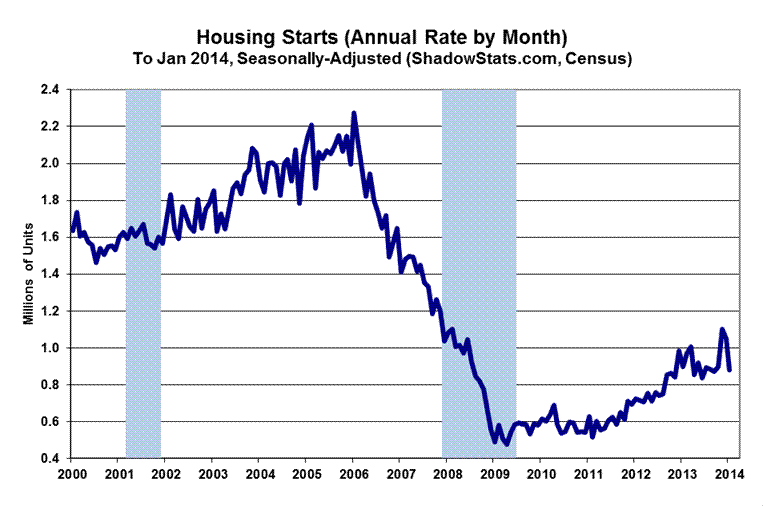
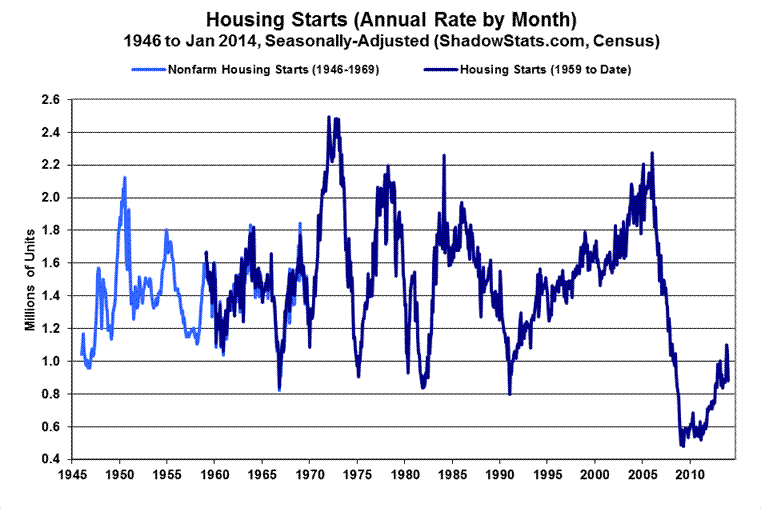
Graphs of Aggregate Housing Starts Activity. The official reporting of housing starts is expressed at an annualized monthly pace of starts, which was 880,000 in January 2014, versus a revised 1,048,000 in December 2013. Those details are shown in the preceding graphs. Where the magnitude of monthly activity more realistically is reflected at the actual monthly rate of 73,333 in January, versus the annualized headline 880,000, the monthly rate is used in the scales of the graphs in the Opening Comments section. With either scale, the appearance of the graph and the monthly and annual percent changes are the same
The record monthly low seen for the present aggregate series was in April 2009, which was down 79% from the January 2006 pre-recession peak. Against the downside-spiked low in April 2009, the January 2014 headline number was up by 84%, but it still was down by 61% from the January 2006 series high.
Further detail on the official residential construction numbers may be found on the site of ShadowStats affiliate www.ExpliStats.com.
PRODUCER PRICE INDEX—PPI (January 2014)
New PPI Series Starts with an Inflation Jump in Goods, Muted by Lower Inflation in Services. As discussed in Commentary No. 591, a new producer price index (PPI)—effective with January 2014 reporting— has replaced the headline monthly measure of wholesale inflation in “finished goods,” with a headline monthly measure of wholesale “total final demand,” which is composed of “final demand goods” (basically the old “finished goods” series) and “final demand services” which tends to cap the goods inflation when oil prices are an issue.
That was the pattern seen in the initial reporting for January 2014. Headline “final demand goods” rose by 0.4% in January. That was the same pace of inflation shown for the new series in December 2013, and 0.4% also was the headline inflation number for the old “final demand” series in December 2013. Due to headline “final demand services” monthly inflation of 0.1% in January, and a 0.1% contraction in December, the headline monthly inflation in the new “total final demand” was 0.2% for January 2014, versus 0.1% in December 2013.
Prior categories of “crude” and “intermediate” goods inflation have been recast into processed and unprocessed goods and services for intermediate demand. Intermediate demand also is broken into four stages of production flow for both goods and services. The new data here often appear to be of limited meaning on the services side, little more than a dog’s breakfast of theoretical constructs. ShadowStats coverage in these areas will tend to be defined by subscriber needs and interests.
A further issue—cured only by the passage of time—is that the historical estimates for the new series are limited to five years.
January 2014 Headline PPI Detail. The Bureau of Labor Statistics (BLS) reported this morning, February 19th, that the headline producer price index (PPI) for January 2014 reflected 0.2% month-to month “total final demand” inflation, following a 0.1% inflation gain in December 2013. Year-to-year, January inflation was up by 1.2%, versus 1.1% in December.
Broken out in the two major subcomponents for the new series, the “final demand goods” sector showed headline monthly inflation of 0.4% in January and 0.4% in December, with year-to-year inflation of 0.9% in January and 0.8% in December. The “final demand services” sector showed headline monthly inflation of 0.1% in January and negative inflation of 0.1% in December, with year-to-year inflation of 1.3% in January and 1.2% in December.
Descriptive materials on the new series are available on the BLS Web site here: New PPI Series, New PPI Detail, and today’s Press Release.
__________
WEEK AHEAD
Weaker-Economic and Stronger-Inflation Reporting Likely in the Months and Year Ahead. Although shifting to the downside, market expectations generally still appear to be overly optimistic as to the economic outlook, based on data that likely were puffed-up in the process of going through the data-gathering and reporting distortions of the October shutdown to the federal government. Expectations should continue to soften, though, with an increasing number of corrective revisions and disappointing headline economic activity. The initial stages of that process have been seen in the recent reporting of December and January payroll, retail sales, housing starts and industrial production data, and in the December trade-balance detail.
That corrective circumstance and underlying weak economic fundamentals remain highly suggestive of deteriorating business activity. Accordingly, weaker-than-consensus economic reporting should become the general trend until such time as an unfolding “new” recession receives general recognition.
Stronger inflation reporting remains likely. Upside pressure on oil-related prices should reflect intensifying impact from a weakening U.S. dollar in the currency markets, and from ongoing political instabilities in the Middle East. The dollar faces pummeling from continuing QE3, the ongoing U.S. fiscal-crisis debacle, a weakening U.S. economy and deteriorating U.S. political conditions (see Hyperinflation 2014—The End Game Begins). Particularly in tandem with a weakened dollar, reporting in the year ahead generally should reflect much higher-than-expected inflation.
A Note on Reporting-Quality Issues and Systemic Reporting Biases. Significant reporting-quality problems remain with most major economic series. Ongoing headline reporting issues are tied largely to systemic distortions of seasonal adjustments. The data instabilities were induced by the still-evolving economic turmoil of the last seven-to-eight years, which has been without precedent in the post-World War II era of modern economic reporting. These impaired reporting methodologies provide particularly unstable headline economic results, where concurrent seasonal adjustments are used (as with retail sales, durable goods orders, employment and unemployment data), and they have thrown into question the statistical-significance of the headline month-to-month reporting for many popular economic series.
PENDING RELEASES:
Consumer Price Index—CPI (January 2014). The release by the Bureau of Labor Statistics (BLS) of the January 2014 CPI is scheduled for tomorrow, Thursday, February 20th. The headline CPI-U is a fair bet to be close to unchanged for the month.
Average gasoline prices rose month-to-month in January 2014 by 1.0%, on a not-seasonally-adjusted basis, per the Department of Energy. The BLS seasonal adjustments will depress gasoline prices in the headline January CPI. As last revised, an unadjusted 0.3% monthly decline in January 2013 gasoline prices was enlarged to a 3.0% monthly contraction, with negative seasonal adjustments. Similar effects in the January 2014 number, by themselves, would subtract about 0.1% from the headline CPI-U number. Upside food prices and core inflation, however, should leave the headline CPI-U around unchanged for the month.
Year-to-year, CPI-U inflation would increase or decrease in January 2014 reporting, dependent on the seasonally-adjusted monthly change, versus an adjusted and negligible 0.03% increase in the monthly inflation reported for January 2013. The adjusted change is used here, since that is how consensus expectations are expressed. To approximate the annual unadjusted inflation rate for January 2014, the difference in January’s headline monthly change (or forecast of same), versus the year-ago monthly change, should be added to or subtracted directly from the December 2013 annual inflation rate of 1.50%. For example, if the January headline CPI-U were unchanged month-to-month, year-to-year change would hold at about 1.5%.
__________