


No. 615: February Trade Deficit and Construction Spending

COMMENTARY NUMBER 615
February Trade Deficit and Construction Spending
April 3, 2014
__________
Trade-Deficit Deterioration Should Hit First-Quarter GDP Growth Hard
Real Merchandise Trade Deficit on Track for
Worst Quarterly Showing Since Fourth-Quarter 2012
February Construction Spending Showed Ongoing Stagnation
__________
PLEASE NOTE: The next regular Commentary is scheduled for tomorrow, Friday, April 4th, covering March employment and unemployment. The Second Installment of the 2014 Hyperinflation Report is in its final preparation and should be posted no later than Monday, April 7th.
Please forgive the juggling of the publication schedule here. The implications of the February trade data were of enough import—in terms of the developing outlook for headline first-quarter 2014 GDP growth and for the ever-evolving consensus economic outlook—to get the related detail published today.
Best wishes to all — John Williams
OPENING COMMENTS AND EXECUTIVE COMMENTARY
Odds Mount for First-Quarter GDP Contraction. Most major economic series have been showing early first-quarter growth patterns suggestive of a headline contraction in the “advance” estimate of first-quarter 2014 GDP, due for release by the Bureau of Economic Analysis (BEA) on April 30th (see Commentary No. 610). Where such an event does not appear to be expected, an economic shock could trigger a variety of negative responses in the financial markets and elsewhere that generally would not be good news for the U.S. dollar.
Today’s reporting of the February 2014 trade deficit—the last such reporting before the GDP estimate—indicated a significant widening in the first-quarter’s real merchandise trade deficit. That should impact the net export account in GDP directly and negatively, knocking off perhaps a percentage point from first-quarter headline GDP growth (the prior quarter’s deficit had contributed a full percentage point to the 2.6% headline growth rate of fourth-quarter GDP).
February 2014 Trade Deficit—Widening Deficit Threatens GDP Growth. Initial quarterly estimates of the GDP are based on only two months of trade numbers for a given quarter. With both January and February 2014 data now in place, the inflation-adjusted, first-quarter 2014 merchandise trade deficit is on track not only to be the largest real trade shortfall since fourth-quarter 2012, but also to help savage the “advance” estimate of first-quarter 2014 GDP growth. For fourth-quarter 2013, a narrowing trade deficit contributed 1.0% of the 2.6% headline GDP growth rate. The widening deficit in first-quarter 2014 could subtract 1.0% from the headline GDP growth rate, a negative swing of two-percentage points in quarterly GDP growth. The initial first-quarter GDP reporting, due April 30th is a fair bet to show an outright quarterly contraction, considering the latest trade data and negative pressures from most other underlying fundamental series, such as retail sales.
In nominal terms, the February deficit in goods and services widened by $3.0 billion, reflecting a double hit from a $2.0 billion drop in exports and a $1.0 billion increase in imports.
Nominal (Not-Adjusted-for-Inflation) February Trade Deficit. The nominal, seasonally-adjusted monthly trade deficit in goods and services for February 2014, on a balance-of-payments basis, widened to $42.300 billion from a revised $39.280 billion in January 2014, but narrowed from a $43.257 billion in February 2013.
Real (Inflation-Adjusted) February 2014 Trade Deficit. Adjusted for seasonal factors, and net of oil-price swings and other inflation (2009 chain-weighted dollars, used for GDP deflation), the February 2014 merchandise trade deficit (no services) widened to $50.084 billion, from a revised $48.493 billion in January 2014, and versus $49.674 billion in February 2013.
The deficit reported for fourth-quarter 2013 annualizes to $564.7 billion, which had narrowed from $583.4 billion in the third-quarter. The correspondingly narrower deficit, reflected in the fourth-quarter net-export account, contributed 1.0% of the 2.6% headline growth last estimated for fourth-quarter 2013 GDP.
With two months in place for first-quarter 2014—all the data that will be available for the initial estimate of first-quarter GDP—the first-quarter estimate of the real trade deficit annualizes out to $591.5 billion. That number not only would reflect the deepest quarterly real deficit since fourth-quarter 2012, but also, versus a $564.7 billion deficit in fourth-quarter 2013, would reverse the contribution to quarterly GDP from plus one-percentage point in the fourth-quarter, to perhaps taking away a full percentage point from the headline GDP growth rate in the first-quarter. While the data here do not track perfectly with the numbers reported by the BEA in the GDP, they are the primary numbers used in generating the BEA’s guesstimates.
February Construction Spending Showed Continuing Stagnation. The headline 0.1% monthly gain in February 2014 construction spending was not statistically-significant. Net of upside revisions to January’s reporting, the monthly gain for February would have been 0.3%, but still statistically-insignificant. The level of December 2013 activity was revised higher by 0.5% from the previous estimate. This pattern of weaker initial reporting and subsequent upside revision is common for this series. In general, private construction spending was revised higher (January by 1.2%) for recent months, while public construction spending was revised lower (January by 3.2%).
That said, the regular monthly reporting rarely is statistically-significant. As shown in the graph that follows (and the series of graphs in the Reporting Detail section), the collapse in construction spending, since early-2006 into a period of protracted stagnation, has not been close to an economic recovery, particularly after adjustment for inflation.
Adjusting Construction Spending for Inflation. There is no perfect inflation measure for deflating construction, but the PPI’s “new construction index” (NCI) remains the closest found in publicly-available series. For February 2014, the NCI showed 0.8% year-to-year and 0.7% month-to-month inflation.
Official Reporting. The headline, total value of construction put in place in the United States for February 2014 was $945.7 billion, on a seasonally-adjusted—but not-inflation-adjusted—annual-rate basis. That estimate was up month-to-month by a statistically-insignificant 0.1%, against a revised $944.6 billion in January, which, in turn, was down by a revised 0.2% (previously a 0.1% gain) against a revised $946.7 billion in December. Headline construction spending in February 2014 was up by 0.3% from the initial reporting for January 2014, before prior-period revisions.
Adjusted for PPI NCI inflation, aggregate real spending in February 2014 was down month-to-month by 0.6%, versus a revised monthly decline of 0.8% (previously down by 0.5%) in January 2014.
On a year-to-year or annual-growth basis, February 2014 construction spending was up by a statistically-significant 8.7%, versus a revised 9.4% gain in January. Net of construction costs indicated by the NCI, year-to-year growth in spending was 7.9% in February, versus a revised 8.0% in January. More-realistic private surveying suggests annual costs to be up by enough to come close to turning some of those annual construction-spending growth rates flat or into annual contractions.
The usual full spectrum of eight graphs in the Reporting Detail section reflects the 0.1% monthly gain in February total construction, with private residential construction down by 0.8%, private nonresidential construction up by 1.2%, and public construction up by 0.1%.
[For further detail on the ebruary trade and construction data, see the Reporting Detail section.]
__________
HYPERINFLATION WATCH
This section will be recast shortly following the release of the Second Installment of the Hyperinflation 2014, due to be posted by Monday, April 7th.
__________
REPORTING DETAIL
U.S. TRADE BALANCE (February 2014)
With Deteriorating First-Quarter Trade Data in Place, GDP Growth Should Take a Hit. Initial quarterly estimates of the GDP are based on only two months of trade data for a given quarter. With both January and February 2014 numbers now in place, the inflation-adjusted, first-quarter 2014 merchandise trade deficit is on track not only to be the largest real trade shortfall since fourth-quarter 2012, but also to help savage the “advance” estimate of first-quarter 2014 GDP growth. For fourth-quarter 2013, a narrowing trade deficit contributed 1.0% of the 2.6% headline GDP growth rate. The widening deficit in first-quarter 2014 could subtract 1.0% from the headline GDP growth rate, a negative swing of two-percentage points in the quarterly GDP growth rate. The initial first-quarter GDP reporting, due April 30th is a fair bet to show an outright quarterly contraction, considering the latest trade data and negative pressures from most other underlying fundamental series, such as retail sales.
In nominal terms, the February deficit in goods and services widened by $3.0 billion, reflecting a double hit from a $2.0 billion drop in exports and a $1.0 billion increase in imports.
Nominal (Not-Adjusted-for-Inflation) February Trade Deficit. The BEA and the Census Bureau reported today, April 3rd, that the nominal, seasonally-adjusted monthly trade deficit in goods and services for February 2014, on a balance-of-payments basis, widened to $42.300 billion from a revised $39.280 (previously $39.095) billion in January 2014, but narrowed from an $43.257 billion in February 2013.
Energy-Related Petroleum Products. For January 2014, the not-seasonally-adjusted average price of imported oil rose to $91.53 per barrel, from $90.21 in January 2014, but was down from $95.96 per barrel in February 2013.
Also not-seasonally-adjusted, physical oil import volume in February 2014 averaged 7.590 million barrels per day, down from 8.275 million in January 2014, but up from 7.313 million in February 2013.
Ongoing Cautions on Data Quality. As previously discussed, potentially heavy distortions in headline data continue from seasonal adjustments, much as has been seen in other economic releases, such as retail sales and payrolls, where the headline number reflects month-to-month change. As has been discussed frequently (see Hyperinflation 2012 for example), the extraordinary length and depth of the current business downturn have disrupted regular seasonality patterns. Accordingly, the markets should not rely heavily on the accuracy of the monthly headline data.
Real (Inflation-Adjusted) February 2014 Trade Deficit. Adjusted for seasonal factors, and net of oil-price swings and other inflation (2009 chain-weighted dollars, used for GDP deflation), the February 2014 merchandise trade deficit (no services) widened to $50.084 billion, from a revised $48.493 (previously $48.525) billion in January 2014, and versus $49.674 billion in February 2013.
The deficit reported for fourth-quarter 2013 annualizes to $564.7 billion, which had narrowed from $583.4 billion in the third-quarter. The correspondingly narrower deficit, reflected in the fourth-quarter net-export account, contributed 1.0% of the 2.6% headline growth last estimated for fourth-quarter 2013 GDP.
With two months in place for first-quarter 2014—the only data that will be available for the initial estimate of first-quarter 2014 GDP—the first-quarter estimate of the real trade deficit annualizes out to $591.5 billion. That number not only would reflect the deepest quarterly real deficit since fourth-quarter 2012, but also, versus a $564.7 billion deficit in fourth-quarter 2013, would reverse the contribution to quarterly GDP from plus one-percentage point in the fourth-quarter, to perhaps taking away a full percentage point from the headline GDP growth rate in the first-quarter. While the data here do not track perfectly with the numbers reported by the Bureau of Economic Analysis (BEA) in the GDP, they are the primary numbers used in generating the BEA’s guesstimates.
CONSTRUCTION SPENDING (February 2014)
Minimal Growth in Headline Construction Spending Again Was in the Context of Upside Prior-Period Revisions. The headline 0.1% monthly gain in February 2014 construction spending was not statistically-significant. Net of upside revisions to January’s reporting, the monthly gain for February would have been 0.3%, but still statistically-insignificant . The level of December 2013 activity was revised higher by 0.5% from the previous estimate. This pattern of weaker initial reporting and subsequent upside revision is common for this series. In general, private construction spending was revised higher (January by 1.2%) for recent months, while public construction spending was revised lower (January by 3.2%).
That said, the regular monthly reporting rarely is statistically-significant. As shown in the graphs that follow, the collapse in construction spending since early-2006 into a period of protracted stagnation has not been close to an economic recovery, particularly after adjustment for inflation.
Adjusting Construction Spending for Inflation. There is no perfect inflation measure for deflating construction, but the PPI’s “new construction index” (NCI) remains the closest found in publicly-available series. ShadowStats continues to look for a more-appropriate index for construction that also is available to the public. The recently revamped PPI includes a new series called “final demand construction” (FDC). In contrast to the 0.8% year-to-year (0.7% month-to-month) February 2014 inflation of the NCI, which the BLS has left intact and continues to publish, the FDC showed annual February 2014 construction inflation of 3.2% (0.1% month-to-month), where the reported annual construction cost changes remain more in line with private surveys. The FDC, however, is published with a history only back to November 2009, which makes the available detail of very limited value in deflating a series with a history going back decades. Accordingly, ShadowStats continues to use the NCI for deflation of construction spending.
Official Reporting. The Census Bureau reported (April 1st) the headline, total value of construction put in place in the United States for February 2014 at $945.7 billion, on a seasonally-adjusted—but not-inflation-adjusted—annual-rate basis. That estimate was up month-to-month by a statistically-insignificant 0.1% +/- 1.5% (all confidence intervals are at the 95% level), against a revised $944.6 (previously $943.1) billion in January, which was down by a revised 0.2% (previously a 0.1% gain) against a revised $946.7 (previously $941.9, initially $930.5) billion in December.
The headline construction spending amount in February 2014 was up by 0.3% from the initial reporting for January 2014, before prior-period revisions.
Adjusted for the NCI inflation in the PPI (see the preceding section), aggregate real spending in February 2014 was down month-to-month by 0.6%, versus a revised monthly decline of 0.8% (previously down by 0.5%) in January 2014.
On a year-to-year or annual-growth basis, February 2014 construction spending was up by a statistically-significant 8.7% +/- 1.9%, versus a revised 9.4% (previously 9.3%) gain in January. Net of construction costs indicated by the NCI, year-to-year growth in spending was 7.9% in February, versus a revised 8.0% (previously 7.9%) in January. More-realistic private surveying suggests annual costs to be up by enough to come close to turning some of those annual construction-spending growth rates flat or into annual contractions.
The statistically-insignificant 0.1% monthly gain in February 2014 construction spending, versus the 0.2% monthly decline in January, included a 0.1% gain in February public construction spending, versus a revised 0.1% contraction in January. February private construction was up by 0.1% for the month, versus a revised 0.2% monthly gain in January. The following graphs reflect the 0.1% monthly gain in February total construction, with private residential construction down by 0.8%, private nonresidential construction up by 1.2%, and public construction up by 0.1%. Also reflected is the 0.2% monthly decline in January total construction, with private residential construction up by 1.3%, private nonresidential construction down by 1.0% and public construction down by 1.3%.
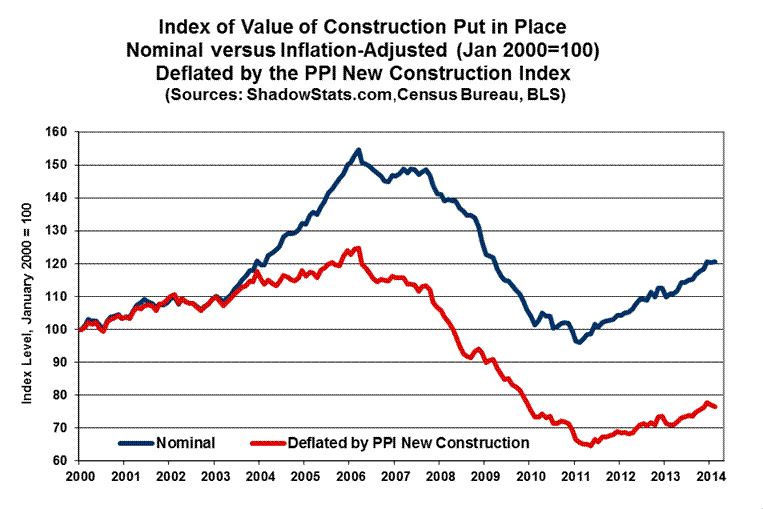
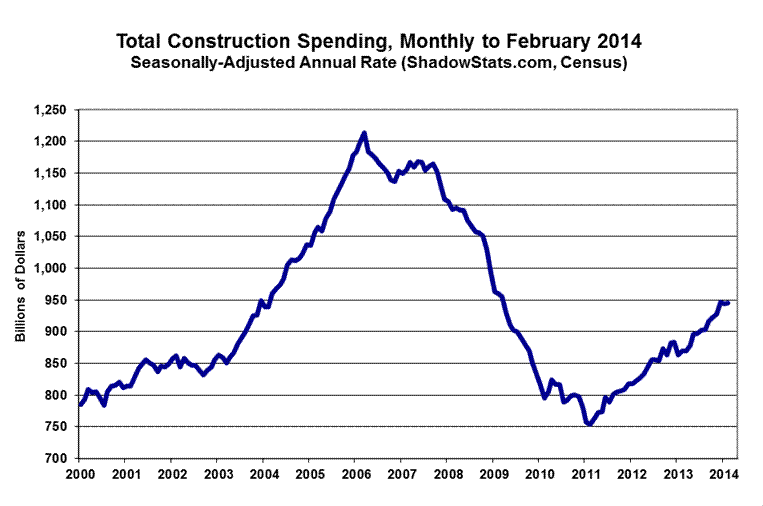
Construction and Related Graphs. The two graphs following reflect total construction spending through February 2014, before and after inflation adjustment. The inflation-adjusted graph is on an index basis, with January 2000 = 100.0.
Adjusted for the PPI’s NCI measure, real construction spending shows the economy slowing in 2006, plunging into 2011, then turning minimally higher in an environment of low-level stagnation and now showing some pullback, in the last two months of reporting. The pattern of inflation-adjusted activity here does not confirm the economic recovery shown in the headline GDP series (see Commentary No. 612). To the contrary, the latest construction reporting, both before (nominal) and after (real) inflation adjustment, shows a pattern of ongoing stagnation, as reflected in the first two graphs following.
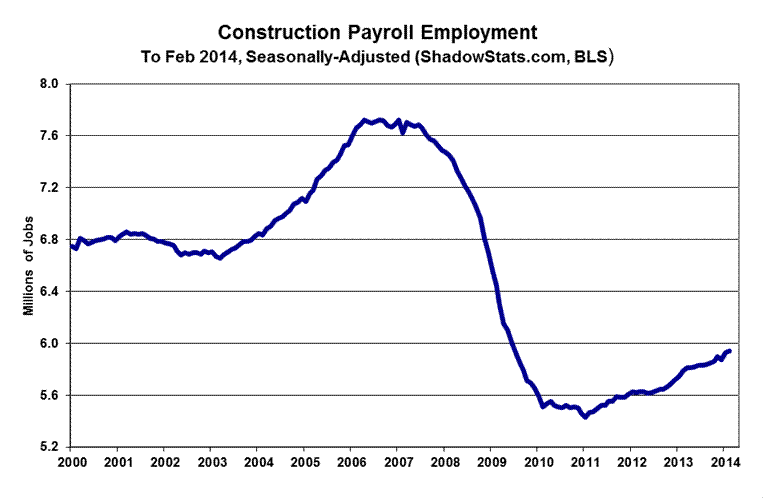
The third graph following reflects the reporting of February 2014 construction employment (see Commentary No. 607 for detail), which will be updated with tomorrow’s April 4th Commentary on the release of March 2014 labor conditions. In theory, payroll levels should move more closely with the inflation-adjusted aggregate series, where the nominal series reflects the impact of costs and pricing, as well as a measure of the level of physical activity.
The fourth graph following shows total nominal construction spending, broken out by the contributions from total-public (blue), private-nonresidential (yellow) and private-residential spending (red).


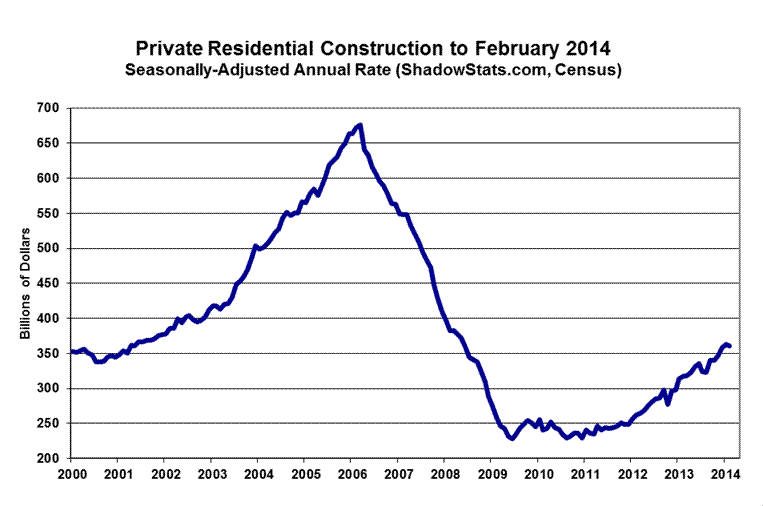
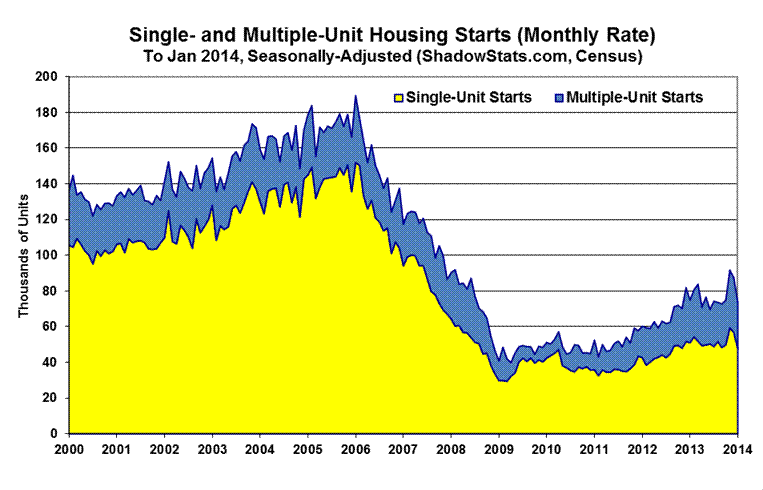
The next two graphs cover private residential construction, including housing starts data, for February.
As detailed in Commentary No. 610, the recent surge, and the subsequent, increasingly-corrective pullback in housing starts activity, likely was at least partially an artefact of surveying and reporting disruptions from the October government shutdown. Keep in mind that the construction spending series is in nominal (not-adjusted-for-inflation) dollars, while housing starts reflect unit volume, which should tend to be more parallel to the real (inflation-adjusted) series.
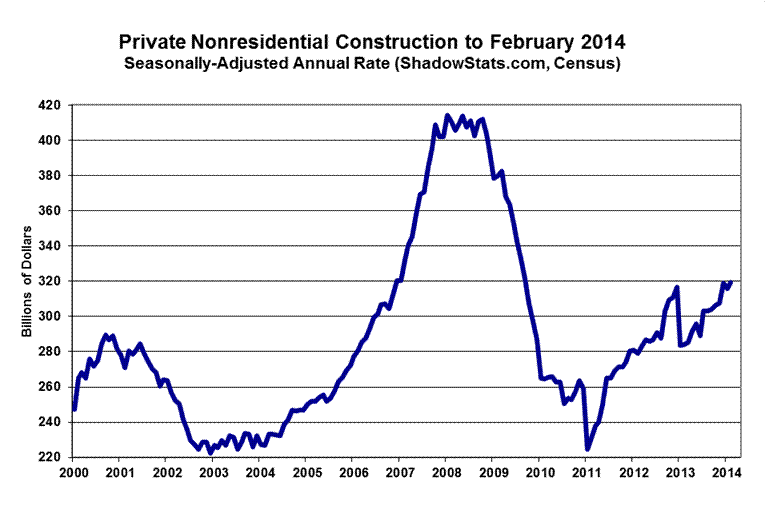
The last two graphs (third and fourth graph following), show the patterns of the monthly level of activity in private nonresidential construction spending and in public construction spending. The spending in private nonresidential construction remains well off its historic peak, but has bounced higher recently off a secondary, near-term dip in late-2012. Public construction spending, which is 98% nonresidential, continues in a broad downtrend, with intermittent, short-lived bounces.

__________
WEEK AHEAD
Much Weaker-Economic and Stronger-Inflation Reporting Likely in the Months and Year Ahead. Although shifting to the downside, market expectations generally still appear to be overly optimistic as to the economic outlook. Expectations should continue to be hammered, though, by continuing, downside corrective revisions and continued, disappointing headline economic activity. The initial stages of that process have been seen in the recent headline reporting of most major economic series.
That corrective circumstance and underlying weak economic fundamentals remain highly suggestive of deteriorating business activity. Accordingly, weaker-than-consensus economic reporting should become the general trend until such time as the unfolding “new” recession receives general recognition.
Stronger inflation reporting remains likely. Upside pressure on oil-related prices should reflect intensifying impact from a weakening U.S. dollar in the currency markets, and from ongoing global political instabilities. The dollar faces pummeling from continuing QE3, the ongoing U.S. fiscal-crisis debacle, a weakening U.S. economy and deteriorating U.S. and global political conditions (see Hyperinflation 2014—The End Game Begins). Particularly in tandem with a weakened dollar, reporting in the year ahead generally should reflect much higher-than-expected inflation.
A Note on Reporting-Quality Issues and Systemic Reporting Biases. Significant reporting-quality problems remain with most major economic series. Ongoing headline reporting issues are tied largely to systemic distortions of seasonal adjustments. The data instabilities were induced by the still-evolving economic turmoil of the last eight years, which has been without precedent in the post-World War II era of modern economic reporting. These impaired reporting methodologies provide particularly unstable headline economic results, where concurrent seasonal adjustments are used (as with retail sales, durable goods orders, employment and unemployment data), and they have thrown into question the statistical-significance of the headline month-to-month reporting for many popular economic series.
PENDING RELEASES:
Employment/Unemployment (March 2014). The Bureau of Labor Statistics (BLS) will release its March 2014 labor data tomorrow, Friday, April 4th. Following February’s stronger-than-consensus 175,000 gain in payroll employment, a downside surprise to expectations is a fair bet. The BLS trend model suggests a 178,000 jobs gain for March. While the consensus tends to close in around the trend, expectations seem to be running about 20,000 above trend. Underlying economic reality would suggest a downside reporting surprise versus both the trend and market expectations.
Further detail on the BLS trend model and indications of same for private-sector payrolls is available to ShadowStats readers here: March 2014 trend detail. This material is provided by ShadowStats affiliate www.ExpliStats.com.
Expectations for the headline March unemployment rate appear to be for U.3 to ease a notch from February’s 6.7% reading. Underlying fundamentals would suggest an upturn in U.3, but the BLS’s continuing purge of discouraged workers from the unemployment rolls would argue in favor of a lower rate. As discussed regularly in the employment/unemployment-related Commentaries, month-to-month comparisons of U.3 are of no meaning, because of the standard, inconsistent reporting calculations that leave the monthly data not comparable.
If U.3 drops, there likely would be some further labor-force loss associated with that. The broader U.6 and ShadowStats unemployment measures would tend to hold, or increase anew, at their broader and higher respective levels.
Again, all these numbers remain unsettled and could come in well outside general expectations.
__________