


No. 623: First-Quarter 2014 Gross Domestic Product (GDP)

COMMENTARY NUMBER 623
First-Quarter 2014 Gross Domestic Product (GDP)
April 30, 2014
__________
Not Annualized, First-Quarter GDP Gained Just 0.03%
Annualized GDP Change of Plus 0.1% Was Minus 1.0%,
Net of Questionable Healthcare Spending
Headline Weakness in GDP Reflected Consumer Liquidity Problems, Not Weather;
Adverse Weather Had Offsetting Impacts
__________
PLEASE NOTE: The next regular Commentary is scheduled for Friday, April 30th, covering April employment and unemployment, March construction spending and detail of the annual benchmark revision to retail sales (released today).
Best wishes to all — John Williams
OPENING COMMENTS AND EXECUTIVE COMMENTARY
The Economy Turns Down. The Bureau of Economic Analysis (BEA) has tremendous leeway in the level of growth that it reports in its first or “advance” estimate of headline GDP growth in a given quarter. Usually, the BEA attempts to target the initial headline growth estimate to consensus expectations, moving the internal BEA estimate towards the consensus number. Where the consensus appears to have been about 1.0% coming into this morning’s (April 30th) report, and where the BEA gave a 0.1% headline growth estimate—the lowest positive growth rate possible—the message was negative as to what the BEA was seeing in reality. The internal BEA estimate probably was for a quarterly contraction, and the message from the BEA to consensus forecasters likely was that the numbers were worse than they appeared, and that downside revisions are pending.
The inflation-adjusted, annualized headline growth of 0.11% (0.03% not annualized), primarily reflected constraints imposed on the consumer by structural liquidity issues, covered in 2014 Hyperinflation Report—Great Economic Tumble – Second Installment, and updated at the end of these Opening Comments. The downside pressures in areas such as housing already had hurt fourth-quarter GDP activity. Flailing consumer activity had been reflected in an involuntary buildup in inventories, which had helped to spike reported headline GDP growth recent quarters. Heavy negative impact on the first quarter GDP growth was seen in a pullback in growth of unwanted inventories, and in a large negative swing in the trade deficit.
Where the preceding elements largely were independent of weather impact, the popular press likely still will alibi the virtually unchanged level of first-quarter economic activity, based on unusually unseasonable weather. While there were effects from the weather, they went both ways, with a surge in consumer utility usage contributing 0.73% to the 0.11% headline GDP growth.
Headline GDP would have contracted by 1.00% in the quarter, but for a surge in healthcare spending, which likely reflected disruptions in the industry from changes in the health-insurance system. In a field that is transition, and where the numbers are nearly impossible to measure meaningfully under the best of conditions, these politically-sensitive numbers likely were guesstimated by the BEA. Unlike the impact of a positive trade balance, growth in this area is not a national wealth builder.
Fed Activity. Despite today’s continued tapering, if Federal Reserve Chair Janet Yellen is looking for weak economic data to provide the Fed with political cover for a future pullback in “tapering” or renewed expansion of quantitative easing, today’s GDP report was such cover (see the Opening Comments of 2014 Hyperinflation Report—Great Economic Tumble – Second Installment). Significantly-increasing political cover will be seen in the months ahead.
Retail Sales Benchmark Revision. Separate from the GDP, this morning also saw the publication of the annual benchmark revision to the retail sales series. Numerous changes were made, and the historical, aggregate data appear to be somewhat lower than they were before. Nominal (before inflation adjustment) activity in 2012 retail sales, for example, which would incorporate detail of the 2012 retail sales census, appears to have been revised lower by about 0.3%. An analysis of the full, aggregate revisions will be published in the Friday, May 2nd Commentary No. 624.
Headline First-Quarter 2014 Gross Domestic Product (GDP). The first or “advance” estimate of first-quarter 2014 GDP effectively showed an unchanged level, a statistically-insignificant, real (inflation-adjusted), annualized, quarterly gain of 0.11% +/- 3.5% (95% confidence interval). That was against a 2.63% headline gain in fourth-quarter 2013, a 4.13% gain in third-quarter 2013, a 2.48% increase in second-quarter 2013 and a 1.15% gain in the first-quarter 2013. First-quarter 2014 GDP year-to-year growth was 2.33%, versus 2.59% in fourth-quarter 2013, 1.97% in the third-quarter, 1.63% in the second-quarter and 1.32% in the first-quarter 2013 (see graphs in the Reporting Detail section).
Implicit Price Deflator (IPD). The initial estimate of first-quarter 2014 GDP inflation, or the implicit price deflator (IPD), was at an annualized quarterly pace of 1.30%, versus 1.58% in fourth-quarter 2013, 1.97% in the third-quarter, 0.58% in the second-quarter and against 1.67% in the first-quarter. Year-to-year, first-quarter 2014 IPD inflation was 1.36%, versus 1.45% in fourth-quarter 2013, 1.41% in the third-quarter, 1.44% in the second-quarter and 1.74% in the first-quarter. The weaker the inflation rate used in deflating an economic series, the stronger will be the resulting inflation-adjusted growth.
For comparison purposes, seasonally-adjusted and annualized quarter-to-quarter, headline CPI-U inflation (Bureau of Labor Statistics—BLS) was up by 1.91% in first-quarter 2014, versus 1.14% in fourth-quarter 2013, 2.16% in the third-quarter, 0.40% in the second-quarter, and 1.19% in the first-quarter. On a year-to-year basis, first-quarter 2014 CPI-U (unadjusted) inflation was 0.86%, versus 1.23% in fourth-quarter 2013, 1.55% in the third-quarter, 1.39% in the second-quarter, and 1.68% in the first-quarter.
Gross National Product (GNP) and Gross Domestic Income (GDI). The initial estimates of first-quarter 2014 GNP and GDI will not be published until next month, given the unreliability of available data. Similar issues with the GDP data argue for a delayed release of that headline number, as well.
GNP is the broadest measure of U.S. economic activity, and GDP is GNP net of trade flows in factor income (interest and dividend payments). GDI is the theoretical income-side equivalent of the consumption-side GDP estimate.
Distribution of Headline GDP Growth. Despite the severely-limited significance of the following detail, it is included for those interested in the reported internal patterns of GDP growth, as guessed at by the BEA. Statistically indistinguishable from an actual quarter-to-quarter gain or contraction, the “advance” estimate of headline growth in first-quarter 2014 GDP was up by 0.11% (0.03% not annualized). That annualized growth rate is detailed in the following aggregation of contributed growth. Please note that the annualized growth number in each sub-category is the additive contribution to the aggregate, headline change in GDP, where 2.04% - 1.01% - 0.83% - 0.09% = 0.11%. Fourth-quarter 2013 aggregate headline GDP growth was estimated at 2.63%:


· Consumer Spending Contributed 2.04% to First-Quarter Growth; 2.22% in Fourth-Quarter. Consumer-dependent personal consumption accounts for 68% of the GDP, but the outright contraction in first-quarter retail sales was not evident in the first-quarter personal-consumption headline reporting or detail. As with the fourth-quarter detail, rising healthcare costs and spiked utility usage dominated personal-consumption services data, and accounted for 1.83% of the 0.11% headline GDP growth. In other words, the headline GDP would have contracted by 1.72% without those contributions (see the preceding graph, courtesy of ShadowStats affiliate www.ExpliStats.com).
· Business/Residential Investment Subtracted 1.01% from First-Quarter Growth; Contributed 0.41% to Fourth-Quarter. The contraction in private investment included falling computer sales and a continued contraction in residential investment. Further, a slowdown in the buildup of unwanted inventories knocked 0.57% off the headline GDP growth rate. Accordingly “final sales”—GDP net of inventory change—was at an annualized 0.68% pace of growth, versus 2.61% in fourth-quarter 2013.
· Net Exports Subtracted 0.83% from First-Quarter Growth; Contributed 0.99% to Fourth-Quarter. Consistent with the recent headline monthly trade data (only two months available for first-quarter 2014), which suggested a quarterly deterioration in the trade deficit, the net-export account subtracted 0.83% from the headline GDP growth, where the same account had added 0.99% to the headline growth rate of the quarter before.
· Government Spending Subtracted 0.09% from First-Quarter Growth; Subtracted 0.99% in Fourth-Quarter. Federal government spending made a 0.05% positive contribution to first-quarter GDP growth (0.16% positive from nondefense, 0.11% negative from defense), otherwise dominated by a 0.14% negative contribution from spending by state and local governments.
Economic Reality. With first-quarter 2014 GDP growth at the level of statistical-noise around “unchanged,” the general outlook has not been altered, and the broad economy appears to have turned down anew. The gist of much of the following text is along the lines of other recent GDP commentaries, but the details and numbers have been updated for today’s initial reporting of aggregate first-quarter 2014 economic activity.
The GDP remains the most-worthless and the most-heavily modeled, massaged and politically-manipulated of government economic series. It does not reflect properly or accurately the changes to the underlying fundamentals that drive the economy. Underlying real-world economic activity suggests that the broad economy began to turn down in 2006 and 2007, plunged into 2009, entered a protracted period of stagnation thereafter—never recovering—and then began to turn down anew in second- and third-quarter 2012 (see 2014 Hyperinflation Report—The End Game Begins – First Installment Revised, and 2014 Hyperinflation Report—Great Economic Tumble – Second Installment ). Irrespective of the reporting gimmicks introduced in the July 2013 GDP benchmark revision, the consistent, fundamental pattern of historical activity is shown in the accompanying “corrected” GDP graph.
Please note that the pattern of activity shown for the “corrected” GDP series is much closer to the patterns shown in the graphs of monthly real median household income and other liquidity measures (as updated at the end of these Opening Comments) and of economic series not otherwise reliant on understated inflation for their reported growth (see the second installment of the hyperinflation report). A sustainable business recovery could not have taken place since 2009, and a recovery will not be forthcoming until the consumer’s structural income and liquidity problems are resolved.
Official and Corrected GDP. As usually discussed in the Commentaries covering the quarterly GDP reporting and monthly revisions, the full economic recovery indicated by the official, real GDP numbers remains an illusion. It is a statistical illusion created by using too-low a rate of inflation in deflating (removing inflation effects) from the GDP series. The accompanying two graphs tell that story, updated for the initial estimate of first-quarter 2014 GDP.
Shown in the first graph of official Headline Real GDP, GDP activity has been reported above pre-2007 recession levels—in full recovery—since second-quarter 2011 (it had been fourth-quarter 2011 before the July 2013 benchmarking), and headline GDP had shown sustained growth since, now flattening out with the first-quarter 2014 estimate. Adjusted for official GDP inflation (the implicit price deflator), the level of first-quarter 2014 GDP now stands at 6.3% (same as the fourth-quarter) above the pre-recession peak-GDP estimate of fourth-quarter 2007. In contrast, the “corrected” GDP version, in the second graph, shows fourth-quarter GDP activity at 6.4% below the pre-recession peak of first-quarter 2006 (it was down by 6.0% as of fourth-quarter 2013 reporting).

Also, as discussed in the second installment of the hyperinflation report, no other major economic series has shown a parallel pattern of official full economic recovery and meaningful expansion beyond, consistent with the GDP reporting. Either the GDP reporting is wrong, or all other major economic series are wrong. While the GDP is heavily modeled, imputed, theorized and gimmicked, it also encompasses reporting from those various major economic series and private surveys, which still attempt to survey real-world activity. Flaws in the GDP inflation methodologies and simplifying reporting assumptions have created the “recovery.”
The second graph plots the Corrected Real GDP, corrected for the understatement inherent in official inflation estimates, with the deflation by the implicit price deflator (IPD) adjusted for understatement of roughly two-percentage points of annual inflation. The inflation understatement has resulted from hedonic-quality adjustments, as discussed in the hyperinflation reports. Both graphs here are indexed to first-quarter 2000 = 100.

Continuing Structural Consumer Liquidity Squeeze. Serious, structural liquidity problems continue to impair consumer activity, as discussed frequently in these Commentaries and as indicated in the accompanying graphs. Without real, inflation-adjusted, growth in income, and without the ability or willingness to take on meaningful new debt, the consumer simply cannot sustain real growth in retail sales or in the personal-consumption activity that dominates the headline growth in GDP (see 2014 Hyperinflation Report—Great Economic Tumble – Second Installment, particularly as to the latest, limited growth in consumer credit outstanding).
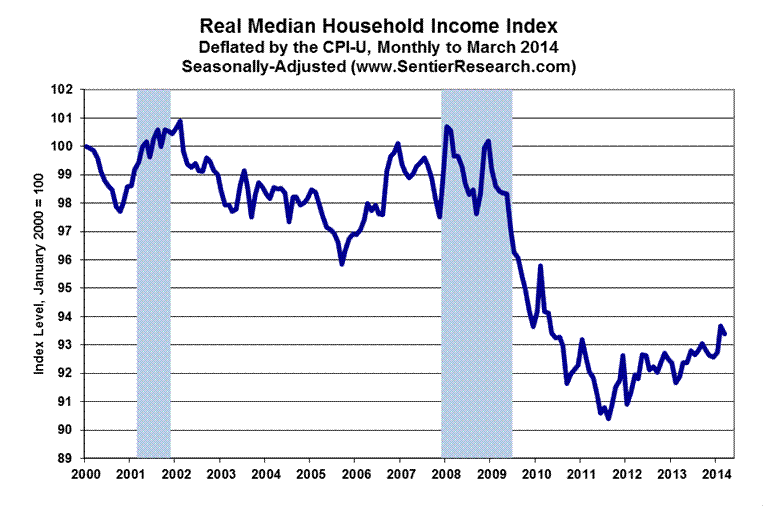
The first graph following of real median household income by month, based on data published by www.SentierResearch.com, showed continued income stagnation in March 2014, with real median household income remaining near the cycle-low for the series.
As the GDP purportedly was starting a solid recovery in mid-2009, household income plunged to new lows. Deflated by headline CPI-U, the annual series published by the Census Bureau showed further that annual real median household income in 2012 was at levels seen in the late-1960s and early-1970s (again, see the Hyperinflation Report – Second Installment).
The second and third graphs reflect the April 2014 reporting of the ever-volatile consumer confidence (Conference Board) and consumer sentiment (University of Michigan) indices. Current levels for both series remain deep in traditional-recession territory. The pattern here, as with household income, has been one of collapse and stagnation, as opposed to the pattern of economic collapse and recovery indicated by the faulty GDP series.
Again, without growth in real income; without the ability or the will to expand debt meaningfully; and without the confidence to take on new debt, where possible; the consumer simply cannot sustain real growth in retail sales, housing or in the dominant, personal-consumption measure of the GDP. There is no broad economic recovery that is pending or underway.


[For further detail on first-quarter 2014 GDP, see the Reporting Detail section]
__________
HYPERINFLATION WATCH
Money Supply Velocity. Incorporating the new nominal data on first-quarter 2014 GDP, as well as recent Federal Reserve benchmark revisions to money supply-related data, updated estimates of money velocity for money supply M2 and M3 are graphed below. Velocity turned slightly lower in fourth-quarter 2014 for both money-supply M2 and M3 (ShadowStats Ongoing-M3 Measure), as shown in the accompanying graph.
Where velocity simply is the ratio of the nominal GDP to the money supply number, the downturn in the quarter, here, reflects somewhat stronger money growth and weakening GDP.
Subscribers often ask for specifics on the velocity of the money supply, with the result that this section has become a standard feature for Commentaries covering the first GDP reporting of a given quarter. The nature of velocity is discussed in some detail in the 2008 Money Supply Special Report. Velocity simply is the number of times the money supply turns over in the economy in a given year, or the ratio in nominal terms (not adjusted for inflation) of GDP to the money supply. It is a residual number, not otherwise open to calculation.

Velocity has theoretical significance, where, in combination with money-supply growth, it should be a driving force behind inflation. Yet, since velocity is a ratio of two numbers that are not particularly well or realistically measured, its actual estimate is of very limited value. As an inflation predictor, it has to be viewed in the context of accompanying money-supply growth, and vice versa, generally as a coincident indicator, with limited predictive value.
M3 and M2 had been showing opposite patterns since 2011, because growth in M3 has been weaker than growth in M2. The reason behind that difference was that much of the relatively stronger M2 growth reflected cash moving out of M3 categories—such as large time deposits and institutional money funds—into M2 or M1 accounts. The clarity of what happened there is why ShadowStats still tracks what had been the broadest money measure (M3) available. Again, full definitions can be found in the Money Supply Special Report.
Hyperinflation Summary Outlook. The hyperinflation and economic outlook were updated with the publication of 2014 Hyperinflation Report—The End Game Begins – First Installment Revised, on April 2nd, and publication of 2014 Hyperinflation Report—Great Economic Tumble – Second Installment, on April 8th. Consistent with those Special Commentaries and incorporating the renewed official business slowdown/downturn evident in today’s initial estimate of first-quarter 2014 GDP, a revised summary outlook is planned soon for this section.
__________
REPORTING DETAIL
GROSS DOMESTIC PRODUCT—GDP (First-Quarter 2014, First or “Advance” Estimate)
No Economic Growth Here. This morning’s (April 30th) initial estimate of first-quarter 2014 GDP headline growth of 0.1%—effectively unchanged—was a downside surprise for market expectations of about 1.0%. As discussed in the Opening Comments, the estimating Bureau of Economic Analysis (BEA) tends to move its internal estimate towards the consensus outlook for initial reporting. These numbers suggest not only that the internal BEA numbers were negative for the quarter, but also that downside revisions are likely in the months ahead. The indications of negative quarterly change from recent trade and housing numbers generally proved out. There was little indication of the quarterly contraction in first-quarter real retail sales in the related categories of personal consumption expenditures (see Commentary No. 621).
The GDP remains the most-worthless and the most-heavily modeled, massaged and politically-manipulated of government economic series. It does not reflect properly or accurately the changes to the underlying fundamentals that drive the economy. Underlying real-world economic activity suggests that the broad economy began to turn down in 2006 and 2007, plunged into 2009, entered a protracted period of stagnation thereafter—never recovering—and then began to turn down anew in second- and third-quarter 2012 (see 2014 Hyperinflation Report—The End Game Begins – First Installment Revised, and 2014 Hyperinflation Report—Great Economic Tumble – Second Installment ).
__________________
Notes on GDP-Related Nomenclature and Definitions
For purposes of clarity and the use of simplified language in the text of the GDP analysis, here are definitions of several key terms used related to GDP reporting:
Gross Domestic Product (GDP) is the headline number and the most widely followed broad measure of U.S. economic activity. It is published quarterly by the Bureau of Economic Analysis (BEA), with two successive monthly revisions, and with an annual revision in the following July.
Gross Domestic Income (GDI) is the theoretical equivalent to the GDP, but it generally is not followed by the popular press. Where GDP reflects the consumption side of the economy and GDI reflects the offsetting income side. When the series estimates do not equal each other, which almost always is the case, since the series are surveyed separately, the difference is added to or subtracted from the GDI as a “statistical discrepancy.” Although the BEA touts the GDP as the more accurate measure, the GDI is relatively free of the monthly political targeting the GDP goes through.
Gross National Product (GNP) is the broadest measure of the U.S. economy published by the BEA. Once the headline number, now it rarely is followed by the popular media. GDP is the GNP net of trade in factor income (interest and dividend payments). GNP growth usually is weaker than GDP growth for net-debtor nations. Games played with money flows between the United States and the rest of the world tend to mute that impact on the reporting of U.S. GDP growth.
Real (or Constant Dollars) means the data have been adjusted, or deflated, to reflect the effects of inflation.
Nominal (or Current Dollars) means growth or level has not been adjusted for inflation. This is the way a business normally records revenues or an individual views day-to-day income and expenses.
GDP Implicit Price Deflator (IPD) is the inflation measure used to convert GDP data from nominal to real. The adjusted numbers are based on “Chained 2009 Dollars,” as introduced with the 2013 comprehensive revisions, where 2009 is the base year for inflation. “Chained” refers to the substitution methodology which gimmicks the reported numbers so much that the aggregate of the deflated GDP sub-series missed adding to the theoretically-equivalent deflated total GDP series by $41.8 billion in “residual,” as of the initial estimate of second-quarter 2013.
Quarterly growth, unless otherwise stated, is in terms of seasonally-adjusted, annualized quarter-to-quarter growth, i.e., the growth rate of one quarter over the prior quarter, raised to the fourth power, a compounded annual rate of growth. While some might annualize a quarterly growth rate by multiplying it by four, the BEA uses the compounding method, raising the quarterly growth rate to the fourth power. So a one percent quarterly growth rate annualizes to 1.01 x 1.01 x 1.01 x 1.01 = 1.0406 or 4.1%, instead of 4 x 1% = 4%.
Annual growth refers to the year-to-year change of the referenced period versus the same period the year before.
__________________
Gross Domestic Product (GDP). Published this morning, April 30th, by the Bureau of Economic Analysis (BEA), the first or “advance” estimate of first-quarter 2014 GDP showed effectively an unchanged level, a statistically-insignificant, real (inflation-adjusted), annualized, quarterly gain of 0.11% +/- 3.5% (95% confidence interval). That was against a 2.63% headline gain in fourth-quarter 2013, a 4.13% gain in third-quarter 2013, a 2.48% increase in second-quarter 2013 and a 1.15% gain in the first-quarter.
Distribution of the headline quarterly GDP growth rate, by major component, is detailed in the Opening Comments section.
Shown in the following two graphs are the latest year-to-year or annual real rates of change for the GDP series. First-quarter 2014 GDP year-to-year growth was 2.33%, versus 2.59% in fourth-quarter 2013, 1.97% in the third-quarter, 1.63% in the second-quarter and 1.32% in the first-quarter 2013.
The first graph shows near-term historical detail since 2000. The second graph shows the full history of the series. The latest quarterly year-to-year growth remained below the near-term peak of 3.13% growth reported for third-quarter 2012. The current-cycle trough was in second-quarter 2009 at a 4.09% year-to-year decline. That was the deepest annual contraction seen for any quarterly GDP in the history of the series, which began with first-quarter 1947.


Implicit Price Deflator (IPD). The initial estimate of first-quarter 2014 GDP inflation, or the implicit price deflator (IPD), was at an annualized quarterly pace of 1.30%, versus 1.58% in fourth-quarter 2013, 1.97% in the third-quarter, 0.58% in the second-quarter and against 1.67% in the first-quarter. Year-to-year, first-quarter 2014 IPD inflation was 1.36%, versus 1.45% in fourth-quarter 2013, 1.41% in the third-quarter, 1.44% in the second-quarter and 1.74% in the first-quarter 2013.
For comparison purposes, on a seasonally-adjusted, annualized quarter-to-quarter basis, CPI-U inflation published by the Bureau of Labor Statistics (BLS), headline CPI-U inflation was up by 1.91% in first-quarter 2014, versus 1.14% in fourth-quarter 2013, 2.16% in the third-quarter, 0.40% in the second-quarter, and 1.19% in the first-quarter. On a year-to-year basis, first-quarter 2014 CPI-U (unadjusted) inflation was 0.86%, versus 1.23% in fourth-quarter 2013, versus 1.55% in the third-quarter, 1.39% in the second-quarter, and 1.68% in the first-quarter 2013.
The weaker the inflation rate used in deflating an economic series, the stronger will be the resulting inflation-adjusted growth.
ShadowStats-Alternate GDP. The ShadowStats-Alternate GDP estimate for first-quarter 2014 GDP is a 1.9% year-to-year contraction, versus a headline year-to-year gain of 2.3%. The alternate fourth-quarter 2013 estimate was a 1.4% year-to-year contraction, versus a headline year-to-year gain of 2.6% (see the Alternate Data tab).
While annualized real quarterly growth is not estimated formally on an alternate basis, a quarter-to-quarter contraction remains a possibility for actual headline growth in the fourth-quarter, but that would not be evident until after the annual revisions to the GDP are published in July 2014. An actual quarterly contraction appears to have been a realistic possibility for the real GDP in most quarters since the official second-quarter 2009 end to the recession.
Adjusted for gimmicked inflation and other methodological changes (such as the inclusion of intellectual property, including software), the business downturn that began in 2006/2007 is ongoing; there has been no meaningful economic rebound. The corrected real GDP graph (see the Opening Comments section) is based on the removal of the impact of hedonic quality adjustments that have reduced the reporting of official annual GDP inflation by roughly two-percentage points. It is not the same measure as the ShadowStats-Alternate GDP, which reflects reversing additional methodological distortions (“Pollyanna Creep”) of recent decades.
Gross National Product (GNP) and Gross Domestic Income (GDI). The initial estimates of first-quarter 2014 GNP and GDI will not be published until next month, given the unreliability of available data. Similar issues with the GDP data argue for a delayed release of the headline number there, as well.
GNP is the broadest measure of U.S. economic activity, and GDP is GNP net of trade flows in factor income (interest and dividend payments). GDI is the theoretical income-side equivalent of the consumption-side GDP estimate. See the earlier “notes on GDP” for further detail.
__________
WEEK AHEAD
Much-Weaker-Economic and Stronger-Inflation Reporting Likely in the Months and Year Ahead. Although shifting to the downside, market expectations generally still appear to be overly optimistic as to the economic outlook. Expectations should continue to be hammered, though, by ongoing downside corrective revisions and further, disappointing headline economic activity. The initial stages of that process have been seen in the recent headline reporting of many major economic series (see 2014 Hyperinflation Report—Great Economic Tumble – Second Installment).
That corrective circumstance and underlying weak economic fundamentals remain highly suggestive of deteriorating business activity. Accordingly, weaker-than-consensus economic reporting should become the general trend until such time as the unfolding “new” recession receives general recognition.
Stronger inflation reporting also remains likely. Upside pressure on oil-related prices should reflect intensifying impact from a weakening U.S. dollar in the currency markets, and from ongoing global political instabilities. Food inflation has started to pick up as well. The dollar faces pummeling from continuing QE3, the ongoing U.S. fiscal-crisis debacle, a weakening U.S. economy and deteriorating U.S. and global political conditions (see Hyperinflation 2014—The End Game Begins (Updated) – First Installment). Particularly in tandem with a weakened dollar, reporting in the year ahead generally should reflect much higher-than-expected inflation.
A Note on Reporting-Quality Issues and Systemic Reporting Biases. Significant reporting-quality problems remain with most major economic series. Ongoing headline reporting issues are tied largely to systemic distortions of seasonal adjustments. The data instabilities were induced by the still-evolving economic turmoil of the last eight years, which has been without precedent in the post-World War II era of modern economic reporting. These impaired reporting methodologies provide particularly unstable headline economic results, where concurrent seasonal adjustments are used (as with retail sales, durable goods orders, employment and unemployment data), and they have thrown into question the statistical-significance of the headline month-to-month reporting for many popular economic series.
PENDING RELEASES:
Construction Spending (March 2014). The Commerce Department is scheduled to release its estimate of March 2014 construction spending tomorrow, Thursday, May 1st. The headline monthly changes, as usual, should not be statistically significant, while previous data again may be subject to unusually large and unstable revisions.
Employment/Unemployment (April 2014). The Bureau of Labor Statistics (BLS) will release its April 2014 labor data on Friday, May 2nd. Following March’s stronger-than-consensus and artificially-bloated 192,000 gain in payroll employment, a downside surprise to even-stronger April expectations is a fair bet. The BLS trend model suggests a 210,000 headline jobs gain for April (see Commentary No. 618). For further detail, including the BLS trend estimates for private employment, prepared by ShadowStats affiliate www.ExpliStats.com, see the following link: Private Employment Trend.
The consensus tends to close in around the trend, and expectations for total payrolls seem to be running near trend level. Again, underlying economic reality would suggest a downside surprise versus both the trend and market expectations.
Expectations also appear to be for the headline April U.3 unemployment rate to ease a notch from March’s 6.7% reading. Underlying fundamentals would suggest an upturn in U.3, but the BLS’s continuing purge of discouraged workers from the unemployment rolls would argue in favor of a lower rate. As discussed regularly in the employment/unemployment-related Commentaries, month-to-month comparisons of U.3 are of no meaning, because of the standard, inconsistent reporting calculations that leave the monthly data not comparable.
If U.3 drops, there likely would be some further labor-force loss associated with that. The broader U.6 and ShadowStats unemployment measures would tend to hold, or increase anew, at their broader and higher respective levels. All these Labor Department numbers remain unsettled and could come in well outside general expectations.
__________