


No. 626: April Retail Sales, Consumer Liquidity

COMMENTARY NUMBER 626
April Retail Sales, Consumer Liquidity
May 13, 2014
__________
CPI-Adjusted April Retail Sales Likely Contracted
Increasingly Unstable Retail Sales Reporting, Despite Recent Benchmarking
Impaired Consumer Liquidity Continues to Constrain Consumption
__________
PLEASE NOTE: The next regular Commentary is scheduled for Thursday, May 15th, covering April PPI, CPI, real retail sales and earnings, and industrial production, followed by one on May 16th, covering April housing starts.
Best wishes to all — John Williams
OPENING COMMENTS AND EXECUTIVE COMMENTARY
No Relief for the Economy Amidst Increasingly Unstable Data. In the wake of incredibly-unstable April unemployment data, which told a horrific headline-unemployment story (see Commentary No. 624), today’s (May 13th) headline gain of 0.1% in April retail sales was no better. Not only was the monthly sales gain below market consensus and less than the likely headline CPI-U inflation, but also it was in the context of highly unstable revisions and reporting.
The reporting issues—for both the unemployment and retail sales series—are due to the concealed heavy shifting of seasonal factors, which can distort current headline month-to-month reporting meaningfully. Offsetting historical revisions are masked, because they are not published at all (unemployment) or published only on an extremely limited basis (retail sales). Such has been the legacy of the use of concurrent-seasonal-factor adjustments (see discussion in the Reporting Detail section and in Commentary No. 624). The monthly recalculation of seasonal adjustments in a period of economic instability can result in particularly-unstable, adjusted monthly patterns, as was evident during the month-to-month collapse of various economic series in 2008 and 2009. Regular seasonal patterns simply became overwhelmed by the unusual economic activity.
This problem also has the potential to mask underlying business trends, with the economy—in the present circumstance—transitioning into renewed downturn. While the recent headline data have been consistent with that downturn, the numbers, again, have been unstable and are of ongoing questionable quality.
Today’s relatively brief missive focuses on the headline reporting of nominal (not adjusted for inflation) retail sales for April 2014, and on the underlying factors still impairing consumer liquidity. Real, or inflation-adjusted, retail sales will be covered in the May 15th Commentary No. 627, covering April CPI reporting, as well as real earnings and industrial production. Commentary No. 628 on May 16th, covering housing starts, also will include a review of major economic reporting for April, published through that date.
April 2014 Retail Sales—Likely Contracted, Adjusted for Inflation. Aside from not being statistically-significant, the 0.09% monthly gain in nominal April 2014 retail sales likely did not exceed the pace of headline April inflation. That should mean a headline monthly contraction in the inflation-adjusted real retail sales series for April.
The latest nominal reporting was in the context of the April 30th retail sales benchmark revision (see Commentary No. 624), which tended to lower the reported annual sales growth of recent years. Dominated by the 2012 census of retail sales, monthly year-to-year growth rates were lowered by an average of 0.1% in 2011, and by 0.2% from January 2012 through March 2014. The changes were enough to promise some downside-revision pressures to the historical GDP, with the annual GDP revision due on July 30th.
Nominal (Not-Adjusted-for-Inflation) Retail Sales—April 2014. Beyond the benchmarking, the latest headline retail sales detail also was in the context of a post-benchmark upside revision to March 2014 retail sales. Not adjusted for consumer inflation, headline April 2014 retail sales indicated a statistically-insignificant, seasonally-adjusted, monthly gain of 0.09%, which was a monthly gain of 0.54% before post-benchmark revisions. The April gain followed a post-benchmark revised, statistically-significant monthly gain of 1.55% in March.
Year-to-year growth in April 2014 retail sales was a statistically-significant 4.05%, versus a post-benchmark revised 4.18% gain in March 2014.
Real (Inflation-Adjusted) Retail Sales—April 2014. The headline 0.09% nominal gain in the monthly April retail sales was before accounting for inflation. Real retail sales for April, will be reported along with the headline estimate of consumer inflation, the April CPI-U, in the May 15th Commentary No. 627. As discussed in the Week Ahead section, April headline inflation should be on the plus-side, likely leaving the headline April real retail sales in a month-to-month contraction.
No Relief from the Consumer Liquidity Squeeze. As discussed frequently in these Commentaries, significant, structural liquidity problems continue, and they impair and constrain consumer activity. Except for the plot of consumer credit outstanding, as of March 2014, new details for the accompanying liquidity-related graphs have not been published since they were shown last in Commentary No. 623.
Without real, inflation-adjusted, growth in income, and without the ability or willingness to take on meaningful new debt, the consumer simply cannot sustain real growth in retail sales (see 2014 Hyperinflation Report—Great Economic Tumble – Second Installment).
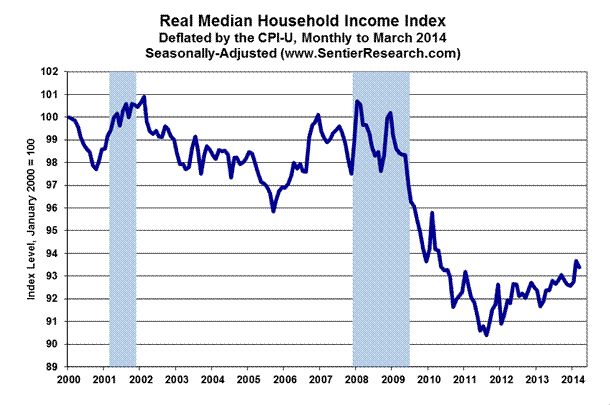
The first graph following of real median household income by month, based on data published by www.SentierResearch.com, showed continued income stagnation in March 2014, with real median household income remaining near the cycle-low for the series.
As the GDP purportedly started a solid recovery in mid-2009, household income plunged to new lows. Deflated by headline CPI-U, the annual series published by the Census Bureau showed further that annual real median household income in 2012 was at levels seen in the late-1960s and early-1970s (again, see the Hyperinflation Report – Second Installment).
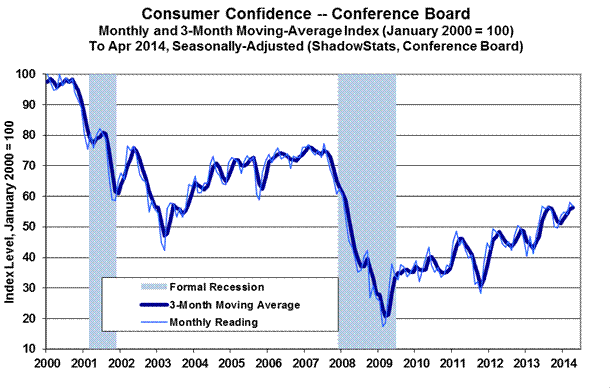
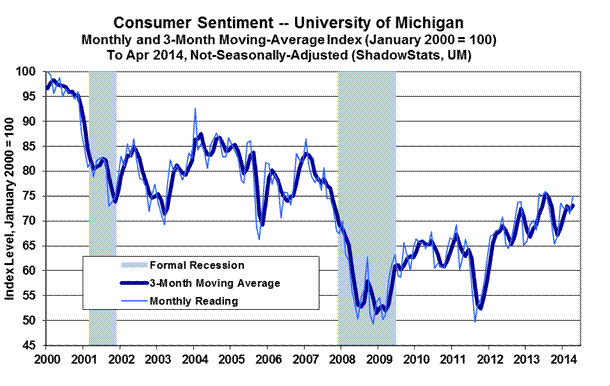
The second and third graphs following reflect the April 2014 reporting of the ever-volatile consumer confidence (Conference Board) and consumer sentiment (University of Michigan) indices. Current levels for both series remain deep in traditional-recession territory. The patterns with these series, as with household income, have been of collapse and stagnation, as opposed to the pattern of economic collapse and recovery indicated by the faulty GDP series.
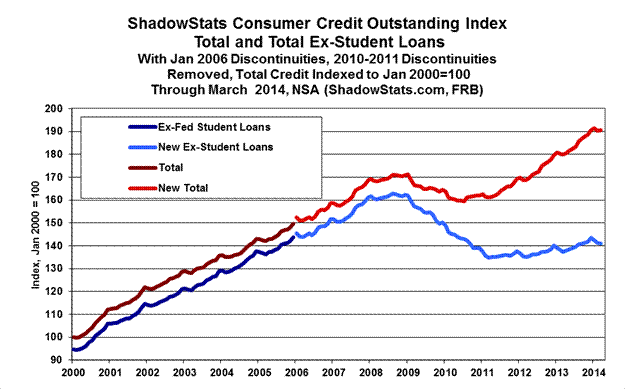
The final graph is of consumer credit outstanding, based on the detail published by the Federal Reserve Board, through March 2014. The unadjusted series shows that all the consumer credit growth of the last four years has been in federally-held student loans, not from bank lending that otherwise would tend to help fuel basic consumption.
Again, without growth in real income; without the ability or the will to expand debt meaningfully; and without the confidence to take on new debt, where possible; the consumer simply cannot sustain real growth in retail sales, housing or in the dominant, personal-consumption component of the GDP. As recently redefined, personal consumption accounts for 68% of the GDP. There has been no broad economic recovery, and there is none that is underway or pending.
[For further detail on April retail sales, see the Reporting Detail section]
__________
HYPERINFLATION WATCH
Hyperinflation Summary Outlook. The hyperinflation and economic outlooks were updated with the publication of 2014 Hyperinflation Report—The End Game Begins – First Installment Revised, on April 2nd, and publication of 2014 Hyperinflation Report—Great Economic Tumble – Second Installment, on April 8th. A basic summary of the broad outlook is found in the Opening Comments and Overview and Executive Summary in the First Installment Revised. The broad outlook for a hyperinflationary great depression beginning this year has not changed—only evolved—with various details continuing to fall into place. A formal and more-condensed summary of the extraordinarily-difficult times ahead will take over this section, soon. What follows here is detail on the evolving economic outlook—with negligible language change from prior Commentary No. 625—to be incorporated into that summary.
Economy Turns Down Anew. Consistent with the above Special Commentaries, a renewed U.S. business slowdown/downturn was evident in the initial headline estimate of first-quarter 2014 GDP, with an annualized headline growth of 0.11% (Commentary No. 623). As the patterns of headline growth in economic reporting continue to slow and to turn down, financial-market expectations increasingly should shift towards renewed or deepening recession. That circumstance, in turn, in confluence with other fundamental issues, should place mounting and massive selling pressure on the U.S. dollar, as well as potentially resurrect elements of the 2008-Panic.
The fundamental issues threatening the dollar, again, include, but are not limited to: the U.S. government not addressing its long-term solvency issues; monetary malfeasance by the Federal Reserve seeking to provide liquidity to a troubled banking system, and to the U.S. Treasury, with a current pace of 70% monetization of effective net issuance of public federal debt; a mounting domestic and global crisis of confidence in a dysfunctional U.S. government; mounting global political pressures contrary to U.S. interests; and a severely damaged U.S. economy, which never recovered post-2008 and is turning down anew (including a widening trade deficit).
The reporting of the March 2014 trade data, confirmed the steep deterioration in the first-quarter trade deficit, sharply reducing the chances for a major change to initial, headline first-quarter GDP growth in the pending two regular revisions. Watch out, though, for the annual benchmarking on July 30th.
Generally reflecting weaker data in revisions to underlying data, downside revisions to recent GDP reporting are likely in the annual benchmark revisions. Specifically, underlying current economic activity actually is deteriorating and weak enough that the benchmark GDP revision likely will show a contracting first-quarter 2014 GDP, coincident with the initial reporting of a contraction in second-quarter 2014 GDP (also July 30th). That quickly should gain formal recognition as a new recession.
Following the unstable, questionable and otherwise horrendous unemployment reporting for April 2014 (see Commentary No. 624), and today’s softer-than-expected headline April retail sales number, most of the other monthly economic series in April (see Week Ahead section) through June should continue to show or suggest ongoing contraction in broad economic activity. If that happens, market expectations—and related financial-market reactions—should move into the “renewed recession” camp, well before the July 30th GDP benchmarking.
__________
REPORTING DETAIL
RETAIL SALES (April 2014)
April Retail Sales Likely Contracted, Net of Inflation Effects. Aside from not being statistically-significant, the 0.09% monthly gain in April 2014 retail sales likely did not exceed the headline CPI-U inflation rate for the month. That means headline real (inflation-adjusted) retail sales likely contracted month-to-month in April.
The latest nominal retail sales reporting was in the context of the April 30th benchmark revision to historical reporting of recent years (see Commentary No. 624), which tended to lower the annual sales growth of recent years. Dominated by the 2012 census of retail sales, monthly year-to-year growth rates were lowered by an average of 0.1% in 2011, and by 0.2% from January 2012 onward, through March 2014. The changes were enough to offer some downside-revision pressures to historical GDP reporting. Annual GDP revisions are scheduled for July 30th.
Reporting Instabilities and Distortions. Despite the benchmark revision having reported all the recent, seasonally-adjusted historical data on a consistent basis, the year ago numbers for March and April 2013 were just revised with the new April data, as were all other historical numbers, but only the March and April details were published. These prior-period, post-benchmark revisions of one year ago reflected nothing more than continuing unstable monthly revisions in the concurrent-seasonal-adjustment process.
Concurrent seasonal adjustments are recalculated every month, but not reported on a consistent, historical basis. This allows for invisible shifts in seasonally-adjusted current activity that are not consistent with published historical reporting. Further, the stability of the seasonal-adjustment process (particularly the concurrent-seasonal-adjustment process used with retail sales) and sampling methods has been disrupted severely by the unprecedented depth and length of the current economic downturn in the post-World War II era (the period of modern economic reporting).
Retail sales reporting suffers the same inconsistency issues that are seen with other series, such as payroll employment, the unemployment rate, and durable goods orders. The highly variable and unstable seasonal factors here continued to cloud relative activity in the February 2014-to-April 2014, and in the March 2013-to-April 2013 periods, five months that are published on a non-comparable basis with all the other historical data.
Although the published historical numbers were consistent at the time of the April 30, 2014 benchmark revision, the first round of post-revision, concurrent-seasonal adjustments now has thrown all the historical numbers into disorder, once again. Again, the resulting inconsistencies allow for unreported shifts in the historical data that distort the estimates of the current headline numbers.
Underlying Fundamentals Remain Bleak. The quarterly contraction in first-quarter 2014 real retail sales and the likely monthly contraction in headline April 2014 real retail sales are consistent with the basic outlook of a renewed broad economic downturn, and with the traditional recession signals that have been in place. As has been the circumstance during the six-plus years of economic collapse, activity in consumer buying of goods and services has been constrained by the intense, structural-liquidity woes besetting the consumer, as discussed in the Opening Comments section. Without real, or inflation-adjusted, growth in income, and without the ability or willingness to take on meaningful new debt, the consumer simply cannot sustain real growth in retail sales or in personal-consumption activity that dominates the headline change in GDP.
Nominal (Not-Adjusted-for-Inflation) Retail Sales—April 2014. Beyond the benchmarking, the latest headline retail sales detail was in the context of a post-benchmark upside revision to March retail sales. Not adjusted for consumer inflation, today’s (May 13th) report on April 2014 retail sales—issued by the Census Bureau—indicated a statistically-insignificant, seasonally-adjusted, headline monthly gain of 0.1%. That was an increase of 0.09% at the second decimal point, +/- 0.58% (all confidence intervals are at the 95% level), and a monthly gain of 0.54% before post-benchmark revisions. The April gain followed a post-benchmark revised, statistically-significant month-to-month gain of 1.55% +/- 0.23% (previously up by 1.18% in the benchmark) for March 2014.
Year-to-year growth in April 2014 retail sales was a statistically-significant 4.05% +/- 0.82%, versus a post-benchmark revised 4.18% gain (previously up by 3.63% in the benchmark) in March.
April Core Retail Sales—Unchanged for the Month. With rising food prices and an unadjusted 3.6% jump in monthly gasoline prices, seasonally-adjusted monthly grocery-store sales rose by 0.10% in April, with gasoline-station sales rising by 0.80%. Under normal conditions, the bulk of non-seasonal variability in food and gasoline sales is in pricing, instead of demand. “Core” retail sales—consistent with the Federal Reserve’s preference for ignoring food and energy prices when “core” inflation is lower than full inflation—are estimated using two approaches:
Version I: April 2014 versus March 2014 seasonally-adjusted retail sales series—net of total grocery store and gasoline station revenues—was unchanged, versus the official gain of 0.09%.
Version II: April 2014 versus March 2014 seasonally-adjusted retail sales series—net of the monthly change in revenues for grocery stores and gas stations—was unchanged, versus the official gain of 0.09%.
Real (Inflation-Adjusted) Retail Sales—April 2014. The headline 0.09% nominal gain in the monthly April retail sales was before accounting for inflation. Real retail sales for April (adjusted for inflation), will be reported along with the headline estimate of consumer inflation, the April CPI-U, in the May 15th Commentary No. 627. As discussed in the Week Ahead section, April headline inflation should be on the plus-side, likely leaving the headline April real retail sales in month-to-month contraction.
__________
WEEK AHEAD
Much-Weaker-Economic and Stronger-Inflation Reporting Likely in the Months and Year Ahead. Although shifting to the downside, market expectations generally still appear to be overly optimistic as to the economic outlook. Expectations should continue to be hammered, though, by ongoing downside corrective revisions and an accelerating pace of downturn in headline economic activity. The initial stages of that process have been seen in the recent headline reporting of many major economic series (see 2014 Hyperinflation Report—Great Economic Tumble – Second Installment), including the initial estimate of first-quarter 2014 GDP.
Weakening, underlying economic fundamentals indicate deteriorating business activity. Accordingly, weaker-than-consensus economic reporting should become the general trend until such time as the unfolding “new” recession receives general recognition.
Stronger inflation reporting also remains likely. Upside pressure on oil-related prices should reflect intensifying impact from a weakening U.S. dollar in the currency markets, and from ongoing global political instabilities. Food inflation has started to pick up as well. The dollar faces pummeling from continuing QE3, the ongoing U.S. fiscal-crisis debacle, a weakening U.S. economy and deteriorating U.S. and global political conditions (see Hyperinflation 2014—The End Game Begins (Updated) – First Installment). Particularly in tandem with a weakened dollar, reporting in the year ahead generally should reflect much higher-than-expected inflation.
A Note on Reporting-Quality Issues and Systemic Reporting Biases. Significant reporting-quality problems remain with most major economic series. Ongoing headline reporting issues are tied largely to systemic distortions of seasonal adjustments. The data instabilities were induced by the still-evolving economic turmoil of the last eight years, which has been without precedent in the post-World War II era of modern economic reporting. These impaired reporting methodologies provide particularly unstable headline economic results, where concurrent seasonal adjustments are used (as with retail sales, durable goods orders, employment and unemployment data), and they have thrown into question the statistical-significance of the headline month-to-month reporting for many popular economic series.
PENDING RELEASES:
Producer Price Index—PPI (April 2014). The April 2014 PPI is scheduled for release tomorrow, Wednesday, May 14th, by the Bureau of Labor Statistics (BLS). A small month-to-month gain is likely, but, once again, not from rising energy prices.
Depending on the oil contract followed, not-seasonally-adjusted monthly-average oil prices were up by 0.2% to 1.2% for the month of April, along with a 3.6% increase in average retail gasoline prices. PPI negative seasonal adjustments for energy in April are severe enough to wipe out any unadjusted gains in energy inflation. Although the new PPI series is less dependent on the increasingly “antiquated” concepts of oil, food and “core” (ex-food and energy) inflation, services costs should be seeing some continued inflationary pressures from the rising prices in the hard economy. That likely will help to keep the headline April PPI in minimally-positive territory.
Consumer Price Index—CPI (April 2014). The release by the Bureau of Labor Statistics (BLS) of the April 2014 CPI is scheduled for Thursday, May 15th. The headline CPI-U is a fair bet to show a small gain for the month, likely exceeding 0.1%, the headline growth rate of nominal retail sales in April.
Average gasoline prices rose month-to-month in April 2014 by 3.6%, on a not-seasonally-adjusted basis, per the Department of Energy. BLS seasonal adjustments will depress the gain in gasoline prices in the headline April CPI by enough to reduce the contribution of gasoline prices to the headline seasonally-adjusted, aggregate inflation rate from plus 0.2% to plus 0.1%. Upside inflation pressures also are likely from the food and “core” (ex-food and energy) categories.
Year-to-year, CPI-U inflation would increase or decrease in April 2014 reporting, dependent on the seasonally-adjusted monthly change, versus an adjusted 0.16% decline in the monthly inflation reported for April 2013. The adjusted change is used here, since that is how consensus expectations are expressed. To approximate the annual unadjusted inflation rate for April 2014, the difference in April’s headline monthly change (or forecast of same), versus the year-ago monthly change, should be added to or subtracted directly from the March 2014 annual inflation rate of 1.51%. For example, if the headline April CPI-U 2014 gained 0.2% for the month, year-to-year inflation for April would increase to about 1.9%.
Index of Industrial Production (April 2014). Also on Thursday, May 15th, the April 2014 index of industrial production will be released by the Federal Reserve Board. Market expectations have shifted from minimal monthly April production growth to flat-to-minus activity. Net of the still ongoing irregular volatility in utility output tied to seasonable or unseasonable weather (and catch up from same), expectations still are a fair bet to be disappointed on the downside, as consumption slows and companies continue to reduce excessive inventory levels. As usual, this series is subject to large prior-period revisions.
Residential Construction—Housing Starts (April 2014). On Friday, May 16th, the Census Bureau will publish its estimate of April 2014 housing starts. In quarterly contraction for two months, despite extreme monthly volatility in reporting and despite near-perpetual wishful market expectations for strengthening activity in housing starts, month-to-month change likely will remain in a pattern of statistical-insignificance, with ongoing stagnation and renewed downturn or downside revisions seen in the aggregate series, as well as particularly in single-unit housing starts. As usual, this series is subject to large prior-period revisions.
In the wake of a 75% collapse in aggregate activity from 2006 through 2008, and an ensuing five-year pattern of housing starts stagnation at historically low levels, little has changed. There remains no chance of a near-term, sustainable turnaround in the housing construction market, unless there is a fundamental upturn in consumer and banking-liquidity conditions. That has not happened and still does not appear to be in the offing.
__________