


No. 630: April Durable Goods Orders

COMMENTARY NUMBER 630
April Durable Goods Orders
May 27, 2014
__________
Defense Orders Dominated April Headline Gain in Durable Goods
New Orders Activity Continued in General Pattern of Stagnation
Emerging Recessionary Patterns
__________
PLEASE NOTE: The next regular Commentary is scheduled for Thursday, May 29th, covering the second estimate, first revision to first-quarter 2014 GDP.
Best wishes to all! — John Williams
OPENING COMMENTS AND EXECUTIVE SUMMARY
Recession Recognition Should Gain Sharply in Month Ahead. Consistent with the discussion in prior Commentary No. 629, as to the potential downside revision of first-quarter 2014 GDP growth to an outright quarterly contraction (on May 29th), other not-so-happy information has been surfacing.
For example, suggestive of a weaker, recent economic history than previously had been reported, the Bureau of Labor Statistics (BLS) just released (May 23rd) its midyear update on consumer expenditures. For the twelve months through June 2013, year-to-year income, before taxes, fell by 0.2%, while average annual expenditures rose by 1.5%, per average consumer unit. Where CPI-U inflation was up 1.7% for the same period, that means the reported income and expenditures both were down year-to-year, after inflation. (“Consumer units include families, single persons living alone or sharing a household with others but who are financially independent, or two or more persons living together who share expenses,” per the BLS). It is impossible to have a series turn negative year-to-year without there also having been at least one quarter-to-quarter contraction.
Likely near-term developments in major economic reporting and other indicators will be discussed in the next Commentary No. 631, covering the GDP revision. In substance, market expectations should move at an accelerating pace into the “renewed” recession camp, as a result of economic reporting in June and July, culminating in the July 30th GDP annual revisions and the first estimate of second-quarter 2014 GDP, which should provide a second consecutive quarterly GDP contraction. Separately, the benchmark revisions also could show the “renewed” recession to have been in place before first-quarter 2014.
Today’s missive concentrates on this morning’s (May 27th) reporting of April 2014 new orders for durable goods. The small monthly increase in the headline number was driven by surging defense orders.
New Orders for Durable Goods—April 2014—A Benchmark Revision of No Substance, and Surging Defense Orders. Annual revisions to durable goods orders usually encompass better-quality information and corrections to detail that had been reported in earlier periods. That was not the case with the May 15th annual revision, which only recast seasonal factors back to the 1992 onset of the current series. The unadjusted numbers were not revised, and the new seasonally-adjusted detail was not accompanied by a press release. The revisions, though, are reflected fully in all accompanying graphs.
As with the annual revision to industrial production, detail from the 2012 census of manufactures was not available for the durable-goods revisions. That detail now is scheduled for release sometime between July and December 2014, likely too late for the GDP revisions on July 30th, and already beyond the scope of significantly improving the quality and correcting the detail of both the new orders and the production series. The revised industrial production numbers at least reflected corrections from survey detail that came in too late for regular reporting, with some resulting downside revisions to earlier periods (see Commentary No. 613).
Nominal (Not-Adjusted-for-Inflation) April 2014 Reporting. The regularly-volatile, seasonally-adjusted nominal level of April 2014 new orders for durable goods rose by a headline 0.80% for the month, following a revised 3.56% jump in March. From before the annual revision, total new orders in April rose by 2.18%. From before the revisions subsequent to the annual benchmarking, the growth was 1.83%. On a year-to-year basis (seasonally-adjusted), April 2014 sales were up by 7.08%, versus a revised 11.33% in March, where much of the annual gains reflected volatility in commercial-aircraft orders.
For April 2014, however, the dominant irregular monthly series was new orders for defense capital goods, which surged by 39.27% on a month-to-month basis, on top of a revised 18.82% monthly gain in March. Net of defense new orders, April new orders fell by 0.82% for the month, having risen by a revised 2.89% in March, while new orders for nondefense capital goods fell by 1.00%, having risen by a revised 9.67% in March.
In this traditionally-unstable series, the headline April monthly and annual gains were within the scope of normal month-to-month volatility. An ongoing longer-term pattern of stagnation has remained in place for the durable goods series—particularly when viewed net of inflation—and it recently has started to turn down anew, although April provided an upside blip. The patterns of activity in this series remain of a nature that commonly precedes or coincides with a recession or deepening business downturn. The inflation-adjusted real series, and the same series corrected for understatement of the official inflation series, are discussed below and reflected in the accompanying graphs.
Net of Volatility in Commercial Aircraft Orders. The reporting of contractions and surges in commercial aircraft orders is seen in an irregularly-repeating process throughout the year and often dominates headline monthly durable goods orders. These extremely volatile aircraft orders are booked well into the future and are indicative more of longer-term, rather than shorter-term prospects for manufacturing activity.
In April, nondefense (or commercial) aircraft orders fell by 4.12% month-to-month, following a revised 15.18% gain in March. Net of the aircraft numbers, month-to-month new orders rose by 1.17% in April, versus a revised 2.77% in March. Year-to-year orders, ex-commercial aircraft, were up by 3.24% in April, versus 8.95% in March.
Real (Inflation-Adjusted) Durable Goods Orders—April 2014. ShadowStats uses the PPI aggregated inflation measure “durable manufactured goods” for deflating the new orders for durable goods series. Published only on a not-seasonally-adjusted basis, the related PPI series reflected a headline rise in monthly inflation of 0.2% in April, following a 0.1% decline in March 2014, with headline annual inflation of 1.0% in April 2014, versus 0.7% in March.
Adjusted for that inflation, and again as reflected in the accompanying graphs, real month-to-month aggregate orders rose by 0.56% in April, versus a revised 3.68% gain in March. Ex-commercial aircraft, orders rose for the month by 0.93% in April, versus a 2.90% gain in March.
Real year-to-year aggregate orders rose by 6.05% in April, versus a revised 10.52% in March, and, ex-commercial aircraft, they rose by 2.25% in April, versus a revised 8.66% in March.
Graphs of Inflation-Adjusted and Smoothed Durable Goods Orders and the Corrected Series. The first two graphs following plot new orders for durable goods, adjusted for inflation. Consistent with the recently revamped Producer Price Index (PPI) series, the inflation measure used here is an aggregation published from the PPI for “Durable Manufactured Goods.” These graphs show monthly as well as a six-month moving average of the activity level. The first graph shows the aggregate new orders series. The second graph is the headline series, net of the unstable commercial-aircraft order sector. Accordingly, that plot is somewhat smoother than the first graph.
In terms of inflation-adjusted activity, both of these series have shown a slowing uptrend and flattening-out in the last two-to-three years—with a dip and upside bouncing into 2013, and renewed downturn/ stagnation in recent reporting. Broadly, there has been a recent general pattern of stagnation or bottom-bouncing evident in the orders—clearly not the booming recovery that is seen in official GDP reporting. The real (inflation-adjusted) level of orders in April 2014 remained at or below both the pre-2001 and pre-2007 recession highs. The pattern of recent stagnation and downturn in the inflation-adjusted series also is one that commonly precedes or is coincident with a recession.
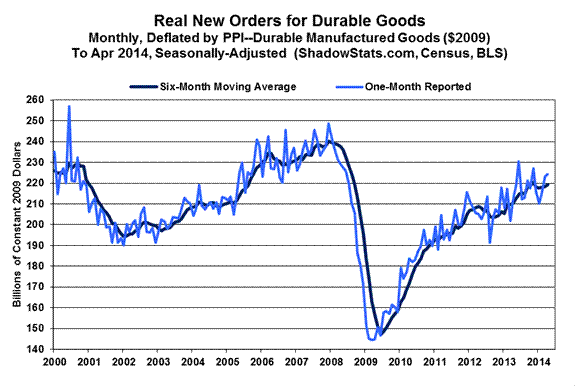
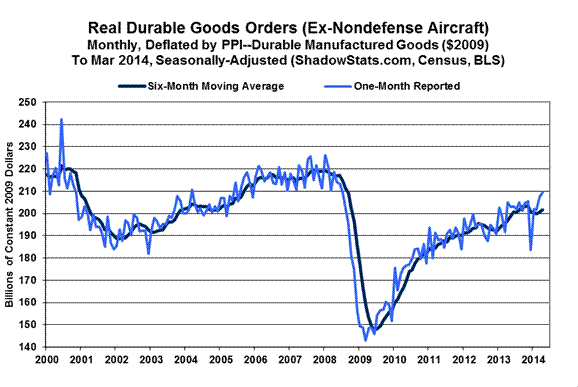
As with other economic series that are deflated by official government inflation measures, estimates of inflation-adjusted growth in new orders for durable goods are overstated, due to the understatement of the official inflation. That understatement here is through the use of hedonic-quality adjustments—usually not perceived by the consumer—used to reduce the pace of headline inflation (see Public Comment on Inflation). As has been done with other series such as the GDP, retail sales and industrial production, ShadowStats now publishes an experimental corrected version of the inflation-adjusted graph of real new orders for durable goods, corrected for the understatement of the related headline PPI inflation.
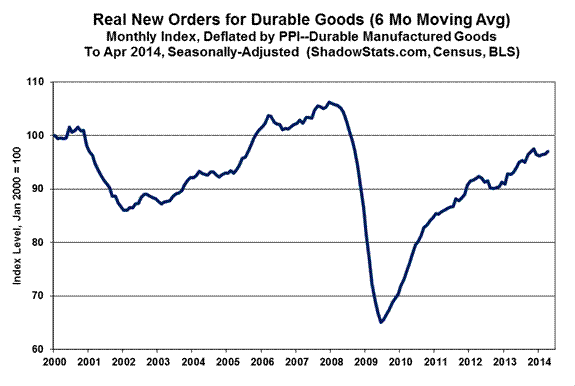
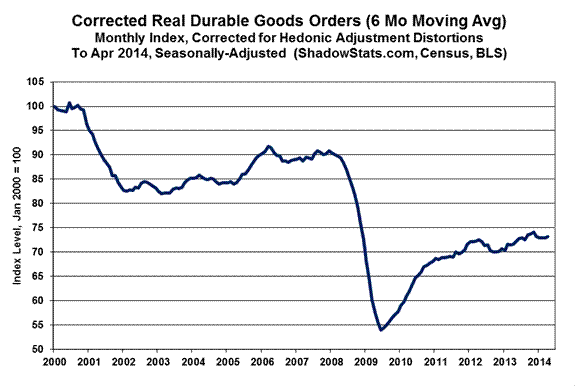
The two graphs following reflect a smoothed version of the real total durable goods orders series (using a six-month moving average). The first graph reflects the real series, as graphed previously, only indexed to January 2000 = 100. The second graph is a “corrected” version of the first, where the estimated, understated inflation effects (overstated inflation-adjusted growth effects) from hedonic adjustments have been reversed by ShadowStats. As shown in 2014 Hyperinflation Report—Great Economic Tumble – Second Installment, the “corrected” real new orders for durable goods series shows a fair correlation to the “corrected” industrial production series.
[For further detail on April durable goods orders, see the Reporting Detail section.]
__________
HYPERINFLATION WATCH
Hyperinflation Summary Outlook. The hyperinflation and economic outlooks were updated with the publication of 2014 Hyperinflation Report—The End Game Begins – First Installment Revised, on April 2nd, and publication of 2014 Hyperinflation Report—Great Economic Tumble – Second Installment, on April 8th. A basic summary of the broad outlook is found in the Opening Comments and Overview and Executive Summary in the First Installment Revised. The broad outlook for a hyperinflationary great depression beginning this year has not changed—only evolved—with various details continuing to fall into place. A formal and more-condensed summary of the extraordinarily-difficult times ahead will take over this section, soon. What follows here is detail on the evolving economic outlook—with little new text since the prior Commentary No. 629—all to be incorporated into that summary.
Economy Turns Down Anew. Consistent with the above Special Commentaries, a renewed U.S. business slowdown/downturn was evident in the initial headline estimate of first-quarter 2014 GDP, with an annualized headline growth of 0.11% (Commentary No. 623). As the patterns of headline growth in economic reporting continue to slow and to turn down, financial-market expectations increasingly should shift towards renewed or deepening recession. That circumstance, in turn, in confluence with other fundamental issues, should place mounting and massive selling pressure on the U.S. dollar, as well as potentially resurrect elements of the 2008-Panic.
The fundamental issues threatening the dollar, again, include, but are not limited to: the U.S. government not addressing its long-term solvency issues; monetary malfeasance by the Federal Reserve seeking to provide liquidity to a troubled banking system, and to the U.S. Treasury, with a current pace of 70% monetization of effective net issuance of public federal debt; a mounting domestic and global crisis of confidence in a dysfunctional U.S. government; mounting global political pressures contrary to U.S. interests; and a severely damaged U.S. economy, which never recovered post-2008 and is turning down anew (including a widening trade deficit).
Pending GDP Contractions. The reporting of the March 2014 trade data, confirmed the steep deterioration in the first-quarter trade deficit, sharply reducing the chances for a major change to initial, headline first-quarter GDP growth in the pending two regular revisions. As noted in the Week Ahead section, though, market expectations are for the first revision (May 29th) to take headline first-quarter-2014 GDP growth into contraction (see also Commentary No. 629). Watch out, though, for the annual GDP benchmarking and the initial headline estimate of second-quarter 2014 GDP growth on July 30th.
Generally reflecting weaker data in revisions to underlying data, downside revisions to recent GDP reporting are likely in the annual benchmark revisions. Specifically, underlying current economic activity actually is deteriorating and weak enough that the benchmark GDP revision likely will show a contracting first-quarter 2014 GDP (if not already in place), coincident with the initial reporting of a contraction in second-quarter 2014 GDP. That circumstance quickly should gain formal recognition as a new recession.
Despite the unstable, questionable and otherwise horrendous unemployment reporting for April 2014 (see Commentary No. 624), the subsequent headline downturns in April industrial production and real retail sales, and the headline upturns in the CPI and PPI, even weaker economic data and stronger inflation are likely in the months ahead. If those patterns continue, market expectations—and related financial-market reactions—should move into the “renewed recession” camp, before or coincident with the July 30th annual revisions to GDP.
__________
REPORTING DETAIL
NEW ORDERS FOR DURABLE GOODS (April 2014)
April 2014 New Orders for Durable Goods Rose by 0.80% for the Month, in Context of Eviscerated Annual Revisions. Normally, annual revisions to durable goods orders encompass better-quality information and corrections to detail that had been reported in earlier periods. That was not the case with the May 15th annual revision, which only recast seasonal factors back to the 1992 onset of the current series. The unadjusted numbers were not revised, and the new seasonally-adjusted detail was not accompanied by a press release.
As with the annual revision to industrial production, the detail from the 2012 census of manufactures was not available. That detail now is scheduled for some time between July and December 2014, likely too late for the GDP revisions on July 30th, and already beyond the scope of significantly improving the quality and correcting the detail of both the current new orders and the production series. The revised industrial production numbers at least reflected corrections from survey detail that came in too late for regular reporting, with some resulting downside revisions to earlier periods (see Commentary No. 613).
Nominal (Not-Adjusted-for-Inflation) April 2014 Reporting. The Census Bureau reported today, May 27th, that the regularly-volatile, seasonally-adjusted nominal level of April 2014 new orders for durable goods rose by 0.80% for the month, following a revised 3.56% jump in March. From before the annual revision, total new orders in April rose by 2.18%. From before the revisions subsequent to the annual benchmarking, the growth was 1.83%. On a year-to-year basis (seasonally-adjusted), April 2014 sales were up by 7.08%, versus a revised 11.33% in March, where much of the annual gains reflected volatility in commercial-aircraft orders.
For April 2014, however, the dominant irregular monthly series was new orders for defense capital goods, which surged by 39.27% on a month-to-month basis, on top of a revised 18.82% monthly gain in March. Net of defense new orders, April new orders fell by 0.82% for the month, having risen by a revised 2.89% in March, while new orders for nondefense capital goods fell by 1.00%, having risen by a revised 9.67% in March.
In this traditionally-unstable series, the headline April monthly and annual gains were within the scope of normal month-to-month volatility. An ongoing longer-term pattern of stagnation has remained in place for the durable goods series—particularly when viewed net of inflation—and it recently has started to turn down anew. The patterns of activity in this series remain of a nature that commonly precedes or coincides with a recession or deepening business downturn. The inflation-adjusted real series, and the same series corrected for understatement of the official inflation series, are discussed and graphed in the Opening Comments section.
Net of Volatility in Commercial Aircraft Orders. The reporting of contractions and surges in commercial aircraft orders is seen in an irregularly-repeating process throughout the year and often dominates headline monthly durable goods orders. These extremely volatile aircraft orders are booked well into the future and are indicative more of longer-term, rather than shorter-term prospects for manufacturing activity.
In April, nondefense (or commercial) aircraft orders fell by 4.12% month-to-month, following a revised 15.18% gain in March. Net of the aircraft numbers, month-to-month new orders rose by 1.17% in April, versus a revised 2.77% in March. Year-to-year orders, ex-commercial aircraft, were up by 3.24% in April, versus 8.95% in March.
Caution: Current durable goods reporting remains subject to many of the same sampling and concurrent-seasonal-adjustment problems that are seen with retail sales, payroll and unemployment reporting. Unusual seasonal-factor volatility raises issues as to the significance of reported seasonally-adjusted monthly and annual changes. While those issues are brought into balance, temporarily, with an annual benchmark revision to durable goods orders—as was seen on May 15th this year—subsequent reporting already has made all historical reporting prior to February 2014 inconsistent with the current headline numbers.
Real (Inflation-Adjusted) Durable Goods Orders—April 2014. ShadowStats uses the PPI aggregated inflation measure “durable manufactured goods” for deflating the new orders for durable goods series. Published only on a not-seasonally-adjusted basis, the related PPI series reflected a headline rise in monthly inflation of 0.2% in April, following a 0.1% decline in March 2014, with headline annual inflation of 1.0% in April 2014, versus 0.7% in March.
Adjusted for that inflation, and again as reflected in the graphs of the Opening Comments section, real month-to-month aggregate orders rose by 0.56% in April, versus a revised 3.68% gain in March. Ex-commercial aircraft, orders rose for the month by 0.93% in April, versus a 2.90% gain in March.
Real year-to-year aggregate orders rose by 6.05% in April, versus a revised 10.52% in March, and, ex-commercial aircraft, they rose by 2.25% in April, versus a revised 8.66% in March.
Graphs of Inflation-Adjusted and “Corrected” Smoothed Durable Goods Orders. Two sets of inflation-adjusted graphs are found in the Opening Comments section. The first set shows the monthly as well as a six-month moving-average activity for both the aggregate new orders series and the series net of the unstable commercial-aircraft order sector. The moving-average levels in both series have been holding in a pattern of near-stagnation, with some a recent turn to the downside, and a current upside blip.
Real levels of the April 2014 orders remained at or below both the pre-2001 and pre-2007 recession highs. The pattern of recent stagnation and downturn in the inflation-adjusted series also is one that commonly precedes or is coincident with a recession.
The second set of graphs in the Opening Comments section also shows the pattern of historical real new durable goods orders net of official inflation and “corrected” for the understatement of that inflation (overstatement of official, inflation-adjusted growth).
__________
WEEK AHEAD
Much-Weaker-Economic and Stronger-Inflation Reporting Likely in the Months and Year Ahead. Although shifting to the downside, market expectations generally still appear to be overly optimistic as to the economic outlook. Expectations should continue to be hammered, though, by ongoing downside corrective revisions and an accelerating pace of downturn in headline economic activity. The initial stages of that process have been seen in the recent headline reporting of many major economic series (see 2014 Hyperinflation Report—Great Economic Tumble – Second Installment), including the initial estimate of first-quarter 2014 GDP.
Weakening, underlying economic fundamentals indicate deteriorating business activity. Accordingly, weaker-than-consensus economic reporting should become the general trend until such time as the unfolding “new” recession receives general recognition.
Stronger inflation reporting also remains likely. Upside pressure on oil-related prices should reflect intensifying impact from a weakening U.S. dollar in the currency markets, and from ongoing global political instabilities. Food inflation has started to pick up as well. The dollar faces pummeling from continuing QE3, the ongoing U.S. fiscal-crisis debacle, a weakening U.S. economy and deteriorating U.S. and global political conditions (see Hyperinflation 2014—The End Game Begins (Updated) – First Installment). Particularly in tandem with a weakened dollar, reporting in the year ahead generally should reflect much higher-than-expected inflation.
A Note on Reporting-Quality Issues and Systemic Reporting Biases. Significant reporting-quality problems remain with most major economic series. Ongoing headline reporting issues are tied largely to systemic distortions of seasonal adjustments. The data instabilities were induced by the still-evolving economic turmoil of the last eight years, which has been without precedent in the post-World War II era of modern economic reporting. These impaired reporting methodologies provide particularly unstable headline economic results, where concurrent seasonal adjustments are used (as with retail sales, durable goods orders, employment and unemployment data), and they have thrown into question the statistical-significance of the headline month-to-month reporting for many popular economic series.
PENDING RELEASES:
Gross Domestic Product—GDP (First-Quarter 2014, Second Estimate, First Revision). The Bureau of Economic Analysis (BEA) has scheduled its release of the second estimate of, first revision to, first-quarter 2014 GDP for Thursday, May 29th. Expectations appear to be for a downside revision in the quarterly headline growth estimate from an initial headline estimate of 0.1% quarterly growth to an annualized quarterly contraction of around 0.5% (see the discussion in the Opening Comments section here, and particularly in prior Commentary No. 629).
The market expectations are reasonable, but greater revision activity likely will come on July 30th, as part of the annual GDP benchmark revision, and coincident with the likely initial reporting of a headline contraction in second-quarter 2014 GDP. That should confirm that a renewed recession is in place (see also Commentary No. 628).
__________