


No. 657: August Industrial Production

COMMENTARY NUMBER 657
August Industrial Production
September 15, 2014
__________
August Production Decline Was on Top of Downside Revisions to July Activity
Plunge in Auto Manufacturing Highlighted
Poor-Quality Seasonal Adjustments and Difficulties in Inventory Accounting
___________
PLEASE NOTE: The next regular Commentary is scheduled for tomorrow, Tuesday, September 16th, covering August PPI and the Census Bureau’s 2013 income and poverty survey, with another Commentary on Wednesday covering the August CPI, real retail sales and earnings, and one on Thursday covering August housing starts and the Bureau of Labor Statistics’ initial estimate of the 2014 benchmark revision to the payroll-employment survey.
Best wishes to all — John Williams
OPENING COMMENTS AND EXECUTIVE SUMMARY
Overstated July Activity Revised Lower in Production Report. Despite Friday’s relatively strong report on nominal August retail sales (real retail sales accounting awaits the August CPI), the unexpected weakness and downside revisions in today’s (September 15th) August 2014 industrial production were more in line with the unexpected weakness in and downside revisions to the August 2014 payroll-employment reporting.
Consistent with the updated broad financial outlook discussed in Friday’s Commentary No. 656, the pattern of renewed headline economic weakness and downside revisions to prior reporting should continue to be a common pattern of reporting in the weeks and month ahead. The basic economic outlook has not changed. The economy collapsed into 2009; it never recovered, and it has started to turn down anew.
Today’s brief missive concentrates on industrial production, the second of five consecutive business days of Commentaries covering an unusual week of economic releases. New data will include the Census Bureau’s annual income survey (tomorrow, September 16th), and the Bureau of Labor Statistics’ initial estimate of the 2014 benchmark revision to payroll employment (Thursday, September 18th). An update and review of the latest economic data will accompany Thursday’s Commentary No. 660.
Industrial Production—August 2014—Prior-Period Revisions Muted the Decline in Production. Headline August 2014 production fell by 0.1% (0.1%) month-to month, and July production rose by a downwardly revised 0.2%, from what initially had been headline monthly growth of 0.4%. Accordingly, despite market expectations for roughly a 0.3% headline gain in August production, August’s production level was down by 0.3% (-0.3%) from the initial level of activity reported for July.
Headline August production weakened, dominated by a 7.6% (-7.6%) collapse in monthly automobile production, which largely reversed a downwardly-revised 9.3% (previously 10.1%) surge seen in July, against no (0.0%) automobile production growth in June. Combined with the gyrating automobile sales reflected in the stronger nominal August retail sales report, both for August and as revised in September (see Commentary No. 656), there are two caution flags being waved. First, end-of-model-year swings in sales and production largely should be neutralized by seasonal adjustments. That has not happened, and the related seasonal adjustments, along with the reported levels of activity, are not stable. Second, the unstable production and sales activity should feed directly into inventory accounting, which likely will have significant but uncertain impact on headline growth for the initial reporting of and subsequent revisions to the third-quarter 2014 GDP estimate. The initial GDP estimate is scheduled for October 30th.
Industrial Production—August 2014. Headline monthly production fell by 0.10% (0.10%) in August 2014. Net of prior-period revisions, the monthly August decline was 0.26% (-0.26%). The headline August decline was against a downwardly revised 0.22% gain in July and a downwardly revised 0.32% gain in June. The downside revision to June growth actually reflected a small upside revision to June activity, in combination with a slightly greater upside revision to May production.
By major industry group, the headline decline of 0.1% (-0.1%) in August 2014 [a revised gain of 0.2% in July] aggregate production was composed of a 0.4% (-0.4%) decline in August [a revised 0.7% gain in July] manufacturing; a 0.5% August gain [a revised July decline of 0.3% (-0.3%)] in mining; and a 1.0% August gain [a revised July decline of 2.7% (-2.7%)] in utilities.
Year-to-year growth in August 2014 production backed off to a four-month low of 4.12%, from a revised 4.80% in July and from 4.40% in June.
Production Graphs. Official production levels have moved higher since the June 2009 trough, setting a new series high as of July 2014, and prior to the August 2014 monthly decline. Corrected for the understatement of inflation used in deflating portions of the industrial production index, however, the series has shown more of a pattern of stagnation with a slow upside trend, since 2009, topping out into 2012, with a renewed upside move into a recent, protracted period of inventory build-up in 2013. A further topping out pattern has developed in 2014, reflecting the working off of excess inventories.
Updated graphs of industrial production activity follow, including an index of the headline production level, and the production index as corrected for the understatement of the inflation used in deflating certain components of industrial production. The regular graphs of short- and long-term headline industrial production activity, both in terms of official level and reported year-to-year change, are found in the Reporting Detail section. Drill-down and various graphics options for the official headline data also are available at ShadowStats-affiliate www.ExpliStats.com.
Corrected Industrial Production. Hedonic quality adjustments to inflation understate the inflation used in deflating some components of industrial production. That has the effect of overstating the resulting inflation-adjusted growth in the headline industrial production series (see Public Comment on Inflation and the discussion in Chapter 9 of 2014 Hyperinflation Report—Great Economic Tumble).
Again, the two following graphs address that issue. The first reflects official industrial production reporting, indexed to January 2000 = 100, instead of the Fed’s formal index that is set at 2007 = 100. The 2000 indexing is used simply to provide for some consistency in this series of revamped graphics; it does not affect the appearance of the graph or reported growth rates. The second graph is a version of the first that has been corrected for the understatement of the inflation rate used in deflating the production index, with estimated hedonic-inflation adjustments backed-out of the official industrial-production deflator.

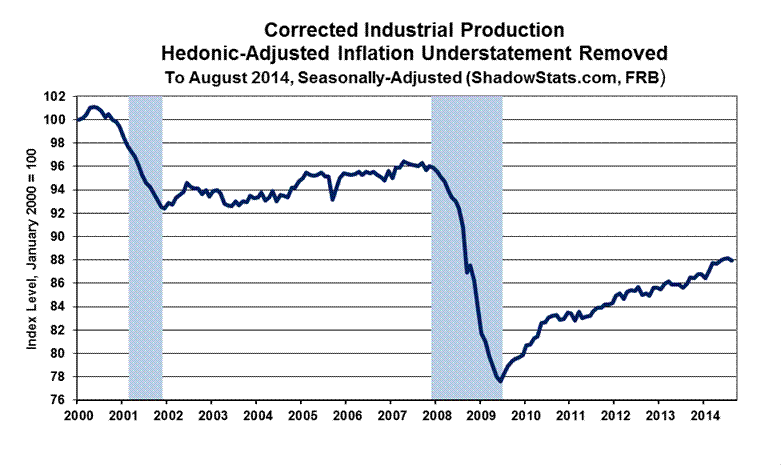
The “corrected” graph does show some growth in the period following the official June 2009 near-term trough in production activity. Yet, that upturn has been far shy of the full recovery and the renewed expansion reported in official GDP estimation. Unlike the headline-production data and the headline GDP, corrected production levels have not recovered pre-recession highs. Instead, corrected production entered a period of protracted low-level stagnation in 2012, with quarterly contractions in third-quarter 2012, second-quarter 2013, with stagnation in third-quarter 2013, and some upturn in the fourth-quarter 2013 and into a renewed period of stagnation/topping-out in 2014.
[For further details on August industrial production, see the Reporting Detail section. Again, various drill-down detail and graphics options on the headline reporting are available to ShadowStats subscribers at our affiliate: www.ExpliStats.com]
__________
HYPERINFLATION WATCH
Hyperinflation Outlook Summary. This Summary has not been revised from Commentary No. 655 of September 5th. The next revision is planned to follow the heavy calendar of economic releases through September 18th. The long-standing hyperinflation and economic outlooks were updated with the publication of 2014 Hyperinflation Report—The End Game Begins – First Installment Revised, on April 2nd, and publication of 2014 Hyperinflation Report—Great Economic Tumble – Second Installment, on April 8th, along with ongoing updates in the regular Commentaries, including a review in Commentary No. 639.
Primary Summary. The primary and basic summary of the broad outlook and the story of how and why this crisis has unfolded and developed over the years—particularly in the last decade—is found in the Opening Comments and Overview and Executive Summary of that First Installment Revised (linked above). The following section summarizes the underlying current circumstance.
Consistent with the above Special Commentaries, the unfolding economic circumstance, in confluence with other fundamental issues, should place mounting and massive selling pressure on the U.S. dollar, as well as potentially resurrect elements of the 2008-Panic. Physical gold and silver, and holding assets outside the U.S. dollar, remain the primary hedges against the pending total loss of U.S. dollar purchasing power.
Current Economic Issues versus Underlying U.S. Dollar Fundamentals. U.S. economic activity has turned down anew, with headline first-quarter 2014 GDP having contracted at an annualized real pace of 2.11% (-2.11%), following 3.50% fourth-quarter 2013 growth, per the July 30th GDP benchmark revisions. Although the second estimate of second-quarter 2014 GDP growth came in at 4.17%, such still heavily overstated actual current economic activity and remained subject to some downside revisions. The “advance” estimate of third-quarter GDP on October 30th will be that last reporting before the midterm election. While third-quarter GDP should show a quarterly contraction within its standard revision cycle, one should not underestimate the ability of the Bureau of Economic Analysis to keep that final pre-election number in positive territory, in initial reporting.
Nonetheless, basic underlying economic series, such as the trade deficit, retail sales and industrial production, even payroll employment, should be showing enough of a downturn or weakness in headline activity during the same timeframe—the next several months—so as to provide consensus expectations with downside shocks. That increasingly should shift the popular outlook towards a “new recession,” with negative shifts in the economic consensus likely to disrupt stability in the financial markets.
As financial-market expectations increasingly shift towards renewed or deepening recession, that circumstance, in confluence with other fundamental issues, should place mounting and massive selling pressures on the U.S. dollar, as well as potentially resurrect elements of the 2008-Panic.
Unexpected economic weakness intensifies the known stresses on an already-impaired banking system, hence a perceived need for expanded, not reduced, quantitative easing. The highly touted “tapering” by the FOMC is pre-conditioned by a continued flow of “happy” economic news. Banking-system and other systemic (i.e. U.S. Treasury) liquidity needs likely still will be provided, as needed, by the Fed, under the ongoing political covering of a weakening economy—a renewed, deepening contraction in business activity.
Unexpected economic weakness also savages projections of headline, cash-based, federal-budget deficits (particularly the 10-year versions) as well as projected funding needs for the U.S. Treasury. Current fiscal “good news” is from cash-based, not GAAP-based accounting projections, and comparative year-ago cash numbers are distorted against U.S. Treasury and government activity operating sub rosa, in order to avoid the limits of a constraining debt ceiling.
All these crises will combine against the U.S. dollar, likely in the very-near future.
In general, summary, the fundamental issues threatening the U.S. dollar could not be worse. They include, but are not limited to:
· A severely damaged U.S. economy, which never recovered post-2008 and is turning down anew. The circumstance includes a sharply widening trade deficit, as reflected in headline first- and second-quarter reporting, as well as ongoing severe, structural-liquidity constraints on the consumer, which are preventing a normal economic rebound in the traditional, personal-consumption-driven U.S. economy.
· U.S. government unwillingness to address its long-term solvency issues. Those controlling the U.S. government have demonstrated not only a lack of will to address long-term U.S. solvency issues, but also the current political impossibility of doing so. Any current fiscal “good news” comes from cash-based, not GAAP-based accounting projections. The GAAP-based version continues to run in the $6-trillion-plus range for annual shortfall, while those in Washington continue to increase spending and to take on new, unfunded liabilities.
· Monetary malfeasance by the Federal Reserve, as seen in central bank efforts to provide liquidity to a troubled banking system, and also to the U.S. Treasury. The current pace of the Fed’s monetization is at 58.2% of effective net issuance of the federal debt to be held by the public in calendar-year 2014 (through September 3rd). The pace of effective monetization has been 65.9% since the January 2013 expansion of QE3.
· Mounting domestic and global crises of confidence in a dysfunctional U.S. government, where the relative positive rating by the public of the U.S. President tends to have a meaningful correlation with the foreign-exchange-rate strength of the U.S. dollar. Positive ratings for both the President and Congress are pushing, if not at, historic lows.
· Mounting global political pressures contrary to U.S. interests. Downside pressures on the U.S. currency generally are increasing, in the context of global political and military developments that have been contrary to U.S. strategic, financial and economic interests.
· Spreading global efforts to dislodge the U.S. dollar from its primary reserve-currency status.
Renewed and intensifying weakness in the U.S. dollar will place upside pressure on oil prices and other commodities, boosting domestic inflation and inflation fears. Domestic willingness to hold U.S. dollars will tend to move in parallel with global willingness, or lack of willingness, to do the same. Both dollar weakness and the resulting higher inflation should boost the prices of gold and silver, where physical holding of those key precious metals remains the ultimate hedge against the pending inflation and financial crises.
__________
REPORTING DETAIL
INDEX OF INDUSTRIAL PRODUCTION (August 2014)
Decline in Production Was Muted by Prior-Period Revisions. Headline August 2014 production fell by 0.1% (0.1%) for the month, and headline July production rose by a downwardly revised 0.2%, from what initially had been headline monthly growth of 0.4%. Accordingly, despite market expectations for roughly a 0.3% headline gain in August production, August’s production level was down by 0.3% (-0.3%) from the initial level of activity reported for July.
Headline August production weakened, dominated by a 7.6% (-7.6%) collapse in monthly automobile production, which largely reversed a downwardly-revised 9.3% (previously 10.1%) surge seen in July, against no (0.0%) automobile production growth in June. Combined with the gyrating automobile sales reflected in the stronger nominal August retail sales report, both for August and as revised in September (see Commentary No. 656), there are two caution flags being waved. First, end-of-model-year swings in sales and production largely should be neutralized by seasonal adjustments. That has not happened, and the related seasonal adjustments, along with the reported levels of activity, accordingly are unstable. Second, the production and sales activity should feed directly into inventory accounting, which should have significant but uncertain impact on headline growth for the initial reporting of (October 30th) and subsequent revisions to the third-quarter 2014 GDP estimate.
Industrial Production—August 2014. The Federal Reserve Board released its first estimate of the seasonally-adjusted, August 2014 industrial production this morning (September 15th). Headline monthly production fell by 0.10% (0.10%). Net of prior-period revisions, the monthly August decline was 0.26% (-0.26%).
In the context of prior-period revisions, the August headline decline was against a revised 0.22% (previously 0.44%) gain in July and a revised 0.32% (previously 0.38%, initially 0.22%) gain in June. The downside revision to June growth actually reflected an small upside revision in June activity in the context of a slightly greater upside revision to May activity.
By major industry group, the headline August 2014 decline of 0.1% (-0.1%) [a revised July 0.2% gain, previously up by 0.4%] in aggregate production was composed of an August decline of 0.4% (-0.4%) [a revised July 0.7%, previously 1.0% gain] in manufacturing; a 0.5% August gain [a revised decline in July of 0.3% (-0.3%), previously a gain of 0.3%] in mining; and a 1.0% August gain [a revised July decline of 2.7% (-2.7%), previously down by 3.4% (-3.4%)] in utilities.
Year-to-year growth in August 2014 production backed off to a four-month low of 4.12%, from a revised 4.80% (previously 4.97%) in July and from 4.40% (previously 4.34%, initially 4.32%) in June.
Production Graphs. The following two sets of graphs reflect headline industrial production activity. The first graph in the first set shows the monthly level of the production index, while the second graph shows the year-to-year percentage change in the same series for recent historical detail, beginning January 2000. The second set of graphs shows the same data in historical context since World War II.
Shown more clearly in the first set of graphs, the pattern of year-to-year activity dipped anew in late-2013 to levels usually seen only at the onset of recessions, bounced higher into mid-2014 and headed lower again in the most-recent reporting. Annual growth remains well off the recent relative peak for the series, which was 8.49% in June 2010, going against the official June 2009 trough of the economic collapse. Indeed, as shown in the second set of graphs, the year-to-year contraction of 15.06% in June 2009, at the end of second-quarter 2009, was the steepest annual decline in production since the shutdown of war-time production following World War II.
Official production levels have moved higher since the June 2009 trough, setting a new series high with July 2014 reporting, but pulling back some in August. Corrected for the understatement of inflation used in deflating portions of the industrial production index, however, the series has shown more of a pattern of stagnation with a slow upside trend, since 2009, topping out into 2012, with a renewed upside trend into and now a topping out in the recent, protracted period of inventory build-up.
The corrected production series is discussed and graphed in the Opening Comments section.


__________
WEEK AHEAD
Against Overly-Optimistic Expectations, Pending Economic Releases Should Be Much Weaker; Inflation Releases Should Be Increasingly Stronger. Although shifting to the downside, again, amidst wide fluctuations, market expectations for business activity generally remain overly optimistic, well above any potential, underlying economic reality. Market outlooks should be hammered, though, by ongoing, downside corrective revisions and by an accelerating pace of downturn in headline economic activity.
Longer-Range Reporting Trends. The initial stages of the process shifting economic-growth expectations to the downside already have been seen in the recent headline reporting of many major economic series (see 2014 Hyperinflation Report—Great Economic Tumble – Second Installment), including the sharp pace of economic decline seen in real first-quarter 2014 GDP, which largely survived the GDP benchmark revisions. The strong bounce-back estimated by the Bureau of Economic Analysis (BEA) for headline second-quarter GDP still should face some downside revision, with a likely GDP contraction eventually seen in third-quarter 2014.
Indeed, weakening, underlying economic fundamentals indicate still further deterioration in business activity. Accordingly, weaker-than-consensus economic reporting should remain the general trend until the unfolding “new” recession receives broad recognition, which likely would follow the next reporting of a headline contraction in real GDP growth.
A generally stronger inflation trend remains likely to continue, as seen in recent months. Beyond the spread of earlier oil-based inflation pressures into the broad economy, upside pressure on oil-related prices should continue and be rekindled from the intensifying impact of global political instabilities and a likely near-term weakening of the U.S. dollar in the currency markets. Again, near-term food inflation has been picking up, partially due to supply issues. The dollar faces pummeling from the weakening economy, continuing QE3, the ongoing U.S. fiscal-crisis debacle, and deteriorating U.S. and global political conditions (see Hyperinflation 2014—The End Game Begins (Updated) – First Installment). Particularly in tandem with a weakened dollar, reporting in the year ahead generally should reflect much higher-than-expected U.S. inflation across the board.
A Note on Reporting-Quality Issues and Systemic-Reporting Biases. Significant reporting-quality problems remain with most major economic series. Ongoing headline reporting issues are tied largely to systemic distortions of seasonal adjustments. The data instabilities were induced by the still-evolving economic turmoil of the last eight years, which has been without precedent in the post-World War II era of modern economic reporting. These impaired reporting methodologies provide particularly unstable headline economic results, when concurrent seasonal adjustments are used (as with retail sales, durable goods orders, employment, and unemployment data). These issues have thrown into question the statistical-significance of the headline month-to-month reporting for many popular economic series.
PENDING RELEASES:
Annual Poverty and Income Survey (2013). Tomorrow, Tuesday, September 16th, the Census Bureau plans the release of its 2013 annual survey on poverty and income. The same survey also will provide numbers on health insurance coverage, but not on a basis comparable with the pre-Obamacare environment. Only the income numbers will have any significance. The other detail is so heavily politicized as to be worthless, although some comments will be offered in the ShadowStats analysis of the release.
As discussed in Commentary No. 654, the latest numbers on real median household income likely will be close to 2012 reporting, well below pre-recession levels and at or below levels seen in the late-1960s and early-1970s, based on CPI-U inflation. Income dispersion—a measure of income distribution—likely has continued at historic extremes.
Producer Price Index—PPI (August 2014). The August 2014 PPI also is scheduled for release tomorrow, Tuesday, September 16th, by the Bureau of Labor Statistics (BLS). A small month-to-month increase is a reasonable expectation, despite a negative contribution from the energy sector. Inflation in food, “core” goods (everything but food and energy), and the spreading inflationary impact from hard-goods into the soft-services sector, all are likely, again.
Depending on the oil contract followed, not-seasonally-adjusted, monthly-average oil prices were down by 4.8%-to-6.8% for the month of August, along with a 3.3% (-3.3%) unadjusted monthly drop in average retail-gasoline prices. PPI seasonal adjustments for energy costs in August should be somewhat to the downside-side.
The wildcard in this revamped PPI remains the newly-added services sector, which largely is unpredictable, volatile and of limited meaning due to its inflation measurements having minimal relationship to real-world activity.
The new services series, in theory, is much-less dependent on the increasingly “antiquated” concepts of oil, food and “core” (ex-food and energy) inflation of the “hard” production-based economy. Yet, services costs increasingly have reflected spreading, general inflationary pressures—and shrinking profit margins—from rising prices in that hard economy. Accordingly, the aggregate headline August PPI inflation most likely still will show at least a minimal headline monthly increase, which generally would be in line with early consensus expectations.
Consumer Price Index—CPI (August 2014). The August 2014 CPI is scheduled for release on Wednesday, September 17th, by the Bureau of Labor Statistics (BLS). The headline CPI-U is a fair bet to show a minimal inflation gain, against early market expectations for an unchanged headline August inflation number.
Average gasoline prices fell month-to-month in August 2014 by 3.3% (-3.3%), on a not-seasonally-adjusted basis, per the Department of Energy, and BLS seasonal adjustments to gasoline prices should be slightly negative for the month. Based on August 2013 adjustment patterns, the unadjusted decline in month gasoline prices was enough to reduce the headline seasonally-adjusted inflation August 2014 rate by 0.2% (-0.2%) from whatever it would have been otherwise.
Higher food and “core” (net of food and energy) inflation, however, should more than offset the negative energy number, leading to a small headline gain in the CPI.
Year-to-year, CPI-U inflation would increase or decrease in August 2014 reporting, dependent on the seasonally-adjusted monthly change, versus an adjusted 0.08% gain in the monthly inflation reported for August 2013. The adjusted change is used here, since that is how consensus expectations are expressed. To approximate the annual unadjusted inflation rate for August 2014, the difference in August’s headline monthly change (or forecast of same), versus the year-ago monthly change, should be added to or subtracted directly from the July 2014 annual inflation rate of 1.99%. For example if the headline CPI-U rose by 0.1% for the month of August, the annual inflation rate would hold at about 2.0%.
Residential Construction—Housing Starts (August 2014). The Census Bureau plans the release of August 2014 residential construction detail, including housing starts, on Thursday, September 18th. Despite extreme monthly volatility seen regularly in the reporting of this series, and despite near-perpetual wishful upside market expectations for housing starts—although flat-to-down activity appears to be expected in the current circumstance—month-to-month change likely will continue a pattern of statistical-insignificance, with ongoing stagnation and renewed downturn and/or downside revisions. As usual, this series is subject to extremely-large prior-period revisions.
In the wake of a 75% collapse in aggregate activity from 2006 through 2008, and of an ensuing five-year pattern of housing starts stagnation at historically low levels, little has changed. Again, as was discussed in the Consumer Liquidity section of Commentary No. 654, there remains no chance of a near-term, sustainable turnaround in the housing market, unless there is a fundamental upturn in consumer and banking-liquidity conditions. That has not happened and does not appear to be in the offing.
Payroll Employment Benchmark Revision (Preliminary Estimate for March 2014). Although full detail will not be released until the February 2015 publication of January 2015 payroll data, the Bureau of Labor Statistics (BLS) will publish its initial estimate of the aggregate benchmark revision to not-seasonally-adjusted March 2014 payrolls on Thursday, September 18th. Odds favor a downside revision, barring unrelated series redefinitions, as were introduced in last year’s benchmarking.
__________