


No. 659: August CPI, Real Retail Sales and Earnings

COMMENTARY NUMBER 659
August CPI, Real Retail Sales and Earnings
September 17, 2014
__________
With Some Double-Counting, Sharp Declines in Headline Inflation
Boosted Monthly Real Retail Sales and Earnings
An Issue with Consistent Measurement of Gasoline Prices?
August Annual Inflation: 1.7% (CPI-U), 1.6% (CPI-W), 9.4% (ShadowStats)
Outlook Weakened for 2015 Social Security COLA
___________
PLEASE NOTE: The next regular Commentary is scheduled for tomorrow, Thursday, September 18th, covering August housing starts and the Bureau of Labor Statistics’ initial estimate of the 2014 benchmark revision to the payroll-employment survey.
Best wishes to all — John Williams
OPENING COMMENTS AND EXECUTIVE SUMMARY
Consumer-Inflation Decline Damaged COLA Prospects and Spiked Headline Real Growth. To adjust an economic series, meaningfully, from nominal terms (before inflation adjustment), to real terms (after inflation adjustment), the adjusting inflation series should be highly coordinated with, and should tie specifically and consistently to the nominal series. If data from the inflation and economic series are not well coordinated, distorted growth patterns in the adjusted real series may result, as it appears likely happened with some of today’s (September 17th) headline reporting. Conflicts and instabilities are evident in the measurement of the rapid changes in gasoline prices around the August-2014 period.
Overly-aggressive accounting for declining energy prices, and questionable coordination of the survey data and seasonal factors, helped to exacerbate a sharp headline drop in monthly consumer inflation, particularly for the more energy-dependent CPI-W series. The CPI-W fell by 0.3% (-0.3%) for the month, versus the CPI-U’s 0.2% (-0.2%) decline. In turn, these issues exaggerated real (inflation-adjusted) growth in real retail sales and real earnings.
Consider, the BLS survey indicated gasoline prices declined by 4.1% (-4.1%) in August, not seasonally adjusted, while the more-comprehensive Department of Energy survey showed prices to be down by an unadjusted 3.3% (-3.3%). Retail sales suggested an unadjusted decline of about 2.0% (-2.0%). Separate from all the other regular issues with headline inflation estimation, this suggests a synchronization issue with other economic reporting, during a period of rapid decline in gasoline prices.
As result, real retail sales (CPI-U deflated) and real average-weekly earnings (CPI-W deflated) received inflation-related boosts in August, on top of already-strong nominal gains, where a confluence of poor-quality coordination of seasonal adjustments actually may have had the effect of double-counting some of the real gains. Those issues should balance out in the months ahead, where there also should be reverse double-counting, with weak nominal activity being hit hard by off-cycle stronger inflation.
Usually, monthly changes in gasoline station sales mirror the monthly change in gasoline prices, both adjusted and unadjusted. Seasonally-adjusted nominal August retail sales reflected a 0.8% (-0.8%) decline in gasoline station sales, probably a fair estimate of the seasonally-adjusted decline in gasoline prices (in that circumstance adjusted CPI-U inflation would have been unchanged). Alternatively, the adjusted headline decline of 4.1% (-4.1%) in gasoline prices could suggest that seasonally-adjusted real retail gasoline sales were up by an improbable 2.1% for the month, on top of what otherwise had been reported as a headline 2.0% (2.0%) decline in unadjusted gasoline station sales. One reworking of the gasoline-consistency issue in retail sales would leave headline nominal retail sales up by 0.3%, instead of the headline 0.6%.
COLA Determination Next Month. Separately, prospects dimmed for the magnitude of inflation-adjustments to Social Security payments in the year ahead. Along with the existing July and August 2014 numbers, the September 2014 CPI-W will determine the 2015 annual cost-of-living adjustment (COLA) for Social Security recipients, among others.
With August 2014 CPI-W—the second of three months used in determining the COLA—now in place, the latest reporting has pushed the likely 2015 COLA to well below 2.0%. The 2014 adjustment was 1.5% (based on the average year-to-year change for third-quarter 2013 unadjusted CPI-W).
The same number for third-quarter 2014 (the basis for the 2015 adjustment) is headed in the direction of what was reported last year. Where second-quarter 2014 CPI-W was up year-to-year by 2.0%, and annual CPI-W July annual inflation was 1.9%, August would have been 1.9%, as well, if the “unchanged” seasonally-adjusted consensus CPI expectations were met. Instead, the headline 0.3% (-0.3%) monthly decline in CPI-W left annual unadjusted August inflation at 1.6%. Existing trends would tend to leave the 2015 COLA adjustment in the 1.6% to 1.7% range.
A COLA in that range significantly understates what is needed in order to keep the growth of an individual’s income even with the pace of inflation, as needed to maintain a constant standard of living. The current circumstance of COLA-shortfall is a direct result of changes made to the CPI-reporting methodology, by the U.S. government, for the explicit purpose of reducing annual COLA adjustments to Social Security. An annual income adjustment of 9.4% would be needed, today, to offset the inflation-reporting reductions put in place since 1980, and a 5.3% adjustment would be needed to offset the inflation-reporting reductions put in place since 1990. See the ShadowStats Alternate Inflation Measure, discussed later, and the discussion in the Public Comment on Inflation Measurement.
The balance of this missive, in the fourth of five consecutive business days of Commentaries, concentrates on August 2014 CPI reporting (Opening Comments and Reporting Detail), including related real retail sale, real average weekly earnings and—just in the Opening Comments—an updated review of consumer liquidity issues. The gold-related graphs that usually accompany the CPI Commentaries are found at the end of the Hyperinflation Watch section. A review of the latest economic data and updated outlook will accompany tomorrow’s (September 18th) Commentary No. 660.
Consumer Price Index (CPI)—August 2014—Falling Energy Prices Savaged Headline Inflation.
CPI-U. Headline, seasonally-adjusted CPI-U for August 2014 declined month-to-month by 0.2% (-0.2%) [down by 0.20% (0.20%) at the second decimal point], following an increase of 0.1% [0.09% at the second decimal point] in the July CPI-U. On a not-seasonally-adjusted basis, the August CPI-U declined by 0.17% (-0.17%), versus a decline of 0.04% (-0.04%) in July. Not seasonally adjusted, August 2014 year-to-year inflation for the CPI-U was a gain of 1.70% in August, versus 1.99% in July.
Encompassed by the seasonally-adjusted headline August 2014 CPI-U contraction of 0.20% (-0.20%), aggregate August energy inflation was down for the month by 2.58% (-2.58%). In the other major CPI sectors, food (and beverage) inflation was up by 0.27% for the month, while “core” inflation was “unchanged” at the first decimal point, up by an adjusted 0.01% at the second decimal point. Core inflation also showed unadjusted year-to-year inflation of 1.72% in August 2014, versus 1.86% in July 2014.
CPI-W. The August 2014 seasonally-adjusted, headline CPI-W, which is a narrower series and has greater weighting for gasoline than does the CPI-U, fell by 0.26% (-0.26%) [down by 0.21% (-0.21%) unadjusted] for the month, following a monthly gain of 0.08% in July [down by 0.08% (-0.08%) unadjusted]. Unadjusted, August 2014 year-to-year CPI-W inflation was 1.59%, versus 1.93% in July.
Alternate Consumer Inflation Measures. The ShadowStats-Alternate Consumer Inflation Measure (1990-Base) annual inflation was roughly 5.3% in August 2014, versus 5.6% in July 2014. The ShadowStats-Alternate Consumer Inflation Measure (1980-Base), which reverses gimmicked changes to official CPI reporting methodologies back to 1980, eased to about 9.4% in August, versus roughly 9.7% in July.
Real (Inflation-Adjusted) Retail Sales—August 2014—Negative-Inflation Boosted Already-Strong Nominal Numbers. In nominal terms, before adjustment for inflation, headline monthly retail sales rose by 0.58% in August, versus a revised 0.34% gain in July (see Commentary No. 656).
Based on today’s reporting of a 0.20% (-0.20%) contraction in headline August 2014 CPI-U, and in the context of the prior headline 0.09% gain in the July CPI-U, seasonally-adjusted real (inflation-adjusted) monthly retail sales jumped by 0.78% in August, following a revised 0.25% gain in July. Previously, July’s real sales had notched lower by 0.05% (-0.05%).
Year-to-year change in August 2014 real retail sales jumped to 3.23%, up from a revised 2.17% (previously 1.65%) gain in July. That was against an unrevised annual gain of 2.14% in June. In normal economic times, annual real growth at or below 2.0% would signal an imminent recession. That signal had been given recently and remains in play, a signal that likely will serve as an indicator of renewed downturn in broad economic activity. Graphs of real-retail sales level and year-to-year change are found in the Reporting Detail section.
Discussed later, there has been no change in the underlying consumer-liquidity fundamentals. With low levels of stagnant, real household income and lack of the ability and/or willingness of the consumer to offset limited income with debt expansion, there is nothing that would support a sustainable turnaround in retail sales, personal consumption, housing or general economic activity. There never was a broad economic recovery, and there is no recovery underway, just general bottom-bouncing that has begun turning down anew.
As official consumer-inflation resumes its upturn in the months ahead, and as overall retail sales continue to suffer from ongoing impaired consumer liquidity, these headline numbers should continue to trend meaningfully lower, in what eventually will gain recognition as a formal new or double-dip recession.
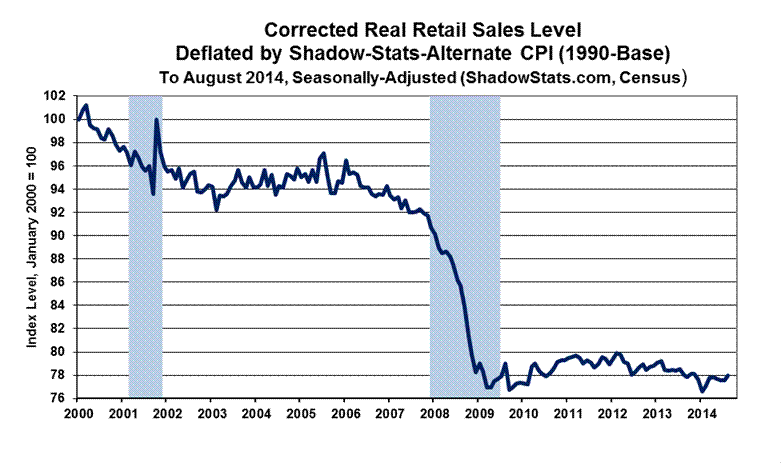
Corrected Real Retail Sales. The apparent “recovery” in the headline real retail sales series continues, due to the understatement of the rate of inflation used in deflating the retail sales series. As discussed more fully in Chapter 9 of 2014 Hyperinflation Report—Great Economic Tumble – Second Installment, deflation by too-low an inflation number (such as the CPI-U) results in the deflated series overstating inflation-adjusted economic growth.
Both graphs following are indexed to January 2000 = 100.0 so as to maintain consistency in the series of graphs related to corrected inflation-adjustment. The first graph reflects the official real retail sales series, except that it is indexed, instead of being expressed in dollars. The plotted patterns of activity and rates of growth are exactly same for the official series, whether it is indexed or in dollars.
Instead of being deflated by the CPI-U, the “corrected” real retail sales numbers—in the second graph—use the ShadowStats-Alternate Inflation Measure (1990-Base) for deflation. With the higher inflation of the ShadowStats measure, the revamped numbers show a pattern of plunge and stagnation and renewed downturn, consistent with patterns seen in series such as real median household income, the consumer confidence measures, unemployment and most housing statistics. A topping out in late-2011 and early-2012 reverted to renewed decline in second-quarter 2012 in this series, which had been bottom-bouncing along a low-level plateau of economic activity since the economic collapse from 2006 into 2009. The renewed contraction has trended, so far, into 2014, allowing for the temporary upside blip from the initial August 2014 reading.

Real Average Weekly Earnings—August 2014—Boosted by Headline Inflation Drop. In the production and nonsupervisory employees series—the only series for which there is a meaningful history—headline real average weekly earnings (deflated by the CPI-W) rose by 0.55% in August 2014, boosted by a headline 0.26% decline in the seasonally-adjusted CPI-W. Net of prior-period revisions, the monthly gain in August was 0.60%.
The monthly gain in August real earnings was against an unrevised 0.12% gain in July, and a revised decline of 0.11% (-0.11%) in June. Year-to-year and seasonally-adjusted, August 2014 real average weekly earnings rose by 0.92%, versus a revised 0.99% annual gain in July, and a revised 0.24% gain in June. Both the monthly and annual fluctuations in this series are irregular, but current reporting remains well within the normal bounds of volatility. Prior-period revisions usually are due to the instabilities in the BLS monthly surveys.
The regular, accompanying graph of this series plots the earnings as officially deflated by the BLS (red-line), and as adjusted for the ShadowStats-Alternate CPI Measure, 1990-Base (blue-line). When inflation-depressing methodologies of the 1990s began to kick-in, the artificially-weakened CPI-W (also used in calculating Social Security cost-of-living adjustments) helped to prop up the reported real earnings. Official real earnings today still have not recovered their inflation-adjusted levels of the early-1970s, and, at best, have been flat for the last decade. Deflated by the ShadowStats measure, real earnings have been in fairly-regular decline for the last four decades, which is much closer to common experience than the pattern suggested by the CPI-W. See Public Commentary on Inflation Measurement for further detail.

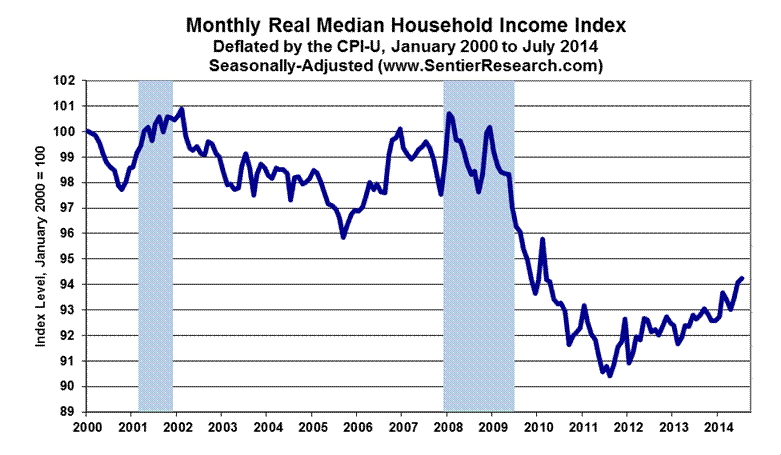
Structural Constraints on Consumer Liquidity Still Inhibit Economic Rebound. The primary structural issue preventing meaningful, domestic U.S. economic growth remains impaired consumer liquidity. The latest annual reporting of real median household income was reviewed in yesterday’s (September 16th) Commentary No. 658. The first graph following, of monthly real median household income is repeated from that prior Commentary. Further, discussed in the section immediately preceding this one is a somewhat related graph, showing issues with real average weekly earnings.
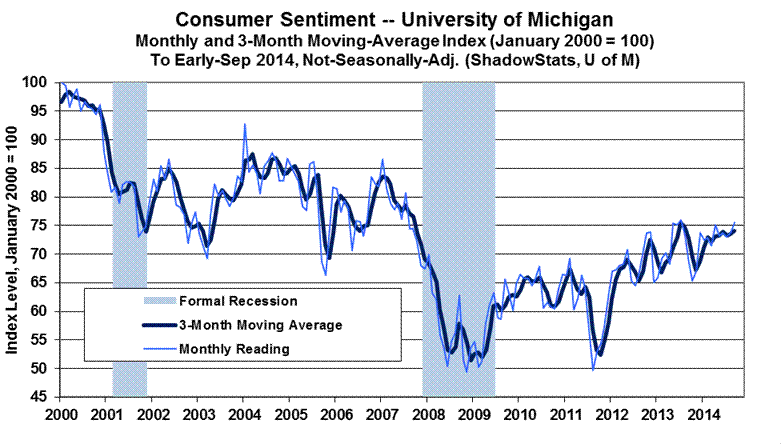
The general liquidity story is repeated regularly, usually with the monthly Commentary on real retail sales. The accompanying graphs show the latest available detail for monthly real median household income, consumer credit outstanding, and the consumer-confidence and sentiment measures.
Without real growth in income, and without the ability and/or willingness to offset declining purchasing power with debt expansion, the consumer lacks the ability to fuel traditional, consumption-based growth or recovery in U.S. economic activity. In the latest reporting of gross domestic product (GDP), the consumer accounted for 72% of economic activity, as reflected in personal consumption expenditure and residential investment,.
The first two graphs following show real median household income through July 2014, based on numbers provided by www.SentierResearch.com, and July consumer credit outstanding, as updated by the Federal Reserve.
Real median household income showed continued income stagnation in July 2014, notching higher for a third month. The gain was not statistically-significant, however, and the overall level remained near the cycle-low for the series. As the GDP purportedly started its solid economic recovery in mid-2009, household income plunged to new lows. Deflated by headline CPI-U, the same series, published by the Census Bureau on an annual basis (again see No. 658), showed further that 2013 real median household income held at a low level of activity, at levels that also had been seen in the late-1960s and early-1970s.

Growth in consumer credit, post-2008 Panic, continues to be dominated by growth in federally-held student loans, not in bank loans to consumers that otherwise would fuel broad consumption growth.
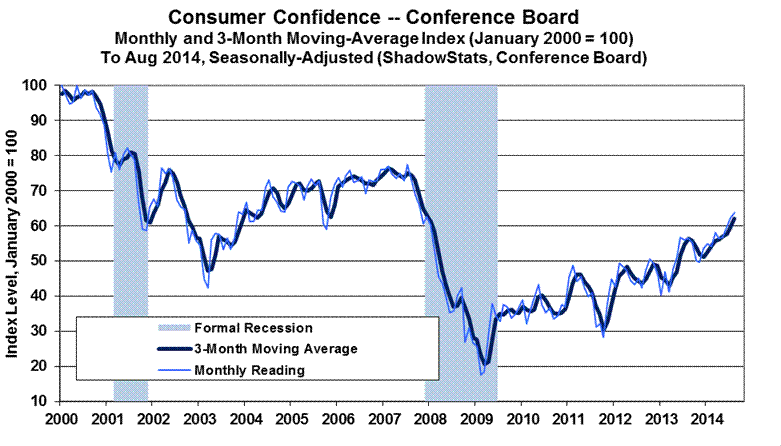
The third and fourth graphs here respectively reflect the final-August 2014 and early-September 2014 reporting of the ever-volatile consumer confidence (Conference Board) and consumer sentiment (University of Michigan) indices. Current levels for both series remain deep in traditional-recession territory, despite recent monthly increases. The patterns with these series, as with household income, have been of collapse and stagnation, since 2007, as opposed to the pattern of economic collapse and recovery indicated in the heavily-distorted GDP series.
[For further detail on the August CPI, see the Reporting Detail section. Various graphics and drill-down options are available at ShadowStats affiliate www.ExpliStats.com.]
__________
HYPERINFLATION WATCH
Hyperinflation Outlook Summary. This Summary has not been changed since Commentary No. 655 of September 5th. The next revision is planned for tomorrow, following the heavy calendar of economic releases through September 18th. The long-standing hyperinflation and economic outlooks were updated with the publication of 2014 Hyperinflation Report—The End Game Begins – First Installment Revised, on April 2nd, and publication of 2014 Hyperinflation Report—Great Economic Tumble – Second Installment, on April 8th, along with ongoing updates in the regular Commentaries, including a review in Commentary No. 639.
Primary Summary. The primary and basic summary of the broad outlook and the story of how and why this crisis has unfolded and developed over the years—particularly in the last decade—is found in the Opening Comments and Overview and Executive Summary of that First Installment Revised (linked above). The following section summarizes the underlying current circumstance.
Consistent with the above Special Commentaries, the unfolding economic circumstance, in confluence with other fundamental issues, should place mounting and massive selling pressure on the U.S. dollar, as well as potentially resurrect elements of the 2008-Panic. Physical gold and silver, and holding assets outside the U.S. dollar, remain the primary hedges against the pending total loss of U.S. dollar purchasing power.
Current Economic Issues versus Underlying U.S. Dollar Fundamentals. U.S. economic activity has turned down anew, with headline first-quarter 2014 GDP having contracted at an annualized real pace of 2.11% (-2.11%), following 3.50% fourth-quarter 2013 growth, per the July 30th GDP benchmark revisions. Although the second estimate of second-quarter 2014 GDP growth came in at 4.17%, such still heavily overstated actual current economic activity and remained subject to some downside revisions. The “advance” estimate of third-quarter GDP on October 30th will be that last reporting before the midterm election. While third-quarter GDP should show a quarterly contraction within its standard revision cycle, one should not underestimate the ability of the Bureau of Economic Analysis to keep that final pre-election number in positive territory, in initial reporting.
Nonetheless, basic underlying economic series, such as the trade deficit, retail sales and industrial production, even payroll employment, should be showing enough of a downturn or weakness in headline activity during the same timeframe—the next several months—so as to provide consensus expectations with downside shocks. That increasingly should shift the popular outlook towards a “new recession,” with negative shifts in the economic consensus likely to disrupt stability in the financial markets.
As financial-market expectations increasingly shift towards renewed or deepening recession, that circumstance, in confluence with other fundamental issues, should place mounting and massive selling pressures on the U.S. dollar, as well as potentially resurrect elements of the 2008-Panic.
Unexpected economic weakness intensifies the known stresses on an already-impaired banking system, hence a perceived need for expanded, not reduced, quantitative easing. The highly touted “tapering” by the FOMC is pre-conditioned by a continued flow of “happy” economic news. Banking-system and other systemic (i.e. U.S. Treasury) liquidity needs likely still will be provided, as needed, by the Fed, under the ongoing political covering of a weakening economy—a renewed, deepening contraction in business activity.
Unexpected economic weakness also savages projections of headline, cash-based, federal-budget deficits (particularly the 10-year versions) as well as projected funding needs for the U.S. Treasury. Current fiscal “good news” is from cash-based, not GAAP-based accounting projections, and comparative year-ago cash numbers are distorted against U.S. Treasury and government activity operating sub rosa, in order to avoid the limits of a constraining debt ceiling.
All these crises will combine against the U.S. dollar, likely in the very-near future.
In general, summary, the fundamental issues threatening the U.S. dollar could not be worse. They include, but are not limited to:
· A severely damaged U.S. economy, which never recovered post-2008 and is turning down anew. The circumstance includes a sharply widening trade deficit, as reflected in headline first- and second-quarter reporting, as well as ongoing severe, structural-liquidity constraints on the consumer, which are preventing a normal economic rebound in the traditional, personal-consumption-driven U.S. economy.
· U.S. government unwillingness to address its long-term solvency issues. Those controlling the U.S. government have demonstrated not only a lack of will to address long-term U.S. solvency issues, but also the current political impossibility of doing so. Any current fiscal “good news” comes from cash-based, not GAAP-based accounting projections. The GAAP-based version continues to run in the $6-trillion-plus range for annual shortfall, while those in Washington continue to increase spending and to take on new, unfunded liabilities.
· Monetary malfeasance by the Federal Reserve, as seen in central bank efforts to provide liquidity to a troubled banking system, and also to the U.S. Treasury. The current pace of the Fed’s monetization is at 58.2% of effective net issuance of the federal debt to be held by the public in calendar-year 2014 (through September 3rd). The pace of effective monetization has been 65.9% since the January 2013 expansion of QE3.
· Mounting domestic and global crises of confidence in a dysfunctional U.S. government, where the relative positive rating by the public of the U.S. President tends to have a meaningful correlation with the foreign-exchange-rate strength of the U.S. dollar. Positive ratings for both the President and Congress are pushing, if not at, historic lows.
· Mounting global political pressures contrary to U.S. interests. Downside pressures on the U.S. currency generally are increasing, in the context of global political and military developments that have been contrary to U.S. strategic, financial and economic interests.
· Spreading global efforts to dislodge the U.S. dollar from its primary reserve-currency status.
Renewed and intensifying weakness in the U.S. dollar will place upside pressure on oil prices and other commodities, boosting domestic inflation and inflation fears. Domestic willingness to hold U.S. dollars will tend to move in parallel with global willingness, or lack of willingness, to do the same. Both dollar weakness and the resulting higher inflation should boost the prices of gold and silver, where physical holding of those key precious metals remains the ultimate hedge against the pending inflation and financial crises.
Monthly Gold Graphs. Following are the graphs of gold prices versus the Swiss franc, oil prices and silver prices that usually accompany the Commentary on the monthly CPI release. Volatile markets continue, amidst mounting and shifting global political tensions, a rapidly weakening U.S. economy and nascent recognition of rising inflation. Related market fears also center on worsening fiscal and monetary instabilities, and rapidly deteriorating domestic political circumstances.
All these issues have sharply negative implications for the U.S. dollar, which still remains an excellent bet to be an early casualty. Precious metals and oil prices would benefit from a weakened U.S. dollar. All that said, the most-recent price movements still have been to the upside for the dollar, to the downside for oil and the precious metals.
As discussed in the two installments of the 2014 Hyperinflation Report, linked above, the underlying fundamentals could not be much weaker for the U.S. dollar, and they could not be stronger for gold and silver, irrespective of unusual price volatility in the last year or two, and in recent days. Market movements increasingly should reflect the fundamentals. More-recent oil price volatility has reflected intensifying global political instabilities, which are not likely to abate, but oil prices also will face significant, separate upside pressure when the U.S. dollar comes under heavy selling pressure.
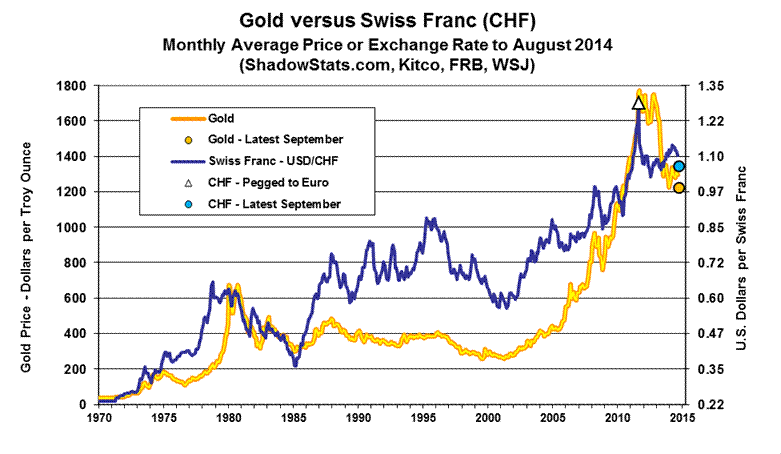
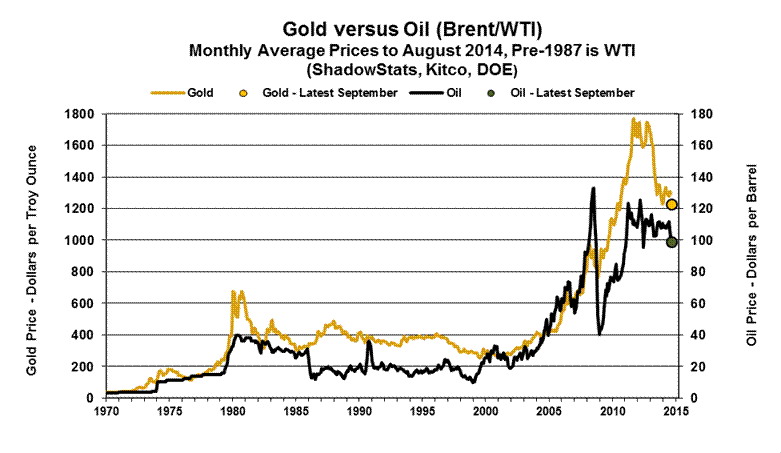
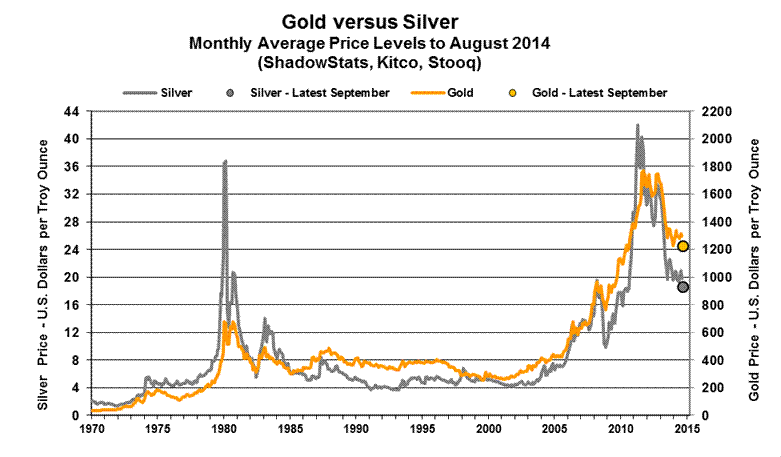
The “latest September” points in the preceding graphs reflect approximate conditions as of late-afternoon New York time, September 17th, post-FOMC meeting.
__________
REPORTING DETAIL
CONSUMER PRICE INDEX—CPI (August 2014)
A Confluence of Uncoordinated Numbers? To adjust an economic series, meaningfully, from nominal terms (before inflation adjustment), to real terms (after inflation adjustment), the adjusting inflation series should be highly coordinated with, and directly measure the inflation affecting the nominal series. Discussed in the Opening Comments, there appear to be some conflicts in the measurement of gasoline prices during a period of rapid change in and around August 2014. If the data from the inflation and economic series are uncoordinated, distorted growth patterns in the real series may result, and likely did in some of today’s (September 17th) headline reporting.
Pending COLA Calculations. Separately, the headline weakness the August consumer inflation dimmed prospects for the magnitude of inflation-adjustments to Social Security payments in the year ahead. Along with the existing July and August 2014 numbers, the September 2014 CPI-W will determine the 2015 annual cost-of-living adjustment (COLA) for Social Security recipients, among others.
With August 2014 CPI-W—the second of three months used in determining the COLA—now in place, the latest reporting has pushed the likely 2015 COLA to well below 2.0%. The 2014 adjustment was 1.5% (based on the average year-to-year change for third-quarter 2013 unadjusted CPI-W).
The same number for third-quarter 2014 (the basis for the 2015 adjustment) is headed in the direction of what was reported last year. Where second-quarter 2014 CPI-W was up year-to-year by 2.0%, and annual CPI-W July annual inflation was 1.9%, August would have been 1.9%, as well, if the “unchanged” seasonally-adjusted consensus CPI expectations were met. Instead, the headline 0.3% (-0.3%) monthly decline in CPI-W left annual unadjusted August inflation at 1.6%. Existing trends would tend to leave the 2015 COLA adjustment in the 1.6% to 1.7% range.
Longer-Range Inflation Outlook. Going forward, and as discussed in 2014 Hyperinflation Report—The End Game Begins – First Installment Revised and in the Hyperinflation Watch section, risks of a massive flight from the U.S. dollar threaten upside energy and global-commodity inflation, which would drive headline consumer inflation much higher. Nascent dollar problems could surface and accelerate at any time, with little warning. Renewed financial-market turmoil surrounding deteriorating global and domestic political, fiscal and monetary instabilities, and rapidly worsening economic activity, all should pummel the U.S. dollar. Ongoing economic and financial-system-liquidity crises still threaten systemic instabilities that, as with their 2008 Panic precursors, cannot be contained without further, official actions that have serious inflation consequences.
As a separate issue, inflation—generally perceived by the public from the standpoint of personal income or investment use—continues to run well above any of the government’s rigged price measures. Related methodological changes to the CPI series in recent decades were designed to understate the government’s reporting of consumer inflation, as discussed in the Public Comment on Inflation Measurement.
__________________
Notes on Different Measures of the Consumer Price Index
The Consumer Price Index (CPI) is the broadest inflation measure published by the U.S. Government, through the Bureau of Labor Statistics (BLS), Department of Labor:
The CPI-U (Consumer Price Index for All Urban Consumers) is the monthly headline inflation number (seasonally adjusted) and is the broadest in its coverage, representing the buying patterns of all urban consumers. Its standard measure is not seasonally-adjusted, and it never is revised on that basis except for outright errors.
The CPI-W (CPI for Urban Wage Earners and Clerical Workers) covers the more-narrow universe of urban wage earners and clerical workers and is used in determining cost of living adjustments in government programs such as Social Security. Otherwise, its background is the same as the CPI-U.
The C-CPI-U (Chain-Weighted CPI-U) is an experimental measure, where the weighting of components is fully substitution based. It generally shows lower annual inflation rate than the CPI-U and CPI-W. The latter two measures once had fixed weightings—so as to measure the cost of living of maintaining a constant standard of living—but now are quasi-substitution-based. Since it is fully substitution based, the series tends to reflect lower inflation than the other CPI measures. Accordingly, the C-CPI-U is the “new inflation” measure being considered by Congress and the White House as a tool for reducing Social Security cost-of-living adjustments by stealth.
The ShadowStats Alternative CPI-U Measures are attempts at adjusting reported CPI-U inflation for the impact of methodological change of recent decades designed to move the concept of the CPI away from being a measure of the cost of living needed to maintain a constant standard of living. There are two measures, where the first is based on reporting methodologies in place as of 1980, and the second is based on reporting methodologies in place as of 1990.
__________________
CPI-U. The Bureau of Labor Statistics (BLS) reported this morning, September 17th, that the headline, seasonally-adjusted CPI-U for August 2014 declined month-to-month by 0.2% (-0.2%) [down by 0.20% (0.20%) at the second decimal point], following an increase of 0.1% (0.09% at the second decimal point) in the July CPI-U. On a not-seasonally-adjusted basis, the August CPI-U declined by 0.17% (-0.17%), versus a decline of 0.04% (-0.04%) in July.
Monthly Gasoline Prices. The BLS used a 4.1% decline (-4.1%) in not-seasonally-adjusted gasoline prices for August, where a 3.3% decline (-3.3%) was indicated by the more-comprehensive, industry-based surveying of the Department of Energy. In line with last year’s numbers showing neutral seasonal-adjustments to gasoline prices, that 4.1% (-4.1%) unadjusted drop held after seasonal adjustments. Seasonal adjustments, however, were negative across the board, for headline aggregate energy inflation, food inflation and “core” inflation (net of food and energy).
Major CPI Groups. Encompassed by the headline August 2014 CPI-U seasonally-adjusted contraction of 0.20% (-0.20%) [down by 0.17% (-0.17%) unadjusted], aggregate August energy inflation was down for the month by an adjusted 2.58% (-2.58%) [down by an unadjusted 2.70% (-2.70%)]. In the other major CPI sectors, adjusted food inflation was up by 0.27% for the month [up by 0.34% unadjusted], while “core” inflation, “unchanged” at the first decimal point, was up by an adjusted 0.01% [up by 0.07% unadjusted]. Core inflation also showed unadjusted year-to-year inflation of 1.72% in August 2014, versus 1.86% in July 2014.
Year-to-Year CPI-U. Not seasonally adjusted, August 2014 year-to-year inflation for the CPI-U was a gain of 1.70% in August, versus 1.99% in July.
Year-to-year, CPI-U inflation would increase or decrease in next month’s September 2014 reporting, dependent on the seasonally-adjusted monthly change, versus an adjusted 0.13% gain in the monthly inflation reported for September 2013. The adjusted change is used here, since that is how consensus expectations are expressed. To approximate the annual unadjusted inflation rate for September 2014, the difference in September’s headline monthly change (or forecast of same), versus the year-ago monthly change, should be added to or subtracted directly from the August 2014 annual inflation rate of 1.70%.
CPI-W. The August 2014 seasonally-adjusted, headline CPI-W, which is a narrower series and has greater weighting for gasoline than does the CPI-U, fell by 0.26% (-0.26%) [down by 0.21% (-0.21%) unadjusted] for the month, following a monthly gain of 0.08% in July [down by 0.08% (-0.08%) unadjusted].
Unadjusted, August 2014 year-to-year CPI-W inflation was 1.59%, versus 1.93% in July.
Chained-CPI-U. Initial reporting of unadjusted year-to-year inflation for the August 2014 C-CPI-U was 1.54%, versus 1.87% in July.
[The balance of the C-CPI-U discussion is unchanged from the prior Commentary covering the CPI.] The recent, two-year budget deficit agreement (see Commentary No. 581) cut cost-of-living adjustments (COLA) for certain military retirees by one-percent. The Congressional negotiators did not use the Chained-CPI as had been threatened otherwise for Social Security, etc., where the idea had been that the chained series would cut COLAs by about one-percent on an annual basis, versus existing calculations. The approach taken is more open about what is being done, as opposed to the prior subterfuge of trying to pass off a fully-substitution-based CPI as a legitimate COLA measure.
The Chained-CPI-U currently is not designed as a benchmark cost-of-living indicator, with the series subject to revisions for two years, before the inflation-rate reduction is realized fully. Despite White House and Congressional considerations of making the chained index the new cost-of-living-adjustment (COLA) measure for programs such as Social Security, the system cannot be made workable as a concept for using a substitution-based CPI measure as a COLA, without the new index becoming even more of a sham than it already is. For further detail, see the Public Commentary on Inflation Measurement and Chained-CPI), and the C-CPI material posted on the BLS site, apparently in anticipation possible political uses for the measure: Chained CPI.
Alternate Consumer Inflation Measures. Adjusted to pre-Clinton methodologies—the ShadowStats-Alternate Consumer Inflation Measure (1990-Base)—annual inflation was roughly 5.3% in August 2014, versus 5.6% in July 2014. The ShadowStats-Alternate Consumer Inflation Measure (1980-Base), which reverses gimmicked changes to official CPI reporting methodologies back to 1980, eased to about 9.4% (9.42% for those using the second decimal point) in August, versus roughly 9.7% in July.
[The balance of the text in this Alternate Consumer Inflation Measures sub-section is unchanged from the prior CPI Commentary.]
Note: The ShadowStats-Alternate Consumer Inflation Measure largely has been reverse-engineered from the BLS’s CPI-U-RS series, which provides an official estimate of historical inflation, assuming that all current methodologies were in place going back in time. The ShadowStats estimates effectively are adjusted on an additive basis for the cumulative impact on the annual inflation rate of various methodological changes made by the BLS (the series is not recalculated).
Over the decades, the BLS has altered the meaning of the CPI from being a measure of the cost of living needed to maintain a constant standard of living, to something that neither reflects the constant-standard-of-living concept nor measures adequately what most consumers view as out-of-pocket expenditures. Roughly five percentage points of the additive ShadowStats adjustment reflect the BLS’s formal estimate of the annual impact of methodological changes; roughly two percentage points reflect changes by the BLS, where ShadowStats has estimated the impact not otherwise published by the BLS. (See Public Commentary on Inflation Measurement and Chained-CPI for further details.)
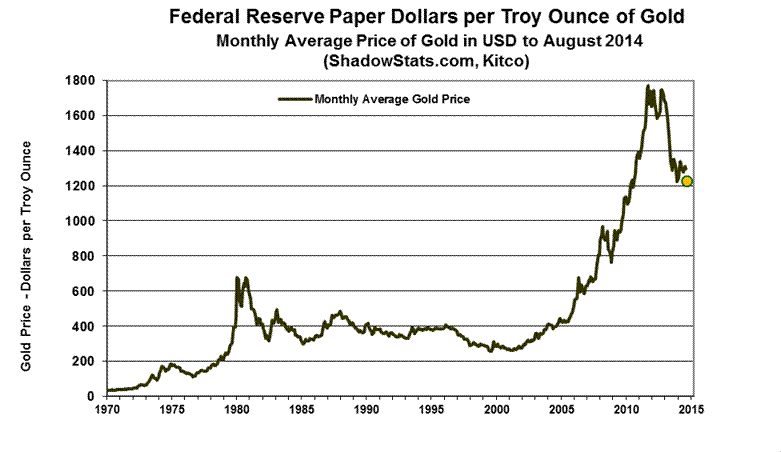
Gold and Silver Highs Adjusted for CPI-U/ShadowStats Inflation. Despite the September 5, 2011 historic-high gold price of $1,895.00 per troy ounce (London afternoon fix), and despite the multi-decade-high silver price of $48.70 per troy ounce (London fix of April 28, 2011), gold and silver prices have yet to re-hit their 1980 historic levels, adjusted for inflation. The earlier all-time high of $850.00 (London afternoon fix, per Kitco.com) for gold on January 21, 1980 would be $2,599 per troy ounce, based on August 2014 CPI-U-adjusted dollars, and $11,282 per troy ounce, based on August 2014 ShadowStats-Alternate-CPI (1980-Base) adjusted dollars (all series not seasonally adjusted).
In like manner, the all-time high nominal price for silver in January 1980 of $49.45 per troy ounce (London afternoon fix, per silverinstitute.org), although approached in 2011, still has not been hit since 1980, including in terms of inflation-adjusted dollars. Based on August 2014 CPI-U inflation, the 1980 silver-price peak would be $151 per troy ounce and would be $656 per troy ounce in terms of August 2014 ShadowStats-Alternate-CPI (1980-Base) adjusted dollars (again, all series not seasonally adjusted).
As shown in Table 1, on page 31 of 2014 Hyperinflation Report—The End Game Begins – First Installment Revised, over the decades, the increases in gold and silver prices have compensated for more than the loss of the purchasing power of the U.S. dollar as reflected by CPI inflation, while they effectively have come close to fully compensating for the loss of purchasing power of the dollar based on the ShadowStats-Alternate Consumer Price Measure (1980-Methodologies Base).
Real (Inflation-Adjusted) Retail Sales—August 2014—Negative-Inflation Boosted Already-Strong Nominal Numbers. In nominal terms, before adjustment for inflation, headline monthly retail sales rose by 0.58% in August, versus a revised 0.34% (previously 0.04%) gain in July (see Commentary No. 656).
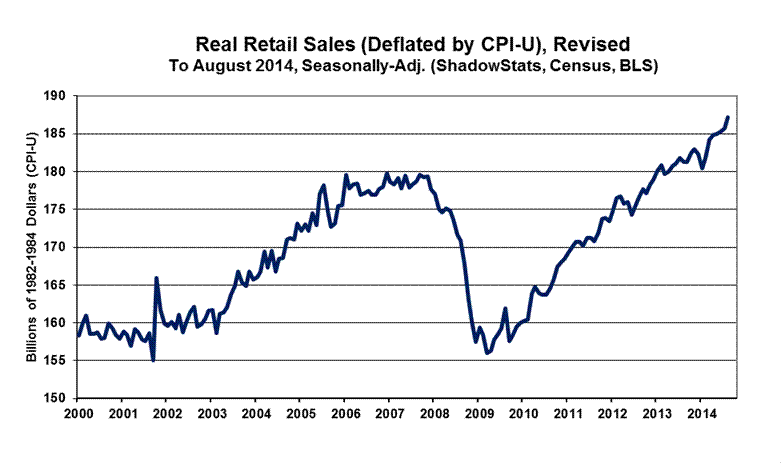
Based on today’s reporting of a 0.20% (-0.20%) contraction in headline August 2014 CPI-U, and in the context of the prior July CPI-U headline 0.09% gain, seasonally-adjusted real (inflation-adjusted) monthly retail sales jumped by 0.78% in August, following a revised 0.25% gain in July. Previously, July real sales had notched lower by 0.05% (-0.05%).
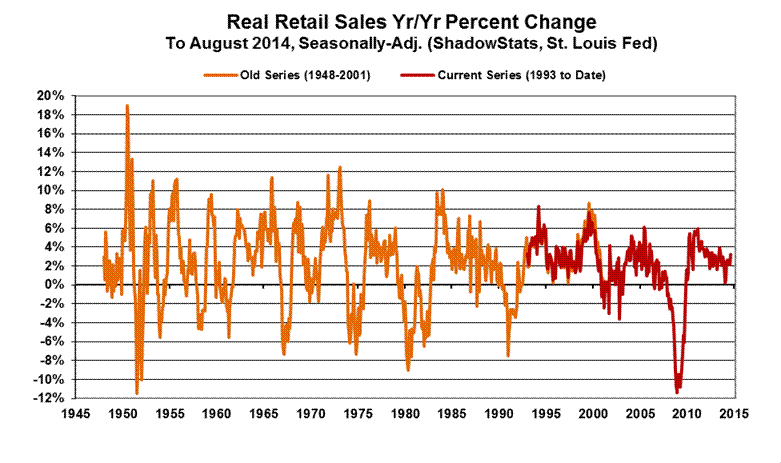
Year-to-year change in August 2014 real retail sales jumped to 3.23%, up from a revised 2.17% (previously 1.65%) gain in July. That was against an unrevised annual gain of 2.14% in June, as shown in the second and fourth graphs following. In normal economic times, annual real growth at or below 2.0% would signal an imminent recession. That signal had been given recently and remains in play, a signal that likely will serve as an indicator of renewed downturn in broad economic activity.
Real Retail Sales Graphs. The first of the following four accompanying graphs shows the level of real retail sales activity (deflated by the CPI-U) since 2000; the second graph shows year-to-year percent change for the same period. The level of monthly activity turned down sharply in December 2013 and January 2014 with a bounce-back into today’s reporting. Year-to-year activity, which had plunged to a near-standstill in January and February, also has bounced back, temporarily. The third and fourth graphs show the level of and annual growth in real retail sales (and its predecessor series) in full post-World War II detail.
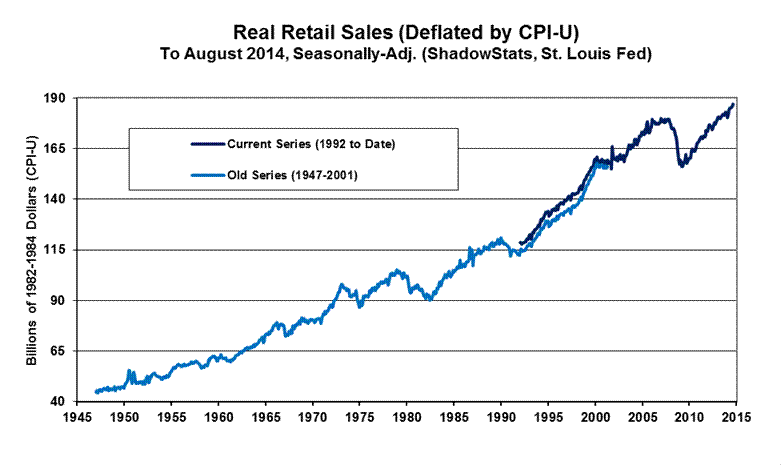

The apparent “recovery” in the real retail sales series and industrial production (as well as in the GDP) is due to the understatement of the rate of inflation used in deflating retail sales and other series. As discussed more fully in Chapter 9 of 2014 Hyperinflation Report—Great Economic Tumble – Second Installment, deflation by too-low an inflation number (such as the CPI-U) results in the deflated series overstating inflation-adjusted economic growth.
As shown in the latest “corrected” real retail sales graph, in the Opening Comments, with the deflation rates corrected for understated inflation, the recent pattern of real sales activity has turned increasingly negative. The corrected graph shows that the post-2009 period of protracted stagnation ended, and a period of renewed contraction began in second-quarter 2012. The corrected real retail sales numbers use the ShadowStats-Alternate Inflation Measure (1990-Base) for deflation instead of the CPI-U.
In addition, as discussed at the end of the Opening Comments, there has been no change in the underlying consumer-liquidity fundamentals. With low levels of stagnant, real household income and lack of the ability and/or willingness of the consumer to offset limited income with debt expansion, there is nothing that would support a sustainable turnaround in retail sales, personal consumption, housing or general economic activity. There never was a broad economic recovery, and there is no recovery underway, just general bottom-bouncing that has begun turning down anew.
As official consumer inflation resumes its upturn in the months ahead, and as overall retail sales continue to suffer from the ongoing consumer liquidity squeeze—reflected partially by the general pattern of real earnings difficulties, discussed in the next section—these data should continue to trend meaningfully lower, in what should gain recognition as a formal new or double-dip recession.
Real (Inflation-Adjusted) Average Weekly Earnings—August 2014—Real Earnings Boosted by Headline-Inflation Drop. Coincident with today’s August 2014 CPI-W release, the BLS also published real average weekly earnings for August. In the production and nonsupervisory employees series—the only series for which there is a meaningful history—headline real average weekly earnings (deflated by the CPI-W) rose by 0.55%, boosted by a headline 0.26% decline in the seasonally-adjusted CPI-W. Net of prior-period revisions, the monthly gain in August was 0.60%.
The gain in August earnings was against an unrevised 0.12% gain in July, a revised 0.11% (-0.11%) decline in June [previously down by 0.16% (-0.16%), and initially down by 0.11% (-0.11%)], versus unrevised monthly declines of 0.14% (-0.14%) in May and 0.19% (-0.19%) in April.
Year-to-year and seasonally-adjusted, August 2014 real average weekly earnings rose by 0.92%, versus a revised 0.99% (previously 0.95%) gain in July, a revised 0.24% (previously 0.28%, initially 0.24%) gain in June, and unrevised gains of 0.28% in May and 0.32% in April. Both the monthly and annual fluctuations in this series are irregular, but current reporting remains well within the normal bounds of volatility. Prior-period revisions usually are due to the instabilities in the BLS monthly surveys.
The regular graph of this series is in the Opening Comments section. As shown there, the graph plots the earnings as officially deflated by the BLS (red-line), and as adjusted for the ShadowStats-Alternate CPI Measure, 1990-Base (blue-line). When inflation-depressing methodologies of the 1990s began to kick-in, the artificially-weakened CPI-W (also used in calculating Social Security cost-of-living adjustments) helped to prop up the reported real earnings. Official real earnings today still have not recovered their inflation-adjusted levels of the early-1970s, and, at best, have been flat for the last decade. Deflated by the ShadowStats measure, real earnings have been in fairly-regular decline for the last four decades, which is much closer to common experience than the pattern suggested by the CPI-W. See Public Commentary on Inflation Measurement for further detail.
Real Money Supply M3—August 2014. The signal for a double-dip or ongoing recession, based on annual contraction in the real (inflation-adjusted) broad money supply (M3), remains in place and continues, despite real annual M3 growth holding in positive territory. As shown in the accompanying graph—based on August 2014 CPI-U reporting and the latest ShadowStats-Ongoing M3 Estimate—annual inflation-adjusted growth in M3 for August 2014 moved higher to 2.9%, from an unrevised 2.7% in July. The pick up in the growth rate reflected a somewhat softer gain in annual headline M3 growth, more than offset by headline annual CPI-U inflation dropping to 1.7% in August, from 2.0% in July.

The signal for a downturn or an intensified downturn is generated when annual growth in real M3 first turns negative in a given cycle; the signal is not dependent on the depth of the downturn or its duration. Breaking into positive territory does not generate a meaningful signal one way or the other for the broad economy. The current downturn signal was generated in December 2009, even though there had been no upturn since the economy hit bottom in mid-2009. The broad economy tends to follow in downturn or renewed deterioration roughly six-to-nine months after the signal. Weaknesses in a number of series continued to the present, with significant new softness in recent reporting. Actual post-2009 economic activity has remained relatively low levels of activity—in protracted stagnation.
A renewed downturn in official data appears to be underway, and that eventually should lead to official recognition of a “new” or double-dip recession. Reality remains that the economic collapse into 2009 was followed by a plateau of low-level economic activity—no upturn or recovery, no end to the official 2007 recession—and the unfolding renewed downturn remains nothing more than a continuation and re-intensification of the downturn that began unofficially in 2006. Further discussion of this issue is found in Chapter 8 of the 2014 Hyperinflation Report—Great Economic Tumble – Second Installment.
__________
WEEK AHEAD
Against Overly-Optimistic Expectations, Pending Economic Releases Should Be Much Weaker; Inflation Releases Should Be Increasingly Stronger. Although shifting to the downside, again, amidst wide fluctuations, market expectations for business activity generally remain overly optimistic, well above any potential, underlying economic reality. Market outlooks should be hammered, though, by ongoing, downside corrective revisions and by an accelerating pace of downturn in headline economic activity.
Longer-Range Reporting Trends. The initial stages of the process shifting economic-growth expectations to the downside already have been seen in the recent headline reporting of many major economic series (see 2014 Hyperinflation Report—Great Economic Tumble – Second Installment), including the sharp pace of economic decline seen in real first-quarter 2014 GDP, which largely survived the GDP benchmark revisions. The strong bounce-back estimated by the Bureau of Economic Analysis (BEA) for headline second-quarter GDP still should face some downside revision, with a likely GDP contraction eventually seen in third-quarter 2014.
Indeed, weakening, underlying economic fundamentals indicate still further deterioration in business activity. Accordingly, weaker-than-consensus economic reporting should remain the general trend until the unfolding “new” recession receives broad recognition, which likely would follow the next reporting of a headline contraction in real GDP growth.
A generally stronger inflation trend remains likely to continue, as seen in recent months. Beyond the spread of earlier oil-based inflation pressures into the broad economy, upside pressure on oil-related prices should continue and be rekindled from the intensifying impact of global political instabilities and a likely near-term weakening of the U.S. dollar in the currency markets. Again, near-term food inflation has been picking up, partially due to supply issues. The dollar faces pummeling from the weakening economy, continuing QE3, the ongoing U.S. fiscal-crisis debacle, and deteriorating U.S. and global political conditions (see Hyperinflation 2014—The End Game Begins (Updated) – First Installment). Particularly in tandem with a weakened dollar, reporting in the year ahead generally should reflect much higher-than-expected U.S. inflation across the board.
A Note on Reporting-Quality Issues and Systemic-Reporting Biases. Significant reporting-quality problems remain with most major economic series. Ongoing headline reporting issues are tied largely to systemic distortions of seasonal adjustments. The data instabilities were induced by the still-evolving economic turmoil of the last eight years, which has been without precedent in the post-World War II era of modern economic reporting. These impaired reporting methodologies provide particularly unstable headline economic results, when concurrent seasonal adjustments are used (as with retail sales, durable goods orders, employment, and unemployment data). These issues have thrown into question the statistical-significance of the headline month-to-month reporting for many popular economic series.
PENDING RELEASES:
Residential Construction—Housing Starts (August 2014). The Census Bureau plans the release of August 2014 residential construction detail, including housing starts, tomorrow Thursday, September 18th. Despite extreme monthly volatility seen regularly in the reporting of this series, and despite near-perpetual wishful upside market expectations for housing starts—although flat-to-down activity appears to be expected in the current circumstance—month-to-month change likely will continue a pattern of statistical-insignificance, with ongoing stagnation and renewed downturn and/or downside revisions. As usual, this series is subject to extremely-large prior-period revisions.
In the wake of a 75% collapse in aggregate activity from 2006 through 2008, and of an ensuing five-year pattern of housing starts stagnation at historically low levels, little has changed. Again, as was discussed in the Consumer Liquidity section of Commentary No. 654, there remains no chance of a near-term, sustainable turnaround in the housing market, unless there is a fundamental upturn in consumer and banking-liquidity conditions. That has not happened and does not appear to be in the offing.
Payroll Employment Benchmark Revision (Preliminary Estimate for March 2014). Although full detail will not be released until the February 2015 publication of January 2015 payroll data, the Bureau of Labor Statistics (BLS) will publish its initial estimate of the aggregate benchmark revision to not-seasonally-adjusted March 2014 payrolls also tomorrow, Thursday, September 18th. Odds favor a downside revision, barring unrelated series redefinitions, as were introduced in last year’s benchmarking.
__________