


No. 670: Third-Quarter 2014 GDP, Money Velocity

COMMENTARY NUMBER 670
Third-Quarter 2014 GDP, Money Velocity
October 30, 2014
__________
Happy Election-Eve Numbers!
GDP up by 3.5% (+/- 3.5% Range of Reporting-Confidence),
Boosted by Guessed-At Trade Numbers and Resurgent Defense Spending
Significant Downside Revisions Loom for Third-Quarter Growth
End of Declining Velocity of Money
Disappointing October Jobs Growth?
___________
PLEASE NOTE: The next regular Commentary is planned for Tuesday, November 4th, covering the September trade deficit and construction spending, followed by one on Friday, November 7th, covering October employment and unemployment, and M3.
Best wishes to all — John Williams
OPENING COMMENTS AND EXECUTIVE SUMMARY
Third-Quarter 2014 GDP. Although at a slower pace than in the second-quarter, third-quarter GDP growth came in at a headline 3.5%, versus 3.0% market expectations. With the headline details of the bloated "advance" estimate very much in the areas of predicted fluff, however, there is a very strong chance of significant downside revisions to the guessed-at underlying data and assumptions that supported the 3.5% guesstimate. New detail—triggering downside revisions—will be forthcoming as early as Election Day, November 4th (see the Trade Deficit in the Week Ahead section). The latest headline gain in the GDP, which remains the most worthless and most heavily manipulated and massaged of the popular economic series, appears to have been little more than political gaming this time around.
Discussed in Commentary No. 668, "The initial GDP guess should be dominated by a positive boost from the net-exports account, which is based on just two months of partial data. Pending trade deficit reporting and revisions (November 4th) could knock down the initial GDP growth estimate sharply, in the two subsequent GDP revisions, to below two-percent, and potentially into negative territory, along with other factors. In any event, a likely initial headline GDP growth estimate, near market expectations [3.0%], would not be statistically-significant."
Those comments and revision outlooks hold, with the third estimate of third-quarter GDP scheduled for December 23rd. Discussed in the Week Ahead section, the headline trade data in July and August were used as a basis for guesstimating a sharp narrowing of the net-export account deficit in the third-quarter GDP. In fact, that guess accounted for at least 37% of the 3.5% annualized headline quarterly third-quarter GDP growth, which would have been 2.2% with an unchanged trade deficit, let alone a further reduced growth rate with likely widening in the revised, actual quarterly trade shortfall.
Not only should the net trade deficit contribution to the quarterly growth rate turn negative, but other revisions in terms of more-negative inventory adjustments, weaker auto sales and defense spending, downside adjustments to healthcare and health-insurance activity, and still-weaker construction should pummel estimated third-quarter GDP growth in revision.
Today’s Missive. Beyond the heavy concentration on headline third-quarter GDP detail in today’s (October 30th) Commentary, the Hyperinflation Watch covers the latest numbers on money velocity (money supply turnover in the GDP), where recent sharp declines in M1 and M2 velocity appear to have bottomed out, while M3 velocity has continued to be flat. Separately the Hyperinflation Outlook Summary was updated to reflect the new GDP and changing Fed policies.
In the Week Ahead section, the trend model suggests a headline October payroll gain that would be unusually weak for the series and well below market expectations. Upcoming trade and construction spending data also are reviewed.
Gross Domestic Product (GDP)—Third-Quarter 2014—"Advance" Guesstimate Was Not Significant, Was Overstated, and Is Subject to Heavy Downside Revisions. The "advance" or first estimate of third-quarter 2014 GDP was a statistically-insignificant, real (inflation-adjusted), annualized, quarterly headline gain of 3.5% (3.55% at the second decimal point). That was down from the heavily-overstated estimate of 4.59% growth in second-quarter 2014, and versus a benchmarked contraction of 2.11% (-2.11%) [a pre-benchmark drop of 2.93% (-2.93%) per Commentary No. 646)] in first-quarter 2014 GDP. The third-quarter GDP growth estimate should revise sharply lower in the next two months.
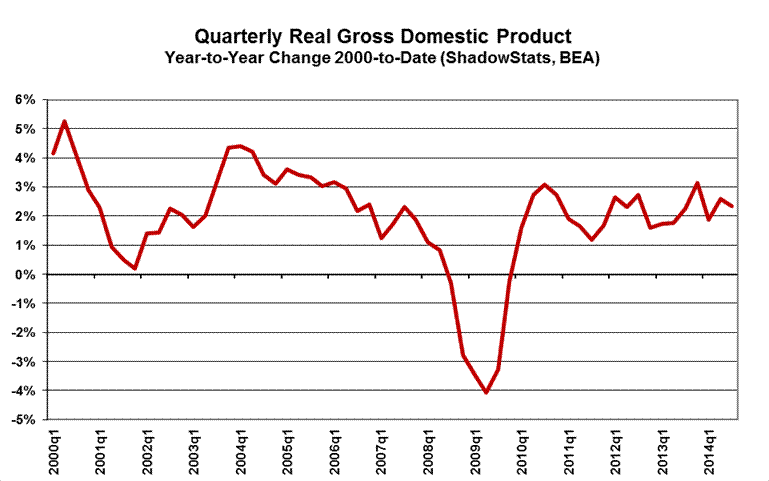
Third-quarter 2014 year-to-year growth in real GDP slowed to 2.35% (rounds to 2.3%), from 2.59% in the second-quarter and versus benchmarked growth of 1.89% (1.54% pre-benchmark) in the first-quarter. Historical plots of annual real growth are shown in the Reporting Detail section.
Implicit Price Deflator (IPD). The "advance" estimate of third-quarter 2014 GDP inflation, or the implicit price deflator (IPD), was 1.28%, versus 2.15% in second-quarter 2014, and a benchmarked 1.33% in first-quarter 2014. Year-to-year, third-quarter 2014 IPD inflation was 1.54%, versus 1.64% in second-quarter 2014 and a benchmarked 1.37% in first-quarter 2014. The weaker the inflation rate used in deflating an economic series, the stronger will be the resulting inflation-adjusted growth.
For comparison, on a seasonally-adjusted, annualized quarter-to-quarter basis, CPI-U inflation published by the Bureau of Labor Statistics (BLS) was up by 1.10% for third-quarter 2014, versus 3.03% for second-quarter 2014 and 1.91% for first-quarter 2014. Unadjusted, year-to-year quarterly inflation was 1.78% for third-quarter 2014, versus 2.05% for second-quarter 2014 and 1.41% for first-quarter 2014.
Gross National Product (GNP) and Gross Domestic Income (GDI). Neither the advance estimate of the third-quarter GNP nor the advance estimate of the third-quarter GDI will be published until next month, because adequate information is not available for the BEA to hazard a meaningful guess on these numbers. Today’s BEA guesstimate of the "advance" third-quarter GDP similarly was not meaningful. As a service to the public and the financial markets, the BEA also would do well to delay release of the initial GDP estimate by at least one month, on a regular basis.
Distribution of Headline GDP Growth. Despite the severely-limited significance of the following detail, it is included for those interested in the reported internal patterns of GDP growth, as guessed at by the BEA. The first or "advance" guesstimate of the headline growth in third-quarter 2014 GDP, was 3.55% (rounds to 3.5%), following a 4.59% growth estimate for second-quarter 2014, and an estimated contraction of 2.11% (-2.11%) in first-quarter 2014 GDP.
The initial, annualized third-quarter growth rate is detailed in the following aggregation of contributed growth. Please note that the annualized growth number in each sub-category is the additive contribution to the aggregate, headline change in GDP, where 1.22% + 0.17% + 1.32% + 0.83% = 3.54% (rounding differential).
· Consumer Spending Contributed 1.22% to Third-Quarter Growth; Contributed 1.75% to Second-Quarter. The bulk of the growth contribution here came from sales of autos, recreational goods and vehicles, surging financial services and insurance and healthcare costs, with a small offset from a weather-related decline in utility usage. Auto sales were overstated, and the healthcare and health-insurance related numbers lacked reporting substance.
· Business/Residential Investment Contributed 0.17% to Third-Quarter Growth; Contributed 2.87% to Second-Quarter. The biggest factor in the business sector was a negative contribution to aggregate quarterly GDP growth of 0.57% (-0.57%) with an outright reduction in inventories. Net of inventories, final sales rose by 4.11%. The biggest plus-side item was a 0.39% positive contribution from transportation equipment, again, largely tied to the poor-quality numbers tied to automobile activity. Nonresidential and residential construction activity was on the plus-side of flat. Look for further downside adjustments to the inventory numbers and construction.
· Net Exports Contributed 1.32% to Third-Quarter Growth; Subtracted 0.34% (-0.34%) from Second-Quarter. Reflecting positive contributions from lower imports and higher exports, an unusual narrowing of the deficit in the net-export account generated nearly 40% of the headline annualized growth rate in third-quarter GDP. These numbers should swing to neutral or negative in revisions of the next week and next month, pulling the headline GDP growth rate much lower.
· Government Spending Contributed 0.83% to Third-Quarter Growth; Contributed 0.31% to Second-Quarter. A surge in quarterly defense spending contributed 0.67% to the aggregate GDP growth rate. That may be subject to some downside revision. The balance of the gain in the government sector was in reduced/slower consumption and investment growth on the state and local government side, likely distorted by ongoing lack of meaningful detail related to health insurance changes.
Economic Reality. Even with the headline "advance" annualized growth estimate of 3.55% (rounds to 3.5%) in third-quarter 2014 GDP, following 4.59% growth in second-quarter 2014 and a contraction of 2.11% (-2.11%) in first-quarter 2014, the general outlook as to underlying economic reality has not changed. The broad economy still is turning down anew, and a wide variety of monthly economic detail should confirm that in reporting of the next month or two, particularly with downside revisions to the initial third-quarter GDP estimate. Accordingly, the gist of much of the following text remains along the lines of other recent GDP Commentaries, but the details and numbers have been updated for the third-quarter reporting.
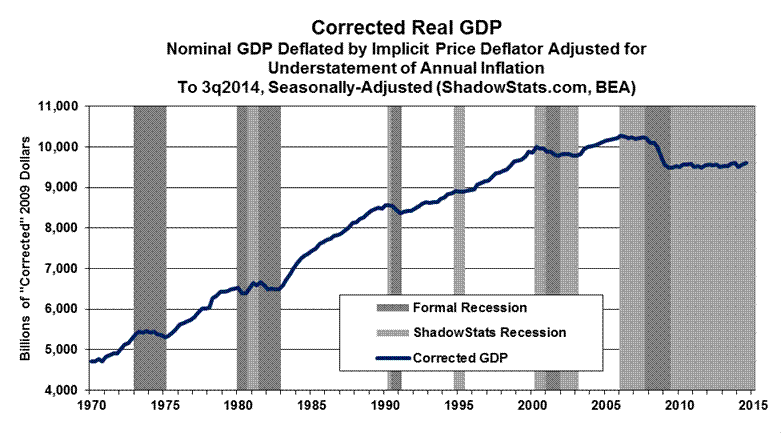
As discussed earlier, the GDP does not reflect properly or accurately the changes to the underlying fundamentals that drive the economy. Underlying real-world economic activity shows that the broad economy began to turn down in 2006 and 2007, plunged into 2009, entered a protracted period of stagnation thereafter—never recovering—and then began to turn down anew in recent quarters. Irrespective of the reporting gimmicks introduced in the July 2013 and July 2014 GDP benchmark revisions, a consistent, fundamental pattern of faltering historical activity is shown in the accompanying sets of “corrected” GDP graphs.
Please note that the pattern of activity shown for the “corrected” GDP series is much closer to the patterns shown in the graphs of monthly real median household income and other liquidity measures. Similar patterns are found in recent indications of annual consumer expenditures (see graphs and discussions in Commentary No. 665, Commentary No. 656, Commentary No. 667 and Commentary No. 668), and of economic series not otherwise reliant on understated inflation for their reported growth, such as housing starts (see 2014 Hyperinflation Report—Great Economic Tumble – Second Installment). A sustainable business recovery could not have taken place since 2009, and a recovery will not be forthcoming until the consumer’s structural income and liquidity problems are resolved.
Official and Corrected GDP. As usually discussed in the Commentaries covering the quarterly GDP reporting and monthly revisions, the full economic recovery indicated by the official, real GDP numbers remains an illusion. It is a statistical illusion created by using too-low a rate of inflation in deflating (removing inflation effects) from the GDP series. The accompanying two sets of graphs tell that story, updated for the initial estimate of third-quarter 2014 GDP.
The first set of graphs (2000-to-date) is the one traditionally that has been incorporated in the GDP Commentaries, and is expressed on an index base where first-quarter 2000 = 100.0. The second set updates the longer-term graphs (1970-to-date), expressed in billions of 2009 dollars as used in headline GDP reporting, and as published initially in the second installment of the Hyperinflation Report.
Shown in the first graph of official Headline Real GDP, GDP activity has been reported above pre-2007 recession levels—in full recovery—since second-quarter 2011, and headline GDP has shown sustained growth since (with a growth interruption in first-quarter 2014). Adjusted for official GDP inflation (the implicit price deflator), the level of third-quarter 2014 GDP currently stands at 7.7% above the pre-recession peak-GDP estimate of fourth-quarter 2007. In contrast, the “corrected” GDP version, in the second graph, shows third-quarter 2014 GDP activity at 6.6% (-6.6%) below the pre-recession peak of first-quarter 2006.
Further, as discussed in the second installment of the Hyperinflation Report, no other major economic series has shown a parallel pattern of official full economic recovery and meaningful expansion beyond, consistent with the GDP reporting (see discussions on the real retail sales series in Commentary No. 668 and the industrial production series in Commentary No. 666). Either the GDP reporting is wrong, or all other major economic series are wrong. While the GDP is heavily modeled, imputed, theorized and gimmicked, it also encompasses reporting from those various major economic series and private surveys, which still attempt to survey real-world activity. Flaws in the GDP inflation methodologies and simplifying reporting assumptions have created the “recovery.”
The second graph in each series plots the Corrected Real GDP, corrected for the understatement inherent in official inflation estimates (see Public Commentary on Inflation Measurement), with the deflation by the implicit price deflator (IPD) adjusted for understatement of roughly two-percentage points of annual inflation. The inflation understatement has resulted from hedonic-quality adjustments, as discussed in the Hyperinflation Reports. Both graphs in the first set are indexed to first-quarter 2000 = 100, and show official periods of recession as shaded areas.

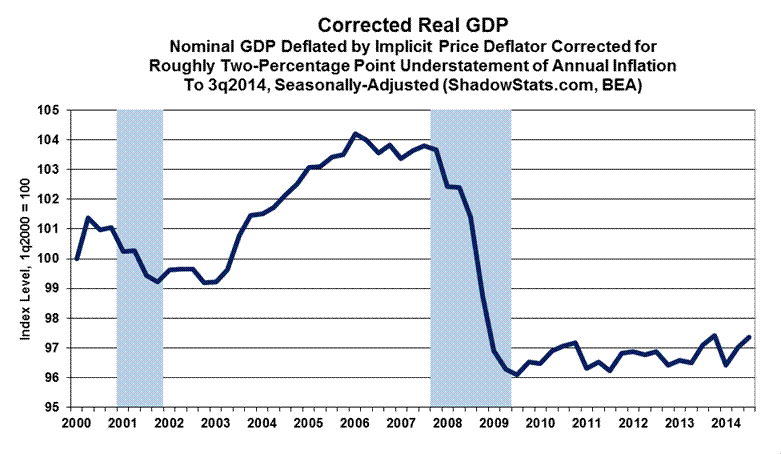

The shaded areas in the “corrected” graph that follows reflect official as well as ShadowStats-defined recessions, as discussed in detail in the second installment of the Hyperinflation Report.
[For further detail on the advance estimate of third-quarter GDP, see the Reporting Detail section. Various drill-down and graphics options on the headline GDP data are available to ShadowStats subscribers at our affiliate: www.ExpliStats.com].
__________
HYPERINFLATION WATCH
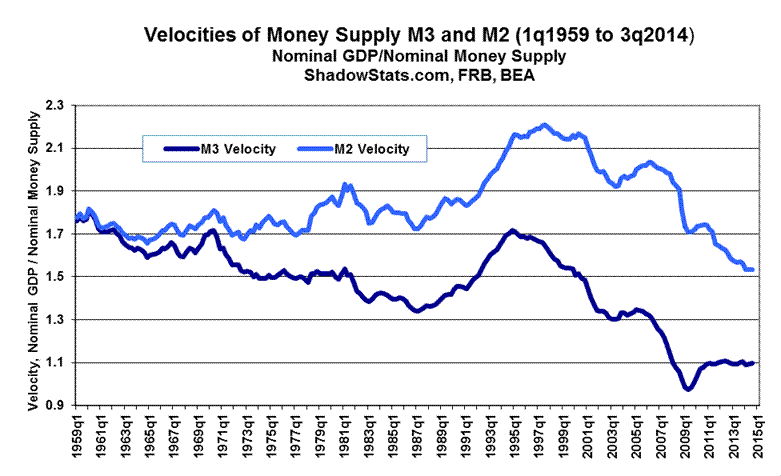
Money Supply Velocity. Incorporating the initial new nominal data on third-quarter 2014 GDP, as well as recent Federal Reserve benchmark revisions to money supply-related data, graphed below are updated estimates for the velocity of money, money supply M1, M2 and M3.
Velocity generally held steady in third-quarter 2014 for each money-supply measure, M1, M2 and M3 (ShadowStats Ongoing-M3 Measure), as shown in the accompanying graphs, having plunged into 2014 for M1 and M2. M3 velocity has been stagnant since the end of 2010.
Where velocity simply is the ratio of the nominal GDP to the nominal money supply, the unchanged ratios, reflected somewhat stronger money growth and GDP growth, with recent slowing in M1 and M2 velocity bottoming out, and the flattening of M3 holding in place or turning slightly to the upside.
As to M1, consider that perhaps 70% or more of the cash-in-circulation component of that measure (with cash accounting for about 43% of M1) could be physically outside the United States, per the Federal Reserve. Where that has been an increasing trend, a true measure of domestic M1 velocity well could be showing a significant uptrend. In like manner, where M1 includes cash, M2 includes M1, and M3 includes M2, M2 and M3 velocities also would be somewhat higher (cash is 11% of M2, 8% of M3).
Most recently, M3 versus M1 and M2 had been showing opposite patterns since 2011, because growth in M3 has been weaker than growth in M1 and M2. The reason behind that difference was that much of the relatively stronger M1 and M2 growth reflected cash moving out of M3 categories—such as large time deposits and institutional money funds—into M2 or M1 accounts. The clarity of what happened there is why ShadowStats still tracks what had been the broadest money measure (M3) available.
Subscribers often ask for specifics on the velocity of the money supply, with the result that this section has become a standard feature (the M1 detail being introduced today) for Commentaries covering the first GDP reporting of a given quarter. The nature of velocity is discussed in some detail in the 2008 Money Supply Special Report. Velocity simply is the number of times the money supply turns over in the economy in a given year, or the ratio in nominal terms (not adjusted for inflation) of GDP to the money supply. It is a residual number, not otherwise open to calculation.
Velocity has theoretical significance. In combination with money-supply growth, it should be a driving force behind inflation. Yet, since velocity is a ratio of two not-particularly-well or realistically-measured numbers, its actual estimate is of limited value. As an inflation predictor, it has to be viewed in the context of accompanying money-supply growth, and vice versa, generally as a coincident indicator. Again, full definitions can be found in the Money Supply Special Report.

Comparative changes in year-to-year growth rates in nominal GDP and the nominal money supply that generate the relative changes in the velocity numbers are shown here in the accompanying graph.

Hyperinflation Outlook Summary. The Summary has been updated to reflect the initial third-quarter 2014 GDP estimate and the completion of the Fed’s tapering program. Changes to the text have been underlined. The prior version of the Summary is found in Commentary No. 668 of October 23rd. If this is being read for the first time, reading it in the context of the Opening Comments of Commentary No. 664 of October 10th still is suggested.
The long-standing hyperinflation and economic outlooks were updated with the publication of 2014 Hyperinflation Report—The End Game Begins – First Installment Revised, on April 2nd, and publication of 2014 Hyperinflation Report—Great Economic Tumble – Second Installment, on April 8th, along with ongoing updates in the regular Commentaries, including Commentary No. 661. The two 2014 Hyperinflation Report installments remain the primary background material for the hyperinflation and economic analyses and forecasts.
Primary Summary. Current fiscal conditions show the effective long-term insolvency of the U.S. government, a circumstance that usually would be met by unfettered monetization of the national debt and obligations, leading to an eventual hyperinflation. The 2008 Panic and near-collapse of the financial system, and official (U.S. government and Federal Reserve) response to same, pulled the elements of the eventual hyperinflation crisis into the 2014 period. The primary and basic summary of the broad outlook and the story of how and why this fiscal, financial and economic crisis has unfolded and developed over the years—particularly in the last decade—is found in the Opening Comments and Overview and Executive Summary of that First Installment Revised (linked above). The following section summarizes the underlying current circumstance and recent developments.
Consistent with the above Special Commentaries, the unfolding economic circumstance, in confluence with other fundamental issues, should place mounting and massive selling pressure on the U.S. dollar, as well as potentially resurrect elements of the 2008-Panic. Physical gold and silver, and holding assets outside the U.S. dollar, remain the primary hedges against the pending total loss of U.S. dollar purchasing power, despite sharp recent rallies in the U.S. dollar’s exchange rate and related heavy selling in the gold and silver markets.
Current relative U.S. economic strength versus major U.S. trading partners is seriously over-estimated, with a crash back to recognition of realistic domestic-economic circumstances likely to be accompanied by a crash in the U.S. dollar versus major currencies, such as the euro, yen, pound, Swiss franc, Canadian dollar and Australian dollar; related rallies in precious metals and oil; and related sell-offs in the domestic stock and bond markets.
Current Economic Issues versus Underlying U.S. Dollar Fundamentals. U.S. economic activity is turning down anew, despite gimmicked GDP reporting. The headline contraction in first-quarter 2014 GDP was the reality; the headline second-quarter GDP boom was the aberration. The headline third-quarter growth of 3.5% appears to have been spiked by overly-optimistic trade-deficit and inventory numbers, which will be subject to downside revisions. Such should become increasingly and painfully obvious to the financial markets in the domestic economic reporting and accompanying revisions of the weeks and months ahead.
Recent reporting of relatively hard annual numbers from 2013 showed ongoing economic contraction, with no trend towards sustainable economic growth (see Commentary No. 656). Also, as discussed in Commentary No. 668, real business activity—net of all the happy assumptions and modeling used by the Bureau of Economic Analysis in putting together the overstated third-quarter GDP growth estimate—has been flat-to-minus, with real sales of the S&P 500 showing a decline in third-quarter 2014 activity.
Despite short-term pre-election fluff, those basic underlying and increasingly-negative economic conditions should show up soon with mounting frequency in various series, such as the trade deficit, retail sales, industrial production, payroll employment and inventories, providing consensus expectations with downside shocks. In turn, that should shift the popular outlook quite rapidly towards a "new recession," with negative shifts in the economic consensus further disrupting the already-disintegrating stability in the financial markets.
As financial-market expectations shift towards renewed or deepening recession, that circumstance, in confluence with other fundamental issues, specifically should place mounting and massive selling pressures on the U.S. dollar, as well as potentially resurrect elements of the 2008-Panic.
Unexpected economic weakness intensifies the known stresses on an already-impaired banking system, hence a perceived need for expanded, not reduced, quantitative easing. The highly touted "tapering" by the FOMC finally has run its course. Future, constructive Federal Reserve behavior—purportedly moving towards normal monetary conditions in the currently unfolding, perfect economic environment—is pre-conditioned by a continued flow of "happy" economic news. Suggestions that all is right again with world are nonsense. The 2008 Panic never has been resolved.
The economy has not recovered; the banking system is far from stable and solvent; and the Federal Reserve and the federal government still have no way out. Significant banking-system and other systemic (i.e. U.S. Treasury) liquidity needs will be provided, as needed, by the Fed, under the ongoing political cover of a weakening economy—a renewed, deepening contraction in business activity. The Fed has no choice. Systemic collapse is not an option for the Board of Governors. This circumstance does not have a happy solution.
Accordingly, some speculation already has begun to circulate as to an added round of Federal Reserve quantitative easing, QE4. That would be a major factor behind crashing the dollar and boosting the price of gold. The Fed has strung out its options for propping up the system as much as it could, with continual, negative impact on the U.S. economy. The easing to date, however, appears to have been a prop to the now-faltering equity markets (see Commentary No. 663).
In the event of QE4, any resulting renewed boost to U.S. equities likely would be a fleeting illusion, at least in terms of real value (purchasing power of the dollar). Such gains would tend to be losses, in real terms, with the stocks valued in terms of Swiss francs, for example, or valued against what would be a rapidly-increasing pace of domestic U.S. inflation.
Unexpected economic weakness also savages projections of headline, cash-based, federal-budget deficits (particularly the 10-year versions) as well as projected funding needs for the U.S. Treasury. Current fiscal "good news" is from cash-based, not GAAP-based and accounting projections, where comparative year-ago, cash numbers recently were distorted against U.S. Treasury and government activity operating sub rosa, in order to avoid the limits of a constraining debt ceiling.
All these crises should combine against the U.S. dollar, likely in the very-near future. That said, recent faux market perceptions of domestic economic, financial-system and monetary tranquility have boosted the U.S. dollar’s strength significantly in global trading and have contributed to savaging the prices of precious metals. Again, such should not prevail in the context of underlying reality. The actual fundamental problems threatening the U.S. dollar could not be worse. The broad outlook has not changed. The key issues include, but are not limited to:
· A severely damaged U.S. economy, which never recovered post-2008 and is turning down anew. The circumstance includes a sharply widening trade deficit (initial reporting of third-quarter 2014 excepted, revisions there are pending), as well as ongoing severe, structural-liquidity constraints on the consumer, which are preventing a normal economic rebound in the traditional, personal-consumption-driven U.S. economy.
· U.S. government unwillingness to address its long-term solvency issues. Those controlling the U.S. government have demonstrated not only a lack of will to address long-term U.S. solvency issues, but also the current political impossibility of doing so. Any current fiscal "good news" comes from cash-based, not GAAP-based accounting projections. The GAAP-based version has continued to run in the $6-trillion-plus range for annual shortfall—and should have done so again in the just-completed fiscal-2014—while those in Washington continue to increase spending and to take on new, unfunded liabilities. The history and issues here are explored in the first installment of the Hyperinflation Report, as previously linked.
· Monetary malfeasance by the Federal Reserve, as seen in central bank efforts to provide liquidity to a troubled banking system, and also to the U.S. Treasury. Despite the end of the Fed’s new asset purchases, the current pace of the Fed’s monetization was at 58.9% of effective net issuance of federal debt to be held by the public in calendar-year 2014, as late as October 8th. The pace then of effective monetization had been 66.0%, since the January 2013 expansion of QE3. It would not be surprising in this period of changing, overt Federal Reserve activities to see increasingly covert purchases of Treasury debt by nations financially friendly to the United States.
· Mounting domestic and global crises of confidence in a dysfunctional U.S. government. The relative positive rating by the public of the U.S. President tends to be an indicative measure of this circumstance, with a meaningful correlation with the foreign-exchange-rate strength of the U.S. dollar. The weaker the rating, the weaker tends to be the U.S. dollar. Positive ratings for both the President and Congress are at historic lows and plummeting.
· Mounting global political pressures contrary to U.S. interests. Downside pressures on the U.S. currency generally are mounting, in the context of global political and military developments contrary to U.S. strategic, financial and economic interests. Current conditions include the situation in Ukraine versus Russia and the extremely-volatile circumstances in the Middle East.
· Spreading global efforts to dislodge the U.S. dollar from its primary reserve-currency status. Active efforts or comments against the U.S. dollar have been seen with Russia, China, France and India, along with some rumblings in OPEC and elsewhere.
When the selling pressure breaks massively against the U.S. currency, the renewed and intensifying weakness in the dollar will place upside pressure on oil prices and other commodities, boosting domestic inflation and inflation fears. Domestic willingness to hold U.S. dollars will tend to move in parallel with global willingness, or lack of willingness, to do the same. These circumstances will trigger the early stages of a hyperinflation.
Both the renewed dollar weakness and the resulting inflation spike should boost the prices of gold and silver, where physical holding of those key precious metals remains the ultimate hedge against the pending inflation and financial crises.
__________
REPORTING DETAIL
GROSS DOMESTIC PRODUCT—GDP (Third-Quarter 2014, "Advance" or First Estimate)
Most-Worthless of Economic Series. Broadly discussed throughout this Commentary, the GDP remains the most-worthless and the most-heavily modeled, massaged and politically-manipulated of government economic series. Beyond historical changes in reporting methodology, a special-purpose political manipulation appears increasingly likely as a factor in recent and current reporting. While it likely will take some time for the full story to surface, key underlying data and third-quarter GDP revisions of the next two months likely will see significant downside reporting and revisions.
Otherwise, the headline GDP does not reflect properly or accurately the changes to the underlying fundamentals that drive the economy. Underlying real-world economic activity suggests that the broad economy began to turn down in 2006 and 2007, plunged into 2009, entered a protracted period of stagnation thereafter—never recovering—and then began to turn down anew in recent quarters (see 2014 Hyperinflation Report—The End Game Begins – First Installment Revised, and 2014 Hyperinflation Report—Great Economic Tumble – Second Installment).
__________________
Notes on GDP-Related Nomenclature and Definitions
For purposes of clarity and the use of simplified language in the text of the GDP analysis, here are definitions of several key terms used related to GDP reporting:
Gross Domestic Product (GDP) is the headline number and the most widely followed broad measure of U.S. economic activity. It is published quarterly by the Bureau of Economic Analysis (BEA), with two successive monthly revisions, and with an annual revision in the following July.
Gross Domestic Income (GDI) is the theoretical equivalent to the GDP, but it generally is not followed by the popular press. Where GDP reflects the consumption side of the economy and GDI reflects the offsetting income side. When the series estimates do not equal each other, which almost always is the case, since the series are surveyed separately, the difference is added to or subtracted from the GDI as a “statistical discrepancy.” Although the BEA touts the GDP as the more accurate measure, the GDI is relatively free of the monthly political targeting the GDP goes through.
Gross National Product (GNP) is the broadest measure of the U.S. economy published by the BEA. Once the headline number, now it rarely is followed by the popular media. GDP is the GNP net of trade in factor income (interest and dividend payments). GNP growth usually is weaker than GDP growth for net-debtor nations. Games played with money flows between the United States and the rest of the world tend to mute that impact on the reporting of U.S. GDP growth.
Real (or Constant Dollars) means the data have been adjusted, or deflated, to reflect the effects of inflation.
Nominal (or Current Dollars) means growth or level has not been adjusted for inflation. This is the way a business normally records revenues or an individual views day-to-day income and expenses.
GDP Implicit Price Deflator (IPD) is the inflation measure used to convert GDP data from nominal to real. The adjusted numbers are based on “Chained 2009 Dollars,” as introduced with the 2013 comprehensive revisions, where 2009 is the base year for inflation. “Chained” refers to the substitution methodology which gimmicks the reported numbers so much that the aggregate of the deflated GDP sub-series missed adding to the theoretically-equivalent deflated total GDP series by $41.8 billion in “residual,” as of the initial estimate of second-quarter 2013.
Quarterly growth, unless otherwise stated, is in terms of seasonally-adjusted, annualized quarter-to-quarter growth, i.e., the growth rate of one quarter over the prior quarter, raised to the fourth power, a compounded annual rate of growth. While some might annualize a quarterly growth rate by multiplying it by four, the BEA uses the compounding method, raising the quarterly growth rate to the fourth power. So a one percent quarterly growth rate annualizes to 1.01 x 1.01 x 1.01 x 1.01 = 1.0406 or 4.1%, instead of 4 x 1% = 4%.
Annual growth refers to the year-to-year change of the referenced period versus the same period the year before.
__________________
Gross Domestic Product (GDP). Published this morning, October 30th, by the Bureau of Economic Analysis (BEA), the "advance" or first estimate of third-quarter 2014 GDP was a statistically-insignificant, real (inflation-adjusted), annualized, quarterly headline gain of 3.5% (3.55% at the second decimal point) +/- 3.5% (95% confidence interval). That was down from the heavily-overstated estimate of 4.59% growth in second-quarter 2014, and versus a benchmarked 2.11% contraction (-2.11%) [a pre-benchmark 2.93% drop (-2.93%) per Commentary No. 646)] in first-quarter 2014. The third-quarter GDP growth estimate should revise sharply lower, as discussed in the Opening Comments and Week Ahead sections. The distribution of the headline quarterly GDP growth rate by major components also is detailed in the Opening Comments.
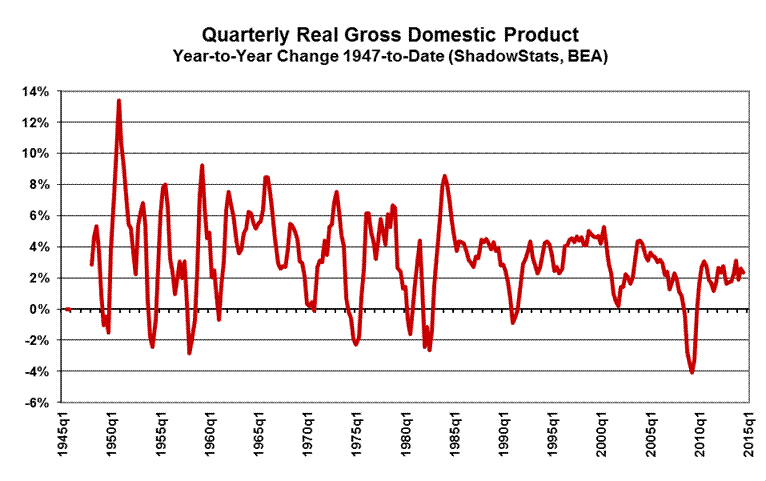
As shown in the two following graphs, headline year-to-year growth in real third-quarter 2014 GDP slowed to 2.35% (rounds to 2.3%), from 2.59% in the second-quarter and versus benchmarked growth of 1.89% (1.54% pre-benchmark) in the first-quarter. The first graph shows current detail, from 2000-to-date, where the second graph shows the series in terms of its full quarterly history.
The latest quarterly year-to-year growth remained below the near-term peak of 3.13% seen in fourth-quarter 2013. The current-cycle trough in annual change was in second-quarter 2009, at a 4.09% pace of decline (-4.09%). That was the deepest year-to-year contraction for any quarterly GDP in the history of the series, which began with first-quarter 1947.
Implicit Price Deflator (IPD). The "advance" estimate of third-quarter 2014 GDP inflation, or the implicit price deflator (IPD), was 1.28%, versus 2.15% in second-quarter 2014, and a benchmarked 1.33% in first-quarter 2014. Year-to-year, third-quarter 2014 IPD inflation was 1.54%, versus 1.64% in second-quarter 2014 and a benchmarked 1.37% in first-quarter 2014.
For comparison, on a seasonally-adjusted, annualized quarter-to-quarter basis, CPI-U inflation published by the Bureau of Labor Statistics (BLS) was up by 1.10% for third-quarter 2014, versus 3.03% for second-quarter 2014 and 1.91% for first-quarter 2014. Unadjusted, year-to-year quarterly inflation was 1.78% for third-quarter 2014, versus 2.05% for second-quarter 2014 and 1.41% for first-quarter 2014.
The weaker the inflation rate used in deflating an economic series, the stronger will be the resulting inflation-adjusted growth.
Gross National Product (GNP) and Gross Domestic Income (GDI). Neither the advance estimate of the third-quarter GNP nor the advance estimate of the third-quarter GDI will be published until next month, because adequate information is not available for the BEA to hazard a meaningful guess on these numbers. Today’s BEA guesstimate of the "advance" third-quarter GDP similarly was not meaningful. As a service to the public and the financial markets, the BEA also would do well to delay release of the initial GDP estimate by at least one month, on a regular basis.
GNP is the broadest measure of U.S. economic activity, where GDP is GNP net of trade flows in factor income (interest and dividend payments). As a reporting gimmick aimed at boosting the headline reporting of economic growth for net-debtor nations such as Greece and the United States, international reporting standards were shifted some decades back to reporting headline GDP instead of GNP.
GDI is the theoretical income-side equivalent of the consumption-side GDP estimate. The GDP and GDI are made to equal each other, every quarter, with the addition of a “statistical discrepancy” to the GDI-side of the equation, but the discrepancy just as easily could be added to the GDP number.
ShadowStats-Alternate GDP. The ShadowStats-Alternate GDP estimate for third-quarter 2014 GDP is a 1.7% year-to-year contraction (-1.7%) versus the headline GDP gain of 2.3%. Those third-quarter estimates were against a similar ShadowStats estimated 1.7% (-1.7%) year-to-year contraction but a headline year-to-year gain of 2.6% in second-quarter GDP (see the Alternate Data tab).
While annualized real quarterly growth is not estimated formally on an alternate basis, the headline 3.5% quarter-to-quarter gain for third-quarter 2014 likely was much weaker, flat-to-minus, net of all the regular reporting gimmicks. Significant downside revisions should follow in the GDP reporting of the next two months. An actual quarterly contraction appears to have been a realistic possibility for the real GDP in most quarters since the official, second-quarter 2009 end to the 2007 recession.
Adjusted for understated inflation and other methodological changes (such as the inclusion of intellectual property, including software), the business downturn that began in 2006/2007 is ongoing; there has been no meaningful economic rebound. The “corrected” real GDP graph, and the longer-term “corrected” graph updated from 2014 Hyperinflation Report—Great Economic Tumble – Second Installment (see the Opening Comments section) are based on the removal of the impact of hedonic quality adjustments that have reduced the reporting of official annual GDP inflation by roughly two-percentage points. It is not the same measure as the ShadowStats-Alternate GDP, which reflects reversing additional methodological distortions (“Pollyanna Creep”) of recent decades.
__________
WEEK AHEAD
Against Overly-Optimistic Expectations, Pending Economic Releases and Revisions Should Trend Much Weaker; Inflation Releases Should Be Increasingly Stronger. Having shifted some to the upside, again, from the downside, amidst wide fluctuations, market expectations for business activity are overly optimistic in the extreme. They exceed any potential, underlying economic reality. Market outlooks increasingly should be hammered, though, by ongoing, downside corrective revisions and by an accelerating pace of downturn in broad-based headline economic activity.
Longer-Range Reporting Trends. The gradual process of downside shifting in economic-growth expectations has been sporadic, but the underlying fundamentals remain extraordinarily negative. Other than for nonsense-growth in the headline second-quarter GDP (see Commentary No. 662), and today’s (October 30th) overstated and subject-to-downside revision third-quarter GDP growth estimate, renewed weakness has been, and increasingly will be seen in the headline reporting of other major economic series (see 2014 Hyperinflation Report—Great Economic Tumble – Second Installment), particularly subsequent to (possibly coincident with) next week’s November 4th election. Indeed, weaker-than-consensus economic reporting should become the general trend until the unfolding "new" recession receives broad recognition, which minimally would follow the next reporting of a headline contraction in real GDP growth (very possibly a sharp downside revision to today’s headline GDP estimate).
A generally stronger consumer inflation trend remains likely, as seen in recent months (August 2014 excepted). Beyond the spread of earlier oil-based inflation pressures into the broad economy, upside pressure on oil-related prices should continue and be rekindled from the intensifying impact of global political instabilities and a likely near-term weakening of the U.S. dollar in the currency markets. Such excludes any near-term financial sanction actions against Russia that are pushing oil prices lower.
The dollar faces eventual pummeling from the weakening economy, continuing perceptions of needed, ongoing quantitative easing, the ongoing U.S. fiscal-crisis debacle, and deteriorating U.S. and global political conditions (see Hyperinflation 2014—The End Game Begins (Updated) – First Installment). Particularly in tandem with a prospective, significantly-weakened dollar, reporting in the year ahead generally should reflect much higher-than-expected U.S. inflation, across the board.
A Note on Reporting-Quality Issues and Systemic-Reporting Biases. Significant reporting-quality problems remain with most major economic series. Ongoing headline reporting issues are tied largely to systemic distortions of seasonal adjustments. The data instabilities were induced by the still-evolving economic turmoil of the last eight years, which has been without precedent in the post-World War II era of modern economic reporting. These impaired reporting methodologies provide particularly unstable headline economic results, when concurrent seasonal adjustments are used (as with retail sales, durable goods orders, employment, and unemployment data). These issues have thrown into question the statistical-significance of the headline month-to-month reporting for many popular economic series.
PENDING RELEASES:
Construction Spending (September 2014). The Commerce Department has scheduled release of September 2014 construction spending for Monday, November 3rd. The headline monthly changes, as usual, should not be statistically significant, while previous data will be subject to large and unstable revisions. Most frequently, revisions are to the downside, irrespective of almost perpetually-positive market expectations for this series.
U.S. Trade Balance (September 2014). The Commerce Department and Bureau of Economic Analysis (BEA) will release their estimate of the September 2014 trade-balance on Tuesday, November 4th. The September trade deficit estimate and revisions to August should set a sharply negative tone for the first revision (November 25th) to today’s October 30th initial growth estimate of third-quarter GDP. Next month’s trade revisions also should have similar impact.
As expected, the headline trade data in July and August were used as a basis for guesstimating a sharp narrowing of the net-export account deficit in the third-quarter GDP. In fact, that guess accounted for at least 37% of the 3.5% annualized headline quarterly third-quarter GDP growth, which would have been 2.2% with an unchanged trade deficit, let alone a further reduced growth rate with any widening of the actual quarterly trade shortfall.
The September deficit (and August in revision) likely will widen sharply, month-to-month, versus market expectations that are for a small monthly deterioration. With the actual, revamped third-quarter deficit widening versus the second-quarter trade shortfall, the third-quarter GDP headline growth would revise sharply lower.
Employment/Unemployment (October 2014). The Bureau of Labor Statistics (BLS) will release its October 2014 labor data on Friday, November 7th. Given continuing indications of weakening broad economic activity, and the heavy, regular distortions in the headline reporting of monthly nonfarm payroll gains, almost anything is possible with the headline October reporting. Nonetheless, amidst an unusual trend signal, the system is due for continuing, negative surprises against persistently overly-optimistic market expectations.
Below-consensus reporting in the October payroll numbers would help to set a negative tone for fourth-quarter GDP activity and for a variety of economic indicators due for release in the month ahead.
As published previously by ShadowStats-affiliate www.ExpliStats.com, in its analysis of the biases built into the concurrent seasonal factor modeling of September 2014 payroll employment, the implied built-in bias trend for October 2014 suggests a headline October jobs gain of 180,000, versus the 248,000 headline payroll employment gain reported in September. Where consensus forecasts tend to settle in around the trend number, market expectations currently seem to be running well above the trend level—by more than 50,000 jobs—with the trend accordingly suggesting a relative downside surprise in reporting, at the moment. Again, underlying economic reality also would suggest a downside surprise to the market expectations for payrolls.
Separately, expectations appear to be for the October U.3 unemployment rate to hold at 5.9% for a second month. That is a seriously troubled level of unemployment, where those that have disappeared from the unemployment rolls have been unable to find work and have given up looking for a job, instead of the much happier circumstance of rejoining the ranks of the employed.
While underlying economic reality and the fundamental drivers of economic activity would suggest a general increase in the U.3 rate, the BLS’s continuing purge of discouraged workers from the unemployment rolls and headline labor force could argue in favor of a lower rate. Further, as discussed regularly in the employment/unemployment-related Commentaries, month-to-month comparisons of U.3 and related numbers are of no meaning, because of the standard, inconsistent reporting calculations that leave the monthly data not comparable.
If U.3 drops again, there should be additional labor-force loss associated with those relative, but still-not-comparable headline numbers. The broader U.6 and ShadowStats unemployment measures would tend to hold, or increase anew, at their broader and higher respective levels. All the Labor Department numbers remain unsettled and could come in well outside general expectations.
__________