


No. 707: February New Orders for Durable Goods

COMMENTARY NUMBER 707
February New Orders for Durable Goods
March 25, 2015
__________
Durable Goods Orders in Back-to-Back Quarterly Contractions,
Both Before and After Consideration of Commercial Aircraft Orders and Inflation
Signal Is for an Intensified Decline in Production and GDP, in
Both First- and Second-Quarter 2015, a Looming Recession
___________
PLEASE NOTE: The next regular Commentary, scheduled for Friday, March 27th, will cover the third estimate of fourth-quarter 2014 GDP.
Best wishes to all — John Williams
OPENING COMMENTS AND EXECUTIVE SUMMARY
Deteriorating New Orders Outlook Casts a Pall over Prospective Second-Quarter 2015 Economic Activity. The headline reporting for February 2015 new orders for durable goods not only indicated that the series effectively was locked into back-to-back quarterly contractions for fourth-quarter 2014 and first-quarter 2015, but also, with its leading relationship to production and GDP, signaled first-quarter and second-quarter contractions beginning to unfold for the broad economy. Such would constitute a formal new recession, if indeed that pattern were to fall into place.
Beware July 30th! The GDP circumstance will be reviewed in the next Commentary, covering the third revision to fourth-quarter 2014 GDP, on March 27th. Initial headline reporting of first-quarter 2015 GDP will follow on April 29th, with revisions following on May 29th and June 24th. First-quarter 2015 GDP reporting appears destined for a headline quarterly contraction. Second-quarter GDP, due for initial release on July 30th, along with what likely will be major downside revisions to historic GDP reporting, also appears headed for a contraction.
If this is to unfold, market expectations for economic activity will be taking increasing hits in the months ahead, with perceptions of a developing "new" recession very likely to be in place well before July 30th.
Today’s Missive (March 25th). The balance of today’s Commentary concentrates on the specifics of the February 2015 new orders for durable goods reporting. The Hyperinflation Watch section has not been revised since yesterday’s Commentary. The Week Ahead section previews Friday’s reporting of the third-estimate, second-revision of fourth-quarter 2014 GDP, which also has not been revised.
New Orders for Durable Goods—February 2015—Consecutive Quarterly Contractions a Virtual Certainty for Durable Goods Orders. The headline reporting of February 2015 new orders for durable goods, a series with broad leading relationships to industrial production and general economic activity, had increasingly-negative implications for the U.S. economy, not only for first-quarter 2015, but also for second-quarter 2015 activity.
With the impact of commercial aircraft orders removed, February 2015 new orders for durable goods declined for the fourth-straight month, setting the stage for back-to-back quarterly downturns in new orders. Net of inflation and ex-commercial aircraft orders, new orders for durable goods, rose at an annualized quarterly pace of 4.30% in third-quarter 2014, but then contracted at an annualized pace of 5.53% (-5.53%) in fourth-quarter 2014. As of February reporting, the series was on track for an annualized contraction of 8.68% (-8.68%) in first-quarter 2015.
The first-quarter 2015 contraction estimate is based on just January and February 2015 reporting. To turn first-quarter growth flat, real growth in new orders ex-commercial aircraft would have to jump month-to-month by 7.38% in March 2015. Although a monthly jump of that magnitude has been seen on occasion—a surge in defense orders, for example (again, this is ex-commercial aircraft orders)—there is no anecdotal evidence for anything like that in play.
The ex-commercial aircraft number is the one to look at as an indicator of pending, broad economic activity, due to the extreme and irregular nature of the volume of aircraft orders, as well as the limited impact of those multi-year orders on near-term economic activity. Consider that including the commercial aircraft orders, real third-quarter total durable goods orders surged an annualized quarterly pace of 39.53%, fourth-quarter total durable goods tumbled at an annualized pace of 34.24% (-34.24%), and are on track for an annualized contraction of 7.34% (-7.34%) in first-quarter 2015.
Activity in aggregate new orders for durable goods is irregularly volatile, usually due to those extreme and unstable patterns in nondefense- or commercial-aircraft orders. Even so, related commercial-aircraft monthly order swings in July and August 2014 (third-quarter 2014) were the most-extreme events of recent years, up by 315.6%, and down by 74.0% (-74.0%), respectively. They were followed by a smaller commercial-aircraft order decline in September of 16.0% (-16.0%), a negligible order gain of 0.8% in October, a decline of 11.0% (-11.0%) in November, a revised December decline of 58.1% (-58.1%), a revised January 2015 monthly gain of 122.2%, and today’s headline monthly decline of 8.9% (-8.9%) for February.
Both before and after consideration of volatility in commercial-aircraft orders, headline February durable goods orders remained well within the normal reporting variations of this highly unstable series, consistent with a pattern of down-trending stagnation. The inflation-adjusted real series, and that same series corrected for understatement of the official inflation series, also are reflected in the accompanying graphs of this Opening Comments section. They remain broadly stagnant with a developing downtrend of a nature that commonly precedes or coincides with a recession or a deepening business downturn.
Nominal (Not-Adjusted-for-Inflation) Reporting. The headline, regularly-volatile, seasonally-adjusted, nominal level of February 2015 new orders for durable goods declined by 1.35% (-1.35%) month-to-month, following a revised gain of 2.02% in January and a revised decline of 3.67% (-3.67%) in December 2014. Net of prior-period revisions, aggregate new orders for February fell by 2.06% (-2.06%) for the month, instead of the headline decline of 1.35% (-1.35%).
Year-to-year and seasonally-adjusted growth in February 2015 durable goods orders slowed to an annual gain of 0.62%, versus a revised annual gain of 4.67% in January 2015, and a revised annual gain of just 0.01% in December 2014.
Detail Net of Volatility in Commercial Aircraft Orders. The reporting of extreme contractions and surges in commercial aircraft orders is seen commonly in an irregularly-repeating process throughout the year and often dominates the changes in headline monthly durable goods orders. These extremely volatile aircraft orders are booked years into the future and are indicative more of longer-term, rather than shorter-term prospects for manufacturing activity.
Net of a headline monthly decline of 8.80% (-8.80%) in February 2015 commercial aircraft orders, aggregate durable goods orders declined by 0.92% (-0.92%). Net of a revised gain of 122.24% in aircraft orders, aggregate orders fell by a revised 1.06% (-1.06%) in January 2015. Net of a revised decline of 58.09% (-58.09%) in December aircraft orders, aggregate orders fell by 0.35% (-0.35%) for the month.
Year-to-year and seasonally-adjusted, February 2015 orders were up by 1.99%, following revised annual gains of 2.96% in January 2015 and 14.71% in December 2014.
Real (Inflation-Adjusted) Durable Goods Orders. ShadowStats uses the PPI aggregated inflation measure "Durable Manufactured Goods" for deflating the new orders for durable goods series. Published only on a not-seasonally-adjusted basis, the related PPI series reflected a headline "unchanged" pace of inflation in February 2015, for a third month, the same as in January and December, with headline annual inflation at 0.60% in February 2015, versus 0.72% in January 2015, and 1.09% in December 2014.
Adjusted for that "unchanged" monthly inflation, and again as reflected in the accompanying graphs, real month-to-month aggregate orders fell by the same 1.35% (-1.35%) as seen in the nominal series. In like manner, January real orders rose by 2.02%, following a headline decline of 3.67% in December. Ex-commercial aircraft, real orders fell by 0.92% (-0.92%) in February, down by 1.06% (-1.06%) in January and by 0.35% (-0.35%) in December.
Real year-to-year aggregate orders rose by just 0.02% in February 2015, versus a revised gain of 3.92% in January 2015, and a revised decline of 1.07% (-1.07%) in December 2014. Ex-commercial aircraft, real orders rose year-to-year by 1.38% in February 2015, by a revised 2.22% in January 2015, and by a revised 13.48% gain in December 2014. The surge in December year-to-year growth was against an unusually-sharp drop in December 2013 defense orders.
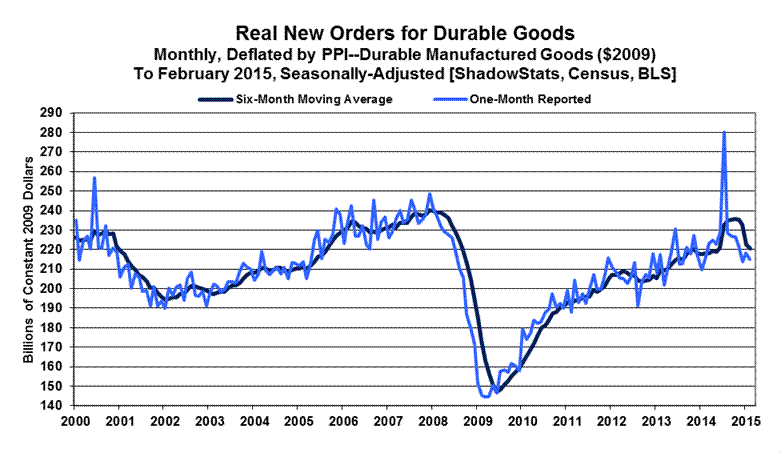
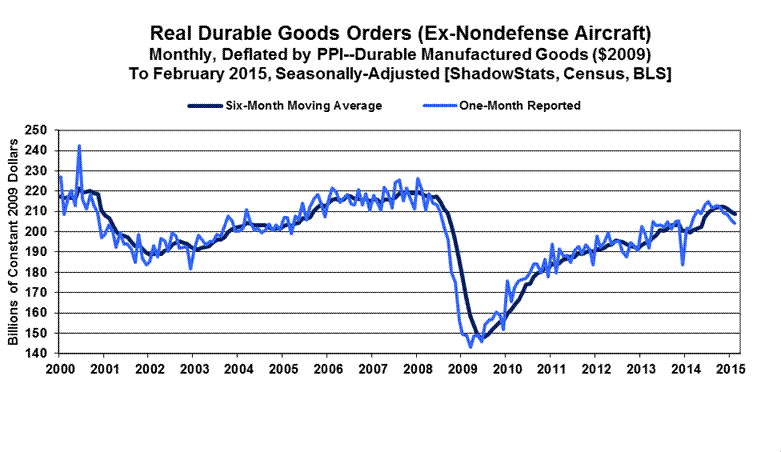
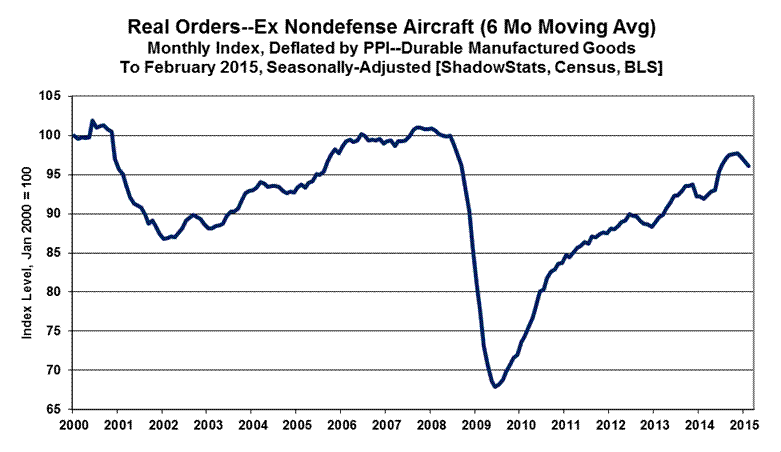
Graphs of Inflation-Adjusted and Smoothed Durable Goods Orders and the Corrected Series. The first two graphs following show new orders for durable goods, again, adjusted for inflation using the Producer Price Index (PPI) measure for "Durable Manufactured Goods." These graphs show monthly as well as a six-month moving-average of the activity level. The first graph shows the aggregate new orders series, including the extreme swings in commercial-aircraft orders in July and August 2014, with a return to some stability in September 2014, through February 2015. The second graph is the headline series, net of the unstable commercial-aircraft order sector. Accordingly, the ex-commercial aircraft plot is somewhat smoother than the first graph. Given the extreme surge in July 2014 aircraft orders, the six-month moving average in the aggregate series, or first graph, looked like an anaconda swallowing a cow, but that passed from the moving average with January 2015 reporting.
In terms of inflation-adjusted activity, both of these series have shown a slowing uptrend and flattening-out in the last two-to-three years—with a dip and upside bouncing into 2013, and renewed stagnation, feeding into the temporary July 2014 surge, with orders in general decline since third-quarter 2014. Broadly, there has been a recent general pattern of down-trending stagnation or bottom-bouncing evident in the orders—clearly not the booming recovery that has been seen in official GDP reporting. The real (inflation-adjusted) monthly and six-month moving-average level of new orders in February 2015 was below the pre-2007 recession high, as well as below the pre-2000 recession high. The pattern of recent stagnation now having turned to a downtrend in the inflation-adjusted series—net of the irregular aircraft-order effects—is one that commonly precedes or is coincident with a recession.
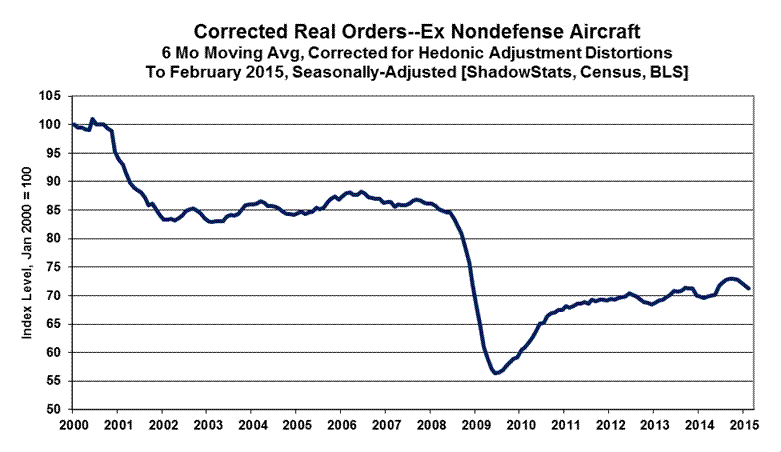
The Real Orders Series Corrected for Inflation Understatement. As with other economic series deflated by official government inflation measures, estimates of inflation-adjusted growth in new orders for durable goods are overstated, due to the understatement of the official inflation. That understatement here is through the government’s use of hedonic-quality adjustments—quality issues usually not perceived by the consumer—in justifying a reduced pace of headline inflation (see Public Commentary on Inflation Measurement).
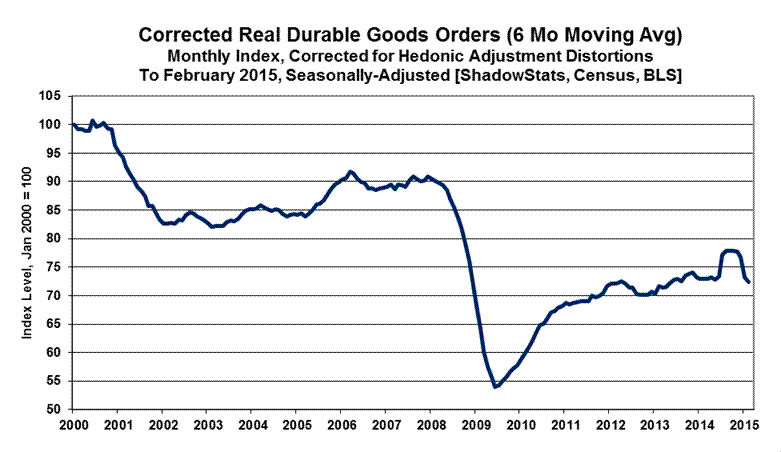
As has been done with other series such as the GDP, retail sales and industrial production, ShadowStats publishes an experimental corrected version of the inflation-adjusted graph of real new orders for durable goods, corrected for the understatement of the related headline PPI inflation.
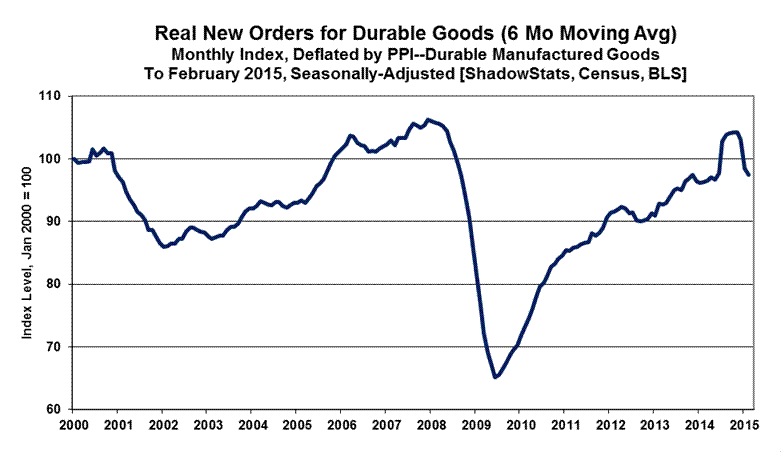
The following two sets of graphs are first, for the aggregate series or total durable goods orders. The second set is for the ex-commercial aircraft series. The first plot in each series is the official six-month moving average, the same heavy dark-blue line shown in the earlier graphs along with the light-blue thin line of monthly detail. The second plot is the same series as re-deflated to correct for the estimated understatement of the PPI-related inflation measure used in the headline-deflation process. This set of graphs is indexed to January 2000=100.0.
The second graph in the second set, entitled "Corrected Real Orders—Ex Nondefense Aircraft," is perhaps the best indicator of broad underlying order activity in the durable goods sector, in the context of signaling actual, near-term production and economic activity.
The aggregate orders series—in the first set—includes commercial aircraft orders. Placed years in advance, aircraft orders are a better indicator of long-range production activity, than they are as a near-term leading indicator of production activity.
[The Reporting Detail section contains further background material on new orders for durable goods. Various drill-down and graphics options on the headline orders numbers are available to subscribers at our affiliate: www.ExpliStats.com.]
__________
HYPERINFLATION WATCH
HYPERINFLATION OUTLOOK SUMMARY
General Outlook Unchanged; Intensifying Economic Weakness Begins to Impact Fed Policy and U.S. Dollar Strength. [Note: The text here has not changed since prior Commentary No. 706 of March 24th, other than for adjustments to internal links.]
No. 692 Special Commentary: 2015 - A World Out of Balance of February 2, 2015 updated the Hyperinflation 2014 reports and the broad economic outlook. Previously, the long-standing hyperinflation and economic outlooks were updated with the publication of 2014 Hyperinflation Report—The End Game Begins – First Installment Revised, on April 2, 2014, and publication of 2014 Hyperinflation Report—Great Economic Tumble – Second Installment, on April 8, 2014. The outlooks also are updated regularly in the weekly Commentaries. The Opening Comments of No. 692 should be considered in terms of recent circumstances and near-term, proximal triggers for massive dollar selling. The two 2014 Hyperinflation Report installments, however, remain the primary background material for the hyperinflation and economic analyses and forecasts. One other reference should be considered here, in terms of underlying economic reality, and that is the Public Commentary on Inflation Measurement.
Primary Summary. Current fiscal conditions show the effective long-term insolvency of the U.S. government, a circumstance that usually would be met by unfettered monetization of the national debt and obligations, leading to an eventual hyperinflation. The 2008 Panic and near-collapse of the financial system, and official (U.S. government and Federal Reserve) response to same, pulled the elements of the eventual hyperinflation crisis at the end of this decade into the current period. The primary and basic summary of the broad outlook and the story of how and why this fiscal, financial and economic crisis has unfolded and developed over the years—particularly in the last decade—is found in the Opening Comments and Overview and Executive Summary of that First Installment Revised (linked earlier). The following summarizes the underlying current circumstance and recent developments.
Consistent with the above Special Commentaries, the unfolding economic circumstance, in confluence with other fundamental issues, should place mounting and massive selling pressure on the U.S. dollar, as well as potentially resurrect elements of the 2008-Panic. Physical gold and silver, and holding assets outside the U.S. dollar, remain the primary hedges against the pending total loss of U.S. dollar purchasing power, despite sharp and generally ongoing rally in the U.S. dollar’s exchange rate since mid-2014 and broadly related selling pressures in the gold and silver markets.
Current relative U.S. economic strength and the relative virtuousness of Fed monetary policy versus major U.S. trading partners have been over-estimated heavily by the global markets, and structural faults have started to appear in the foundation underpinning recent U.S. dollar strength (see Commentary No. 706 and Commentary No. 705). Some minor pullback in the dollar has taken place in in recent days, as increasing signs of U.S. economic weakness—unanticipated by the global markets—have begun to threaten the expected near-term hiking of U.S. interest rates by the Federal Reserve.
A crash back to recognition of more-realistic domestic-economic circumstances looms, and it likely will be accompanied by a crash in the U.S. dollar versus major currencies, such as the Swiss franc, Canadian dollar and Australian dollar; related rallies in precious metals and oil; and related sell-offs in the domestic stock and bond markets. Further, a sharp deterioration in near-term domestic U.S. political stability continues to intensify and is of meaningful near-term risk for providing further fuel for heavy selling of the dollar.
Current Economic Issues versus Underlying U.S. Dollar Fundamentals. U.S. economic activity is turning down anew, despite overstated growth in recent GDP reporting. GDP and other major economic series face heavy downside-benchmark revisions through the end of July. Weak, underlying economic reality has begun to surface in headline reporting and should become increasingly and painfully obvious to the financial markets in the headline detail and revisions of the weeks and months ahead, for series such as real retail sales, production, housing and construction, the trade deficit and payroll employment.
As financial-market expectations shift towards renewed or deepening recession, that circumstance, in confluence with other fundamental issues, particularly deteriorating domestic political conditions, should intensify mounting and eventually massive selling pressures against the U.S. dollar, fully reversing the dollar’s gains of the last eight months, pushing the dollar to historic lows. The nascent currency crisis also has meaningful potential to resurrect elements of the Panic of 2008.
Unexpected economic weakness intensifies the known stresses on an already-impaired banking system, increasing the perceived need for expanded, not reduced, quantitative easing (see Commentary No. 706). The highly touted "tapering" by the FOMC ran its course. Future, more-constructive Fed behavior—purportedly moving towards normal monetary conditions in what had been an unfolding, near-perfect economic environment—was pre-conditioned by a continued flow of "happy" economic news. Suggestions that all was right again with world were nonsense. The Panic of 2008 never was resolved, and the Fed soon will find that it has no easy escape from its quantitative easing (QE3), which continues. Only overt expansion of QE3 ceased; QE4 will become the near-term question.
The economy has not recovered; the banking system is far from stable and solvent; and the Federal Reserve and the federal government still have no way out. Significant banking-system and other systemic (i.e. U.S. Treasury) liquidity needs will be provided, as needed, by the Fed, under the ongoing political cover of a weakening economy—a renewed, deepening contraction in business activity. The Fed has no choice. Systemic collapse is not an option for the Board of Governors. This circumstance simply does not have a happy solution.
Accordingly, any renewed market speculation as to an added round of Federal Reserve quantitative easing, QE4, could become a major factor behind crashing the dollar and boosting the price of gold. The Fed has strung out its options for propping up the system as much as it could, with continual, negative impact on the U.S. economy. The easings to date, however, appear to have been largely a prop to the increasingly unstable equity markets.
In the event of a QE4, any resulting renewed boost to U.S. equities would be a fleeting illusion, at least in terms of real value (purchasing power of the dollar). Such gains would tend to be losses, in real terms, with the stocks valued in terms of Swiss francs, for example, or valued against what would become a rapidly-increasing pace of domestic U.S. inflation.
Unexpected economic weakness also savages projections of headline, cash-based, federal-budget deficits (particularly the 10-year versions) as well as projected funding needs for the U.S. Treasury. Current fiscal "good news" is from cash-based, not GAAP-based and accounting projections.
All these crises should combine against the U.S. dollar, likely in the very-near future, if they have not already begun to do so. That said, recent faux market perceptions of domestic economic, financial-system and monetary tranquility had boosted the U.S. dollar’s strength significantly in global trading and contributed to savaging the prices of oil and in weakening the prices of precious metals. That process may be reversing.
The January 2015 shift in the Swiss franc, due to the elimination of the effective pegging of the franc to the euro and, by default to the U.S. dollar, also had the effect of allowing some temporary upside movement in the dollar prices of gold and silver. Recent intensified weakness in the euro, however, had led to increasingly-negative domestic Swiss interest rates and interventions aimed at depressing the franc, prop the dollar. Such policies usually prove to be fleeting, due to significant undesired side effects on the domestic economy and in financial-market distortions. Again, these markets remain in a state of flux, with recent movement continuing against the dollar.
Strength in the U.S. dollar should continue to reverse, sharply in the context of underlying reality outlined here and in the sections that follow. The actual fundamental problems threatening the U.S. dollar could not be worse. The broad outlook has not changed; it is just a matter of market perceptions shifting anew, against the U.S. currency. That process, again, started with the shift in Swiss National Bank policy. Key issues include, but are not limited to:
· A severely damaged U.S. economy, which never recovered post-2008, is turning down anew, with no potential for recovery in the near-term. The circumstance includes a renewed widening in the trade deficit, as well as ongoing severe, structural-liquidity constraints on the consumer, which are preventing a normal economic rebound in the traditional, personal-consumption-driven U.S. economy (see Opening). Sharply-negative economic reporting shocks, versus still-unrealistically-positive consensus forecasts, remain a heavily-favored, proximal trigger for the intensifying the unfolding dollar debacle.
· U.S. government unwillingness to address its long-term solvency issues. Those controlling the U.S. government have demonstrated not only a lack of willingness to address long-term U.S. solvency issues, but also the current political impossibility of doing so. The shift in control of Congress has not altered the systemic unwillingness to address the underlying fundamental issues, specifically to bring the GAAP-based deficit into balance. Any current fiscal "good news" comes from cash-based, not GAAP-based accounting projections. The GAAP-based version continues to run around $5 trillion for the annual shortfall, while those in Washington continue to increase spending and to take on new, unfunded liabilities. The history and issues here are explored in the first installment of the Hyperinflation Report, as previously linked; the initial fiscal-2014 details were discussed in Commentary No. 672, and the official GAAP-based financial statements for 2014 will be discussed fully, soon (see Commentary No. 702).
· Monetary malfeasance by the Federal Reserve, as seen in central bank efforts to provide liquidity to a troubled banking system, and also to the U.S. Treasury. Despite the end of the Federal Reserve’s formal asset purchases, the U.S. central bank monetized 78% of the U.S. Treasury’s fiscal-2014 cash-based deficit (see Commentary No. 672). The quantitative easing QE3 asset purchase program effectively monetized 66% of the total net issuance of federal debt to be held by the public during the productive life of the program (beginning with the January 2013 expansion of QE3). The monetization process was completed with the Federal Reserve refunding the interest income it earned on the Treasury securities to the U.S. Treasury. With highly tenuous liquidity conditions for the banking system and the Treasury, it would not be surprising in this period of increasing instability to see covert Federal Reserve activities masked in the purchases of Treasury debt by nations or other entities financially friendly to or dependent upon the United States. Renewed expansion to quantitative easing remains likely, given ongoing banking-system stresses, vulnerable stock markets and weakening, actual U.S. economic activity. As has been commonplace, the Fed likely would seek political cover for new or expanded systemic accommodation in any "renewed" economic distress.
· Mounting domestic and global crises of confidence in a dysfunctional U.S. government. The positive rating by the public of the U.S. President tends to be an indicative measure of this circumstance, usually with a meaningful correlation with the foreign-exchange-rate strength of the U.S. dollar. The weaker the rating, the weaker tends to be the U.S. dollar. The positive rating for the President is off its historic low, but still at levels that traditionally are traumatic for the dollar. Chances of a meaningful shift towards constructive cooperation between the White House and the new Congress, in addressing fundamental issues are nil. Issues such as non-recovered, faltering economic activity and the consumer liquidity crisis, and addressing the nation’s long-range solvency issues should continue to devolve, into extreme political crisis.
· Mounting global political pressures contrary to U.S. interests. Downside pressures on the U.S. currency generally are mounting, or sitting in place, in the context of global political and military developments contrary to U.S. strategic, financial and economic interests. Current conditions include the ongoing situation in Ukraine versus Russia and extremely-volatile circumstances in the Middle East. U.S. response to the Ukrainian situation may be behind part of the recent strength in the U.S. dollar and related weakness in oil prices, with U.S. actions aimed at causing financial distress for Russia. The situation has yet to run its full course, and it has the potential to reverse rapidly.
· Spreading global efforts to dislodge the U.S. dollar from its primary reserve-currency status. Active efforts or comments against the U.S. dollar continue to expand. In particular, anti-dollar rhetoric and actions have been seen with Russia, China, France, India and Iran, along with some regular rumblings in OPEC and elsewhere. Temporary, recent dollar strength may have bought some time versus those who have to hold dollars for various reasons. Nonetheless, developing short-term instabilities and a quick reversal in the dollar’s strength could intensify the "dump-the-dollar" rhetoric rapidly.
When the selling pressure breaks massively against the U.S. currency, the renewed and intensifying weakness in the dollar will place upside pressure on oil prices and other commodities, boosting domestic inflation and inflation fears. Domestic willingness to hold U.S. dollars will tend to move in parallel with global willingness, or lack of willingness, to do the same. These circumstances will trigger the early stages of a hyperinflation, likely in the year ahead.
Both the renewed dollar weakness and the resulting inflation spike should boost the prices of gold and silver, where physical holding of those key precious metals remains the ultimate hedge against the pending inflation and financial crises. Investors need to preserve the purchasing power and liquidity of their wealth and assets during the hyperinflation crisis ahead. Again, see Chapter 10, 2014 Hyperinflation Report—Great Economic Tumble for detailed discussion on approaches to handing the hyperinflation crisis and No. 692 Special Commentary: 2015 - A World Out of Balance, for other factors afoot in the current environment.
__________
REPORTING DETAIL
NEW ORDERS FOR DURABLE GOODS (February 2015)
Second, Consecutive Quarterly Contraction a Virtual Certainty for Durable Goods Orders. The headline reporting for February 2015 new orders for durable goods, a series with broad leading relationships to industrial production and general economic activity, had increasingly-negative implications for the U.S. economy, not only for first-quarter 2015, but also for second-quarter 2015.
With the impact of commercial aircraft orders removed, February 2015 new orders for durable goods declined for the fourth-straight month, setting the stage for back-to-back quarterly downturns in new orders. Net of inflation and ex-commercial aircraft orders, new orders for durable goods, rose at an annualized quarterly pace of 4.30% in third-quarter 2014, but then contracted at an annualized pace of 5.53% (-5.53%) in fourth-quarter 2014. As of February reporting, the series is on track for an annualized contraction of 8.68% (-8.68%) in first-quarter 2015.
The first-quarter 2015 contraction estimate is based on just January and February 2015 reporting. To turn first-quarter growth flat, real growth in new orders ex-commercial aircraft would have to jump month-to-month by 7.38% in March 2015. Although a monthly jump of that magnitude has been seen on occasion, a surge in defense orders, for example (again, this is ex-commercial aircraft orders), there is no anecdotal evidence for anything like that in play at the moment.
The ex-commercial aircraft number is the one to look at as an indicator of pending, broad economic activity, due to the extreme and irregular nature of the volume of aircraft orders, as well as the limited impact of those multi-year orders on near-term economic activity. Consider that including the commercial aircraft orders, real third-quarter total durable goods orders surged an annualized pace of 39.53%, fourth-quarter total durable goods tumbled at an annualized quarterly pace of 34.24% (-34.24%), and are on track for an annualized contraction of 7.34% (-7.34%) in first-quarter 2015.
Activity in aggregate new orders for durable goods is irregularly volatile, usually due to the extreme and unstable patterns in nondefense- or commercial-aircraft orders. Even so, related commercial-aircraft order swings in July and August 2014 (third quarter) reporting were the most-extreme events of recent years, up by 315.6%, and down by 74.0% (-74.0%), respectively. They were followed by a smaller commercial-aircraft order decline in September of 16.0% (-16.0%), a negligible order gain of 0.8% in October, a decline of 11.0% (-11.0%) in November, a revised December decline of 58.1% (-58.1%), a revised January 2015 monthly gain of 122.2%, and today’s headline monthly decline of 8.9% (-8.9%) for February 2015.
Both before and after consideration of volatility in commercial-aircraft orders, headline February durable goods orders remained well within the normal reporting variations of this highly unstable series, consistent with a pattern of down-trending stagnation. The inflation-adjusted real series, and that same series corrected for understatement of the official inflation series, also are discussed and graphed in the Opening Comments section. They remain broadly stagnant with a developing downtrend of a nature that commonly precedes or coincides with a recession or a deepening business downturn.
Nominal (Not-Adjusted-for-Inflation) February 2015 Reporting. The Census Bureau reported today, March 25th, that the regularly-volatile, seasonally-adjusted, nominal level of February 2015 new orders for durable goods declined month-to-month by 1.35% (-1.35%), following a revised gain of 2.02% [previously up by 2.83%] in January, and a revised decline of 3.67% (-3.67%) [previously down by 3.74% (-3.74%), initially down by 3.41% (-3.41%)] in December 2014. Net of prior-period revisions, aggregate new orders for February fell by 2.06% (-2.06%) for the month, instead of the headline decline of 1.35% (-1.35%).
Year-to-year and seasonally-adjusted growth in February 2015 durable goods orders slowed to a gain of 0.62%, versus a revised annual gain of 4.67% [previously up by 5.42%] in January 2015, and a revised annual gain of just 0.01% [previously a contraction of 0.07% (-0.07%), initially a 0.31% gain] in December 2014.
Detail Net of Volatility in Commercial Aircraft Orders. The reporting of extreme contractions and surges in commercial aircraft orders is seen commonly in an irregularly-repeating process throughout the year and often dominates the changes in headline monthly durable goods orders. These extremely volatile aircraft orders are booked years into the future and are indicative more of longer-term, rather than shorter-term prospects for manufacturing activity.
Net of a headline monthly decline of 8.80% (-8.80%) in February 2015 commercial aircraft orders, aggregate orders declined by 0.92% (-0.92%). Net of a revised gain of 122.24% [previously up by 128.50%] in aircraft orders, aggregate orders fell by a revised 1.06% (-1.06%) [previously down by 0.38% (-0.38%)] in January 2015. Net of a revised decline of 58.09% (-58.09%) [previously down by 58.33% (-58.33%), initially down by 55.51% (-55.51%)] in December aircraft orders, aggregate orders fell by 0.35% (-0.35%) [previously down by 0.41% (-0.41%), initially up by 0.24% (-0.24%)] for the month.
Year-to-year and seasonally-adjusted, February 2015 orders were up by 1.99%, following revised annual gains of 2.96% in January 2015 and 14.71% in December 2014.
Caution: Current durable goods reporting remains subject to many of the same sampling and concurrent-seasonal-adjustment problems seen with retail sales, payroll and unemployment reporting. Unusual seasonal-factor volatility raises issues as to the significance of reported seasonally-adjusted monthly and annual changes. While those issues are brought into balance, temporarily, with an annual benchmark revision to durable goods orders—last seen on May 15, 2014—subsequent reporting already has made all historical reporting prior to December 2014 inconsistent with the current headline numbers. The next benchmark, scheduled for May 14, 2015, will be a major one, updating and recasting historical new orders activity back to January 1997.
Real (Inflation-Adjusted) Durable Goods Orders—February 2015. ShadowStats uses the PPI aggregated inflation measure "Durable Manufactured Goods" for deflating the new orders for durable goods series. Published only on a not-seasonally-adjusted basis, the related PPI series reflected a headline "unchanged" pace of inflation in February 2015, for a third month, the same as in January and December, with headline annual inflation at 0.60% in February 2015, versus 0.72% in January 2015, and 1.09% in December 2014.
Adjusted for that "unchanged" monthly inflation, and again as reflected in the graphs of the Opening Comments section, real month-to-month aggregate orders fell by the same 1.35% (-1.35%) as seen in the nominal series. In like manner, January real orders rose by 2.02%, following a headline decline of 3.67% in December. Ex-commercial aircraft, real orders fell by 0.92% (-0.92%) in February, by 1.06% (-1.06%) in January and by 0.35% (-0.35%) in December.
Real year-to-year aggregate orders rose by just 0.02% in February 2015, versus a revised gain of 3.92% in January 2015, and a revised decline of 1.07% (-1.07%) in December 2014. Ex-commercial aircraft, real orders rose year-to-year by 1.38% in February 2015, by a revised 2.22% in January 2015, and by a revised 13.48% gain in December 2014. The surge in December year-to-year growth was against an unusually-sharp drop in defense orders in December 2013.
Graphs of Inflation-Adjusted and "Corrected" Smoothed Durable Goods Orders. Three sets of inflation-adjusted graphs are displayed in the Opening Comments section. The first set shows the monthly as well as a six-month moving-average activity for both the aggregate new orders series and the series net of the unstable commercial-aircraft order sector. The moving-average levels in both series had been holding in a pattern of near-stagnation, with some recent downturn prior to the extreme movements in July and August of 2014. Please note that due to the extreme July 2014 number, the six-month moving average for the aggregate series had been showing a large upside bump, which just worked its way out of the system. Orders generally have been in decline in recent months
The second and third sets of graphs in the Opening Comments section show the patterns of historical real new durable goods orders net of official inflation, as well as those patterns "corrected" for the understatement of that inflation (overstatement of official, inflation-adjusted growth), for the aggregate series and net of commercial aircraft orders.
__________
WEEK AHEAD
Headline Reporting and Revisions Should Trend Much Weaker versus an Overly-Optimistic Economic Consensus; Inflation Will Rise Anew, Following the Bottoming of Oil-Prices. Shifting some to the downside, again, amidst wide fluctuations in the numbers, market expectations for business activity have been, and still remain overly optimistic in the extreme. They still exceed any potential, underlying economic reality, even though downside corrective revisions and an accelerating pace of downturn in broad-based, monthly headline economic reporting already have begun to hammer those expectations. Recent GDP excesses will not face downside revisions until the July 30, 2015 GDP benchmark revision, other than for the one monthly revision still pending for fourth-quarter 2014 GDP on Friday.
Headline consumer inflation—recently driven lower by collapsing prices for gasoline and other oil-price related commodities—likely hit or was close to a near-term low in January 2015 reporting. Significant upside inflation pressures should resume as oil prices rebound, a process that already appears to be underway, and one that would accelerate rapidly with an eventual sharp downturn in the exchange-rate value of the U.S. dollar. These areas, the general economic outlook and longer range reporting trends are reviewed broadly in No. 692 Special Commentary: 2015 - A World Out of Balance.
A Note on Reporting-Quality Issues and Systemic-Reporting Biases. Significant reporting-quality problems remain with most major economic series. Beyond gimmicked changes to reporting methodologies of the last several decades, ongoing headline reporting issues are tied largely to systemic distortions of seasonal adjustments. Data instabilities were induced partially by the still-evolving economic turmoil of the last eight years, which has been without precedent in the post-World War II era of modern-economic reporting. The severity and ongoing nature of the downturn provide particularly unstable headline economic results, when concurrent seasonal adjustments are used (as with retail sales, durable goods orders, employment, and unemployment data, see the prior labor data related Commentary No. 695). Combined with recent allegations of Census Bureau falsification of data in its monthly Current Population Survey (the source for the Bureau of Labor Statistics’ Household Survey), these issues have thrown into question the statistical-significance of the headline month-to-month reporting for many popular economic series (see Commentary No. 669).
PENDING RELEASE:
Gross Domestic Product—GDP (Fourth-Quarter 2014, Second Revision, Third Estimate). The Bureau of Economic Analysis (BEA) will publish its third estimate of fourth-quarter 2014 GDP on Friday, March 27th. Market expectations are for a negligible upside second revision to 2.4% [Bloomberg], little more than statistical noise versus the headline real growth rate of 2.2% from the second estimate (initial growth estimate was 2.6%).
Where underlying fundamentals suggest that a fourth-quarter growth rate something on the plus-side of flat is realistic, revisions down to that level likely are not likely until the July 30th benchmark revision. Yet, in recent quarters, BEA first and second revisions to GDP growth estimates have been unusually volatile, signaling instabilities in the reporting system. The most-recent trend suggested by current BEA activity has been to the downside. Accordingly, though not based on new underlying reporting, other than revised, weaker production, which in turn is suggestive of less inventory building, reporting risks still run to the downside of 2.2%.
Potential reporting surprises also could lurk in the reporting of headline activity closely related to the GDP. Delayed by the poor-quality of the broad economic data available earlier, year-end initial reporting on fourth-quarter 2014 estimates of Gross National Product (GNP) and Gross Domestic Income (GDI) will accompany the March 27th report. GDP is a component of the broader GNP measure, which includes the trade balance in factor income (interest and dividend payments), while GDP is the consumption-side equivalent to the income-side GDI.
__________