


No. 742: SPECIAL COMMENTARY - A WORLD INCREASINGLY OUT OF BALANCE

A WORLD INCREASINGLY OUT OF BALANCE
U.S. Economy Falters; High Risk Mounts for a Massive Dollar Sell-Off
No. 742 SPECIAL COMMENTARY
August 10, 2015
Heavy Flight from U.S. Dollar Remains Likely in Year Ahead;
Underlying Perceptions and Fundamentals Already Are Shifting
Economic Reality Has Begun to Overtake Illusion;
No Economic Recovery Is Likely This Decade
Global Financial, Economic and Political Instabilities
Are Pushed to Limits
Long-Range U.S. Sovereign-Solvency Issues Remain Unresolved
Gold and Silver Prices Will Explode in Flight from Dollar;
Oil Prices Will Spike
Soaring U.S. Inflation Should Accompany Dollar Demise,
Precursor to Domestic Hyperinflation
Physical Precious Metals Remain Best Inflation Hedge and Store of Wealth,
Irrespective of Central Bank Gold-Price Manipulations
__________
________________________________________________________________________
Background Documents. Underlying this missive, No. 692 Special Commentary: 2015 - A World Out of Balance of February 2, 2015 updated the Hyperinflation 2014 reports and the broad economic outlook. Previously, the long-standing hyperinflation and economic outlooks were updated with the publication of 2014 Hyperinflation Report—The End Game Begins – First Installment Revised, on April 2, 2014, and publication of 2014 Hyperinflation Report—Great Economic Tumble – Second Installment, on April 8, 2014. The two 2014 Hyperinflation Report installments, however, remain the primary background material for the hyperinflation and economic analyses and forecasts. In terms of underlying economic reality, one other reference is the Public Commentary on Inflation Measurement. The regular Commentaries also update elements of the general outlook, as circumstances develop.
________________________________________________________________________
OUTLOOK FOR U.S. HYPERINFLATION — UPDATE
Dollar Selling Could Be Triggered by Economic Shocks. This relatively brief Special Commentary updates No. 692 Special Commentary: 2015 - A World Out of Balance as to the prospects for a U.S. hyperinflationary great depression unfolding within the next year or so. In the six months since that February 2nd missive, the broad outlook has not changed. The U.S. economy remains in ongoing downturn, while the U.S. dollar still faces a massive decline, with implications for a resulting, meaningful upturn in inflation evolving into a great hyperinflationary crisis. Signs of financial-system risks continue to mount anew, while stopgap measures taken by authorities in the Panic of 2008 continue to wane.
A panicked sell-off in, and general flight from, the U.S. dollar most likely will trigger the early stages of a hyperinflation. A dollar panic could hit at any time, with little warning, initiated by factors ranging from the negative implications of unfolding, severe domestic economic instabilities and an intensifying fiscal crisis, to renewed difficulties in the banking system or to perceived, domestic political instabilities. Given the nature of "surprises," "shocks" and "panics," the precise timing of the dollar crisis cannot be called with any confidence. With growing signs of systemic instabilities, however, market turmoil remains highly likely in the year ahead, and sooner rather than later. From a practical standpoint, these issues easily could push into 2016, but circumstances are such that the hatches already should be battened down (Commentary No. 736).
Points covered here review current circumstances for the U.S. currency, systemic risks and Federal Reserve activity, and current economic activity. Consideration of conditions surrounding gold and silver—the physical precious metals that offer meaningful hedges against the extraordinary circumstances ahead—also follows, updated and contrasted with other types of assets. Refreshed summary points, outlining the major risk factors to the U.S. dollar conclude this Commentary and update to No. 692.
Dollar Strengthening versus Economic Weakening. Where the U.S. dollar has seen sporadic bouts of selling during the prior six months, it still has strengthened meaningfully—hitting a twelve-year high in recent weeks versus the other major Western currencies. The strength in the U.S. currency remains the major distorting element in global financial markets, a circumstance related to successful central bank jawboning and interventions, including manipulations in the gold market that have pummeled the near-term prices for the precious metals. Specifically from the Federal Reserve has come incessant, but varied jawboning on interest rates, along with the federal government having provided an extended period of overstated, headline economic-growth statistics.
Updating the detail in No. 692, the ShadowStats Financial-Weighted Dollar Index (FWD), shown in Graphs 1 and 2, reflects a composite index of the value of the U.S. dollar (USD), weighted by the proportionate currency-trading volume of the USD versus the six highest volume currencies: the euro (EUR), yen (JPY), pound sterling (GBP), Swiss franc (CHF), Australian dollar (AUD) and the Canadian dollar (CAD). The FWD index is set with January 1985 = 100.
The Federal Reserve Board’s Trade-Weighted Dollar (TWD), also shown in Graphs 1 and 2, is the Major Currency Index published by the Fed with the USD index weighted by respective U.S. merchandise trade volume with the countries of the same currencies in the FWD. For purposes of comparison with the ShadowStats measure, the FRB index has been reweighted to January 1985 = 100, from its standard March 1973 = 100. In contrast to the TWD, the FWD is more heavily weighted versus the Swiss franc, and less heavily weighted versus the euro and the Canadian dollar, with the effect that the TWD has tended to show a lower weighted-average U.S. dollar value over time.
Seen in the current period, the dollar is stronger than during the Panic of 2008—at its highest level since 2003—with headline volatility approaching the Panic levels. Nonetheless, what is unfolding continues to be part of the Panic, still playing out.
Graph 1: U.S. DOLLAR – Financial- versus Trade-Weighted U.S. Dollar Indices (1985 – 2015)

Graph 2: U.S. DOLLAR – Financial- versus Trade-Weighted U.S. Dollar Indices Yr-to-Yr % (1985 – 2015)

Pushing on the other side, the last six months also have seen significant movement in underlying, negative-domestic-economic reality beginning to overcome the popular-media illusions of ongoing economic recovery and booming near-term activity in the environment of post-Panic of 2008. Separately, signs of systemic instability continue to resurface.
The Panic of 2008 Never Was Resolved. Faced with imminent collapse of the domestic financial system in 2008, the Federal Reserve and U.S. government used whatever money they needed to create, spend, lend or grant, and acted to guarantee whatever liabilities had to be covered, or to bailout whatever entities had to be saved. The system could not be allowed to fail. Faced with limited options, the Fed and the government did little that was fundamental to resolve or correct the issues that led to the crisis. The 2008 and ensuing interventions generally were stopgap efforts that only pushed problems into the future.
While the system was saved, temporarily, some instabilities never went away. The economy never recovered, the banking system remains troubled and the U.S. government still faces longer-range sovereign-solvency issues. Where issues persist or are resurfacing, they have not yet had the effect, or have not been to the extent, of collapsing the U.S. dollar. Yet, that collapse came close again, in 2011, at the time of Standard & Poor’s downgrading the AAA rating of U.S. Treasury securities. Then, extraordinary currency machinations, including massive interventions, jawboning aimed at misdirecting currency and liquidity fears to the euro area, and a happy—albeit false—rebound in headline U.S. economic activity bought some further time for the U.S. currency.
Fed Actions. Facing subsequent payback from its stopgap, emergency measures during the Panic of 2008, the Fed increasingly has found there is no easy escape from its continuing quantitative easing (QE3). Only overt expansion of QE3 ceased. If the Fed does not act quickly to extricate itself from prior actions, QE4 will become the near-term question in the markets, as the downturn in domestic economy intensifies in headline reporting.
There is little the Fed can do, or has been able to do, to stimulate domestic economic activity. Its post-panic easings were designed, instead, to provide needed liquidity to the banking system, not to help the economy. The Fed used the weakening economy, however, as political cover for its actions in propping the domestic banking system and effectively the stock market. That political cover continues, but now it may be preventing the Fed from a needed hike in interest rates.
The expressed desire by some in the Fed to push interest rates higher, to more-normal levels, combined with a failing economy that could continue to provide a practical restraint to such action, is suggestive of an economic-and-monetary system that continues to move beyond effective control of the U.S. central bank and the federal government (see Commentary No. 729).
Nonetheless, the Fed could raise interest rates at any time, irrespective of economic activity. Where the stock and currency markets already largely have anticipated such an action—much of recent U.S. Dollar strengthening can be tied directly to perceptions of a pending increase in U.S. interest rates—the bigger stock- and currency-market moves ahead are likely to come from downside surprises in U.S. economic reporting, which increasingly will show contracting, headline activity. Then again, a rate hike still could pummel the stock market, creating a new set of problems for the Fed.
U.S. Economy Has Entered a Period of Renewed Economic Contraction. A variety of basic indicators show that the U.S. economy has entered what traditionally would be viewed as a "new" recession, and economic reporting of key series in the months ahead, and the quarters into 2016, increasingly should confirm a deepening contraction in business activity. ShadowStats contends, however, that the current weakening in activity is part of ongoing turmoil in the wake of the economic collapse into 2008 and 2009. There never was a post-Panic economic recovery.
That said, the GDP benchmark revision of July 30th revamped first-quarter 2015 real (inflation-adjusted) growth from an annualized contraction of 0.2% (-0.2%) to growth of 0.6%, along with an initial second-quarter growth estimate at 2.3%. Keep in mind that GNP, which is broader than GDP (GDP is GNP net of trade flows in dividend and interest income), remained in first-quarter contraction. The first estimate of second-quarter GNP growth is due on August 27th, along a likely downside, first revision to second-quarter GDP growth.
Noted in Commentary No. 739, covering the GDP benchmarking, some months still may pass before recognition of a formal recession is declared. Yet, monthly, quarterly and annual growth patterns in industrial production (Commentary No. 737), real retail sales and real earnings (Commentary No. 736), and new orders for durable goods (Commentary No. 738) all are showing patterns of activity usually seen leading into, or during recessions.
Consider also the S&P 500 stock index, where quarterly revenues reportedly have contracted year-to-year in both first- and second-quarter 2015, a pattern last seen during the 2009 collapse and one generally not seen outside of recessions. Adjusting for inflation and the impact of increasing share buybacks, the annual revenue contractions are worse than they might appear to be otherwise.
Even the latest payroll-employment indicators are signaling a slowing pattern of growth, while the broader indicators of unemployment never have shown a recovery subsequent to the onset of the economic collapse into 2008 and 2009 (Commentary No. 741).
A primary driving factor behind the continued non-recovery in the economy remains constrained consumer liquidity, last detailed in Commentary No. 740. Never recovering in the post-Panic of 2008 era, limited income, credit and a faltering consumer outlook have eviscerated and continue to impair business activity that feeds off the financial health and liquidity of consumers.
Without real (inflation-adjusted) growth in household income and without the ability or willingness to take on meaningful new debt, the consumer simply has not had the wherewithal to fuel sustainable economic growth. Impaired consumer liquidity and its direct restraints on consumption have been responsible for much of the economic turmoil of the last eight-plus years, driving the housing-market collapse and ongoing stagnation in consumer-related real estate and construction activity, as well as constraining real retail sales activity and the related, personal-consumption-expenditures category of the GDP. Together, those sectors account for more than 70% of total U.S. GDP activity.
Underlying economic fundamentals simply have not supported, and do not support a turnaround in broad economic activity. There has been no economic recovery, and there remains no chance of meaningful, broad economic growth, without a fundamental upturn in consumer- and banking-liquidity conditions.
Multiple-Dip Economic Collapse. Also discussed in Commentary No. 739, the general pattern of GDP benchmark revisions has been to minimize, and should continue to erode, the headline patterns of formal economic recovery in the post-collapse period. Those revisions should reach a crescendo in the comprehensive GDP benchmark revision tentatively scheduled for July 2018. Increasingly, official post-collapse economic activity will take on the pattern of a multiple-dip collapse.
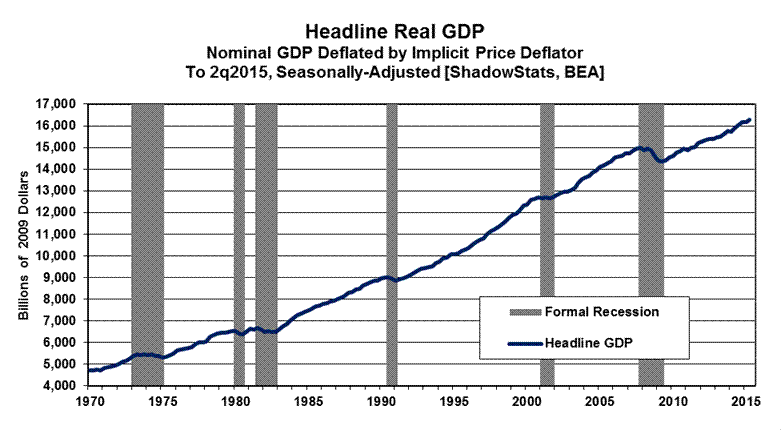
Official and Corrected GDP. The economic recovery indicated in the official GDP numbers remains an illusion. It is a statistical illusion created at least partially by using too-low a rate of inflation in deflating (removing inflation effects) from the nominal GDP series. Graphs 3 and 4 tell that story, updated through second-quarter 2015 GDP and the 2015 annual benchmark revisions.
These updated graphs first were published in the second installment of the Hyperinflation Report and updated in No. 692 (both linked in the opening Background Documents section). The graphs also show official periods of recession as shaded areas (the darker shading is for formal NBER recessions, the ShadowStats-defined recessions are indicated by the lighter shading in Graph 4).
Shown in Graph 3 of official Headline Real GDP, activity has been reported above pre-2007 recession levels—in full recovery—since second-quarter 2011, and headline GDP has shown sustained growth since (growth pauses or interruptions for second-half 2012 and first-quarter 2014 excepted). Adjusted for official GDP inflation (the implicit price deflator - IPD), the post-benchmark level of headline second-quarter 2015 GDP currently stands at 8.5% above its pre-recession peak-GDP estimate of fourth-quarter 2007. In contrast, the "corrected" GDP version, in Graph 4, now shows post-benchmark second-quarter 2015 GDP activity down by 7.3% (-7.3%) from its pre-recession peak of first-quarter 2006.
Graph 4 of the Corrected Real GDP is corrected for the understatement inherent in official inflation estimates, with the deflation by the implicit price deflator (IPD) adjusted for understatement of roughly two-percentage points of annual inflation in the most-recent years. The inflation understatement has resulted from hedonic-quality adjustments, as discussed in the Hyperinflation Reports and Public Commentary on Inflation, linked earlier. The corrected GDP pattern shows a pattern of plunge, followed by protracted low-level of stagnation, not recovery.
Graph 3: Real GDP Index (1970-2015)
Graph 4: "Corrected" Real GDP (1970-2015)
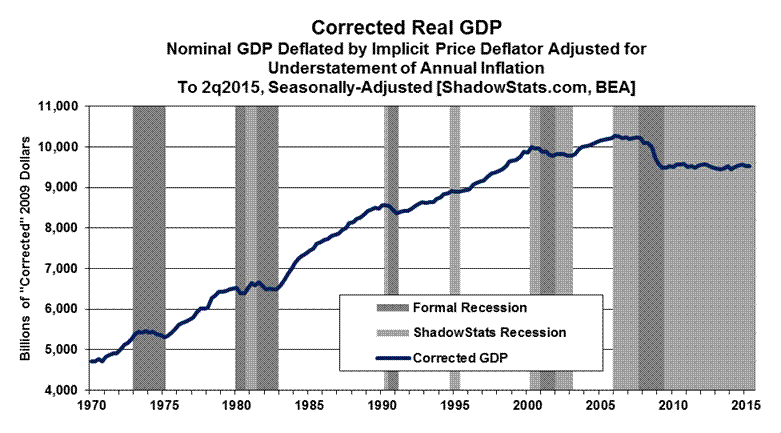
While future GDP benchmark revisions will move Graph 3 in the direction of the Graph 4, recent activity in the headline reporting never will flatten out fully. The benchmark revisions correct only for overly-positive assumptions and other misreporting built into initial and early estimates of GDP activity, the revisions do not address the appropriateness of the inflation adjustment to the series.
Irrespective of Central Bank Market Interventions, Gold Remains the Primary Hedge Against the Problems Ahead. Discussed in Commentary No. 737, prudent individuals increasingly have hedged the long-term purchasing power, stability and liquidity of their assets with holdings of physical gold, against the ongoing likelihood of massive debasement of the U.S. dollar and other financial-system disruptions, both domestic and global. Central banks balk at that concept. If the price of gold rallies, with a flight-to-safety into the precious metal, such usually reflects negatively on central-bank policies when financial-system stability is the issue.
Despite deteriorating global circumstances, such as seen with the evolving crisis with Greece in the euro area, and with Fed policies likely stymied by a weakening economy—irrespective of the repetitive and manipulative braying of various Fed spokespeople—gold and silver prices have been hit hard recently. Prices temporarily are stable, off their multi-year lows. Perversely, this is the time when private investors generally would be looking to move into precious metals for safety. Central bank selling of gold, aimed at discouraging that flight-to-quality appears to be a major, ongoing factor.
Over the years, direct market intervention and manipulation have been the preferred methods for those looking to depress gold prices and to discourage private investment in precious metals. Such trading patterns and activity have pushed gold prices sharply lower in recent years, and that happened again in July. Discussed in a widely covered article by Ambrose Evans-Pierce of The Telegraph on July 20th: "Speculators smash gold as dollar squeeze tightens," manipulators dumped a large number of gold contracts into a very thin market for the clear purpose of hammering the price of gold.
The mysterious market manipulators here almost certainly are the U.S. Federal Reserve and/or other major central banks, operating through their agents in the investment and banking community. If it were otherwise, "concerned" regulatory authorities certainly would be investigating such blatant and damaging market manipulation. If central banks indeed are pushing this action, the circumstance also could signal developing new issues or intensifying, existing systemic difficulties. For those interested in general information in this area, the GATA (Gold Anti-Trust Action Committee) site has significant material.
Underlying fundamental reasons for private investors to be holding physical, precious metals have strengthened not weakened, since the financial Panic of 2008, and since the near-term peak in gold and silver prices in 2011. The issues that drove the Panic of 2008 remain largely unaddressed. Long-range solvency issues and fiscal instabilities continue for the U.S. government. With domestic business conditions weakening and the banking system still far from normal stability and solvency, the Federal Reserve and the federal government still have no way out.
Systemic collapse never has been an option for the Board of Governors. This circumstance simply does not have a happy solution, ending eventually in hyperinflation and full debasement of the U.S. dollar. In the shorter term, when U.S. dollar selling gains broad-based momentum, offsetting sharp rallies should occur, on a coincident basis, for gold and silver prices, as well as for oil prices.
In the circumstance of continuing deterioration of conditions in the domestic and global financial, economic and political arenas, holding gold to preserve the purchasing power of one’s wealth and assets is not an issue of near-term profit or loss, but rather of financial and potentially even physical survival. Irrespective of short-term, extreme price volatility in precious metals, when held through the unfolding crises, physical gold and silver remain primary hedges—core protection—against the instabilities ahead. Underlying fundamentals eventually will overwhelm and overcome the interventions and manipulations.
Held through the crises, for example, physical gold will preserve the purchasing power of the funds put into it, while retaining liquidity and portability. Further, with core assets so protected and liquid, other options open up in terms of handling less-liquid hard assets such as real estate and gold-mining stocks.
Specifically, systemic crises may create liquidity constraints on hard assets such as real estate, or shares in gold-mining companies, where illiquid circumstances could discourage holding of such assets in a crisis, such as the one that still is unfolding, even though the involved assets would retain their real value over the time needed to reestablish liquidity (see the Hyperinflation Reports). Holding adequate liquid assets, such as physical gold, could allow the needed time to establish those longer-term liquidity circumstances.
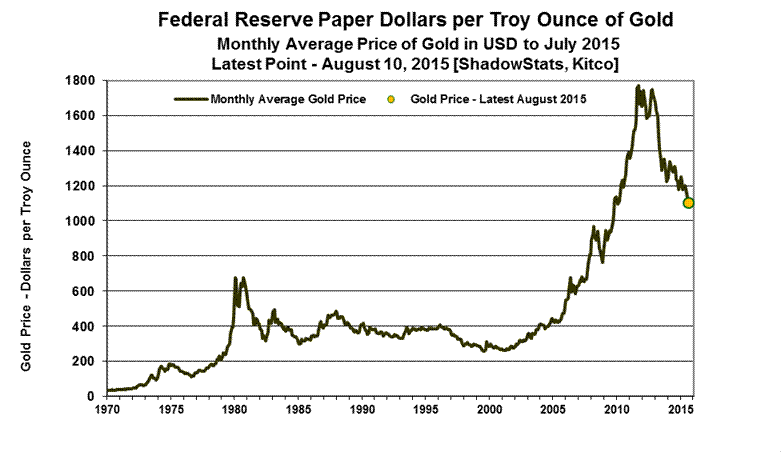
Graph 5 plots the monthly-average gold price from 1970 to date. The depressing effects of intervention and jawboning can disappear overnight, as underlying fundamentals and reality take hold and demand soars anew for gold as an inflation hedge. In particular, gold will spike in the context of a massive flight from the U.S. dollar, which remains likely within the year ahead.
Graph 6 shows the relative performance of gold versus the Dow Jones Industrial Average, with both series adjusted for CPI-U inflation and indexed to a common point of January 2000 = 100. Despite the recent hit on gold and highs in stock prices, gold has put in the stronger, long-range performance. The DJIA plot does not take account of dividends, but that does not alter the relative picture meaningfully.
Graph 5: Gold Price
Graph 6: Gold versus the DJIA — Adjusted for the CPI

Graph 7: Gold versus the Swiss Franc
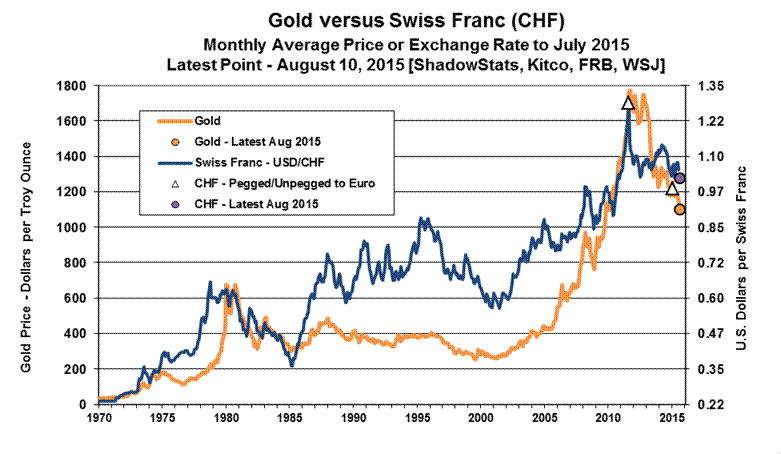
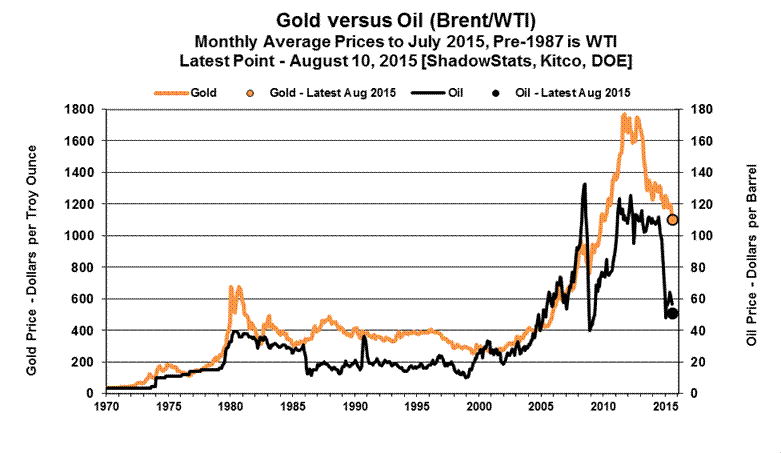
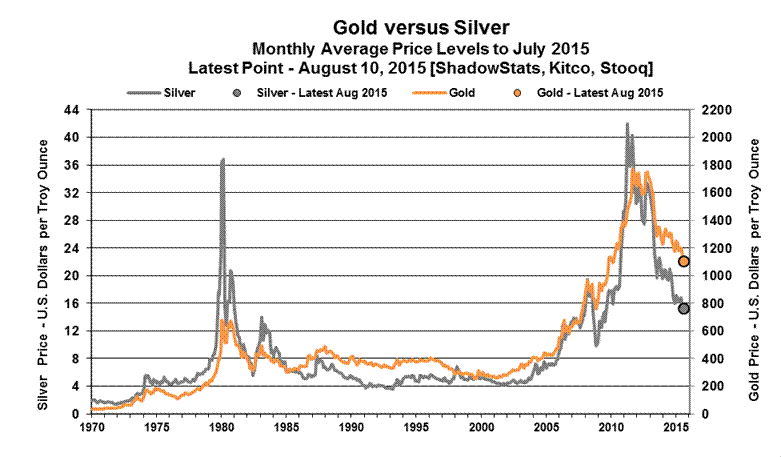
Graphs 7 through 9, usually found in the CPI Commentaries, show the long-term relationships between gold and the Swiss franc, oil and silver. The latest price points shown reflect August 10th afternoon prices in New York.
Graph 8: Gold versus Oil
Graph 9: Gold versus Silver
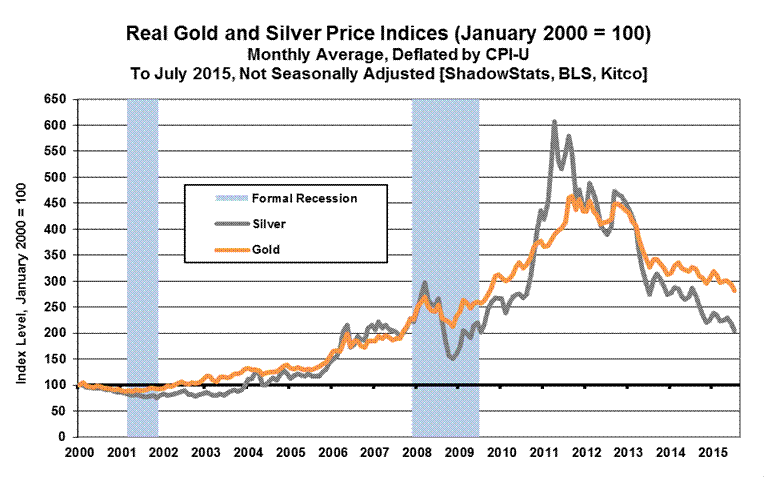
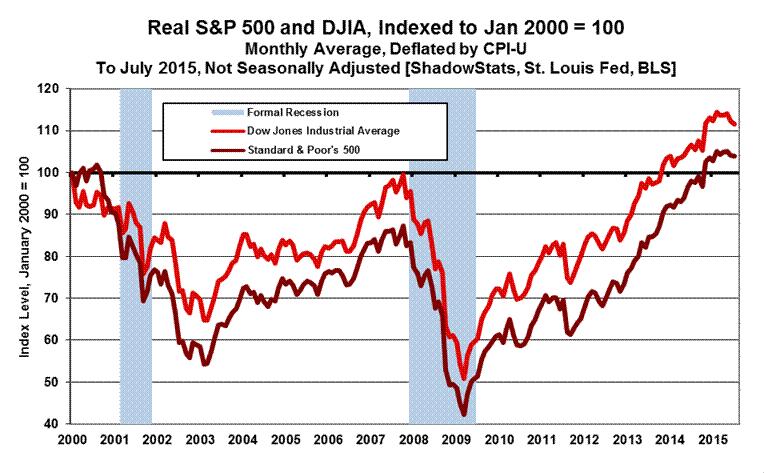
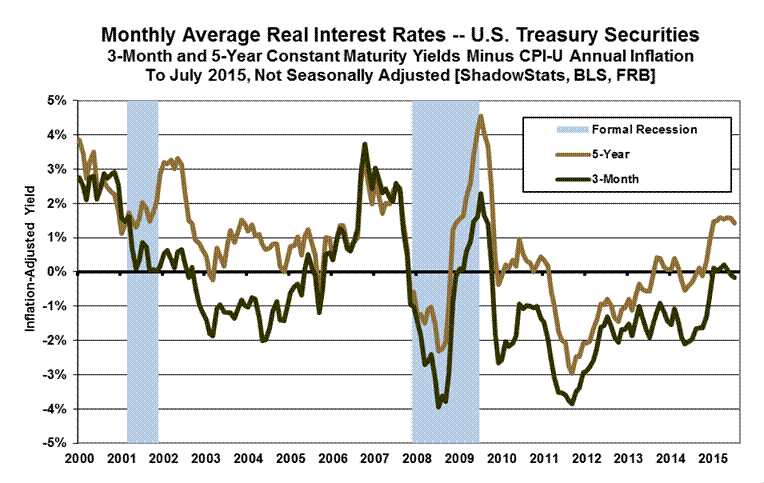
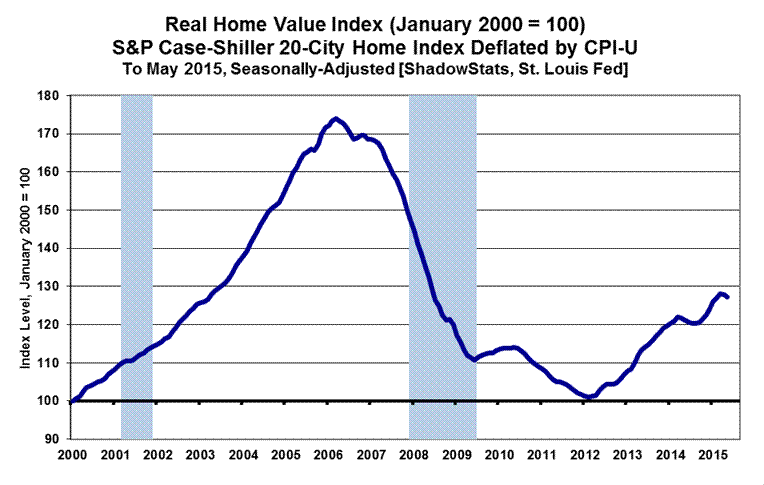
Updated Graphs of Various Assets Deflated by the CPI-U. For comparison purposes, the asset value levels in Graphs 6, 10, 11 and 13 are indexed to a starting value of January 2000 = 100. Graph 12 of real Treasury yields is expressed in interest rates. The plots and detail here have been updated from No. 692.
Graph 10: Indexed Real Gold and Silver Prices
Graph 11: Indexed Real S&P 500 and Dow Jones Industrial Average
Graph 12: Indexed Real U.S. Treasury Yields
Graph 13: Real Home Values
Primary Summary. Current fiscal conditions show the effective long-term insolvency of the U.S. government, a circumstance that usually would be met by eventual, unfettered monetization of the national debt and obligations, leading to a hyperinflation. As first estimated by ShadowStats in 2004, such hyperinflation appeared likely by 2020. That time horizon for the hyperinflation forecast was moved to 2014, because of the 2008 Panic, the near-collapse of the financial system, and official (U.S. government and Federal Reserve) responses to same. That hyperinflation forecast remains in place, but has been adjusted to 2015 or 2016, as discussed in the opening paragraphs and in No. 692.
The primary and basic summary of the broad outlook and the story of how and why this fiscal, financial and economic crisis has unfolded and developed over the years—particularly in the last decade—is found in the Opening Comments and Overview and Executive Summary of the 2014 Hyperinflation Report—The End Game Begins—First Installment Revised. The following summarizes the underlying current circumstance and recent developments.
The U.S. dollar rallied sharply from mid-2014 into early-2015, initially reflecting likely covert financial sanctions and oil-price manipulations by the United States, aimed at creating financial stresses for Russia, in the context of the Ukraine situation. Relative U.S. economic strength, and the relative virtuousness of Fed monetary policy versus major U.S. trading partners, were heavily picked-up on and over-estimated by global markets looking to support the dollar.
The still unfolding, weakening domestic-economic circumstance in 2015, in confluence with other fundamental issues, had begun to raise doubts in the markets as to the sustainability of the purported U.S. economic recovery, and as to the imminence of meaningful monetary tightening by the U.S. Federal Reserve. As a result, the U.S. dollar briefly backed off its highs, with some related upside pressure having been seen on oil prices. Pressures reversed recently, spiking the U.S. dollar—also hitting oil prices anew—with the euro-area crisis with Greece continuing, with false domestic economic strength being touted by Wall Street, and with some in the Fed indicating that interest rates would be raised in September, irrespective of negative indications on the economy. Coincident, with these events, not-so-covert central-bank actions appear to have driven the price of gold lower
The U.S. economy remains in contraction, irrespective of the near-term headline GDP (see Commentary No. 739), with a variety of key indicators showing recession. Although formal recognition could take months, consensus recognition of a "new" recession should gain quickly, in tandem with a variety of monthly, quarterly and annual data reflecting the downturn in business activity.
As market expectations move towards an imminent, new recession, such should reduce not only expectations for a significant tightening in Fed policy—if the Fed has not tightened already—but also renew expectations for a more-accommodative or newly-accommodative Fed. While such could help to fuel further stock-market mania, any resulting rallies in equity prices likely will be more than offset in real terms, by percentage declines in the exchange-rate value of the U.S. dollar or in the eventual increases in headline consumer inflation.
Faltering expectations on the direction of domestic economic activity, also would place mounting and eventually massive selling pressure on the U.S. dollar, as well as potentially resurrect elements of the Panic of 2008. Physical gold and silver, and holding assets outside the U.S. dollar, remain the ultimate primary hedges against an eventual total loss of U.S. dollar purchasing power. These circumstances should unwind what has been the sharp and generally ongoing rally in the U.S. dollar’s exchange rate since mid-2014, and the broadly-related selling pressures seen in the gold and silver markets. Further, oil prices should spike anew with a sharp reversal in the dollar’s strength.
A crash back to recognition of more-realistic domestic-economic circumstances is underway, likely intensifying in the weeks and months ahead. It should be accompanied by a crash in the U.S. dollar versus major currencies, such as the Swiss franc, Canadian dollar and Australian dollar (currencies with some ties to gold); and related rallies in precious metals and oil. Further, a sharp deterioration in the near-term outlook for domestic and global political stability continues and is of meaningful risk for fueling further heavy selling of the dollar. Once in heavy downturn, the dollar’s gains since June 2014 should reverse fully, pushing the exchange-rate value of the dollar to new historic lows. Again, the nascent currency crisis also has meaningful potential to resurrect elements of the Panic of 2008.
Unexpected economic weakness intensifies the known stresses on an already-impaired banking system, increasing the perceived need for expanded, not reduced, quantitative easing. The highly touted "tapering" by the FOMC ran its course. Future, more-constructive Fed behavior—moving towards normal monetary conditions in what had been an unfolding, purportedly near-perfect economic environment—was pre-conditioned by a continued flow of "happy" economic news. Suggestions that all was right again with world were nonsense.
Nonetheless, the Fed still likely would move to normalize interest rates (see Opening Comments of Commentary No. 726), if it could get away with it. The FOMC meeting of June 17th apparently concluded that the Fed could not get away with it (see Opening Comments of Commentary No. 729). The Panic of 2008 never was resolved, and the Fed increasingly has found that it has no easy escape from its quantitative easing (QE3), which continues; only overt expansion of QE3 ceased. If the Fed does not act quickly to extricate itself from prior actions, QE4 will become the near-term question. Again, despite loud promises of higher rates in September, the economy and banking-system issues likely will keep the interest rate hike in a continual state of suspension.
Unexpected economic weakness—a renewed downturn—also savages prospective federal budget deficit prognostications (particularly the 10-year versions). Such throws off estimates of U.S. Treasury funding needs and estimates as to how long the Treasury effectively can dodge the limits of the recently re-imposed debt ceiling. Current fiscal "good news" remains from cash-based, not GAAP-based accounting projections and is heavily impacted by changes in business activity.
The economy has not recovered; the banking system is far from stable and solvent; and the Federal Reserve and the federal government still have no way out. Significant banking-system and other systemic (i.e. U.S. Treasury) liquidity needs will be provided, as needed, by the Fed, under the ongoing political cover of a weakening economy—a renewed, deepening contraction in business activity. The Fed has no choice. Systemic collapse is not an option for the Board of Governors. This circumstance simply does not have a happy solution.
Accordingly, any significant, renewed market speculation as to an added round of Federal Reserve quantitative easing, QE4, may become a major factor behind crashing the dollar and boosting the price of gold. The Fed has strung out its options for propping up the system as much as it thought it could, with continual, negative impact on the U.S. economy. The easings to date, however, appear to have been largely a prop to the increasingly unstable equity markets.
While higher domestic interest rates would tend to act as a dollar prop, a hike in rates also could crash the stock market, as some on Wall Street fear, triggering a round of other systemic problems. Again, there is no happy way out of this for the Fed.
The fundamental problems threatening the U.S. dollar could not be worse. The broad outlook has not changed; it is just a matter of market perceptions shifting anew, increasingly against the U.S. currency. That process likely will become dominated by increasingly-negative global perceptions of stability in U.S. economic activity and the ability of the Federal Reserve to control its monetary policy. Key issues include, but are not limited to:
· A severely damaged U.S. economy, which never recovered post-2008, is turning down anew, with no potential for recovery in the near-term. The circumstance includes a renewed widening in the trade deficit and contracting production, as well as ongoing severe, structural-liquidity constraints on the consumer, which are preventing a normal economic rebound in the traditional, personal-consumption-driven U.S. economy (see Commentary No. 740). Sharply-negative economic reporting shocks, versus softening consensus forecasts, still remain a heavily-favored, proximal trigger for intensifying the pending dollar debacle.
· U.S. government unwillingness to address its long-term solvency issues. Those controlling the U.S. government have demonstrated not only a lack of willingness to address long-term U.S. solvency issues, but also the current political impossibility of doing so. The shift in control of Congress did not alter the systemic unwillingness to address underlying fundamental issues, specifically to bring the GAAP-based deficit into balance. Any current fiscal "good news" comes from cash-based, not GAAP-based accounting projections. The GAAP-based version continues to run around $5 trillion for the annual shortfall, while many in Washington look to continue increasing spending and to take on new, unfunded liabilities. This circumstance now operates in the context of the formal constraint of a renewed debt ceiling.
· Monetary malfeasance by the Federal Reserve, as seen in central bank efforts to provide liquidity to a troubled banking system, and also to the U.S. Treasury. Despite the end of the Federal Reserve’s formal asset purchases, the U.S. central bank monetized 78% of the U.S. Treasury’s fiscal-2014 cash-based deficit (see Commentary No. 672). The quantitative easing QE3 asset purchase program effectively monetized 66% of the total net issuance of federal debt to be held by the public during the productive life of the program (beginning with the January 2013 expansion of QE3). The 2014 monetization process was completed with the Federal Reserve refunding the interest income it earned on the Treasury securities to the U.S. Treasury, but more of that lies ahead. If the Fed does not move soon to boost interest rates, it may be trapped in a renewed expansion of quantitative easing, given ongoing banking-system stresses, vulnerable stock markets and weakening, actual U.S. economic activity. As has been commonplace, the Fed likely would seek political cover for any new or expanded systemic accommodation in any the intensifying economic distress.
· Mounting domestic and global crises of confidence in a dysfunctional U.S. government. The positive rating by the public of the U.S. President tends to be an indicative measure of this circumstance, usually with a meaningful correlation with the foreign-exchange-rate strength of the U.S. dollar. The weaker the rating, the weaker tends to be the U.S. dollar. The positive rating for the President is off its historic low, but still at levels that traditionally are traumatic for the dollar. Chances of a meaningful shift towards constructive cooperation between the White House and the new Congress in addressing fundamental fiscal and economic issues are nil. Issues such as non-recovered, faltering economic activity, the consumer liquidity crisis and the nation’s long-range solvency should continue to devolve into extreme political crises.
· Mounting global political pressures contrary to U.S. interests. Downside pressures on the U.S. currency generally are intensifying, or sitting in place, in the context of global political and military developments contrary to U.S. strategic, financial and economic interests. Current conditions include the ongoing situation versus Russia and extraordinarily-volatile circumstances in the Middle East. U.S. response to Russian activity in the Ukrainian situation likely was behind part of the recent strength in the U.S. dollar and related weakness in oil prices, with U.S. actions aimed at causing financial distress for Russia. These situations have yet to run their full courses, and they have the potential for rapid and massive negative impact on the financial and currency markets.
· Spreading global efforts to dislodge the U.S. dollar from its primary reserve-currency status. Active efforts or comments against the U.S. dollar continue to expand. In particular, anti-dollar rhetoric and actions have been seen with Russia, China, France, India and Iran, along with some regular rumblings in OPEC and elsewhere. Temporary, recent dollar strength may have bought some time versus those who have to hold dollars for various reasons. Nonetheless, developing short-term instabilities and a quick, significant reversal in the dollar’s strength should intensify the "dump-the-dollar" rhetoric rapidly.
When the selling pressure breaks massively against the U.S. currency, the renewed and intensifying weakness in the dollar will place upside pressure on oil prices and other commodities, boosting domestic inflation and inflation fears. Domestic willingness to hold U.S. dollars will tend to move in parallel with global willingness, or lack of willingness, to do the same. These circumstances will trigger the early stages of a hyperinflation, likely in the year ahead.
Both the renewed dollar weakness and the resulting inflation spike should boost the prices of gold and silver, where physical holding of those key precious metals remains the ultimate hedge against the pending inflation and financial crises. Investors need to preserve the purchasing power and liquidity of their wealth and assets during the hyperinflation crisis ahead. See Chapter 10, 2014 Hyperinflation Report—Great Economic Tumble for detailed discussion on approaches to handing the hyperinflation crisis and No. 692 Special Commentary: 2015 - A World Out of Balance, for other factors afoot in the current environment.
__________