


No. 761: September Housing Starts, Economic Update

COMMENTARY NUMBER 761
September Housing Starts, Economic Update
October 20, 2015
___________
September Housing Starts Continued in Low-Level
But Up-Trending Stagnation
Total Starts Down 47% (-47%), Single-Unit Starts Down 60% (-60%)
From Pre-Recession Highs
Multiple-Unit Starts Have Regained Pre-Recession Levels
"Advance" Third-Quarter GDP Growth Likely Will Be Well Below 1.0%,
Along with Risk of a September Trade-Deficit Shock
___________
PLEASE NOTE: The next regular Commentary, scheduled for Tuesday, October 27th, will cover September New Orders for Durable Goods and New- and Existing-Home Sales. A subsequent Commentary on October 29th will review the first estimate of third-quarter 2015 GDP and detail from the "advance" report on the September merchandise trade numbers.
Best wishes to all! — John Williams
OPENING COMMENTS AND EXECUTIVE SUMMARY
Unfolding Recession Increasingly Found in Headline Details. With the bulk of September 2015 headline monthly reporting in hand, my ShadowStats broad economic outlook has not changed. A renewed downturn in U.S. economic activity has been in place since December 2014, and recognition of that timing as the onset of a formal "new" recession likely should be forthcoming in the quarters ahead. The quotation marks around "new" are used here, since ShadowStats contends that the current economic woes are just a continuation of the economic collapse into 2009, which was followed by ongoing, low-level stagnation, not by the proffered economic rebound of the last six years (see Commentary No. 755, and No. 742 Special Commentary: A World Increasingly Out of Balance).
Noted in No. 755, while headline Gross Domestic Product (GDP) reporting of 3.9% in second-quarter 2015 was of unusually-limited quality, first- and second-quarter 2015 Gross Domestic Income (GDP reporting-alternative GDI) showed flat U.S. economic activity for first-half 2015, largely consistent with contracting or flat economic activity seen with first-half 2015 industrial production and real retail sales.
Third-Quarter 2015 GDP. The "advance" estimate of third-quarter 2015 GDP will be published on Thursday, October 29th, by the Bureau of Economic Analysis (BEA), and a near-contraction quarterly reading is a fair bet (see the Week Ahead section); the GDP-alternative third-quarter GDI will not be published until November 24th. Consensus expectations appear to be settling around 2.0% for the headline real GDP growth, but that still is overstated heavily. The Atlanta Fed GDP Model, which has had an extraordinarily-good track record in predicting the BEA’s headline GDP estimates, indicated headline annualized third-quarter GDP real growth of 0.9% in its October 20th iteration.
The ShadowStats expectation is for an initial headline real growth estimate of about 0.5% (discussed below), subject to downside revisions in the next two months of reporting, ultimately a quarterly contraction. "Unexpected" weakness surfaced in a variety of headline data of the last month, including September payroll employment (No. 756) and an announced initial-estimate of a downside 2015 payroll-benchmark revision. The August trade-deficit deteriorated sharply (No. 757); real and nominal September earnings contracted (No. 759); September industrial production (No. 760) continued showing monthly contractions, along with recession-level annual growth. September real retail sales continued showing near-stagnant monthly growth, along with recession-level annual growth (No. 759), while today’s release of September housing starts showed a sharp slowing in annualized quarterly growth from 96% in second-quarter 2015, to 2% in third-quarter 2015. Separately, confirming-detail of a contracting economy is seen in successive quarterly revenue contractions among the companies in the S&P 500 stock index.
Pummeling the Consensus. Noted in the Week Ahead, where consensus estimates for third-quarter activity, again, likely will settle in around 2.0%—at least before next week’s "advance" trade report—a much weaker headline number is likely at 1.0% or below, possibly closing in on zero in the "advance" estimate. Again, the ShadowStats estimate is for a headline 0.5% gain.
The BEA tends to target the consensus outlook with its "advance" GDP estimates, but it has brought in lower or higher numbers, respectively, if the consensus outlook was deemed to be markedly too high or too low. Limited in scope only by the BEA’s positioning versus consensus expectations. Near-zero growth could come from late-breaking September trade-deficit detail showing an accelerated pace of deficit deterioration. Such is a reasonably good bet. From the BEA’s standpoint, though, initial headline reporting of a quarterly GDP contraction is not likely, until after consensus expectations already have moved there. The "advance" estimate of September merchandise-trade activity is scheduled for Wednesday, October 28th, the day before the GDP estimate.
Today’s Commentary (October 20th). The balance of these Opening Comments provides summary coverage of September Housing Starts. The Hyperinflation Outlook Summary has not been changed. The Week Ahead previews the September Existing- and New-Home Sales releases as well as the first-estimate of third-quarter 2015 GDP (and the related "advance" trade report). The GDP outlook also is discussed in the opening paragraphs of these Opening Comments.
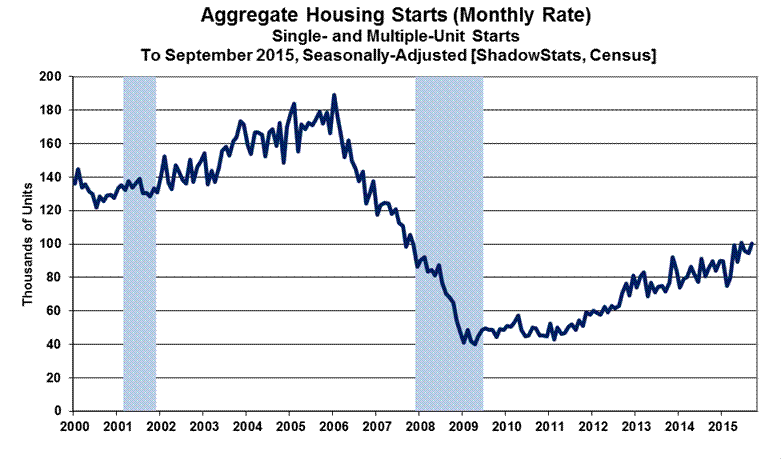
Housing Starts—September 2015—Broad Activity Continued in a Smoothed Pattern of Low-Level, Up-Trending Stagnation. With the September reporting, the headline detail of the aggregate housing-starts series continued to be of little meaning, other than as viewed in the context of a six-month moving average. The monthly gain of 6.5% in September 2015 housing starts was subdued minimally by an upside revision to August 2015 activity. Versus the initial reporting of August 2015, the September gain was 7.1%, above consensus expectations. As usual, though, not one aggregate headline growth detail—month-to-month, year-to-year, before-or-after revisions, consensus expectations—was close to being meaningful, as measured by statistical significance.
Quarterly Growth Slowed Markedly. With the initial headline detail now in place for third-quarter 2015, the aggregate housing-starts count rose at an annualized-quarterly pace of just 2.0%, markedly slower than the annualized growth of 96.3% in second-quarter 2015, versus an annualized contraction of 26.2% (-26.2%) in first-quarter 2015, for this massively unstable series.
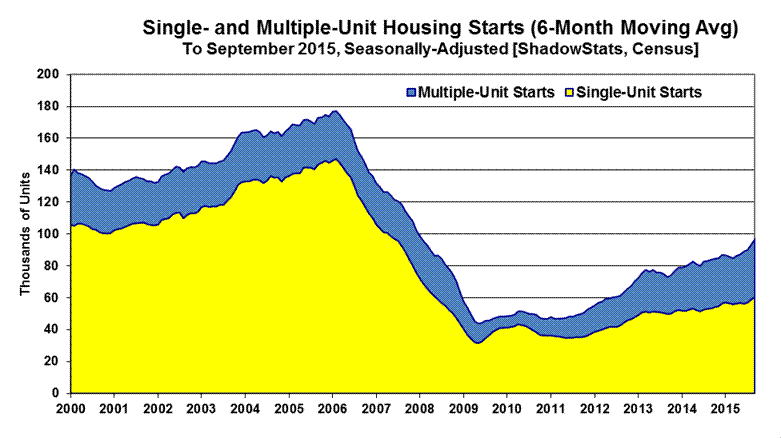
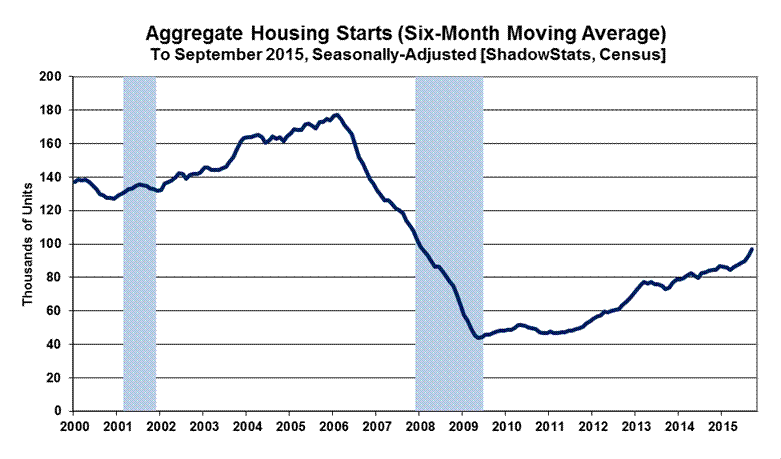
Smoothed Numbers. A general pattern of low-level, albeit up-trending stagnation continued in the broad series, as best viewed in terms of the longer-range historical graph of aggregate activity (see Graph 10 in the Reporting Detail), and in the context of the headline activity, smoothed by six-month moving averages, as shown in accompanying Graphs 2 and 4. Although there has been a minor upside trend in the broad, low-level stagnation of the aggregate series, total housing-starts activity has remained well below any recovery level, holding at 47% (-47%) below its pre-recession high.
Separately, the dominant, single-unit housing starts component of the series (Graphs 5 and 6) remained down by 60% (-60%) from its January 2006 pre-recession peak, in smoothed, flat-trending activity.
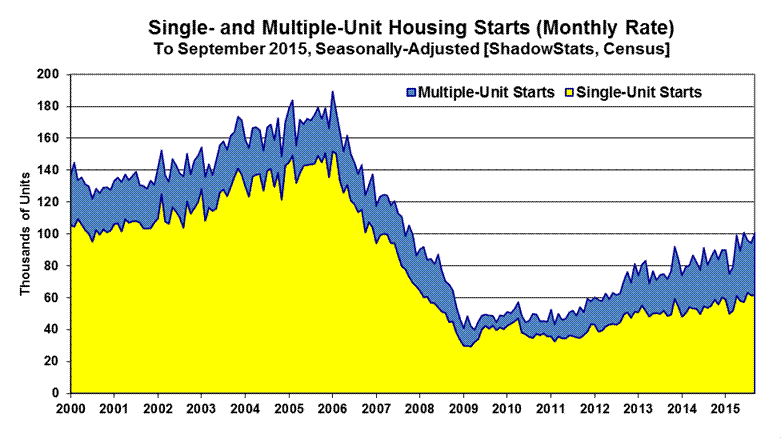
Reflected in the smoothed graphs, the aggregate housing-starts series ticked minimally higher in September, reflecting upside movement in both the six-month smoothed single-unit starts (Graph 6) and the six-month smoothed multiple-unit starts (Graph 8) categories, where single-unit monthly activity was flat for the month, but multiple-unit activity jumped.
Over time, the bulk of the extreme, headline instability and the minimal uptrend in the aggregate series has been due largely to particularly-volatile reporting in the multiple-unit, housing-starts category (apartments, etc.). Recent activity in multiple-unit starts actually has recovered to above pre-recession levels, again, in the context of extreme month-to-month volatility. Even so, the recent impact of that recovery largely has been lost in the detail of total housing starts.
Consumer Liquidity Problems Continue to Impair Housing Activity. On a per-structure basis, housing-starts volume, again, is dominated by the single-unit housing-starts category, which has remained broadly stagnant on a smoothed basis, at a low level of activity since hitting bottom in early-2009. The private-housing sector never recovered from the business collapse of 2006 into 2009.
The primary, underlying difficulty for the housing market remains intense, structural-liquidity constraints on the consumer. That circumstance, during the last nine-plus years of economic collapse and stagnation, has continued to prevent a normal recovery in broad U.S. business activity, as discussed more fully in Commentary No. 758 and updated briefly in the Opening Comments of Commentary No. 760.
Without real (inflation-adjusted) growth in household income and without the ability or willingness to take on meaningful new debt, the consumer simply has not had the wherewithal to fuel sustainable economic growth. There remains no chance of a near-term, sustainable turnaround in the housing market, until there is a fundamental upturn in consumer and banking-liquidity conditions. That has not happened and does not appear to be in the offing.
September 2015 Housing-Starts Headline Reporting. The seasonally-adjusted, headline monthly gain of 6.5% in September 2015 housing starts was not statistically significant (see Graphs 1 to 4, 9 to 10). The September monthly gain followed a revised decline of 1.7% (-1.7 %) in August and a revised decline in July of 4.9% (-4.9%). Net of prior-period revisions, September 2015 housing starts rose by a still-statistically-insignificant 7.1% for the month, instead of the headline gain of 6.5%.
Year-to-year change in the seasonally-adjusted, aggregate September 2015 housing-starts measure was a statistically-insignificant gain of 17.5%, versus a revised annual gain of 17.2% in August 2015 and a revised annual gain of 5.2% in July 2015.
The September 2015 monthly gain of 6.5% in total housing starts reflected a headline monthly increase of 0.3% in the "one unit" category, and a jump of 17.0% in the "five units or more" category. None of the headline monthly gains was statistically-significant.
By-Unit Category. Where the irregular housing starts series can show varying patterns, that partially is due to a reporting mix of residential construction products, with the largest physical-count category of one-unit structure housing starts—generally for individual consumption, resulting in new home sales—versus multi-unit structure starts that generally reflect the building of rental and apartment units.
Housing starts for single-unit structures in September 2015 increased month-to-month by a statistically-insignificant 0.3%, following a revised monthly contraction of 2.8% (-2.8%) in August and a revised July gain of 10.5%. Single-unit starts for September 2015 showed a statistically-significant, year-to-year annual gain of 12.0%, versus a revised annual gain of 14.8% in August, and a revised annual gain of 15.5% in July 2015 (see Graphs 1, 2, 5 and 6).
Housing starts for apartment buildings (generally 5-units-or-more) in September 2015 rose month-to-month by a statistically-insignificant 17.0%, versus a revised monthly gain of 1.6% in August and a revised monthly drop of 25.1% (-25.1%) in July. The statistically-insignificant September 2015 year-to-year gain of 28.6%, followed a revised year-to-year gain of 26.8% in August 2015 and a revised annual contraction of 9.4% (-9.4%) in July 2015.
Expanding the multi-unit housing starts category to include 2-to-4-units plus 5-units-or-more usually reflects the bulk of rental- and apartment-unit activity. The Census Bureau does not publish estimates of the 2-to-4-units category, due to statistical significance problems (a general issue for the aggregate series). Nonetheless, the total multi-unit category can be calculated by subtracting the single-unit category from the total category (see Graphs 1, 2, 7 and 8).
Accordingly, the statistically-insignificant September 2015 monthly gain of 6.5% in aggregate housing starts was composed of parallel, statistically-insignificant gains of 0.3% in one-unit structures and 18.3% in the multiple-unit structures categories (2-units-or-more, including the 5-units-or-more category), as reflected in Graphs1 and 2.
Housing Starts Graphs. Headline reporting of housing starts activity is expressed by the Census Bureau as an annualized monthly pace of starts, which was 1,206,000 in September 2015, versus a revised 1,132,000 in August 2015. The scaling detail in the aggregate Graphs 9 and 10 at the end of the Reporting Detail section reflects those annualized numbers.
Nonetheless, given the nonsensical monthly volatility in reporting and the exaggerated effect of annualizing the monthly numbers in this unstable series, the magnitude of monthly activity and the changes in same, more realistically are reflected at the non-annualized monthly rate. Consider that the headline 236,000 month-to-month gain in the annualized April 2015 housing starts was larger than any actual total (non-annualized) level of monthly starts ever, for a single month. That is since related starts detail first was published after World War II.
Accordingly, the monthly rate of 110,500 units in September 2015, instead of the annualized 1,206,000-headline number, is used in the scaling of the preceding Graphs 1 to 8 shown in these Opening Comments. With the use of either scale of units, though, appearances of the graphs and the relative monthly, quarterly and annual percentage changes are otherwise identical, as can be seen in a comparison of Graph 3 versus Graph 9 in the Reporting Detail.
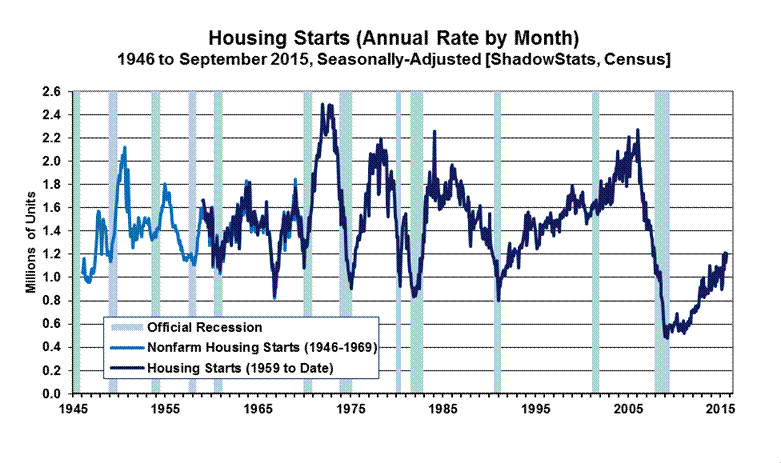
The record monthly low level of activity seen for the present aggregate series was in April 2009, where the annualized monthly pace of housing starts then was down 79% (-79%) from the January 2006 pre-recession peak. Against the downside-spiked low in April 2009, the September 2015 headline number was up by 152%, but it still was down by 47% (-47%) from the January 2006 pre-recession high. Shown in the historical perspective of the post-World War II era, current aggregate-starts activity is in up-trending stagnation at low levels that otherwise have been at or near the historical troughs of recession activity of the last 70 years, as seen in Graph 10 at the end of the Reporting Detail section.
Graph 1: Single- and Multiple-Unit Housing Starts (Monthly Rate of Activity)
Graph 2: Single- and Multiple-Unit Housing Starts (Six-Month Moving Average, Monthly Rate of Activity)
Graph 3: Aggregate Housing Starts (Monthly Rate of Activity)
Graph 4: Aggregate Housing Starts (Six-Month Moving Average, Monthly Rate of Activity)
Graph 5: Single-Unit Housing Starts (Monthly Rate of Activity)
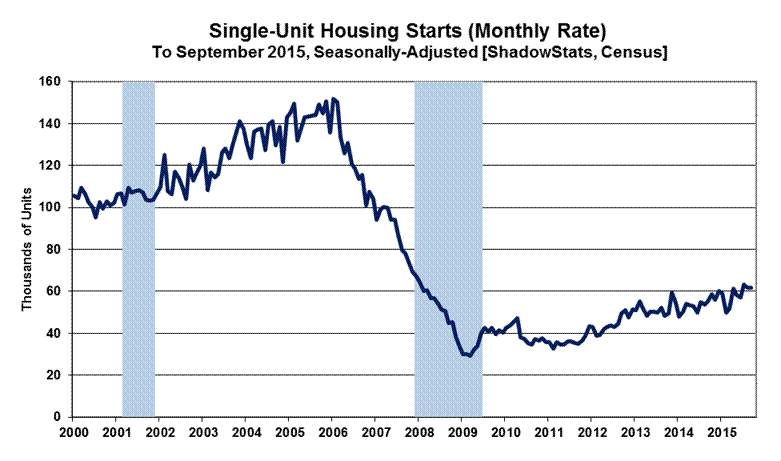
Graph 6: Single-Unit Housing Starts (Six-Month Moving Average, Monthly Rate of Activity)

Graph 7: Multiple-Unit Housing Starts (Monthly Rate of Activity)
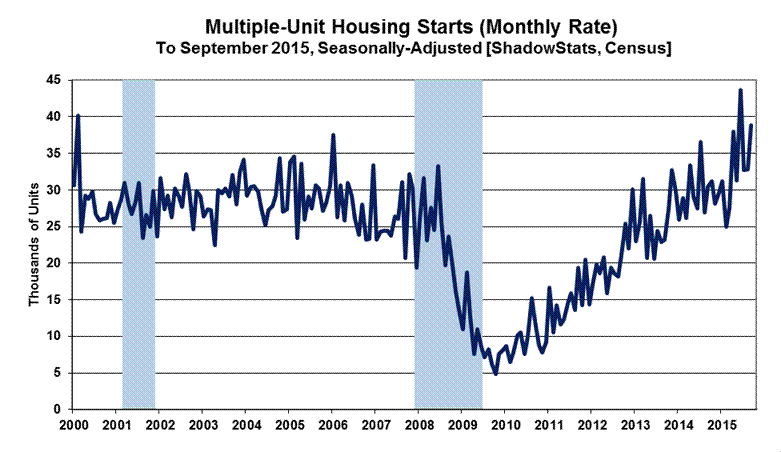
Graph 8: Multiple-Unit Housing Starts (Six-Month Moving Average, Monthly Rate of Activity)
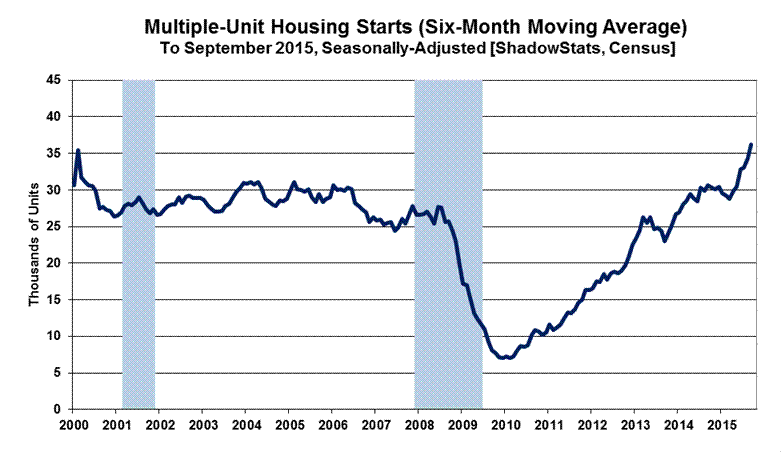
[The Reporting Detail section includes further graphs and added information on Housing Starts.]
__________
HYPERINFLATION WATCH
HYPERINFLATION OUTLOOK SUMMARY
Broad Outlook Is Unchanged: Economy Remains in Downturn; Questions Mount on Systemic Stability; Dollar Faces Massive Decline with Ongoing Implications for Hyperinflation. This Summary has not been changed since Commentary No. 754 of September 24th, other than for updated internal references or links and for minor language corrections.
Background Documents to this Summary. Underlying this Summary are No. 742 Special Commentary: A World Increasingly Out of Balance of August 10th, and No. 692 Special Commentary: 2015 - A World Out of Balance of February 2, 2015, which updated the Hyperinflation 2014 reports and the broad economic outlook. Previously, the long-standing hyperinflation and economic outlooks were updated with the publication of 2014 Hyperinflation Report—The End Game Begins – First Installment Revised, on April 2, 2014, and publication of 2014 Hyperinflation Report—Great Economic Tumble – Second Installment, on April 8, 2014. The two 2014 Hyperinflation Report installments, however, remain the primary background material for the hyperinflation and economic analyses and forecasts. In terms of underlying economic reality, one other reference is the Public Commentary on Inflation Measurement. The regular Commentaries also update elements of the general outlook, as circumstances develop.
Primary Summary. The U.S. economy remains in ongoing downturn, while the U.S. dollar still faces a massive decline in the wake of an extraordinary rally seen since June 2014, and in the context of a renewed economic downturn, ongoing domestic fiscal imbalances and ongoing financial-system instabilities. Financial-system concerns likely are the primary reason behind the inability or unwillingness of the Federal Reserve’s Federal Open Market Committee (FOMC) to raise interest rates. Those factors have implications for a meaningful upturn in domestic inflation, eventually evolving into a great hyperinflationary crisis.
Indeed, symptomatic of a financial system in serious distress, the FOMC remains unable or unwilling to move decisively on raising interest rates, to move the financial system towards monetary normalcy. Continued inaction or waffling by the Fed has begun to shift the focus and concerns of domestic and global investors away from what appears increasingly to be perpetual moribund economic activity into the areas of systemic instabilities, prospective or otherwise, that are so troubling to the U.S. central bank (see Commentary No. 750 and Commentary No. 754). Fed policy inaction, if anything, has exacerbated the long-term economic stagnation and renewed business downturn, where the quantitative easings always were intended as covert bailouts for the banking system, under the political cover of a weak economy (see for example, the Monetary Conditions section of Commentary No. 756).
Current fiscal conditions show the effective long-term insolvency of the U.S. government, a circumstance that usually would be met by eventual, unfettered monetization of the national debt and obligations, leading to a hyperinflation. As first estimated by ShadowStats in 2004, such hyperinflation appeared likely by 2020. That time horizon for the hyperinflation forecast was moved to 2014, because of the 2008 Panic, the near-collapse of the financial system, and official (U.S. government and Federal Reserve) responses to same. That hyperinflation forecast remains in place, but it has been adjusted into 2015 or 2016, as discussed in No. 742 and No. 692.
The basic story of how and why this fiscal, financial and economic crisis has unfolded and developed over the years—particularly in the last decade—is found in the Opening Comments and Overview and Executive Summary of the 2014 Hyperinflation Report—The End Game Begins—First Installment Revised.
Dollar Circumstance. Discussed in the background documents, the U.S. dollar rallied sharply from mid-2014 into early-2015, and despite some fluttering, into August and September, there has been some easing of the dollar’s strength in October (see Commentary No. 759). Initially, the rally reflected likely covert financial sanctions and oil-price manipulations by the United States, aimed at creating financial stresses for Russia, in the context of the Ukraine situation. Relative U.S. economic strength, and the relative virtuousness of Fed monetary policy versus major U.S. trading partners, were heavily picked-up on and over-estimated by global markets looking to support the dollar.
The still unfolding, weakening domestic-economic circumstance in 2015, in confluence with other fundamental issues, had begun to raise doubts, and more recently to confirm fears in the markets as to the sustainability of the purported U.S. economic recovery, and as to the imminence of meaningful monetary tightening by the U.S. Federal Reserve. As a result, the U.S. dollar briefly backed off its highs, with some related upside pressure having been seen on oil prices. Pressures reversed recently, spiking the U.S. dollar—also hitting oil prices anew—with false domestic economic strength being touted by Wall Street, and with some in the Fed indicating that interest rates would be raised in September, irrespective of negative indications on the economy (such did not happen). Coincident, with these events, not-so-covert central-bank actions appear to have driven the price of gold lower, also in the context of mounting global financial-market instabilities.
The U.S. economy remains in contraction (see Commentary No. 747, Commentary No. 751 and Commentary No. 755), with a variety of key indicators, such as industrial production, real retail sales and revenues of the S&P 500 companies continuing to show recession. Although formal recognition could take months, consensus recognition of a "new" recession should gain relatively rapidly, in tandem with a variety of monthly, quarterly and annual data reflecting the downturn in business activity. When formal recognition comes, timing of the onset of the recession likely will be December 2014.
As market expectations move towards an imminent, new recession, such not only should reduce expectations for a significant tightening in Fed policy, but also should renew expectations for a more-accommodative or newly-accommodative Fed. While such could help to fuel further stock-market mania, any resulting rallies in equity prices should be more than offset in real terms, by percentage declines in the exchange-rate value of the U.S. dollar or in the eventual increases in headline consumer inflation.
Faltering expectations on the direction of domestic economic activity, also would place mounting and eventually massive selling pressure on the U.S. dollar, as well as potentially resurrect elements of the Panic of 2008. Physical gold and silver, and holding assets outside the U.S. dollar, remain the ultimate primary hedges against an eventual total loss of U.S. dollar purchasing power. These circumstances should unwind what has been the sharp and generally ongoing rally in the U.S. dollar’s exchange rate since mid-2014, and the broadly-related selling pressures seen in the gold and silver markets. Further, oil prices should spike anew, along with a sharp reversal in the dollar’s strength.
A crash back to recognition of more-realistic domestic-economic circumstances looms, possibly in the weeks and certainly in the months ahead. It should be accompanied by a crash in the U.S. dollar versus major currencies, such as the Swiss franc, Canadian dollar and Australian dollar (currencies with some perceived ties to gold); and related rallies in precious metals and oil. Further, a sharp deterioration in the near-term outlook for domestic and global political stability continues and is of meaningful risk for fueling further heavy selling of the dollar. Once in heavy downturn, the dollar’s gains since June 2014 should reverse fully, pushing the exchange-rate value of the dollar to new historic lows. Again, the nascent currency crisis also has meaningful potential to resurrect elements of the Panic of 2008.
Unexpected economic weakness intensifies stresses on an already-impaired banking system, increasing the perceived need for expanded, not reduced, quantitative easing. The highly touted "tapering" by the FOMC ran its course. Future, more-constructive Fed behavior—moving towards normal monetary conditions in what had been an unfolding, purportedly near-perfect economic environment—was pre-conditioned by a continued flow of "happy" economic news. Fed tightening likely is not now on the horizon until after the 2016 presidential election. Suggestions that all was right again with world were nonsense. The Fed’s games likely now will be played out as far as possible, with hopes, once again, of avoiding a financial-system collapse.
Inaction by the FOMC on September 17th was telling. The Panic of 2008 never was resolved, and the Fed increasingly has found that it has no easy escape from its quantitative easing (QE3), which continues; only overt expansion of QE3 ceased. If the Fed does not act quickly to extricate itself from prior actions, QE4 will become the near-term question. Again, despite loud promises now of higher rates before year-end or next year, banking-system issues (not the economy) may keep the "pending" interest rate hike in a continual state of suspension. The economy certainly will supply continuing political cover for the Fed’s "inaction," with the U.S. central bank having lost control of the system.
Unexpected economic weakness—a renewed downturn—also savages prospective federal budget deficit prognostications (particularly the 10-year versions). Such throws off estimates of U.S. Treasury funding needs and estimates as to how long the Treasury effectively can dodge the limits of the recently re-imposed debt ceiling. Current fiscal "good news" remains from cash-based, not GAAP-based accounting projections and is heavily impacted by changes in business activity.
The economy has not recovered; the banking system is far from stable and solvent; and the Federal Reserve and the federal government still have no way out. Significant banking-system and other systemic (i.e. U.S. Treasury) liquidity needs will be provided, as needed, by the Fed, under the ongoing political cover of a weakening economy—a renewed, deepening contraction in business activity. The Fed has no choice. Systemic collapse is not an option for the Board of Governors. This circumstance simply does not have a happy solution.
Accordingly, any significant, renewed market speculation in the near future, as to an added round of Federal Reserve quantitative easing, QE4, may become a major factor behind crashing the dollar and boosting the price of gold. The Fed has strung out its options for propping up the system as much as it thought it could, with continual, negative impact on the U.S. economy. The easings to date, however, appear to have been largely a prop to banking system and to the increasingly unstable equity markets. While higher domestic interest rates would tend to act as a dollar prop, a hike in rates also could crash the stock market, as some on Wall Street fear, triggering a round of other systemic problems. Again, there is no happy way out of this for the Fed.
The fundamental problems threatening the U.S. dollar could not be worse. The broad outlook has not changed; it is just a matter of market perceptions shifting anew, increasingly against the U.S. currency. That process likely will become dominated by deteriorating global perceptions of stability in U.S. economic activity and political system, and the ability of the Federal Reserve to control its monetary policy. Key issues include, but are not limited to:
· A severely damaged U.S. economy, which never recovered post-2008, is turning down anew, with no potential for recovery in the near-term. The circumstance includes a renewed widening in the trade deficit and contracting production, as well as ongoing severe, structural-liquidity constraints on the consumer, which are preventing a normal economic rebound in the traditional, personal-consumption-driven U.S. economy (see Commentary No. 758, and the reporting of September real earnings in Commentary No. 759). Sharply-negative economic reporting shocks, versus softening consensus forecasts, remain a heavily-favored, proximal trigger for intensifying the pending dollar debacle (see Opening Comments of No. 756).
· U.S. government unwillingness to address its long-term solvency issues. Those controlling the U.S. government have demonstrated not only a lack of willingness to address long-term U.S. solvency issues, but also the current political impossibility of doing so. The shift in control of Congress did not alter the systemic unwillingness to address underlying fundamental issues, specifically to bring the GAAP-based deficit into balance. Any current fiscal "good news" comes from cash-based, not GAAP-based accounting projections. The GAAP-based version continues to run around $5 trillion for the annual shortfall, with total net obligations of the U.S. government pushing $100 trillion, including the net present value of unfunded liabilities. Still, many in Washington look to continue increasing spending and to take on new, unfunded liabilities. This circumstance now operates in the context of the formal constraint of a renewed debt ceiling that is within a month of being in crisis (see Opening Comments of No. 756).
· Monetary malfeasance by the Federal Reserve, as seen in central bank efforts to provide liquidity to a troubled banking system, and also to the U.S. Treasury. Despite the end of the Federal Reserve’s formal asset purchases, the U.S. central bank monetized 78% of the U.S. Treasury’s fiscal-2014 cash-based deficit (see Commentary No. 672). The quantitative easing QE3 asset purchase program effectively monetized 66% of the total net issuance of federal debt to be held by the public during the productive life of the program (beginning with the January 2013 expansion of QE3). The 2014 monetization process was completed with the Federal Reserve refunding the interest income it earned on the Treasury securities to the U.S. Treasury, but more of that lies ahead. If the Fed does not move soon to boost interest rates, it may be trapped in a renewed expansion of quantitative easing, given ongoing banking-system stresses, vulnerable stock markets and weakening, actual U.S. economic activity. As has been commonplace, the Fed likely would seek political cover for any new or expanded systemic accommodation in the intensifying economic distress.
· Mounting domestic and global crises of confidence in a dysfunctional U.S. government. The positive rating by the public of the U.S. President tends to be an indicative measure of this circumstance, usually with a meaningful correlation with the foreign-exchange-rate strength of the U.S. dollar. The weaker the rating, the weaker tends to be the U.S. dollar. The positive rating for the President is off its historic low, but still at levels that traditionally are traumatic for the dollar. Chances of a meaningful shift towards constructive cooperation between the White House and the new Congress in addressing fundamental fiscal and economic issues remain nil. Issues such as non-recovered, faltering economic activity, the consumer liquidity crisis and the nation’s long-range solvency issues should continue to devolve into extreme political crises.
· Mounting global political pressures contrary to U.S. interests. Downside pressures on the U.S. currency generally are intensifying, or sitting in place, in the context of global political and military developments contrary to U.S. strategic, financial and economic interests. Current conditions include the ongoing situation versus Russia and extraordinarily-volatile circumstances in the Middle East. U.S. response to Russian activity in the Ukrainian situation likely was behind part of the recent strength in the U.S. dollar and related weakness in oil prices, with U.S. actions aimed at causing financial distress for Russia. These situations have yet to run their full courses, and they have the potential for rapid and massive negative impact on the financial and currency markets.
· Spreading global efforts to dislodge the U.S. dollar from its primary reserve-currency status. Active efforts or comments against the U.S. dollar continue to expand. In particular, anti-dollar rhetoric and actions have been seen with Russia, China, France, India and Iran, along with some regular rumblings in OPEC and elsewhere. Temporary, recent dollar strength may have bought some time versus those who have to hold dollars for various reasons. Nonetheless, developing short-term global financial instabilities and a quick, significant reversal in the dollar’s strength should intensify the "dump-the-dollar" rhetoric rapidly. Consider that China has been selling some of its U.S. Treasury debt holdings to raise cash in for its near-term financial needs. Again, much of the rest of the world also has been backing away from holding U.S. treasury securities. Slack demand for U.S. Treasuries always can be taken up by the Federal Reserve’s renewed monetization of the debt.
When the selling pressure breaks massively against the U.S. currency, the renewed and intensifying weakness in the dollar will place upside pressure on oil prices and other commodities, boosting domestic inflation and inflation fears. Domestic willingness to hold U.S. dollars will tend to move in parallel with global willingness, or lack of willingness, to do the same. These circumstances will trigger the early stages of a hyperinflation, still likely in the year ahead.
Both the renewed dollar weakness and the resulting inflation spike should boost the prices of gold and silver, where physical holding of those key precious metals remains the ultimate hedge against the pending inflation and financial crises. Investors need to preserve the purchasing power and liquidity of their wealth and assets during the hyperinflation crisis ahead. See Chapter 10, 2014 Hyperinflation Report—Great Economic Tumble for detailed discussion on approaches to handing the hyperinflation crisis and No. 742, for other factors afoot in the current environment.
__________
REPORTING DETAIL
RESIDENTIAL CONSTRUCTION—HOUSING STARTS (September 2015)
Broad Activity Continued in a Smoothed Pattern of Up-Trending Stagnation. With September 2015 reporting, the headline detail of the aggregate housing-starts series continued to be of little meaning, other than as viewed in the context of a six-month moving average. The monthly gain of 6.5% in September 2015 housing starts was subdued minimally by an upside revision to August 2015 activity. Versus the initial reporting of August 2015 activity, the September gain was 7.1%, stronger than consensus expectations. As usual, though, not one aggregate headline detail—month-to-month, year-to-year, before-or-after revisions or consensus expectations—was close to being meaningful, as measured by statistical significance.
Quarterly Growth Slowed Markedly. Nonetheless, with the headline September detail, a small upside revision to August, and a small downside revision to July activity all in place, the aggregate housing-starts count rose at an annualized-quarterly pace of just 2.0% [that been trending towards an annualized contraction of 4.8% (-4.8%), based on just July and August reporting, initially trending towards an annualized 18.7% gain, based on just initial July detail]. Such slowed markedly from the unrevised annualized-quarterly growth pace of 96.3% in second-quarter 2015, versus the unrevised contraction of 26.2% (-26.2%) in first-quarter 2015.
Smoothed Numbers. A general pattern of low-level, albeit up-trending stagnation continued in the broad series, as best viewed in terms of the longer-range historical graph of aggregate activity (Graph 10), at the end of this section, and in the context of the headline activity, smoothed by six-month moving averages, as shown in Graphs 2 and 4 in the Opening Comments section. Although there has been a minor upside trend in the broad stagnation of the aggregate series, total housing-starts activity has remained well below any recovery level, holding at 47% (-47%) below its pre-recession high.
Separately, the dominant, single-unit housing starts component of the series (Graphs 5 and 6) remains down by 60% (-60%) from its January 2006 pre-recession peak, in smoothed, flat-trending activity.
Reflected in the smoothed graphs, the aggregate housing-starts series ticked minimally higher in September, reflecting upside movement in both the six-month smoothed single-unit (Graph 6) and multiple-unit starts (Graph 8) categories, where single-unit monthly activity was flat for the month, but multiple-unit activity jumped.
Over time, the bulk of the extreme, reporting instability and the minimal uptrend in the aggregate series has been due largely to particularly-volatile reporting in the multiple-unit housing-starts category (apartments, etc.). Recent activity in multiple-unit starts actually has recovered to above pre-recession levels, again, in the context of extreme month-to-month volatility. Even so, the recent impact of that recovery largely has been lost in the detail of total housing starts.
Consumer Liquidity Problems Continue to Impair Housing Activity. On a per-structure basis, housing starts volume, again, is dominated by the single-unit housing starts category, which has remained broadly stagnant on a smoothed basis, at a low level of activity since hitting bottom in early-2009. The private housing sector never recovered from the business collapse of 2006 into 2009.
The primary, underlying difficulty for the housing market remains intense, structural-liquidity constraints on the consumer. That circumstance, during the last eight-plus years of economic collapse and stagnation, has continued to prevent a normal recovery in broad U.S. business activity, as discussed more fully in Commentary No. 758 and updated briefly in the Opening Comments of Commentary No. 760.
Without real (inflation-adjusted) growth in household income and without the ability or willingness to take on meaningful new debt, the consumer simply has not had the wherewithal to fuel sustainable economic growth. There remains no chance of a near-term, sustainable turnaround in the housing market, until there is a fundamental upturn in consumer and banking-liquidity conditions. That has not happened and does not appear to be in the offing.
September 2015 Housing-Starts Headline Reporting. The Census Bureau reported this morning, October 20th, a statistically-insignificant, seasonally-adjusted, headline monthly gain of 6.5% +/- 19.2% (all confidence intervals are expressed at the 95% level) in September 2015 housing starts (see Graphs 1 to 4, 9 to 10). Such followed a revised decline of 1.7% (-1.7 %) [previously down by 3.0% (-3.0%)] in August, and a revised decline of 4.9% (-4.9%) [previously down by 4.1% (-4.1%), initially up by 0.2%] in July. Net of prior-period revisions, September 2015 housing starts rose by a still-statistically-insignificant 7.1% for the month, instead of the headline gain of 6.5%.
Year-to-year change in the seasonally-adjusted, aggregate September 2015 housing-starts measure was a statistically-insignificant gain of 17.5% +/- 21.1%, versus a revised annual gain of 17.2% [previously up by 16.6%] in August 2015, and a revised gain of 5.2% [previously up by 6.0%, initially up by 10.1%] in July 2015.
The September 2015 monthly gain of 6.5% in total housing starts reflected a headline monthly increase of 0.3% in the "one unit" category, and a jump of 17.0% in the "five units or more" category. None of the headline monthly gains was statistically-significant.
By-Unit Category (See Graphs in the Opening Comments). Where the irregular housing starts series can show varying patterns, that partially is due to a reporting mix of residential construction products, with the largest physical-count category of one-unit structure housing starts—generally for individual consumption, resulting in new home sales—versus multi-unit structure starts that generally reflect the building of rental and apartment units.
Housing starts for single-unit structures in September 2015 increased month-to-month by a statistically-insignificant 0.3% +/- 11.2%, following a revised monthly contraction of 2.8% (-2.8%) [previously down by 3.0% (-3.0%)] in August, and a revised July gain of 10.5% [previously up by 10.9%, initially up by 12.8%]. Single-unit starts for September 2015 showed a statistically-significant year-to-year annual gain of 12.0% +/- 9.2%, versus a revised annual gain of 14.8% [previously up by 14.9%] in August, and a revised annual gain of 15.5% [previously up by 16.0%, initially up by 19.0%] in July 2015 (see Graphs 1, 2, 5 and 6).
Housing starts for apartment buildings (generally 5-units-or-more) in September 2015 rose month-to-month by a statistically-insignificant 17.0% +/- 53.8%, versus a revised monthly gain of 1.6% [previously down by 2.3% (-2.3%)] in August, and a revised drop in July of 25.1% (-25.1%) [previously down by 23.5% (-23.5%), initially down by 17.1% (-17.1%)]. The statistically-insignificant September 2015 year-to-year gain of 28.6% +/- 56.9%, followed a revised year-to-year gain of 26.8% [previously up by 24.5%] in August 2015, and a revised annual contraction of 9.4% (-9.4%) [previously down by 7.5% (-7.5%), initially down by 2.1% (-2.1%)] in July 2015.
Expanding the multi-unit housing starts category to include 2-to-4-units plus 5-units-or-more usually reflects the bulk of rental- and apartment-unit activity. The Census Bureau does not publish estimates of the 2-to-4-units category, due to statistical significance problems (a general issue for the aggregate series). Nonetheless, the total multi-unit category can be calculated by subtracting the single-unit category from the total category (see Graphs 1, 2, 7 and 8).
Accordingly, the statistically-insignificant September 2015 monthly gain of 6.5% in aggregate housing starts was composed of parallel, statistically-insignificant gains of 0.3% in one-unit structures and 18.3% in the multiple-unit structures categories (2-units-or-more, including the 5-units-or-more category). Again, these series all are graphed in the Opening Comments section.
Housing Starts Graphs. Headline reporting of housing starts activity is expressed by the Census Bureau as an annualized monthly pace of starts, which was 1,206,000 in September 2015, versus a revised 1,132,000 [previously 1,126,000] in August 2015. That scaling detail, in terms of an annualized monthly rate is used in the aggregate Graphs 9 and 10 at the end of this section.
Nonetheless, given the nonsensical monthly volatility in reporting and the exaggerated effect of annualizing the monthly numbers in this unstable series, the magnitude of monthly activity and the changes in same, more realistically are reflected at the non-annualized monthly rate. Consider that the headline 236,000 month-to-month gain reported for annualized April 2015 housing starts was larger than any actual total (non-annualized) level of monthly starts ever, for a single month. That is since related starts detail first was published after World War II.
Accordingly, the monthly rate of 110,500 units in September 2015, instead of the annualized 1,206,000-headline number, is used in the scaling of Graphs 1 to 8 shown in the Opening Comments section. With the use of either scale of units, though, appearances of the graphs and the relative monthly, quarterly and annual percentage changes are otherwise identical, as can be seen in a comparison of Graph 9 versus Graph 3 in the Opening Comments.
The record monthly low level of activity seen for the present aggregate series was in April 2009, where the annualized monthly pace of housing starts then was down 79% (-79%) from the January 2006 pre-recession peak. Against the downside-spiked low in April 2009, the September 2015 headline number was up by 152%, but it still was down by 47% (-47%) from the January 2006 pre-recession high. Shown in the historical perspective of the post-World War II era, current aggregate-starts activity is in up-trending stagnation at low levels that otherwise have been at or near the historical troughs of recession activity of the last 70 years, as seen in the accompanying Graph 10.
Graph 9: Housing Starts (Annualized Monthly Rate of Activity), 2000 to Date

Graph 10: Housing Starts (Annualized Monthly Rate of Activity), 1946 to Date
__________
WEEK AHEAD
Economic Reporting Generally Should Trend Much Weaker than Expected; Inflation Will Rise Anew, Along with a Renewed Rebound in Oil Prices. Still in a fluctuating trend to the downside, amidst mixed reporting in headline data, market expectations for business activity nonetheless tend to move with the latest economic hype in the popular media. That general effect holds the consensus outlook at overly-optimistic levels, with current expectations still exceeding any potential, underlying economic reality. Again, the expectations trend generally has continued to soften, albeit at an accelerating pace.
Headline reporting of the regular monthly economic numbers increasingly should continue turning lower in the weeks and months ahead, along with likely downside or otherwise much weaker-than-expected reporting for at least the next several quarters of GDP (and GDI and GNP) into 2016, including next week’s initial detail for third-quarter 2015 GDP.
CPI-U consumer inflation—driven lower earlier this year by collapsing prices for gasoline and other oil-price related commodities—likely has seen its near-term, year-to-year low. It turned positive in June 2015, for the first time in six months, notched somewhat higher in July and August, with a minimal fallback in September, tied to renewed weakness in gasoline prices. Gasoline prices appear to be bottoming out again, with a combination of temporarily-stable gasoline prices and related, positive seasonal adjustments likely to spike headline October 2015 CPI-U.
Meaningful upside inflation pressures should mount anew, once oil prices begin to rebound. Again, that process eventually should accelerate, along with a pending sharp downturn in the exchange-rate value of the U.S. dollar. Those areas, the general economic outlook and longer range reporting trends were reviewed broadly, recently, in No. 742 Special Commentary: A World Increasingly Out of Balance, No. 692 Special Commentary: 2015 - A World Out of Balance and are covered in the Hyperinflation Outlook Summary.
A Note on Reporting-Quality Issues and Systemic-Reporting Biases. Significant reporting-quality problems remain with most major economic series. Beyond the pre-announced gimmicked changes to reporting methodologies of the last several decades, which have tended to understate actual inflation and to overstate actual economic activity, ongoing headline reporting issues are tied largely to systemic distortions of monthly seasonal adjustments. Data instabilities—induced partially by the still-evolving economic turmoil of the last eight-to-ten years—have been without precedent in the post-World War II era of modern-economic reporting. The severity and ongoing nature of the downturn provide particularly unstable headline economic results, when concurrent seasonal adjustments are used (as with retail sales, durable goods orders, employment and unemployment data, discussed and explored in the labor-numbers related Commentary No. 695).
Combined with recent allegations of Census Bureau falsification of data in its monthly Current Population Survey (the source for the Bureau of Labor Statistics’ Household Survey), these issues have thrown into question the statistical-significance of the headline month-to-month reporting for many popular economic series (see Commentary No. 669).
PENDING RELEASES:
Existing- and New-Home Sales (September 2015). September 2015 Existing-Home Sales are due for release on Thursday, October 22nd, from the National Association of Realtors (NAR), with the September 2015 New-Home sales report due from the Census Bureau on Monday, October 26th. The detail from both series will be covered in ShadowStats regular Commentary No. 762 of October 27th.
The primary, underlying difficulty for the housing market remains intense, structural-liquidity constraints on the consumer. That circumstance, during the last eight-plus years of economic collapse and stagnation, has continued to prevent a normal recovery in broad U.S. business activity, as discussed fully in Commentary No. 758 and updated briefly in the Opening Comments of Commentary No. 760. There remains no chance of a near-term, sustainable turnaround in the housing market, until there has been a fundamental upturn in consumer and banking-liquidity conditions. Accordingly, prospects remain bleak for a sustainable increase in home-sales activity.
With a longer-term flat trend in headline Existing-Home Sales, despite recent headline monthly gains, and a decline in August, some further downside catch-up in month-to-month activity remains a fair possibility for September 2015 reporting. Smoothed for extreme and nonsensical monthly gyrations, a continuing pattern of stagnation or downturn in New-Home Sales also is likely, despite some recently up-trending stagnation. Monthly changes in activity here rarely are statistically-significant, amidst otherwise unstable headline monthly reporting and revisions.
Again, reflecting deteriorating consumer issues, both New- and Existing-Home Sales increasingly should continue to reflect downside volatility in headline reporting.
Gross Domestic Product (GDP)—Third-Quarter 2015, First or "Advance" Estimate. The Bureau of Economic Analysis (BEA) will publish its first estimate of third-quarter 2015 GDP on Thursday, October 29th. The pace of annualized quarterly real growth should drop sharply from the 3.9% headline gain currently estimated for second-quarter 2015 GDP. Where consensus estimates for third-quarter activity likely will settle in around 2.0%, at least before the trade reporting, a much weaker headline number is likely at 1.0% or below, possibly closing in on zero in this "advance" estimate.
Discussed in the Opening Comments, the BEA tends to target the consensus outlook with its "advance" GDP estimates, but it has brought in lower or higher numbers, respectively, if the consensus outlook was deemed to be markedly too high or too low.
That said, quite possibly showing a much-greater-than-anticipated tumble, again, the headline GDP number should come in below 1.0%—it could approach zero—limited only by the BEA’s positioning versus consensus expectations. Near-zero growth could come from late-breaking September trade-deficit detail showing an accelerated pace of deficit deterioration. Such is a reasonably good bet. From the BEA’s standpoint, though, initial headline reporting of a quarterly GDP contraction is not likely, until after consensus expectations already have moved there.
The "advance" estimate of September merchandise-trade activity is scheduled for Wednesday, October 28th, the day before the GDP estimate. That trade detail will be incorporated into the GDP number, where this "advance" trade report specifically was designed to improve the headline reporting quality of the BEA’s initial guess at a given quarter’s GDP activity. A shock in the headline trade numbers likely would move both the financial markets and late-expectations for the GDP reporting.
Where headline details and market impact will follow immediately upon the release of the "advance" trade report, numbers of interest there will be covered by ShadowStats, along with the next day’s GDP release, in the October 29th Commentary No.763, and as related to the pending full September trade detail in Commentary No. 764 of November 4th.
Separately, alternative details to the most-heavily gimmicked Gross Domestic Product (GDP), from third-quarter Gross Domestic Income (GDI) and Gross National Product (GNP), will not be published until November 24th.
__________