


No. 770: October New Orders for Durable Goods, New-Home Sales

COMMENTARY NUMBER 770
October New Orders for Durable Goods, New-Home Sales
November 25, 2015
___________
Ex-Commercial Aircraft, Nominal October Durable Goods Orders Contracted
Month-to-Month, Year-to-Year and Suggested a Fourth-Quarter Downturn
New-Home Sales Continued in a Smoothed Pattern of
Down-Trending, Low-Level Stagnation
Recession Outlook Continued to Deepen
___________
PLEASE NOTE: The next regular Commentary, scheduled for Friday, December 4th, will cover November Employment and Unemployment, the October Trade Deficit and Construction Spending.
HAPPY THANKSGIVING! — John Williams
OPENING COMMENTS AND EXECUTIVE SUMMARY
Fourth-Quarter Bad News Intensified. Other than updating prior Commentary No. 769 for today’s durable goods reporting, economic conditions remain as they were. The next Commentary No. 771, on December 4th, however, shall look ahead prospectively at headline November economic reporting, in context of the November payroll and employment reporting of that date.
Reflecting today’s (November 25th) headline durable goods detail in the reporting of economic activity for October 2015—the first month of fourth-quarter 2015—each series of Real Durable Goods Orders Ex-Commercial Aircraft, Industrial Production, Existing Home Sales, Housing Starts and Real Retail Sales has generated an early indication for a quarterly contraction. This remains about as strong a signal as can be generated—at this stage of reporting—for a possible, related headline quarterly contraction in fourth-quarter 2015 GDP.
Today’s Commentary (November 25th). The balance of these Opening Comments provides summary coverage of October New Orders for Durable Goods and New-Home Sales, along with updated consumer conditions tied to November Consumer Sentiment and Confidence.
In the process of being updated for the latest economic, Federal Reserve and global political developments, a revised Hyperinflation Outlook Summary will be posted along with Commentary No. 772 of December 11th. In the interim, the latest Summary (written November 4, 2015) is available in Commentary No. 768; the broad, general outlook has not changed.
The Week Ahead previews November labor conditions and detail on the full October Trade Deficit reporting and October Construction Spending.
New Orders for Durable Goods—October 2015—Ex-Commercial Aircraft, Orders Contracted for the Month and the Year, and Suggested a Quarterly Downturn. The headline jump of 3.0% in October 2015 new orders for durable goods was more than accounted for by an 81.0% surge in commercial aircraft orders, reflecting Boeing’s orders from a recent airshow. Yet, the aggregate headline gain in October orders also was after an upside revision to September orders, where that revision also was more than accounted for by an upside revision to commercial aircraft orders.
Ex-commercial aircraft orders, headline October orders fell by 0.4% (-0.4%), and were down year-to-year by 0.6% (-0.6%), with nominal orders falling for the ninth consecutive month. In real terms, net of inflation, that string of annual contractions was broken in October, due to heavily-negative annual headline durable goods inflation in October 2015. Such a protracted pattern of annual contraction in new orders has not been seen since the formal economic collapse into 2008 and 2009.
Nonetheless, the headline gain in October 2015 orders remained within the normal bounds of volatility in this highly-irregular series. All factors considered, the broad signal for unfolding U.S. economic activity remained sharply negative, with the summary statistics still signaling a deepening and ongoing recession.
Quarterly Growth. Annualized quarterly declines in real new orders (ex-commercial aircraft) were 5.58% (-5.58%) in fourth-quarter 2014, and 7.73% (-7.73%) in first-quarter 2015. Following with appropriate one-quarter lags, both first- and second-quarter 2015 industrial production contracted (see Commentary No. 767), with third-quarter production growth on the plus-side, along with a negative signal in hand for fourth-quarter 2015 production.
Annualized real change for second-quarter 2015 orders was a revised gain of 2.10%, while the pace of annualized growth for third-quarter activity was a revised gain of 10.57%, with an initial signal for fourth-quarter 2015 growth (based solely on October reporting) of an annualized quarterly contraction of 1.57% (-1.57%). The quarterly gains here were due partially to highly-suspect, negative durable goods inflation in the PPI reporting, which began turning back into positive territory in October.
On a nominal basis (before inflation adjustment), third-quarter 2015 growth—again, ex-commercial aircraft— was up at a revised annualized pace of 8.65%, following an unrevised second-quarter 2015 quarterly growth of 0.57%, an annualized contraction of 7.29% (-7.29%) in first-quarter 2015, and a decline of 4.36% (-4.36%) in fourth-quarter 2014.
Based on October 2015 reporting, the initial, nominal annualized growth rate for fourth-quarter 2015 coincidentally also is a contraction of 1.57% (-1.57%), the same as the indication for inflation-adjusted activity.
Headline Nominal (Not-Adjusted-for-Inflation) October 2015 Reporting. The regularly-volatile, seasonally-adjusted, nominal level of October 2015 new orders for durable goods rose month-to-month by a headline 2.99%, following a revised, more shallow decline of 0.82% (-0.82%) in September and a minimally revised monthly August contraction of 2.94% (-2.94%). Net of the revisions to September, aggregate new orders rose by 3.42% in October. All of the headline gain and upside revisions were due to surges in commercial aircraft orders.
The year-to-year gain in October 2015 durable goods orders was 0.51%, following a revised annual decline of 2.58% (-2.58%) in September 2015, and a minimally revised annual contraction in August 2015 of 3.24% (-3.24), all seasonally adjusted.
Again, all the gain in October and the revision in September were before consideration of volatility in commercial-aircraft orders. With the aircraft orders considered, headline changes in October and September durable goods orders were minimal, remained well within the normal reporting variations of this highly unstable series and were consistent with a continuing pattern of broad stagnation, showing an unfolding downturn of a nature that usually precedes or coincides with a recession or a deepening business downturn.
Detail Net of Volatility in Commercial-Aircraft Orders. The reporting of extreme contractions and surges in commercial-aircraft orders is seen commonly in an irregularly-repeating process throughout the year and often dominates the changes in headline monthly durable goods orders, as happened again with the headline October 2015 detail. These extremely volatile aircraft orders are booked years into the future and are indicative more of longer-term, rather than shorter-term prospects for manufacturing activity.
Net of headline commercial-aircraft order gain of 81.02% in October 2015, and a revised headline decline of 32.17% (-32.17%) in September 2015, aggregate new orders fell by 0.41% (-0.41%) in October and rose by a revised 1.22% in September. Net of a minimally-deeper, revised decline of 11.25% (-11.25%) in commercial aircraft orders, aggregate new orders fell by a minimally-revised 2.35% (-2.35%) in August.
Falling for the ninth month in a row, year-to-year and seasonally-adjusted, October 2015 new orders (net of commercial aircraft) were down by 0.62% (-0.62%), versus a revised decline of 0.53% (-0.53%) in September 2015, and a revised decline of 1.61% (-1.61%) in August 2015.
Real (Inflation-Adjusted) Durable Goods Orders—October 2015. ShadowStats uses the PPI component inflation measure “Durable Manufactured Goods” for deflating the new orders for durable goods series. Published only on a not-seasonally-adjusted basis, the related October 2015 PPI series turned to the plus-side month-to-month, having contracted in each of the preceding eight months. The related PPI series rose by 0.12% in October 2015, having been down for the month by 0.06% (-0.06%) in September, and by 0.24% (-0.24%) in October. Headline annual inflation contracted at a negative year-to-year pace of 0.78% (-0.78%) in October 2015, having been down by 0.48% (-0.48%) in both September and August 2015.
Adjusted for that monthly gain of 0.12% in headline October 2015 inflation, and as reflected in the accompanying graphs, real month-to-month aggregate orders rose by 2.86% in October, following a revised monthly contractions of 0.76% (-0.76%) in September, and 2.71% (-2.71%) in August. Ex-commercial aircraft, monthly real orders were down by 0.53% (-0.53%), versus a revised gain of 1.28% in September 2015, and decline of 2.11% (-2.11%) in August.
Real year-to-year aggregate orders rose by 1.30% in October 2015, versus revised declines in September 2015 of 2.11% (-2.11) and in August 2015 of 2.77% (-2.77%). Ex-commercial aircraft, real orders gained year-to-year by 0.15% in October 2015, having been down by a revised 0.06% (-0.06%) in September 2015 and a revised 1.15% (-1.15%) in August 2015.
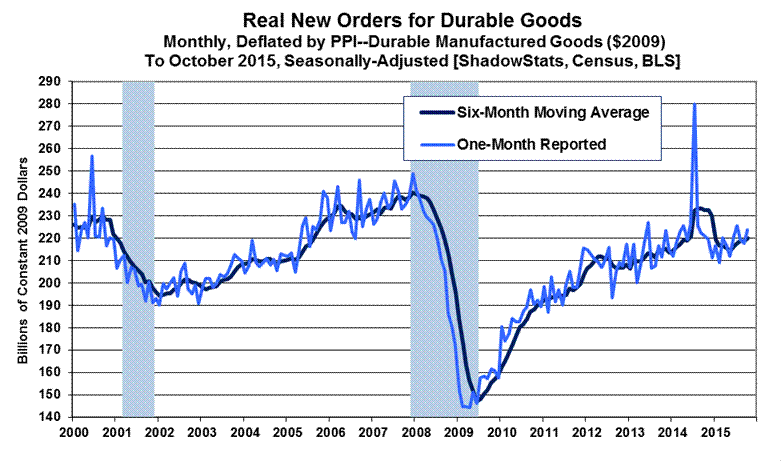
Graphs of Inflation-Adjusted and Smoothed Durable Goods Orders and the Related Corrected Series. The following two graphs (Graph 1 and Graph 2), show new orders for durable goods, adjusted for inflation using the Producer Price Index (PPI) measure for “Durable Manufactured Goods.” These graphs show monthly and six-month moving-averages of the activity level, updated for this morning’s headline reporting of the October 2015 numbers.
Graph 1 shows the aggregate new orders series, including the extreme swings in commercial-aircraft orders. Extreme monthly volatility was seen particularly about one year ago, in July and August 2014, with a return to some stability in September 2014 through February 2015, an uptick in March, minor declines in April and May, a jump in June and minor declines in the third-quarter 2015, with aircraft orders boosting October activity. Graph 2 is the headline series, net of the unstable commercial-aircraft order sector. Accordingly, the ex-commercial aircraft plot is somewhat smoother than the first graph. Again, given the extreme surge in July 2014 aircraft orders, the six-month moving average in the aggregate series, or first graph, looked like an anaconda swallowing a cow, for a while, but that passed from the moving average with January 2015 reporting.
In terms of inflation-adjusted activity, both of the durable goods orders series have shown a slowing uptrend and flattening-out in the last two-to-three years—with a dip and upside bouncing into 2013, and renewed stagnation, feeding into the temporary July 2014 surge. Orders had been in general decline since third-quarter 2014, with two consecutive quarterly contractions in place for fourth-quarter 2014 and first-quarter 2015, but with activity in a minor uptrend, since, both before and after any consideration for aircraft orders and/or inflation. Net of commercial aircraft sales, however, activity once again has turned lower. That said, annual growth in new orders, net of commercial aircraft, has been in annual contraction for nine months straight. That generally has not been seen outside of recessions.
Graph 1: September 2015 Real Total New Orders for Durable Goods
Graph 2: September 2015 Real New Orders for Durable Goods – Ex Commercial-Aircraft Orders

Separately, where related headline PPI inflation for manufactured durable goods had been negative month-to-month for the prior eight consecutive months, it just turned to the plus-side in October 2015, but the headline inflation remained sharply negative year-to-year. As a result, what was negative annual nominal growth in October ex-commercial aircraft orders, turned slightly positive after inflation adjustment, due to the much higher year-ago inflation rate.
Broadly, there has been a recent general pattern of stagnation or bottom-bouncing evident in the orders—clearly not the booming recovery that has been seen in official GDP reporting. The real (inflation-adjusted) monthly and six-month moving-average level of new orders in October 2015 remained below both the pre-2007 recession high, as well as the pre-2000 recession high. The pattern of low-level stagnation and now general downtrend in the annual inflation-adjusted series since mid-2014—net of the irregular aircraft-order effects—again is one that usually precedes or is coincident with a recession.
The Real New Orders Series Corrected for Inflation Understatement. As with other economic series deflated by official government inflation measures, estimates of inflation-adjusted growth in new orders for durable goods generally are overstated, due to the understatement of official inflation. That understatement here comes from the government’s use of hedonic-quality adjustments—quality issues usually not perceived by users or consumers of the involved products—in justifying a reduced pace of headline inflation (see Public Commentary on Inflation Measurement).
As done for other series such as the GDP, real retail sales and industrial production, ShadowStats publishes an experimental corrected version of the inflation-adjusted graph of real new orders for durable goods, corrected for the understatement of the related headline PPI inflation.
Two sets of graphs follow. The first set (Graph 3 and Graph 4) shows the aggregate series or total durable goods orders; the second set (Graph 5 and Graph 6) shows the ex-commercial aircraft series. The first plot in each series is the official six-month moving average, the same heavy dark-blue line shown in Graph 1 and Graph 2, along with the light-blue thin line of monthly detail. The second plot in each set is the same six-month, moving-average series shown in the first plot, but re-deflated so as to correct for the understatement of the PPI durable goods inflation measure used in the headline-deflation process. ShadowStats estimates that inflation understatement, with the graphs indexed to January 2000 = 100.
Graph 6, entitled “Corrected Real Orders—Ex-Commercial Aircraft,” is perhaps the best indicator of broad underlying order activity in the durable goods sector, in the context of signaling in advance actual near-term production and economic activity.
The aggregate orders series—in the first set—includes commercial aircraft orders. Placed years in advance, aircraft orders are a better indicator of long-range production activity, than they are as a near-term leading indicator of production activity.
Graph 3: September 2015 Index of Real Total New Orders for Durable Goods (Six-Month Moving Average)

Graph 4: Corrected Index of Real Total New Orders for Durable Goods (Six-Month Moving Average)

Graph 5: September 2015 Index of Durable Goods Orders – Ex Commercial Aircraft (Six-Month Moving Average)
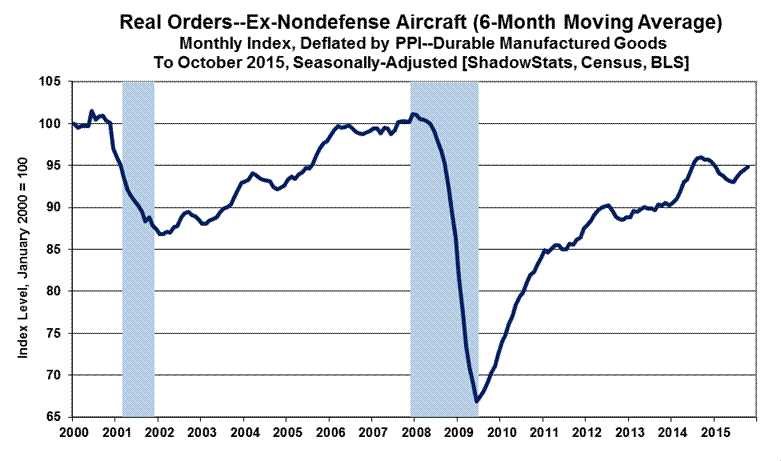
Graph 6: Corrected Index of Durable Goods Orders – Ex Commercial Aircraft (Six-Month Moving Average)

New- and Existing-Home Sales—October 2015—Ten-Plus Years into the Housing Industry’s Great Depression. Discussed in Commentary No. 754, the U.S. housing industry has been in a great depression, with activity never having recovered from the economic collapse into 2009, despite the purported full recovery of headline Gross Domestic Product (GDP) in 2011, and the purported, continued expansion of the GDP ever since (see Commentary No. 769).
With a great depression defined here as a peak-to-trough contraction in excess of 25% (-25%), ten-plus years into the housing-market implosion, activity in the major housing series remains down by more than 25% (-25%) from pre-recession peaks (see accompanying Graphs 7 to 13).
Although each series is off its cycle low, and existing-home sales briefly rose minimally out of great-depression territory in September, all the series were down by more than 25% (-25%) as of October 2015. New- and Existing-Home sales were down respectively by 64% (-64%) and 26% (-26%) from their pre-recession highs, with aggregate Housing Starts and Single-Unit Housing Starts down respectively by 53% (-53%) and 60% (-60%).
Updated again briefly in the following Consumer Conditions section, and as discussed fully in Commentary No. 766, there has been no improvement in underlying consumer liquidity conditions. Correspondingly, with no fundamental growth in liquidity to fuel increasing consumer activity, there is no basis for a current or imminent recovery in the housing market.
New-Home Sales—October 2015—Deepening Downtrend in Low-Level Stagnation, Amidst Unstable Headline Reporting and Downside Revisions. The volatile reporting of monthly and annual changes in October 2015 new-home sales activity was not statistically significant, as usual. In the context of continued, major downside revisions to previously-reported July, August and September sales, headline October activity rose by 10.7% for the month (5.8% net of prior-period revisions), with year-to-year annual growth at 4.9%, versus a revised annual contraction of 2.6% (-2.6%) [previously a 2.0% gain] in September 2015.
Where the unstable reporting of headline October 2015 annualized sales of 495,000 units (42,250 at a monthly rate as used in the graphs) was below August 2015 reporting, it also was down by 64% (-64%) from the pre-recession peak for the series. With the otherwise meaningless monthly swings in these numbers smoothed out, new-home sales activity continued in a broad pattern of down-trending, low-level stagnation.
ShadowStats assesses such unstable series by considering the gyrations in monthly activity in the context of a six-month moving average of the headline numbers, as reflected in the accompanying graphs, showing both the headline-monthly level and smoothed detail for new-home sales.
Graphed either way, smoothed or not, the various housing series generally have continued to show a pattern of economic activity plunging from 2005 or 2006 into 2009, and then low-level stagnation, never recovering with the purported GDP recovery.
New-Home Sales Headline Detail. New-home sales (counted based on contract signings, Census Bureau) rose for the month of October 2015, in the context of heavy downside revisions to activity in July through September. Headline October sales rose by a statistically-insignificant 10.7%, which followed a revised decline of 12.9% (-12.9%) in September, a downwardly revised monthly gains of 2.6% in August, and 6.6% in July. Net of prior-period revisions, October 2015 monthly sales rose by 5.8%, instead of the headline 10.7%.
Year-to-year, October 2015 sales increased by a statistically-insignificant 4.9%%. That followed a revised annual contraction of 2.6% (-2.6%) in September 2015, and downwardly revised annual gains of 13.0% in August 2015 and 24.1% in July 2015.
In the arena of continued extreme volatility and unstable, nonsensical headline reporting, consider that the annualized quarterly pace of sales gain in first-quarter 2015 was 43.9%, with the second-quarter 2015 sales activity in an annualized quarterly decline of 14.8% (-14.8%). Where initial reporting for third-quarter 2015 sales had shown annualized growth of 2.7%, that just revised to an annualized contraction of 7.8% (-7.8%). Based solely October reporting, fourth-quarter 2015 new-home sales were increasing at an annualized pace of 7.0%.
Existing-Home Sales—October 2015—Sales Fell by 3.4% (-3.4%) in October, Down by 26.3% (-26.3%) from Pre-Recession High. [The following text largely repeats the detail published in prior Commentary No. 769.] In the context no revision to September’s activity, October 2015 existing-home sales fell by 3.4% (-3.4%) to 5,360,000 million or 446.7 thousand units at a monthly pace as reflected in Graph 11. Off by 3.9% from the July 2015 near-term high for the series, sales remained down by 26.3% (-26.3%) from the June 2005 pre-recession peak. In contrast, the October 2015 headline monthly housing starts remained down by 53.4% (-53.4%) versus its January 2006 pre-recession high.
First-quarter 2015 showed an annualized quarterly contraction of 6.7% (-6.7%) in existing sales, with the second-quarter 2015 pace of annualized growth at 28.7%. Third-quarter 2015 growth slowed to an annualized pace of 14.3%, with and initial indication of relative fourth-quarter 2015 activity—based solely on October reporting—contracting at an annualized quarterly pace of 8.3% (-8.3%).
Existing-Home Sales Headline Detail. Headline October 2015 existing-home sales (counted based on actual closings, National Association of Realtors [NAR]) showed a seasonally-adjusted monthly decline of 3.4% (-3.4%), following an unrevised gain of 4.7% in September. Year-to-year, October 2015 annual sales growth slowed to 3.9%, from an unrevised 8.2% in September 2015.
The headline October sales data remained well within the normal scope of reporting volatility for this series. Smoothed for irregular distortions, the series remained statistically consistent with a period of broad stagnation, albeit still up-trending, again, as seen in Graph 11. The quality of data underlying this series, however, remains highly questionable.
Proportion of Distressed Sales Declined, with All-Cash Sales Unchanged in October. The NAR estimated the portion of October 2015 sales in “distress” eased by a notch, to the lowest reading since the NAR began surveying those numbers in October 2008. Reversing what had been an negative shift in the portion of September sales in foreclosure, October distressed sales eased to 6% (5% foreclosures, 1% short sales), from the September 2015 levels of 7% (6% foreclosures, 1% short sales) and versus October 2014 distressed sales of 9% (7% foreclosures, 2% short sales).
Reflecting continued lending problems and stresses within the financial system, including related banking-industry and consumer-solvency issues, as well as the ongoing influx of speculative investment money into the existing-housing market, the NAR estimated that all-cash sales in October 2015 held at a still-high 24% of total activity, same as in September 2015 but down from 27% in October 2014.
Graph 7: New-Homes Sales – Monthly Level

Graph 8: Single Unit Housing Starts – Monthly Level

Graph 9: New-Homes Sales – Six-Month Moving Average

Graph 10: Single Unit Housing Starts – Six-Month Moving Average

Graph 11: Existing-Home Sales – Monthly Level

Graph 12: Total Housing Starts – Monthly Level

Graph 13: Aggregate Housing Starts (Six-Month Moving Average, Monthly Rate of Activity)

New- and Existing-Home Sales Graphs. Preceding are the regular monthly graphs of October new-and existing-home sales activity. The new-home sales plots (Graph 7 and Graph 9) reflect activity based both on headline monthly reporting as well as using a smoothed, six-month moving average of the series.
Those graphs are accompanied by comparative graphs of October 2015 single-unit housing starts activity (Graph 8 and Graph 10), measures which are limited to single-unit activity.
The existing-home sales graph (Graph 11) is accompanied by comparative plots of aggregate housing starts activity (Graph 12 and 13). Those measures include both single- and some multiple-unit activity.
The various comparative housing starts graphs are repeated from Commentary No. 768.
Consumer Conditions—Update for November 2015 Consumer Sentiment and Confidence. Consumer liquidity conditions, discussed broadly in Commentary No. 766 and updated briefly in yesterday’s Commentary No. 769 are revised further here for the November 2015 Consumer Sentiment measure published by the University of Michigan.
Without meaningful real (inflation-adjusted) growth in household income and without the ability or willingness to take on significant new debt, the consumer simply has not had the wherewithal to fuel a sustainable economic expansion. Impaired consumer liquidity and its direct restraints on consumption have been responsible for much of the economic turmoil of the last eight-plus years, driving the housing-market collapse and ongoing stagnation in consumer-related real estate and construction activity, as well as constraining both nominal and real retail sales activity and the related, personal-consumption-expenditures and residential construction categories of the GDP. Together, those sectors account for more than 70% of total economic activity in the United States, as measured by the Gross Domestic Product.
Underlying economic fundamentals simply have not supported, and do not support a turnaround in broad economic activity. There has been no economic recovery, and there remains no chance of meaningful, broad economic growth without a fundamental upturn in consumer- and banking-liquidity conditions.
Consumer Confidence Collapsed Anew in November 2015, Early-November Sentiment Revised Lower. The Conference Board’s seasonally-adjusted [unadjusted data are not available] Consumer-Confidence Index (Graph 14) and the University of Michigan’s not-seasonally-adjusted Consumer-Sentiment Index (Graph 15) for the full-month of November 2015 moved in opposite directions, with confidence down sharply but sentiment up minimally for the month. Yet the sentiment measure was up by less than had been indicated in the early reporting of the series.
Plotted in Graph 14, and as discussed in yesterday’s Commentary No. 769, the November 2015 reading for the Conference Board’s Consumer-Confidence measure plunged by 8.8% (-8.8%) from October 2015, which in turn was down by 3.4% from the September 2015 level, which had been the highest Confidence reading since January 2015. The tumbling November 2015 reading, however, was the lowest since September 2014, declining both month-to-month and in its three-month moving average.
Plotted in Graph 15, the University of Michigan’s Consumer Sentiment measure had fallen sharply in September, at least partially reflecting stock-market turmoil, but Sentiment rallied in October, regaining August’s level. The full-November 2015 reading for Consumer Sentiment (as released today, November 25th) showed some further gain, but not as strong as indicated initially. In early reporting for the month, Sentiment had jumped by 3.4% relative to October, but that fell back to a 1.4% gain in the final reporting.
Smoothed for irregular, short-term volatility, the two series both appear to have topped out in 2014, coincident with what likely will gain recognition as the onset of a new recession (Commentary No. 769), and otherwise they both remain at levels seen typically in recessions. Suggested in Graph 16—plotted for the last 45 years—the latest readings of Confidence and Sentiment generally have not recovered levels preceding most formal recessions of the last four decades. Broadly, the consumer measures remain well below, or are inconsistent with, periods of historically-strong economic growth seen in 2014 and the strong, headline upturn in second-quarter 2015 GDP growth.
For purposes of plotting the Consumer Confidence and Consumer Sentiment measures on a comparable basis, both measures have been re-indexed to January 2000 = 100 for the monthly reading. Standardly reported, the Conference Board’s Consumer Confidence Index is set with 1985 = 100, while the University of Michigan’s Consumer Sentiment Index is set with January 1966 = 100.
Where the Confidence and Sentiment series tend to mimic the tone of headline economic reporting in the press (see discussion in Commentary No. 764), they often are highly volatile month-to-month, as a result. Both series generally have continued to move lower or to hold off near-term peaks, smoothed for their three-month and six-month moving-average readings. With increasingly-negative, headline financial and economic reporting and circumstances at hand and ahead, successive negative hits to both the confidence and sentiment readings remain highly likely to continue in the months ahead.
Graph 14: Consumer Confidence to November 2015

Graph 15: Consumer Sentiment to November 2015

Graph 16: Comparative Consumer Confidence and Sentiment (6-Month Moving Averages) since 1970

[The Reporting Detail section includes further material on
October Durable Goods Orders and New-Home Sales.]
__________
HYPERINFLATION WATCH
HYPERINFLATION OUTLOOK SUMMARY. In the process of being updated for the latest economic and Federal Reserve developments, this section will be posted anew with Commentary No. 772 on December 11th. In the interim, the latest Summary (November 4, 2015-based) is available here: Commentary No. 768.
__________
REPORTING DETAIL
NEW ORDERS FOR DURABLE GOODS (October 2015)
Ex-Commercial Aircraft, October Durable Goods Orders Contracted for the Month and the Year, and Suggested a Quarterly Downturn. The headline jump of 3.0% in October 2015 new orders for durable goods was more than accounted for by an 81.0% surge in commercial aircraft orders, reflecting Boeing’s orders from a recent airshow. Yet, the aggregate headline gain in October orders also was after an upside revision to September orders, where that revision also was more than accounted for by an upside revision to commercial aircraft orders.
Ex-commercial aircraft orders, headline October orders fell by 0.4% (-0.4%), and were down year-to-year by 0.6% (-0.6%), with nominal orders falling for the ninth consecutive month. In real terms, net of inflation, that string of annual contractions was broken in October, due to much weaker headline durable goods inflation in October 2015 than was seen the year before. Such a protracted pattern of annual contraction in new orders has not been seen since the formal economic collapse into 2008 and 2009.
Nonetheless, the headline gain in October 2015 orders remained within the normal bounds of volatility in this highly-irregular series. All factors considered, however, the broad signal for unfolding U.S. economic activity remained sharply negative, with the summary statistics still signaling a deepening and ongoing recession.
Quarterly Growth. Annualized quarterly declines in real new orders (ex-commercial aircraft) were 5.58% (-5.58%) in fourth-quarter 2014, and 7.73% (-7.73%) in first-quarter 2015. Following with appropriate one-quarter lags, both first- and second-quarter 2015 industrial production contracted (see Commentary No. 767), with third-quarter production growth on the plus-side, along with a negative signal in hand for fourth-quarter 2015 production.
Annualized real change for second-quarter 2015 orders was a revised gain of 2.10%, while the pace of annualized growth for third-quarter activity, was a revised gain of 10.57% [previously up by 10.24%], with an initial signal for fourth-quarter 2015 growth (based solely on October reporting) of an annualized quarterly contraction of 1.57% (-1.57%). The quarterly gains here were due partially to highly-suspect, negative durable goods inflation in the PPI reporting, which began turning back into positive territory in October.
On a nominal basis (before inflation adjustment), third-quarter 2015 growth—again, ex-commercial aircraft— was up at a revised annualized pace of 8.65% [previously 8.32%], following an unrevised second-quarter 2015 quarterly growth of 0.57%, an annualized contraction of 7.29% (-7.29%) in first-quarter 2015, and a decline of 4.36% (-4.36%) in fourth-quarter 2014.
Based on October 2015 reporting, the initial, nominal annualized growth rate for fourth-quarter 2015 coincidentally also is a contraction of 1.57% (-1.57%), the same as the indication for inflation-adjusted activity.
Headline Nominal (Not-Adjusted-for-Inflation) October 2015 Reporting. The Census Bureau reported today, November 25th, that the regularly-volatile, seasonally-adjusted, nominal level of October 2015 new orders for durable goods rose month-to-month by a headline 2.99%, following a revised, more shallow decline of 0.82% (-0.82%) [previously down by 1.22% (-1.22%)] in September and a minimally revised monthly August contraction of 2.94% (-2.94%) [previously down by 2.95% (-2.95%) initially down by 2.01% (-2.01%)]. Net of the revisions to September, aggregate new orders rose by 3.42% in October. All of the headline gain and upside revisions were due to surges in commercial aircraft orders.
The year-to-year gain in October 2015 durable goods orders was 0.51%, following a revised annual decline of 2.58% (-2.58%) [previously down by 2.99% (-2.99%)] in September 2015, and a minimally revised annual contraction of 3.24% (-3.24) [previously down by 3.25% (-3.25%) , initially down by 2.26% (-2.26%)] in August 2015, all seasonally adjusted.
Again all the gain in October and the revision in September were before consideration of volatility in commercial-aircraft orders. With the aircraft orders considered, headline changes in October and September durable goods orders were minimal and remained well within the normal reporting variations of this highly unstable series and were consistent with a continuing pattern of broad stagnation. The inflation-adjusted real series, and that same series corrected for the understatement of the official inflation, also are discussed and graphed in the Opening Comments section. The corrected series—net of commercial aircraft orders—has remained relatively flat, at a low level of stagnation, with the other plotted series showing an unfolding downturn of a nature that usually precedes or coincides with a recession or a deepening business downturn.
Detail Net of Volatility in Commercial-Aircraft Orders. The reporting of extreme contractions and surges in commercial-aircraft orders is seen commonly in an irregularly-repeating process throughout the year and often dominates the changes in headline monthly durable goods orders, as happened again with the headline October 2015 detail. These extremely volatile aircraft orders are booked years into the future and are indicative more of longer-term, rather than shorter-term prospects for manufacturing activity.
Net of a headline gain of 81.02% in October 2015, and revised headline decline of 32.17% (-32.17%) [previously down by 35.66% (-35.66%)] in September 2015 commercial aircraft orders, aggregate new orders fell by 0.41% (-0.41%) in October and rose by a revised 1.22% [previously up by 1.02%] in September. Net of a minimally-deeper, revised decline of 11.25% (-11.25%) [previously down by 11.22% (-11.22%), initially down by 5.90% (-5.90%)] in commercial aircraft orders, aggregate new orders fell by a minimally-revised 2.35% (-2.35%) [previously 2.36% (-2.36%), initially down by 1.73% (-1.73%)] in August.
Falling for the ninth month in a row, year-to-year and seasonally-adjusted, October 2015 new orders (net of commercial aircraft) were down by 0.62% (-0.62%), versus a revised decline of 0.53% (-0.53%) [previously down by 0.75% (-0.75%)] in September 2015, and a revised decline of 1.61% (-1.61%) [previously down by 1.64% (-1.64%), initially down by 0.95% (-0.95%)] in August 2015.
Real (Inflation-Adjusted) Durable Goods Orders—October 2015. ShadowStats uses the PPI component inflation measure “Durable Manufactured Goods” for deflating the new orders for durable goods series. Published only on a not-seasonally-adjusted basis, the related October 2015 PPI series turned to the plus-side, month-to-month, having contracted in each of the preceding eight months. The related PPI series rose by 0.12% in October 2015, having been down for the month by 0.06% (-0.06%) in September, and by 0.24% (-0.24%) in October. Headline annual inflation contracted at a negative year-to-year pace of 0.78% (-0.78%) in October 2015, having been down by 0.48% (-0.48%) in both September and August 2015.
Adjusted for that monthly gain of 0.12% in headline October 2015 inflation, and as reflected in the graphs in the Opening Comments section, real month-to-month aggregate orders rose by 2.86% in October, following a revised monthly contraction of 0.76% (-0.76%) in September, and a revised contraction of 2.71% (-2.71%) in August. Ex-commercial aircraft, monthly real orders were down by 0.53% (-0.53%), versus a revised gain of 1.28% in September 2015, and decline of 2.11% (-2.11%) in August.
Real year-to-year aggregate orders rose by 1.30% in October 2015, versus a revised decline in September 2015 of 2.11% (-2.11), and a revised declines of 2.77% (-2.77%) in August 2015. Ex-commercial aircraft, real orders gained year-to-year by 0.15% in October 2015, having been down by a revised 0.06% (-0.06%) in September 2015 and a revised 1.15% (-1.15%) in August 2015.
Graphs of Inflation-Adjusted and “Corrected” Smoothed Durable Goods Orders. Three sets of inflation-adjusted graphs (Graphs 1 to 6) are displayed in the Opening Comments section. The first set (Graphs 1 and 2) shows the headline monthly detail, as well as the six-month moving-average activity for both the aggregate new orders series and the series net of the unstable commercial-aircraft orders. The moving-average levels in both series had turned lower into year-end 2014 and into the first two quarters of 2015, with some smoothed bounce-back in the most recent months.
The second set of graphs (Graphs 3 to 4) shows the patterns of six-month moving averages of historical, headline real new orders for durable goods, net of official inflation, as well as that pattern “corrected” for the understatement of that inflation (and for the related overstatement of official, inflation-adjusted growth). The third set of graphs (Graphs 5 to 6) shows the same patterns, but for the aggregate durable goods series, net of commercial aircraft orders.
Caution: Current durable goods reporting remains subject to many of the same sampling and concurrent-seasonal-adjustment problems seen with retail sales, payroll and unemployment reporting. Unusual seasonal-factor volatility raises issues as to the significance of reported seasonally-adjusted monthly and annual changes. While those issues were brought into balance, temporarily, with the annual benchmark revision to durable goods orders on May 14, 2015, subsequent monthly reporting and revisions have made all historical reporting prior to August 2015 inconsistent with the current headline numbers.
NEW-HOME SALES (October 2015)
A Deepening Downtrend in Low-Level, New-Home Sales Stagnation, Amidst Unstable Headline Reporting and Downside Revisions. [A review of the headline October Existing-Home Sales and the Latest Consumer Conditions is found in the Opening Comments section.] The volatile reporting of monthly and annual changes in October 2015 new-home sales activity was not statistically significant, as usual. In the context of continued, major downside revisions to previously-reported July, August and September sales, headline October sales rose by 10.7% for the month (5.8% net of prior-period revisions), with year-to-year annual growth at 4.9%, versus a revised annual contraction of 2.6% (-2.6%) [previously a 2.0% gain] in September 2015.
Where the unstable reporting of a headline October 2015 annualized sales level of 495,000 units (42,250 monthly rate as used in the graphs) was below August 2015 reporting, it also was down by 64% (-64%) from the pre-recession peak for the series. With the otherwise meaningless monthly swings in these numbers smoothed out, new-home sales activity continued in a broad pattern of low-level, down-trending stagnation.
ShadowStats assesses such unstable series by considering the gyrations in monthly activity in the context of a six-month moving average of the headline numbers. Today’s Opening Comments section includes the regular graphs of the October 2015 headline-monthly and smoothed detail for new-home sales, as well as comparative graphs of single-unit housing starts and existing-home sales.
Graphed either way, smoothed or not, the various housing series generally have continued to show a pattern of economic activity plunging from 2005 or 2006 into 2009, and then stagnation, with the stagnation continuing at a low level of activity to date. Housing activity never recovered with the purported GDP recovery. Again, headline September 2015 new-home sales activity still was down by 64.4% (-64.4%) from its pre-recession peak of July 2005, while October 2015 single-unit housing starts were down by 60.4.% (-60.4%) from the January 2006 high of that series.
Updated anew in the Opening Comments section, there has been no improvement in underlying consumer liquidity conditions. Correspondingly, with no fundamental growth in liquidity to fuel increasing consumer activity, there is no basis for a current or imminent recovery in the housing market.
Headline October 2015 Reporting. Reported by the Census Bureau this morning, November 25th, October 2015 new-home sales (counted based on contract signings) rose for the month, in the context of heavy downside revisions to activity in July through September. Headline October sales rose by a statistically-insignificant 10.7% +/- 19.9% (all confidence intervals are at the 95% level). That followed a revised decline of 12.9% (-12.9%) [previously down by 11.5% (-11.5%)] in September, a downwardly revised monthly gain of 2.6% [previously up by 5.2%, initially up by 5.7%] in August, and a downwardly revised monthly gain of 6.6% [previously up by 7.2%, by 12.0% and initially up by 5.4%] in July. Net of prior-period revisions, October 2015 monthly sales rose by a still statistically-insignificant 5.8%, instead of the headline 10.7%.
Year-to-year, October 2015 sales increased by a statistically-insignificant 4.9%% +/- 20.6%. That followed an annual contraction of 2.6% (-2.6%) [previously a gain of 2.0%] in September 2015, a downwardly revised annual gain of 13.0% [previously up by 16.5%, initially up by 21.6%] in August 2015, and a downwardly revised gain of 24.1% [previously up by 24.8%, by 29.5%, and initially up by 25.8%] in July 2015.
In the arena of continued extreme volatility and unstable, nonsensical headline reporting, consider that the annualized quarterly pace of sales gain in first-quarter 2015 was 43.9%, with the second-quarter 2015 sales activity in an annualized quarterly decline of 14.8% (-14.8%). Where initial reporting for third-quarter 2015 sales had shown annualized growth of 2.7%, that just revised to an annualized contraction of 7.8% (-7.8%). Based solely October reporting, fourth-quarter new-home sales were increasing at an annualized pace of 7.0%.
New-Home Sales Graphs. The regular monthly graph of new-home sales activity is included in the Opening Comments section, along with a six-month moving-average version of those sales. Added for comparison are parallel graphs of the headline and six-month moving-average versions of October 2015 housing starts for single-unit construction, from Commentary No. 768 (see Graphs 7 to 10).
__________
WEEK AHEAD
Economic Reporting Generally Should Trend Much Weaker than Expected; Inflation Will Rise Anew, Along with a Renewed Rebound in Oil Prices. Still in a fluctuating, general trend to the downside, amidst mixed reporting in headline data, market expectations for business activity nonetheless can gyrate some with the latest economic hype in the popular media. That general effect holds the consensus outlook still at overly-optimistic levels, with current expectations still exceeding any potential, underlying economic reality. Where the net trend still has been towards weakening expectations, movement towards recession recognition has been at something of an accelerating pace.
Headline reporting of the regular monthly economic numbers increasingly should turn lower in the weeks and months ahead, along with likely downside revisions and otherwise much weaker-than-expected reporting for at least the next several quarters of GDP (and GDI and GNP) into 2016. That includes the December 22nd second revision to the third-quarter 2015 GDP estimate, and early signals for a headline contraction in fourth-quarter 2015 GDP, to be released at the end of January 2016 (see GDP comments).
CPI-U consumer inflation—intermittently driven lower this year by collapsing prices for gasoline and other oil-price related commodities—likely has seen its near-term, year-to-year low. Annual CPI-U turned minimally positive in June 2015, for the first time in six months, notched somewhat higher in July and August, with a minimal fallback in September, tied to renewed weakness in gasoline prices. Gasoline prices appear to be bottoming out, again, with a combination of relatively stable gasoline prices and related, positive seasonal adjustments helping to boost headline October 2015 CPI-U annual inflation to 0.2%, and likely to hold gasoline-price impact at roughly neutral on headline annual inflation for the November CPI-U.
Significant upside inflation pressures should mount anew, once oil prices rebound meaningfully. Again, that process eventually should accelerate, along with a pending sharp downturn in the exchange-rate value of the U.S. dollar. Those areas, the general economic outlook and longer range reporting trends were reviewed broadly, recently, in No. 742 Special Commentary: A World Increasingly Out of Balance, and No. 692 Special Commentary: 2015 - A World Out of Balance and in the Hyperinflation Outlook Summary of Commentary No. 768.
Note on Reporting-Quality Issues and Systemic-Reporting Biases. Significant reporting-quality problems remain with most major economic series. Beyond the pre-announced gimmicked changes to reporting methodologies of the last several decades, which have tended to understate actual inflation and to overstate actual economic activity, ongoing headline reporting issues are tied largely to systemic distortions of monthly seasonal adjustments. Data instabilities—induced partially by the still-evolving economic turmoil of the last eight-to-ten years—have been without precedent in the post-World War II era of modern-economic reporting. The severity and ongoing nature of the downturn provide particularly unstable headline economic results, when concurrent seasonal adjustments are used (as with retail sales, durable goods orders, employment and unemployment data, discussed and explored in the labor-numbers related Commentary No. 695).
Combined with recent allegations of Census Bureau falsification of data in its monthly Current Population Survey (the source for the Bureau of Labor Statistics’ Household Survey), these issues have thrown into question the statistical-significance of the headline month-to-month reporting for many popular economic series (see Commentary No. 669).
PENDING RELEASES:
Construction Spending (October 2015). The Commerce Department will release its estimate of October 2015 construction spending on Tuesday, December 1st. The details will be covered in the next ShadowStats Commentary No. 771 of Friday, December 4th.
As usual, headline monthly changes should not be statistically-significant, while previous data will be subject to large and irregular revisions. Irrespective of almost perpetually-positive market expectations for this series, the detail should continue in down-trending stagnation, net of inflation.
In what will have negative impact on nominal (not-inflation-adjusted) growth, relative to real (inflation-adjusted) growth, related inflation (PPI – Final Demand Construction) rose by 0.97% month-to-month, and by 2.33% year-to-year for October 2015, on a seasonally-adjusted basis, consistent with the headline construction-spending number. Headline monthly inflation in October appears to top early market expectations for a headline nominal gain in the series.
U.S. Trade Balance (October 2015). The Commerce Department and Bureau of Economic Analysis (BEA) will release their full version of the monthly U.S. trade balance for October 2015 on Friday, December 4th, updating the limited and questionable “advance” October merchandise trade detail published yesterday, November 24th.
Based on the “advance” detail, the October trade shortfall should be little changed from the headline September detail, despite underlying fundamentals indicating an ongoing deterioration of headline monthly trade shortfall into the near future. Any sharp variation in the October versus September trade deficit should flow directly through to a further revision of third-quarter 2015 GDP on December 22nd.
Employment and Unemployment (November 2015). The Bureau of Labor Statistics (BLS) will publish its November 2015 labor data also on Friday, December 4th. Both employment and the broader unemployment numbers are open for negative, headline surprises, given the ongoing, general weakening tone in a number of business indicators.
Established monthly distortions to payroll employment (excessive upside biases, and publishing irregularities with the concurrent-seasonal-factor process) continue, as do the regular monthly distortions to headline unemployment (definitional issues with “discouraged workers,” and publishing irregularities whereby seasonally-adjusted data are not comparable month-to-month).
Underlying economic fundamentals continue to suggest slowing or negative month-to-month growth in headline payrolls, as well as deterioration in the broader unemployment rates such as U.6 and the ShadowStats-Alternate Unemployment Measure, while the headline U.3 unemployment rate likely will hold at 5.0% in November reporting.
As seen with the reduction in the narrow, headline U.3 unemployment rate in recent months and years, any meaningful further narrowing of the headline November unemployment rate likely would encompass more unemployed being redefined off the headline unemployment rolls and out of the headline labor force, rather than the number of unemployed gaining new employment.
Implied Monthly Trend for November Payroll Employment. Published previously by ShadowStats-affiliate www.ExpliStats.com, in its analysis of the biases built into the BLS’s concurrent-seasonal-factor modeling of the October 2015 payroll-employment reporting, the November 2015 built-in-bias trend is for a headline monthly employment gain of 237,000 (see Commentary No. 765), versus the much stronger-than-expected headline jobs gain of 271,000 in October. Where, consensus forecasts usually settle-in near the trend level, they seem to be somewhat below trend, early in the headline consensus development.
To the extent that underlying fundamentals continue to shine through all the regular monthly volatility and distortions, headline activity should continue to favor much weaker-than-expected payroll gains, with a potential downside “surprise” to November payroll growth.
Also, keep in mind that the advance estimate of the 2015 benchmarking for payroll employment indicated a pending downside revision of 208,000 (-208,000) jobs to the base-March 2015 payroll employment levels (see Commentary No. 753 of September 17th).
__________