


No. 775: GDP Revision, November Existing-Home Sales

COMMENTARY NUMBER 775
GDP Revision, November Existing-Home Sales
December 22, 2015
___________
Existing-Homes Sales Collapse Consistent with Deepening Recession,
Even Allowing for Special Factors
Rapidly Mounting Odds for Fourth-Quarter GDP Contraction
GDP Revisions Were No More than Statistical Noise;
Third-Quarter Gain of 1.98% Was Not Statistically Significant;
Annual Growth at Six-Quarter Low
With Rate-Hike Speculation Temporarily Sated,
Deteriorating Economy Should Hit U.S. Dollar Hard,
Boosting Gold, Silver and Oil Prices, and Domestic Inflation
___________
PLEASE NOTE: The next regular Commentary, scheduled for tomorrow, Wednesday, December 23rd, will cover November New Orders for Durable Goods and New-Home Sales, the last major economic releases of calendar-year 2015.
Next week’s Year-End General Commentary, planned for December 30th, will review a variety of issues, of the year passed and the year ahead, specifically covering U.S. political and economic developments, along with implications for domestic fiscal and inflation conditions, Federal Reserve behavior and related global-market impact, including the U.S. dollar and the gold, silver and oil markets. In the event of intervening developments requiring a timely response between regular Commentaries, a Flash Commentary will follow.
Best wishes to all for a Most Joyous Holiday Season! — John Williams
OPENING COMMENTS AND EXECUTIVE SUMMARY
With Fed-Rate-Hike Hyperventilation in Temporary Abeyance, a Weakening Economy Should Begin to Pummel the U.S. Dollar. The FOMC’s first rate hike of the post-panic era is out of the way; the dust has begun to settle, and the U.S. dollar has begun to weaken.
In its FOMC statement of December 16th, the Federal Reserve still emphasized the economy as the driver of interest-rate policy. Accordingly, an accelerating economic downturn should begin to dominate currency-market concerns, turning the dollar sharply lower, and triggering related counter movements spiking gold, silver and oil prices, along with a nascent upturn in headline CPI inflation.
Recent monthly economic reporting, ranging from November Industrial Production (Commentary No. 774) to today’s November New-Homes Sales (later in the Opening Comments and the Reporting Detail) were shockingly-negative versus consensus expectations. A rapid downturn in near-term, headline economic activity has begun to surface, as fourth-quarter activity plunges into a likely headline GDP contraction, the onset of a formal “new” recession. That recognition should loom within first-quarter 2016; the unfolding of that recognition would hit the U.S. dollar hard.
Holding physical gold as a hedge against the massive U.S. dollar debasement ahead still should be the primary consideration for those living in a U.S. dollar-denominated world. Holding physical Gold provides the purchasing-power and liquidity protection for one’s dollar-denominated paper wealth and assets, but only if it is held through the period of the crisis. Accordingly, almost any pre-crisis circumstance is a hedging opportunity.
These circumstances will be more fully discussed and explored in the December 30th Year-End General Commentary. The broad issues have been discussed previously in No. 742 Special Commentary: A World Increasingly Out of Balance
Today’s Commentary (December 22nd). The balance of these Opening Comments provides summary coverage of the third estimate of third-quarter 2015 GDP and November New-Home Sales.
The Hyperinflation Outlook Summary revision will follow in next week’s, December 30th Year-End General Commentary, which has evolved into a broad review of political economic and financial conditions of the year passed and likely related developments in the year ahead. The broad outlook has not changed. If there are any circumstances that require timely intervening comment, a Flash Commentary will be issued as needed. In the interim, the latest Summary Outlook (November 4, 2015-based) is available here: Commentary No. 768.
The Week Ahead previews tomorrow’s reporting of November New Orders for Durable Goods and New-Home Sales, the last major economic releases of calendar-year 2015.
Gross Domestic Product (GDP)—Third-Quarter, Second Revision—November 2015—Quarterly Growth and Revisions Were Not Statistically Significant. The headline growth in third-quarter 2015 gross domestic product (GDP) revised from 2.08% to 1.98%, remaining statistically insignificant, while the minimal revisions were no more than statistical noise. As will be detailed in the December 30th Year-End General Commentary, a still unrecognized recession is unfolding, likely to be timed from December 2014, and it most likely will be called following the formal reporting or broad market recognition of the looming quarterly contraction in fourth-quarter 2015 GDP.
Discussed in the Underlying Economic Reality section, the GDP simply remains the most worthless of the popular government economic series, in terms of determining what really is happening to U.S. business activity. The series is the most-heavily-modeled, politically-massaged and gimmicked government indicator of the economy. It has been so since at least the days when President Lyndon Johnson reportedly reviewed the numbers before their release, and then would return them to the Commerce Department, if Commerce had gotten them “wrong,” and would keep doing so until Commerce got the numbers “right.”
Nonetheless, despite all the upside biases and gimmicks built into the GDP reporting, real-world activity occasionally surfaces in the formal GDP estimates, and that is in the process of unfolding. With major monthly economic series such as retail sales, industrial production, durable goods orders and various housing-market measures showing regular monthly, quarterly and/or annual contractions, underlying reality has become weak enough, once again, for the headline GDP, GNP and/or GDI to signal the onset of a formal “new” recession. That recognition likely looms within first-quarter 2016.
Gross Domestic Product (GDP). The third estimate, second revision to third-quarter 2015 GDP showed a downwardly-revised, statistically-insignificant, real (inflation-adjusted), annualized, quarterly headline gain of 1.98%. That was slower than headline growth of 3.92% in second-quarter 2015 GDP, but it was up from the previously benchmarked gain of 0.64% [it had shown a pre-benchmarking contraction of 0.17% (-0.17%)] in first-quarter 2015.
The downwardly-revised year-to-year real growth in third-quarter 2015 still slowed sharply to a headline 2.15%—the weakest growth in six quarters—down from annual growth of 2.72% in second-quarter 2015 and from 2.88% in first-quarter 2015. The latest quarterly year-to-year growth remained below the near-term peak of 3.08% in third-quarter 2010. The current-cycle trough in annual change was in second-quarter 2009, reflecting a year-to-year decline of 4.09% (-4.09%). That was the deepest year-to-year contraction for any quarterly GDP measure in the history of the series, which began with first-quarter 1947 (1948 in terms of available year-to-year detail).
Graphs 8 to 11 in the Reporting Detail section plot the latest headline levels and year-to-year growth rates for real quarterly GDP activity
Third-Quarter 2015 GDP Revised Growth Distribution. Despite the severely-limited significance of the following detail, it is included for those interested in the reported internal patterns of GDP growth, as indicated by the Bureau of Economic Analysis (BEA). The third estimate of annualized quarterly third-quarter 2015 GDP growth was 1.98% [previously 2.08%, initially 1.49%], versus annualized quarterly real gains of 3.92% in second-quarter 2015 and 0.64% in first-quarter 2015.
The BEA’s third guess at real third-quarter GDP growth is detailed in the following aggregation of contributed growth. The annualized growth number in each sub-category is the additive contribution to the total, headline change in GDP, where 2.04% - 0.11% - 0.26% + 0.32% = 1.98%, with a rounding difference. Commentary No. 769 of November 24th detailed the growth-distribution estimate for the second estimate of third-quarter GDP.
Revisions Were Minimal. Aside from some downside revision to inventory build-up, a minimal widening of the trade deficit, and some shifting between personal consumption categories, the headline revisions in this third estimate of third-quarter GDP were nil, nothing more than statistical noise.
Accordingly, aggregate headline growth in third-quarter GDP still was generated primarily from growth in personal consumption. Largely offsetting changes were seen between a small contraction in fixed investment (dominated by inventories) and a deteriorating trade circumstance, versus an increase in spending by state and local governments.
· Consumer Spending Contributed 2.04% [Previously 2.05%, Initially 2.19%] to Third-Quarter GDP Growth; Second-Quarter Growth Contribution was 2.42%. The contribution from personal consumption still was split about evenly between goods and services, with goods split about evenly between durable and nondurable goods, and with services split about evenly between health care and everything else.
· Business/Residential Investment Subtracted 0.11% (-0.11%) [Previously Contracting by 0.05% (-0.05%), Initially Down by 0.97% (-0.97%)] from Third-Quarter GDP Growth; Second-Quarter Growth Contribution was 0.85%. Fixed investment growth contribution of 0.60% (previously 0.54%), was somewhat more than offset by a negative-growth contribution of 0.71% (-0.71%) [previously a negative 0.59% (-0.59%)] from the change in the level of inventory buildup. With the added reduction to the pace of inventory building, final sales (GDP net of inventories) increased by an upwardly-revised 2.69% [previously up by 2.61%, initially 2.93%] in third-quarter 2015, versus 3.90% growth in second-quarter 2015.
· Net Exports Subtracted 0.26% (-0.26%) [Previously Down by 0.22 % (-0.22%), Initially Down by 0.03% (-0.03%)] from Third-Quarter GDP Growth; Second-Quarter Growth Contribution Was 0.18% Reflecting still somewhat-weaker trade data than previously guessed at—albeit still far shy of a much weaker underlying reality—the second revision reduced headline aggregate GDP growth by a further 0.04% (-0.04%).
· Government Spending Contributed 0.32% [Previously 0.29%, Initially 0.30%] to Third-Quarter GDP Growth; Second-Quarter Growth Contribution was 0.46%. Little revised from initial headline reporting, virtually all of the growth in the government sector still was from state and local government spending.
Gross National Product (GNP) Headline Detail. GNP is the broadest measure of U.S. economic activity, where GDP is GNP net of trade flows in factor income (interest and dividend payments). As a reporting gimmick aimed at boosting the headline reporting of economic growth for net-debtor nations such as Greece and the United States, international reporting standards were shifted about twenty-five years ago to reporting headline GDP instead of GNP.
The second estimate of headline, annualized, real quarterly third-quarter 2015 GNP growth was 1.35% (rounds to 1.3%), down sharply from an unrevised second-quarter 2015 estimate of 3.93% and versus an annualized contraction of 0.15% (-0.15%) in first-quarter 2015. Revised year-to-year annual growth still slowed to its weakest level in eight quarters, to 1.74% in third-quarter 2015, down from 2.54% in second-quarter 2015 and 2.66% in first-quarter 2015.
Gross Domestic Income (GDI) Headline Detail. GDI is the theoretical income-side equivalent of the consumption-side GDP estimate. Still reflecting highly-questionable income and wage estimates by the Bureau of Labor Statistics (BLS)—with historical errors recently being acknowledged by the BLS—the second estimate of headline, annualized, real quarterly third-quarter 2015 GDI growth slowed sharply to 2.66% in revision. The revised headline gain, though still was up from unrevised annualized growth of 2.20% in second-quarter 2015 and 0.42% in first-quarter 2015. Even so, revised year-to-year annual GDI growth slowed to 2.04% in third-quarter 2015, its weakest level in six quarters, down from 2.64% in second-quarter 2015 and 3.18% in first-quarter 2015.
The GDP and GDI are made to equal each other, every quarter, with the addition of a “statistical discrepancy” to the GDI-side of the equation, but the discrepancy just as easily could be added to the GDP number. The third-quarter discrepancy narrowed in revision to -$211.9 billion in current dollars, but it still widened versus -$114.4 billion in second-quarter 2015.
Implicit Price Deflator (IPD). As general guidance, the weaker the inflation rate used in deflating an economic series, the stronger will be the resulting inflation-adjusted growth. The third estimate, second revision of third-quarter 2015 GDP inflation, or the implicit price deflator (IPD), was a downwardly -revised annualized quarterly increase of 1.30%, versus 2.13% in second-quarter 2015 and a benchmarked gain of 0.12% in the first-quarter 2015.
Year-to-year, third-quarter 2015 IPD inflation was a downwardly-revised 0.90%, versus 0.98% in second-quarter 2015 and a benchmarked 1.01% annual gain in first-quarter 2015.
For purposes of comparison, headline CPI-U inflation (BLS), showed an annualized, seasonally-adjusted, quarter-to-quarter gain of 1.58% in third-quarter 2015, versus a gain of 2.98% in second-quarter 2015 and a contraction of 3.01% (-3.01%) in first-quarter 2015. Unadjusted, year-to-year quarterly CPI-U inflation showed a year-to-year third-quarter 2015 gain of 0.11%, versus a second-quarter 2015 annual contraction of 0.04% (-0.04%) and a 0.10% (-0.10%) year-to-year decline in first-quarter 2015.
Underlying Economic Reality. The U.S. economy continues in an as-yet-unrecognized “new” recession, despite the minimal downside revision in the annualized third estimate of real third-quarter 2015 GDP activity to 1.98%. That followed a second-quarter gain of 3.92%. The headline activity continues to run well above economic reality as signaled by a number of business indicators, such as corporate revenues, and a variety of better-quality economic series, such as industrial production and real retail sales. Such will be detailed in the December 30th Year-End General Commentary.
In contrast to the third estimate of third-quarter 2015 real GDP growth at 1.98% versus second-quarter growth of 3.92%, and first-quarter growth of 0.64%, today’s (December 22nd) second estimate of third-quarter real GNP growth was 1.35%, down from an second-quarter growth of 3.93%, and versus a first-quarter contraction of 0.15% (-0.15%). Year-to-year annual GNP growth also slowed to its weakest level in eight quarters, to 1.74% in third-quarter 2015, versus year-to-year third-quarter GDP growth of 2.15%.
Noted later in these Opening Comments, November Existing-Home Sales indicated a developing sharp quarterly contraction in fourth-quarter 2015, joined the ranks of Industrial Production, Housing Starts, New Orders for Durable Goods, with Real Retail Sales having slowed to flat for the quarter, in conjunction with a number series (including Real Retail Sales) generating recession signals based on annual growth.
Odds now favor an outright, headline fourth-quarter 2015 GDP contraction. Although the recent headline GDP and related detail and revisions remain mixed, there is enough sustained and fundamental weakness in the headline monthly economic detail to time this “new” recession from December 2014.
Accordingly, the broad ShadowStats economic outlook has not changed, and the gist of most of the following text remains along the lines of other recent GDP Commentaries. The details and numbers, however, are updated for the latest reporting.
Discussed in Commentary No. 739, which covered the 2015 GDP annual revisions, the annual benchmarkings increasingly are reshaping the GDP-reporting history into a post-2007 collapse pattern of successive multiple dips. By the likely next comprehensive GDP benchmark revision in July 2018, post-2007 historical GDP reporting should be confirming a non-recovering, multiple-dip economic collapse.
That circumstance should encompass the evolving, current downturn in broad, domestic economic activity, discussed previously in No. 742 Special Commentary: A World Increasingly Out of Balance. Where again, the present “new” recession or multiple-dip downturn remains likely to be timed from December 2014, without headline back-to-back contractions of quarterly GDP currently in place, formal recognition of same still could be delayed for months. Recognition of the onset of the December 2007 recession was not formalized until November 28, 2008. Ongoing monthly economic-reporting detail for key series, however, increasingly should confirm the patterns of declining economic activity, which should engender a formal recession call, irrespective of the timing of actual, headline quarterly contractions in real GDP.
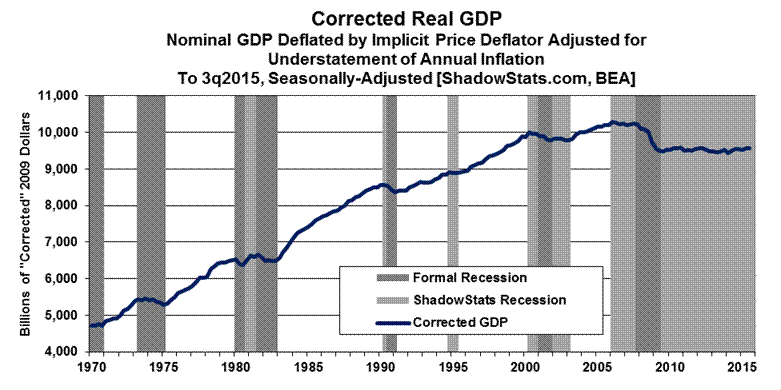
Frequently discussed here, the headline GDP does not reflect properly or accurately the changes to the underlying fundamentals that drive the economy, at present. Fundamental, real-world economic activity shows that the broad economy began to turn down in 2006 and 2007, plunged into 2009, entered a protracted period of stagnation thereafter—never recovering—and then began to turn down anew in recent quarters. Irrespective of the reporting gimmicks introduced in the July 2013 and July 2014 GDP benchmark revisions—including a recent pattern of inclusion and estimation of highly-questionable data on the Affordable Care Act (ACA)—a consistent, fundamental pattern of faltering historical activity is shown in the accompanying “corrected” GDP graphs.
Please note that the pattern of activity shown for the “corrected” GDP series is much closer to the patterns shown in the graphs of unemployment (see Commentary No. 771), monthly real median household income and other consumer measures (see Commentary No. 772). This also has been detailed in No. 742 Special Commentary: A World Increasingly Out of Balance and No. 692 Special Commentary: 2015 - A World Out of Balance. Similar patterns are found in recent indications of annual consumer expenditures (see Commentary No. 656 and Commentary No. 673) and economic series not otherwise reliant on understated inflation for their reported growth, such as housing starts (see Commentary No. 774 and 2014 Hyperinflation Report—Great Economic Tumble – Second Installment).
With liquidity-strapped consumers unable to fuel sustainable growth in consumption, a full business recovery could not have taken place since 2009, and a recovery will not be forthcoming until consumer structural income and liquidity problems are resolved, including more-normal credit functioning of the domestic banking system.
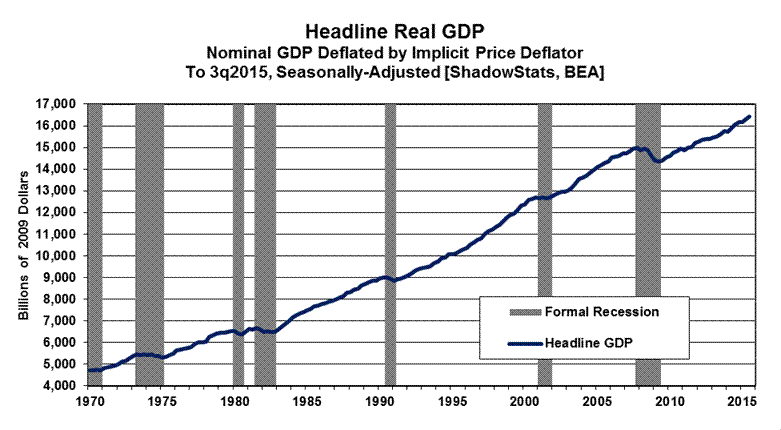
Official and Corrected GDP. Usually discussed in these Commentaries covering the quarterly GDP reporting and monthly updates, the full economic recovery indicated by the official, real GDP numbers remains an illusion. It is a statistical illusion created at least partially by using too-low a rate of inflation in deflating (removing inflation effects) from the GDP series. The accompanying two sets of graphs tell that story, updated for today’s third estimate of third-quarter 2015 GDP.
The first set of graphs (2000-to-date) is the one that traditionally has been incorporated in the GDP Commentaries. Graphs 1 and 2 show short-term detail, expressed on an index base where first-quarter 2000 = 100.0. The second set of graphs (Graphs 3 and 4) updates the longer-term detail (1970-to-date), expressed in billions of 2009 dollars as used in the headline GDP reporting. The graphs also show official periods of recession as shaded areas, with ShadowStats-defined recessions indicated by the lighter shading in Graph 4, the second graph of the second set, as detailed and published initially in 2014 Hyperinflation Report—Great Economic Tumble – Second Installment.
Shown in the first graph of each set (Graphs 1 and 3) of official Headline Real GDP, GDP activity has been reported above pre-2007 recession levels—in full recovery—since second-quarter 2011, and headline GDP has shown sustained growth since (growth pauses or interruptions for second-half 2012 and first-quarter 2014 excepted). Adjusted for official GDP inflation (the implicit price deflator - IPD), the headline third-quarter 2015 GDP currently stands at an unrevised 9.5% above its pre-recession peak-GDP estimate of fourth-quarter 2007. In contrast, the “corrected” GDP version, in the second graph of each set (Graphs 2 and 4), shows third-quarter 2015 GDP activity down by 6.9% (-6.9%), from its pre-recession peak of first-quarter 2006.
Further, discussed broadly in the second installment of the Hyperinflation Report, no other major economic series has shown a pattern of official full economic recovery and meaningful expansion thereafter, consistent with the headline GDP reporting. Such is covered in the recent discussions on industrial production, real retail sales and real durable goods orders (see respectively Commentary No. 774, Commentary No. 773 and Commentary No. 770. Either the GDP reporting is wrong, or all other major economic series are wrong. While the GDP is heavily modeled, imputed, theorized and gimmicked, it also encompasses reporting from those various major economic series and private surveys, which still attempt to measure real-world activity. Flaws in the GDP inflation methodologies and simplifying reporting assumptions have created the “recovery.”
Again, the second graph in each series (Graphs 2 and 4) plots the Corrected Real GDP, corrected for the understatement inherent in official inflation estimates (see Public Commentary on Inflation Measurement), with the deflation by the implicit price deflator (IPD) adjusted for understatement of roughly two-percentage points of annual inflation in recent years. The inflation understatement has resulted from hedonic-quality adjustments, also as discussed in the Hyperinflation Reports.
Graph 1: Real GDP Index – Headline Real GDP (2000-2015)

Graph 2: “Corrected” Real GDP Index (2000-2015)

Graph 3: Real GDP Index (1970-2015)
Graph 4: “Corrected” Real GDP (1970-2015)
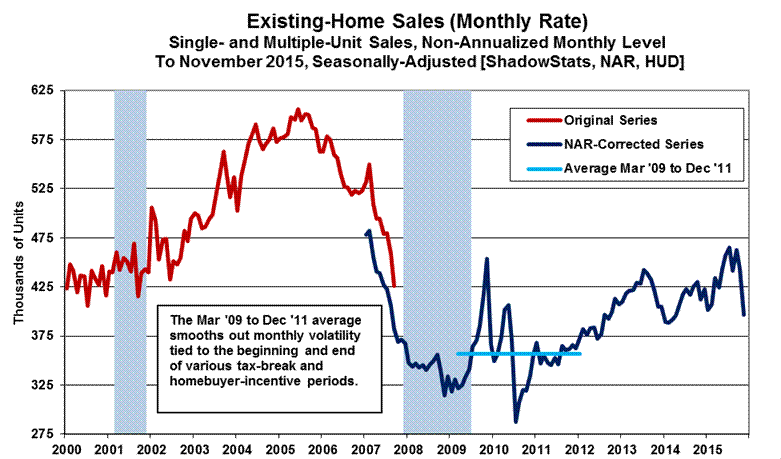
Existing-Home Sales—November 2015—Monthly Sales Plunged 10.5% (-10.5%), While Foreclosed Properties Rose from 5% to 7% of Sales Activity. In the context of a sharp downside revision to the prior month’s initial sales reporting, monthly November existing-home sales collapsed by 10.5% (-10.5%) to 4,760,000 million annualized units, or to 396.7 thousand units at a monthly pace as reflected in accompanying Graph 5. Headline sales dropped by 3.8% (-3.8%) year-to-year, hitting the lowest level of activity since April 2014.
Any Regulatory Distortions Were in Effect in October, in an Environment of Already-Faltering Sales. The National Association of Realtors® [NAR] noted in its press release that “some of the [November monthly] decrease was likely because of an apparent rise in closing timeframes.” The cautioned circumstance involved the effects of implementing the “Know Before You Owe” rule.
According the Consumer Financial Protection Bureau, the implementing regulatory authority, “The Know Before You Owe mortgage disclosure rule replaces four disclosure forms with two new ones, the Loan Estimate and the Closing Disclosure. The new forms are easier to understand and easier to use. The rule also requires that you get three business days to review your Closing Disclosure and ask questions before you close on a mortgage.”
Given the creativity of most realtors and mortgage lenders, any issues with closing delays likely will be minimal. That said, the law went into effect at the beginning of October 2015 and should have had some impact on October activity, if it was a factor in November. To the extent the closing process has slowed down, the month-to-month sales impact should be one-time, with closings lost in one month consistently being pushed into the next one. Again, to the extent this was a factor in November, October also should have been affected, with some mollifying, offsetting effects pushed into November.
To the extent that monthly sales activity has seen unusual shifts, recently, buyers trying to game the Fed’s rate hike was a more-likely distortion. Those issues aside, headline sales activity had been slowing and had been signaling a fourth-quarter contraction in activity, in advance of the November details. In any event, headline December 2015 activity could reflect a one-time, partial bounce-back, to the extent there was a meaningful delay in the regular pattern of just November (not October) closings.
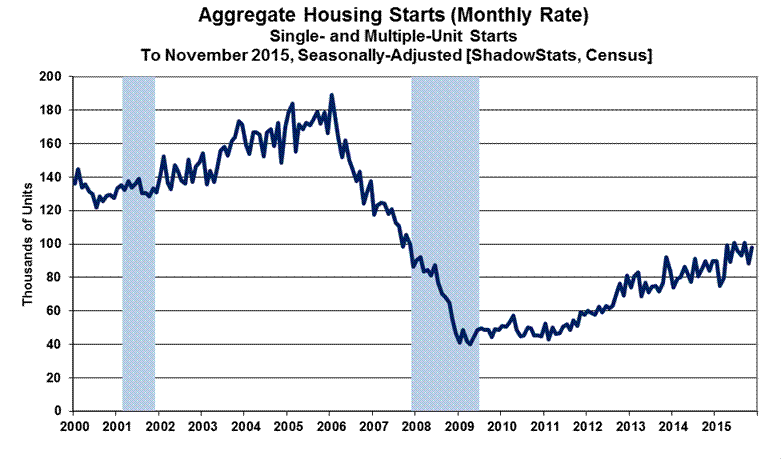
Deepening Pace of Quarterly Contraction, Ongoing Lack of Recovery from Collapse into 2009. Existing-Home Sales in November 2015 were down by 34.5% (-34.5%) from the June 2005 pre-recession peak, a high that has not been matched since the collapse. In contrast, the November 2015 headline monthly Housing Starts remained down by 57.9% (-57.9%) versus its January 2006 pre-recession high.
First-quarter 2015 showed an annualized quarterly sales contraction of 6.7% (-6.7%) in existing sales, with the second-quarter 2015 pace of annualized growth at 28.7%. Third-quarter 2015 growth slowed to an annualized pace of 14.3%, with an early indication of relative fourth-quarter 2015 activity—based just on October and November reporting—contracting at an annualized quarterly pace of 28.3% (-28.3%). The first fourth-quarter estimate, based solely on the initial headline October activity, was for a quarterly contraction of 8.3% (-8.3%).
Headline Detail for November 2015 Existing-Home Sales. November 2015 existing-home sales (counted based on actual closings, NAR) showed a seasonally-adjusted, headline monthly drop of 10.5% (-10.5%), following a revised, deepened month-to-month contraction in revision of 4.1% (-4.1%) in October. On a year-to-year basis, November 2015 annual sales turned negative, down by 3.8% (-3.8%), versus a downwardly-revised gain of 3.1% in October 2015.
The November sales data still remained within the normal scope of reporting volatility for this series. Smoothed for irregular distortions, the series remained statistically consistent with a period of broad stagnation, albeit now flat-to-down-trending, again, as seen in Graph 5. The quality of data underlying this series, however, remains highly questionable.
Graph 5: Existing-Home Sales (Monthly Rate of Activity)
Graph 6: Aggregate Housing Starts (Monthly Rate of Activity)
Proportion of Distressed Sales Jumps, Along with All-Cash Sales in November. The NAR estimated the portion of November 2015 sales in “distress” rose for the month to 9% (7% foreclosures, 2% short sales), from 6% (5% foreclosures, 1% short sales) in October 2015, and versus November 2014 distressed sales of 9% (6% foreclosures, 3% short sales).
Reflecting continued lending problems and stresses within the financial system, including related banking-industry and consumer-solvency issues, as well as the ongoing influx of speculative investment money into the existing-housing market, the NAR estimated that all-cash sales in November 2015 rose to 27% of total sales, versus 24% in October 2015 and 25% in November 2014.
The primary, underlying difficulty for the housing market remains intense, structural-liquidity constraints on the consumer. That circumstance, during the last eight-plus years of economic collapse and stagnation, has continued to prevent a normal recovery in broad U.S. business activity, as recently updated and discussed in Commentary No. 772.
Existing-Home Sales Graph. The preceding Graphs 5 and 6 of Existing-Home Sales and comparative November 2015 aggregate Housing Starts activity (from Commentary No. 774), both reflect activity in terms of single- and multiple-housing units.
[The Reporting Detail section includes further material on the GDP and Existing-Home Sales.]
__________
HYPERINFLATION WATCH
HYPERINFLATION OUTLOOK SUMMARY. Discussed in the Opening Comments, the Hyperinflation Outlook Summary revisions will follow in next week’s, December 30th Year-End General Commentary, which has evolved into a broad review of political economic and financial conditions of the year passed and some outlook for likely related developments in the year ahead. The broad outlook, however, has not changed. Any unusual developments requiring timely comment between regular Commentaries will be covered in a Flash Commentary, as needed. In the interim, the latest Summary Outlook (November 4, 2015-based) is available here: Commentary No. 768.
__________
REPORTING DETAIL
GROSS DOMESTIC PRODUCT—GDP (Third-Quarter 2015, Third Estimate, Second Revision)
Gross Domestic Product—Quarterly Growth and Revisions Were Not Statistically Significant. [Most of the text in next four paragraphs is repeated from the Opening Comments.] The headline growth in third-quarter 2015 gross domestic product (GDP) revised from 2.08% to 1.98% remaining statistically insignificant, while the minimal revisions were no more than statistical noise. Discussed in the Opening Comments and as will be detailed in the December 30th Year-End General Commentary a still unrecognized recession is unfolding, likely to be timed from December 2014, and most likely to be called following the formal reporting or broad market recognition of a quarterly contraction in fourth-quarter 2015 GDP.
Discussed frequently, the GDP does not reflect properly or accurately the changes to the underlying fundamentals that drive the economy. Underlying real-world economic activity shows that the broad economy began to turn down in 2006 and 2007, plunged into 2009, entered a protracted period of stagnation thereafter—never recovering—and then began to turn down anew in recent quarters.
The GDP simply remains the most worthless of the popular government economic series, in terms of determining what really is happening to U.S. business activity. The series is the most heavily-modeled, politically-massaged and gimmicked government indicator of the economy. It has been so since at least the days when President Lyndon Johnson reportedly reviewed the numbers before their release, and then would return them to the Commerce Department, if Commerce had gotten them “wrong,” and would keep doing so until Commerce got the numbers “right.”
Nonetheless, despite all the upside biases and gimmicks built into the GDP reporting, the real world occasionally surfaces in formal GDP estimates, and that still is in the process of unfolding. With major monthly economic series such as retail sales, industrial production, durable goods orders and housing-market measures showing regular contractions, underlying reality has become weak enough, once again, for headline GDP, GNP and/or GDI to signal the onset of a formal “new” recession. That recognition likely looms within first-quarter 2016.
__________________
Notes on GDP-Related Nomenclature and Definitions
For purposes of clarity and the use of simplified language in the text of the GDP analysis, here are definitions of several key terms used related to GDP reporting:
Gross Domestic Product (GDP) is the headline number and the most widely followed broad measure of U.S. economic activity. It is published quarterly by the Bureau of Economic Analysis (BEA), with two successive monthly revisions, and with an annual revision in the following July.
Gross Domestic Income (GDI) is the theoretical equivalent to the GDP, but it generally is not followed by the popular press. Where GDP reflects the consumption side of the economy and GDI reflects the offsetting income side. When the series estimates do not equal each other, which almost always is the case, since the series are surveyed separately, the difference is added to or subtracted from the GDI as a “statistical discrepancy.” Although the BEA touts the GDP as the more accurate measure, the GDI is relatively free of the monthly political targeting the GDP goes through.
Gross National Product (GNP) is the broadest measure of the U.S. economy published by the BEA. Once the headline number, now it rarely is followed by the popular media. GDP is the GNP net of trade in factor income (interest and dividend payments). GNP growth usually is weaker than GDP growth for net-debtor nations. Games played with money flows between the United States and the rest of the world tend to mute that impact on the reporting of U.S. GDP growth.
Real (or Constant Dollars) means the data have been adjusted, or deflated, to reflect the effects of inflation.
Nominal (or Current Dollars) means growth or level has not been adjusted for inflation. This is the way a business normally records revenues or an individual views day-to-day income and expenses.
GDP Implicit Price Deflator (IPD) is the inflation measure used to convert GDP data from nominal to real. The adjusted numbers are based on “Chained 2009 Dollars,” as introduced with the 2013 comprehensive revisions, where 2009 is the base year for inflation. “Chained” refers to the substitution methodology, which gimmicks the reported numbers so much that the aggregate of the deflated GDP sub-series missed adding to the theoretically-equivalent deflated total GDP series by $60.4 billion in “residual,” as of the second estimate of fourth-quarter 2014.
Quarterly growth, unless otherwise stated, is in terms of seasonally-adjusted, annualized quarter-to-quarter growth, i.e., the growth rate of one quarter over the prior quarter, raised to the fourth power, a compounded annual rate of growth. While some might annualize a quarterly growth rate by multiplying it by four, the BEA uses the compounding method, raising the quarterly growth rate to the fourth power. So a one percent quarterly growth rate annualizes to 1.01 x 1.01 x 1.01 x 1.01 = 1.0406 or 4.1%, instead of 4 x 1% = 4%.
Annual growth refers to the year-to-year change of the referenced period versus the same period the year before.
__________________
Gross Domestic Product (GDP). Published today, December 22nd, by the Bureau of Economic Analysis (BEA), the third estimate, second revision to third-quarter 2015 GDP showed a downwardly-revised statistically-insignificant, real (inflation-adjusted), annualized, quarterly headline gain of 1.98% [previously up by 2.08%, initially up by 1.49%] +/- 3.5% (95% confidence interval). That was slower than headline growth of 3.92% in second-quarter 2015 GDP, but it was up from the previously benchmarked gain of 0.64% [it had shown a pre-benchmarking contraction of 0.17% (-0.17%)] in first-quarter 2015.
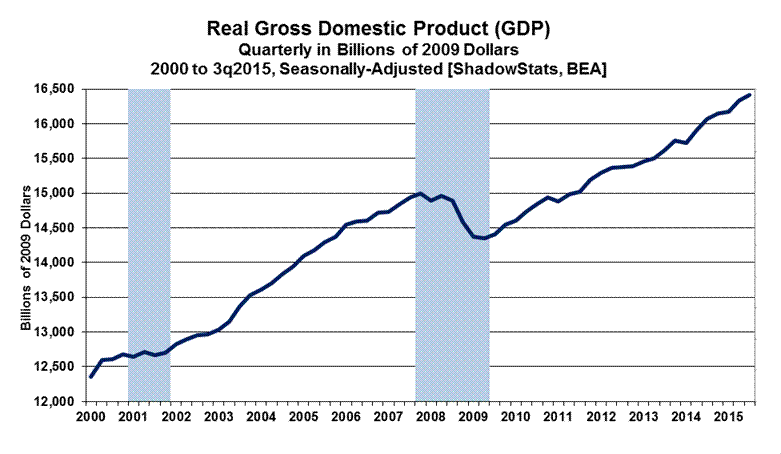
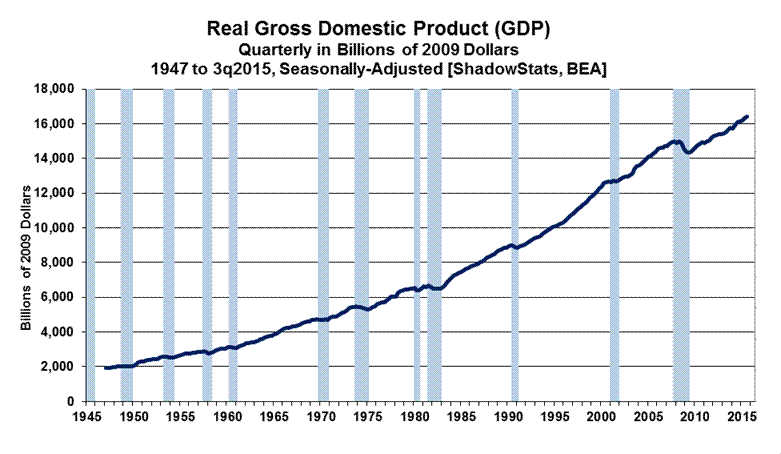
Graphs 8 and 10 plot the latest headline levels of real quarterly GDP activity, respectively showing short-term (since 2000) and long-term (since the historical onset of the quarterly GDP series in 1947) perspectives. Revised distribution detail of third-quarter 2015 GDP growth is outlined in the Opening Comments.
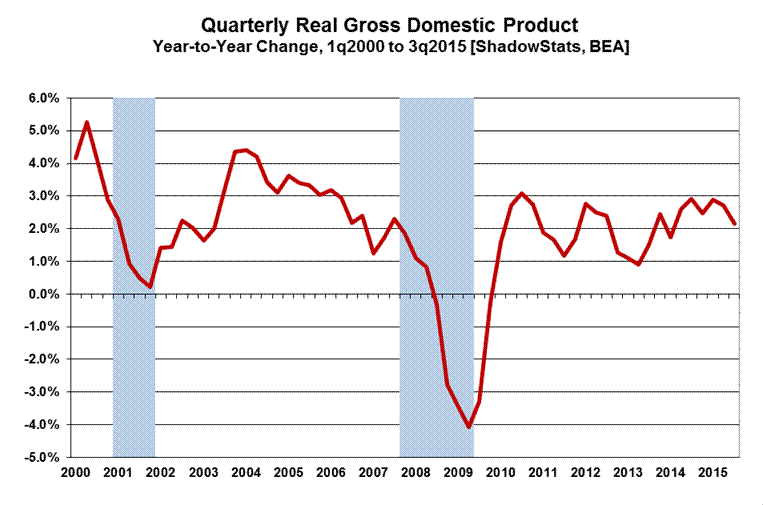
Shown in Graphs 9 and 11, headline year-to-year real growth in third-quarter 2015 still slowed sharply to a downwardly-revised 2.15% [previously up by 2.18%, initially up by 2.02%]—the weakest headline growth in six quarters—down from annual growth of 2.72% in second-quarter 2015 and from 2.88% in first-quarter 2015.
Graph 8: Quarterly GDP in Billions of 2009 Dollars (2000 to Third-Quarter 2015)
Graph 9: Quarterly GDP Real Year-to-Year Change (2000 to Third-Quarter 2015)
Graph 10: Quarterly GDP in Billions of 2009 Dollars (1947-2015)
Graph 11: Quarterly GDP Real Year-to-Year Change (1948-2015)
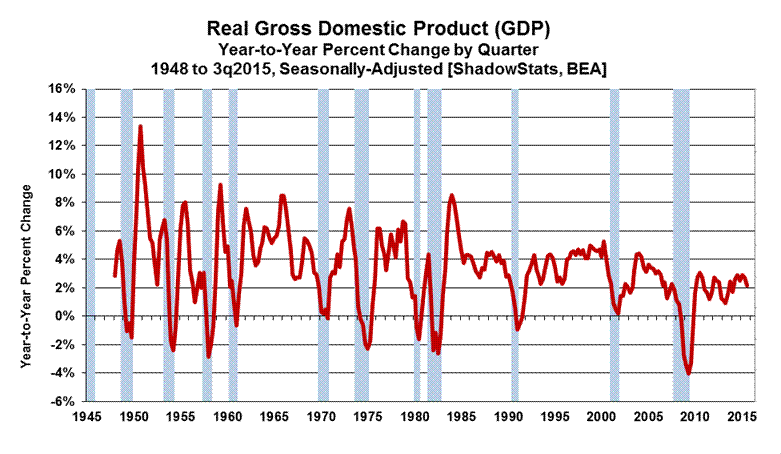
The latest quarterly year-to-year growth remained below the near-term peak of 3.08% in third-quarter 2010. The current-cycle trough in annual change was in second-quarter 2009, reflecting a year-to-year decline of 4.09% (-4.09%). That was the deepest year-to-year contraction for any quarterly GDP in the history of the series, which began with first-quarter 1947 (1948 in terms of available year-to-year detail).
Graph 9 shows current year-to-year quarterly detail, from 2000-to-date, where Graph 11 shows the same series in terms of its full quarterly, year-to-year history back to 1948.
Implicit Price Deflator (IPD). As general guidance, the weaker the inflation rate used in deflating an economic series, the stronger will be the resulting inflation-adjusted growth. The third estimate, second revision of third-quarter 2015 GDP inflation, or the implicit price deflator (IPD), was a downwardly -revised annualized quarterly increase of 1.30% [previously 1.31%, initially 1.22 %], versus 2.13% in second-quarter 2015 and a benchmarked gain of 0.12% in the first-quarter 2015.
Year-to-year, third-quarter 2015 IPD inflation was a downwardly-revised 0.90% [previously an annual gain of 0.91%, initially up by 0.88%], versus 0.98% in second-quarter 2015 and a benchmarked 1.01% annual gain in first-quarter 2015.
For purposes of comparison, headline CPI-U inflation (Bureau of Labor Statistics), showed an annualized, seasonally-adjusted, quarter-to-quarter gain of 1.58% in third-quarter 2015, versus a gain of 2.98% in second-quarter 2015 and a contraction of 3.01% (-3.01%) in first-quarter 2015. Unadjusted, year-to-year quarterly CPI-U inflation showed a year-to-year third-quarter 2015 gain of 0.11%, versus a second-quarter 2015 annual contraction of 0.04% (-0.04%) and a 0.10% (-0.10%) year-to-year decline in first-quarter 2015.
Gross National Product (GNP) Headline Detail. GNP is the broadest measure of U.S. economic activity, where GDP is GNP net of trade flows in factor income (interest and dividend payments). As a reporting gimmick aimed at boosting the headline reporting of economic growth for net-debtor nations such as Greece and the United States, international reporting standards were shifted about twenty-five years ago to reporting headline GDP instead of GNP.
The second estimate of headline, annualized, real quarterly third-quarter 2015 GNP growth was 1.35% (rounds to 1.3%) [previously 1.27%], down from an unrevised second-quarter 2015 estimate of 3.93% and versus an annualized contraction of 0.15% (-0.15%) in first-quarter 2015. Revised year-to-year annual growth still slowed to its weakest level in eight quarters, to 1.74% [previously 1.72%] in third-quarter 2015, down from 2.54% in second-quarter 2015 and 2.66% in first-quarter 2015.
Gross Domestic Income (GDI) Headline Detail. GDI is the theoretical income-side equivalent of the consumption-side GDP estimate. Still reflecting highly-questionable income and wage estimates by the Bureau of Labor Statistics (BLS)—with historical errors recently being acknowledged by the BLS—the second estimate of headline, annualized, real quarterly third-quarter 2015 GDI growth slowed sharply to 2.66% in revision [previously up by 3.10%]. The revised headline gain, though still was up from unrevised annualized growth of 2.20% in second-quarter 2015 and 0.42% in first-quarter 2015. Even so, revised year-to-year annual GDI growth slowed to 2.04% [previously 2.15%] in third-quarter 2015, its weakest level in six quarters, down from 2.64% in second-quarter 2015 and 3.18% in first-quarter 2015.
The GDP and GDI are made to equal each other, every quarter, with the addition of a “statistical discrepancy” to the GDI-side of the equation, but the discrepancy just as easily could be added to the GDP number. The third-quarter discrepancy narrowed in revision to -$211.9 billion in current dollars [previously -$227.4 billion], but it still widened versus -$114.4 billion in second-quarter 2015.
ShadowStats-Alternate GDP. The ShadowStats-Alternate GDP estimate for third-quarter 2015 GDP remains a year-to-year contraction of 1.4% (-1.4%) versus the revised headline third-quarter GDP year-to-year gain of 2.1% [previously up by 2.2%, initially up by 2.0%]. That was against a ShadowStats estimate of a second-quarter 2015 year-to-year contraction of 1.2% (-1.2%) versus the headline second-quarter GDP year-to-year gain of 2.7% (see the Alternate Data tab).
While the annualized, real quarterly growth rate is not estimated formally on an alternate basis, the headline 2.0% annualized quarter-to-quarter gain in third-quarter 2015 most likely was much weaker, net of all the regular reporting gimmicks and still should revise lower in next month’s reporting. An actual quarterly contraction appears to have been a realistic possibility for inflation-adjusted GDP in most quarters since the official, second-quarter 2009 end to the 2007 recession.
Adjusted for understated inflation and other methodological changes—such as the inclusion of intellectual property, software and recent accounting for the largely not-measurable and questionable impact of the Affordable Care Act (ACA)—the business collapse that began in 2006/2007 is ongoing; there has been no meaningful economic rebound. The “corrected” real GDP graph, and the longer-term “corrected” graph (see Graphs 2 and 4), updated from 2014 Hyperinflation Report—Great Economic Tumble – Second Installment (see also the Opening Comments section), are based on the removal of the impact of hedonic quality adjustments that have reduced the reporting of official annual GDP inflation by roughly two-percentage points. It is not the same measure as the ShadowStats-Alternate GDP, here, which reflects reversing additional methodological distortions (“Pollyanna Creep”) of recent decades.
EXISTING-HOME SALES (November 2015)
Monthly Sales Plunged by 10.5% (-10.5%), While Foreclosed Properties Rose from 5% to 7% of Sales Activity. In the context of a sharp downside revision to the prior month’s initial sales reporting, monthly November existing-home sales collapsed by 10.5% (-10.5%) to 4,760,000 million, or 396.7 thousand units at a monthly pace as reflected in Graph 5 in the Opening Comments. Headline sales dropped by 3.8% (-3.8%) year-to-year, hitting the lowest level of activity since April 2014.
Any Regulatory Distortions Were in Effect in October, in an Environment of Already-Faltering Sales. The National Association of Realtors® [NAR] noted in its press release that “some of the [November monthly] decrease was likely because of an apparent rise in closing timeframes.” The cautioned circumstance involved the effects of implementing the “Know Before You Owe” rule.
According the Consumer Financial Protection Bureau, the implementing regulatory authority, “The Know Before You Owe mortgage disclosure rule replaces four disclosure forms with two new ones, the Loan Estimate and the Closing Disclosure. The new forms are easier to understand and easier to use. The rule also requires that you get three business days to review your Closing Disclosure and ask questions before you close on a mortgage.”
Given the creativity of most realtors and mortgage lenders, any issues with closing delays likely will be minimal. That said, the law went into effect at the beginning of October 2015 and should have had some impact on October activity, if it was a factor in November. To the extent the closing process has slowed down, the month-to-month sales impact should be one-time, with closings lost in one month consistently being pushed into the next one. Again, to the extent this was a factor in November, October also should have been affected, with some mollifying, offsetting effects pushed into November.
To the extent that monthly sales activity has seen unusual shifts, recently, buyers trying to game the Fed’s rate hike was a more-likely distortion. Those issues aside, headline sales activity had been slowing and had been signaling a fourth-quarter contraction in activity, in advance of the November details. In any event, headline December 2015 activity could reflect a one-time, partial bounce-back, to the extent there was a meaningful delay in the regular pattern of just November (not October) closings.
Deepening Pace of Quarterly Contraction, Ongoing Lack of Recovery from Collapse into 2009. Existing-Home Sales in November 2015 were down by 34.5% (-34.5%) from the June 2005 pre-recession peak, a high that has not been matched since the collapse. In contrast, the November 2015 headline monthly Housing Starts remained down by 57.9% (-57.9%) versus its January 2006 pre-recession high.
First-quarter 2015 showed an annualized quarterly sales contraction of 6.7% (-6.7%) in existing sales, with the second-quarter 2015 pace of annualized growth at 28.7%. Third-quarter 2015 growth slowed to an annualized pace of 14.3%, with an early indication of relative fourth-quarter 2015 activity—based just on October and November reporting—contracting at an annualized quarterly pace of 28.3% (-28.3%). The initial fourth-quarter estimate, based solely on the initial headline October activity, was for a quarterly contraction of 8.3% (-8.3%).
Headline Detail for November 2015 Existing-Home Sales. Today’s December 22nd release of November 2015 existing-home sales (counted based on actual closings, NAR) showed a seasonally-adjusted, headline monthly drop of 10.5% (-10.5%), following a revised, deeper month-to-month contraction of 4.1% (-4.1%) [previously down by 3.4% (-3.4%)] in October. On a year-to-year basis, November 2015 annual sales turned negative, down by 3.8% (-3.8%), versus a downwardly-revised gain of 3.1% [previously up by 3.9%] in October 2015.
The November sales data still remained within the normal scope of reporting volatility for this series. Smoothed for irregular distortions, the series remained statistically consistent with a period of broad stagnation, albeit now flat-to-down-trending, again, as seen in Graph 5 in the Opening Comments. The quality of data underlying this series remains highly questionable.
Proportion of Distressed Sales Jumps, Along with All-Cash Sales in November. The NAR estimated the portion of November 2015 sales in “distress” rose for the month to 9% (7% foreclosures, 2% short sales), from 6% (5% foreclosures, 1% short sales) in October 2015, and versus November 2014 distressed sales of 9% (6% foreclosures, 3% short sales).
Reflecting continued lending problems and stresses within the financial system, including related banking-industry and consumer-solvency issues, as well as the ongoing influx of speculative investment money into the existing-housing market, the NAR estimated that all-cash sales in November 2015 rose to 27% of total sales, versus 24% in October 2015 and 25% in November 2014.
The primary, underlying difficulty for the housing market remains intense, structural-liquidity constraints on the consumer. That circumstance, during the last eight-plus years of economic collapse and stagnation, has continued to prevent a normal recovery in broad U.S. business activity, as recently updated and discussed in Commentary No. 772.
Existing-Home Sales Graph. The regular monthly graph of Existing-Home Sales is found in the Opening Comments section, accompanied by a comparative graph of November 2015 aggregate Housing Starts activity from Commentary No. 774. Both series reflect activity in terms of single- and multiple-housing units (see Graphs 5 and 6).
__________
WEEK AHEAD
Economic Reporting Generally Should Trend Much Weaker than Expected; Inflation Will Rise Anew, Along with a Renewed Rebound in Oil Prices. Still in a fluctuating, general trend to the downside, amidst mixed reporting in headline data, market expectations for business activity nonetheless can gyrate some with the latest economic hype in the popular media. That general effect holds the consensus outlook still at overly-optimistic levels, with current expectations exceeding any potential, underlying economic reality. Where the net trend continues towards weakening expectations, movement towards recession recognition remains at something of an accelerating pace.
Headline reporting of the regular monthly economic numbers increasingly should continue to turn lower in the weeks and months ahead, along with much weaker-than-expected reporting for at least the next several quarters of GDP (and GDI and GNP) well into 2016. That includes intensifying early signals of a headline contraction in fourth-quarter 2015 GDP, due for release on January 29, 2016, as well as downside revisions to recent GDP history in the 2016 annual benchmark revision due on July 29, 2016.
CPI-U consumer inflation—intermittently driven lower this year by collapsing prices for gasoline and other oil-price related commodities—likely has seen its near-term, year-to-year low. Annual CPI-U turned minimally positive in June 2015, for the first time in six months, notched somewhat higher in July and August, with a minimal fallback in September, tied to renewed weakness in gasoline prices. With positive seasonal adjustments countering some of the monthly weakness in gasoline prices, combined with particularly weak headline inflation one year ago, headline November 2015 CPI-U annual inflation was boosted to 0.5%, with further upside movement to headline annual inflation likely in December.
Significant inflation pressures should mount anew, at such time as oil prices rebound meaningfully. Again, that process eventually should accelerate, along with a pending sharp downturn in the exchange-rate value of the U.S. dollar. Those areas, the general economic outlook and longer range reporting trends were reviewed broadly, recently, in No. 742 Special Commentary: A World Increasingly Out of Balance, and No. 692 Special Commentary: 2015 - A World Out of Balance and in the Hyperinflation Outlook Summary of Commentary No. 768.
Note on Reporting-Quality Issues and Systemic-Reporting Biases. Significant reporting-quality problems remain with most major economic series. Beyond the pre-announced gimmicked changes to reporting methodologies of the last several decades, which have tended to understate actual inflation and to overstate actual economic activity, ongoing headline reporting issues are tied largely to systemic distortions of monthly seasonal adjustments. Data instabilities—induced partially by the still-evolving economic turmoil of the last eight-to-ten years—have been without precedent in the post-World War II era of modern-economic reporting. The severity and ongoing nature of the downturn provide particularly unstable headline economic results, when concurrent seasonal adjustments are used (as with retail sales, durable goods orders, employment and unemployment data, discussed and explored in the labor-numbers related Commentary No. 695).
Combined with recent allegations of Census Bureau falsification of data in its monthly Current Population Survey (the source for the Bureau of Labor Statistics’ Household Survey), these issues have thrown into question the statistical-significance of the headline month-to-month reporting for many popular economic series (see Commentary No. 669).
The BLS also has suspended reporting of key earnings data from the period of economic collapse, due to reporting errors. More will follow there, along with the indicated downside benchmark revisions to 2015 payroll employment on February 5, 2016.
PENDING RELEASES:
New Orders for Durable Goods (November 2015). The Census Bureau will report November 2015 New Orders for Durable Goods tomorrow, Wednesday, December 23rd. Net of irregular activity in commercial aircraft orders, aggregate orders likely continued a pattern of down-trending stagnation.
Net of commercial aircraft orders, real durable goods orders contracted quarterly in fourth-quarter 2014 and first-quarter 2015, but were to the upside in reporting for second- and third-quarter 2015, despite an intensifying plunge in year-to-year activity. Increasingly-negative annual growth in real orders, ex-commercial aircraft were seen in October and similar patterns remain likely for the November 2015 detail, with indications of annual and quarterly contractions in fourth-quarter 2015 remaining in play.
Commercial aircraft orders are booked for the long-term—years in advance—so they have only limited impact on near-term production. Further, by their nature, these types of orders do not lend themselves to seasonal adjustment. As a result, the durable goods measure that best serves as a leading indicator to broad production—a near-term leading indicator of economic activity and GDP—is the activity in new orders, ex-commercial aircraft.
New-Home Sales (November 2015). The Census Bureau also will report November 2015 New-Home sales tomorrow, Wednesday, December 23rd. Smoothed for extreme and nonsensical monthly gyrations, a continuing pattern of stagnation or downturn in New-Home Sales is likely. Its pattern of stagnation turned from up-trending to down-trending as of September. Monthly changes in activity here rarely are statistically-significant, amidst otherwise unstable headline monthly reporting and revisions.
Noted in today’s Existing-Home Sales comments, as detailed fully in Commentary No. 772, the primary issues constraining headline housing market activity remains intense, structural-liquidity constraints on the consumer. That circumstance, during the last eight-plus years of economic collapse and stagnation, has continued to prevent a normal recovery in broad U.S. business activity. There remains no chance of a near-term, sustainable turnaround in the housing market, until there has been a fundamental upturn in consumer and banking-liquidity conditions. Accordingly, prospects remain bleak for meaningful, ongoing monthly increases in home-sales activity.
Reflecting deteriorating consumer issues, both New- and Existing-Home Sales should continue to suffer meaningful downside volatility in related headline reporting of the months ahead.
__________