


No. 791: Some General Observations

COMMENTARY NUMBER 791
Some General Observations
March 11, 2016
___________
Headline Economic Data Should Tumble in the Week Ahead,
Along with Weaker Headline Inflation
Domestic Freight Index Continued in Year-to-Year Decline
Slowing Business Activity Should Hit the U.S. Dollar;
Central Banks Never Resolved 2008
___________
PLEASE NOTE: The next regular Commentary on Tuesday, March 15th will cover February nominal Retail Sales and the Producer Price Index (PPI). A subsequent missive on March 16th will cover the Consumer Price Index (CPI), real Retail Sales and earnings, Industrial Production and Housing Starts.
Best wishes to all — John Williams
GENERAL COMMENTS ON THE ECONOMY
Economic Consensus Should Take a Downside Hit in the Week Ahead. With no major releases this week, next week’s reporting will be unusually heavy and likely of negative substance. Expectations already are faltering for some key series (see Week Ahead). Headline February detail could indicate prospective first-quarter 2016 contractions for industrial production, real retail sales and housing starts.
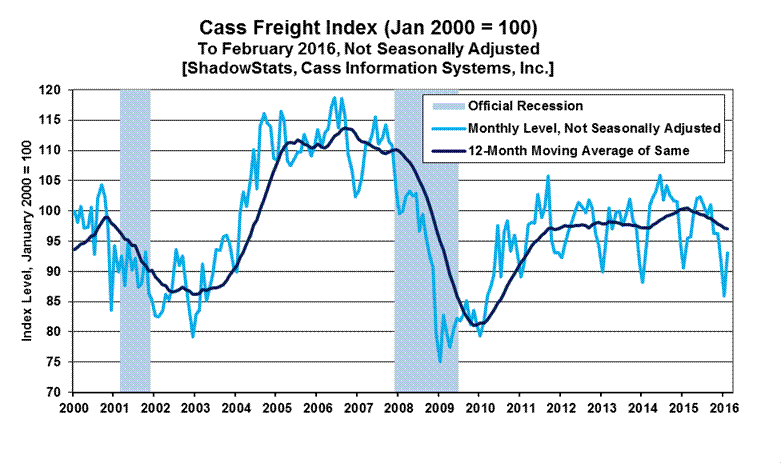
Continuing “Other” Confirmation of Non-Recovery and Renewed Downturn. Patterns of non-recovery in the general economy and renewed downturn in business activity were reconfirmed in the headline detail of the February 2016 Cass Freight Index™ (released March 10th).
Graph 1: Cass Freight Index to (2000-2016), Trailing 12-Month Average vs. Unadjusted Monthly Index
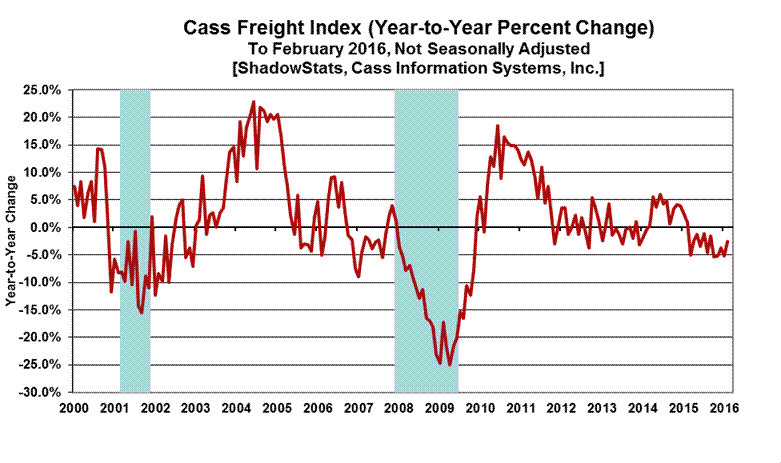
Graph 2: Cass Freight Index to (2000-2016), Unadjusted Year-to-Year Change in Monthly Index
Beginning with Commentary No. 782 (further background available there), ShadowStats published graphic detail on the Cass Index, a measure of North American freight volume as calculated by, and used with the permission of Cass Information Systems, Inc. As background, of the combined U.S. and Canadian (North American) GDP in 2014, roughly 91% was attributable to the United States.
The plot in Graph 1 reflects the monthly numbers updated through February 2016. The headline monthly detail is not adjusted for broad seasonal patterns, such as retailers stocking for the holiday shopping season. Accordingly, ShadowStats plots the series using a trailing twelve-month average, which tends to neutralize regular seasonal patterns over the period of a year, along with the unadjusted monthly detail plotted in the background. In prior Commentary No. 790 (see pages 7 to 10), a variation on Graph 1 was compared with various U.S. unemployment and economic measures.
Shown in Graph 1, the trailing twelve-month average peaked in January 2015 and has been slowing since, with the twelve-month average level through February 2016 currently standing 3.4% (-3.4%) below the average as of February 2015.
Another approach to assessing not-seasonally-adjusted monthly detail is to look at year-to-year change by month, as plotted in Graph 2. The unadjusted monthly detail has been in continual year-to-year decline since March of 2015, down year-to-year in the last three months by 2.6% (-2.6%) in February 2016, by 5.2% (-5.2%) in January 2016, and by 3.7% (-3.7%) in December 2015.
In combination, Graphs 1 and 2 are consistent with a pattern of economic collapse into 2009, low-level stagnation thereafter and renewed downturn effectively coincident with a “new” recession, which likely will be timed from December 2014. There is no evidence of an economic rebound or recovery in the works, based on this independent (as in non-government) and broadly-based indicator of business activity, or on other independent indicators such as S&P 500 revenues (Commentary No. 790).
Bad News for the Dollar and for Central Bank Efforts to Stabilize the System. Despite some relative monthly boosts to headline January 2016 data from likely poor-quality seasonal adjustments, headline economic reporting is about to offer a new round of downside “surprises,” in the week ahead. That should re-intensify the movement of market expectations towards a pending “new” recession.
The U.S. Federal Reserve’s recent actions to back away from its quantitative easings peaked in December 2015, with the FOMC’s hiking the targeted federal funds rate by 0.25%. Expectations then were for regular rate hikes to follow, with the next one possibly as early as March (next Wednesday, March 16th), based on the ongoing strength and recovery in the U.S. economy. Yet, the economy never recovered, and it is not likely to rebound in the foreseeable future. As faltering business activity increasingly stresses the still-unstable banking system, as the budget deficit explodes well beyond current expectations, the Fed will need to keep pumping liquidity into the banking system as well as into the U.S. Treasury. Quantitative easing is not about to disappear.
Discussed in No. 777 Year-End Special Commentary, when the Federal Reserve and the U.S. Treasury acted to forestall the collapse of the banking system in the Panic of 2008, the decision was to save the system at any cost. Yet, the actions taken were stopgap only; underlying issues that had led to the crisis generally were not addressed. Still living under the weight and fear of systemic failure, the Fed will move again, as needed, to save the system. The ultimate cost eventually will be in the total debasement of the U.S. dollar.
Today’s Commentary (March 11th). The balance of today’s general comments provides a brief update of Consumer Conditions (consumer credit), followed by a preview of next week’s reporting on February PPI and CPI inflation, as well as Industrial Production, nominal and real Retail Sales and Housing Starts in the Week Ahead. With no major economic reporting since the prior Commentary, there is no Reporting Detail today. The latest Hyperinflation Outlook Summary is found in Commentary No. 783.
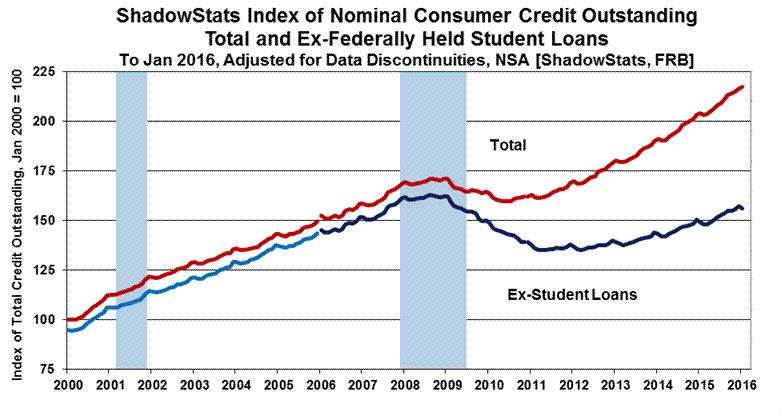
Consumer Conditions Continue to Reflect Soft Credit Conditions. Noted in prior Commentary No. 790, which reviewed general consumer conditions, the consumer-credit measures usually followed here were due for updates this week. Accordingly, new headline details are reflected in the accompanying Graph 3 of Household Sector, Real Credit Market Debt Outstanding and Graph 4 of Nominal Consumer Credit Outstanding.
The level of and growth in real income, and the ability and willingness to take on new debt remain at the root of consumer liquidity issues still constraining consumer activity. Generally, the higher and stronger those measures are, the healthier is consumer spending. Although most measures of consumer liquidity and attitudes are off their lows, underlying economic fundamentals simply have not supported, and do not support a turnaround in the broad economy. There has been no economic recovery, and there remains no chance of sustainable economic growth, without a meaningful, fundamental upturn in consumer- and banking-liquidity conditions (see the general discussion in No. 777 Year-End Special Commentary).
Household Sector and Consumer Credit. Debt expansion can help make up for a shortfall in income growth. Shown in Graph 3 of Household Sector, Real Credit Market Debt Outstanding, household debt declined in the period following the Panic of 2008, and it still has not recovered, based on the Federal Reserve’s flow-of-funds accounting (published May 10th) through fourth-quarter 2015.
Graph 3: Household Sector, Real Credit Market Debt Outstanding through Fourth-Quarter 2015
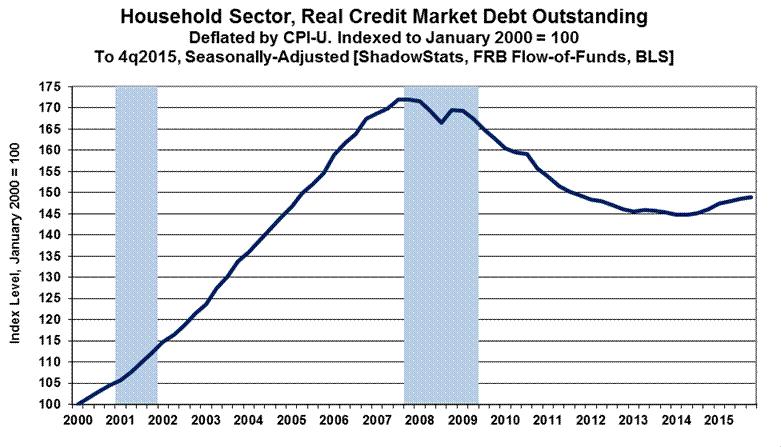
The series includes mortgages, automobile and student loans, credit cards, secured and unsecured loans, etc., all deflated by the headline CPI-U. The level of real debt outstanding has remained largely stagnant for several years, reflecting, among other issues, lack of normal lending by the banking system into the regular flow of commerce.
The recent minor upturn in the 2015 inflation-adjusted real series, as also seen with increases in real monthly median household income survey (see prior Commentary No. 790), was due largely to gasoline-price-driven, flat-to-negative CPI inflation, which continues to impact the system. Nonetheless, where nominal consumer credit outstanding (net of student loans) has been slightly up-trending since 2013, as reflected in Graph 4, nominal mortgages outstanding began turning higher in second-quarter 2015.
Shown through January 2016 reporting, Graph 4 of monthly Consumer Credit Outstanding is a subcomponent of Graph 3 on real Household Sector debt, but Graph 4 is not adjusted for inflation. Post-2008 Panic, outstanding consumer credit has continued to be dominated by growth in federally-held student loans, not in bank loans to consumers that otherwise would help to fuel broad consumption or housing growth. Although in slow uptrend, the nominal level of Consumer Credit Outstanding (ex-student loans) has not recovered since the onset of the recession. These disaggregated data are available and plotted only on a not-seasonally-adjusted basis, with January 2016 levels reflecting a seasonal decline in the not-seasonally-adjusted series. They also encompass data discontinuities in 2006 and 2010.
Graph 4: Nominal Consumer Credit Outstanding through January 2016
__________
WEEK AHEAD
Economic Reporting Should Continue on the Downside of Expectations, Pummeling the Dollar and Boosting Gold, Silver and Oil Prices. Likely moving to the downside, again, amidst intensifying, negative headline reporting in week ahead, market expectations for business activity should be in increasing deterioration, even as reviewed in the popular media. The broad trend in weakening expectations for business activity has continued, and movement towards looming recession recognition has accelerated, as discussed in Commentary No. 789 and in No. 777 Year-End Special Commentary. Nascent negative reaction had surfaced in trading of the U.S. dollar and in related financial markets, with some upside movement recently in prices for gold and silver (see Commentary No. 784 and Commentary No. 785). Circumstances here also should limit further heavy selling in the oil market and turn the pricing there to the upside, as the dollar comes under steady, heavy selling pressure.
Weaker headline reporting of the regular monthly economic numbers increasingly should be accompanied by much worse-than-expected—negative—reporting for at least the next several quarters of GDP (and GDI and GNP), still for fourth-quarter 2015 and well into the looming 2016 detail. That includes an eventual outright quarterly contraction in revised fourth-quarter 2015 GDP activity, as well as other pending downside revisions to GDP history in the 2016 annual benchmark revisions, due on July 29th.
CPI-U consumer inflation—intermittently driven lower in 2015 and early-2016 by collapsing prices for gasoline and other oil-price related commodities—likely has seen its near-term, year-to-year low. Although month-to-month headline inflation was unchanged for January 2016, annual CPI-U jumped sharply, against year-ago weak inflation, to a 15-month high. Although headline monthly February CPI-U inflation should be negative (see Pending Releases), annual inflation will remain positive. Monthly prices should turn sharply positive, again, pending an environment of a weakening U.S. dollar and a related upturn in otherwise battered oil prices and other commodities. Separately, fundamental reporting issues with the CPI are discussed here: Public Commentary on Inflation Measurement.
Note on Reporting-Quality Issues and Systemic-Reporting Biases. Significant reporting-quality problems remain with most major economic series. Beyond the pre-announced gimmicked changes to reporting methodologies of the last several decades, which have tended to understate actual inflation and to overstate actual economic activity, ongoing headline reporting issues are tied largely to systemic distortions of monthly seasonal adjustments. Data instabilities—induced partially by the still-evolving economic turmoil of the last nine-to-eleven years—have been without precedent in the post-World War II era of modern-economic reporting. The severity and ongoing nature of the downturn provide particularly unstable headline economic results, when concurrent seasonal adjustments are used (as with retail sales, durable goods orders, employment and unemployment data). That has been discussed and explored in the labor-numbers related Supplemental Commentary No. 784-A and Commentary No. 695.
Separately, discussed in Commentary No. 778, a heretofore unheard of spate of “processing errors” has surfaced in recent surveys of earnings (Bureau of Labor Statistics) and construction spending (Census Bureau). This is suggestive of deteriorating internal oversight and control of the U.S. government’s headline economic reporting. At the same time, it indicates an openness of the involved statistical agencies in revealing the reporting-quality issues.
Combined with ongoing allegations in the last year or two of Census Bureau falsification of data in its monthly Current Population Survey (the source for the BLS Household Survey), these issues have thrown into question the statistical-significance of the headline month-to-month reporting for many popular economic series (see Commentary No. 669).
PENDING RELEASES:
Nominal and Real Retail Sales (February 2016). The Census Bureau has scheduled release of February 2016 nominal (not-adjusted-for-inflation) Retail Sales for Tuesday, March 15th, which will be covered in Commentary No. 792 of that date. Real (inflation-adjusted) Retail Sales for February will follow the next day, March 16th, in ShadowStats Commentary No. 793, in conjunction with the publication of detail on headline February CPI-U. With high odds of a month-to-month decline in the February CPI, there is a parallel chance for real sales growth in February to be less-negative or stronger than the headline nominal sales activity. The pace of annual CPI-U inflation, however, should remain positive, with a continuing recession signal as currently generated by low-level, annual real retail sales growth.
Early market expectations appear to be on the downside of flat for nominal sales. In the current environment, however, downside-reporting surprises remain a good bet for this series, including a much weaker-than-expected headline number, along with potential downside revisions to the December and January detail. An outright monthly contraction in February activity indeed is a good possibility, following what had been a stronger-than-expected 0.2% gain in January. That gain, however, likely was bloated by seasonal-factor distortions from year-ago weather. Renewed weakness in these numbers should intensify the shift in consensus expectations towards renewed economic contraction or a “new” recession.
Constraining retail sales activity, the consumer remains in an extreme liquidity bind, as updated briefly in today’s Commentary and as discussed broadly in prior Commentary No. 790 and No. 777 Year-End Special Commentary. Without sustained growth in real income, and without the ability and/or willingness to take on meaningful new debt in order to make up for the income shortfall, the U.S. consumer is unable to sustain positive growth in domestic personal consumption, including retail sales, real or otherwise.
Producer Price Index—PPI (February 2016). The Bureau of Labor Statistics (BLS) will release the February 2016 PPI also on Tuesday, March 15th. Odds favor a headline decline in wholesale inflation, at least on the goods side of the reporting, due to continued weakness in oil prices and prices of related products. The aggregate number, though, likely will benefit from some offsetting, more-positive “inflation” in the dominant services sector, which reflects the usual counterintuitive pricing pressures from shifting margins (see Inflation that Is More Theoretical than Real World? on page 31 of Commentary No. 786).
Unadjusted oil prices were mixed in February 2016, with gasoline prices lower. Based on the two most-widely-followed oil contracts, not-seasonally-adjusted, monthly-average oil prices rose by 4.8% and declined by 4.3% (-4.3%). That was accompanied by a further decline of 9.0% (-9.0%) in unadjusted monthly-average retail-gasoline prices (Department of Energy). Where PPI seasonal adjustments for energy costs in February are slightly negative, they should intensify the monthly negative pressures in adjusted energy prices.
Consumer Price Index—CPI (February 2016). The Bureau of Labor Statistics (BLS) will release the February 2016 CPI on Wednesday, March 16th. The headline February CPI-U should be on the downside-side, by roughly 0.3% (-0.3%), or so, reflecting a continuing decline in gasoline prices. Gasoline prices already have turned enough higher in March, however, to shift the gasoline contribution to a positive for that month’s subsequent headline CPI.
Despite the likely month-to-month decline in the seasonally-adjusted February CPI-U, annual unadjusted headline inflation should remain well in positive territory, although off the headline 1.4% annual pace reported in January 2016.
Gasoline Impact. Average gasoline prices declined, again, in February 2016, down by 8.99% (-8.99%) for the month on a not-seasonally-adjusted basis, per the Department of Energy (DOE). Where BLS seasonal adjustments to gasoline prices in February traditionally are on the downside, they should exacerbate the headline downturn in adjusted gasoline prices, barring significant “intervention-analysis” by the BLS. Based on the seasonal factors used in February 2015, gasoline prices fell by enough to make a net-negative contribution of about 0.38% (-0.38%) to the aggregate, seasonally-adjusted monthly headline February 2016 CPI-U change. Somewhat higher food and “core” (net of food and energy) inflation should provide some positive offset, muting the headline CPI-U decline to about 0.3% (-0.3%).
Annual Inflation Rate. Year-to-year, CPI-U inflation would increase or decrease in February 2016 reporting, dependent on the seasonally-adjusted monthly change, versus the adjusted, headline gain of 0.20% in February 2015 CPI-U. The adjusted change is used here, since that is how consensus expectations are expressed. To approximate the annual unadjusted inflation rate for February 2016, the difference in February’s headline monthly change (or forecast of same), versus the year-ago monthly change, should be added to or subtracted directly from the January 2016 annual inflation rate of 1.37%. For example, a seasonally-adjusted, headline monthly decline of 0.3% (-0.3%) in the February 2016 CPI-U would reduce the annual February inflation rate to roughly a positive 0.9%, plus-or-minus, depending on rounding.
Index of Industrial Production (February 2016). The Federal Reserve Board will release its estimate of Industrial Production activity for February 2016, also on Wednesday, March 16th. Headline reporting detail is a good bet to come in below consensus expectations, which are negative in early renditions. That likely reflects some pullback in what had been a sharply-positive, weather-induced utility surge in January, which had contributed to the headline 0.9% gain in headline January reporting. As recently has been the case with the production series, not only does headline reporting tend to come in on the downside of expectations, but also in the context of downside historical revisions.
A meaningful monthly downturn in production should intensify “new” recession expectations, with prospective first-quarter 2016 quarter-to-quarter activity turning to contraction, with a deepening year-to-year decline in headline activity.
Also likely to be announced is the publication date for the annual benchmark revisions to industrial production currently specified as “around the end of the first quarter of 2016.”
Residential Construction—Housing Starts (February 2016). Rounding out the major economic reporting on Wednesday, March 16th, the Census Bureau will release February 2016 residential construction detail. In line with common-reporting experience of recent years, monthly results are likely to be unstable and not statistically meaningful, holding in a general pattern of down-trending stagnation. While consensus expectations likely will be on the upside, as usually is the case with this series, those expectations also likely will be well shy of statistical significance.
Irrespective of the generally meaningless headline detail, the broad pattern of housing starts should remain consistent with the low-level, stagnant activity, seen in the series at present, where January 2016 current activity remained down by about 52% (-52%) from its pre-recession high. Such is particularly evident with the detail viewed in the context of a six-month moving average. This series also is subject to regular and extremely-large, prior-period revisions. Nonetheless, less-than-robust headline detail and revisions would leave the series on track for a quarter-to-quarter contraction in first-quarter 2016
As discussed in Commentary No. 660 on the August 2014 version of this most-unstable of major monthly economic series, the monthly headline detail here simply is worthless. The series best is viewed in terms of a six-month moving average. Again, not only is month-to-month reporting volatility frequently extreme, but also those headline monthly growth rates rarely come close to being statistically significant.
__________