


Flash Update
JOHN WILLIAMS’ SHADOW GOVERNMENT STATISTICS
FLASH UPDATE
April 3, 2009
__________
Seriously Flawed BLS Payroll Reporting
March Payroll Loss Was 750,000 Net of Concurrent Seasonal Factor Bias,
749,000 Net of Reporting Revisions
SGS-Alternate Unemployment Rate at 19.8%
__________
BLS Jobs Reporting Is Seriously Flawed, at Best. This morning’s (April 3rd) reported March jobs loss of 663,000 again was close to consensus expectations, but, as has been common in recent releases, major downward revisions to prior reporting helped to mute the current headline jobs loss significantly. In each of the six most recent monthly payroll reports, the prior month’s payroll level was revised lower. For October 2008 to March 2009 reporting, the downward revisions to the prior month’s seasonally-adjusted payroll level were respectively: 179,000, 199,000, 154,000, 311,000 (still significant net of benchmark revisions), 161,000 and 86,000. Five of the six revisions exceeded the Bureau of Labor Statistics’ (BLS) 95% confidence interval of +/- 129,000 jobs for monthly change.
Net of revisions, the March jobs loss would have been 749,000. Net of the Concurrent Seasonal Factor Bias (CSFB), which reflects the reporting problems, the loss would have been 750,000, in line with my estimate in the March 29th Flash Update.
Payroll Survey. The BLS reported a statistically-significant, seasonally-adjusted jobs loss of 663,000 (down 749,000 net of revisions) +/- 129,000 (95% confidence interval) for March 2009, following an unrevised 651,000 jobs loss in February, but January’s jobs loss was revised from 655,000 to 741,000. Annual contraction (unadjusted) in total nonfarm payrolls continued to deepen, down 3.56% in March, versus a revised 3.10% (was 3.12%) in February. The annual decline in March was the deepest since July 1958. The seasonally-adjusted series also continued contracting year-to-year, down by 3.48% in March versus a revised 3.08% (was 3.02%) contraction in February.
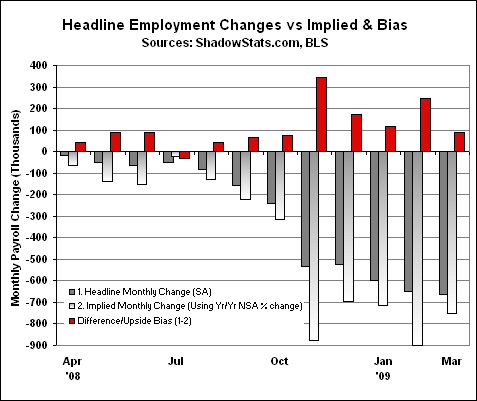
Concurrent Seasonal Factor Bias. The pattern of impossible biases being built into the headline monthly payroll employment continued with March 2009 reporting (see the opening section above and the Reporting/Market Focus in SGS Newsletter No. 43 of June 10, 2008). Instead of the headline jobs loss of 663,000, consistent application of seasonal-adjustment factors — net of what I call the concurrent seasonal factor bias — would have shown a more-severe monthly jobs loss of about 750,000. This upside reporting bias has been seen in 11 of the last 12 months, with a rolling 12-month total upside headline-number bias of 1,345,000. A worksheet on this is available upon request.
Birth-Death/Bias Factor Adjustment. An element that helped to soften the reported March jobs loss was the monthly upside bias factor (birth-death model). Never designed to handle the downside pressures from a recession, the model adds a fairly consistent upside bias to the payroll levels each year, averaging about 60,000 jobs per month, assuming the BLS adequately is seasonally adjusting for same. The upside adjustment to unadjusted March 2009 payrolls was 114,000, versus 134,000 in February.
Household Survey. The usually statistically-sounder household survey, which counts the number of people with jobs, as opposed to the payroll survey that counts the number of jobs (including multiple job holders), showed March employment down by 861,000, where February had been down by 351,000.
The March 2009 seasonally-adjusted U.3 unemployment rate showed still another statistically-significant increase, to 8.54% +/- 0.23%, from 8.08% in February. Unadjusted U.3 rose to 9.0% in March from 8.9% in February. The broader March U.6 unemployment rate jumped to an adjusted 15.6% (16.2% unadjusted) from 14.8% (16.0% unadjusted) in February.
During the Clinton Administration, "discouraged workers" — those who had given up looking for a job because there were no jobs to be had — were redefined so as to be counted only if they had been "discouraged" for less than a year. This time qualification defined away the bulk of the discouraged workers. Adding them back into the total unemployed, unemployment in line with common experience, as estimated by the SGS-Alternate Unemployment Measure, rose to about 19.8% in March, from 19.1% in February.
Employment Environment. The continued significant deterioration in March’s employment environment broadly was in line with deterioration in the better-quality employment-environment indicators, which not only led the March report, but also are leading indicators to the April report:
- February newspaper help-wanted advertising (Conference Board) held at its historic low level for a third month, with year-to-year change on a three-month moving average basis down by a record 44.6%. The deepening annual fall-off in online help-wanted advertising (Conference Board) also continued, down 36.0% year-to-year in March, versus an annual decline of 34.3% in February. The Monster.com online survey estimated that online jobs offerings were down 29% year-to-year in March, versus a 26% decline in February.
- New claims for unemployment insurance have continued to surge, with the 17-week moving average up by 72.4% as of March 28th (the highest since the 1975 recession), versus 66.9% as of February 28th.
- Employment readings continued in the deepest recession territory for the February and March manufacturing and non-manufacturing purchasing managers surveys.
Money Supply Growth Slower in March. With little impact in hand from the Fed’s expanded dollar debasement activities on data reported through March 23rd, the SGS-Ongoing M3 estimate for March 2009 likely will show minimal month-to-month change in the seasonally-adjusted level, with year-to-year change likely slowing from about 9.9% in February to 8.5% to 8.7% in March, despite probable higher annual growth in M2. Growth in large time deposits and institutional money funds has been slowing.
A preliminary M3 estimate for May will be post on the Alternate Data tab at www.shadowstats.com over the weekend, following tonight’s banking report from the Fed. I expect the broad money measure to expand sharply in the months ahead.
Week Ahead: Trade Deficit: The markets purportedly are looking for a slight widening of January’s monthly trade deficit (briefing.com), due for release next Thursday (April 9th). Oil prices have bottomed in the trade data, so the recent upturn in oil prices should again result in bigger deficits in the months ahead. This series continues be to be subject to heavy distortions.
The broad outlook is unchanged. The next full newsletter remains pending, and its likely publication date will be advised early next week.
__________