


No. 531: May Employment and Unemployment, Money Supply M3,

COMMENTARY NUMBER 531
May Employment and Unemployment, Money Supply M3,
Updated Hyperinflation Outlook
June 8, 2013
__________
Monthly Changes in Employment and Unemployment Remain Meaningless;
Economic Recovery Remains an Illusion
May Unemployment: 7.6% (U.3), 13.8% (U.6), 23.0% (ShadowStats)
Annual M3 Growth Slows to Six–Month Low
__________
PLEASE NOTE: The next regular Commentary is scheduled for Thursday, June 13th, covering May retail sales. A subsequent Commentary on Friday, June 14th, will cover the May producer price index (PPI) and industrial production.
In this Commentary, as with others, necessary explanatory, definitional or background text is repeated—often verbatim—each month. Such text sections are noted specifically in this Commentary, and any new or revised text is highlighted by an underline, for the reading convenience of those who otherwise are familiar with the background material.
Best wishes to all — John Williams
OPENING COMMENTS AND EXECUTIVE SUMMARY
Increasing Market Volatility Suggestive of Mounting Global Uneasiness. As discussed in the new and expanded summary of the Hyperinflation Outlook in the Hyperinflation Watch section, unusual activity various financial markets in the last several weeks could be suggestive of shifting global expectations towards increasing economic and systemic difficulties in the months ahead.
Also in the Hyperinflation Watch is the latest detail on year-to-year growth in M3 (ShadowStats Ongoing-M3 Measure) for May 2013. Annual growth there slowed to a six-month low of 4.2%, from 4.4% in April. With annual growth in the monetary base soaring, the suggestion here, again, is a signal for mounting liquidity stresses in the banking system.
The broad economic outlook remains dismal, despite the heavily-flawed numbers that continue to be published by the Bureau of Labor Statistics (BLS). Neither the 175,000 jobs gain in May payrolls nor the increase in the headline U.3 unemployment rate to 7.6%, from 7.5%, was significant, thanks to severe distortions in seasonal-adjustment factors that continue to plague the statistical-reporting system.
Despite the purported uptick in the May U.3 unemployment rate, that particular measure generally has been in a downtrend in recent months. As was discussed extensively in the Opening Comments of Commentary No. 521, that downtrend in the narrow unemployment rate is bad news. The unemployment rate is not dropping due to a surge in hiring; instead, it is dropping because of discouraged workers being dropped from the headline labor force.
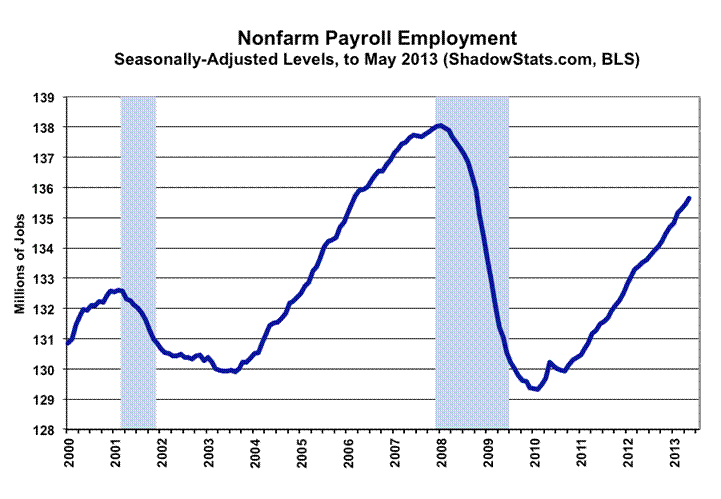
The monthly payroll level still is 2.4-million jobs shy of its pre-recession high, and it puts the lie to the expanding economic recovery propagandized in GDP reporting. To match the purported GDP recovery and expansion, payroll employment should be at least 6.0-million jobs higher, at present. Separately, May 2013 unemployment—as viewed by common experience (the ShadowStats Alternate Measure)—held at the all-time high for the series of 23.0%, a high level that rivals any other downturn of the post-Great Depression era.
Payroll Employment—No Economic Recovery Here. In the context of downside revisions to April, the headline payroll employment gain was 175,000 for May 2013. Net of prior-period revisions, the monthly gain was 163,000. Where the standard 95% confidence interval on headline monthly change in payroll employment reporting is +/- 129,000, circumstances suggest that a much wider confidence interval could be justified. The current numbers continue to be so far out of balance as to be absolutely meaningless, here, due partially to concurrent-seasonal-factor distortions. The April headline monthly jobs increase was revised lower to 149,000 (previously 165,000).
Untouched by distortions from the concurrent-seasonal-adjustment factors, year-to-year or annual growth in the not-seasonally-adjusted payroll numbers inched higher in the latest reporting. For May 2013, the annual gain in payrolls was 1.60%, versus a revised 1.56% in April. Despite the most recent uptick, comparative changes in year-to-year payroll growth show a general pattern of slowing growth since early-2012, as graphed in the Reporting Detail section.
Coincident Indicator of Broad Economic Activity. Payroll activity always has been a coincident indicator of broad economic activity. Yet, it never has confirmed the current “economic recovery,” as defined by having regained pre-recession levels. Payroll growth remains far shy of confirming the official GDP recovery in fourth-quarter 2011, and it continues to run counter to the GDP’s purported expansion in the post-recovery period. If nonfarm payroll activity were consistent with the GDP’s reported gains, May’s nonfarm payrolls would need to be at least 6.0-million jobs higher. The basic discrepancy here likely will be partially corrected in the July 31st comprehensive benchmark revision to the GDP series.
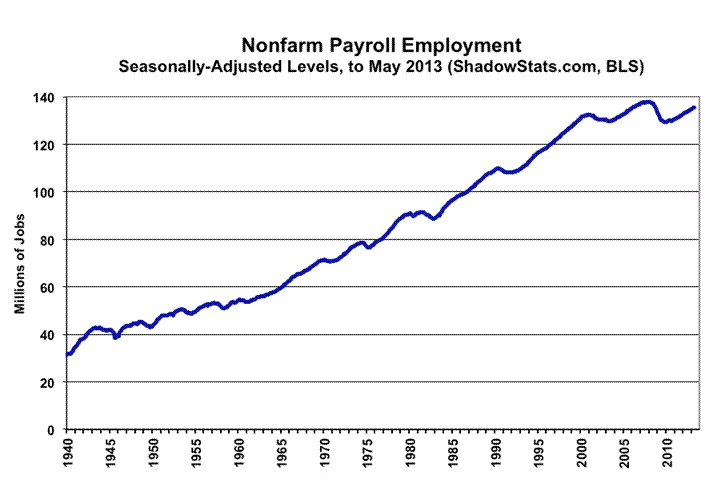
Indeed, the headline level of May 2013 payroll employment remains far shy of reflecting a full economic recovery, short by 2.4-million jobs or 1.8% in official reporting. The accompanying graph of seasonally-adjusted payroll levels since 2000 shows that detail. The longer-term graph of the payroll employment level shows historical detail back to 1940. In perspective, that graph shows the extreme duration of the current non-recovery in payrolls—the worst such circumstance since regular unemployment surveying began in 1940. The current circumstance remains the worst of the post-Great Depression period.
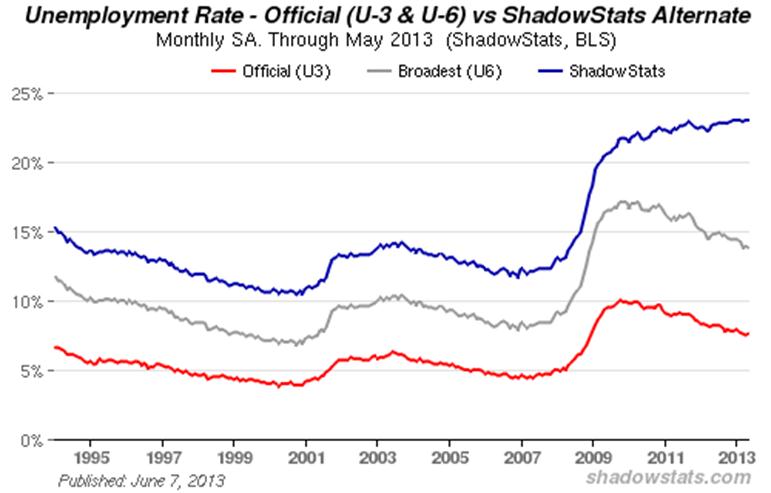
ShadowStats Alternate Unemployment Measure Holds at Series High. As reported, the headline U.3 unemployment rate rose to 7.6% (7.57% to the second decimal point) in May 2013, from 7.5% (7.51%) in April. The broader, headline U.6 measure, which includes a measure for short-term discouraged workers, fell by a notch to 13.8% in May, from 13.9% in April. None of the monthly changes in the headline unemployment measures were meaningful, because each month is calculated separately from, and is not reported in manner consistent with, the prior month’s headline reporting (see the concurrent-seasonal-factor-adjustment discussion in the Reporting Detail section).
The ShadowStats-Alternate Unemployment Measure for May, which includes long-term discouraged workers excluded from U.6, held at the series-high reading of 23.0% for a second month. The ShadowStats estimate of the growing ranks of excluded, long-term discouraged workers, broad unemployment—more in line with common experience, reflects the increasing toll of unemployed leaving the headline labor force. Added back into the total U.6 unemployed and labor force, the ShadowStats-alternate estimate generally is built on top of the official U.6 reporting and tends to follow its relative monthly movements. Accordingly, the alternate measure often will suffer some of the same seasonal-adjustment woes that afflict the base series, including underlying annual revisions.
As seen in the accompanying graph of the various unemployment measures, there continues to be a noticeable divergence in the ShadowStats series versus U.6. The reason for this is that U.6 only includes discouraged workers who have been discouraged for less than a year. As the discouraged-worker status ages, those that go beyond one year fall off the government counting, even as new workers enter “discouraged” status. All the discouraged workers are retained in the ShadowStats measure.
With continual rollover, the flow of headline workers continues into the short-term discouraged-worker category (U.6), and from U.6 into long-term discouraged-worker status (a ShadowStats measure). There was a lag in this happening, as those having difficulty during the early months of the economic collapse, first moved into short-term discouraged status, and then, a year later, into long–term discouraged status, hence the lack of earlier divergence between the series. The movement of the discouraged unemployed out of the headline labor force has been accelerating.
[For further detail on the May employment and unemployment, see Reporting Detail;
for further detail on May money supply, see Hyperinflation Watch.]
__________
HYPERINFLATION WATCH
May 2013 Annual Growth in Money Supply M3 Slowed to 4.2%, a Six-Month Low. As discussed in prior Commentary No. 530, in the context of the continued surge in the level and annual growth in the monetary base, the preliminary estimate of year-to-year growth in the ShadowStats Ongoing-M3 Estimate for May 2013 is 4.2%, down from a revised 4.4% (previously 4.3%) in April, and the softest reading since November 2012. The May detail is based on three-plus weeks of data from the Federal Reserve and has been published in the Alternate Data tab of www.shadowstats.com. Again, see No. 530 for detail on monetary-base activity through the most-recent two-week period, ended May 29th.
Where annual growth had been on the upswing in recent months, the unfolding new pattern of slowing growth likely is a sign of mounting systemic problems, with May’s detail suggesting possible intensifying banking-system stress. As has been case for Fed activity in the ongoing systemic-solvency crisis of the post-2008-panic era, the Fed’s active and expanded QE3 has not flowed through to meaningful growth in the broad money supply. Bank lending remains troubled, and that is a signal of ongoing and, at present, likely intensifying liquidity issues. The Fed’s easing activities have been aimed primarily at propping banking-system solvency and at providing systemic-liquidity. Heavily publicized efforts at, or talk of boosting the economy and containing inflation have been purely secondary considerations for the U.S. central bank, with those efforts aimed largely at providing political cover for the Fed’s bank-centric easing actions.
Prior-period revisions in the following numbers are due to Federal Reserve revisions to the underlying data. The seasonally-adjusted, preliminary estimate of month-to-month change for May 2013 money supply M3 is for an unchanged reading, versus a revised gain of 0.2% (previously 0.1%) in April. The estimated month-to-month M3 changes, however, remain less reliable than the estimates of annual growth.
For May 2013, early estimates of year-to-year and month-to-month changes follow for the narrower M1 and M2 measures (M2 includes M1, M3 includes M2). Full definitions of the measures are found in the Money Supply Special Report. M2 for May is estimated to show year-to-year growth of about 6.9%, versus a revised 7.1% (previously 6.7%) in April, with month-to-month change estimated at roughly a 0.2% gain in May, versus a revised 0.6% (previously 0.3%) gain in April. The early estimate of M1 for May 2013 is year-to-year growth of roughly 11.6%, versus a revised 12.0% (previously 11.8%) in April, with the month-to-month May change a likely gain of 0.1%, versus a revised 2.4% (previously 2.2%) increase in April.
Hyperinflation Outlook—Expanded Summary. The current hyperinflation outlook was revised and updated with new detail, May 29th, in No. 527: Special Commentary. Modified to reflect the content of that Special Commentary and subsequent Commentaries, a revised and expanded synopsis of the general outlook is provided here. It is intended as background material for new subscribers and for those looking for a brief summary of the broad outlook of the economic, systemic and inflation crises that face the United States in the year or so ahead.
Background Material. No. 527: Special Commentary (May 2013) supplemented No. 485: Special Commentary (November 2012), reviewing shifting market sentiment on a variety of issues affecting the U.S. dollar and prices of precious metals. No. 485, in turn, updated Hyperinflation 2012 (January 2012)—the base document for the hyperinflation story—and the broad outlook for the economy and inflation, as well as for systemic-stability and the U.S. dollar. Of some use, here, also is the Public Comment on Inflation.
These are the primary articles outlining current conditions and the background to the hyperinflation forecast, and they are suggested reading for subscribers who have not seen them and/or for those who otherwise are trying to understand the basics of the hyperinflation outlook. The fundamentals have not changed in recent years, other than events keep moving towards the circumstance of a domestic U.S. hyperinflation by the end of 2014. Nonetheless, the next, fully-updated hyperinflation report is targeted for publication late this month (June 2013).
Beginning to Approach the End Game. Nothing is normal: not the economy, not the financial system, not the financial markets and not the political system. The financial system still remains in the throes and aftershocks of the 2008 panic and near-systemic collapse, and from the ongoing responses to same by the Federal Reserve and federal government. Further panic is possible and hyperinflation remains inevitable.
Typical of an approaching, major turning point in the domestic- and global-market perceptions, bouts of extreme volatility and instability have been seen with increasing frequency in the financial markets, including equities, currencies and the monetary precious metals (gold and silver). Consensus market expectations on the economy and Federal Reserve policy also have been in increasing flux, but the markets are stuck with underlying reality and, eventually, they will have to recognize same. The economy remains in continued and deepening trouble, and the Federal Reserve—despite currency-market platitudes to the contrary—is locked into quantitative easing by persistent problems now well beyond its control.
At the same time, rapidly deteriorating expectations for domestic political stability reflect widening government scandals, in addition to the dominant global-financial-market concern of there being no viable prospect of those controlling the U.S. government addressing the long-range sovereign-solvency issues of the United States government. All these factors, in combination, show the end game to be nearing.
The most visible and vulnerable financial element to suffer early in this crisis likely will be the U.S. dollar in the currency markets (all dollar references here are to the U.S. dollar, unless otherwise stated). Heavy dollar selling should evolve into massive dumping of the dollar and dollar-denominated paper assets. Dollar-based commodity prices, such as oil, should soar, accelerating the pace of domestic inflation. In turn, that circumstance likely will trigger some removal of the U.S. dollar from its present global-reserve-currency status, which would further exacerbate the currency and inflation problems tied to the dollar.
This still-forming great financial tempest has cleared the horizon; its impact on the United States and those living in a dollar-based world will dominate and overtake the continuing economic and systemic-solvency crises of the last eight years. The issues that never were resolved in the 2008 panic and its aftermath are about to be exacerbated. Based on the precedents established in 2008, likely reactions from the government and the Fed would be to throw increasingly worthless money at the intensifying crises. Attempts to save the system all have inflationary implications. A domestic hyperinflationary environment should evolve from something akin to these crises before the end of next year (2014). The shifting underlying fundamentals are discussed in No. 527: Special Commentary; some of potential breaking crises will be expanded upon in the next revision to the hyperinflation report.
Still Living with the 2008 Crisis. There never was an actual recovery following the economic downturn that began in 2006 and collapsed into 2008 and 2009. What followed was a protracted period of business stagnation that began to turn down anew in second- and third-quarter 2012 (see new detail in Commentary No. 530). The official recovery seen in GDP has been a statistical illusion generated by the use of understated inflation in calculating key economic series (see No. 527: Special Commentary, Commentary No. 528 and Public Comment on Inflation). Nonetheless, given the nature of official reporting, the renewed downturn likely will gain recognition as the second-dip in a double- or multiple-dip recession.
What continues to unfold in the systemic and economic crises is just an ongoing part of the 2008 turmoil. All the extraordinary actions and interventions bought a little time, but they did not resolve the various crises. That the crises continue can be seen in deteriorating economic activity and in the ongoing panicked actions by the Federal Reserve, where it still proactively is monetizing U.S. Treasury debt at a pace suggestive of a Treasury that is unable to borrow otherwise.
Before and since the mid-April rout in gold prices, there had and has been mounting hype about the Fed potentially pulling back on its “easing” and a coincident Wall Street push to talk-down gold prices. As discussed in No. 527: Special Commentary, those factors appear to be little more than platitudes to the Fed’s critics and intensified jawboning to support the U.S. dollar and to soften gold, in advance of the still-festering crises in the federal-budget and debt-ceiling negotiations. Despite orchestrated public calls for “prudence” by the Fed, the underlying and deteriorating financial-system and economic instabilities have self-trapped the Fed into an expanding-liquidity or easing role that likely will not be escaped until the ultimate demise of the U.S. dollar.
Further complicating the circumstance for the U.S. currency is the increasing tendency of major U.S. trading partners to move away from using the dollar in international trade, such as seen most recently in the developing relationship between France and China (see No. 527: Special Commentary).
The Fed’s recent and ongoing liquidity actions themselves suggest a signal of deepening problems in the financial system. Mr. Bernanke admits that the Fed can do little to stimulate the economy, but it can create systemic liquidity and inflation. Accordingly, the Fed’s continuing easing moves appear to have been primarily an effort to prop-up the banking system and also to provide back-up liquidity to the U.S. Treasury, under the political cover of a “weakening economy.” Mounting signs of intensifying domestic banking-system stress are seen in softening annual growth in the broad money supply, despite a soaring pace of annual growth in the monetary base, and in global banking-system stress that followed the crisis in Cyprus and continuing, related aftershocks.
Still Living with the U.S. Government’s Fiscal Crisis. Again, as covered in No. 527: Special Commentary, the U.S. Treasury is in the process of going through extraordinary accounting gimmicks, at present, in order to avoid exceeding the federal-debt ceiling. Early-September appears to be the deadline for resolving the issues tied to the debt ceiling, including—in theory—significant budget-deficit cuts.
Both Houses of Congress recently put forth outlines of ten-year budget proposals that still are shy on detail. The ten-year plan by the Republican-controlled House proposes to balance the cash-based deficit as well as to address issues related to unfunded liabilities. The plan put forth by the Democrat-controlled Senate does not look to balance the cash-based deficit. Given continued political contentiousness and the use of unrealistically positive economic assumptions to help the budget projections along, little but gimmicked numbers and further smoke-and-mirrors are likely to come out of upcoming negotiations. There still appears to be no chance of a forthcoming, substantive agreement on balancing the federal deficit.
Indeed, ongoing and deepening economic woes assure that the usual budget forecasts—based on overly-optimistic economic projections—will fall far short of fiscal balance and propriety. Chances also remain nil for the government fully addressing the GAAP-based deficit that hit $6.6 trillion in 2012, let alone balancing the popularly-followed, official cash-based accounting deficit that was $1.1 trillion in 2012 (see No. 500: Special Commentary).
Efforts at delaying meaningful fiscal action, including briefly postponing conflict over the Treasury’s debt ceiling, bought the politicians in Washington minimal time in the global financial markets, but the time has run out and patience in the global markets is near exhaustion. The continuing unwillingness and political inability of the current government to address seriously the longer-range U.S. sovereign-solvency issues, only pushes along the regular unfolding of events that eventually will trigger a domestic hyperinflation, as discussed in Commentary No. 491.
U.S. Dollar Remains Proximal Hyperinflation Trigger. The unfolding fiscal catastrophe, in combination with the Fed’s direct monetization of Treasury debt, eventually (more likely sooner rather than later) will savage the U.S. dollar’s exchange rate, boosting oil and gasoline prices, and boosting money supply growth and domestic U.S. inflation. Relative market tranquility has given way to mounting instabilities, and severe market turmoil likely looms, despite the tactics of delay by the politicians and ongoing obfuscation by the Federal Reserve.
This should become increasingly evident as the disgruntled global markets begin to move sustainably against the U.S. dollar. As discussed earlier, a dollar-selling panic is likely this year—still of reasonably high risk in the next month or so—with its effects and aftershocks setting hyperinflation into action in 2014. Gold remains the primary and long-range hedge against the upcoming debasement of the U.S. dollar, irrespective of any near-term price gyrations in the gold market.
The rise in the price of gold in recent years was fundamental. The recent panicked sell-off in gold was not. With the underlying fundamentals of ongoing dollar-debasement in place, the upside potential for gold, in dollar terms, is limited only by its inverse relationship to the purchasing power of the U.S. dollar (eventually headed effectively to zero). Again, physical gold—held for the longer term—remains as a store of wealth, the primary hedge against the loss of U.S. dollar purchasing power.
__________
REPORTING DETAIL
EMPLOYMENT AND UNEMPLOYMENT (May 2013)
Payroll and Unemployment Data Remain Seriously Misleading. The broad economic outlook has not changed, despite the heavily-flawed numbers that continue to be published by the Bureau of Labor Statistics (BLS). Neither the 175,000 jobs gain in May payrolls nor the increase in the headline U.3 unemployment rate to 7.6%, from 7.5%, was significant, thanks to severe distortions in seasonal-adjustment factors that continue to plague the statistical-reporting system. Particular problems continue with the unstable concurrent-seasonal-factor adjustments used by the BLS in adjusting both the payroll and household surveys, and given restrictive definitions on the nature of “unemployment.”
Despite the purported uptick in the May U.3 unemployment rate, that particular measure generally has been in a downtrend in recent months. As was discussed extensively in the Opening Comments of Commentary No. 521, that downtrend in the narrow unemployment rate is bad news. The unemployment rate is not dropping due to a surge in hiring; instead, it is dropping because of discouraged workers being dropped from the headline labor force.
To the extent that there is any meaning in the monthly reporting, it remains that the economy has not recovered and is not in recovery. The monthly payroll level still is 2.4-million jobs shy of the pre-recession high, and it puts the lie to the expanding economic recovery propagandized in GDP reporting. Further, unemployment—as viewed by common experience (the ShadowStats Alternate Measure)—held at an all-time high for the series, in May, a high level that rivals any other downturn of the post-Great Depression era.
PAYROLL SURVEY DETAIL. In the context of a downside revision to April’s headline payroll data, the BLS reported June 7th, a seasonally-adjusted, month-to-month headline payroll employment gain of 175,000 for May 2013. Net of prior-period revisions, the monthly gain was 163,000. Where the standard 95% confidence interval on headline monthly change in payroll employment reporting is +/- 129,000, circumstances suggest that a much wider confidence interval could be justified. The current numbers continue to be so far out of balance as to be absolutely meaningless, here, due partially to concurrent-seasonal-factor distortions (discussed in the Concurrent Seasonal Factor Distortions section).
The April 2013 headline month-to-month jobs increase was revised lower to a seasonally-adjusted 149,000 (previously 165,000), versus a revised 142,000 headline gain in March (previously 138,000, initially 88,000).
The reporting issue here remains that the BLS publishes only two prior months of consistent data with concurrent-seasonally-adjusted payrolls. Accordingly, the published March number no longer is consistent with February reporting, and month-to-month comparisons have no meaning, given the BLS adjustment and reporting policies discussed in Concurrent Seasonal Factors Distortions in this Reporting Detail section. Using the latest concurrent seasonal-factor calculations from the BLS, ShadowStats is able to estimate that the consistent, revised (but not published) month-to-month change for the March gain, versus February was really 143,000, instead of 142,000 (unusually close to official reporting). For February versus January, the consistently-prepared reporting gain was 304,000, instead of the currently-official 332,000. The month-to-month reporting discrepancies often are greater, with magnitudes approaching 100,000 jobs, on occasion.
The BLS explains that it avoids publishing consistent, prior-period revisions so as not to “confuse” its data users. No one seems to mind if the published earlier numbers are wrong, particularly if unstable seasonal-adjustment patterns have shifted prior jobs growth into current reporting, without any indication of same in the published historical data.
Trend Model. As described generally in Payroll Trends, the trend indication from the BLS’s concurrent seasonal-adjustment model is for a reduced 148,000 monthly payroll gain in June 2013, based on May’s reporting. While the trend indication often misses actual reporting (the indication for May was for a 204,000 monthly gain, more than the actual—near-consensus—headline 175,000 gain), the trend number nonetheless usually becomes the basis for the consensus outlook.
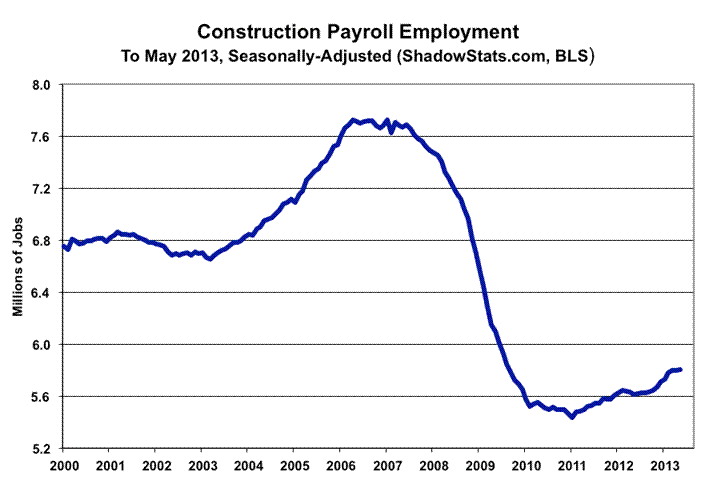
Construction Payroll Employment. The accompanying graph of construction employment shows updated payrolls for the plot included in Commentary No. 530, which covered construction spending. Detail from the May 2013 payroll survey showed a gain in the level of seasonally-adjusted construction employment, with May jobs of 5.804 million up from a revised 5.797 (previously 5.790) million in April. The detail here, however, is subject to the same seasonal-factor issues that are distorting the aggregate payroll series.
Annual Change in Payrolls. In terms of year-to-year change, the not-seasonally-adjusted annual change is untouched by the concurrent seasonal adjustments, so the monthly comparisons of year-to-year change are on a consistent basis. For May 2013, the year-to-year percent gain in payrolls was 1.60%, versus a revised 1.56% (previously 1.57%) in April and a revised 1.56% (previously 1.55%%, initially 1.49%) gain estimated for March.
The following graphs of year-to-year unadjusted payroll change show a slowly rising trend in annual growth into 2011, which reflected protracted bottom-bouncing in the level of nonfarm payrolls. That pattern of annual growth flattened out in late-2011 and, as shown in the first graph of the near-term detail in year-to-year change, began a pattern of slowing growth early in 2012.
As reflected in the longer-term graph (historical detail back to 1940), with the bottom-bouncing of recent years, current annual growth has recovered from the post-World War II record 5.06% decline seen in August 2009. That 5.06% decline remains the most severe annual contraction since the production shutdown at the end of World War II (a trough of a 7.59% annual contraction in September 1945). Disallowing the post-war shutdown as a normal business cycle, the August 2009 annual decline was the worst since the Great Depression.
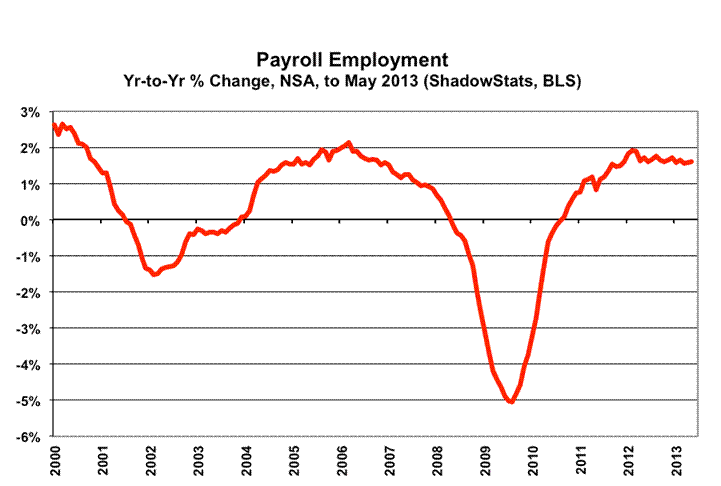
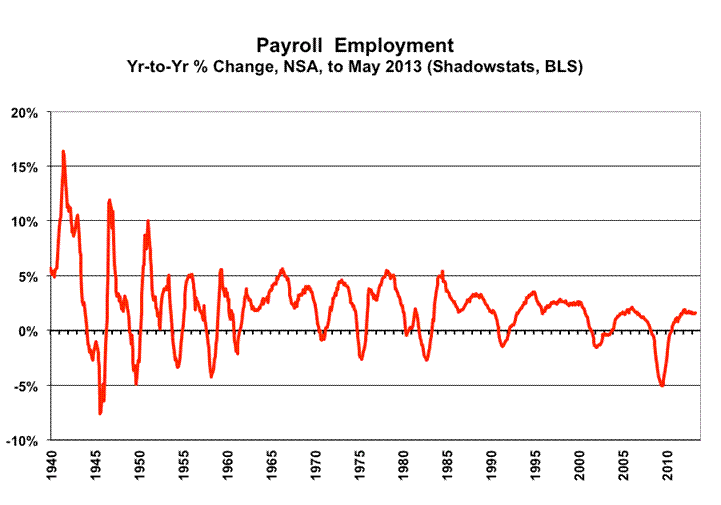
Still, even with the annual growth seen in the series since mid-2010, the May 2013 level of employment is shy by 2.4-million jobs, or 1.8% in official reporting, from recovering its pre-recession high. In the Opening Comments section, the regular graph of seasonally-adjusted payroll levels since 2000 shows that detail. The longer-term graph of the payroll-employment level shows historical detail back to 1940. In perspective, the longer-term plot shows the extreme duration of the non-recovery in payrolls—the worst such circumstance of the post-Great Depression era—and further, that payroll levels still are not so far ahead of the levels in 2000.
Concurrent Seasonal Factor Distortions. [Only underlined text in this Concurrent Seasonal Factor section and subsections is new or revised from Commentary No. 521 on April 2013 labor conditions.] As reflected the accompanying graph, seasonal-factor instabilities continued to mount in the latest payroll reporting. The bulk of the reporting issues here, however, never are brought before the public by the BLS.
Indeed, there are serious and deliberate reporting flaws with the government’s seasonally-adjusted, monthly reporting of employment and unemployment. Each month, the BLS uses a concurrent-seasonal-adjustment process to adjust both the payroll-employment and unemployment-rate data for the latest seasonal patterns. The headline payroll gain and unemployment rate are so-calculated, but the adjustment process also revises the history of each series, recasting prior reporting on a basis that is consistent with the new headline numbers.
The BLS, however, uses the current estimate but does not publish the revised history, even though it calculates the new data each month. As a result, headline reporting generally is neither consistent with nor comparable to earlier reporting, and month-to-month comparisons of these popular numbers usually are of no substance, other than for market hyping or political propaganda.
For May 2013 the headline-unemployment rate was 7.6%, and the headline monthly payroll change was a gain of 175,000 jobs. Yet, the reported May 2013 headline unemployment rate was neither consistent with nor comparable to the headline April unemployment rate of 7.5%. While the 175,000 jobs gain for May was consistent with the revised 149,000 jobs increase estimated for April, those increases were not consistent with the new 142,000 jobs gain reported for March or with any earlier published data.
Unemployment Numbers Simply Are Not Comparable Month-to-Month. Except for the once-per-year December release of revisions to seasonally-adjusted data, the BLS publishes no revised seasonally-adjusted data on a monthly basis for the household survey, even though those revisions are made and are available internally to the BLS for publication every month, as part of the concurrent-seasonal-factor process. Accordingly, the reported increase in May U.3 unemployment to 7.6%, from 7.5%, was of no meaning. The unemployment rate could have been up, down or unchanged; there just is no way to know from existing BLS reporting.
As discussed frequently (see Commentary No. 473, Commentary No. 461, and Commentary No. 451, for example), the revisions to earlier data from the concurrent-seasonal-factor process can be significant. As a result, month-to-month changes in seasonally-adjusted unemployment rates are meaningless—not determinable under current BLS reporting policies—and use of monthly comparisons simply should be avoided. At this time, the BLS does not make usable, comparative data available to the public.
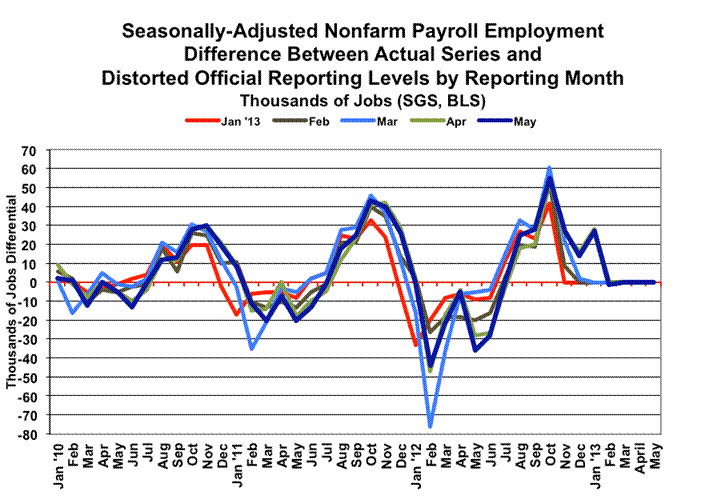
Payroll Growth Is Consistent Only One-Month Back, With Heavy Distortions Usual. With the payroll series, the level of payrolls is released for the headline month, and for the two prior months, on a consistent basis. That means that only the current headline month-to-month change and the change for the prior month are consistent and comparable. Unlike the household-survey circumstance, however, the BLS makes available the seasonal-adjustment models and data so that others can calculate the payroll revisions, and ShadowStats has done so for the accompanying graph. All these data were reset with the March 2012 benchmark revision, which was published in January 2013.
Distortions in the post-benchmark environment already have surfaced, even though the data are based on the initial public reporting of the benchmark revision. The reason for this is that the benchmark revision actually was run internally by the BLS, based on October 2012 numbers. With subsequent internal runs in November, December and January 2013, three months of revisions already had skewed the January data, as shown in the accompanying graph. The line for February reflects only one month subsequent of new seasonal-factor revisions, the March line reflects a second month and April a third month, with mounting seasonal instabilities. Without distortions, the plotted lines would be flat and at zero.
Conceivably, the shifting and unstable seasonal adjustments could move 90,000 jobs (based on last year’s full revisions, and quickly being approached by this year’s numbers) or more from earlier periods and insert them into the current period as new jobs, without there being any published evidence of that happening.
Note: The issues with the BLS’s concurrent-seasonal-factor adjustments and related inconsistencies in the monthly reporting of the historical time series are discussed and detailed further in the ShadowStats.com posting on May 2, 2012 of Unpublished Payroll Data.
As discussed in other writings (see for example Hyperinflation 2012), seasonal-factor estimation for most economic series has been distorted severely by the extreme depth and duration of the economic contraction. These distortions are exacerbated for payroll employment data based on the BLS’s monthly seasonal-factor re-estimations and lack of full reporting.
A further issue remains that the month-to-month seasonally-adjusted payroll data have become increasingly meaningless, with reporting errors likely now well beyond the official 95% confidence interval of +/- 129,000 jobs in the reported monthly payroll change. Yet, the media and the markets tout the data as meaningful, usually without question or qualification.
Birth-Death/Bias-Factor Adjustment. [Only underlined text in the Birth-Death section and subsections is new or revised from Commentary No. 521 on April 2013 labor conditions.] Despite the ongoing, general overstatement of monthly payroll employment—as evidenced usually by regular and massive, annual downward benchmark revisions (2011 and 2012, excepted)—the BLS generally adds in upside monthly biases to the payroll employment numbers. The process was created simply by adding in a monthly “bias factor,” so as to prevent the otherwise potential political embarrassment of the BLS understating monthly jobs growth. The “bias factor” process resulted from an actual such embarrassment, with the underestimation of jobs growth coming out of the 1983 recession. That process eventually was recast as the now infamous Birth-Death Model (BDM), which purportedly models the effects of new business creation versus existing business bankruptcies.
May 2013 Bias. The not-seasonally-adjusted May 2013 bias was a monthly add factor of 205,000, versus an upside bias of 205,000 in May 2012, and an upside bias of 193,000 in April 2013. The aggregate upside bias for the current year appears to have been held at 622,000 versus April, or a monthly average of roughly 52,000 jobs created out of thin air, on top of some indeterminable amount of other jobs that are lost in the economy from business closings. Those losses simply are assumed away by the BLS as part of the BDM, as discussed below.
Problems with the Model. The aggregated upside annual reporting bias in the BDM reflects an ongoing assumption of a net positive jobs creation by new companies versus those going out business. Such becomes a self-fulfilling system, as the upside biases boost reporting for financial-market and political needs, with relatively good headline data, while often also setting up downside benchmark revisions for the next year, which traditionally are ignored by the media and the politicians. Where the BLS cannot measure meaningfully the impact of jobs loss and jobs creation from employers starting up or going out of business, on a timely basis (within at least five years, if ever), such information is estimated by the BLS along with the addition of a bias-factor generated by the BDM.
Positive assumptions—commonly built into government statistical reporting and modeling—tend to result in overstated official estimates of general economic growth. Along with happy guesstimates, there usually are underlying assumptions of perpetual economic growth in most models. Accordingly, the functioning and relevance of those models become impaired during periods of economic downturn, and the current downturn has been the most severe—in depth as well as duration—since the Great Depression.
Indeed, historically, the BDM biases have tended to overstate payroll employment levels—to understate employment declines—during recessions. There is a faulty underlying premise here that jobs created by start-up companies in this downturn have more than offset jobs lost by companies going out of business. So, if a company fails to report its payrolls because it has gone out of business (or has been devastated by a hurricane), the BLS assumes the firm still has its previously-reported employees and adjusts those numbers for the trend in the company’s industry.
Further, the presumed net additional “surplus” jobs created by start-up firms are added on to the payroll estimates each month as a special add-factor. These add-factors are set now, for a second month, to add an average of about 52,000 jobs per month in the current year. The aggregate overstatement of monthly jobs likely exceeds 100,000 jobs per month. With the economy slowing anew, with growth generally below consensus expectations, the next hope for relief in current over-reporting of jobs growth would be the 2013 benchmark revision, due to be published in February of 2014.
HOUSEHOLD SURVEY DETAILS. As discussed in the Opening Comments, the seasonally-adjusted or headline May 2013 household-survey data are inconsistent with April 2013 reporting, due to the BLS’s unconscionable practice of revising previous estimates that are the basis for and consistent with current reporting, but then publishing only the current number, not the consistent prior-period revisions. The BLS leaves in place earlier monthly estimates, knowing them to be inconsistent and not comparable with each other, let alone the current headline reporting. Accordingly, seasonally-adjusted month-to-month comparisons of components in the household survey are of no meaning.
Headline Household Employment. The household survey counts the number of people with jobs, as opposed to the payroll survey that counts the number of jobs (including multiple job holders more than once). On that basis May 2013 employment rose by 319,000, after rising by 293,000 in April, but these numbers are not corrected for the unpublished and currently unknowable in-house BLS seasonal-adjustment revisions. Accordingly, as discussed in the Unemployment Rates section, the seasonally-adjusted household numbers in May are not legitimately comparable to the April reporting.
Unemployment Rates. Headline unemployment rose to 7.6% in May, from 7.5% in April, recovering its level of March. Nonetheless, the May 2013 reading is down from an estimated 8.2% from the year before, but that annual decline is not good news. As discussed in the Opening Comments of Commentary No. 521, the reporting pattern here of a recent pattern of declining unemployment rates is not good news. Instead of reflecting those who are unemployed finding jobs, the lower headline U.3 rate of recent months generally has reflected those who are unemployed being defined out of the government’s unemployment measurement by restrictive government definitions.
Further, the reported May 2013 seasonally-adjusted headline (U.3) unemployment rate of 7.56%, simply was not comparable to the reported 7.51% unemployment rate of April, just as the April rate was not comparable to March’s 7.57%. As with the other headline household-survey data, the problem with unemployment-rate comparability is tied to the use of concurrent-seasonal-factor adjustments.
When the seasonally-adjusted May 2013 unemployment data were calculated, consistent, new seasonal factors also were recalculated for April 2013 and prior months. Based on the new seasonal factors, there is a revised April unemployment rate that is consistent with May’s new headline reporting, but it is not available to the public. Although the BLS knows that number, it will not publish it; it has left intact the now-inconsistent number that previously had been reported for April.
This pattern of inconsistent reporting is repeated every month, except in December when a revised and consistently seasonally-adjusted series is published. The misreporting process begins anew with the reporting of the unemployment data for each January (see the discussions in Commentary No. 451, Commentary No. 487 and the earlier Concurrent Seasonal Factor Distortions section for further detail).
As a result, the purported headline, month-to-month gain in the May U.3 employment rate of 0.5% could have been an increase, unchanged, or a decline, but no one other than the BLS knows for sure. Even so, the official rate decline was statistically insignificant, based on official error estimates.
The official 95% confidence interval of +/- 0.23 percentage-point around the monthly headline U.3 number is meaningless in the context of comparative month-to-month reporting inconsistencies already discussed. On an unadjusted basis, however, the unemployment rates are not revised and are consistent in reporting methodology; they just are not adjusted for regular seasonal variations. May’s unadjusted U.3 unemployment rate was 7.3%, versus 7.1% in April.
The broadest unemployment rate published by the BLS, U.6 includes accounting for those marginally attached to the labor force (including short-term discouraged workers) and those who are employed part-time for economic reasons (such as they cannot find a full-time job).
Reflecting reported slight decreases in people working part-time for economic reasons and in short-term discouraged workers, the May 2013 U.6-unemployment rate notched back to a seasonally-adjusted 13.8%, from 13.9% in April. Again, though, the monthly seasonally-adjusted numbers are not comparable and the BLS guesstimates are unstable. The unadjusted May U.6 rate held even with the 13.4% in April.
Discouraged Workers. The count of short-term discouraged workers (never seasonally-adjusted) was 780,000 in May, versus 835,000 in April 2013, 803,000 in March, 885,000 in February and 804,000 in January. Those numbers still never will be comparable with the 1,068,000 of December 2012, the 979,000 in November, or the 813,000 in October, thanks to the change in population assumptions that were published with the January 2013 data.
The current official discouraged-worker number reflected the flow of the unemployed—increasingly giving up looking for work—leaving the headline U.3 unemployment category and being rolled into the U.6 measure as short-term “discouraged workers,” net of those moving from short-term discouraged-worker status into the netherworld of long-term discouraged-worker status. It is the long-term discouraged-worker category that defines the ShadowStats-Alternate Unemployment Measure. There appears to have been relatively heavy rollover from the short-term to the long-term category in May.
[The balance of the text this section, up to the Week Ahead is unrevised from Commentary No. 521 on April 2013 labor conditions.] In 1994, “discouraged workers”—those who had given up looking for a job because there were no jobs to be had—were redefined so as to be counted only if they had been “discouraged” for less than a year. This time qualification defined away a large number of long-term discouraged workers. The remaining short-term discouraged workers (those discouraged less than a year) were included in U.6.
Adding back into the total unemployed and labor force the ShadowStats estimate of the growing ranks of excluded, long-term discouraged workers, broad unemployment—more in line with common experience, as estimated by the ShadowStats-Alternate Unemployment Measure—rose a notch to 23.0% in April 2013, regaining the series high level, up from 22.9% in March. Prior to March, that measure had held at a series high of 23.0% for the three months through February 2013. The ShadowStats estimate reflects the increasing toll of unemployed leaving the headline labor force. Where the ShadowStats alternate estimate generally is built on top of the official U.6 reporting, it tends to follow its relative monthly movements. Accordingly, the alternate measure often will suffer some of the same seasonal-adjustment woes that afflict the base series, including underlying annual revisions.
As seen in the usual graph of the various unemployment measures (see the Opening Comments), there continues to be a noticeable divergence in the ShadowStats series versus U.6. The reason for this is that U.6, again, only includes discouraged workers who have been discouraged for less than a year. As the discouraged-worker status ages, those that go beyond one year fall off the government counting, even as new workers enter “discouraged” status.
With the continual rollover, the flow of headline workers continues into the short-term discouraged workers category (U.6), and from U.6 into long-term discouraged worker status (a ShadowStats measure). There was a lag in this happening as those having difficulty during the early months of the economic collapse, first moved into short-term discouraged status, and then, a year later into long–term discouraged status, hence the lack of earlier divergence between the series. The movement of the discouraged unemployed out of the headline labor force has been accelerating. See the Alternate Data tab for more detail.
As discussed in previous writings, an unemployment rate around 23% might raise questions in terms of a comparison with the purported peak unemployment in the Great Depression (1933) of 25%. Hard estimates of the ShadowStats series are difficult to generate on a regular monthly basis before 1994, given the reporting inconsistencies created by the BLS when it revamped unemployment reporting at that time. Nonetheless, as best estimated, the current ShadowStats level likely is about as bad as the peak actual unemployment seen in the 1973 to 1975 and in the double-dip recession of the early-1980s.
The Great Depression unemployment rate of 25% was estimated well after the fact, with 27% of those employed working on farms. Today, less that 2% of the employed work on farms. Accordingly, a better measure for comparison with the ShadowStats number would be the Great Depression peak in the nonfarm unemployment rate in 1933 of roughly 34% to 35%.
__________
WEEK AHEAD
Generally, Weaker Economic and Mixed Inflation Data Are Likely for May. Despite a near-consensus May payroll report, most economic reporting in the month ahead likely will disappoint an overly-optimistic consensus view of the broad economy. Separately, as was the case in the prior two months of consumer-inflation reporting, May 2013 consumer inflation also should be muted by seasonal-adjustment constraints on oil and gasoline prices. PPI inflation, however, should turn to the upside with May reporting.
The highly irregular, not-seasonally-adjusted oil and gasoline prices all turned to the plus-side in May. Separately, distortions from increasingly irrelevant, shifting and severely-negative gasoline and oil price seasonal adjustments should flip to the positive-side with June and July’s adjusted CPI reporting, and flip to neutral in May and then to positive in June for the PPI. Going forward, reflecting the still-likely negative impact on the U.S. dollar in the currency markets from continuing QE3 and the still-festering fiscal crisis/debt-ceiling debacle, reporting in the ensuing months and year ahead generally should reflect much higher-than-expected inflation (see No. 527: Special Commentary).
Where expectations for economic data in the months and year ahead should tend to soften, weaker-than-expected economic results still remain likely, given the intensifying structural liquidity constraints on the consumer. Increasingly, previous estimates of economic activity should revise lower, particularly in upcoming annual benchmark revisions, as has been seen already in industrial production, new orders for durable goods, retail sales, and the trade deficit, and as likely is pending for construction spending (July 1st). The big event, though, will be the July 31st comprehensive overhaul, benchmark revision and redefinition of the GDP back to 1929. A ShadowStats estimate of the likely net shift in GDP reporting patterns (generally slower growth in recent years) will be published before that revision.
Reporting Quality Issues and Systemic Reporting Biases. [Text in this particular section, only, is unchanged from the prior Commentary. All text for next week’s specific economic releases—in the individual sections following—is new.] Significant reporting-quality problems remain with most major economic series. Headline reporting issues are tied largely to systemic distortions of seasonal adjustments. The data instabilities were induced by the still-ongoing economic turmoil of the last six-to-seven years, which has been without precedent in the post-World War II era of modern economic reporting. These impaired reporting methodologies provide particularly unstable headline economic results, where concurrent seasonal adjustments are used (as with retail sales, durable goods orders, employment and unemployment data), and they have thrown into question the statistical-significance of the headline month-to-month reporting for many popular economic series.
With an increasing trend towards downside surprises in near-term economic reporting, recognition of an intensifying double-dip recession should continue to gain. Nascent concerns of a mounting inflation threat, though muted, increasingly have been rekindled by the Fed’s monetary policies. Again, though, significant inflation shocks are looming in response to the fiscal crisis and a likely, severely-negative response in the global currency markets against the U.S. dollar.
The political system and Wall Street would like to see the issues disappear, and the popular media do their best to avoid publicizing unhappy economic news, putting out happy analyses on otherwise negative numbers. Pushing the politicians and media, the financial markets and their related spinmeisters do their best to hype anything that can be given a positive spin, to avoid recognition of serious problems for as long as possible. Those imbedded, structural problems, though, have horrendous implications for the markets and for systemic stability, as discussed in Hyperinflation 2012, No. 485: Special Commentary and No. 527: Special Commentary.
Retail Sales (May 2013). Scheduled for release on Thursday, June 13th, by the Census Bureau, the headline May 2013 retail sales number likely will offer a downside reporting surprise to a developing upside consensus. This “advance” release will be the first since the May 31st benchmark revision to the series (see Commentary No. 529). Although prior growth was revised lower in conjunction with the 2011 survey of retail trade, the usual overly-optimistic assumptions and upside biases continued in the most-recent reporting.
The downside reporting surprise to the nominal (not-adjusted-for-inflation) numbers should be generated by the effects of the mounting structural stresses on consumer liquidity, including lack of real income growth, rising taxes, and constrained credit. May real retail sales (inflation-adjusted) will be addressed in a separate Commentary on Tuesday, June 18th, along with the detail on the May 2013 CPI-U.
Producer Price Index—PPI (May 2013). The May 2013 PPI is scheduled for release on Friday June 14th, by the Bureau of Labor Statistics (BLS). With flat-to-higher energy prices in the context of likely neutral energy-price related seasonal factors, and with upside food and “core” inflation, the headline May PPI should show positive aggregate price movement, albeit likely not a large gain.
Depending on the oil contract followed, oil prices, on average, were up by 0.3-to-3.0 percentage points for the month of May, with retail gasoline up by 1.0 percentage point. Accordingly, neutrally-adjusted energy inflation should put a positive base under the headline PPI finished goods number.
Index of Industrial Production (May 2013). The release of detail on the May 2013 index of industrial production is scheduled for Friday, June 14th, by the Federal Reserve Board (FRB). With inventories still too high for existing demand levels (should be confirmed by weak retail sales), an outright monthly contraction in production—below developing positive expectations—is a fair bet for May reporting.
While the ISM’s purchasing managers survey (manufacturing) showed an outright contraction for May production, seasonal factor problems in both series have weakened the correlation between ISM and FRB measures. Nonetheless, with negative underlying fundamentals, the ISM production hit was large enough to serve as warning for overly-optimistic consensus estimates on the pending FRB number.
__________