


No. 406: November Retail Sales, Payroll Tax Receipts

COMMENTARY NUMBER 406
November Retail Sales, Payroll Tax Receipts
December 13, 2011
__________
Faltering Tax Receipts Show
Consumer Income Taking A New Hit
November Retail Sales Change Not Meaningful
__________
PLEASE NOTE: The next regular Commentary is scheduled for Friday, December 16th, covering the November CPI, PPI, real retail sales and industrial production. See Schedule for month ahead.
—Best wishes to all for a most joyous holiday season! John Williams
Opening Comments and Executive Summary. The U.S. consumer’s structural liquidity problems are getting worse, not better. That point is supported by an analysis of federal withholding tax receipts at the U.S. Treasury. Accordingly, the ongoing outlook for retail sales and the broad economy remains one of deteriorating bottom-bouncing—a second dip that eventually will be recognized formally—not a near-term economic recovery of any form. An unexpectedly weak economy has a wide range of negative implications, including for state, local and federal budget projections; for funding needs of the U.S. Treasury; and for banking system solvency.
The broad economic and inflation outlooks have not changed, but they will be updated in the next Commentary on Friday (December 16th), when most of the major economic and inflation data for November will be in place.
Federal Withholding Taxes (U.S. Treasury Receipts). Suggestive of a downturn in individual income, and running contrary to the still relatively happy estimates of payroll income being published by the Bureau of Labor Statistics (BLS), annual growth in U.S. Treasury receipts of federal withholding taxes began to tumble in October 2011. Where the Treasury numbers reflect full reporting, the BLS data are sampled, heavily modeled and usually heavily revised. The implication is that the BLS has overstated average earnings and payrolls meaningfully in recent months.
Retail Sales. The 0.2% headline monthly gain in November retail sales, was not statistically meaningful, as has been the trend, and it likely did not top the increase in November’s prices by much, if at all. With ongoing seasonal factor distortions, current reporting here is not giving a reliable story to the markets. Underlying consumer fundamentals in terms of income, credit and confidence remain terribly impaired, with no sustainable upturn on the horizon.
Hyperinflation Watch—Outlook Unchanged. The latest language used in the prior Commentary No. 405’s Hyperinflation Watch still holds. When I refer to “reiterating” points from prior Commentaries, that means the language largely has been repeated from what was published before. I apologize to those who inadvertently found themselves re-reading text last week that they had read before. In future usage of significant repetitive language, the circumstance will be stated clearly. Friday’s (December 16th) Commentary will have an updated Hyperinflation Watch section.
The following paragraph largely is repeated from the prior Commentary: Since the publication of the Hyperinflation Special Report (2011) back in March, the outlooks on the economic and systemic-solvency crises, including the hyperinflation prediction, have not changed, but events—suggestive of accelerating movement towards a near-term dollar and inflation catastrophe—continue to unfold. Outside timing for the hyperinflation crisis remains 2014. These issues have been discussed and explored in various Commentaries, but they will be fully reviewed and updated in Hyperinflation 2012, which is planned for the second week of January.
__________
REPORTING DETAIL
FEDERAL WITHHOLDING TAXES, TREASURY RECEIPTS (Through December 7, 2011)
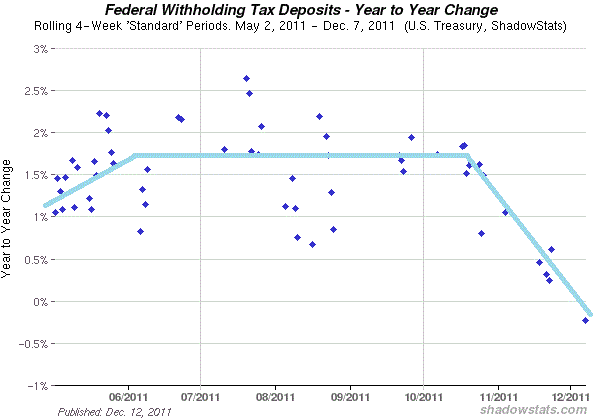
Withholding Puzzle: Downturn in Annual Change for Withholding Tax Receipts Runs Counter to BLS Earnings Reports. A sharp downturn in the annual change in withholding tax receipts by the U.S. Treasury is signaling a deterioration in personal income. The shift in tax revenues began to surface in Treasury reporting of October 2011 and has continued through the latest available numbers, as of December 7th.
Since January 2011, we have been publishing the results of the proprietary ShadowsStats.com model that tracks payroll withholding taxes as received and reported by the U.S. Treasury. The resulting analyses and the model for synthesizing and smoothing this data are described in the Chart Library (Employment/Federal Withholding Taxes) tab on www.shadowstats.com.
Although the relationship between employment, income and these tax receipts is a complex one, essentially, one would expect to see the year-to-year change in the tax receipts run in parallel to the year-over-year change in total payroll earnings (jobs times average earnings), as estimated by the Bureau of Labor Statistics (BLS).
This was the case during most of 2011, but, starting in October, a divergence developed: Whereas year-to-year change in BLS estimated payroll earnings continued at a more-or-less constant, positive level, tax receipts fell quite markedly.
The first chart below shows our set of data points for year-to-year growth in tax receipts. The scattering of the points, for example, in June, July and August 2011, was due mainly to residual calendar effects, which have not yet been modeled fully in this still work-in-progress. The solid line shows what we approximate as the underlying trend.
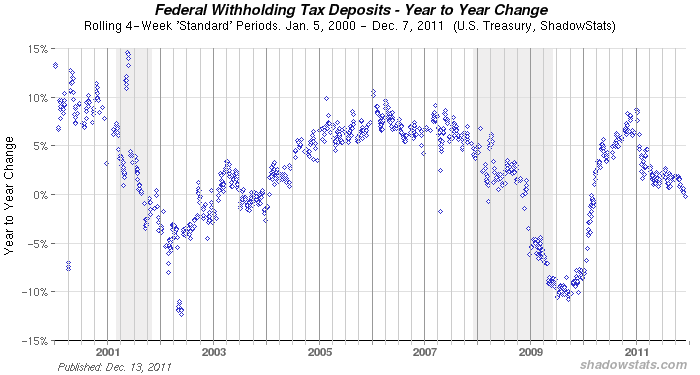
The second graph shows the same current year-to-year downturn in tax receipts, in historical perspective since 2000. Please note that in each year the period from mid-December to mid-April contains two bonus payment periods, which often distort the annual growth trend in underlying regular tax receipts.
The data points are backward-looking and represent the taxes collected in the prior four weeks. The start of the recent downtrend thus represents a start in tax-receipt drop-off sometime in October 2011.
That, however, is not consistent with continuing, steady annual growth reported in the BLS’s measure of total payroll earnings. Given the size of the drop in annual tax revenue growth (reflective of total earnings), the change likely reflects a combination of a steep fall-off in average earnings and declining payrolls. Accordingly, this suggests recent overstatement in BLS surveys of average weekly earnings and/or payroll levels.
Keep in mind that the tax receipts data reflect complete reporting. The receipts are not seasonally-adjusted, but year-to-year change and the modeling are designed to eliminate the issues of seasonality. Issues such as tax and withholding changes and calendar shifts are considered in the analysis. See the Web page for specifics.
The BLS data are sampled. For comparison purposes, seasonally-adjusted year-to-year change in BLS payroll income is used, which is affected by the BLS’s troubled seasonally-adjustment process discussed regularly in payroll Commentaries. We use the BLS’s adjusted series, here, since the unadjusted BLS earnings estimates reflect calendar and structural problems that are addressed in the adjusted series.
Other considerations in comparing the Treasury receipts and BLS earnings estimates include that the BLS estimates excluding farm payrolls and earnings, as well as state and local government earnings. Also, the Treasury receipts detail excludes certain withholdings for federal employees. Irrespective of the nature of the differences in the numbers, the downturn in withholding tax growth reflects a deteriorating liquidity circumstance for U.S. consumers.
RETAIL SALES (November 2011)
November Retail Sales Gain Not Statistically Meaningful, Close to Likely Inflation Gain. As has been the case in six of the last seven months the monthly change in November retail sales was not statistically meaningful. Further, the official 0.2% headline monthly gain in November sales was not much above what was due rising prices, and it may have been less.
Additionally, the concurrent seasonal factor issues and broader distortions seen otherwise in current seasonal factors and sampling, as discussed in the Hyperinflation Special Report (2011), continued. The stability of the seasonal-adjustment process and sampling methods have been disrupted severely by the unprecedented depth and length of the current economic downturn in the post-World War II era (the period of modern economic reporting).
Under such circumstances, where the markets effectively are flying blind as to actual economic activity, consideration of broad underlying fundamentals is essential. Consumer income and credit remain structurally impaired, and continue to signal economic deterioration, not recovery, and the broad economy remains in serious trouble (see Commentary No. 401). The income difficulties suggested by the faltering tax receipts exacerbate consumer difficulties.
Nominal (Not-Adjusted-for-Inflation) Retail Sales. Today’s (December 13th) report on November 2011 retail sales—issued by the Census Bureau—indicated a statistically-insignificant, seasonally-adjusted monthly gain of 0.22% (up by 0.42% before prior-period revisions) +/- 0.6% (95% confidence interval). November’s increase followed a revised 0.61% (previously 0.54%) monthly gain in October.
On a year-to-year basis, November 2011 retail sales were reported up by 6.75%, a slower pace than seen in the revised year-to-year October 2011 gain of 7.50% (previously 7.25%).
Real (Inflation-Adjusted) Retail Sales. Details on real retail sales for November will be published in the Friday, December 16th, Commentary, along with details from the November 2011 CPI-U release. Where November CPI-U inflation likely will be flat-to-positive (see Week Ahead), and somewhat shy of the headline retail sales gain, official November inflation still has the potential to offset the sales gain fully.
Core Retail Sales. In November, both gasoline stations and groceries stores showed small declines in monthly sales. Assuming that the bulk of non-seasonal variability in food and gasoline sales is in pricing, instead of demand, “core” retail sales—consistent with the Federal Reserve’s preference for ignoring food and energy prices when “core” inflation is lower than full inflation—are estimated using two approaches:
Version I: November 2011 versus October 2011 seasonally-adjusted retail sales—net of total grocery store and gasoline station revenues—was up by 0.33%, versus an official gain of 0.22%.
Version II: November 2011 versus October 2011 seasonally-adjusted retail sales—net of the monthly change in revenues for grocery stores and gas stations—was up by 0.27%, versus an official gain of 0.22%.
Week Ahead. Although receiving sporadic bursts of attention, an intensifying double-dip recession (it will be classified as a double-dip, because the first dip already has been called), as well as an escalating inflation problem still are not are widely recognized. The political system would like to see the issues disappear until after the 2012 election, and the financial markets will do their best to avoid recognition of the problems that have horrendous implications for the markets and for systemic stability. Until such time as financial-market expectations move to catch up fully with underlying reality, or underlying reality catches up with the markets, reporting generally will continue to show higher-than-expected inflation and weaker-than-expected economic results in the months and year ahead. Increasingly, previously unreported economic weakness should show up in prior-period revisions.
Producer Price Index—PPI (November 2011). The November PPI is due for release on Thursday, December 15th. A positive number is likely here, given flat to higher oil prices and a positive bias in energy-related seasonal factors. Also, the effects of higher oil prices still are spreading within broad economic activity.
Industrial Production (November 2011). November industrial production is due for release on Thursday, December 15th, and likely will be flat-to-minus for the month, net of prior period revisions. That probably will be weaker than consensus estimates.
Consumer Price Index—CPI (November 2011). The November CPI is due for release on Friday, December 16th. Given a 1.8% monthly decline in average November gasoline prices (Department of Energy), and seasonal factors that turned last November’s 2.0% gain in gasoline prices into a 0.7% gain, any monthly gain in November 2011’s CPI likely will come primarily from the still-spreading impact of higher energy costs in the broad economy. Reporting risk is slightly to the upside of what appears to be a flat or narrowly-positive consensus.
Year-to-year total CPI-U inflation would increase or decrease in November 2011 reporting, dependent on the seasonally-adjusted monthly change, versus the 0.12% gain in the adjusted monthly level reported for November 2010. I use the adjusted change here, since that is how consensus expectations are expressed. To approximate the annual unadjusted inflation rate for November 2011, the difference in November’s headline monthly change (or forecast of same) versus the year-ago monthly change should be added to or subtracted directly from October 2011’s reported annual inflation rate of 3.53%. For example, an unchanged monthly November CPI-U would result in reported annual inflation of about 3.4%.
__________