Monday, July 20th, 2009
__________
Number 51
July 20, 2009
__________
Current Recession Now Longest Since Great Depression
June U-6 Unemployment Rate Topped 20% (25% SGS) in
Michigan, Oregon, Nevada, California, South Carolina and Rhode Island
Pressures Will Mount for New Stimulus and Bailouts
Spreading Depression Creates Its Own Statistical Distortions
Inflation Signs Begin to Surface
U.S. Dollar Remains the Key to the Markets and Inflation
__________
Equity Markets Gyrate in Heavily Orchestrated Fantasy World
The U.S. economic and systemic solvency crises show no signs of abating, despite the happy hype out of Washington and Wall Street. While the pending second-quarter GDP estimate likely will show a narrowing quarterly contraction, such will be against a deepening annual downturn and revisions that should show the recession to have been not only longer and deeper than previously reported, but also the most severe recession since the shutdown of war production after World War II. Irrespective of media excitement around the fluttering of often statistically-insignificant or seasonally-warped monthly numbers, annual growth rates in key series have been holding at or pushing to new historic or post-war lows.
On the systemic liquidity front, circumstances appear to be deteriorating, once again. Significant flow-through from the near-100% annual growth in the monetary base to the broad money measures has not happened, signaling ongoing systemic liquidity stress. Both consumers and businesses have suffered as a result. The Fed’s attempt at extreme systemic liquefaction eventually will succeed, when it is "forced" into further significant monetization (overtly or covertly) of U.S. Treasury debt.
The ongoing tumble in business activity and the intensifying systemic liquidity crisis still appear to have the worst ahead of them, and that promises a likely second stimulus package out of Washington, as well as ongoing and expanded bailout efforts in the financial system, in the months ahead.
Higher oil prices have helped to bottom the downside inflationary pressures from the collapse in oil prices that started about one year ago. Declining annual inflation appears to have bottomed in both the CPI and PPI, while the June purchasing managers surveys both have higher prices-paid components that no longer are in deflation territory.
In the markets, stocks have rebounded off their lows of four months ago but still are well shy of their October 2007 highs, and the underlying fundamentals remain bleak. Ongoing problems with the economy, the U.S. dollar and domestic interest rates promise an eventual further sharp decline in equity prices. At such time as dollar selling intensifies, so too should inflationary pressures and upside movement in precious metals prices.
In general, the broad outlooks for the economy, the financial system and the financial markets are unchanged.
Worst Recession Since the Great Depression. July 2009 marks the 19th month of official recession and the longest U.S. economic contraction since the first downleg of the Great Depression (43 months in 1929 to 1933). The prior record duration of a post-Great Depression recession was 16 months, seen for both the 1973 to 1975 and 1981 to 1982 downturns, and that was passed in May. The second dip of the Great Depression in 1937 to 1938 lasted 13 months. Recession durations are as estimated by the National Bureau of Economic Research (NBER).
Further, with annual growth in key economic series holding at or pushing to new post-World War II lows, there are no meaningful indications that the business contraction has run its course. Despite all the reporting gimmicks in the GDP series, pending revisions and the "advance" estimate of second-quarter GDP should show that the current downturn has been the worst since quarterly GDP estimates were started in 1947. As discussed in the Key Indicators section, close to a decade of economic growth has been wiped out in this recession.
Despite the usual six-to-nine month lead time between efforts at economic stimulus and the resulting impact on economic activity, the severe and protracted economic downturn will barrel ahead, showing only a minor bump, if that, from the existing stimulus. The current loss of business activity will prove generally unresponsive to existing and any likely additional stimuli, because little has been or is likely to be done to address the structural issues tied to consumer income, which are driving the depression.
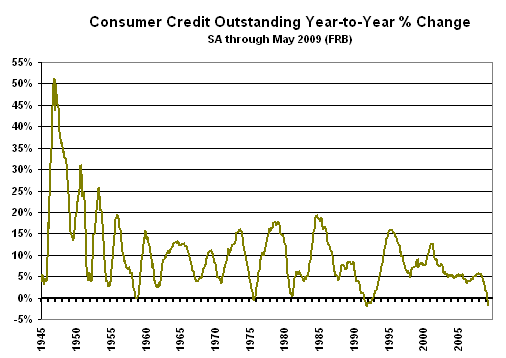
Specifically, without sustained real (inflation-adjusted) income growth, sustained real economic growth is not possible, shy of perpetual consumer debt expansion. At present, actual growth in real, disposable consumer income is inadequate to support ongoing growth in real personal consumption, and heavy expansion of consumer debt is not pending. As will be discussed in the key economic indicators section, in the ongoing systemic solvency crisis, annual growth in nominal (not adjusted for inflation) consumer credit outstanding is contracting at a pace not seen since 1991, a rate of decline otherwise not seen in the post-World War II era. (For expanded detail, see the general background note "Deepening Structural Depression Will Be Protracted, Eventually Feeding into a Hyperinflation," following the section showing the graphs of key indicators).
The Federal Reserve recently updated its economic forecasts — based on the outlooks of the regional Fed presidents — with apparently contradictory results showing a narrower real GDP contraction for 2009 (on average 0.4% better) but a higher unemployment rate (on average 0.5% worse). Beyond playing to perceived market needs, what could be at work here is foreknowledge by the Fed of pending downside revisions to 2008 GDP (due July 31st). With greater economic weakness growth thrown back into 2008, the Fed could even lower the level of its 2009 GDP forecasts but still show better relative annual growth.
Economic restatements aside, noting that the economy has turned out to be weaker than they expected, per the Vice President, some such as Obama economic advisor Laura Tyson already have raised prospects of a second stimulus package. Though that concept has been rejected officially by the President, it will keep surfacing and likely will be acted upon in the next several months, as the hoped-for economic turnaround fails to materialize, and the Democrats increasingly worry about the 2010 mid-term election.
Compounding the current economic difficulties has been a series of major actions taken by the White House and Democrat controlled Congress. The stimulus package, the nationalization of much of the U.S. automotive industry, the cap-and-trade environmental package, and the pending national healthcare package all were or are being pushed through Congress with limited or no public debate, despite their massive impacts on society and the economy. A further nationalization of much of the U.S. banking industry still remains a likely outcome of the ongoing systemic solvency crisis.
The U.S. government never has been a particularly efficient operator of businesses, even with efforts at quasi-independent operations such as seen with the U.S. Postal Service and Amtrak. Parlay those "successes" into government control of the auto and banking industries and into open competition with private insurance companies, and robust growth in those areas not only will be lacking, but the inevitable problems will prove a heavy drain on the U.S. taxpayer and will hamper U.S. economic competitiveness against the rest of the world, competitiveness that already has been severely impaired by excessive government intervention and faulty trade policies. Of course, the cap-and-trade and healthcare packages will have heavy costs to the system in fees and taxes, including proposed punitive taxes on those earning high incomes, as the Administration and Congress move to redistribute income and wealth.
Although free and open markets have been lacking in the United States for many years, the open marketplace generally resolves unhappy business or economic issues. While the solutions may be painful (i.e., recessions and bankruptcies), the outcomes usually allow for ongoing, healthy and happy economic growth, albeit with an ongoing economic cycle of booms and busts. Efforts at forced income and wealth redistribution, and at centralized government control of businesses and society, usually end up fostering economies that are in a state of perpetual bottom-bouncing, as was seen with the former Soviet Union.
As an important aside, raising taxes or imposing "fees" during a recession usually is akin to economic suicide. This applies not only to the federal government, but also to state and local governments, where recession-enhanced fiscal crises generally are being approached with higher taxes and limited spending cuts. As suggested by the regional unemployment rates discussed in the Reporting/Market Focus, some of the particularly troubled states already are in what I would define as formal depression.
Depression-Induced Economic Reporting Distortions. A note of caution: The severe shocks to the U.S. economic and financial system from the crises of the last two years could be expected to disrupt standard economic reporting, and, indeed, distortions from same have started to surface. In particular, major bankruptcies and other financial stresses that have changed the regular behavior of consumers, businesses and governments can severely distort seasonally-adjusted data. Seasonal adjustments are made to most economic series in order to remove patterns of regularly-recurring activity, such as school years, holiday-season shopping and retooling automobile lines for the next year’s models. When the regular patterns are disrupted, and the reporting is adjusted for "normal" seasonal variations, the resulting data can be skewed terribly, either to the plus-side or down-side.
Such was seen recently in the reported sharp decline in seasonally-adjusted weekly new claims for unemployment, where regular adjustments for the retooling of automobile lines artificially reduced claims, when full normal retooling did not take place. Distortions from automotive, banking, retail and other industries in upheaval, distortions from severe foreclosure activity and credit contraction, all can produce misleading seasonally-adjusted monthly economic reporting. Accordingly, year-to-year change on a not-seasonally-adjusted basis likely is the safest way to interpret most numbers, but even there, the spreading depression is having impact.
The economy has been in contraction for an extended period of time, longer than any other downturn since the Great Depression. As shown shortly in the graphs of key economic indicators, year-to-year comparisons now are going against prior year periods of collapsing activity. As a result, annual growth rates in a number of series have started to plateau at record-low levels; some series are showing a slight easing in the year-to-year declines; others still are pushing to new lows. Any apparent bottom-bouncing here largely is an artifact of the protracted collapse and is not due to a rebound in business activity.
Key Indicators Continue to Show Severe Loss of Business Activity. The still-unfolding depression has wiped out most of the economic growth of the last decade. June’s housing starts (actual number of starts, not a growth measure) reflected a low level of activity (outside of recent months) not seen since the World War II. June’s level of industrial production activity was the lowest since July 1998. Outside of other recent reporting, June’s level of real retail sales was the lowest since September 2001, in the wake of the terrorist attacks of 9/11. June payroll employment was at its lowest level since August of 2004.
Indeed, despite ongoing hype to the contrary, the U.S. economic activity has continued to collapse, as shown in the accompanying graphs of annual growth in payroll employment, industrial production, housing starts, retail sales and consumer credit outstanding. Except for payrolls and consumer credit, which are within a month or two of hitting the lowest annual growth rates seen since the Great Depression (ignoring the extreme special-circumstance distortions placed on system and the economy by World War II), the other series already have crossed that extreme benchmark.
A new graph in this newsletter is annual nominal growth in consumer credit outstanding. Credit remains a key constraint on consumer economic activity.
As mentioned in the preceding section on reporting distortions, both housing starts and retail sales are showing patterns of extreme annual contraction plateauing or bottoming at record-low levels of growth.
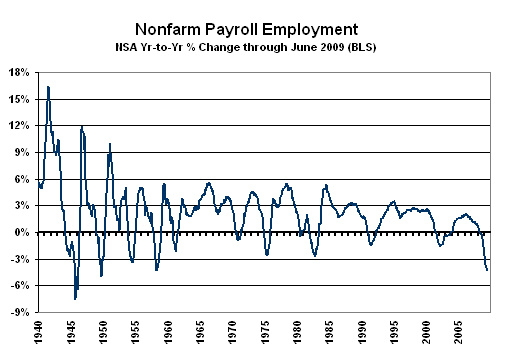
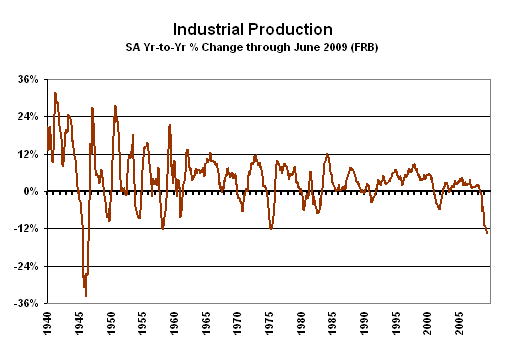
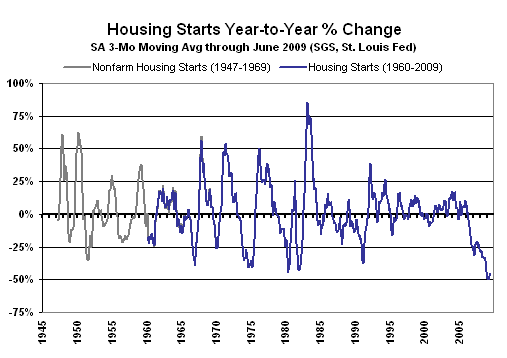
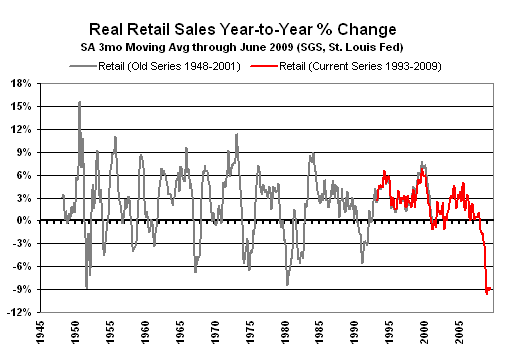
Second-Quarter GDP Contractions Likely Will Be Less Severe Quarterly, More Severe Annually. While the degree of contraction in real GDP has been severely understated by the Bureau of Economic Analysis, year-to-year change in second-quarter GDP would show its deepest annual contraction since World War II, even if quarter-to-quarter growth were unchanged. Such an outcome, however, could be altered by a severe downward revision to 2008 GDP in the upcoming benchmark revision (see the GDP section in the Reporting Perspective). Nonetheless, the outcome of the pending revisions and first estimate of second-quarter growth should leave the current recession with the clear status of being the worst since the Great Depression.
Recently reported quarterly real GDP changes have not followed the patterns of key underlying economic indicators. That said, current reporting generally has shown less-severe annualized quarterly contractions in the second-quarter indicators, and such likely will be reflected in the second-quarter GDP and embraced by the Administration and the markets as evidence of an improving economy. In contrast, the deepening annual contraction will indicate ongoing economic deterioration.
In terms of respective annualized quarterly growth in the second quarter versus the first quarter, seasonally-adjusted nonfarm payrolls contracted by 4.6% versus 5.9%, retail sales contracted by 3.0% versus 3.1%, industrial production contracted by 11.6% versus 19.1%, and housing starts actually expanded at an annualized pace of 10.5% in the second quarter, against an annualized 58.6% contraction in the first quarter.
PLEASE NOTE: A "General background note" provides a broad background paragraph or section on certain series or concepts that is used in more than one SGS newsletter. Where language used in a past newsletter is repeated in subsequent newsletters (or used repetitively month-after-month),any text changes in such a section are highlighted in italics upon first usage. This is done so that regular readers may avoid re-reading material they have seen before, but where they will have the material available for reference, if so desired.
Deepening Structural Depression Will Be Protracted, Eventually Feeding into a Hyperinflation. General background note(this immediate section and the next on "Structural Economic Issues"): As discussed in further detail in Shadow Government Statistics Newsletters Nos. 47, 48, 49 and 50 (incorporated here by reference), the U.S. economy has entered a long-term structural recession, which rapidly is deepening into a depression.
The SGS definition of depression is a peak-to-trough contraction in inflation-adjusted economic activity in excess of 10%. A great depression is a peak-to-trough contraction in inflation-adjusted economic activity in excess of 25%.
The current depression may be subject to multiple dips, and it is not subject to an easy or quick fix. It is deep enough to absorb the recent stimulus package without the economy breaking above water.
The stimuli put forth by the government and Fed do little to address the structural issues, and thus should have only limited positive impact on economic activity. The government and Fed’s actions, however, do offer the promise of much higher inflation. Such, in conjunction specifically with recent Fed moves to accelerate monetization of Treasury debt, and calls among major central banks to replace the U.S. dollar as the global reserve currency, significantly increase the risk of triggering a near-term U.S. hyperinflation as soon as late-2009 or early in 2010. A hyperinflation already was inevitable in the next five years — before the current systemic solvency crisis — based on extreme pre-crisis U.S. fiscal abuses. My best estimate on U.S. hyperinflation timing remains in the period from late-2009 to 2014, with particularly high risk in the year ahead. That outlook will be reviewed and detailed in a pending update and expansion the SGS Hyperinflation Special Report of April 8, 2008.
The structural nature of the downturn is tied to the loss of high paying domestic production or technical jobs in recent decades to offshore competition, or where jobs were moved offshore, with a result that U.S. household income has not kept up with inflation. If the consumer’s disposable income cannot grow faster than inflation, then neither can economic activity, shy of temporary debt expansion or savings liquidation, which have been stretched to their limits.
Debt expansion has been used in recent decades to fuel U.S. economic growth and to mask the growing structural limitations with consumer income. Given the recent credit market problems, debt expansion no longer can fuel economic expansion, either from the standpoint of consumers, or to an increasing extent from the standpoint of businesses. The only sector of the economy expanding its debt significantly is the federal government. While government borrowing from the public is not inflationary, government borrowing from the Fed is extremely inflationary. Therein lies the problem for ongoing federal debt expansion. With willing purchasers of U.S. Treasuries beginning to dry up, the Federal Reserve stands as a lender of last resort, monetizing federal debt (and other instruments) at an accelerating pace, limited only by its ability to print money and by the eventual costs from the resulting inflation
Structural Economic Issues. Direct impact of this circumstance [loss of high-paying production/technical jobs] has been seen in deteriorating U.S. household income, net of taxes and inflation. Using the government’s numbers, real (inflation-adjusted) average weekly earnings (Bureau of Labor Statistics) in June 2009 were down 16% from the October 1972 high. Average weekly earnings never regained their pre-1973/1975 recession high. Partially as a result, households that once tended to have one breadwinner, now tend to have multiple breadwinners, out of necessity. Even so, the latest poverty survey published by the Census Bureau showed that real household income (average and median) in 2007 still had not regained its pre-2001 recession highs.
The numbers are much worse if the SGS-Alternate Consumer Inflation estimates are used for deflating the income measures. The SGS measure is an attempt to reflect the rate of inflation inherent in maintaining a constant standard of living, as reflected in earlier CPI reporting methodologies. In the real world, average household income has not kept up with the cost of maintaining a constant standard of living, and that shortfall has been met in recent decades, at least partially, by consumers taking on increasing levels of debt.
Indeed, without growth in inflation-adjusted income, real economic growth cannot be sustained, other than through temporary measures such as debt expansion. Aware of this circumstance, former Federal Reserve Chairman Alan Greenspan et al did their best to keep the economy growing in recent decades by encouraging unsustainable debt growth, with a resultant economic growth effectively borrowed from the future. The current downturn is akin to something of a payback period.
What I refer to as the "debt standard" was created during the Franklin Roosevelt Administration as replacement for the gold standard. Its expansion through the decades has led to excessive use of debt by government, industry and individuals. In recent years, creative derivative and structured financial instruments have allowed for even greater leverage, building debt excess upon debt excess.
Now, as the debt excesses begin to implode, the federal government, and unusually large segments of local and state governments and the commercial and private sector, face financial distress and possible insolvency. Fallout has been seen in the rapidly intensifying economic contraction.
The current recession, however, began before the solvency/liquidity issues came to a head and was itself instrumental in triggering the systemic liquidity crisis. The systemic liquidity crisis, in turn, has severely exacerbated the economic contraction. Neither President Obama’s stimulus package nor Messrs. Geithner and Bernanke’s still-evolving systemic bailout program will turn the economy fundamentally or provide any lasting prop for the equity market. What these packages do promise is an ongoing effort to maintain a functioning system of depository institutions, and higher — much higher — inflation.
End of general background note.
Inflation Signals Begin to Surface. Both the June CPI and PPI topped consensus expectations for monthly inflation, and the decline in annual inflation for both series appeared to be bottoming. At the same time, the June prices-paid components of both the manufacturing and non-manufacturing purchasing managers surveys moved to 50.0 or above, no longer signaling contracting prices.
At work here are higher oil and related energy prices, as well as the regular reversal of seasonal factors that depress reporting of energy inflation in the first half of the year. Also, on a year-to-year basis, current energy prices will be measured against the collapsing prices of the year before. Ongoing weakness in the U.S. dollar and mounting global political tensions should keep net upside pressure on oil prices, irrespective of any near-term price volatility, with related general upside pressure on consumer inflation in the months ahead.
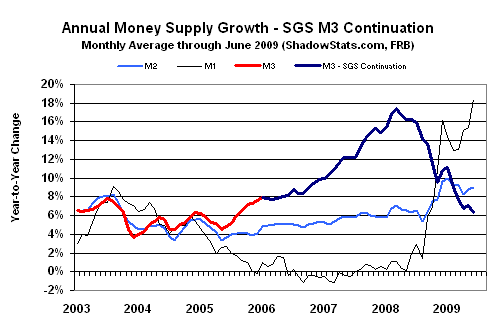
Monetary Base Expansion Fluctuates Minimally. Despite all efforts by the Fed and the U.S. Treasury to debase the U.S. dollar, broad money growth has stalled anew (see the Money Supply section in the Reporting Perspective), suggesting an intensifying solvency crisis, with new or expanded Fed actions likely. Again, however, broad money growth should pick up with escalating Fed monetization of Treasury debt. In response to the dollar debasement efforts, however, the U.S. dollar generally has weakened in the currency markets in the last several months, as global investors increasingly have shunned the greenback. Eventually, intense dollar weakness will push dollar-based prices, such as oil, much higher, igniting consumer inflation that ultimately will feed into a U.S. hyperinflation.
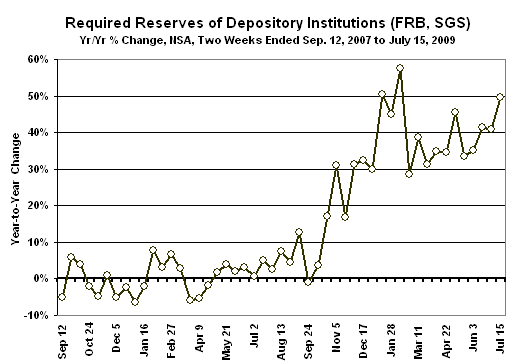
In terms of the monetary base — the Fed’s primary tool, in theory, for affecting the money supply — year-to-year change rebounded to 95.7% in the two week period ended July 15th, after having slipped to 89.9% in the prior two-week period, as reflected in the seasonally-adjusted St. Louis Fed’s adjusted series. The monetary base consists basically of currency in circulation plus bank reserves, and the fluctuation in annual growth largely was reflected in excess reserves. Of continued significance to the broader money measures, however, annual growth in required reserves (not-seasonally-unadjusted), jumped to 49.7% in the latest two weeks, the strongest showing since February, up from 40.9% annual growth in the prior two-week period.
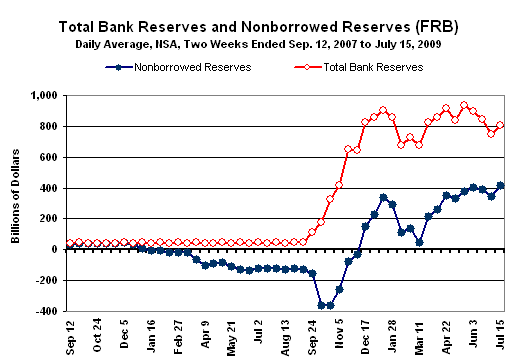
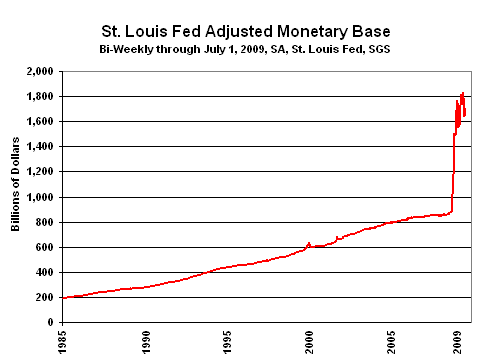
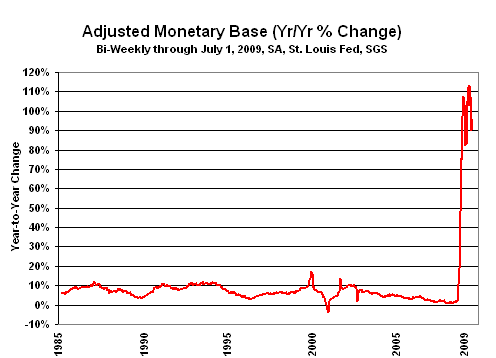
Inflation Remains the Concern: No Practical Way Out for the Fed in Reversing Dollar Debasement Actions. General background note(this immediate section): Mr. Bernanke is dedicated to debasing the U.S. dollar, in order to create inflation and to avoid deflation (he outlined such plans to avoid deflation while a Federal Reserve Governor in 2002). Accordingly, it seems somewhat silly for the Fed to assure the markets that its policies will not create inflation, where such actually is the intent of the policies. The assurances here presumably are that inflation will not get out of control, but control is not easily or likely had.
The problems here are at least twofold. First, any return to economic or financial-market normalcy is years off in the future. To the extent that the Fed’s programs work in restoring economic and systemic normalcy, such would have to be in place and moving solidly under its own power, before the Fed would pull the plug on its various supports, potentially risking a relapse of the systemic crash. Inflation likely would have a strong footing before then.
Second, with a looming massive sell-off in the U.S. dollar, the Fed will have no market for the Treasuries it has been and will be monetizing. The Fed’s eventual choices would be to dump its Treasury holdings, spiking U.S. rates and tanking the U.S. markets and economy, or to continue to monetize the growing and increasingly unwanted federal debt, further fueling inflationary pressures.
End of general background note.
Financial Markets Remain Volatile and Unstable. Over the long haul, the general outlook is unchanged: a hyperinflationary great depression, much lower stock prices (at least in inflation-adjusted terms), much higher interest rates, severe dollar selling against most major currencies, and much higher prices for precious metals, particularly gold and silver. With unstable economic and systemic solvency issues, the current financial markets remain in extreme flux, unstable and dangerous, with high volatility, tremendous gimmicking and likely at least sporadic, government-coordinated market manipulations. Accordingly, over the short-term, almost anything remains possible in the markets.
Alternative Realities. This section updates the Shadow Government Statistics (SGS) alternative measures of official GDP, unemployment and CPI reporting. When a government economic measure does not match common public experience, it has little use outside of academia or the spin-doctoring rooms of the Federal Reserve, White House and Wall Street. In these alternative measures, the effects of gimmicked methodological changes have been removed from the official series so as to reflect more accurately the common public experience, as embodied by the pre-Reagan-Era CPI and GDP and the pre-Clinton Era unemployment rate. Methodologies for the GDP and CPI series are discussed in the August 2006 SGS.
GDP. The alternate first-quarter 2009 GDP growth reflects the "final" estimate, with many of the methodological gimmicks of recent decades removed. The alternate first-quarter inflation-adjusted annual growth rate (year-to-year, as opposed to the popularly-touted annualized quarter-to-quarter rate) for GDP was a decline of roughly 5.1% versus the official year-to-year contraction of 2.5%. The official, annualized real quarter-to-quarter change for the first quarter stands at a 5.5% contraction. While the quarterly growth number is popularly followed, its significant inaccuracies are expanded to the fourth-power in reporting. The alternate measure safely would have shown an annualized quarterly contraction in the first quarter in excess of eight-percent.
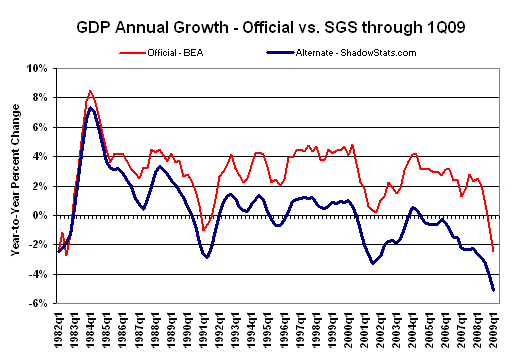
General background note: Historical data on both the official and SGS-Alternate GDP series are available for download on the Alternate Data page of www.shadowstats.com. The Alternate GDP numbers tend to show deeper and more protracted recessions than have been reported formally or reflected in related official reporting. Nonetheless, the patterns shown in the alternate data are broadly consistent with the payroll employment and industrial production series, which are major indicators used by the National Bureau of Economic Research in determining the official timing of U.S. business cycles. GDP historical growth patterns back to 1929 are subject to a grand benchmark revision on July 31st. An SGS special report will detail those revisions.
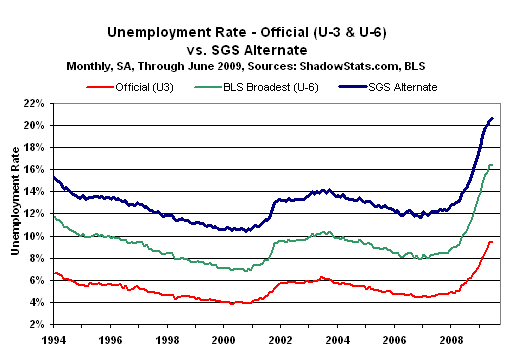
Unemployment Rate. Shown are two official seasonally-adjusted unemployment measures, U.3 and U.6, and the SGS-Alternate Unemployment Measure. The various measures inched higher in June, reflecting continued deterioration in labor-market conditions. The June rates stood respectively at 9.5%, 16.5% and 20.6%, up from 9.4%, 16.4% and 20.5% in May. Estimates of June state-by-state unemployment rates at the U.3, U.6 and SGS-Alternate levels are explored in this month’s Reporting/Market Focus
The average person has a pretty good sense as to whether or not he or she is unemployed, regardless of varying official definitions. It is to the broad, common-experience unemployment measure that the SGS-Alternate Unemployment Measure is addressed; its calculation is described below. Ask people simply if they are employed or unemployed, and the response likely would indicate an unemployment rate much closer to 20.6% than to 9.5%.
As to how the rates line up historically, the widely circulated estimate of 25% peak unemployment in 1933 of the Great Depression was guesstimated from a variety of sources, well after the fact. Unemployment was not surveyed in the 1930s; such was started by the government in 1940. The 1933 estimate appears to reflect what I would call a broad unemployment definition. Where roughly 28% of employment in 1933 was agricultural, the nonfarm unemployment rate was estimated then at a peak of 34%. With less than 2% of current employment accounted for by agriculture, the 34% unemployment rate might be the better one to use in comparing the 1933 circumstance with today’s.
Putting the SGS-Alternate Unemployment Measure into perspective, in the best of times, it would have fallen perhaps into the 8% to 9% range. Now topping 20%, it likely is comparable to the depths of the 1973 to 1975 recession and still is well shy of the 34% peak reported in 1933.
General background note: U.3 is the popularly followed unemployment rate published by the Bureau of Labor Statistics (BLS), while U.6 is the broadest unemployment measure published by the BLS. U.6 is defined as total unemployed, plus all marginally attached workers, plus total employed part time for economic reasons, as a percent of the civilian labor force plus all marginally attached workers. Marginally attached workers include short-term discouraged workers who survived redefinition during the Clinton Administration. The SGS-Alternate Unemployment Measure simply is U.6 adjusted for an estimate of the millions of long-term discouraged workers defined away in 1994 — those who had been "discouraged" for more than one year.
General background note: Historical data on both the official and SGS-Alternate unemployment series are available for download on the Alternate Data page of www.shadowstats.com. The Alternate numbers are reported from the 1994 series redefinitions forward. While it had been planned to take the alternate series further back in time, such appears to be impractical at the moment, given the lack of ongoing or parallel alternate data, as well as lack of good quality estimates of the impact of methodological shifts.
CPI. Reflecting higher oil and gasoline prices, as well as a washing out of regular seasonal adjustments that depress gasoline price reporting in the first half of the year, monthly inflation rebounded some in June, while the decline in year-to-year CPI inflation began to flatten out. Curiously, the May PCE Deflator (I.5 in the accompanying table), which tends to track closely with the C-CPI-U (I.6), continued to hold above zero and well above the C-CPI-U.
Despite any near-term faltering in oil prices, current annual inflation rates should be at or near the trough of the current cycle, as year ago comparisons begin to be against the collapse in oil prices. Prospective stronger broad money growth and a prospective weaker U.S. dollar (higher related oil prices) still threaten much higher inflation in the year ahead.
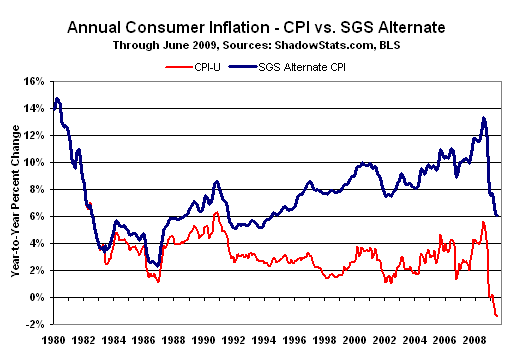
General background note: Historical data on both the official and SGS-Alternate CPI series are available for download on the Alternate Data page of www.shadowstats.com. The Alternate CPI numbers tend to show significantly higher inflation over time, generally reflecting the reversal of hedonic adjustments, geometric weighting and the use of a more traditional approach to measuring housing costs, measures all consistent with the reporting methodology in place as of 1980. The changes made are additive, reflecting BLS estimates of the impact of the various methodological changes on the aggregate annual inflation rate. Available as a separate tab at the SGS homepage www.shadowstats.com is the SGS Inflation Calculator that calculates the impact of inflation between any two months, 1913 to date, based on both the official CPI-U and the SGS-Alternate CPI series.
|
Ten Levels of Consumer Inflation
Annual Inflation for March to June 2009
|
|
Measure
|
Mar 09
|
Apr
|
May
|
Jun
|
|
I.1
|
Core PCE Deflator (BEA)
|
1.8%
|
1.9%
|
1.8%
|
n.a.
|
|
I.2
|
Core Chained-CPI-U (BLS)
|
1.3%
|
1.4%
|
1.4%
|
1.3%
|
|
I.3
|
Core CPI-U (BLS)
|
1.8%
|
1.9%
|
1.8%
|
1.7%
|
|
I.4
|
Core CPI-W (BLS)
|
1.8%
|
2.0%
|
2.0%
|
1.9%
|
|
I.5
|
PCE Deflator (BEA)
|
0.6%
|
0.5%
|
0.1%
|
n.a.
|
|
I.6
|
Chained-CPI-U (BLS)
|
-0.8%
|
-1.1%
|
-1.4%
|
-1.3%
|
|
I.7
|
CPI-U (BLS)
|
-0.4%
|
-0.7%
|
-1.3%
|
-1.4%
|
|
I.8
|
CPI-W (BLS)
|
-0.9%
|
-1.3%
|
-1.9%
|
-2.0%
|
|
I.9
|
Pre-Clinton CPI-U (SGS)
|
2.9%
|
2.6%
|
2.0%
|
1.9%
|
|
I.10
|
SGS Alternate Consumer Inflation
|
7.3%
|
6.7%
|
6.1%
|
6.1%
|
|
Sources: SGS, BLS (Bureau of Labor Statistics), BEA (Bureau of Economic Analysis).
Notes: I.1 to I.4 reflect the core inflation rates, respectively, of the substitution-based personal consumption expenditure (PCE) deflator, the substitution-based Chained-CPI-U, and the geometrically-weighted CPI-U and CPI-W. I.5 to I.8 are the same measures, as standardly reported, with energy and food inflation included. The CPI-U (I.7) "all urban consumers" is the measure popularly followed by the financial press, when the media are not hyping core inflation. The CPI-W (I.8) "urban wage earners and clerical workers is a narrower measure, more heavily weighted in basics such as gasoline, and used in calculating cost-of-living adjustments for items such as Social Security Payments. I.9 is the CPI-U with the effects of geometric weighting (Pre-Clinton Era as estimated by SGS) reversed. This is the top series in the CPI graph on the SGS home page www.shadowstats.com. I.10 reflects the SGS Alternate Consumer Inflation measure, which reverses the methodological gimmicks of the last 25 years or so, plus an adjustment for the portion of Clinton-Era geometric weighting that is not otherwise accounted for in BLS historic bookkeeping.
|
Monday, April 20th, 2009
__________
Number 50
April 20, 2009
__________
Worst Still Ahead for Economy and Solvency Crisis
Faulty Data, Government/Fed Obfuscation Are No Basis for Rebuilding Confidence
Do Not Mistake Declining Living Standards for Deflation
Resurgent Inflation Likely to Be Triggered by U.S. Dollar Weakness
Greenback’s Credibility Cracks as Fed Accelerates Dollar Debasement
__________
OVERVIEW — OPENING COMMENTS
"Glimmers of Hope" Are Just Hype
The U.S. economy remains in a deepening depression that will prove to be particularly protracted and unresponsive to traditional stimuli. A few indications of possible bottom-bouncing at a temporary plateau of low business generally were flawed. Deteriorating patterns of year-to-year contraction in key economic series have continued, setting post-World War II lows. Despite all efforts by the Fed and Treasury to debase the U.S. dollar, broad money growth has stalled anew, suggesting an intensifying solvency crisis, with new or expanded Fed actions likely. Broad money growth should pick up, however, with escalating Fed monetization of Treasury debt. Although the U.S. dollar generally has held its recent relative strength in the currency markets, global investors increasingly will shun the greenback, and intense dollar weakness eventually will push dollar-based prices such as oil much higher, igniting consumer inflation that ultimately will feed into a U.S. hyperinflation.
The financial markets remain in extreme flux, unstable and dangerous, with high volatility, tremendous gimmicking and likely at least sporadic government-coordinated market manipulations. Accordingly, over the short-term, almost anything is possible in the markets. Over the long haul, the general outlook is unchanged: a hyperinflationary great depression, much lower stock prices (in inflation-adjusted terms), much higher interest rates, severe dollar selling against most major currencies, and much higher prices for precious metals, particularly gold and silver.
Recent, intermittent strong stock market rallies are reminiscent of strong rallies seen in stocks during the general stock market sell-off of 1929 to 1932. The four largest-ever percentage daily gains in the Dow Jones Industrial Average were seen in that period. Equity values, however, worked their way lower by an aggregate 89.2% from the September 3, 1929 peak (DJIA 381.17) to the July 8, 1932 low (DJIA 41.22), only to recover the 1929 peak in 1954, some 25-years later (source: dowjonesindexes.com).
Anything But the Truth. When the government decides to rig numbers in an effort to create a rosier consensus outlook, or when it moves to hide uncomfortable information from the public on a problem, odds favor the underlying reality being much worse than the public or markets perceive. Indeed, the Administration, Fed and Wall Street are attempting to sell the concept that the worst of the economic and solvency crises has passed, but evidence runs quite to the contrary, as shown in the monetary and better economic data. The worst likely still is ahead.
On the economic numbers front, unusual revisions to prior-period reporting in series such as nonfarm payrolls and retail sales suggest serious reporting flaws in key data. The revisions here are suspect, where they have tended to be all in the same direction (recent retail sales excepted) and have been regularly of magnitudes that exceeded published 90% and 95% confidence intervals of statistical significance. Where prior-period downward revisions provide a relative boost to the latest reporting, these unusual patterns have helped the monthly headline numbers for the series, which in turn generally have been happy news for the stock market. Separately, unusual seasonal-adjustment patterns have enabled part of the revision gimmicking, at least in terms of the payroll data (see details in the Reporting/Market Focus).
Also, the latest reporting of monetary aggregates by the Fed (see Money Supply section in the Reporting Perspective) showed unusually large downside revisions to recent estimates of M2 and other M3 components. While the patterns of broad money supply growth still tell the same story, questions on the quality of Fed data are raised anew. With the Fed’s broad oversight of the banking and financial system, one might expect reasonably meaningful and stable data from the U.S. central bank on the U.S. banking system, but such has been sorely lacking for years, as evidenced by the poor quality of quarterly flow-of-funds data published by the Fed. With the current unusual revisions (unusual in terms of magnitude and pattern), one might wonder if there is some gaming afoot to contain reported annual growth rates in the broader money measures, given the expanded monetization of Treasury debt and with annual growth in the monetary base back over 100%.
As to information on the systemic solvency crisis, the Federal Reserve and U.S. Treasury have refused to disclose details as to where certain banking bailout/liquefaction funds have gone. Then, there is the "stress" testing being applied to banks. It would be a shock to find that the results of these analyses (at least those to be released eventually to the public) adequately measured the solvency risks to the banking system, with the downside economic case beginning to look more like the consensus outlook than a risk scenario.
Even so, Bloomberg reported (April 10th): "The U.S. Federal Reserve has told Goldman Sachs Group Inc., Citigroup Inc. and other banks to keep mum on the results of ’stress tests’ that will gauge their ability to weather the recession, people familiar with the matter said." Subsequent to that, there has been a flurry of public comment and activity promising "transparency" on the stress tests, although there seem to be significant issues as to how the results can be released within the context of the new rosy scenario fable being crafted by Washington/Wall Street.
Also, accounting standards have been shifted to allow banks effectively to guesstimate and book the "economic fair-value" of otherwise illiquid and impaired assets on their balance sheets, rather than to mark-to-market, reflecting values estimated at what would have been obtained in a forced liquidation or actual sale. The resulting inflation in banking balance sheets already is being hyped in the markets, without there being any real change in the underlying financial conditions of the banking industry.
At work here are efforts to rebuild consumer confidence and investor confidence. While these generally are admirable and necessary goals, it would be much healthier for the system if the confidence rebuilding were based on underlying reality, as opposed to fantasies woven by Administration, Federal Reserve and Wall Street spinmeisters. Eventually, the fantasies will unwind, and consumer and investor confidence will take a renewed battering, worse than otherwise would have been seen or necessary.
Deepening Structural Depression Will Be Protracted. As discussed in further detail in Shadow Government Statistics Newsletters Nos. 47, 48 and 49 (incorporated here by reference), the U.S. economy has entered a long-term structural recession, which rapidly is deepening into a depression (see definitions below). The current depression may be subject to multiple dips, and it is not subject to an easy or quick fix. It is deep enough to absorb the recent stimulus package without the economy breaking above water.
The stimuli put forth by the government and Fed do little to address the structural issues, and thus should have only limited positive impact on economic activity. The government and Fed’s actions, however, do offer the promise of much higher inflation. Such, in conjunction specifically with recent Fed moves to accelerate monetization of Treasury debt, and calls among major central banks to replace the U.S. dollar as the global reserve currency, significantly increase the risk of triggering a near-term U.S. hyperinflation as soon as late-2009 or early in 2010. A hyperinflation already was inevitable in the next five years — before the current systemic solvency crisis — based on extreme pre-crisis U.S. fiscal abuses. My best estimate on U.S. hyperinflation timing remains in the period from late-2009 to 2014. That outlook will be reviewed and detailed in a pending update and expansion the SGS Hyperinflation Special Report of April 8, 2008.
The structural nature of the downturn is tied to the loss of high paying domestic production or technical jobs in recent decades to offshore competition, or where jobs were moved offshore, with a result that U.S. household income has not kept up with inflation. If the consumer’s disposable income cannot grow faster than inflation, then neither can economic activity, shy of temporary debt expansion or savings liquidation, which have been stretched to their limits (see the "general background note" below for expanded detail).
Debt expansion has been used in recent decades to fuel U.S. economic growth and to mask the growing structural limitations with consumer income. Given the recent credit market problems, debt expansion no longer can fuel economic expansion, either from the standpoint of consumers, or to an increasing extent from the standpoint of businesses. The only sector of the economy expanding its debt significantly is the federal government. While government borrowing from the public is not inflationary, government borrowing from the Fed is extremely inflationary. Therein lies the problem for ongoing federal debt expansion. With willing purchasers of U.S. Treasuries beginning to dry up, the Federal Reserve stands as a lender of last resort, monetizing federal debt (and other instruments) at an accelerating pace, limited only by its ability to print money and by the eventual costs from the resulting inflation
PLEASE NOTE: A "General background note" provides a broad background paragraph or section on certain series or concepts that is used in more than one SGS newsletter. Where language used in a past newsletter is repeated in subsequent newsletters (or used repetitively month-after-month),any text changes in such a section are highlighted in italics upon first usage. This is done so that regular readers may avoid re-reading material they have seen before, but where they will have the material available for reference, if so desired.
Structural Economic Issues. General background note(balance of this immediate section): Direct impact of this circumstance [loss of high-paying production/technical jobs] has been seen in deteriorating U.S. household income, net of taxes and inflation. Using the government’s numbers, real (inflation-adjusted) average weekly earnings (Bureau of Labor Statistics) in March 2009 were down 15% from the October 1972 high. Average weekly earnings never regained their pre-1973/1975 recession high. Partially as a result, households that once tended to have one breadwinner, now tend to have multiple breadwinners, out of necessity. Even so, the latest poverty survey published by the Census Bureau showed that real household income (average and median) in 2007 still had not regained its pre-2001 recession highs.
The numbers are much worse if the SGS-Alternate Consumer Inflation estimates are used for deflating the income measures. The SGS measure is an attempt to reflect the rate of inflation inherent in maintaining a constant standard of living, as reflected in earlier CPI reporting methodologies. In the real world, average household income has not kept up with the cost of maintaining a constant standard of living, and that shortfall has been met in recent decades, at least partially, by consumers taking on increasing levels of debt.
Indeed, without growth in inflation-adjusted income, real economic growth cannot be sustained, other than through temporary measures such as debt expansion. Aware of this circumstance, former Federal Reserve Chairman Alan Greenspan et al did their best to keep the economy growing in recent decades by encouraging unsustainable debt growth, with a resultant economic growth effectively borrowed from the future. The current downturn is akin to something of a payback period.
What I refer to as the "debt standard" was created during the Franklin Roosevelt Administration as replacement for the gold standard. Its expansion through the decades has led to excessive use of debt by government, industry and individuals. In recent years, creative derivative and structured financial instruments have allowed for even greater leverage, building debt excess upon debt excess.
Now, as the debt excesses begin to implode, the federal government, and unusually large segments of local and state governments and the commercial and private sector, face financial distress and possible insolvency. Fallout has been seen in the rapidly intensifying economic contraction.
The current recession, however, began before the solvency/liquidity issues came to a head and was itself instrumental in triggering the systemic liquidity crisis. The systemic liquidity crisis, in turn, has severely exacerbated the economic contraction. Neither President Obama’s stimulus package nor Messrs. Geithner and Bernanke’s still-evolving systemic bailout program will turn the economy fundamentally or provide any lasting prop for the equity market. What these packages do promise is an ongoing effort to maintain a functioning system of depository institutions, and higher — much higher — inflation.
End of general background note.
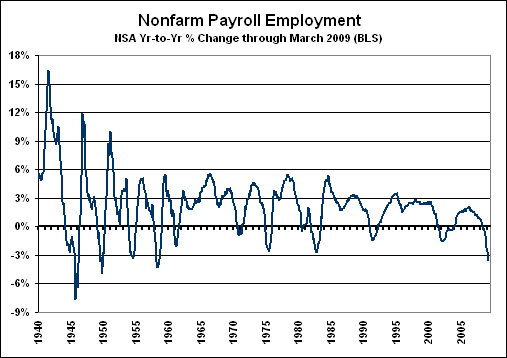
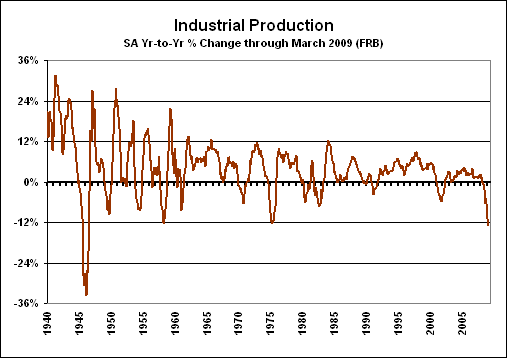
Historical Comparisons Close in on Pre-World War II. Despite temporary hype to the contrary, the U.S. economy has continued in freefall. In the accompanying graphs, payroll employment, industrial production, retail sales and housing starts plots have been extended back through 1940, where available, or otherwise back to the earliest point published for related historical series. While several recent reports have suggested the potential of some bottom-bouncing in the economy at a low-level plateau of business activity, the reported monthly gains were not meaningful (see later Bottom-Bouncing section).
In recent reporting, most key series now have been reported with the worst year-to-year declines since the Great Depression, ignoring the extreme special-circumstance distortions placed on system and the economy by World War II. The exception is nonfarm payroll employment, which was down year-to-year by 3.56% as of March 2009, the weakest showing since July 1958 and the effects of a steel strike.
If the current pace of monthly jobs loss holds above 600,000 for the next three months — a fair bet — then the annual percentage decline in payrolls will exceed all but 1949 as of May 2009, and it will be the worst since the shutdown of war production at the end of World War II, as of the reporting for June 2009.
For March 2009, industrial production — the other series plotted back through 1940 — showed its greatest year-to-year decline for any month since the shutdown of war production at the end of World War II. March 2009 production was down 12.8% from the year before.
The plots on housing starts and retail sales series include both current the prior historical series, which tend to go back to the end of World War II. Despite series redefinitions, year-to-year change varies little between the old and new versions, allowing for a longer-term historical perspective.
In both the housing starts and retail sales graphs, year-to-year change in the three-month moving average is used in order to soften reporting volatility in the monthly series. In both the housing and retail series, annual growth in the current cycle has hit historic lows and, very likely, the lowest levels seen since the Great Depression, outside of the World War II systemic upheaval.
First-Quarter GDP Contraction Should Deepen. In terms of annualized growth, key indicators suggest the inflation-adjusted GDP decline in the first quarter should be worse than the fourth-quarter’s 6.3% loss. Given the heavily politicized nature of GDP reporting, though, such a result is far from certain.
Consider that seasonally-adjusted nonfarm payrolls contracted by an annualized 5.9% in the first quarter versus a 3.7% contraction in the fourth. Aside from any gimmicking issues, the nonfarm payrolls series is the broadest coincident indicator of domestic economic activity that has any basis in actual surveying. Seasonally-adjusted industrial production contracted at an annualized 20.0% pace in the first quarter, versus a 12.7% drop in the fourth. In earlier times, industrial production was used as a surrogate for broad economic reporting.
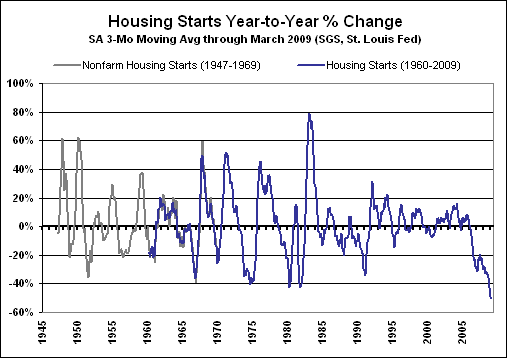
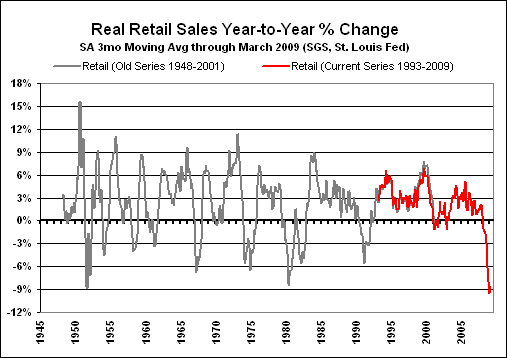
Housing starts (seasonally-adjusted, three-month moving average) fell at an annualized 60.5% in the first quarter, versus a 67.7% contraction in the fourth. Only inflation-adjusted retail sales (seasonally-adjusted, three-month moving average) showed a large narrowing in contraction, with sales down an annualized 2.5% in the first quarter, versus an 18.8% drop in the fourth. The retail sales result, however, was of suspect reporting (see the Reporting/Market Focus).
Depths of Contraction Breach Depression and Great Depression Definitional Barriers. Furthermore in terms of peak-to-trough contraction, definitional barriers have been broken by key series. By SGS definition, a depression is a peak-to-trough contraction in inflation-adjusted GDP (broad economic activity) in excess of 10%; a great depression is a peak-to-trough contraction in excess of 25%. Even as reported with official GDP, a depression is probable in the current downturn. A great depression, however, likely will evolve primarily as a result of the inevitable hyperinflation, where normal commerce simply would cease to function.
In the current cycle, inflation-adjusted retail sales (seasonally-adjusted, three-month moving average) have declined peak-to-trough by 10.4%, and industrial production has dropped 13.3%. Accordingly, both those series are in depression territory.
New orders for durable goods (seasonally-adjusted, three-month moving average) have declined peak-to-trough by 25.4%, breaking into the range of a great depression. The real contraction would be greater, if there were an adequate inflation series for deflating durable goods. For housing starts (seasonally-adjusted, three-month moving average), the peak-to-trough decline has hit 75.5%. Both series here are in great-depression territory.
Some Bottom-Bouncing Remains Likely, But Not Yet. As discussed in the various sections related to the indicators mentioned below, reporting in the last month or so has generated some possible signals of bottom-bouncing, where tumbling business activity begins to bounce along a low-level plateau of activity. Such usually happens in protracted and severe downturns, but it has not happened in the current circumstance, yet. When it does, it likely will serve as a just a temporary pause in the current ongoing business freefall, as part of the formation of multiple-dip recession/depression.
In terms of the recent grasping at straws by spinmeisters on Wall Street, at the Fed and in the Administration, most monthly gains simply were not statistically meaningful (housing data, new orders for durable goods, new claims for unemployment insurance, early-month consumer sentiment), while annual growth continued in significant deterioration. Some had unusual seasonal-factor distortions (retail sales). Subsequent reporting in certain series also has reversed the market-stirring prior gains (housing, retail sales). Again, these series are discussed in their regular sections in the Reporting Perspective.
Broad Money Supply Has Failed, So Far, to Respond to Continued Boom in Monetary Base. The latest release of bank reserves data showed the annual growth in the St. Louis Fed’s Adjusted Monetary Base rebounding to 105.5% in the two weeks ended April 8th, up from 99.5% in the prior two-week period, reflecting the intensified systemic liquefaction efforts by the Fed, following the March FOMC meeting. Such was up from its recent trough of 81.9% in the two weeks ended February 11th but still was shy of the record 107.2% seen in the two weeks ended January 14th. The bulk of volatility in the series has been due to variations in excess reserves. The monetary base (basically currency plus bank reserves) is the Fed’s primary tool for targeting growth in the money supply.
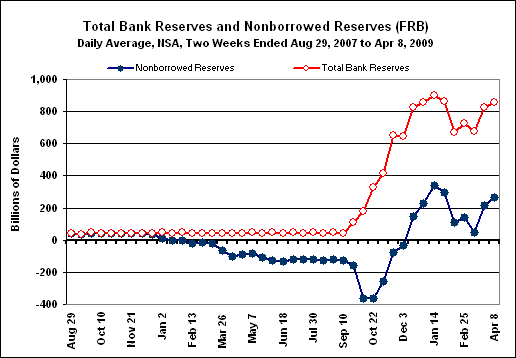

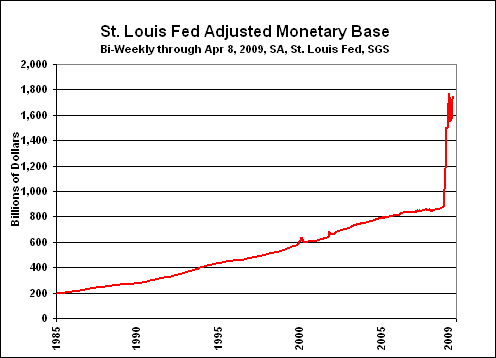

Of continued significance to the broader money measures, annual growth in required reserves (seasonally-unadjusted) rose to 34.8%, up from 31.2% in the prior two weeks. Such remained shy of the record 57.6% annual growth reported for the two weeks ended February 11th. Aside from higher growth seen recently, though, the current growth remained in record-high post-World War II territory. It suggests ongoing growth in depository accounts. The preceding four graphs were updated for the latest detail in terms of bank reserves and the monetary base.
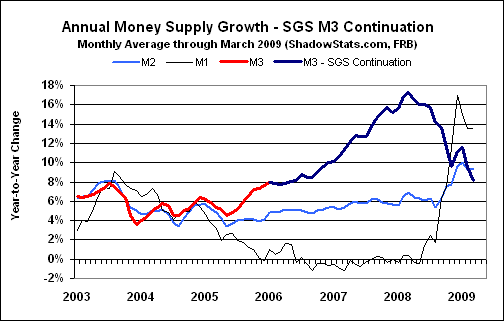
Stalling Broad Money Growth Suggests Pressures on Fed for Expanded Action. Despite the U.S. Treasury’s plan for subsidizing an arrangement with private investors to purchase so-called "toxic assets" from banks’ balance sheets, the approach likely will not have much positive impact on the systemic solvency crisis. Assuming that the assets were sold at a realistic value, the selling banks would have to recognize actual losses, instead of enjoying fantasy value enabled by the recent revamping of accounting rules. The Fed’s extreme liquefaction of the U.S. financial system has not had its desired effects, yet, either.
In the ongoing systemic solvency crisis, periods of slowing broad money growth appear to have signaled periods of crisis intensification. Given no signs of relief for broad money growth — the latest weekly numbers show sharp contraction in M2 and little net change in the other published M3 components — the Federal Reserve appears to be under intensified near-term pressure for further unusual and/or excessive actions. Those pressures for increased U.S. dollar debasement (inflation creation) recently were intensified by the reporting of formal CPI-U annual deflation in March 2009, the first such number since Dwight Eisenhower was U.S. President.
As shown in the money supply graph, and as detailed in the Money Supply section in the Reporting Perspective, year-to-year change in the seasonally-adjusted estimate SGS-Ongoing M3 has continued to soften, hitting 8.1% in March, versus 9.5% in February and a short-lived, near-term peak of 12.6% annual growth in January. The slowing growth in February was a signal for the Fed to begin monetizing longer-term debt (unexpected at the time by the markets). The Fed’s effort at debasing the U.S. dollar by exploding the monetary base has yet to flow through to the broader money measures, but it will.
Little Choice But for Greater Debt Monetization. As discussed in the Federal Deficit section, the rolling 12-month federal deficit through March 2009 was $1.1 trillion, up from $0.2 trillion in March 2008. Gross federal debt as of March 31st was up by $1.7 trillion from the year before. The official deficit should top $2 trillion in the 2009 fiscal year, as outlays explode wildly and as depression-impaired tax revenues fall off sharply. As a result, U.S. Treasury funding needs in the months ahead will exceed market expectations significantly.
The timing of such funding needs is unfortunate, however, given the coincident growing reluctance of domestic and foreign investors to hold dollar-denominated U.S. Treasury instruments. Normal market forces would push Treasury yields higher, but the Fed still is trying actively to debase the U.S. dollar, to create domestic inflationary pressures. The U.S. central bank stands eagerly now as buyer of last resort for U.S. Treasuries. Such debt monetization tends to be particularly stimulative to broad money growth and is inflationary. The Treasury’s cash here is provided by the Fed, not drained from the working capital of an otherwise purchasing investment community, and the funds from the Treasury usually flow through the private sector on their way to getting deposited into the banking system.
Inflation Remains the Concern: No Practical Way Out for the Fed in Reversing Dollar Debasement Actions. Mr. Bernanke is dedicated to debasing the U.S. dollar, in order to create inflation and to avoid deflation (he outlined such plans to avoid deflation while a Federal Reserve Governor in 2002). Accordingly, it seems somewhat silly for the Fed to assure the markets that its policies will not create inflation, where such actually is the intent of the policies. The assurances here presumably are that inflation will not get out of control, but control is not easily or likely had.
The latest assurances that the Fed’s massive liquidity creation will not create inflation came from Federal Reserve Vice Chairman Donald L. Kohn in an April 18th speech, "Monetary Policy in the Financial Crisis:"
"Will These Policies Lead to a Future Surge in Inflation? No, and the key to preventing inflation will be reversing the programs, reducing reserves, and raising interest rates in a timely fashion. Our balance sheet has grown rapidly, the amount of reserves has skyrocketed, and announced plans imply further huge increases in Federal Reserve assets and bank reserves. Nonetheless, the size of our balance sheet will not preclude our raising interest rates when that becomes appropriate for macroeconomic stability. Many of the liquidity programs are authorized only while circumstances in the economy and financial markets are ‘unusual and exigent,’ and such programs will be terminated when conditions are no longer so adverse. Those programs and others have been designed to be unattractive in normal market conditions and will naturally wind down as markets improve.
"However, our newly purchased Treasury securities and MBS will not mature or be repaid for many years; the loans we are making to back the securitization market are for three years, and their nonrecourse feature could leave us with assets thereafter. But we have a number of tools we can use to absorb the resulting reserves and raise interest rates when the time comes. We can sell the Treasury and agency debt either on an outright basis or temporarily through reverse repurchase agreements, and we are developing the capability to do the same with MBS. We are paying interest on excess reserves, which we can use to help provide a floor for the federal funds rate, as it does for other central banks, even if declines in lending or open market operations are not sufficient to bring reserves down to the desired level. Finally, we are working with the Treasury to promote legislation that would further enhance our toolkit for absorbing reserves."
The problems here are at least twofold. First, any return to economic or financial-market normalcy is years off in the future. To the extent that the Fed’s programs work in restoring economic and systemic normalcy, such would have to be in place and moving solidly under its own power, before the Fed would pull the plug on its various supports, potentially risking a relapse of the systemic crash. Inflation likely would have a strong footing before then.
Second, with a looming massive sell-off in the U.S. dollar, the Fed will have no market for the Treasuries it has been and will be monetizing. The Fed’s eventual choices would be to dump its Treasury holdings, spiking U.S. rates and tanking the U.S. markets and economy, or to continue to monetize the growing and increasingly unwanted federal debt, further fueling inflationary pressures.
Do Not Mistake Declining Living Standards for Deflation. The popularly-followed CPI-U inflation measure just turned in its first formal deflation reading (year-to-year contraction) in 54 years. With March 2009 reflecting annual deflation of 0.4%, the SGS-Alternate Consumer Inflation measures still reflect annual inflation ranging from somewhat below 3% to roughly 7%, with the 7% being my best estimate of where current CPI reporting would be, if it were calculated using the methodologies in place as of 1955, the time of the last formal deflation reading.
In terms of official inflation reporting, the recent downturn in aggregate prices has been due largely to collapsing oil and gasoline prices. Energy prices are on the rise again, however, and they should help to bottom the annual CPI inflation measures at close to current levels. Still, the question arises as to the differences between the official and SGS measures. The biggest differences between the official CPI reporting measures and the SGS measures are whether they reflect the cost of maintaining a constant standard of living (the official CPI measure no longer do so), including hedonic adjustments for quality changes that cannot be directly measured and that have little relationship to common experience (see the SGS Response to BLS Article on CPI Misconceptions on www.shadowstats.com).
Hedonic quality adjustments continue to depress prices on computers, other electronic equipment, appliances, automobiles, etc., even though consumption of such items may not be strong. Consider, too, that in a recession, consumers who used to eat out once or twice a week might cut back as to frequency and/or cost of the dining facility. While such may feel like deflation to the participant, it does not reflect the cost of maintaining a constant standard of living. Such, however, would be picked up as deflationary pressure in official CPI reporting, with the pending reweighting of CPI expenditure categories.
Weakness in Debased U.S. Dollar Likely to Trigger Inflation Surge. The FOMC announced on March 18th, that, "to help improve conditions in private credit markets, the Committee decided to purchase up to $300 billion of longer-term Treasury securities over the next six months." The market did not anticipate the announcement, and such generated a quick 5% hit on the U.S. dollar in the currency and gold markets, as well as a corresponding boost in oil prices. Such offered some flavor of what lies ahead for the U.S. dollar and domestic inflation.
The efforts at U.S. dollar debasement by the Federal Reserve not only will spike broad money supply growth eventually, but also will contribute to massive selling pressure against the U.S. dollar in the currency markets. Foreshadowing the latter, comments and actions by a variety of U.S. trading partners, including China, have been critical of U.S. Treasury and Federal Reserve policies and have indicated a growing wariness among central banks of holding U.S. dollars and dollar-denominated U.S. government or quasi-U.S. government securities. China, in particular, has called for the use of expanded special drawing rights (SDR) as a mechanism for holding of currency reserves, in lieu of the U.S. dollar. Any use of a new reserve currency or surrogate in place of the U.S. dollar would generate heavy dollar selling/dumping. The U.S. Treasury Secretary even blundered briefly, suggesting he was open to a change in the U.S. dollar’s reserve currency status, before reversing himself, triggering a brief bout of intense dollar selling.
Whenever investors lose confidence in the dollar, and heavy selling commences, the hit on the greenback should be massive. One subscriber likened this circumstance to what happened to the currency of the Confederate States of America, when holders of CSA money dumped it as being worthless, or having the prospects of becoming worthless in the very near term.
Heavy dollar selling, in turn, would spike the dollar-denominated prices of key commodities, such as oil. Indeed, recent dollar fluctuations have contributed to the recent upturn in oil prices. Abandonment of the U.S. dollar as a reserve currency would only exacerbate the rise in oil and other global commodity prices in dollar terms.
Oil prices spiking due to dollar debasement, instead of strong economic demand, would trigger a non-economic-demand-driven inflation in the United States. Such was seen last year, with a crashing dollar, rising oil prices and spiking domestic inflation. It is on such inflation that the Fed’s dollar debasement could feed and fuel the early stages of an eventual hyperinflation.
A Penny for All Your Debts and Obligations. I recently received a framed sampling of Zimbabwe (formerly Rhodesia) currency from my sonas a birthday present. Zimbabwe has been through a number of years of high inflation and hyperinflation, and through three devaluations, where excess zeros repeatedly were lopped off notes as high as 100 trillion Zimbabwe dollars. My son noted that a stack of current two dollar bills equal in value to a single Zimbabwe two-dollar bill of 1978 would stretch from the Earth to the Andromeda Galaxy.
My definition of hyperinflation has been that when the largest currency note in circulation before the inflation (a $100 bill in the case of United States) becomes worth more as functional toilet paper than as currency, one has a hyperinflation. Along those lines, a subscriber recently forwarded an image of a restroom facility at a South African border station with Zimbabwe, where a sign directed that Zimbabwe dollars were not to be used as toilet paper.
The governor of the Zimbabwe Reserve Bank recently indicated he felt his actions in printing money were vindicated by the recent actions of the U.S. Federal Reserve. If the U.S. went through a hyperinflation like that of Zimbabwe’s, total U.S. federal debt and obligations (over $65 trillion with unfunded liabilities) could be paid off for much less than a current penny.
What helped enable the evolution of the Zimbabwe monetary excesses over the years, while still having something of a functioning economy, was the back-up of a well functioning black market in U.S. currency. The United States has no such backup, however, with implications for a more rapid and disruptive hyperinflation than seen in Zimbabwe, when it hits. These areas will be more fully explored in the pending update to the SGS Hyperinflation Special Report.
Alternate Realities. This section updates the Shadow Government Statistics (SGS) alternate measures of official GDP, unemployment and CPI reporting. When a government economic measure does not match common public experience, it has little use outside of academia or the spin-doctoring rooms of the Federal Reserve, White House and Wall Street. In these alternate measures, the effects of gimmicked methodological changes have been removed from the official series so as to reflect more accurately the common public experience, as embodied by the pre-Reagan-Era CPI and GDP and the pre-Clinton Era unemployment rate. Methodologies for the GDP and CPI series are discussed in the August 2006 SGS.

GDP. The alternate fourth-quarter 2008 GDP growth reflects the "final" estimate, with many of the methodological gimmicks of recent decades removed. The alternate fourth-quarter inflation-adjusted annual growth rate (year-to-year, as opposed to the popularly-touted annualized quarter-to-quarter rate) for GDP was a decline of roughly 4.1% versus the official year-to-year contraction of 0.8%. The official, annualized real quarter-to-quarter change stands at a 6.3% contraction. While the quarterly growth number is popularly followed, its significant inaccuracies are expanded to the fourth-power in reporting. The alternate measure safely would have shown an annualized quarterly contraction in the fourth quarter in excess of seven-percent.
General background note: Historical data on both the official and SGS-Alternate GDP series are available for download on the Alternate Data page of www.shadowstats.com. The Alternate GDP numbers tend to show deeper and more protracted recessions than have been reported formally or reflected in related official reporting. Nonetheless, the patterns shown in the alternate data are broadly consistent with the payroll employment and industrial production series, which are major indicators used by the National Bureau of Economic Research in determining the official timing of U.S. business cycles.
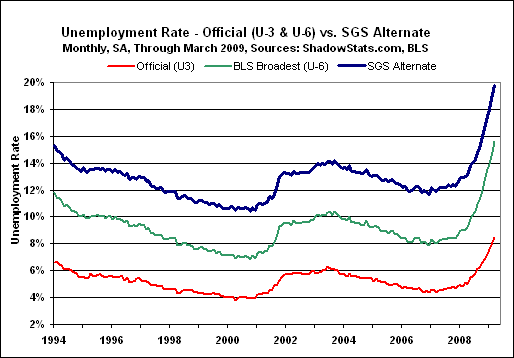
Unemployment Rate. Shown are two official seasonally-adjusted unemployment measures, U.3 and U.6, and the SGS-Alternate Unemployment Measure. The various measures moved sharply higher again in March, reflecting continued rapid deterioration in labor-market conditions. The March rates stood respectively at 8.5%, 15.6% and 19.8%, up from 8.1%, 14.8% and 19.1% in February.
The average person has a pretty good sense as to whether or not he or she is unemployed, regardless of varying official definitions. It is to the broad, common-experience unemployment measure that the SGS-Alternate Unemployment Measure is addressed; its calculation is described below. Ask people simply if they are employed or unemployed, and the response likely would indicate an unemployment rate much closer to 19.8% than to 8.5%.
As to how the rates line up historically, the widely circulated estimate of 25% peak unemployment in 1933 of the Great Depression was guesstimated from a variety of sources as late as 1940. Unemployment was not surveyed at the time. The 1933 estimate appears to reflect what I would call a broad unemployment definition. Where roughly 28% of employment then was agricultural, the nonfarm unemployment rate was estimated at a peak of 34% in 1933. With less than 2% of current employment accounted for by agriculture, the 34% unemployment rate might be the better one to use in comparing the 1933 circumstance with today’s.
Putting the SGS-Alternate Unemployment Measure into perspective, in the best of times, it would have fallen perhaps into the 8% to 9% range. Now approaching 20%, it likely is comparable to the experience in the 1973/1975 recession and still is well shy of the 34% peak reported in 1933.
General background note: U.3 is the popularly followed unemployment rate published by the Bureau of Labor Statistics (BLS), while U.6 is the broadest unemployment measure published by the BLS. U.6 is defined as total unemployed, plus all marginally attached workers, plus total employed part time for economic reasons, as a percent of the civilian labor force plus all marginally attached workers. Marginally attached workers include the discouraged workers who survived redefinition during the Clinton Administration. The SGS-Alternate Unemployment Measure simply is U.6 adjusted for an estimate of the millions of old-definition discouraged workers defined away during the Clinton Administration — those who had been "discouraged" for more than one year.
General background note: Historical data on both the official and SGS-Alternate unemployment series are available for download on the Alternate Data page of www.shadowstats.com. The Alternate numbers are reported from the 1994 series redefinitions forward. While it had been planned to take the alternate series further back in time, such appears to be impractical at the moment, given the lack of ongoing or parallel alternate data, as well as lack of good quality estimates of the impact of methodological shifts.
CPI. Irrespective of the rebound in oil and gasoline prices, March’s annual full inflation rates sank anew due to "declining" energy costs, while so-called "core" inflation held steady on an annual basis. CPI-U (I.7) turned negative, year-to-year. Curiously, the February PCE Deflator (I.5 in the accompanying table), which tends to track closely with the C-CPI-U (I.6), continued to show annual inflation holding well above the C-CPI. Such remains suggestive of conflicting issues in handling energy costs in the government’s various inflation measures.
Nonetheless, with oil prices generally moving higher again, current annual inflation rates should be at or near the trough of the current cycle. Prospective stronger broad money growth and a prospective weaker U.S. dollar (higher related oil prices) threaten much higher inflation ahead this year and next.
General background note: Historical data on both the official and SGS-Alternate CPI series are available for download on the Alternate Data page of www.shadowstats.com. The Alternate CPI numbers tend to show significantly higher inflation over time, generally reflecting the reversal of hedonic adjustments, geometric weighting and the use of a more traditional approach to measuring housing costs, measures all consistent with the reporting methodology in place as of 1980. The changes made are additive, reflecting BLS estimates of the impact of the various methodological changes on the aggregate annual inflation rate. Available as a separate tab at the SGS homepage www.shadowstats.com is the SGS Inflation Calculator that calculates the impact of inflation between any two months, 1913 to date, based on both the official CPI-U and the SGS-Alternate CPI series.

|
Ten Levels of Consumer Inflation
Annual Inflation for December 2008 to March 2009
|
|
Measure
|
Dec
|
Jan 09
|
Feb
|
Mar
|
|
I.1
|
Core PCE Deflator (BEA) (r)
|
1.8%
|
1.7%
|
1.8%
|
n.a.
|
|
I.2
|
Core Chained-CPI-U (BLS) (r)
|
1.3%
|
1.2%
|
1.3%
|
1.3%
|
|
I.3
|
Core CPI-U (BLS)
|
1.8%
|
1.7%
|
1.8%
|
1.8%
|
|
I.4
|
Core CPI-W (BLS)
|
1.7%
|
1.7%
|
1.7%
|
1.8%
|
|
I.5
|
PCE Deflator (BEA)
|
0.8%
|
0.8%
|
1.0%
|
n.a.
|
|
I.6
|
Chained-CPI-U (BLS) (r)
|
-0.5%
|
-0.5%
|
-0.3%
|
-0.8%
|
|
I.7
|
CPI-U (BLS)
|
0.1%
|
0.0%
|
0.2%
|
-0.4%
|
|
I.8
|
CPI-W (BLS)
|
-0.5%
|
-0.5%
|
-0.3%
|
-0.9%
|
|
I.9
|
Pre-Clinton CPI-U (SGS)
|
3.4%
|
3.3%
|
3.6%
|
2.9%
|
|
I.10
|
SGS Alternate Consumer Inflation
|
7.8%
|
7.5%
|
7.7%
|
7.3%
|
|
Sources: SGS, BLS (Bureau of Labor Statistics), BEA (Bureau of Economic Analysis).
Notes: (r) Revised. I.1 to I.4 reflect the core inflation rates, respectively, of the substitution-based personal consumption expenditure (PCE) deflator, the substitution-based Chained-CPI-U, and the geometrically-weighted CPI-U and CPI-W. I.5 to I.8 are the same measures, as standardly reported, with energy and food inflation included. The CPI-U (I.7) "all urban consumers" is the measure popularly followed by the financial press, when the media are not hyping core inflation. The CPI-W (I.8) "urban wage earners and clerical workers is a narrower measure, more heavily weighted in basics such as gasoline, and used in calculating cost-of-living adjustments for items such as Social Security Payments. I.9 is the CPI-U with the effects of geometric weighting (Pre-Clinton Era as estimated by SGS) reversed. This is the top series in the CPI graph on the SGS home page www.shadowstats.com. I.10 reflects the SGS Alternate Consumer Inflation measure, which reverses the methodological gimmicks of the last 25 years or so, plus an adjustment for the portion of Clinton-Era geometric weighting that is not otherwise accounted for in BLS historic bookkeeping.
|
Monday, February 16th, 2009
__________
OVERVIEW - OPENING COMMENTS
"Worst Economy Since…"
Moves to Mid-1970s and Earlier
It may be hard for the federal government to offer $787 billion dollars in stimulus without having a noticeably positive impact on economic activity, but it can be done. Despite prior hype on employment, annual growth in inflation-adjusted retail sales is the first major economic measure to trigger a legitimate "worst since the Great Depression" comparison. The economic contraction now is severe enough to consume the stimulus without affected business activity ever breaking above water. Also, too little of the stimulus package addresses the structural issues driving the downturn. Even if the structural problems were addressed, fundamental recovery would be measured in years, at best. Further, the systemic-solvency crisis is deepening again, with bailout exposures opening up to almost unlimited costs. That situation increasingly looks like it will involve the nationalization of major banks.
The financial markets remain incredibly volatile, unstable and dangerous. Gold has rallied not only from mounting flight-to-safety concerns, but also with a touch of renewed inflation fear. Those betting on the relative safety of the U.S. Treasuries and U.S. dollar underestimate the relative depths and severity of the economic and systemic-solvency crises in the United States versus the rest of the world.
Also underestimated is the upside inflation risk in the United States. The costs to the system of the stimulus and bailout packages will be inflation, with risks of high inflation moving to hyperinflation as early as the end of this year.
Structural Depression Largely Untouched by Stimulus and Bailout Packages. As discussed in greater detail in Shadow Government Statistics Newsletters Nos. 47 and 48 (incorporated here by reference), the deepening economic contraction currently roiling regular commerce and business activity in the United States fundamentally is structural in nature, and it is not subject to an easy or quick fix. The cures being offered by the government should have only limited positive impact on the economy, but they do offer the promise of much higher inflation. They also significantly increase the risk of triggering a U.S. hyperinflation — such was inevitable, based on extreme pre-crisis fiscal abuses — as early as the end of this year. My best estimate on U.S. hyperinflation timing remains in the period of late-2009 to 2014.
The current crisis has developed and evolved during the last four decades, as trade and economic policies — counter to the interests of much of the U.S. citizenry — have resulted in the significant loss of high paying domestic production or technical jobs, where production operations have been lost to offshore competition, or simply moved offshore.
Direct impact of this circumstance has been seen in deteriorating U.S. household income, net of taxes and inflation. Using the government’s numbers, real (inflation-adjusted) average weekly earnings (Bureau of Labor Statistics) in December 2008 were down 14% from the October 1972 high. Average weekly earnings never regained their pre-1973/1975 recession high. Partially as a result, households that once tended to have one breadwinner, now tend to have multiple breadwinners, out of necessity. Even so, the latest poverty survey published by the Census Bureau showed that real household income (average and median) in 2007 still had not regained is pre-2001 recession highs.
The numbers are much worse if the SGS-Alternate Consumer Inflation estimates are used for deflating the income measures. The SGS measure is an attempt to reflect the rate of inflation inherent in maintaining a constant standard of living, as reflected in earlier CPI reporting methodologies. In the real world, average household income has not kept up with the cost of maintaining a constant standard of living, and that shortfall has been met in recent decades, at least partially, by consumers taking on increasing levels of debt.
Indeed, without growth in inflation-adjusted income, real economic growth cannot be sustained, other than through temporary measures such as debt expansion. Aware of this circumstance, former Federal Reserve Chairman Alan Greenspan et al did their best to keep the economy growing in recent decades by encouraging unsustainable debt growth, with a resultant economic growth effectively borrowed from the future. The current downturn is akin something of a payback period.
What I refer to as the "debt standard" was created during the Franklin Roosevelt Administration as replacement for the gold standard. Its expansion through the decades has led to excessive use of debt by government, industry and individuals. In recent years, creative derivative and structured financial instruments have allowed for even greater leverage, building debt excess upon debt excess.
Now, as the debt excesses begin to implode, the federal government, and unusually large segments of local and state governments and the commercial and private sector, face financial distress and possible insolvency. Fallout has been seen in the rapidly intensifying economic contraction.
The current recession, however, began before the solvency/liquidity issues came to a head and was itself instrumental in triggering the systemic liquidity crisis. The systemic liquidity crisis, in turn, has severely exacerbated the economic contraction. Neither President Obama’s stimulus package or Messrs. Geithner and Bernanke’s still-evolving systemic bailout program will turn the economy fundamentally or provide any lasting prop for the equity market. What these packages do promise is an ongoing effort to maintain a functioning system of depository institutions, and higher — much higher — inflation.
Intensifying Economic Pain Prior to 2010 Mid-Term Election. The "American Recovery and Reinvestment Act of 2009" awaits Mr. Obama’s signature. The process that generated the legislation reflected Washington at its worst, with the dominant Democrats pushing through a package that received limited public airing and virtually no Republican support. Given the likelihood that the package will do little to relieve the financial suffering of the electorate before next year’s mid-term election, perhaps the Republicans in Congress are hoping to use such a circumstance to regain seats in Congress. Both parties and related special interests are playing politics as usual with an economic crisis that is dangerous enough to threaten national security.
Given the long lead time of a number the package’s stimuli, and the limited patience of the U.S. populace, however, refinements to the stimulus package or even an Obama Stimulus II may be a fair shot before the 2010 election. Indeed, while the U.S. economic downturn is unusually deep, and government stimulus efforts should help some, the relative positive impact on economic activity likely will not be noticeable, in aggregate, as the positive impact could be swallowed and masked by the severity of the current downturn. Last year’s Bush stimulus package suffered a similar fate, before the downturn intensified. The current stimulus package, however, already has had the undesirable effect of shifting global market focus to the faltering fiscal condition of the U.S. government.
In terms of historical comparisons, it also is worth keeping in mind that what brought the U.S. out of the Great Depression was the outbreak of war in Europe, and military orders received by U.S. manufacturers, not the various social and spending programs introduced by the Roosevelt Administration (see the Reporting/Market Focus Section).
While Mr. Obama — in both his campaign rhetoric and comments as President — has expressed some understanding of the nature of the structural downturn, his package was limited in addressing such issues. For example, rebuilding the nation’s infrastructure — usually viewed as a government (though not always federal) function — indeed would stimulate activity and create new jobs, at least for a while.
Yet, in an early version of the bill, there also was a "Buy American" clause for items such as steel for bridges, an area of clear stimulus for the flagging U.S. steel industry. Foreign complaints threatened under the World Trade Organization (WTO) treaty, however, caused the Administration effectively to scrap that concept, opening the potential of shifting part of the U.S. tax-payer funded stimulus to a U.S. trading partner. The anti-U.S. nature of the WTO is an example of the trade policies of recent decades that have helped to neuter a fair portion of a once much mightier U.S. industrial base.
Other than to suggest that the private sector and the marketplace usually do a much better job than Uncle Sam in running or determining a viable business, I am not going to get into the relative merits, or lack of same, of the federal government intervening in the private sector. Such applies to the government stepping in to salvage or control existing private enterprise such as the banking and automotive industries; as well as to the federal government trying to establish new industry that otherwise already is nascent in the private sector.
If high paying production jobs are gone, the development of new industries and new jobs in fields such as alternate energy and healthcare information is a natural counterpoint. The stimulus funding here, however, is stretched out over time, with the bulk of the outlays in 2011 and beyond.
As new industries develop, though, there is not much to prevent work or production from being outsourced to cheaper labor environments offshore. Such will remain an ongoing structural issue. Irrespective of the lack of desirability of trade conflicts, the U.S. economic problems ultimately come down to trade considerations in terms of the simple economic self-interest of many in the United States. Increasingly, trade matters could be pushed to the fore, particularly if there is an Obama Stimulus II.
Tax cuts almost always are a plus, but their impact pretty much disappears after 2010. I am not going to get into non-stimulus, political-agenda issues and other gimmicks that were added into the package often because public debate of controversial matters could be dodged easily.
Based on the Congressional Budget Office (CBO) assessment of the final $787 billion stimulus package, only $584 billion will be spent before the 2010 election, $185 billion before September 30, 2009 and $399 billion in fiscal 2010. Traditionally, fiscal stimulus has a six- to nine-month lead time versus economic activity, so little economic gain from the package is likely before fourth-quarter 2009.
The CBO’s estimates of economic impact from the package, measured fourth-quarter over fourth-quarter, are an addition of 1.4 to 3.8 percentage points in annual real GDP growth in 2009, 1.1 to 3.3 percentage points in 2010. In terms of civilian employment, fourth-quarter 2009 purportedly could see a cumulative improvement of 0.8 to 2.3 million jobs, fourth-quarter 2010 could see a cumulative improvement of 1.2 to 3.6 million jobs, relative to where employment would have been without the stimulus. The CBO’s estimates, however, tend to be overly optimistic. In the current circumstance, for example, the CBO projects employment growth and broad-based economic recovery in 2010, even without the stimulus bill.
Economic Activity Continues to Sink, Despite Occasional Bottom-Bouncing. The broad economy pretty much continued in freefall in the latest round of economic reporting, in terms of annual pace of decline, although there was some bottom-bouncing in the monthly retail sales number for January. There may be other short-term monthly bottom-bouncing in series such as industrial production. What is at work here is the natural result of the bottom falling out of a market. Activity rarely falls to zero, but it often will bounce along a plateau of low-level activity, before plunging anew. In such circumstances, the year-to-year change usually continues to deepen or temporarily stalls at a low level.
Record Merchandise Trade Deficit in 2008 — Cumulative 4.7 Million Jobs Lost. The U.S. trade deficit, as reflected in the Net Exports account of GDP, is a net subtraction from total U.S. economic activity, where U.S. exports reflect domestic production (a plus), and U.S. imports reflect lost domestic production (a minus). Based on average annual nominal (not adjusted for inflation) GDP of $14,280.7 billion dollars, net exports of a negative $665.1 billion dollars, and average annual civilian employment of 145.362 million, GDP (net of net exports) per employed individual works out to about $102,800. The implied jobs lost to the trade deficit on that basis is a cumulative 6.5 million, but recalculation based on inflation-adjusted activity — a more appropriate measure given oil prices — works out at 4.7 million.
As noted in the Trade Deficit comments in the Reporting Perspective section, for all of 2008, the total deficit on a balance of payments basis narrowed to $677.1 billion, from $700.3 billion in 2007. The reported improvement, however, was due to a purported increase in the "services" surplus, which is little more than a guesstimate.
The "goods" deficit actually widened minimally for the year, to $799.9 billion in 2008, from $794.5 billion in 2007. For the year, the largest trade deficit was with China, at $266.3 billion in 2008, up from $256.2 billion in 2007. Encompassing the second and third worst deficit accounts, the trade deficit with NAFTA partners Canada and Mexico narrowed to $138.6 billion in 2008, from $142.8 billion in 2007. The deficit with Canada increased to $74.2 billion in 2008, from $68.2 billion in 2007, while the deficit with Mexico shrank to $64.4 billion in 2008, from $74.6 billion in 2007. The deficit with Japan also shrank, down to $72.7 billion in 2008 versus $82.8 billion in 2007. Among OPEC members (including Ecuador in both 2007 and 2008), the U.S. trade deficit soared to $175.6 billion in 2008, versus $127.4 billion in 2007, basically reflecting the significantly higher annual average import oil price in 2008 ($95.23 per barrel in 2008, versus $64.28 in 2007).
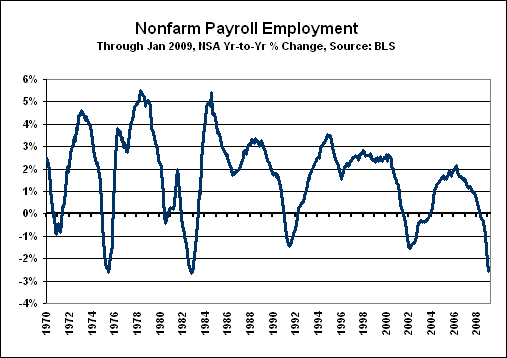
Nonfarm Payroll Losses Much Worse than Headline Reporting (593K Headline versus 1,680K Revised). As discussed in the Employment/Unemployment comments in the Reporting Perspective section, the January 2009 headline payroll contraction, reported at a loss of 598,000 for the month, likely was shy of reality, once again. As reported, though, and as shown in the preceding graph of annual growth in nonfarm payrolls, January 2009 payroll employment was down by 2.6% against January 2008, the steepest decline since the depths of the double-dip recession in the early 1980s. A similar jobs loss in February 2009 would push the annual rate of decline to its lowest level since the 1957/1958 recession, which was a delayed post-Korean War slowdown.
The next graph shows what I call the Concurrent Seasonal Factor Bias, which appears to be built into the current monthly reporting of payrolls (see the Reporting/Market Focus in SGS Newsletter No. 43). Over the period of a year, seasonally-adjusted and unadjusted payroll series should equal each other, with the seasonal factors simply redistributing jobs over time to neutralize the effects of patterns of regular change seen in reporting during the holiday shopping season, the school year, etc. An issue with the payroll series, however, is that the seasonal factors are recalculated each month, as the series develops, which has highlighted and made possible an unusual reporting pattern. Where year-to-year change is an alternate way of eliminating seasonal effects in data, the year-to-year change in the monthly seasonally-adjusted and unadjusted series should be reasonably close, but they are not.
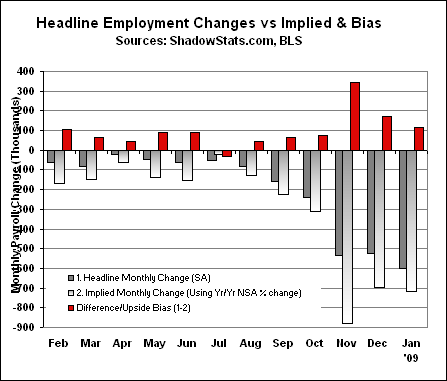
In 11 of the last 12 months, and in 20 of the last 22 months in which I have tracked this particular issue, applying the year-to-year change in unadjusted payroll numbers to the seasonally-adjusted payroll numbers has suggested that reality has been significantly weaker than indicated by the headline payroll numbers as reported by the BLS. The headline numbers are what drive the financial markets. Although the numbers are revised in the next two months of reporting, and in the annual benchmark revisions, the markets rarely take note of revisions, concentrating instead on the latest headline report.
The difference is that if only the headline numbers were tallied, there was a cumulative jobs loss of 593,000 in the 20 months ended November 2008 (December 2008 and January 2009 still are subject to monthly revisions). The SGS estimates made based on the same data published with the headline numbers totaled 1,840,000. In terms of later BLS revisions, total jobs lost in the same period were 1,343,000 before, and 1,680,000 after, the latest benchmark revision.
"Weakest Since …" Estimates Move Back in Time. As shown in the following graphs, annual growth rates in key economic series have continued to tumble. The three-month moving average of the annual decline in housing starts now stands at a contraction of 43.0%, the weakest showing since the double-dip 1980’s recession.
With the annual contraction in the three-month moving average of real retail sales now at 9.4%, it has hit the lowest level of growth in the history of the two historical series that are combined in order to track the numbers back into the late-1940s. Aside from any distortions around World War II, this likely is the weakest showing since the Great Depression.
With annual contraction in industrial production at 7.8%, such is the weakest showing since the 1973/1975 recession.
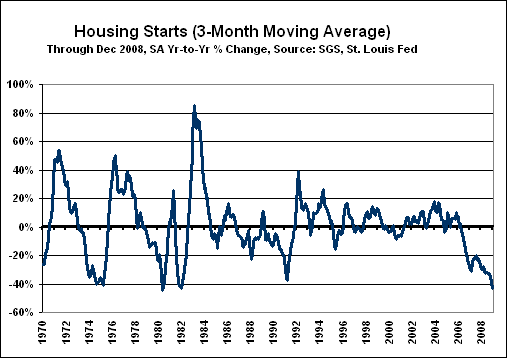
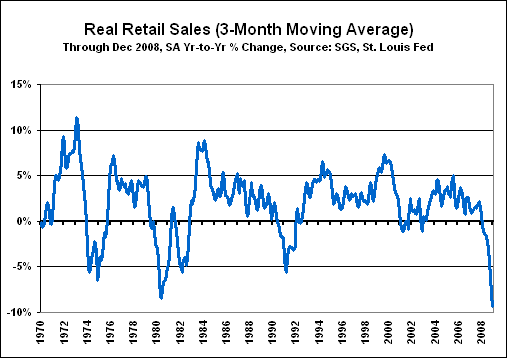
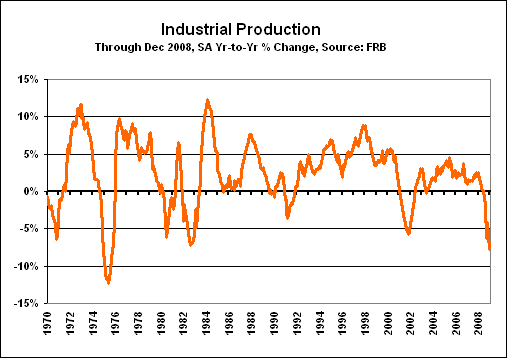
As discussed in the Reporting Perspective, a depression is defined (SGS) as a recession where peak-to-trough contraction in inflation-adjusted economic activity exceeds 10%. That level of contraction currently is exceeded in annualized terms by fourth-quarter 2008 real retail sales, industrial production, new orders for durable goods and housing starts.
Bailout Package Falters as Treasury and Fed Promise More Cash. Treasury Secretary Geithner put forth his latest version of the financial system bailout, promising adequate capital for banks, new stress tests to see which banks are worthy of saving, a public-private investment fund to buy bad assets from troubled banks, extensions of FDIC guarantees, and greater political oversight of banks receiving federal money. With no details provided beyond the usual huffing, puffing and wishful thinking, the stock market tanked in response.
Although the depository system has been salvaged, at least temporarily, the banking system itself remains effectively insolvent, with both the Fed and the Treasury throwing around new trillion-dollar promises as though a trillion dollars is nothing anymore (it quickly would become so in a hyperinflation). Despite some signs of systemic stability, as evidenced by renewed growth in broad money supply, there also are possible signs again of increasing stress (see M3 comments that follow). The depths of the economic and systemic solvency crisis are so severe, the Fed and the Treasury likely are not going to be able to stabilize the banking system without eventual nationalization of at least some of the larger banks. However it unfolds, Messrs. Bernanke and Geithner will create and spend whatever money they have to in order to prevent a systemic collapse, and they will do so until such point as they may have destroyed the purchasing power of the U.S. dollar.
Annual Monetary Base Growth Slows to 81.9% but Required Reserves Jump 57.7%. Friday’s (February 13th) release of bank reserves data showed the annual growth in the St. Louis Fed’s Adjusted Monetary Base easing to 81.9% in the two weeks ended February 11th, versus 103.3% in the two weeks ended January 28th, and a record 107.2% in the two weeks ended January 14th. The slowing growth entirely was due to declining excess reserves, where banks had been parking funds they might otherwise have been lending. If those funds have been shifted into the regular stream of commerce, such is positive news for systemic stability.
Of greater significance to the broader money measures, however, annual growth in required reserves (seasonally-unadjusted) surged to 57.7% in the latest two weeks, up from 45.0% in the prior period and versus 50.4% in the period before that. This record post-World War II annual growth suggests ongoing growth in depository accounts.
The following four graphs are updated for the latest detail in terms of bank reserves and the monetary base (basically currency plus bank reserves). Again, the most significant development is in the continued surge in required reserves growth.
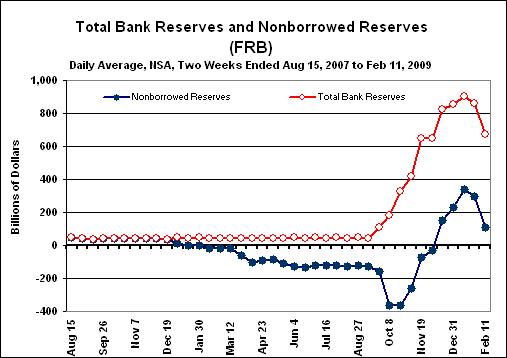
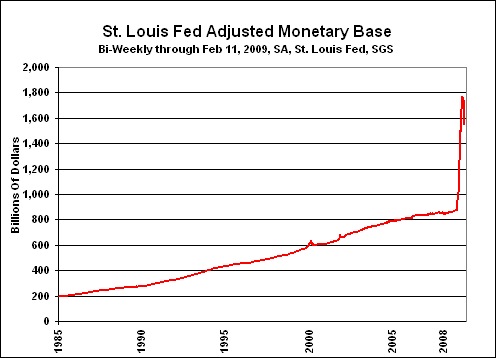
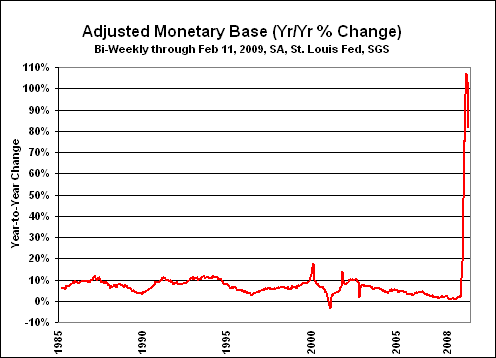
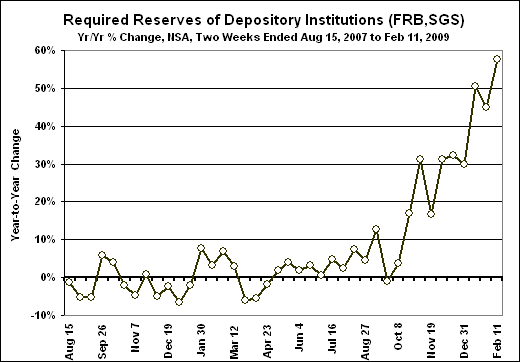
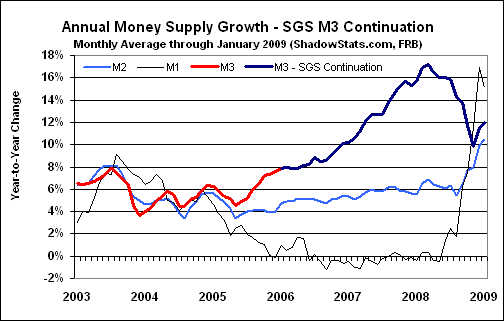
January Annual M3 Growth at 12.0%. As shown above, the annual growth in the SGS-Ongoing M3 measure for January 2009 is estimated at 12.0%, up from 11.4% in December and from the near-term growth trough of 9.8% in November. In the latest reporting (week ended February 2nd), however, weekly declines in seasonally-adjusted M2 and large time deposits largely offset a gain in institutional money funds. While weekly growth patterns vary sharply, any continued faltering of growth in the published M3 components could be a signal of renewed and intensified stress in the banking system. The reserve changes discussed earlier (two weeks ended February 11th), however, suggest increasing broad money growth ahead. Detail will continue in Flash Updates as developments warrant.
The downtick in January’s annual M1 growth just reflects a shifting of funds from checking accounts (M1) to savings accounts (M2).
Inflation Remains the Concern. Mr. Bernanke is dedicated to debasing the U.S. dollar, in order to create inflation and to avoid deflation (he outlined such plans as a Federal Reserve Governor in 2002). The broad money supply has started to grow again, annual growth in required reserves at depository institutions is soaring, and the velocity of money likely is rising again, all suggestive of double-digit consumer inflation later in 2009.
Yet, with some early suggestion of a possible renewed stall in the growth of the broader money measures, the systemic solvency crisis may be intensifying again, frustrating Fed efforts to get more cash into the system. Ahead lies an opportunity for the Fed, with heavy Treasury fundings needed to cover the stimulus package and an otherwise recession-driven deterioration in the federal government’s fiscal condition. With likely light foreign and domestic demand for the Treasury securities, Federal Reserve monetization of that debt would be a reasonably easy option for Mr. Bernanke to help reignite inflationary pressures. The Fed mentioned the possibility of such purchases in its most recent FOMC statement.
All factors considered, the estimated timing for the onset of the hyperinflationary great depression discussed in the Hyperinflation Special Report of April 8, 2008 remains in a range of late-2009 to 2014.
Over the shorter term, volatile oil prices still will move the CPI. With both oil and gasoline prices having bottomed in December — at least temporarily — the January 2009 CPI likely will show a seasonally-adjusted monthly increase and likely will hold around zero on a year-to-year basis, not showing any further significant softening relative to December. Any renewed strength in oil prices would start to boost short-term consumer inflation concerns, anew.
U.S. Dollar Fundamentals Weak — U.S. Generally Worse Off than Rest of World. Despite ongoing strength in the U.S. dollar, I remain extremely bearish on the U.S. currency over the long haul. As discussed later, the underlying fundamentals remain terrible, and despite recent market hype of relatively stronger fundamentals in the U.S. versus its major European trading partners, the reverse is more accurate.
The deepening economic contraction and systemic solvency crisis in the U.S. are much worse than are the related problems among the United States’ major trading partners, particularly against the backdrop of an effective U.S. bankruptcy that was in place before the current crises broke (see the Reporting/Market Focus of prior SGS Newsletter No. 48).
The U.S. dollar ultimately faces a massive selloff, along with dumping of foreign held dollar-denominated assets. The timing of this remains open, but it could break at any time, with little warning. It also could linger in the offing for months. At such time as the greenback comes under heavy selling pressure, U.S. dollar-denominated commodities, particularly oil, will suffer upside dollar pricing pressures as a result of the dollar weakness.
Over the long-term, the broad outlook is little changed. The markets remain highly volatile and dangerous. As to the equity and credit markets, extremely difficult times still lie ahead, with impaired corporate revenues and profits (and the economy) worse than current expectations, and with long-term interest rates likely to move much higher. Rates should rise as financial-panic pressures subside and funds flow out of U.S. Treasuries in response to ongoing dollar debasement (inflation). Also, over the long-term, the U.S. dollar should suffer significant selling, with resulting upside pressure on domestic long-term interest rates. Over the long-term, both gold and silver should rally sharply, in response to the greenback’s eventual problems as well as to mounting flight-to-safety issues.
PLEASE NOTE: A "General background note" provides a broad background paragraph on certain series or concepts. Where the language used in past and subsequent newsletters usually has been or will be identical, month-after-month, any text changes in these sections will be highlighted in bold italics upon first usage. This is designed so that regular readers may avoid re-reading material they have seen before, but where they will have the material available for reference, if so desired.
Alternate Realities. This section updates the Shadow Government Statistics (SGS) alternate measures of official GDP, unemployment and CPI reporting. When a government economic measure does not match common public experience, it has little use outside of academia or the spin-doctoring rooms of the Federal Reserve, White House and Wall Street. In these alternate measures, the effects of gimmicked methodological changes have been removed from the official series so as to reflect more accurately the common public experience, as embodied by the pre-Reagan-Era CPI and GDP and the pre-Clinton Era unemployment rate. Methodologies for the GDP and CPI series are discussed in the August 2006 SGS.
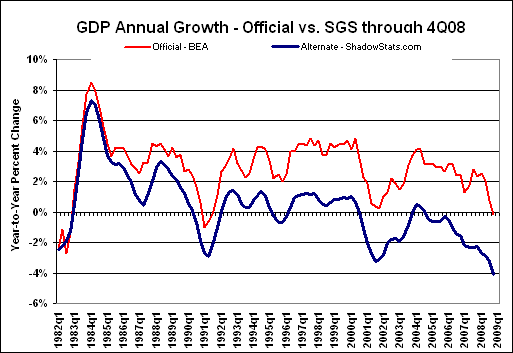
GDP. The alternate fourth-quarter 2008 GDP growth reflects the "advance" estimate, with many of the methodological gimmicks of recent decades removed. The alternate fourth-quarter inflation-adjusted annual growth rate (year-to-year, as opposed to the popularly-touted annualized quarter-to-quarter rate) for GDP was a decline of roughly 4.1% versus the official year-to-year contraction of 0.2%. The official, annualized real quarter-to-quarter change stands at a 3.8% contraction. While the quarterly growth number is popularly followed, its significant inaccuracies are expanded to the fourth-power in reporting. The alternate measure safely would have shown an annualized quarterly contraction in the fourth quarter of more than seven-percent.
General background note: Historical data on both the official and SGS-Alternate GDP series are available for download on the Alternate Data page of www.shadowstats.com. The Alternate GDP numbers tend to show deeper and more protracted recessions than have been reported formally or reflected in related official reporting. Nonetheless, the patterns shown in the alternate data are broadly consistent with the payroll employment and industrial production series, which are major indicators used by the National Bureau of Economic Research in determining the official timing of U.S. business cycles.
Unemployment Rate. Shown are two official seasonally-adjusted unemployment measures, U.3 and U.6, and the SGS-Alternate Unemployment Measure. The various measures moved sharply higher again in January, reflecting continued rapid deterioration in labor-market conditions. The January rates stood respectively at 7.6%, 13.9% and 18.0%, up from 7.2%, 13.5% and 17.5% in December.
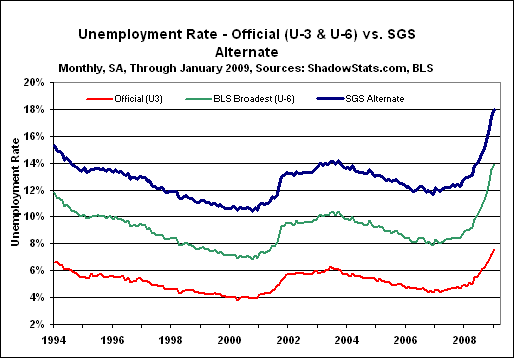
General background note: U.3 is the popularly followed unemployment rate published by the Bureau of Labor Statistics (BLS), while U.6 is the broadest unemployment measure published by the BLS. U.6 is defined as total unemployed, plus all marginally attached workers, plus total employed part time for economic reasons, as a percent of the civilian labor force plus all marginally attached workers. Marginally attached workers include the discouraged workers who survived redefinition during the Clinton Administration. The SGS-Alternate Unemployment Measure simply is U.6 adjusted for an estimate of the millions of discouraged workers defined away during the Clinton Administration — those who had been "discouraged" for more than one year.
General background note: Historical data on both the official and SGS-Alternate unemployment series are available for download on the Alternate Data page of www.shadowstats.com. The Alternate numbers are reported from the 1994 series redefinitions forward. It is planned to take the alternate series further back in time.
CPI. Once again absorbing sharp declines in energy prices, December’s annual full inflation rates eased sharply, while "core" inflation continued to soften as well. Curiously, the PCE Deflator (I.5 in the accompanying table), which tends to track closely with the C-CPI-U (I.6), again showed annual inflation holding well above the C-CPI. Such remains suggestive of conflicting issues in handling the energy cost decline in the government’s various inflation measures.
With oil and gasoline prices moving higher in January, the December annual inflation rates should be at or near the trough of the current cycle. Spiking broad money growth threatens much higher inflation ahead this year, with risk of a sharp dollar decline and oil price spike offering near-term upside risk.
General background note: Historical data on both the official and SGS-Alternate CPI series are available for download on the Alternate Data page of www.shadowstats.com. The Alternate CPI numbers tend to show significantly higher inflation over time, generally reflecting the reversal of hedonic adjustments, geometric weighting and the use of a more traditional approach to measuring housing costs, measures all consistent with the reporting methodology in place as of 1980. Available as a separate tab at the SGS homepage www.shadowstats.com is the SGS Inflation Calculator that calculates the impact of inflation between any two months, 1913 to date, based on both the official CPI-U and the SGS-Alternate CPI series.
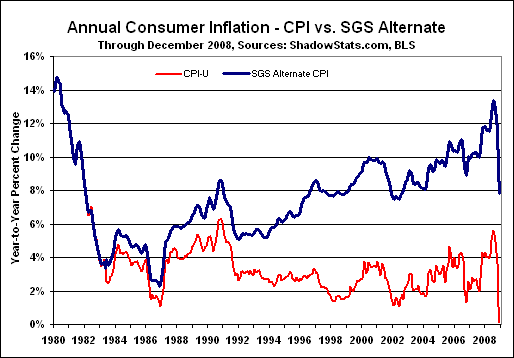
Please Note: At Subscriber request, we have expanded the consumer inflation list to 10 ten indices, adding the CPI-W (urban wage earners and clerical workers), which tracks the more popularly followed CPI-U closely, but which is more heavily weighted toward the basic necessities of living. Accordingly, the I.1 to I.10 numbering scale has been changed to reflect the additions.
|
Ten Levels of Consumer Inflation
Annual Inflation for September to December 2008
|
|
Measure
|
Sep
|
Oct
|
Nov
|
Dec
|
|
I.1
|
Core PCE Deflator (BEA)
|
2.3%
|
2.0%
|
1.9%
|
1.7%
|
|
I.2
|
Core Chained-CPI-U (BLS)
|
2.2%
|
1.9%
|
1.6%
|
1.3%
|
|
I.3
|
Core CPI-U (BLS)
|
2.5%
|
2.2%
|
2.0%
|
1.8%
|
|
I.4
|
Core CPI-W (BLS)
|
2.4%
|
2.1%
|
2.0%
|
1.7%
|
|
I.5
|
PCE Deflator (BEA)
|
4.1%
|
3.2%
|
1.4%
|
0.6%
|
|
I.6
|
Chained-CPI-U (BLS)
|
4.3%
|
3.3%
|
0.7%
|
-0.5%
|
|
I.7
|
CPI-U (BLS)
|
4.9%
|
3.7%
|
1.0%
|
0.1%
|
|
I.8
|
CPI-W (BLS)
|
5.4%
|
3.8%
|
0.7%
|
-0.5%
|
|
I.9
|
Pre-Clinton CPI-U (SGS)
|
8.3%
|
6.9%
|
4.4%
|
3.4%
|
|
I.10
|
SGS Alternate Consumer Inflation
|
12.9%
|
11.6%
|
9.3%
|
7.8%
|
|
Sources: SGS, BLS (Bureau of Labor Statistics), BEA (Bureau of Economic Analysis).
Notes: I.1 to I.4 reflect the core inflation rates, respectively, of the substitution-based personal consumption expenditure (PCE) deflator, the substitution-based Chained-CPI-U, and the geometrically-weighted CPI-U and CPI-W. I.5 to I.8 are the same measures, as standardly reported, with energy and food inflation included. The CPI-U (I.7) "all urban consumers" is the measure popularly followed by the financial press, when the media are not hyping core inflation. The CPI-W (I.8) "urban wage earners and clerical workers is a narrower measure, more heavily weighted in basics such as gasoline, and used in calculating cost-of-living adjustments for items such as Social Security Payments. I.9 is the CPI-U with the effects of geometric weighting (Pre-Clinton Era as estimated by SGS) reversed. This is the top series in the CPI graph on the SGS home page www.shadowstats.com. I.10 reflects the SGS Alternate Consumer Inflation measure, which reverses the methodological gimmicks of the last 25 years or so, plus an adjustment for the portion of Clinton-Era geometric weighting that is not otherwise accounted for in BLS historic bookkeeping.
|
Saturday, January 3rd, 2009
__________
Multiple-Dip Depression Unfolds
Solvency Crisis to Engulf U.S. Government Finances
Stimulus Efforts Would Enhance Hyperinflation Risk
Broad Money Growth Spikes
__________
OVERVIEW — OPENING COMMENTS
Obama Administration to Push Practical Limits of Effective U.S. Fiscal Bankruptcy
By April, the rapidly deteriorating recession will be viewed commonly as the worst downturn since the Great Depression. Fearing same, the incoming Obama Administration is promising stimulus in the form of massive federal spending. Concerns about the government’s fiscal condition can wait until the economy recovers, we are being told. A similar pacifying assurance presumably extends to inflation concerns as well.
Unfortunately, with the economy in a structural downturn (as discussed in the last newsletter) and with the U.S. government effectively bankrupt (as discussed in the Reporting/Market Focus section), there can be no rapid or normal recovery. As inflationary pressures mount anew and the financial markets increasingly shun U.S. Treasuries, an inflationary depression can evolve quickly into a hyperinflationary great depression. Although hyperinflation became inevitable in the last decade, the onset of the process just recently was triggered by Fed and the Treasury actions in addressing the systemic solvency crisis. The process would be accelerated by unfettered and unfunded government spending that appears to loom in early 2009.
The recession is official now, but, as usual, its depth and length have been underestimated. Ahead lies continued economic downturn that likely will evolve as a multiple-dip depression and ultimately a great depression, as hyperinflation eventually kicks in and collapses normal commercial activity. The historical context of the current structural downturn in economic activity was discussed in some detail in the SGS Newsletter No. 47 of November 14, 2008, and is included here by reference.
On the plus side, the tumultuous financial markets appear to have calmed a little, and the Federal Reserve’s panicked liquefaction of the U.S. financial system appears to have triggered some positive early response in bank lending. Yet, along with any relative market tranquility, growth in the broad money supply is spiking anew, and the U.S. dollar has come under renewed selling pressure. The monetary and currency developments bode poorly for the inflation outlook — despite the recent collapse in oil prices and a possible negative reading for December annual CPI — and intensified dollar selling even could start to boost dollar-based oil prices, again. In the year ahead, dollar weakness, an inflation threat (not broadly perceived, yet) and rapidly expanding global political tensions, all will be fodder for the gold market.
Over the long-term, the broad outlook is little changed. As to the equity and credit markets, difficult times lie ahead, with impaired corporate revenues and profits in the deteriorating economic circumstance, and with long-term interest rates likely to move much higher. Rates should rise as financial-panic pressures subside and funds flow out of U.S. Treasuries in response to ongoing dollar debasement (inflation). Again, over the long-term, the U.S. dollar should suffer significant selling, with both gold and silver rallying sharply, partially in response to the greenback’s problems.
Formal Deflation in December CPI? Watch Out for 2009! With collapsing oil prices having pushed the reported annual CPI-U down to 1.0% in November, continued pressures may push the annual CPI-U inflation rate negative in December (see the CPI comments in the Reporting section). While such likely would be extremely shallow and short-lived, it would be formal deflation, nonetheless, the first since the 1950s. Of course, CPI reporting methodologies have changed meaningfully in the last 60 years, and as indicated by the SGS-Alternate CPI measures, today’s zero inflation would be around three-percent or eight-percent, using the respective CPI methodologies in place as of 1990 or 1980.
With oil and gasoline prices having continued to sink into December, with the dollar having strengthened into December, with M3 growth and money velocity likely having slowed into November, and with the prices-paid component of the December purchasing managers manufacturing survey at a 60-year low, it could be hard to argue that much higher inflation looms in 2009.
That said, oil and gasoline prices appeared to be close to a bottom at year-end 2008, with selling pressures mounting anew on the U.S. dollar. A slowing global economy has softened demand for oil, but OPEC has been and likely will continue to address that with production cuts. Also, with the U.S. election out of the way, political tensions in the Middle East and elsewhere around the globe are on the rise again.
Key to the pricing of dollar-denominated commodities — particularly oil — is the value of the U.S. dollar against other currencies. The greenback was manipulated higher, after the Bear Stearns crisis in March, and then suffered extreme distortions as the global financial meltdown forced liquidations of various financial instruments among troubled firms. Dollar fundamentals remained extremely negative, however, and, in the second half of December, net selling pressure resumed on the U.S. currency. Such likely will intensify in the months ahead. If so, not only should oil prices bottom, but they also likely will begin to turn sharply to the upside, once again (see the U.S. Dollar and Oil comments in the respective Markets and Reporting sections).
Most significantly, however, annual M3 growth resumed its upswing in December, beginning to absorb the extreme liquidity pumped into the system by the Federal Reserve. With annual M3 growth rising to an estimated 10.4% in December, from 8.9% in November, growth topping the 17.4% historic high seen in March 2008 likely will be seen before March 2009. Such levels exceed the 16.4% previous historic high of June 1971, which was two months before President Nixon closed the gold window and instituted wage and price controls. Shy of hyperinflation, consumer inflation should hit double digits in 2009.
As discussed in the Reporting/Market Focus, the U.S. government effectively is bankrupt. Yet, extreme fiscal stimulus appears to be likely early in the upcoming Obama Administration, along with a further sharp and immediate increase in U.S. Treasury funding needs. As U.S. and global investors increasingly shun investment in U.S. Treasuries, the Federal Reserve will be forced to monetize that debt, as the lender of last resort to the U.S. government. Accordingly, what likely will become in 2009 the worst U.S. consumer inflation in living memory, increasingly will have the potential to evolve into hyperinflation before the end of the New Year. The estimated timing for the onset of the hyperinflationary great depression discussed in the Hyperinflation Special Report of April 8, 2008 has been narrowed to a range of 2009 to 2014.
Monetary Excesses Continue. As shown in the following graphs, total reserves of depository institutions (FRB, not seasonally adjusted) have continued to surge, rising to $824.1 billion in the two weeks ended December 17th, from $645.6 billion in the prior period, and from $44.2 billion as recently as September 10th. (Late reporting shows total reserves at $856.1 billion in the two weeks ended December 31st). The increase in nonborrowed reserves just means that banks have been placing their cash in reserves faster than the Fed has been lending (the Fed pays interest now on reserves).
Where most of the growth has continued to be in excess reserves, such suggests that the banks generally have not resumed fully-normal lending. Of significance, though, required reserves have been holding above $53 billion, at $53.2 billion in the two weeks ended December 17th ($53.8 in the December 31st period), up from $41.9 billion in the two weeks ended September 10th. Annual growth in required reserves has spiked to 32.0% (as reflected in the graph) and is growing at the fastest pace of the post-World War II era. This indicates that the excess reserves have started entering the system, albeit slowly, but at a pace fast enough to spike broad money growth in December.
The seasonally-adjusted St. Louis Fed Monetary Base — the Fed’s traditional tool for adjusting money supply growth — has continued to spike thanks to the growth in reserves. The monetary base basically includes the currency component of M1 and total bank reserves. Year-to-year growth for the two weeks ended December 17th was a record 97.5%, as shown in the graph. Late reporting for the December 31st period shows annual growth of 99.4%.
Fed apologists offer assurances that the U.S. central bank will dry up excess liquidity when the solvency crisis passes, with no net impact on money supply growth or inflation prospects. Assurances also are being put forth that the surge in government borrowing will be absorbed happily by the usual forced lenders, and that the Fed will not have to monetize Treasury debt further.


Such is nonsense! Money growth has started to accelerate, and there is little that can be done to build global confidence in U.S. Treasuries and the U.S. dollar, given the recent and promised new debasement of the U.S. currency. The Fed is not going to try to collapse money growth with declining economic activity already entering depression. The Fed faces a liquidity trap. It can get the money supply to grow and inflation to spike, but it will not be able to get the economy to rally.
M3 Annual Growth Rebounds. Based on a continuing weekly pickup in key M3 components, the pattern of slowing annual growth seen in the SGS-Ongoing M3 Measure, since April, appears to have bottomed at 8.9% in November. With roughly three weeks of December data in hand, the year-to-year change in the seasonally-adjusted M3 average is estimated to have rebounded to roughly 10.4%. The month-to-month increase in the series — estimated at roughly 2.3% — more than offsets the two month-to-month declines seen in October and November. These estimates will be revised in the next two weeks as more-complete information becomes available.

As bank lending went into a deep freeze and individuals moved to cash or Treasury bills in the unfolding financial panic, not only did annual growth in the broad money supply slow, but also the velocity of money — the speed with which cash turned over in the economy — likely dropped off sharply.
Now, the financial crisis would appear to have calmed to the point that investors are starting to take cash out of their mattresses, and that banks are beginning to lend somewhat more normally. Given the recent excesses of Fed activity, as reflected in soaring annual growth in bank reserves — particularly required reserves — and the monetary base, flow-through to the annual growth in the broad money supply — as reflected in the SGS-Ongoing M3 Measure — likely will surge to the highest levels seen since before the creation of the Federal Reserve in 1913. As bank lending increasingly returns towards normal functioning, and as cash comes out of the mattresses, the velocity of money also should increase. In conjunction with the rising broad money growth, increasing velocity will offer intensified upside pressure on consumer inflation (see the August 3rd Money Supply Special Report for background).
Implications are for a significant pickup in consumer inflation by mid-2009 — despite a severe economic contraction — with likely negative impact on the exchange rate for the U.S. dollar, and likely positive impact on precious metals prices and prices for dollar-denominated commodities such as oil.
Worst Economy Since the Great Depression. Whatever comes forth in the Obama Administration’s economic stimulus package likely will have more of a positive impact on the general economy than did mailing taxpayers direct cash payments in 2008. The checks to taxpayers hardly created a blip in retail sales and did nothing to address the structural issues in the economy. If the promised stimulus indeed is aimed at creating new employment, the impact would be slower in surfacing, but it could have some dampening effect on the contraction, if the funding of the package can be sold to the global markets.
Putting aside philosophical issues as to the relative merits or demerits of the U.S. government increasingly attempting to direct U.S. corporate and/or economic activity (I would argue strongly against such a trend), the new Administration’s biggest problems could be with the credit markets, as discussed in the Reporting/Market Focus.
Getting to the current state of the economy, the Business Cycle Dating Committee of the National Bureau of Economic Research (NBER) — official arbiter of whether or not the U.S. economy is in recession — has determined that the U.S. economy peaked in December 2007 and has been in recession since. I argued in the previous newsletter and still contend that the current downturn began in fourth-quarter 2006, a year earlier than the official start. The current downturn is the second downleg of what will become a multiple-dip depression/great depression (again, SGS Newsletter No. 47 of November 14, 2008 is included here by reference). Economies do not contract in perpetual plunges — they bounce or bottom-bounce — and the pending stimulus package conceivably could help trigger such a bottom-bounce, setting the stage for the next downleg in the structural downturn.
The financial press and Wall Street, of course, will stick with the official version of economic activity, but even that should shift to comparisons with the Great Depression by mid-year. Against its official starting point, the current recession has been ongoing for 13 months and shows no signs of imminent bottoming, where such would be used to mark the recession’s end. By April 2009, the recession will be timed as the longest since the Great Depression (its current 13 months ties the length of the second-dip of the Great Depression in that late 1930s), where, at present, its length was exceeded by the 1973 to 1975 recession and by the second leg of the double-dip recession of the early 1980s.
As shown in the accompanying charts of annual growth in key economic indicators, current economic activity already is at the lowest levels seen since the mid-1970’s and early-1980’s downturns (except for payrolls, which likely will be there in the next monthly reporting).
It is worth noting that shy of the Concurrent Seasonal Factor Bias (also graphed), which has been increasing in recent monthly headline reports of payrolls, the annual payroll contraction reflected in the annual-change graph already might be in the range of the earlier severe recessions (see the Employment comments in the Reporting Section).


By April, all the indicators graphed should be showing new lows in economic activity. Using various measures, both of the major earlier-period contractions have been touted as the weakest economies since the Great Depression. With extreme duration and extreme contraction in place by April, the current "recession" should take on the title as the "weakest economy" since the Great Depression.
Yesterday’s purchasing managers manufacturing survey for the month of December suggests that the mantle already may have been passed. The key index components of production and new orders fell to
their lowest levels ever, since January 1948, suggesting the weakest economy since the Great Depression and the production shutdown following World War II. Also, for the fourth quarter, new orders for durable goods are plunging at an annualized rate of 37%.
Using my SGS-Alternate GDP and my definition of depression — a peak-to-trough contraction in inflation-adjusted economic activity that exceeds 10% — the current downturn should qualify as a depression in the year ahead. Inflation will pick-up in the same time frame. At such time as hyperinflation kicks in (possibly in 2009), normal commerce would tend to cease, and economic activity would tumble into a great depression, with a peak-to-trough downturn exceeding 25%.
PLEASE NOTE: A "General background note" provides a broad background paragraph on certain series or concepts. Where the language used in past and subsequent newsletters usually has been or will be identical, month-after-month, any text changes in these sections will be highlighted in bold italics upon first usage. This is designed so that regular readers may avoid re-reading material they have seen before, but where they will have the material available for reference, if so desired.
Alternate Realities. This section updates the Shadow Government Statistics (SGS) alternate measures of official GDP, unemployment and CPI reporting. When a government economic measure does not match common public experience, it has little use outside of academia or the spin-doctoring rooms of the Federal Reserve, White House and Wall Street. In these alternate measures, the effects of gimmicked methodological changes have been removed from the official series so as to reflect more accurately the common public experience, as embodied by the pre-Reagan-Era CPI and GDP and the pre-Clinton Era unemployment rate. Methodologies for the GDP and CPI series are discussed in the August 2006 SGS.

GDP. The alternate third-quarter 2008 GDP growth reflects the "final" estimate revision, with many of the methodological gimmicks of recent decades removed. The alternate third-quarter inflation-adjusted annual growth rate (year-to-year, as opposed to the popularly-touted annualized quarter-to-quarter rate) for GDP was a decline of roughly 3.3% versus the official year-to-year gain of 0.7%. The official, annualized real quarter-to-quarter change stands at a 0.5% contraction. While the quarterly growth number is popularly followed, its significant inaccuracies are expanded to the fourth-power in reporting. The alternate measure safely would have shown an annualized quarterly contraction in the third quarter, in excess of two-percent.
General background note: Historical data on both the official and SGS-Alternate GDP series are available for download on the Alternate Data page of www.shadowstats.com. The Alternate GDP numbers tend to show deeper and more protracted recessions than have been reported formally or reflected in related official reporting. Nonetheless, the patterns shown in the alternate data are broadly consistent with the payroll employment and industrial production series, which are major indicators used by the National Bureau of Economic Research in determining the official timing of U.S. business cycles.

Unemployment Rate. Shown are two official seasonally-adjusted unemployment measures, U.3 and U.6, and the SGS-Alternate Unemployment Measure. The various measures moved sharply higher again in November, reflecting rapidly deteriorating labor-market conditions. The November rates stood respectively at 6.7%, 12.5% and 16.5%, up from 6.5%, 11.8% and 15.8% in October.
General background note: U.3 is the popularly followed unemployment rate published by the Bureau of Labor Statistics (BLS), while U.6 is the broadest unemployment measure published by the BLS. U.6 is defined as total unemployed, plus all marginally attached workers, plus total employed part time for economic reasons, as a percent of the civilian labor force plus all marginally attached workers. Marginally attached workers include the discouraged workers who survived redefinition during the Clinton Administration. The SGS-Alternate Unemployment Measure simply is U.6 adjusted for an estimate of the millions of discouraged workers defined away during the Clinton Administration — those who had been "discouraged" for more than one year.
General background note: Historical data on both the official and SGS-Alternate unemployment series are available for download on the Alternate Data page of www.shadowstats.com. The Alternate numbers are reported from the 1994 series redefinitions forward. It is planned to take the alternate series further back in time.
CPI. Absorbing continued sharp declines in energy prices, November’s annual full inflation rates eased sharply, while "core" inflation softened as well. Curiously, the PCE Deflator (I.4 in the accompanying table), which tends to track closely with the C-CPI-U (I.5), showed annual inflation easing from 3.2% in October to 1.4% in November, while the C-CPI-U dropped from 3.3% to 0.7%. Such is suggestive of conflicting issues in handling the energy cost decline in the government’s various inflation measures.
Shy of the upcoming, further energy-related battering in December, annual inflation generally should be bottoming out, with much higher inflation seen by mid-2009. Renewed dollar weakness, renewed acceleration in broad money growth and a likely bottoming in energy prices, all should combine with existing inflationary pressures from the ongoing flow-through impact of energy-cost damages still working through the general economy, and from the upside inflation pressures from monetary growth in place before the systemic solvency crisis.
General background note: Historical data on both the official and SGS-Alternate CPI series are available for download on the Alternate Data page of www.shadowstats.com. The Alternate CPI numbers tend to show significantly higher inflation over time, generally reflecting the reversal of hedonic adjustments, geometric weighting and the use of a more traditional approach to measuring housing costs, measures all consistent with the reporting methodology in place as of 1980. Available as a separate tab at the SGS homepage www.shadowstats.com is the SGS Inflation Calculator that calculates the impact of inflation between any two months, 1913 to date, based on both the official CPI-U and the SGS-Alternate CPI series.

|
Eight Levels of Consumer Inflation
Annual Inflation for August to November 2008
|
|
|
|
|
|
|
|
|
Measure
|
Aug
|
Sep
|
Oct
|
Nov
|
|
I.1
|
Core PCE Deflator (r)
|
2.4%
|
2.3%
|
2.0%
|
1.9%
|
|
I.2
|
Core Chained-CPI-U
|
2.2%
|
2.2%
|
1.9%
|
1.6%
|
|
I.3
|
Core CPI-U
|
2.5%
|
2.5%
|
2.2%
|
2.0%
|
|
I.4
|
PCE Deflator (r)
|
4.4%
|
4.1%
|
3.2%
|
1.4%
|
|
I.5
|
Chained-CPI-U
|
4.7%
|
4.3%
|
3.3%
|
0.7%
|
|
I.6
|
CPI-U
|
5.4%
|
4.9%
|
3.7%
|
1.0%
|
|
I.7
|
Pre-Clinton CPI-U
|
8.7%
|
8.3%
|
6.9%
|
4.4%
|
|
I.8
|
SGS Alternate Consumer Inflation
|
13.2%
|
12.9%
|
11.6%
|
9.3%
|
|
(r) Revised.
Notes: I.1 to I.3 reflect the core inflation rates, respectively, of the substitution-based personal consumption expenditure (PCE) deflator, the Chained-CPI-U and the geometrically-weighted CPI-U. I.4 to I.6 are the same measures with energy and food inflation included. The CPI-U (I.6) is the measure popularly followed by the financial press, when the media are not hyping core inflation. I.7 is the CPI-U with the effects of geometric weighting (Pre-Clinton Era as estimated by SGS) reversed. This is the top series in the CPI graph on the SGS home page www.shadowstats.com. I.8 reflects the SGS Alternate Consumer Inflation measure which reverses the methodological gimmicks of the last 25 years or so, plus an adjustment for the portion of Clinton-Era geometric weighting that is not otherwise accounted for in BLS historic
bookkeeping.
|
Friday, November 14th, 2008
__________
Still-Intensifying U.S. Inflationary Recession
Systemic Solvency Crisis/Market Instability Not Contained
Obama Faces Same Limited Options as Bush
Hyperinflation Possible in 2009
__________
OVERVIEW — OPENING COMMENTS
Relapse of Severe U.S. Dollar Woes Could
Trigger Next Phase of Financial Crisis
Despite extraordinary actions by the Federal Reserve, U.S. Treasury and other central banks and finance ministries, the global solvency crises, financial panics and market distortions and instabilities continue. While the collapse of a functional U.S. banking system has been avoided, so far, bank lending has not resumed meaningfully, and other weak links in the economy appear ready to break. Possible failures of the "Big-Three" U.S. automakers now are touted in the financial media. Where GM once boasted, "What is good for General Motors is good for America," a failure there would be the ultimate symbol of structural destruction that has sapped U.S. economic activity for decades. Structural issues drove the economy into deep recession well before any crises exacerbations. With the economy in recession, oil prices down and the dollar stronger, deflation concerns abound. Yet, inflation ultimately is a monetary phenomenon, and the Fed’s recent monetary incontinence promises much higher inflation ahead, regardless of near-term CPI gyrations from the pre-election plunge in gasoline prices.
Inflation/Deflation, Money Supply, U.S. Dollar, Price of Gold, G-20 Are Key Questions. I have received a large number of questions from readers concerning inflationary and deflationary pressures, what is or is not happening to money supply, what is the outlook for the U.S. dollar and gold given significant recent relative counterintuitive gains and losses in those markets, among other issues. Those areas are discussed in the sections ahead, and further, related reader queries are invited.
This weekend’s G-20 meeting, though called to address the global nature of the ongoing financial-system crisis, is not likely to generate any surprises, but one never knows. There is talk of coordinated fiscal stimulus, but, as discussed later, the U.S. has increasingly limited options in that area. There is talk of establishing global regulatory oversight of the financial services industry, but such would do little to improve the current circumstance, and it is not likely that the U.S. would yield any sovereignty over its domestic markets and financial institutions, at present. To the extent anything of substance is forthcoming, such will be addressed in a separate Flash Update or Alert, as usually would be the case for a significant economic or market development in the period between full newsletters.
With third-quarter GDP reported in contraction, and with consensus forecasters and the popular financial media talking recession, my claims of the economy being in a protracted, deep recession are among the least controversial of my analyses. Accordingly, this special double issue concentrates first on the solvency/financial crisis and the resulting monetary implications for inflation. Explored second are the nature, depth and prospects for the ongoing recession, with the downturn considered in historical context in this month’s Reporting/Market Focus.
General Outlook is Unchanged, Except for Hyperinflation Timing (2009). With the financial markets unstable and the systemic-solvency crisis ongoing, my broad outlook has not changed. The various markets are about as volatile and as dangerous as they can get. With extraordinary crosscurrents from the solvency crisis and various governmental and global central bank interventions in the markets and marketplace, volatility likely will continue, sometimes in directions that may seem irrational.
The gold and currency markets, in particular, have suffered extreme distortions, moving against strong fundamentals. As deleveraging pressures subside (timing unknown), the U.S. dollar should come under heavy selling pressure, once again, likely triggering a rebound in gold as well as some pick-up in oil prices. Over the longer term, U.S. equities, bonds and the greenback should suffer terribly, while gold and silver prices should boom.
The U.S. continues in a severe, inflationary recession that was well underway before the housing/ mortgage crisis attracted attention. Little can be done to stimulate near-term economic activity, to contain inflation or to provide a long-term prop to equity values. The government, however, does have the ability to support depositor safety, to prevent a collapse of the related financial services industry and to prevent a deflation in the prices of goods and services. Those government actions are underway, and the cost of systemic salvation is higher price inflation, despite plunging oil prices.
As broad money growth accelerates, inflation will increase. When heavy dollar selling begins anew, and dollar dumping leads to dumping of dollar-based assets held by foreign investors, the Fed will find itself in a circumstance where increasingly it will have to monetize accelerating Treasury debt supply. Under that combination of circumstances, I am moving ahead in time the possible onset of hyperinflation into 2009, from 2010 in the previously estimated range of 2010 to 2018, detailed in the Hyperinflation Special Report of April 2008.
In the severe structural downturn that has unfolded over decades, the U.S. economy cannot be turned overnight with quick-fix stimulus packages that otherwise might help balance out a brief and shallow inventory recession (where production is cut in order to work-off an excess build-up in inventories). An economic fix requires structural change and time. What looms is a depression, which would become a great depression in the event of the disruption to normal commerce from a period of hyperinflation (see the Reporting/Market Focus section).
Obama Faces Same Fiscal Limitations as Bush. The Obama Administration will face the same fiscal constraints that the Bush Administration has faced but largely ignored. Presumably, if Bush could ignore the fiscal constraints, then so could Obama. As the U.S. government’s effective long-term bankruptcy gains broader recognition, however, Uncle Sam increasingly will have difficulty selling its debt to anyone other than the Federal Reserve (see the Hyperinflation Special Report of April 8, 2008). Shy of what new debt can be foisted on a gullible public or severely pressured U.S. trading partners, there should be zero new funds available to pay for new government programs, expanded programs or fiscal stimulus.
Nonetheless, the political miscreants in Washington will continue to spend money they do not have and that they have no prospects of ever raising, at least until the financial markets start to say "no more." With the economy in a structural contraction, promised further fiscal stimulus will have increasingly short-lived positive impact on the economy, but increasingly dire consequences for the U.S. fiscal condition and the U.S. dollar.
Views expressed by President-Elect Obama have been heavily suggestive of a rapid push by his Administration for a more-expansive, more-controlling, more-intrusive and more-expensive central government. As a rule of thumb, forced redistributions of income and wealth, greater government control of production and commerce, and more-intrusive government programs such as nationalized health insurance tend to lead to a less productive and less competitive society. Such programs limit economic growth and — at the extreme — ultimately condemn business activity to perpetual bottom-bouncing. Such programs not only would exacerbate the current structural downturn in the U.S. economy, but also would accelerate the timing on the eventual hyperinflation, given the deficit financing needs of same.
U.S. Dollar Strength a Temporary Artifact of Ongoing Solvency Crisis. As discussed in greater detail in the respective market or reporting sections, the sharp rise in the value of the U.S. dollar has been key to the decline in gold, silver and oil prices. The dollar’s recent surge has been heavily affected by the dollar-holding needs of foreign investors in the process of deleveraging. That process is ongoing. At such time as the markets begin to stabilize, the pressures on the dollar likely will shift sharply to the sell side, which in turn should help to boost pricing both for precious metals, as well as for dollar-denominated oil.
Oil/Gasoline Price Declines Partially Pre-Election Politics? When national gasoline prices averaged above $4.10 per gallon back in June and July — with oil prices at record highs — not only was the gasoline-consuming electorate feeling increasing cost-of-living discomfort, but the political implications for the incumbent Republican Party holding the White House were horrendous. Beyond the possibility of political deals that may have been struck within the global oil industry, a sudden and unfounded surge in buying of the U.S. dollar began (likely Treasury/Fed encouraged), which added significant downside pressure to oil prices. Those factors, combined with already weakening gasoline demand and normal seasonal price variation, brought gasoline prices down by about 45% to an average $2.28 per gallon in the week including election day, back to price levels not seen since February 2007 (Department of Energy numbers).
With the election having gone against the Republicans, whatever political pressures were there to keep gasoline prices low, have vanished. Any new political pressures now will be coming from the Democrats, along with what had been promises of something along the lines of a windfall profits tax for U.S. oil corporations.
Gasoline Prices Will Reduce Near-Term CPI Inflation. Those arguing that the U.S. faces deflation, as opposed to inflation, in goods and services prices in the not-too-distant future — an actual in contraction annual CPI inflation — anticipate contracting money growth and look at collapsing commodity prices hit by an unfolding, savage global recession. In fact, the October manufacturing purchasing managers survey showed a sharp decline in its price index into deflation territory.
Near-term CPI reporting likely will see two fairly strong, seasonally-adjusted monthly contractions in October and November, thanks to the recent collapse in gasoline prices, but that should be about the extent of the oil induced "deflation." As these particularly large declines are absorbed by the CPI, annual inflation will not come close to turning negative.
Aside from risks of a resurgence in oil prices — discussed later — possibly adding near-term upside pressures on energy prices, the long-term impacts of a weaker dollar and high oil prices still are working their way through the system, during the next six months or so.
As a separate and overriding issue, price inflation is a monetary phenomenon. Although broad money growth has slowed on an annual basis (to a level that still is highly inflationary) and contracted on a monthly basis, and although velocity may have slowed along with the solvency crisis, actions by the Federal Reserve and U.S. Treasury have put into play a surge in money growth that should become painfully evident in the next several months. As money growth resumes, so, too, will velocity accelerate, as consumers again consider the implications of negative real interest rates.
Federal Deficit and Debt Continue to Explode. As discussed in more detail in the federal deficit section, gross U.S. federal debt at the end of October had increased by $928 billion since the end of August, an increase of 10.2% in two months. The officially gimmicked federal deficit was $169 billion in 2007, $455 billion in 2008, and it appears to be headed to $1.5 trillion in 2009. Such has contributed to the timing advance in the possible year of the hyperinflation onset.
Risks of U.S. Default. I keep receiving queries on a possible default on U.S. debt within the next year or so, as result of the explosive growth in federal debt. Such is not likely, unless foreign lenders start making not-so-unreasonable demands that the United States issue its debt in yen, pounds, euros, etc. While the government’s gross debt level is exploding, the United States already had no prospects of ever honoring the obligations that were in place before the current crisis (see the Hyperinflation Special Report of April 8, 2008). Under such circumstances, most governments would opt to use the printing press to inflate their way out of debt, rather than to go through a formal debt default.
That is why the agencies that issue sovereign debt ratings usually will give a "AAA" rating, when debt is issued in the sovereign’s currency, backed by the power of being able to create whatever currency is needed in order to meet the obligations.
If, however, the U.S. had to start covering new obligations in something other than the U.S. dollar, then the risk of formal default would become meaningful, and sovereign ratings on non-dollar U.S. Treasury debt easily could fall below investment grade.
Reserves and Monetary Base Surge, Broad Money Measure Still Lags. As shown in the following graphs, total reserves of depository institutions (FRB, not seasonally adjusted) continued to surge, rising to $415.7 billion in the two weeks ended November 5th, from $327.6 billion in the prior two-week period, and from $44.2 billion as recently as September 10th.
Where most of the growth has been in excess reserves, such suggests that the banks generally have not resumed normal lending. Of some significance, however, required reserves rose to $52.1 billion in the latest period, up from $45.9 billion in the prior period and from $41.9 billion in the two weeks ended September 10th. The 31.9% annual growth in required reserves is at the fastest pace of the post-World War II era. This suggests that the excess reserves have started entering the system, albeit slowly, even allowing for shifts in unreserved existing funds into accounts that have reserve requirements.
The seasonally-adjusted St. Louis Fed Monetary Base — the traditional tool for adjusting money supply growth — rose by 7.0% (annualizes to over 3200%) between the two-week periods ended October 22nd and November 5th. The monetary base basically includes the currency component of M1 and total bank reserves. Year-to-year growth for the latest two week period was 48.2%, up from 38.0% year-to-year in the prior period, due largely to surging reserves.
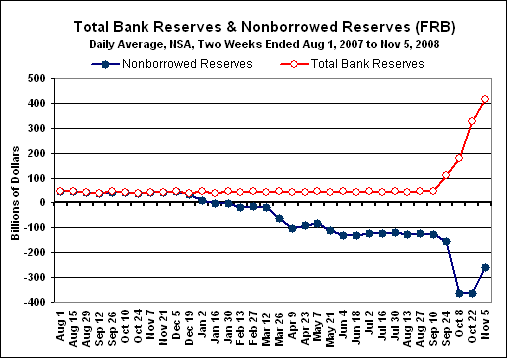
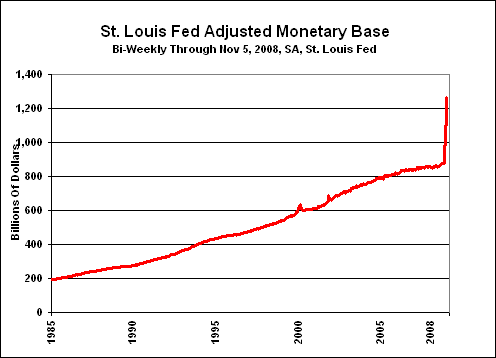
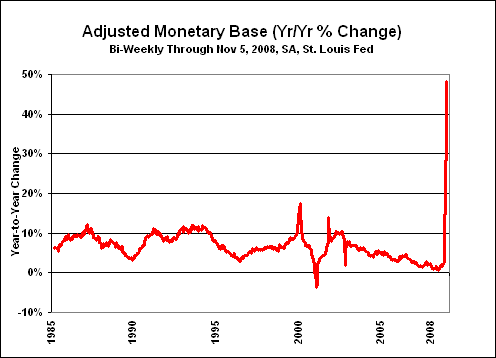
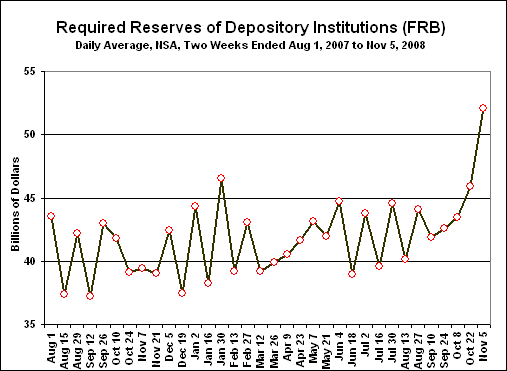
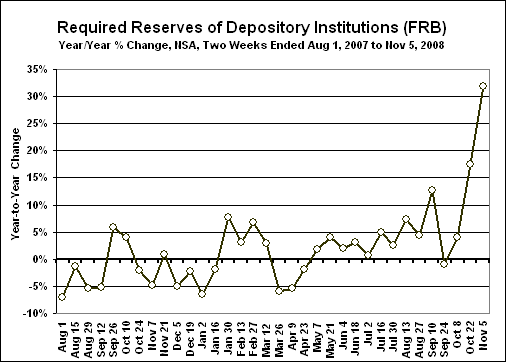
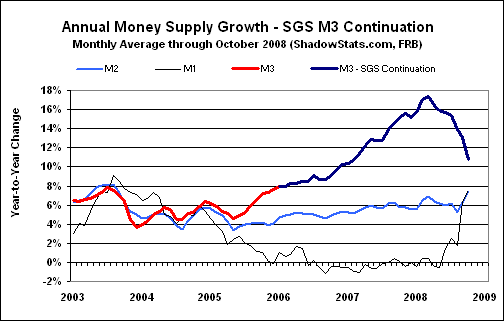
Annual Broad Money Growth Slows, Contracts on Monthly Basis. The monthly-average annual growth in the SGS-Ongoing M3 estimate for October was roughly 10.8%, still a highly inflationary level, and likely the trough in the current growth cycle. Monthly change was a contraction of 0.4%, the ninth such contraction since 2000. There are indications that the M3 components have started to pick-up in response to the recent extreme accommodation by the Federal Reserve. Details will be provided in Flash Updates as the information becomes available.
As discussed in the Money Supply Special Report of August 3, 2008, there is no perfect measure of money growth. Generally, the broader the measure (M3 being the broadest until discontinued by the Fed in 2006, still estimated by the SGS-Ongoing M3), the better it is as a predictor of inflation. Discontinued in 1998 by the Fed was a still-broader measure known as "L" for liquid assets. It contained individual holdings of Treasury bills. In the recent panic, the Treasury issued bills to help keep that market liquid, but that had the effect of drawing cash out of the system and out of the reported money supply. If "L" still were published, I estimate annual growth would have been about 15% in October.
Fed apologists offer assurances that the U.S. central bank will dry up excess liquidity when the crisis passes, with no net impact on money supply growth or inflation prospects. Assurances also are being put forth that the surge in government borrowing will be absorbed happily by the usual forced lenders, and that the Fed will not have to monetize Treasury debt further. Do not count on that! As to talk of declining money supply velocity in the current crisis, such has some merit, but as bank lending returns to normal (which it will, as it is forced by the Fed, the Treasury and Congress), so, too, will velocity likely accelerate anew in response to still negative real (inflation-adjusted) interest rates.
Formal Recession Appears Near. A week before the "advance" estimate of third-quarter GDP was released, the White House effectively warned that it would show a contraction, as would likely the fourth quarter. Such would be a recession terms of traditional definition. Whether that will happen, however, remains to be seen. Recent trade reporting could allow for the artificially small 0.3% third-quarter contraction to revise away.
As shown by almost all major economic indicators, the U.S. economy is in a deep and deteriorating structural recession, which could reach depression status in 2009. The nature of the structural problem and depth of the current downturn are addressed in historical perspective in the Reporting/Market Focus. Based on existing GDP, GDI and GDP reporting, the following quarters have shown inflation-adjusted quarterly contractions: 1Q07 (GNP/GDI), 4Q07 (GDP/GDI), 1Q08 (GDI), 3Q08 (GDP). Accordingly, in conjunction with the better quality underlying economic series, these patterns suggest that a formal recession could be timed from as early as fourth-quarter 2006.
Such timing would support my contention that the current downturn is but the second leg of a multiple-dip recession that began back in 2000. Given the recession’s structural nature and the present fiscal limitations on the U.S. government, this contraction will be particularly protracted. Recovery is not yet within the nine-month horizon of the better leading indicators to economic activity.
The following series of six graphs reflect the official recessions of 1969/70, 1973/5, 1980, 1981/2, 1990/1 and 2001 (see this month’s Reporting/Market Focus), as shown with the low readings or the depths of contraction never seen outside of official recessions. The less-severe downswings tend to coincide with unofficial downturns, also discussed in this month’s Reporting/Market Focus.
The consumer confidence and sentiment measures have shown extremely sharp downturns, and are consistent with the annual growth patterns seen in housing starts and retail sales, as well as the later pattern seen in payrolls. In like manner industrial production has mirrored the pattern of consumer demand.
In each series showing year-to-year change, the patterns show not only sharp year-to-year contraction in the last year or two, but the underlying numbers in each series also show successive quarter-to-quarter contractions. These patterns of sharp contractions never have been seen outside of periods of formal recessions.
The housing starts graph was adjusted to eliminate New York City paperwork distortions that artificially inflated June 2008 reporting. The retail sales graph includes October reporting, with an estimate of a seasonally adjusted 1.0% decline in the October CPI.
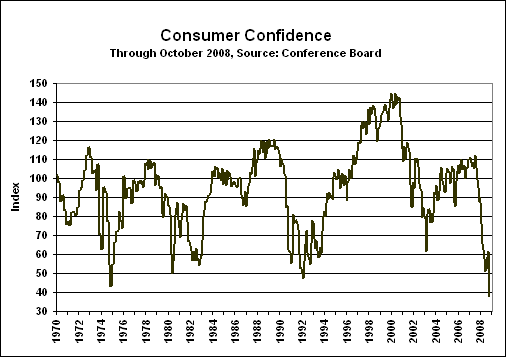
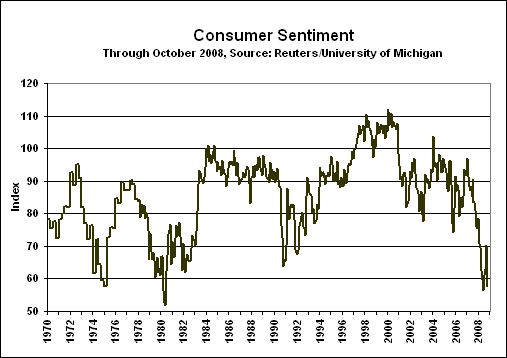
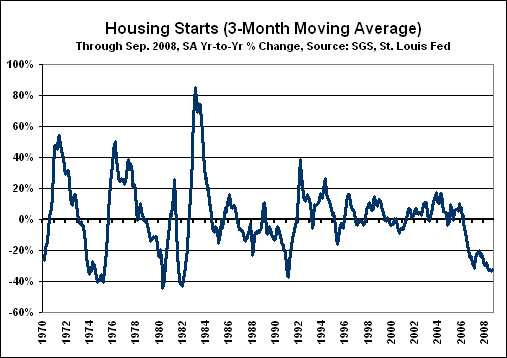
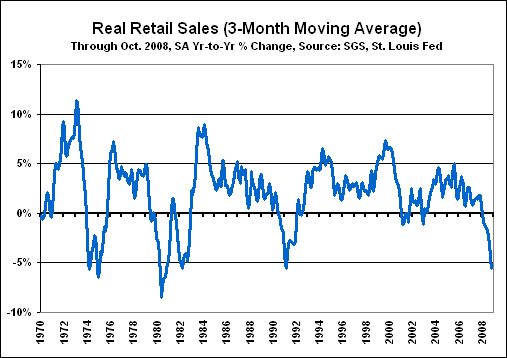
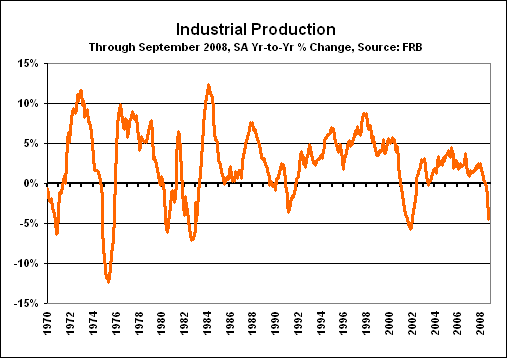
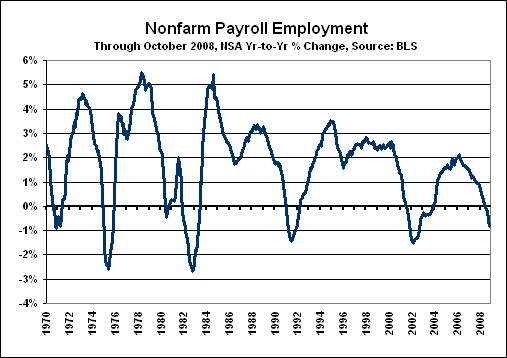
PLEASE NOTE: A "General background note" provides a broad background paragraph on certain series or concepts. Where the language used in past and subsequent newsletters usually has been or will be identical, month-after-month, any text changes in these sections will be highlighted in bold italics upon first usage. This is designed so that regular readers may avoid re-reading material they have seen before, but where they will have the material available for reference, if so desired.
Alternate Realities. This section updates the Shadow Government Statistics (SGS) alternate measures of official GDP, unemployment and CPI reporting. When a government economic measure does not match common public experience, it has little use outside of academia or the spin-doctoring rooms of the Federal Reserve, White House and Wall Street. In these alternate measures, the effects of gimmicked methodological changes have been removed from the official series so as to reflect more accurately the common public experience, as embodied by the pre-Reagan-Era CPI and GDP and the pre-Clinton Era unemployment rate. Methodologies for the GDP and CPI series are discussed in the August 2006 SGS.
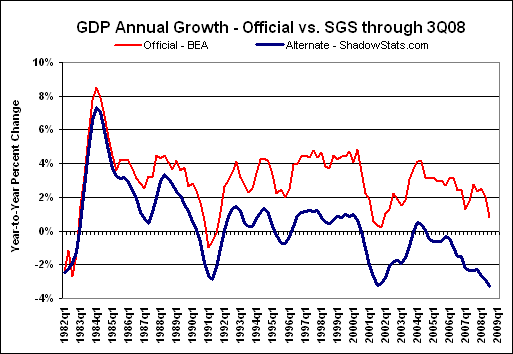
GDP. The alternate third-quarter 2008 GDP growth reflects the "advance" estimate, with many of the methodological gimmicks of recent decades removed. The alternate third-quarter inflation-adjusted annual growth rate (year-to-year, as opposed to the popularly-touted annualized quarter-to-quarter rate) for GDP was a decline of roughly 3.3% versus the official year-to-year gain of 0.8%. The official, annualized real quarter-to-quarter change stands at a 0.3% contraction. While the quarterly growth number is popularly followed, its significant inaccuracies are expanded to the fourth-power in reporting. The alternate measure safely would have shown an annualized quarterly contraction in the third quarter, likely in excess of two-percent.
General background note: Historical data on both the official and SGS-Alternate GDP series are available for download on the Alternate Data page of www.shadowstats.com. The Alternate GDP numbers tend to show deeper and more protracted recessions than have been reported formally or reflected in related official reporting. Nonetheless, the patterns shown in the alternate data are broadly consistent with the payroll employment and industrial production series, which are major indicators used by the National Bureau of Economic Research in determining the official timing of U.S. business cycles.
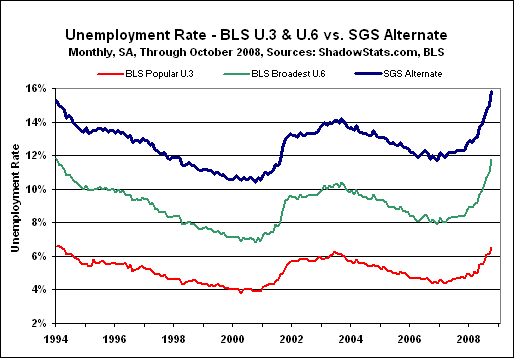
Unemployment Rate. Shown are two official seasonally-adjusted unemployment measures, U.3 and U.6, and the SGS-Alternate Unemployment Measure. The various measures moved sharply higher in October, reflecting the rapidly deteriorating labor-market conditions. They stood respectively at 6.5%, 11.8% and 15.8%, up from 6.1%, 11.0% and 15.0%.
General background note: U.3 is the popularly followed unemployment rate published by the Bureau of Labor Statistics (BLS), while U.6 is the broadest unemployment measure published by the BLS. U.6 is defined as total unemployed, plus all marginally attached workers, plus total employed part time for economic reasons, as a percent of the civilian labor force plus all marginally attached workers. Marginally attached workers include the discouraged workers who survived redefinition during the Clinton Administration. The SGS-Alternate Unemployment Measure simply is U.6 adjusted for an estimate of the millions of discouraged workers defined away during the Clinton Administration — those who had been "discouraged" for more than one year.
General background note: Historical data on both the official and SGS-Alternate unemployment series are available for download on the Alternate Data page of www.shadowstats.com. The Alternate numbers are reported from the 1994 series redefinitions forward. It is planned to take the alternate series further back in time.
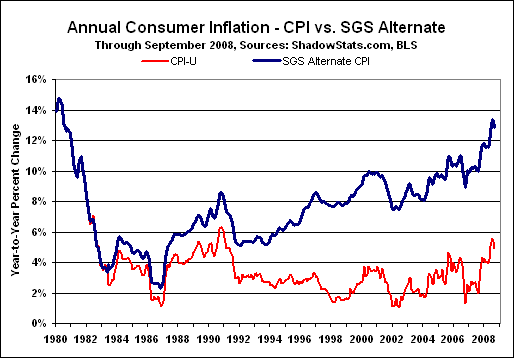
CPI. Absorbing a further sharp decline in energy prices, September’s annual full inflation rates eased again, while "core" inflation largely held at August levels. Shy of October and November’s pending inflation dips from the pre-election plunge in gasoline prices, annual inflation generally should rise well into 2009, with mounting inflationary pressures reflecting the ongoing flow-through impact of energy-cost damages to the general economy and upside inflation pressures from monetary growth in place before the recent systemic solvency crisis. Renewed and intensified money growth and dollar selling will spike the longer range inflation outlook further.
General background note: Historical data on both the official and SGS-Alternate CPI series are available for download on the Alternate Data page of www.shadowstats.com. The Alternate CPI numbers tend to show significantly higher inflation over time, generally reflecting the reversal of hedonic adjustments, geometric weighting and the use of a more traditional approach to measuring housing costs, measures all consistent with the reporting methodology in place as of 1980. Available as a separate tab at the SGS homepage www.shadowstats.com is the SGS Inflation Calculator that calculates the impact of inflation between any two months, 1913 to date, based on both the official CPI-U and the SGS-Alternate CPI series.
|
Eight Levels of Consumer Inflation
Annual Inflation for June to September 2008
|
|
|
|
2008
|
|
|
|
|
Measure
|
Jun
|
Jul
|
Aug
|
Sep
|
|
I.1
|
Core PCE Deflator (r)
|
2.3%
|
2.5%
|
2.5%
|
2.4%
|
|
I.2
|
Core Chained-CPI-U
|
2.1%
|
2.2%
|
2.2%
|
2.2%
|
|
I.3
|
Core CPI-U
|
2.4%
|
2.5%
|
2.5%
|
2.5%
|
|
I.4
|
PCE Deflator (r)
|
4.1%
|
4.5%
|
4.5%
|
4.2%
|
|
I.5
|
Chained-CPI-U
|
4.2%
|
4.8%
|
4.7%
|
4.3%
|
|
I.6
|
CPI-U
|
5.0%
|
5.6%
|
5.4%
|
4.9%
|
|
I.7
|
Pre-Clinton CPI-U
|
8.3%
|
8.9%
|
8.7%
|
8.3%
|
|
I.8
|
SGS Alternate Consumer Inflation
|
12.6%
|
13.4%
|
13.2%
|
12.9%
|
|
(r) Revised.
Notes: I.1 to I.3 reflect the core inflation rates, respectively, of the substitution-based personal consumption expenditure (PCE) deflator, the Chained-CPI-U and the geometrically-weighted CPI-U. I.4 to I.6 are the same measures with energy and food inflation included. The CPI-U (I.6) is the measure popularly followed by the financial press, when the media are not hyping core inflation. I.7 is the CPI-U with the effects of geometric weighting (Pre-Clinton Era as estimated by SGS) reversed. This is the top series in the CPI graph on the SGS home page www.shadowstats.com. I.8 reflects the SGS Alternate Consumer Inflation measure, which reverses the methodological gimmicks of the last 25 years or so, plus an adjustment for the portion of Clinton-Era geometric weighting that is not otherwise accounted for in BLS historic
bookkeeping.
|
Monday, September 29th, 2008
OVERVIEW — OPENING COMMENTS
The Financial Tempest Makes Landfall
Watch Out for the Dollar!
In terms of magnitude, global scope and the underlying complexity and interdependencies of troubled financial instruments, the systemic solvency upheaval roiling the U.S. and global financial markets is without precedence. The crisis is the natural outcome of decades of financial leverage being built upon financial leverage; from decades of income variance being pushed even beyond that which preceded the 1929 financial panic, and the panics and Great Depression of the 1930s (see this issue’s Reporting/Market Focus); and from decades of enabling policies and a willful lack of oversight by the U.S. Federal Reserve and the federal government, which pandered to the needs of Wall Street and to an electorate increasingly addicted to instant gratification.
As this is being written on Sunday afternoon, a $700 billion "bailout" package purportedly has been agreed upon by the White House and Congress (any needed updates on the general outlook will be advised by an Alert). What can and will be bailed out at any and all costs by Treasury Secretary Paulson and Federal Reserve Chairman Bernanke — though not necessarily by the current bailout package — is an ongoing and functional banking and financial system. The cost of such remains much higher inflation. What cannot be prevented by any bailout are major long-term declines in the U.S. dollar and U.S. equity markets. Further, a major, debilitating recession cannot be prevented, since one already has been underway for some time. Preventing a collapse of the banking system, however, prevents an initial deflationary great depression, but such sets up the ultimate financial crisis of a U.S. hyperinflationary great depression, which still looms (see the Hyperinflation Special Report of April 8, 2008) and may have moved a little closer in time.
The troubled financial markets of recent weeks likely should continue, irrespective of any near-term happy market movements resulting from the "bailout," assuming it solidifies as promised. The financial markets remain at extreme risk. Market instabilities likely will continue amidst the cross-currents of investors looking to protect their wealth and assets, extreme market hypes and rumors, pressures from intensifying flight from the U.S. dollar, liquidations of troubled investment portfolios, and ongoing intervention and manipulation in the markets by the President’s Working Group on the Markets (Plunge Protection Team) and its global counterparts.
The broad outlook is unchanged, with still-intensifying crises in systemic solvency and in a deepening inflationary recession. Over the long-term: U.S. equities will continue to suffer in a severe bear market; long-term U.S. Treasury yields will spike in response to inflation, eventual dollar dumping and mounting Treasury borrowing needs against a market with weakening demand; selling will intensify against the U.S. dollar, evolving into dollar dumping and dumping of dollar denominated assets; precious metals, particularly gold, will rally against mounting monetary and inflation pressures (likely higher oil prices), weakness in the dollar, and as safe-havens against increasing systemic instability. Holding gold and holding assets outside the U.S. dollar (such as in Swiss francs) remain the best long-range hedge against all the real risks facing investors and the system.
Fed and Treasury Actions, Bailout, All Promise Higher Broad Money Growth and Inflation. If the U.S. Treasury creates new money with the Fed, with proceeds loaned directly to formerly-private industry, as happened last week, such generates money supply growth. When the Fed floods the system with good liquidity to remove illiquid assets, or where the Treasury buys up troubled assets to help bank balance sheets — all in order to increase bank lending — such increases the money supply, as lending increases. Early signs of new money growth surfaced in recent reporting.
The SGS-Ongoing M3 measure has shown slowing annual growth since April, but the current August annual growth rate of about 14% still is highly inflationary. As discussed in the money supply section, although money growth has remained positive on a monthly basis, the pattern of slowing growth likely reflected the intensifying systemic liquidity crisis that broke into the open recently. September M3 likely, again, will show positive monthly growth, with some further slowing in annual growth, but annual growth probably will be picking sharply, as early as October, based on accommodations made in order to prevent a systemic collapse.
As shown the following graphs, the monetary base has shown a sharp bi-weekly spike, along with a surge in total bank reserves. The Fed has avoided showing a pick-up in reserves for as long as possible. Such creates money supply the old fashioned way, by revving up the (electronic) printing presses. Crises-related actions by the U.S. Treasury also were reflected in an unusual $200 billion surge in gross federal debt, as discussed in the section covering the federal deficit.
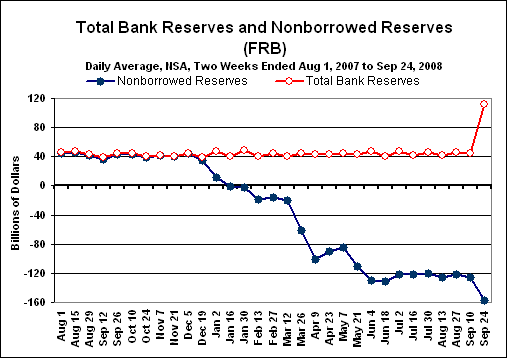

Despite official and neo-deflationist protestations to the contrary, these related actions promise increasing money supply and higher inflation. Again, where failure here is not an option for Messrs. Paulson and Bernanke, they will spend whatever money they need to create, twist any arm that needs to be twisted, bend on any knee, and intervene in or manipulate any market or statistic necessary, in order to save the system. There is a cost to the nation here, and that is in higher inflation.
The Inflationary Recession Keeps Intensifying, Irrespective of Pre-Election GDP Reporting. As shown in the following several graphs, and as indicated in a number of other important economic indicators, the broad economy is behaving exactly as if it were in a recession. The currently observed patterns of officially reported economic growth never have been seen outside of a formal recession.
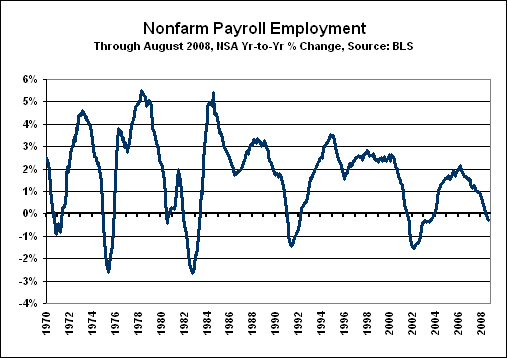
Employment is an extremely broad coincident indicator of economic activity. The series has been in monthly decline since January 2008, and it currently is completing its third consecutive quarter-to-quarter contraction. Annual change also recently turned negative. This series — one of the primary indicators used by the National Bureau of Economic Research (NBER) in officially timing the onset of a recession — is showing growth patterns never seen outside of a formal recession.
With the consumer in trouble, it is not surprising to see patterns of multiple (going-on five) consecutive quarter-to-quarter contractions, and going-on three consecutive quarters with year-to-year contractions in real (inflation-adjusted) retail sales. A leading indicator, this series not only is showing growth patterns not see outside of formal recessions, but it also is signaling an ongoing and deepening recession. Similar growth patterns and story are seen with building permits and housing starts, but are not displayed here.

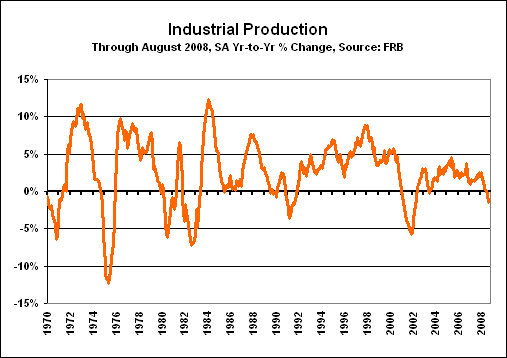
On the industrial side, industrial production is completing its second consecutive sharp quarterly contraction and has turned meaningfully negative on a year-to-year basis. This is another series that is used by the NBER in timing the onset of a recession. Not pictured is new orders for durable goods, which, even before inflation adjustment, is completing its fourth consecutive quarter-to-quarter contraction, and its second consecutive quarter showing deepening year-to-year decline. Industrial production is a coincident economic indicator, new orders for durable goods is a leading indicator.
In combination, these various indicators show the economy to be in a full recession and that the recession is getting worse. Negative GDP results and formal NBER calling of a recession likely will not be seen before the November election.
The current recession, once recognized, should be noted as the second downleg of a structural recession that began back in 2000. As discussed in the April 8th Hyperinflation Special Report, the current inflationary recession eventually should evolve into an inflationary depression and then into a hyperinflationary great depression.
This issue’s Reporting/Market Focus updates the latest income variance numbers. The great variance of income distribution among U.S. households, with heavy weighting towards the upper and lower income brackets, has been a long-lead time indicator of the financial crisis that has started to go public, as well as an indicator of the deepening structural recession frustrating the public. In the next newsletter — barring an intervening systemic collapse — I shall review in depth the background and nature of the current structural economic downturn.
General Outlook is Unchanged. With the financial markets unstable, and the financial crisis in state of flux, I am just going to reiterate here, even though a number of points already have been raised, the long-term outlook published in recent Alerts, and I shall highlight the crisis-related observations in the individual market sections.
It is not likely that the systemic solvency crisis is behind us, and it is too late to prevent a recession. The inflationary recession was well underway before the housing/mortgage crisis, and little can be done to stimulate economic activity, to contain inflation or to provide a long-term prop to equity values. The government, however, does have the ability to support depositor safety, to prevent a collapse of the related financial services industry and to prevent a deflation in the prices of goods and services. Indeed, the cost of systemic salvation is higher price inflation.
The various markets are about as volatile and dangerous as they can get. With extraordinary crosscurrents from the solvency crisis and various governmental and global central bank interventions in the markets and marketplace, volatility likely will continue, sometimes in directions that may seem irrational. The gold and currency markets, in particular, remain subject to jawboning and both covert and overt central bank intervention, aimed at discouraging investors from seeking safety in gold or outside the greenback.
All factors considered, the broad outlook remains the same: further intensification of the inflationary recession and a continued deepening systemic and banking solvency crisis. Growing market recognition of these issues and mounting global political tensions have intensified the risks for continued unstable market conditions, markedly.
Over the near-term, negative major market displacements should follow or be accompanied by intense, broad selling of the U.S. dollar, which may be beginning anew. An eventual, increasing flight-to-safety outside of the U.S. dollar also should include flight-to-safety into gold. Despite continuing softness in oil prices, current levels (anything above $90 per barrel) remain highly inflationary. Over the longer term, U.S. equities, bonds and the greenback should suffer terribly, while gold and silver prices should boom.
PLEASE NOTE: A "General background note" provides a broad background paragraph on certain series or concepts. Where the language used in past and subsequent newsletters usually has been or will be identical, month-after-month, any text changes in these sections will be highlighted in bold italics upon first usage. This is designed so that regular readers may avoid re-reading material they have seen before, but where they will have the material available for reference, if so desired.
Alternate Realities. This section updates the Shadow Government Statistics (SGS) alternate measures of official GDP, unemployment and CPI reporting. When a government economic measure does not match common public experience, it has little use outside of academia or the spin-doctoring rooms of the Federal Reserve, White House and Wall Street. In these alternate measures, the effects of gimmicked methodological changes have been removed from the official series so as to reflect more accurately the common public experience, as embodied by the pre-Reagan-Era CPI and GDP and the pre-Clinton Era unemployment rate. Methodologies for the GDP and CPI series are discussed in the August 2006 SGS.
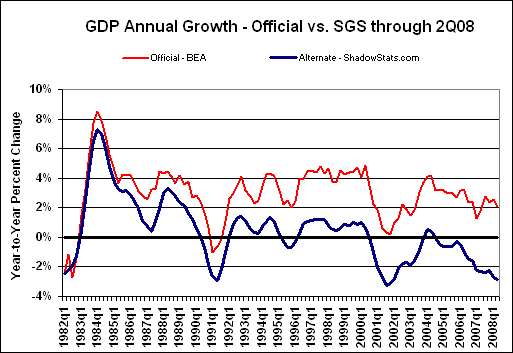
GDP. The alternate second-quarter 2008 GDP growth reflects the "final" estimate revision, with many of the methodological gimmicks of recent decades removed. The alternate second-quarter inflation-adjusted annual growth rate (year-to-year, as opposed to the popularly-touted annualized quarter-to-quarter rate) for GDP was a decline of roughly 2.9% versus the official year-to-year gain of 2.1%. The official, annualized real quarter-to-quarter growth rate now stands at 2.8%. While the quarterly growth number is popularly followed, its significant inaccuracies are expanded to the fourth-power in reporting. The alternate measure, as in the first quarter, safely would have shown a quarterly contraction in the second quarter.
General background note: Historical data on both the official and SGS-Alternate GDP series are available for download on the Alternate Data page of www.shadowstats.com. The Alternate GDP numbers tend to show deeper and more protracted recessions than have been reported formally or reflected in related official reporting. Nonetheless, the patterns shown in the alternate data are broadly consistent with the payroll employment and industrial production series, which are major indicators used by the National Bureau of Economic Research in determining the official timing of U.S. business cycles.
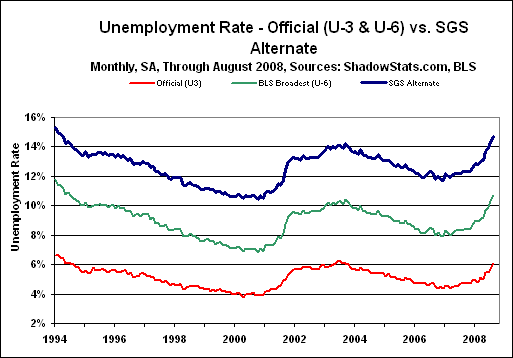
Unemployment Rate. Shown are two official seasonally-adjusted unemployment measures, U.3 and U.6, and the SGS-Alternate Unemployment Measure. All three measures moved sharply higher, again, in August, reflecting rapidly deteriorating labor-market conditions. They stood respectively at 6.1%, 10.7% and 14.7%, up from 5.7%, 10.3% and 14.3% in July.
General background note: U.3 is the popularly followed unemployment rate published by the Bureau of Labor Statistics (BLS), while U.6 is the broadest unemployment measure published by the BLS. U.6 is defined as total unemployed, plus all marginally attached workers, plus total employed part time for economic reasons, as a percent of the civilian labor force plus all marginally attached workers. Marginally attached workers include the discouraged workers who survived redefinition during the Clinton Administration. The SGS-Alternate Unemployment Measure simply is U.6 adjusted for an estimate of the millions of discouraged workers defined away during the Clinton Administration — those who had been "discouraged" for more than one year.
General background note: Historical data on both the official and SGS-Alternate unemployment series are available for download on the Alternate Data page of www.shadowstats.com. The Alternate numbers are reported from the 1994 series redefinitions forward. It is planned to take the alternate series further back in time.
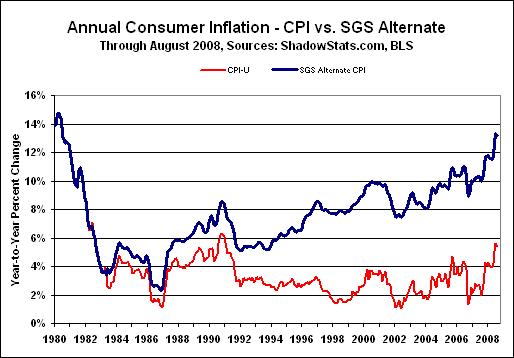
CPI. Absorbing a sharp decline in energy prices, August’s annual full inflation rates eased slightly, while "core" inflation was unchanged. Annual inflation should continue rising well into 2009, with mounting inflationary pressures reflecting the still-increasing impact of energy-cost damages to the general economy, combined with pressures from a weakened dollar and extremely high and monetary growth that appears set to accelerate.
Outright data manipulation appears to be an ongoing issue. Recent food and oil-related price pressures still have been reflected only minimally in current reporting, and that increasingly has caused some in the financial media to question the accuracy of official inflation reporting. The effect is particularly noticeable in the lack of pass-through energy inflation to the so-called "core" numbers.
General background note: Historical data on both the official and SGS-Alternate CPI series are available for download on the Alternate Data page of www.shadowstats.com. The Alternate CPI numbers tend to show significantly higher inflation over time, generally reflecting the reversal of hedonic adjustments, geometric weighting and the use of a more traditional approach to measuring housing costs, measures all consistent with the reporting methodology in place as of 1980. Available as a separate tab at the SGS homepage www.shadowstats.com is the SGS Inflation Calculator that calculates the impact of inflation between any two months, 1913 to date, based on both the official CPI-U and the SGS-Alternate CPI series.
|
Eight Levels of Consumer Inflation
Annual Inflation for May to August 2008
|
|
|
|
2008
|
|
|
|
|
Measure
|
May
|
Jun
|
Jul
|
Aug
|
|
I.1
|
Core PCE Deflator
|
2.2%
|
2.3%
|
2.4%
|
n.a.
|
|
I.2
|
Core Chained-CPI-U
|
2.0%
|
2.1%
|
2.2%
|
2.2%
|
|
I.3
|
Core CPI-U
|
2.3%
|
2.4%
|
2.5%
|
2.5%
|
|
I.4
|
PCE Deflator (r)
|
3.5%
|
4.0%
|
4.5%
|
n.a.
|
|
I.5
|
Chained-CPI-U
|
3.6%
|
4.2%
|
4.8%
|
4.7%
|
|
I.6
|
CPI-U
|
4.2%
|
5.0%
|
5.6%
|
5.4%
|
|
I.7
|
Pre-Clinton CPI-U
|
7.5%
|
8.3%
|
8.9%
|
8.7%
|
|
I.8
|
SGS Alternate Consumer Inflation
|
11.8%
|
12.6%
|
13.4%
|
13.2%
|
|
(r) Revised.
Notes: I.1 to I.3 reflect the core inflation rates, respectively, of the substitution-based personal consumption expenditure (PCE) deflator, the Chained-CPI-U and the geometrically-weighted CPI-U. I.4 to I.6 are the same measures with energy and food inflation included. The CPI-U (I.6) is the measure popularly followed by the financial press, when the media are not hyping core inflation. I.7 is the CPI-U with the effects of geometric weighting (Pre-Clinton Era as estimated by SGS) reversed. This is the top series in the CPI graph on the SGS home page www.shadowstats.com. I.8 reflects the SGS Alternate Consumer Inflation measure, which reverses the methodological gimmicks of the last 25 years or so, plus an adjustment for the portion of Clinton-Era geometric weighting that is not otherwise accounted for in BLS historic
bookkeeping.
|
Wednesday, August 13th, 2008
Issue Number 45
August 13, 2008
__________
Dollar Rally Should Prove Short-Lived — Underlying Fundamentals Deteriorating
Extraordinarily High Systemic Risks — Depositors Moving to Cash?
U.S. Treasuries at Risk of Downgrade?
Economic Activity Tumbles as Inflation Intensifies
GDP Revisions Suggest Shadow of Protracted Recession
__________
OVERVIEW — OPENING COMMENTS
The Best of Times or the Worst of Times?
Despite orchestrated media and market hype to the contrary, there has been absolutely no positive shift in underlying fundamentals driving the still-unfolding economic, financial-market and systemic-stability crises. The U.S. dollar’s recent sharp gains reflect instead uncertainties tied to the outbreak of war in the Caucasus, with the greenback taking on a traditional flight-to-safety role. The dollar’s strength also reflects some spinmeistering and jawboning by central banks, along with possible, if not probable, supportive covert intervention. Not reflecting any change in real-world conditions, the dollar’s happy gains should prove to be fleeting. Related heavy selling of oil and gold, also have not been driven by fundamental changes. Oil markets are volatile by nature and, despite recent sharp swings, prices remain highly inflationary at current levels. The markets and financial system remain vulnerable to the least surprise and are highly unstable. The inflationary recession continues to intensify, and gold remains the best long-term hedge against all the real risks facing investors and the system.
U.S Dollar Fundamentals Remain Horrible. (The following section is excerpted from or expands upon recent Congressional Testimony.) The relative value of a nation’s currency is a measure not only of its trade position, but also of global capital flows that mirror how the rest of the world views that nation’s economic strength, financial-system integrity and political stability.
In terms of underlying fundamentals that drive, or act as surrogates for concerns that drive relative currency values, the U.S. dollar’s portfolio could not be much worse. Not one of the fundamentals has shifted recently in favor of the dollar, despite spinmeistering and jawboning efforts to the contrary. Against major trading partners, consider the United States’ relative positions:
· Trade Balance (Negative): Despite recently reported narrowing of the monthly trade deficit, the U.S. trade shortfall remains unprecedented in its relative global magnitude.
· Economic Activity (Negative): U.S. business conditions are deteriorating, with the economy clearly in a recession in all but formal declaration of same. Even against contracting economies abroad, the current U.S. economy is relatively weaker.
· Inflation (Negative): U.S. inflation has risen sharply, with the CPI-U up 5.0% year-to-year as of June; broad money growth is highest since 1971; double-digit inflation is possible by early 2009.
· Fiscal Discipline (Negative): The U.S. federal budget deficit is deteriorating rapidly, due to the recession, with its unfunded obligations placing the government in a state of practical long-term bankruptcy.
· Interest Rates (Negative): U.S. interest rates are low, relative to the rest of the world, with Federal Reserve policy perceived to be on hold per current market expectations.
· Political/Systemic Stability (Negative): The President’s approval rating (currently low) is a fair indicator of currency trends; the banking crisis is an increasing negative.
Marketing the Rigged Good News. If one believed the orchestrated financial media, the U.S. dollar has turned fundamentally to the upside, because the U.S. economy has dodged a recession as the rest of the global economy seems to be falling into one. Hence, the argument goes, the U.S. economy is the place to park your money. Such is absurdly nonsensical and shows some of the dangers inherent in relying on poor-quality, politically-manipulated GDP statistics.
In reality, the U.S. economy is tumbling in a deep recession. Given the dominant size of the U.S. economy and related global consumption, U.S. recessions usually trigger global recessions. What is missing from the gimmicked conventional wisdom is that the U.S. economy is contracting more rapidly than as seen in downturns in the rest of the world.
Central Bankers and Finance Ministers Lie. Back three or four decades — in the era of fixed exchange rates — one could be sure a currency revaluation was pending, whenever a central bank began denying same. Such is the nature of crisis management by central bankers and finance ministers; they have to deny market moving events until the last moment or until they are ready to act.
Something of a reverse gambit is in play at present, where Federal Reserve officials keep hinting at a needed increase in interest rates, but no rate increase follows. Jean-Claude Trichet, president of the European Central Bank (ECB) recently warned of economic weakness in the eurozone, implying a rate cut, but such followed an action where rates were held constant. If the Fed raised rates and/or the ECB lowered rates, such a fundamental shift would bolster the dollar. Neither central bank, however, is looking to change policy as hinted, so the comments drifted into the realm of jawboning, and the spin doctors in the financial markets wove stories supportive of the greenback. Impact from same was not fundamental, only fleeting fluff.
There recently was a comment out of the U.S. Treasury, however, that had a strong enough odor about it to bring back memories of the currency revaluation days.
Federal Deficit Explosion and a U.S. Treasuries Downgrade? Per a July 31st Associated Press article by Martin Crutsinger (Administration: US bond rating safe despite deficit), "The Bush administration expressed confidence Wednesday that the United States would be able to maintain its top-notch credit rating even as the government scrambles to find new ways of expanding debt sales to cope with soaring budget deficits."
Competent Treasury officials never would discuss such a topic, unless it was felt that some market reassurance was needed and that indeed there was some threat of a downgrade. Something may be afoot in terms of rating U.S. Treasuries from a perspective outside the U.S. dollar. Usually there would be no impaired sovereign rating from the perspective of its domestic currency, since the country in question always has the ability to print money in order to meet its obligations, as advocated by Mr. Bernanke.
The comments followed revised budget deficit estimates that suggest a 2008 shortfall in excess of $400 billion and a 2009 shortfall in excess of $500, if war funding were counted fully. Such also followed the Congress raising the federal debt limit to $10.5 trillion, allowing for the next trillion dollars of debt to be taken on from current levels.
The recession and systemic banking solvency crisis (FDIC expenses) have been spiking federal spending and reducing tax revenues. None of this is good fundamental news for the U.S. dollar.
Ongoing Banking Crisis and Monetary Abnormalities. One question raised by several subscribers in terms of the August 3rd Money Supply Special Report was that if Fed Chairman Bernanke can dodge deflation as claimed, by creating new money and debasing the currency, then why did Japan not follow similar polices in order to avoid its deflation?
Ben Bernanke’s explanation of Japan’s circumstance, in his 2002 speech on avoiding deflation, is in line with mine, specifically that Japan did not want to debase its currency (much as Germany does not want to see the euro debased at present). It was a policy option, not a physical limitation on the government’s ability to create money and inflation. One cannot necessarily impute the long-term willingness of the U.S. to debase its currency system to more fiscally conservative sovereign states.
Along those lines, as seen in the accompanying graphs, the still-unfolding systemic banking solvency crisis has not been getting better. If anything, indications from recent money supply reporting suggest the crisis may be in a stage of renewed deterioration. Shown in the first two graphs, Federal Reserve lending to banks is holding at record levels, and the Fed just recently liberalized its lending policies, again. The third graph shows the level of U.S. Treasuries being held by Federal Reserve banks. The decline in


Treasuries has been offset by holdings of illiquid securitized instruments that are being used as collateral by banks borrowing from the Fed. The problem remains that those assets (declining Treasuries and increasing, illiquid securitized instruments) remain the formal backing for the U.S. currency issued as Federal Reserve Notes.
The cost to the system of a full bailout is surging money growth and higher inflation. As discussed in the money supply section, however, annual growth in M3 is slowing some, albeit still at very high levels, while annual growth in the narrow M1 measure (basically currency and checking accounts) has been surging. Funds appear to be shifting from the large-deposit accounts to cash, suggesting mounting depositor nervousness and a possible trigger for a new round of systemic liquidity creation by the Fed.
There is no good fundamental news here for the U.S. dollar.
Except for GDP, Broad Economic Reporting Shows the U.S. Economy in Recession. With the exception of GDP, and possibly its underlying trade deficit support, every economic indicator discussed in the Reporting Perspective is showing a recession in place, with further deterioration signaled by the better leading indicators through the balance of 2008.
As discussed in the Reporting/Market Focus, even the GDP annual revisions started to move into a pattern that allows for a recession having begun sometime in fourth-quarter 2006.
Shown in the following graphs are three of the broader, more important series that never have shown the displayed current annual growth patterns outside of recession.

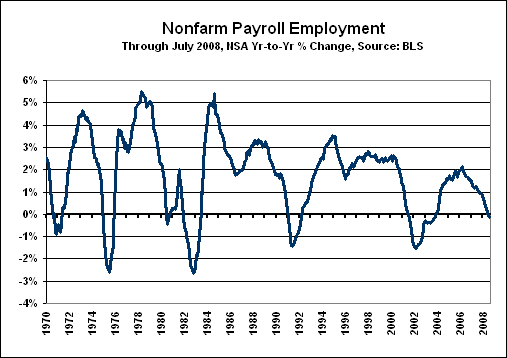
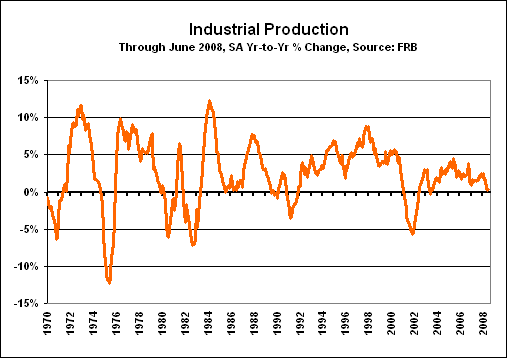
Quarterly contractions (often multiple, consecutive ones) and annual contractions now seen in real "inflation-adjusted" retail sales, nonfarm payrolls, industrial production, housing starts and new orders for durable goods generally are not seen outside of formal recessions.
The current recession eventually should be recognized as the second downleg of a structural recession that began back in 2000. Its formal recognition, however, likely will not be announced by the National Bureau of Economic Research (NBER), official arbiter of same, until sometime after the November election.
As discussed in the April 8th Hyperinflation Special Report, the current inflationary recession eventually should evolve into an inflationary depression and then into a hyperinflationary great depression.
There remains no positive fundamental news for the U.S. dollar here.
Inflation Intensification Belies Benign "Core" Estimates. Annual CPI and PPI inflation rates jumped sharply in June and should be higher again in July. With annual June CPI at a 17-year high of 5.0%, however, a serious question has to be raised about so-called "core" inflation that is net of changes in food and energy prices. While the latest data show some catch-up of accounting for energy inflation in the aggregate CPI, nothing has been catching up in the core numbers.
Core inflation has not been increasing, despite a couple of years of rising oil prices that gradually have permeated the broad economic system. Even with formal energy costs removed from the accounting, inflation impact should be seen in goods and services that consume energy, get transported or involve petroleum based materials ranging from a variety of chemicals and plastics to pharmaceuticals and fertilizers. With the core numbers used for ulterior motives of the Federal Reserve (proof of contained inflation), the lack of increase in core inflation not only is unbelievable, it also reeks of official massaging and gimmicking. This area will be explored further in an upcoming Reporting/Market Focus.
In any event, there is no positive fundamental news for the U.S. dollar here.
Volatile and Unstable Markets. As discussed in the Markets Perspective, the broad outlook is unchanged for eventual sharp sell-offs in U.S. equities and the U.S. dollar, eventual sharp rallies in gold and silver, and eventual spikes in long-term interest rates. At present, the financial markets are extremely volatile and sensitive, and much of recent trading activity has not been rationale, rather egged on by manipulative central banks or by Wall Street spinning poor-quality economic data out of the government.
Given the intensifying inflationary recession and the ongoing banking solvency crisis, there is no likely long-term happy result on the horizon for the U.S. equity and credit markets, or for the U.S. dollar. Gold and silver, however, should see eventual new long-term gains from the same factors that will pummel the other markets.
In terms of annual perspective, despite all the market gimmicks and machinations and heavy selling of gold, gold still is up sharply from the year before, while the major equity indices still are down over the same period.
PLEASE NOTE: A "General background note" provides a broad background paragraph on certain series or concepts. Where the language used in past and subsequent newsletters usually has been or will be identical, month-after-month, any text changes in these sections will be highlighted in bold italics upon first usage. This is designed so that regular readers may avoid re-reading material they have seen before, but where they will have the material available for reference, if so desired.
Alternate Realities. This section updates the Shadow Government Statistics (SGS) alternate measures of official GDP, unemployment and CPI reporting. When a government economic measure does not match common public experience, it has little use outside of academia or the spin-doctoring rooms of the Federal Reserve, White House and Wall Street. In these alternate measures, the effects of gimmicked methodological changes have been removed from the official series so as to reflect more accurately the common public experience, as embodied by the pre-Reagan-Era CPI and GDP and the pre-Clinton Era unemployment rate. Methodologies for the GDP and CPI series are discussed in the August 2006 SGS.
GDP. The alternate second-quarter 2008 GDP growth reflects the "advance" estimate, with many of the methodological gimmicks of recent decades removed. The alternate second-quarter inflation-adjusted annual growth rate (year-to-year, as opposed to the popularly-touted annualized quarter-to-quarter rate) for GDP was a decline of roughly 2.9% versus the official year-to-year gain of 1.8%. The official annualized real growth rate for the quarter was 1.9%. While the quarterly growth number is popularly followed, its significant inaccuracies are expanded to the fourth-power in reporting. The alternate measure, once again, safely would have shown a quarterly contraction. The graph and data postings have been updated for the July 31, 2008 annual revisions to GDP.
General background note: Historical data on both the official and SGS-Alternate GDP series are available for download on the Alternate Data page of www.shadowstats.com. The Alternate GDP numbers tend to show deeper and more protracted recessions than have been reported formally or reflected in related official reporting. Nonetheless, the patterns shown in the alternate data are broadly consistent with the payroll employment and industrial production series, which are major indicators used by the National Bureau of Economic Research in determining the official timing of U.S. business cycles.
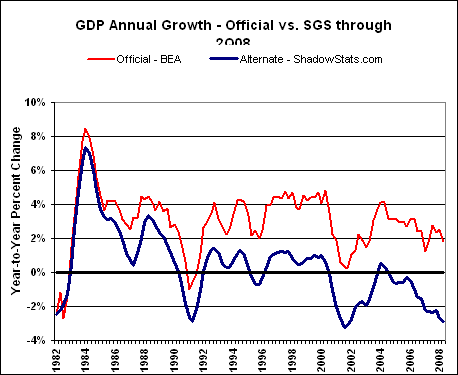
Unemployment Rate. Shown are two official seasonally-adjusted unemployment measures, U.3 and U.6, and the SGS-Alternate Unemployment Measure. All three measures moved sharply higher, again, in July, in response to rapidly deteriorating labor-market conditions, standing respectively at 5.7%, 10.3% and 14.3%, up from 5.5%, 9.9% and 13.9% in June.
General background note: U.3 is the popularly followed unemployment rate published by the Bureau of Labor Statistics (BLS), while U.6 is the broadest unemployment measure published by the BLS. U.6 is defined as total unemployed, plus all marginally attached workers, plus total employed part time for economic reasons, as a percent of the civilian labor force plus all marginally attached workers. Marginally attached workers include the discouraged workers who survived redefinition during the Clinton Administration. The SGS-Alternate Unemployment Measure simply is U.6 adjusted for an estimate of the millions of discouraged workers defined away during the Clinton Administration — those who had been "discouraged" for more than one year.
General background note: Historical data on both the official and SGS-Alternate unemployment series are available for download on the Alternate Data page of www.shadowstats.com. The Alternate numbers are reported from the 1994 series redefinitions forward. It is planned to take the alternate series further back in time.
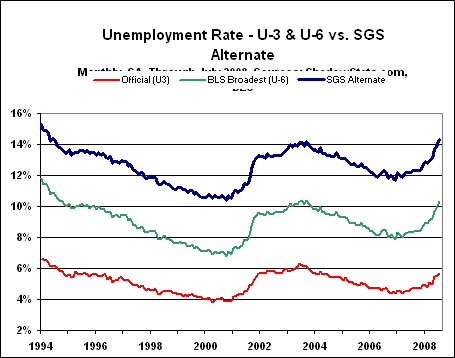
CPI. July’s annual non-core inflation rates spiked, while core inflation was little changed. The PCE measures were revised upwards as part of the annual revisions to the national income accounts. Annual inflation rates should continue rising well into 2009, with mounting inflationary pressures reflecting the increasing impact of energy-cost damages to the general economy, combined with pressures from a weakened dollar and extremely high monetary growth.
Outright data manipulation appears to be an ongoing issue. Recent food and oil-related price pressures still have been reflected only minimally in current reporting, and that increasingly has caused some in the financial media to question the accuracy of official inflation reporting. The effect is particularly noticeable in the lack of pass-through energy inflation to the so-called "core" numbers.
General background note: Historical data on both the official and SGS-Alternate CPI series are available for download on the Alternate Data page of www.shadowstats.com. The Alternate CPI numbers tend to show significantly higher inflation over time, generally reflecting the reversal of hedonic adjustments, geometric weighting and the use of a more traditional approach to measuring housing costs, measures all consistent with the reporting methodology in place as of 1980. Available as a separate tab at the SGS homepage www.shadowstats.com is the SGS Inflation Calculator that calculates the impact of inflation between any two months, 1913 to date, based on both the official CPI-U and the SGS-Alternate CPI series.

|
Eight Levels of Consumer Inflation
Annual Inflation for March to June 2008
|
|
|
|
2008
|
|
|
|
|
Measure
|
Mar
|
Apr
|
May
|
Jun
|
|
I.1
|
Core PCE Deflator (r)
|
2.2%
|
2.2%
|
2.2%
|
2.3%
|
|
I.2
|
Core Chained-CPI-U
|
2.1%
|
2.0%
|
2.0%
|
2.1%
|
|
I.3
|
Core CPI-U
|
2.4%
|
2.3%
|
2.3%
|
2.4%
|
|
I.4
|
PCE Deflator (r)
|
3.4%
|
3.4%
|
3.5%
|
4.1%
|
|
I.5
|
Chained-CPI-U
|
3.6%
|
3.5%
|
3.6%
|
4.2%
|
|
I.6
|
CPI-U
|
4.0%
|
3.9%
|
4.2%
|
5.0%
|
|
I.7
|
Pre-Clinton CPI-U
|
7.3%
|
7.3%
|
7.5%
|
8.3%
|
|
I.8
|
SGS Alternate Consumer Inflation
|
11.6%
|
11.5%
|
11.8%
|
12.6%
|
|
(r) Revised, including annual revisions published August 4, 2008.
Notes: I.1 to I.3 reflect the core inflation rates, respectively, of the substitution-based personal consumption expenditure (PCE) deflator, the Chained-CPI-U and the geometrically-weighted CPI-U. I.4 to I.6 are the same measures with energy and food inflation included. The CPI-U (I.6) is the measure popularly followed by the financial press, when the media are not hyping core inflation. I.7 is the CPI-U with the effects of geometric weighting (Pre-Clinton Era as estimated by SGS) reversed. This is the top series in the CPI graph on the SGS home page www.shadowstats.com. I.8 reflects the SGS Alternate Consumer Inflation measure, which
reverses the methodological gimmicks of the last 25 years or so, plus an adjustment for the portion of Clinton-Era geometric weighting that is not otherwise accounted for in BLS historic
bookkeeping.
|
_____________________________________
PLEASE NOTE: The next SGS Newsletter currently is targeted for the week of September 8th, following the release of the August employment report on September 5th. Intervening Flash Updates and Alerts will be posted in response to key economic or financial-market developments.
Earlier editions of the SGS writings referenced in the text can be found on the Archives tab at www.shadowstats.com.
Occasionally, important, brief updates are communicated directly by e-mail. If you are not receiving e-mail communications from us, please let us know at johnwilliams@shadowstats.com or by using the "Contact Us" option on www.shadowstats.com.
Tuesday, June 10th, 2008
Issue Number 43
June 9, 2008
__________
Inflationary Recession and Banking Crises Continue to Intensify
Market Fantasies of Contained Crises Begin to Fade
Severe Inflation Surge in Offing
Evidence Mounts for Manipulation of Key Headline Economic Numbers
__________
Seasonal Factor Abuse and Misuse
There is no question of the economy being in an intensifying inflationary recession. Market fantasies of a bottomed downturn and a banking system on the mend got a jolt of reality last week, and regardless of any further jolts of alternating market pressures, the longer range outlook remains bleak for U.S. equities, bonds and the dollar but remains brilliant for gold.
A near-manic jump in oil prices and a reported surge in the May unemployment rate understandably rattled the markets. More disturbing, though, was that while Mr. Bernanke was pushing new liquidity into troubled banks — exacerbating inflation and dollar problems — he crossed his fingers behind his back and began jawboning in support of the dollar and raising concerns about inflation. All is not well in the banking system solvency crisis, and the Fed’s waffling suggests some bad news may be in the offing. The crisis continues, and it is severe.
Some questionable economic reporting of recent months can be attributed, at least partially, to the abuse and misuse of seasonal factors.
Data that have been properly seasonally adjusted enable meaningful period-to-period (such as month-to-month) comparisons. Seasonal adjustments are used to smooth out regularly repetitive patterns of economic activity tied to seasons, holidays and the school year, for example, or where monthly business activity may vary by the number of working days in a month.
Good quality seasonal adjustments, however, often are difficult to develop, and otherwise can be misleading by their general nature. My good friend Al Sindlinger (1907-2000), pioneer surveyor of consumer attitudes in the late-1920s and advisor to many presidents, beginning with Herbert Hoover, always had a twinkle in his eye when he described seasonal adjustments.
"You can sit with one foot in a bucket of ice water and the other foot in a bucket of boiling water," he would chuckle. "Seasonally adjusted, you’re very comfortable."
Indeed there is little comfort in the common experience of individuals, when government reporting suggests that they really are not paying $4.00 per gallon for gasoline, or that they really are not unemployed, when viewed on a seasonally-adjusted basis.
Seasonal adjustment of data can be misleading (often times inadvertently) as well as illuminating. This issue’s Reporting/Market Focus explores seasonal-adjustment abuse that appears to have enabled near-term manipulations of headline monthly payroll gains and CPI inflation. In other areas, misuse of the techniques or over-reliance upon inadequate factors may innocently generate inaccurate or conflicting information. Problems in seasonal adjustments, for example, likely accounted for at least part of the surge
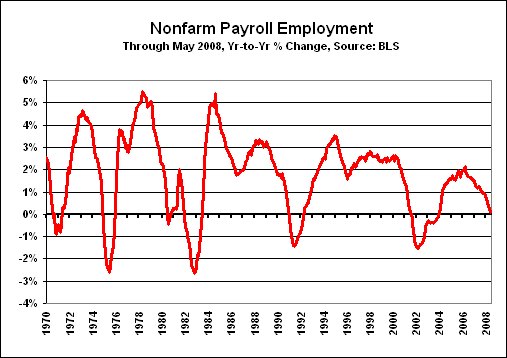
in May’s unemployment rate, as well as the "improved" jobless claims around the Memorial Day weekend, where both series were reported last week.
Recession Solidifies in Key Data. Official economic reporting in the last month or so has generated a rapidly solidifying picture of a recession in place. As shown in the preceding graph, year-to-year change in payroll employment was near zero in May. What the graph shows is that every time annual payroll growth has slowed to zero (in fact, every time it has slowed to below 1.0%), the economy has been in an official recession, or what shortly would be recognized as such. With the latest official payroll reporting, not only did payrolls show a first-quarter quarterly contraction, but also a second-quarter contraction appears highly likely.
The 0.5% surge in the May unemployment rate could be taken as a sign of recession, and indeed the unemployment rate should be rising. As discussed in the Employment/Unemployment section in the Reporting Perspective, though, part of that reported unemployment rate jump may be due to problems the Bureau of Labor Statistics (BLS) has in properly seasonally adjusting for school year variations.
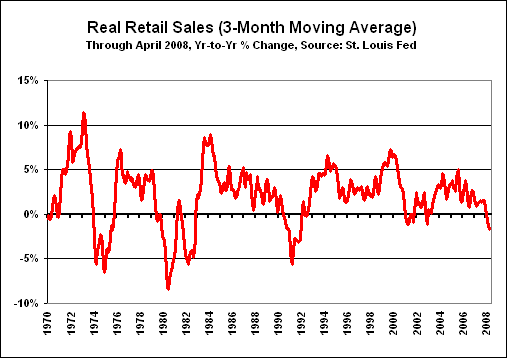
Nonetheless, the weakening employment circumstance is a strain on consumers, who account for more than 70% of GDP, when housing and personal consumption are included. In a related area, year-to-year inflation-adjusted growth in retail sales (smoothed with a three-month moving average), also has locked in a recession pattern. As shown in the preceding graph, the current level of annual contraction has not been seen historically outside of formal recessions, and the current contraction is the deepest since the 1990/1991 recession. When payrolls and retail sales show these patterns, a recession is in place.
Historic or near-historic annual contractions also were reported in May consumer confidence measures, April housing measures and help-wanted advertising. Recession patterns have been reflected in the latest industrial production, purchasing managers manufacturing survey, new orders for durable goods, new claims for unemployment insurance and real average weekly earnings series.
Continuing positive growth reported for the GDP is discussed in the Reporting/Market Focus on manipulation of headline economic data. Nonetheless, the GDI (Gross Domestic Income) — theoretical equivalent to the GDP — was virtually flat in first-quarter 2008, after a fourth-quarter 2007 contraction.
Other data related to consumer conditions are worthy of comment, in that they received some recent press, with the release of the Federal Reserve’s Flow of Funds reporting for first-quarter 2008. Keep in mind that the published data are of poor quality, particularly on a quarterly basis.
The story was that household net worth had declined for the second consecutive quarter, thanks to falling home prices. While indeed the household/nonprofit organizations first-quarter net worth figure of $56.0 trillion was down by $1.7 trillion from the fourth quarter, which in turn was down by $0.5 trillion from the third quarter, home prices had relatively little to do with it. Where household real estate values fell by 1.6% in the first quarter — following a 0.5% decline in the fourth quarter — over 80% of the decline in net worth was due to a decline in the stock market. Again, the numbers should not be relied on, but the suggestion is that the consumer indeed is indeed feeling something of a fundamental financial squeeze.
The economy remains in a major structural downturn that likely will evolve into a depression and eventual hyperinflationary great depression (see the Hyperinflation Special Report). Neither the federal government nor the Federal Reserve has viable options for turning the economy to the upside. Short-lived measures, such as tax rebate checks, will have little impact other than brief upside blips in activity.
Inflation Surge Likely in Second Half of 2008. As noted in the Reporting/Market Focus, seasonal factors that have been suppressing reported CPI annual inflation should reverse in the second half of the year. With current oil prices holding at levels more than double last year’s levels, inflation should start to show a sharp pick-up not only from energy and food, but also from recent dollar weakness and continued excessive money supply growth, as reflected in M3. By year-end 2008, official CPI annual inflation — now at 3.9% — could be pushing double digits.
The preliminary SGS-Ongoing M3 Estimate for May, based on 26 out of 31 days of data, shows annual growth slowing to 16.0%, from 16.4% in April and from a record 17.4% in March. The somewhat slower growth appeared to reflect intensification of the banking system solvency crisis, which the Fed addressed with expanded Term Auction Facility (TAF) lending. While growth in the weekly M3 components resumed thereafter, the turnaround was not soon enough to generate an overall higher rate of annual growth in May. Nonetheless, the May level of M3 annual growth remains significantly above levels that promise higher inflation in the months ahead.
Banking System Stability Remains Elusive. Other than the hypesters on Wall Street, talk from central bankers and others knowledgeable within the system tend to confirm the continuing nature of the problems within the banking system. Direct evidence of ongoing trouble is seen in the increasing net lending of the Federal Reserve to troubled banks. The level of total nonborrowed reserves (a number that should be viewed on a not-seasonally-adjusted basis as to what is happening in the banking system) has continued to sink into record negative territory, a negative $129.3 ($130.3 adjusted) billion daily average for the two-week period ending June 4th, as shown in the following graph.
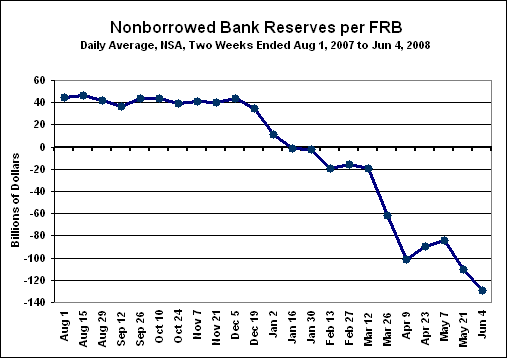
U.S. Currency as Sound as the CDOs Backing It? Updating the numbers as of June 4, 2008, the Fed reported physical U.S. currency (Federal Reserve Notes) in circulation at about $787 billion, the better portion of which circulates outside the geographic confines of the United States. While the U.S. currency has been a fiat currency (not backed by gold) for decades, the Federal Reserve Notes presently in circulation are collateralized by securities held by the Fed. Those securities primarily had been U.S. Treasury securities up until late-2007.
Since the onset of the banking solvency crisis and the establishment of various new lending facilities by the U.S. central bank, however, an increasing portion of the U.S. Treasury securities held as collateral has been lent to troubled financial institutions in exchange for largely illiquid collateralized debt obligations — including mortgage backed securities — those non-Treasuries now total in excess of 22% of the collateral backing the Federal Reserve Notes and appear to be increasing regularly.
Bernanke the Inflation Fighter? Despite developing claims to the contrary, the Fed’s primary concern remains preventing a systemic financial collapse; everything else is secondary or tertiary, including the dollar, inflation and the economy. The Fed has very limited ability at present either to stimulate the economy or to contain inflation, despite severe problems in both areas. From a practical standpoint, its ability to rally the dollar also is limited: (1) to jawboning, which is underway and (2) to intervention, which likely already has been seen on occasion on a covert basis. Raising rates, though an option, could play out very negatively in the domestic markets and economy, and hence the banking system.
Mr. Bernanke made the decision to sacrifice the U.S. dollar and inflation, months ago, as a cost of salvaging the financial system. The purported move now to cease cutting the rates likely is due to the targeted Fed funds rate being near a practical lower limit of 2.00%, and perhaps due to a forced rethinking of the to-hell-with-the-dollar policy of recent years. If sovereign threats of dollar abandonment/dumping appear serious enough to add a dangerous new twist to the domestic solvency crisis, then the Fed may be forced to spike interest rates sharply, despite negative effects on the domestic markets and economy.
Market Turmoil Is Not Over. Given the inflationary recession and the ongoing banking solvency crisis, there is no likely long-term happy result on the horizon for the U.S. equity and credit markets, or for the U.S. dollar. Gold and silver, however, should continue seeing significant long-term gains from the same factors that will pummel the other markets.
Wall Street will unwind at some point, as increasingly nightmarish scenarios begin to capture market thinking. The long-term underlying fundamentals remain miserable for equities and bonds. A severe and protracted bear market in equities already likely is underway. Foreign buying of U.S. debt and sporadic flight-to-quality have depressed Treasury yields, but inflation and developing U.S. dollar woes eventually will push long-term Treasury yields much higher, a process that already may have started. Recent strength/stability in the U.S. dollar and weakness in gold will prove as fleeting as the related central bank jawboning and likely intervention, covert or otherwise. Heavy dollar selling and strong gold buying remain good bets over the longer term.
PLEASE NOTE: A "General background note" provides a broad background paragraph on certain series or concepts. Where the language used in past and subsequent newsletters usually has been or will be identical, month-after-month, any text changes in these sections will be highlighted in bold italics upon first usage. This is designed so that regular readers may avoid re-reading material they have seen before, but where they will have the material available for reference, if so desired.
Alternate Realities. This section updates the Shadow Government Statistics (SGS) alternate measures of official GDP, unemployment rate and CPI reporting. When a government economic measure does not match common public experience, it has little use outside of academia or the spin-doctoring rooms of the Federal Reserve, White House and Wall Street. In these alternate measures, the effects of gimmicked methodological changes have been removed from the official series so as to reflect more accurately the common public experience, as embodied by the pre-Reagan-Era CPI and GDP and the pre-Clinton Era unemployment rate. Methodologies for the GDP and CPI series are discussed in the August 2006 SGS. Issues as to current manipulation of the headline numbers of these series are discussed in the Reporting/Market Focus.
GDP. The alternate first-quarter 2008 GDP growth reflects the "preliminary" estimate revision, with many of the methodological gimmicks of recent decades removed. The alternate first-quarter inflation-adjusted annual growth rate (year-to-year, as opposed to the popularly-touted annualized quarter-to-quarter rate) for GDP was a decline of roughly 2.7% versus the official year-to-year gain of 2.5%. The official annualized real growth rate for the quarter was 0.9%. While the quarterly growth number is popularly followed, its significant inaccuracies are expanded to the fourth-power in reporting. The alternate measure safely would have shown a quarterly contraction.
General background note: Historical data on both the official and SGS-Alternate GDP series are available for download on the Alternate Data page of www.shadowstats.com. The Alternate GDP numbers tend to show deeper and more protracted recessions than have been reported formally or reflected in related official reporting. Nonetheless, the patterns shown in the alternate data are broadly consistent with the payroll employment and industrial production series (as revised), which are major indicators used by the National Bureau of Economic Research in determining the official timing of U.S. business cycles.
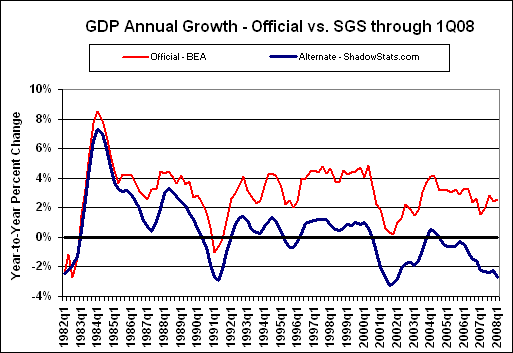
Unemployment Rate. Shown are two official seasonally-adjusted unemployment measures, U.3 and U.6, and the SGS-Alternate Unemployment Measure. All three measures moved sharply higher in May in response, at least partially, to rapidly deteriorating labor conditions, standing respectively at 5.5%, 9.7% and 13.7%, up from 5.0%, 9.2% and 13.1% in April.
U.3 is the popularly followed unemployment rate published by the Bureau of Labor Statistics (BLS), while U.6 is the broadest unemployment measure published by the BLS. U.6 is defined as total unemployed, plus all marginally attached workers, plus total employed part time for economic reasons, as a percent of the civilian labor force plus all marginally attached workers. Marginally attached workers include the discouraged workers who survived redefinition during the Clinton Administration. The SGS-Alternate Unemployment Measure simply is U.6 adjusted for an estimate of the millions of discouraged workers defined away during the Clinton Administration — those who had been "discouraged" for more than one year.
General background note: Historical data on both the official and SGS-Alternate unemployment series are available for download on the Alternate Data page of www.shadowstats.com. The Alternate numbers are reported from the 1994 series redefinitions forward. It is planned to take the alternate series further back in time.
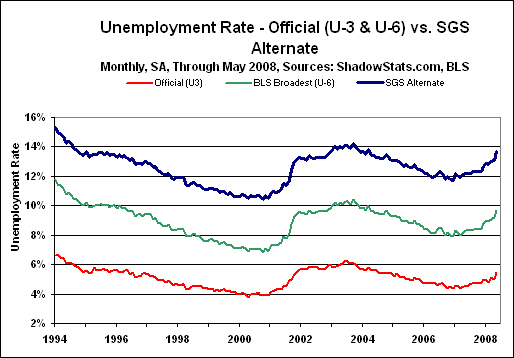
CPI. April’s annual non-core and core inflation rates tended to hold at prior-month levels or one notch lower. Nonetheless, annual inflation rates should continue rising well into 2009, with mounting inflationary pressures reflecting the increasing impact of energy-cost damages to the general economy, combined with pressures from a weak dollar and extremely high monetary growth.
Outright data manipulation appears to be an ongoing issue. Recent food and oil-related price pressures still have been reflected only minimally in current reporting, and that increasingly has caused some in the financial media to question the accuracy of official inflation reporting.
General background note: Historical data on both the official and SGS-Alternate CPI series are available for download on the Alternate Data page of www.shadowstats.com. The Alternate CPI numbers tend to show significantly higher inflation over time, generally reflecting the reversal of hedonic adjustments, geometric weighting and the use of a more traditional approach to measuring housing costs, measures all consistent with the reporting methodology in place as of 1980. Available as a separate tab at the SGS homepage www.shadowstats.com is the SGS Inflation Calculator that calculates the impact of inflation between any two months, 1913 to date, based on both the official CPI-U and the SGS-Alternate CPI series.
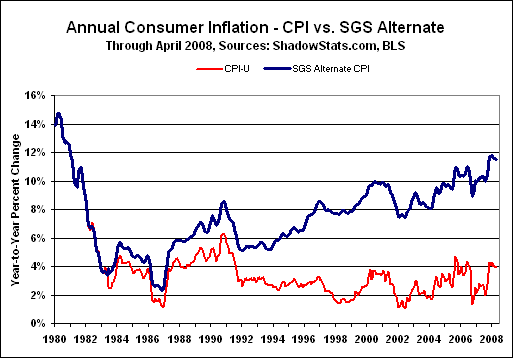
|
Eight Levels of Consumer Inflation
Annual Inflation for January to April 2008
|
| |
|
2008
|
|
|
|
|
Measure
|
Jan
|
Feb
|
Mar
|
Apr
|
| I.1 |
Core PCE Deflator (r) |
2.0% |
1.9% |
2.1% |
2.1% |
| I.2 |
Core Chained-CPI-U |
2.2% |
2.0% |
2.1% |
2.0% |
| I.3 |
Core CPI-U |
2.5% |
2.3% |
2.4% |
2.3% |
| I.4 |
PCE Deflator (r) |
3.5% |
3.4% |
3.2% |
3.2% |
| I.5 |
Chained-CPI-U |
3.9% |
3.7% |
3.6% |
3.5% |
| I.6 |
CPI-U |
4.3% |
4.0% |
4.0% |
3.9% |
| I.7 |
Pre-Clinton CPI-U |
7.6% |
7.3% |
7.3% |
7.3% |
| I.8 |
SGS Alternate Consumer Inflation |
11.8% |
11.6% |
11.6% |
11.5% |
|
(r) Revised.
Notes: I.1 to I.3 reflect the core inflation rates, respectively, of the substitution-based personal consumption expenditure (PCE) deflator, the Chained-CPI-U and the geometrically-weighted CPI-U. I.4 to I.6 are the same measures with energy and food inflation included. The CPI-U (I.6) is the measure popularly followed by the financial press, when the media are not hyping core inflation. I.7 is the CPI-U with the effects of geometric weighting (Pre-Clinton Era as estimated by SGS) reversed. This is the top series in the CPI graph on the SGS home page www.shadowstats.com. I.8 reflects the SGS Alternate Consumer Inflation measure, which
reverses the methodological gimmicks of the last 25 years or so, plus an adjustment for the portion of Clinton-Era geometric weighting that is not otherwise accounted for in BLS historic
bookkeeping.
|
PLEASE NOTE: The next SGS Newsletter is targeted for around the end of June. Intervening Flash Updates and Alerts will be posted in response to key economic or financial-market developments.
Earlier editions of the SGS Newsletter, referenced in the text, can be found on the Archives tab at www.shadowstats.com.
OCCASIONALLY, BRIEF UPDATES ARE COMMUNICATED DIRECTLY BY E-MAIL. IF YOU ARE NOT RECEIVING E-MAIL COMMUNICATIONS FROM US, PLEASE LET US KNOW at johnwilliams@shadowstats.com or by using the "Feedback" option on www.shadowstats.com.
|


