 |
John Williams' |
Shadow Government Statistics Analysis Behind and Beyond Government Economic Reporting |
|


NewslettersHere are the abstracts of all past and present Newsletters. Click on the titles to view the entire article. See also: Alerts and Updates and All Commentaries |
Market/Reporting Focus | Gillespie Research Archives |
|
Subscribers Only |
Open Content Available to all of our readers.
Newsletter (Issue No. 51) July, 20th, 2009 • Current Recession Now Longest Since Great Depression
• June U-6 Unemployment Rate Topped 20% (25% SGS) in Michigan, Oregon, Nevada, California, South Carolina and Rhode Island • Pressures Will Mount for New Stimulus and Bailouts • Spreading Depression Creates Its Own Statistical Distortions • Inflation Signs Begin to Surface • U.S. Dollar Remains the Key to the Markets and Inflation • The U.S. economic and systemic solvency crises show no signs of abating, despite the happy hype out of Washington and Wall Street. While the pending second-quarter GDP estimate likely will show a narrowing quarterly contraction, such will be against a deepening annual downturn and revisions that should show the recession to have been not only longer and deeper than previously reported, but also the most severe recession since the shutdown of war production after World War II. Irrespective of media excitement around the fluttering of often statistically-insignificant or seasonally-warped monthly numbers, annual growth rates in key series have been holding at or pushing to new historic or post-war lows.
Newsletter (Issue No. 50) April, 20th, 2009 • Worst Still Ahead for Economy and Solvency Crisis
• Faulty Data, Government/Fed Obfuscation Are No Basis for Rebuilding Confidence • Do Not Mistake Declining Living Standards for Deflation • Resurgent Inflation Likely to Be Triggered by U.S. Dollar Weakness • Greenback’s Credibility Cracks as Fed Accelerates Dollar Debasement
Newsletter (Issue No. 49) February, 16th, 2009 • Stimulus and Bailout Packages Will Not Reverse the Structural Depression or Resolve the Deepening Systemic-Solvency Crisis
• Fed Monetization of Stimulus-Related Debt Would Spike Inflation • Cumulative 4.7 Million Jobs Lost to Trade Deficit • U.S. Dollar Fundamentals Remain Bleak versus Rest of World • It may be hard for the federal government to offer $787 billion dollars in stimulus without having a noticeably positive impact on economic activity, but it can be done. Despite prior hype on employment, annual growth in inflation-adjusted retail sales is the first major economic measure to trigger a legitimate “worst since the Great Depression” comparison. The economic contraction now is severe enough to consume the stimulus without affected business activity ever breaking above water. Also, too little of the stimulus package addresses the structural issues driving the downturn. Even if the structural problems were addressed, fundamental recovery would be measured in years, at best. Further, the systemic-solvency crisis is deepening again, with bailout exposures opening up to almost unlimited costs. That situation increasingly looks like it will involve the nationalization of major banks.
Newsletter (Issue No. 48) January, 3rd, 2009 • Multiple-Dip Depression Unfolds
• Solvency Crisis to Engulf U.S. Government Finances • Stimulus Efforts Would Enhance Hyperinflation Risk • Broad Money Growth Spikes 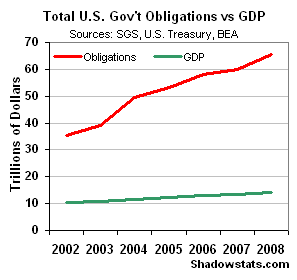 By April, the rapidly deteriorating recession will be viewed commonly as the worst downturn since the Great Depression. Fearing same, the incoming Obama Administration is promising stimulus in the form of massive federal spending. Concerns about the government’s fiscal condition can wait until the economy recovers, we are being told. A similar pacifying assurance presumably extends to inflation concerns as well. Unfortunately, with the economy in a structural downturn and with the U.S. government effectively bankrupt, there can be no rapid or normal recovery. As inflationary pressures mount anew and the financial markets increasingly shun U.S. Treasuries, an inflationary depression can evolve quickly into a hyperinflationary great depression. Although hyperinflation became inevitable in the last decade, the onset of the process just recently was triggered by Fed and the Treasury actions in addressing the systemic solvency crisis. The process would be accelerated by unfettered and unfunded government spending that appears to loom in early 2009.
Newsletter (Issue No. 47) November, 14th, 2008 • Still-Intensifying U.S. Inflationary Recession
• Systemic Solvency Crisis • Market Instability Not Contained • Obama Faces Same Limited Options as Bush • Hyperinflation Possible in 2009 • Despite extraordinary actions by the Federal Reserve, U.S. Treasury and other central banks and finance ministries, the global solvency crises, financial panics and market distortions and instabilities continue. While the collapse of a functional U.S. banking system has been avoided, so far, bank lending has not resumed meaningfully, and other weak links in the economy appear ready to break. Possible failures of the “Big-Three” U.S. automakers now are touted in the financial media. Where GM once boasted, “What is good for General Motors is good for America,” a failure there would be the ultimate symbol of structural destruction that has sapped U.S. economic activity for decades. Structural issues drove the economy into deep recession well before any crises exacerbations. With the economy in recession, oil prices down and the dollar stronger, deflation concerns abound. Yet, inflation ultimately is a monetary phenomenon, and the Fed’s recent monetary incontinence promises much higher inflation ahead, regardless of near-term CPI gyrations from the pre-election plunge in gasoline prices.
Newsletter (Issue No. 46) September, 29th, 2008 • Washington Bailout Likely Will Not End Crisis • Cost of Saving the System Is Inflation • Inflationary Recession Deepens Rapidly • Gold Should Benefit from Inflation-Hedge and Safe-Haven Qualities
In terms of magnitude, global scope and the underlying complexity and interdependencies of troubled financial instruments, the systemic solvency upheaval roiling the U.S. and global financial markets is without precedence. The crisis is the natural outcome of decades of financial leverage being built upon financial leverage; of income variance being pushed even beyond that which preceded the 1929 financial panic…
Newsletter (Issue No. 45) August, 13th, 2008 • Dollar Rally Should Prove Short-Lived — Underlying Fundamentals Deteriorating
• Extraordinarily High Systemic Risks — Depositors Moving to Cash? • U.S. Treasuries at Risk of Downgrade? • Economic Activity Tumbles as Inflation Intensifies • GDP Revisions Suggest Shadow of Protracted Recession • Despite orchestrated media and market hype to the contrary, there has been absolutely no positive shift in underlying fundamentals driving the still-unfolding economic, financial-market and systemic-stability crises.
May 2008 Newsletter June, 10th, 2008 • Inflationary Recession and Banking Crises Continue to Intensify
• Market Fantasies of Contained Crises Begin to Fade • Severe Inflation Surge in Offing • [Reporting/Market Focus] Evidence Mounts for Manipulation of Key Headline Economic Numbers  • There is no question of the economy being in an intensifying inflationary recession. Market fantasies of a bottomed downturn and a banking system on the mend got a jolt of reality last week, and regardless of any further jolts of alternating market pressures, the longer range outlook remains bleak for U.S. equities, bonds and the dollar but remains brilliant for gold.
April 2008 Newsletter April, 29th, 2008 • Inflationary Recession and Banking Crises Intensify
• 4th-Quarter 2007 Gross Domestic Income Contracted 1.0% • Covert Intervention in Currency and Gold Markets Likely • Underlying economic and banking system fundamentals rapidly are getting worse, not suddenly better as touted in Wall Street’s fantasies. Another tall tale is of the Fed’s valiant fight against recession, while containing inflation. Now that the economy has been turned, the story goes, the Fed can slowdown or eliminate its easing so as to concentrate on its inflation fight. What nonsense! The Fed’s primary concern remains preventing a systemic financial collapse; everything else is secondary. The Fed has very limited ability at present either to stimulate the economy or to contain inflation, despite severe problems in both areas.
February/March 2008 Newsletter March, 16th, 2008 • Irrespective of Any Looming Central Bank or Central Government Interventions or
Other Activity, the Financial-Economic-Systemic Crisis Is Going to Get Much Worse • Fed Abandons Inflation Fight • Depression or Recession Depends on Depth of Downturn • Gold Buying and Dollar Selling Muted by Covert Intervention? • The systemic solvency/liquidity crisis has intensified at an accelerating pace, with three major, emergency Federal Reserve actions seen in the eight days through Friday. As we go to press Sunday afternoon, no new actions have been announced, but circumstances are so unstable that most anything is possible, including massive interventions in the markets as well as unconventional actions by central banks or central governments, coordinated or otherwise. Flash Updates or Alerts will be posted as needed to address developments.
January 2008 Edition February, 11th, 2008 • Fed Saves the System — Almost
• As Fed Lending to Banks Tops Pre-1933 Bank Holiday • Inflationary Recession Continues to Intensify • Weak Economy Does Not Mean Lower Gold Prices • Perils of Trying to Mimic Bad Government Data • But for systemic intervention and manipulations by the Federal Reserve, it appears we might be contemplating a collapsed U.S. banking system and a looming deflationary great depression that could have dwarfed the bad times of the 1930s. Such is the good news. The bad news is that with those same systemic interventions, the Fed is locking in a hyperinflationary great depression in the decade ahead, with the turmoil possibly breaking by 2010 or earlier. • Also, this month’s Reporting/Market Focus examines the Payroll Employment Benchmark Revision. 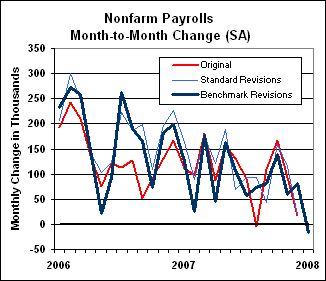
December 2007 Edition January, 2nd, 2008 • Actual 2007 Federal Deficit Topped $4.0 Trillion
• Fed Allows Strongest Money Growth in 36 Years • Inflationary Recession Intensifies Sharply • Dollar and Gold Breathers Are Proving Short-Lived • Solvency Crisis Intensifies as System Careens Towards Economic and Financial Disaster • Pushing the system ever nearer to the brink of the ultimate liquidity crisis, the Fed’s December 11th easing, albeit minimal, played to the Wall Street speculators, not to the increasingly troubled global community holding large quantities of a rapidly-debasing U.S. dollar. Those not-so-happy dollar owners can see the U.S. economy sinking quickly into an inflationary recession, with the U.S. banking system facing a solvency crisis and the U.S. central bank playing games with itself. Such portends very difficult times for the greenback and the U.S. financial markets in 2008. The gold and silver markets, however, will be primary beneficiaries of these troubles.
November 2007 Edition November, 26th, 2007 • Inflation Surges as Economic Activity Plunges
• System Nears Abyss and Fed Moves to Sit on Its Hands Again • Dollar and Gold Movements Are Just Beginning • Wall Street Pushes Hard for Interest Rate Fix That Cannot Work and May Not Happen • In fairness, there is little that Federal Reserve Chairman Ben Bernanke can do, except to play out a losing hand. It was a hand laid off on him by Alan Greenspan, aided and abetted by the U.S. Congress and recent Administrations. As dependent as a drug addict on his next fix, the U.S. stock market is addicted to interest rate cuts, and the pressures on the Fed for another fix are tremendous. Yet, the Fed continues to signal, as clearly as it signals such things, that there is no rate cut coming.
October 2007 Edition October, 29th, 2007 • Inflation Indicators Surge While Recession Signals Mount
• Anticipated Fed Easing Pummels Real-World Markets • Dollar Tanks, Oil and Gold Soar and Funding Crisis Continues • Wall Street's Pollyannas Ignore Darkening Fundamentals • With all-time high oil prices topping $90 per barrel, with the U.S. dollar indices at record lows and under selling pressure, and with the SGS-Ongoing M3 annual growth at a 36-year high of 14.7%, the near-term inflation outlook is turning about as bleak as it gets. On the economic front, annual growth in new orders for durable goods, housing and employment all are generating new, or confirming prior, recession signals. This is despite overstatement of some recent economic activity in the employment data apparently aimed at removing some pressures on the Fed to ease. Nevertheless, the markets are expecting a quarter-point fed funds rate cut on Wednesday. The Federal Open Market Committee (FOMC) most likely will follow market expectations, in that it has had some hand in setting the consensus outlook, and the U.S. central bank likely will look to be as non-disruptive to the markets as possible. Even so, current expectations already are roiling the currency markets. Any rate cut beyond consensus could prove particularly disruptive for the U.S. dollar. At some point — and that point may have been reached — Fed easing will become counterproductive, pummeling domestic U.S. liquidity. Where Wall Street, Administration and Fed efforts appear to be concentrated on continued artificial propping of equity prices, a dollar-induced liquidity crunch would hit both the equity markets and the credit markets hard. Despite increasing volatility in this unsettled environment, the stock market has held up remarkably well, so far. Gold and dollar prices already are at levels that risk inviting short-lived central bank interventions.
September 2007 Edition September, 23rd, 2007 • |Bernanke's Tap Dancing on the Dollar Landmine Triggers Detonation
• The Dollar Matters, and Its Sell-Off Is Just Beginning • It's Inflation and Recession, Not Inflation or Recession • Manic Stocks Ignore Dollar, Oil and Gold • Key Economic Reporting Massaged as Liquidity Crisis Deepens • An old-fashioned bank run in the U.K.? The U.S. and Canadian dollars at parity? Saudi Arabia considering a break with the U.S. Dollar? If you tap dance on a land mine long enough, odds favor an unhappy ending. A good dancer can buy time, and Federal Reserve Chairman Ben Bernanke bought about as much time as he could, having been set up by his predecessor with irreconcilable economic and financial problems. Bernanke might have forestalled the unfolding dollar crisis a bit further with just a 25 basis point cut in the fed funds target, but the 50 basis point move opened Bernanke's Box of U.S. Dollar and inflation unthinkables. The reality is ugly, and like Pandora — who opened a jar unleashing a variety of evils upon the world — Mr. Bernanke will find it very difficult, if not impossible, to push his newly activated nightmares back into the box. With both recession and inflation woes in place for some time, the inflationary recession is deteriorating at an accelerating pace, exacerbated, not triggered, by the still unfolding systemic liquidity crisis.
August 2007 Edition August, 19th, 2007 • Terrible Financial Tempest Nears Landfall
• Fear of Bank Runs Appeared to Force Bernanke into His Tap-Dancing-on-the-Dollar-Landmine Routine • Deteriorating Inflationary Recession Promises Greater Liquidity Woes • Key Reporting Appears Shifted to "Let's Not Hurt the Markets" Mode • The systemic liquidity crisis began running out of control last week, with stories of a run on a major bank. Keep in mind that there is not enough physical cash in the system to handle a major bank run in the traditional sense (see March 2007 SGS). Circumstances became dire enough to force Federal Reserve Chairman Ben Bernanke into publicly visible actions, announcing a 50-basis-point cut in the discount rate and starting to play a three-card monte game with the federal funds rate. Stocks rallied Friday in response, but the Fed's actions have set the stage for a massive dollar sell-off, which can frustrate lower market rates. With the economy in a deepening, inflationary recession, and with the first major Atlantic hurricane of the season within striking range of Gulf of Mexico energy infrastructure, financial-market turmoil likely has only just begun to unfold.
June / July 2007 Edition July, 23rd, 2007 • U.S. Dollar Woes Broaden Rapidly
• Systemic Liquidity Shows Some Cracks • Bernanke Makes Case For Fudging Inflation Data as Fed Fumbles Its Figures • Oil Pushes Record Highs as Economy Continues Tanking • Stock Market Turmoil, Dollar Sell-Off and Gold Boom Move Ever Closer • Against the backdrop of intensifying inflationary recession, the dollar has started taking some early and heavy blows. The sub-prime mortgage difficulties have gained media prominence, but they are just the beginning of difficulties for mortgage and other asset-backed securities. Meanwhile, the Fed keeps sitting on its hands, whistling a tune that inflation is not a problem so long as the public does not see it. At the same time, the U.S. central bank appears to be having trouble tracking the balance sheets of commercial banks. With ongoing annual M3 growth at 13%, alternate CPI at 10.3% and alternate GDP down about 2.2%, apparent complacency by the Fed and euphoria in the record-topping and increasingly volatile equity markets are surreal. Growing recognition of the disconnection between government numbers and economic reality should have even the Wall Street Pollyannas a little bit on edge, as heavy dollar selling and a booming gold market begin moving perhaps a little too close for comfort.
May 2007 Edition June, 6th, 2007 • GDP Contracted Net of Nonsensical Personal Consumption Surge
• Seasonal Factor Distortions Boosted Payrolls Again • M3 Growth at 33-Year High • Fed Remains Impotent • Stock Market Turmoil, Dollar Sell-Off and Gold Boom Just Matter of Time • Last month's key data generally showed a worsening inflationary recession. Relative monthly strength, reported for several indicators of business activity, were not too meaningful. Where the affected numbers are highly volatile, of suspect quality or subject to unusual seasonal factors, countertrend reporting usually is just a one-month aberration. Changes in economic direction are foreshadowed by shifts in leading indicators, not by shifts in coincident or lagging indicators, and most of the better indicators continue to confirm a deepening economic contraction. On the inflation front, annualized CPI inflation, year-to-date April, is running 4.8% to 7.4% (seasonally adjusted or unadjusted). Annual growth in the SGS Ongoing M3 has broken above 13%, rivaling levels seen before the severe 1973 - 1975 inflationary recession.
April 2007 Edition May, 7th, 2007 • April Payroll Contraction Appears to Have Been Masked
• M3 Growth Surges to 9-11 Liquefaction Levels and Worse • Mounting Inflationary Recession Has Hobbled Fed • Intensifying Dollar Sell-Off and Gold Boom Loom • Knees would be knocking audibly in the credit markets, if the Fed still reported M3 growth. Annual growth (SGS Ongoing M3 series) accelerated sharply in April to 12.9%, from 11.7% in March. The last time annual M3 growth approached 13%, the Fed was liquefying the financial system in the wake of the 9-11 terrorist attacks. Before that, the year was 1981 and official annual CPI inflation was running about 10%. If 10% inflation sounds familiar, that is roughly the level of annual CPI inflation that would be reported today using the CPI methodologies of 1980. Exacerbating the financial catastrophe that slowly is unfolding for the U.S. markets, the economy is in a deepening recession and the U.S. dollar has begun suffering nascent selling pressures. In terms of monthly averages, gold already is at an all-time high, and the trade-weighted dollar is at an all-time low. Out of touch with reality, the Dow Jones Industrial Average keeps bouncing to new highs.
March 2007 Edition April, 9th, 2007 • Inflationary Recession Deepens as Markets Sense a Problem
• March Annual M3 Growth Jumps to 11.6% • Foreign Investors Shunning Treasuries? • Handling Hyperinflation in a Near-Cashless Society • Dollar Sell-Off and Gold Boom Still Lie in Offing • Despite continued rapid deterioration in the current inflationary recession, and despite growing market recognition of the intractable difficulties with both inflation and business activity, there are those on Wall Street who just seem unable to accept the concept of inflation without a strong economy. Give the markets a stronger-than-expected employment report, and rumblings start of "full employment" triggering a round of wage inflation and Fed tightenings. Inflation is a problem — due to oil, dollar and monetary issues — but not due to strong economic demand. With consumer liquidity squeezed dry, there is no risk of the economy overheating. With actual unemployment around 12%, there is no risk of inflation pressures from the economy being at full employment.
January/February 2007 Edition February, 20th, 2007 • Economic Activity in Rapid Decline as Miracle Recovery Fades
• Central Bank Dollar Holdings Exacerbate Hyperinflation Risk • Stock Market Euphoria Misses Economic and Political Realities • Dollar Sell-Off, Gold Boom Lie Ahead • An upside blip in economic reporting from unseasonably good weather spiked some December economic data, and market expectations for the economy soared. The U.S. economy, however, does not turn quickly without warning, and early January data showed the recession not only to be very much in place, but also to be deepening rapidly. Although inflation will continue to rise without a further oil price spike, sudden indications of renewed possible terrorist attacks and rumblings of a possible U.S. attack on Iran hold the potential for a rekindled surge in oil prices. Under these circumstances, the U.S. financial markets remain in peril, with higher interest rates, lower equity prices, heavy dollar selling and significant gold buying on the horizon.
December 2006 Newsletter January, 2nd, 2007 • Recession Recognition Likely in 2007
• Dollar Poised for 30% Plunge • Dollar, Debt Monetization and Oil Prices Boost Inflation Outlook • Gold Easily Could Top $1,000 • Fed to Tighten in Dollar Defense? • Equities and Bonds to Suffer • Hyperinflationary Depression Likely by 2010 • The U.S. economy and financial markets face significant peril in 2007, with the dollar sitting on the brink of a major collapse. The positive 2006 U.S equity markets and reasonably tranquil credit markets belie the pending turmoil that already has been set in motion by a rapidly deepening inflationary recession and exacerbated by the de facto long-term insolvency of the U.S. government.
November 2006 Newsletter November, 29th, 2006 • Dollar Selling Will Threaten Credit and Equity Markets
• Economic Activity Continues to Crumble • Distorted Inflation Plunge Bottoms Out • Gold Prices to Rebound Further • The broad outlook for a deepening inflationary recession continued to intensify last month, at the same time that domestic and global political tensions increased sharply. Main Street U.S.A. dumped the Republican controlled Congress for a variety of reasons, not least of which were rapidly deteriorating pocketbook issues. Reflecting a growing market awareness of these problems, the U.S. dollar has come under some selling pressure. When the current minor selling turns massive, the foreign-capital-dependent domestic markets will face a terrible liquidity squeeze, with resulting interest rate spikes and equity selling. Gold should do well under the circumstances.
October 2006 Newsletter October, 30th, 2006 • Collapsing Economic Activity Shows Accelerating Recession
• Twisted Inflation Plunge Will Reverse Post-Election • Is Fed Controlling Manipulations? • U.S. Productivity Has Been Falling Since NAFTA • The broad outlook for a deepening inflationary recession remains in place. The drop-off in economic activity indicated by recent reporting is nothing short of extraordinary. Recession speculation should increase markedly. Also, the plunge in CPI inflation was to be expected, given the recent drop in energy prices and year-ago comparisons with hurricane effects. While the inflation downturn will be very short-lived, economic activity is going to get a great deal worse.
September 2006 Newsletter September, 25th, 2006 • Upsides for Inflation and Gold Have Not Yet Been Touched
• Business Downturn Accelerates • Poverty Report Suggests GDP Reporting Fraud • Katrina and Pre-Election Manipulations Distort Current Numbers • Dollar Selling and Higher Interest Rates in Offing • The economy’s crash landing was evident in most economic reporting of the last month. On the plus side, volatile oil and gasoline prices have enjoyed a short-term decline — just in time for the election — but inflation problems are only beginning. Despite unusual reporting distortions that will surface in the next two months, the broad outlook for a deepening inflationary recession continues. While these conditions remain bearish long-term for the U.S. equity and credit markets and for the U.S. dollar, they remain extremely bullish for gold.
August 2006 Newsletter August, 21st, 2006 • Inflationary Recession Deteriorated Sharply in Second Quarter
• Alternate Measures: Consumer Inflation Hits 11% with Annual GDP Growth Down 0.8% • July M3 Annual Growth at 9.1%. The Federal Reserve’s Open Market Committee "paused" in its string of rate hikes, citing moderating economic growth and hopes for moderating inflation. With the economy in a deepening inflationary recession, the Fed once more is feeding pabulum to the financial markets in an effort to fend off disorderly declines in the U.S. dollar and in the equity and credit markets. Inflation is far from peaking, and interest rates are going to spike sharply. In a related manner, the run-up in oil prices is not over, and the price of gold has a tremendous upside move ahead of it.
July 2006 Newsletter July, 17th, 2006 • Second-Quarter Real Retail Sales Contract 1.3%;Employment Indicators Plunge As Inflation Soars; Fed President Suspects CPI Understatement. Collapsing economic activity and mounting inflation dominated last month’s economic reporting. An inflationary recession is in play, and there is little the Administration or the Fed can do about it. This has created a nightmarish scenario for the financial markets.At the same time, international tensions have escalated to the point where risk of a conventional world war is the highest it has been in 61 years.With U.S. economic and global political conditions unraveling so rapidly, underlying fundamentals do not get much worse for the equity and credit markets, nor much better for gold. Circumstances are fluid and disorderly markets are possible with little or no warning. The U.S. dollar faces severe selling pressure in the near future, although political flight-to-safety effects are providing the greenback with temporary, albeit short-lived, support. The timing of the dollar’s demise ultimately will determine the timing of the fate of the other markets.
June 2006 Edition June, 7th, 2006 • In general, the broad economic outlook has not changed, but the financial markets are beginning to catch up with underlying reality. Faltering economic activity and mounting inflation have created a nightmarish conundrum for the political operatives both in the Bush Administration and at the Federal Reserve. Soft economic numbers and high inflation are being nonsensically spun as "conflicting data." An inflationary recession is in play, and there is little the Administration or the Fed can do about it. The pabulum fed to the investing public — that a weak economy means low inflation and interest rates — cannot work in the current environment. Any conflicts that arise are not in the economic data but in simplistic views on economic activity espoused by Wall Street, or in the statistical manipulation goals of the politicians. Those latter issues explain recent Administration and Fed activities — ranging from Fed Chairman Bernanke’s tap dancing on the inflation outlook to the appointment of a new Treasury Secretary — all anchored in putting a positive spin on an impossible situation and avoiding a financial-market meltdown before November 7th. The markets are not cooperating. Dollar selling and gold buying have just begun, and so have the negative reactions in the credit and equity markets.
May 2006 Edition May, 17th, 2006 • The 2005 to 2007 inflationary recession has moved well beyond stagflation. Circumstances deteriorated markedly in the last month, and market perceptions of same have begun to surface, as exhibited by strong gold and a weak dollar. In addition, the trouble is not confined to a weak economy and higher inflation. It also includes a foundering administration and increasing odds of a shift of power coming out of November’s election. Although purposely suppressed in the "official" data (PPI and CPI), there is an inflation problem. It is driven by oil, and increasingly, it also is being driven by dollar woes. These are factors separate from strong economic activity that commonly is viewed as the source of inflation. Fed tightening — designed in theory to slow the economy in order to slow inflation — will do little to cool the current problem. Moreover, current Fed activity has been the reverse of the jawboned inflation fighting, aimed at stimulating liquidity, not killing it. While short-term interest rates have been increased, broad money growth also has been soaring, at least prior to its reporting cut-off. Excessive money growth tends to be an inflation stimulant, not a retardant.
April 2006 Edition April, 12th, 2006 • There are two broad types of political manipulation of economic data, systematic and current-event, and both are at work distorting economic reports. The current-event manipulation, however, is what will dominate key economic figures out through the mid-term election. It involves direct political intervention in the reporting process in order to enhance the reported results. Indeed, the relatively happy news from the employment
•unemployment front in March appears to have been carefully crafted by Administration manipulators. Similar efforts are likely to generate a reported surge in first-quarter GDP growth, as well as ongoing "strong" jobs data.Nonetheless, continued negative inflation-adjusted growth in money supply (M2), monthly declines in key components of the purchasing managers surveys, sharp downturns in annual change for housing starts and help-wanted advertising, flat to negative annual change in consumer confidence and real earnings, and a record trade deficit all continue to show faltering economic activity. In addition, the price of gold has more than doubled in the last four years, to what is now $600 per ounce. Bullion is sending out a warning of extreme danger facing the U.S. dollar and of rapidly increasing risk of severe global instability. Meanwhile, the political geniuses running Washington continue to fret over the latest polling numbers, while ignoring the fiscal and structural economic crises unfolding around them.
March 2006 Edition March, 15th, 2006 • In general, the broad economic outlook has not changed. Since the beginning of 2005 a number of key indicators have been nearing or at their fail-safe points, with four indicators moving beyond those levels, signaling a recession. Once beyond their fail-safe points, these indicators have never sent out false alarms, either for an economic boom or bust. The 2005 to 2007 inflationary recession showed signs of deepening in the latest reporting. Monthly data show plunging new orders for durable goods and contracting industrial production, retail sales, help-wanted advertising, real average weekly earnings and consumer confidence. Consumer credit growth also remained sub-par. As to inflation, both the CPI and PPI topped expectations, and oil prices have remained strong. Also published recently were the full trade data for 2005. Based on fourth-quarter GDP, net exports and employment data, the U.S. trade deficit has cost 8.8 million jobs over time, with 800,000 jobs lost in 2005, alone. The current edition of "SGS" will examine how these numbers were estimated.
February 2006 Edition February, 9th, 2006 • The 2005 to 2007 recession almost broke to the surface recently, with the Commerce Department’s "advance" estimate of fourth-quarter 2005 GDP. The report was about as honest a one as Commerce has published in a number of years. Somehow, though, considering the Labor Department’s increasing reporting shenanigans last month, the chances of the dawning of a new era of straight-forward economic reports at this time are nil. It is beyond common sense that the current political hacks will allow recession reporting to surface prior to the November election. What almost broke to the surface in the recent GDP reporting most certainly will be beaten back with a club in the months ahead. In general, our broad economic outlook has not changed. The 2005 to 2007 inflationary recession continues to deepen, and the approaching recession, inflation and risks of heavy dollar selling will offer a nightmarish environment for the still Pollyannaish financial markets. However, negative GDP growth is not likely to surface in regular government reporting until after the November 2006 election, given the rampant political manipulation of most key government numbers.
January 2006 Edition January, 11th, 2006 • As the administration hypes the economic boom shown in its manipulated data, less popularly followed numbers continue to show an inflationary recession. The Shadow Government Statistics’ Early Warning System (EWS) was activated in May and signaled the onset of a formal recession early in July 2005. However, negative GDP growth is not likely to surface in regular government reporting until after the November election, given the rampant political manipulation of the GDP, employment and CPI. The National Bureau of Economic Research (NBER) should time the downturn to mid-2005 and announce same also sometime after the election, so as not to be deemed politically motivated in its timing. Further, thanks to the largely ignored federal budget and trade deficits that now are spiraling out of control, the current downturn is at high risk of deepening into a hyperinflationary recession. Mounting concerns outside the political arena have been one factor behind the ongoing strength in gold prices. The growing awareness of the insurmountable problems associated with these deficits will add significant downside risk to the financial markets as 2006 progresses.
December 2005 Edition Supplement (Re: FY2005 Treasury GAAP Accounting) December, 19th, 2005 • The "2005 Financial Report of the United States Government," published December 15th by the U.S. Treasury, reported a $760.0 billion net deficit in U.S. government operations for fiscal 2005, based on generally accepted accounting principles (GAAP), but excluding ongoing liabilities to Social Security, Medicare and similar programs. The $760.0 billion was up 23.2% from 2004’s $615.6 billion GAAP-based deficit, while the official, accounting-gimmicked 2005 deficit of $318.5 declined by 22.8% from $412.3 billion in 2004. However, net of all accounting gimmicks, the actual federal budget deficit is running at an unsustainable, system-dooming pace of $3.5 trillion per year, roughly 11 times the size of the $318.5 billion accounting-gimmicked official deficit for 2005. The U.S. Government’s negative net worth widened to $49.4 trillion in 2005, with total government liabilities topping $50 trillion for the first time.
December 2005 Edition December, 7th, 2005 • In general, the broad economic outlook has not changed. The 2005 to 2007 inflationary recession continues to deepen. This outlook is predicated on economic activity that already has taken place and does not consider any additional risks from exogenous factors. Most economic data already are softening, and the trend will accelerate sharply. Since the beginning of 2005 a number of key indicators have been nearing or are at their fail-safe points. Once beyond their fail-safe points, these indicators have never sent out false alarms, either for an economic boom or bust. Lower tax receipts will combine with disaster recovery spending and the ongoing war in Iraq to accelerate deterioration in the federal deficit. Negative GDP growth will not surface in regular government reporting until at least next year, now that it is clear that Katrina’s impact has been neutralized in official reporting, and that political manipulation of the GDP, employment and CPI is rampant.
November 2005 Edition - Supplement (Re: M3) November, 23rd, 2005 • Unilaterally and without reasonable explanation, the Fed has decided to stop reporting monetary aggregate M3, the broadest of the money-supply measures and probably the most important statistic published by the U.S. central bank. Of the liquidity measures, inflation-adjusted M3 is the best leading indicator of economic activity. Despite its strong growth in nominal terms, net of inflation (calculated on a pre-Clinton Era basis), M3 generated a reliable recession signal several months back. What game the Federal Reserve is playing will become clear soon enough. However, the chances that M3 is being eliminated because it merely duplicates M2 are nil. The cost factor the Fed cited in its announcement also is a canard.
November 2005 Edition November, 21st, 2005 • Indeed, it is the best of times and the worst of times, depending on which economic releases one reads. Unfortunately, underlying economic reality continues to support the latter outlook. Weighed historically against the various political games played with economic reporting, the present state of affairs is without domestic precedent. In the practiced propaganda of totalitarian states, the lack of alternative information makes it difficult to quantify the manipulations. In contrast, what is happening with the US statistics can be demonstrated with alternate data sources — often from within the government itself. The phony numbers appear to have broad public acceptance within the financial community, despite occasional questions being raised in the free press. Regrettably, the financial community’s acceptance of the data is far more related to business self-interest than to an honest public assessment of economic conditions.
October 2005 Edition October, 12th, 2005 • Economic numbers of the last month broadly confirmed an intensifying inflationary recession. The effects of the devastation in New Orleans and along much of the Louisiana, Mississippi and Alabama Gulf Coast have intensified the negative national economic trends but were not the root cause. Nonetheless, hurricane effects will dominate headline-grabbing economic reports of the next month or two, and Katrina likely will take much of the blame for a recession that has been in development for over a year and underway since July.
JWSGS - SEPTEMBER 2005 EDITION September, 7th, 2005 • The impact of Hurricane Katrina now becomes the convenient excuse for an inflationary recession, the ingredients and manifestations of which were falling neatly into place long before this catastrophic event came along. Make no mistake about it, however — Katrina’s influence, if it is "permitted" to find its way into government economic releases, will be very harsh. A sampling of some of the likely storm-enhanced data swings: An addition of 1% to the September CPI, third-quarter GDP that shows no growth in real terms, and a decline in September payrolls of 300,000 accompanied by a 0.4% increase in the unemployment rate. These outcomes would have serious shock value, but from a purely political perspective, it might be advisable to report them anyway, while Katrina remains fresh in everyone’s mind to assume the blame.
August 2005 Edition August, 10th, 2005 • A number of key economic indicators ran counter to our forecasts last month, particularly July employment. Government calculations of seasonal factors can occasionally suffer an across-the-board major distortion that will throw off monthly results for a month or two. Such appeared to be the case in April, and it remains a possibility for June, too. Seasonal-factor rigging also has been used historically as a tool for near-term political manipulation of data. Given flagging presidential ratings, it’s possible the Bush administration has moved into a political-manipulation mode. Nonetheless, the broad economic outlook has not changed, and the 2005-2007 inflationary recession continues to unfold.
JWSGS - JULY 2005 EDITION July, 13th, 2005 • The 2005-2007 inflationary recession continues to unfold and appears ready to offer up its first real data shocks of the cycle: an outright contraction in July payrolls combined with a meaningful jump in the unemployment rate. Upcoming trade deficits should widen sharply, and industrial production is soon due for monthly contractions. Augmenting SGS recession warning signals already in place (money supply, purchasing managers new orders index, real average weekly earnings), help-wanted advertising and housing starts had their three-month moving averages turn negative on a year-to-year basis in last month’s reporting.
JWSGS - JUNE 2005 EDITION June, 8th, 2005 • The Shadow Government Statistics’ Early Warning System was activated last month and continues to signal the onset of a formal recession this month (June) or early in third-quarter 2005. Since the beginning of 2005, a number of key indicators have been nearing or at their fail-safe points. In the last month or two, several indicators moved below those levels, signaling an imminent recession. Once beyond their fail-safe points, these indicators have not sent out false alarms, either for an economic boom or bust. ALSO THIS MONTH: SGS announces the introduction of its own consumer price index!
JWSGS - MAY 2005 EDITION May, 11th, 2005 • The Shadow Government Statistics’ Early Warning System (SGS-EWS) has been activated, signaling the onset of a formal recession in the later part of the current quarter or early part of third-quarter 2005. Sporadic, negative GDP growth likely will not surface in government reporting until later in 2005 or 2006, and the National Bureau of Economic Research will likely time the downturn to mid-2005 and announce same sometime in early-to-mid 2006.
JWSGS - APRIL 2005 EDITION April, 5th, 2005 • Contrary to conventional Wall Street wisdom, high inflation and recession can co-exist in a very uncomfortable and financially debilitating environment. Inflationary recession is about to replace the stagflation of the last couple quarters. Slowly increasing weakness has been evident in many economic indicators, and the first formal recession signal from the SGS early warning system appears ready to kick in within the next couple weeks.
JWSGS - MARCH 2005 EDITION March, 9th, 2005 • Stagnation and inflation remain the words for describing the current economic environment in the United States. Reporting distortions overstated February employment and understated the January Consumer Price Index. Meanwhile, the deterioration in the 2004 trade deficit cost 1.4 million American jobs.
JWSGS - FEBRUARY 2005 EDITION February, 9th, 2005 • The current economic picture remains one of stagflation. The view for later in the year, however, increasingly looks like recession, as key indicators keep flirting with generating a recession warning. No solid warning, however, is in place, yet. ALSO THIS MONTH: Thoughts about how the Social Security crisis threatens US financial stability.
January 2005 Edition January, 12th, 2005 • Recession signals remain borderline as stagflation intensifies. Meanwhile, U.S. obligations exploded by 31% during 2004, to 409% of GDP. And if you were invested outside the dollar last year, it is probable you comfortably outperformed the Dow Jones industrials!
JWSGS - DECEMBER 2004 EDITION December, 8th, 2004 • Stagflation signals intensify, a recession warning is possible in the next two months, and the dual deficits and the dollar do matter!
JWSGS - NOVEMBER 2004 EDITION November, 18th, 2004 • Stagflation or worse signaled by key indicators; payrolls boosted by unusual seasonal adjustment.
|
This material is provided under the ShadowStats.com Terms of Use. Use of this material constitutes agreement to those terms.
Privacy Policy | Contact Us
Copyright 2003-2022. Shadow Government Statistics, Walter J. Williams.
Privacy Policy | Contact Us
Copyright 2003-2022. Shadow Government Statistics, Walter J. Williams.